Session 1: Introduction to
Ethics
Dr. Chan Ho Mun
Department of Public and Social Administration
City University of Hong Kong
June 6, 2007
Cases Studies
 Selected movie scene from “Vertical Limit”.
 Should the son kill the father?
 If you were the son,….
 If you were the daughter,…
 If you were the father,…
 William’s story of Jim and the Indians
 What should he do?
 If you were Jim,...
 Four versions of the trolley problem
 What are your answers and justifications?
 Would the answers be different if you were the
person who need to make the decision and
take the action?
 Craniotomy (crushing the skull of the unborn
child to save the life of a pregnant woman) vs
Hysterectomy (save the life of a pregnant
woman by the removal of cancerous uterus)
 Is your response in this case consistent with
the ones in other cases?
What is ethics?
 (1) What makes an act morally right or wrong
(a question of conduct)?
 (2) What makes a person or something good
or bad (a question of value)?
 (3) How to draw the correct conclusion about
what we ought to do or what kind of person
we ought to be?
 (1) and (2) are theoretical/conceptual
questions and (3) is a practical question
about moral reasoning.
Characteristics of Ethical Issues
 Moral disagreements are common. Moral
issues are often controversial and open-
ended. It is often difficult to arrive at some
consensus.
 How serious could people disagree with one
another? Could the disagreement be radical
and fundamental?
 People even disagree about what and how
much they disagree.
Moral Theories
 A moral theory consists of a set of moral
principles.
 These principles specify the conditions under
which an action is morally right or wrong, or
what makes a person or something good or
bad. (Theoretical questions (1) and (2))
 They purport to guide our moral reasoning
(Practical question (3)).
 Together with facts about different moral
situations, moral rules that guide the morality
of specific kinds of actions could be derived.
 Together with facts about an individual case,
we can further judge whether an individual
act is morally right or wrong, or whether a
person or something is good or bad.
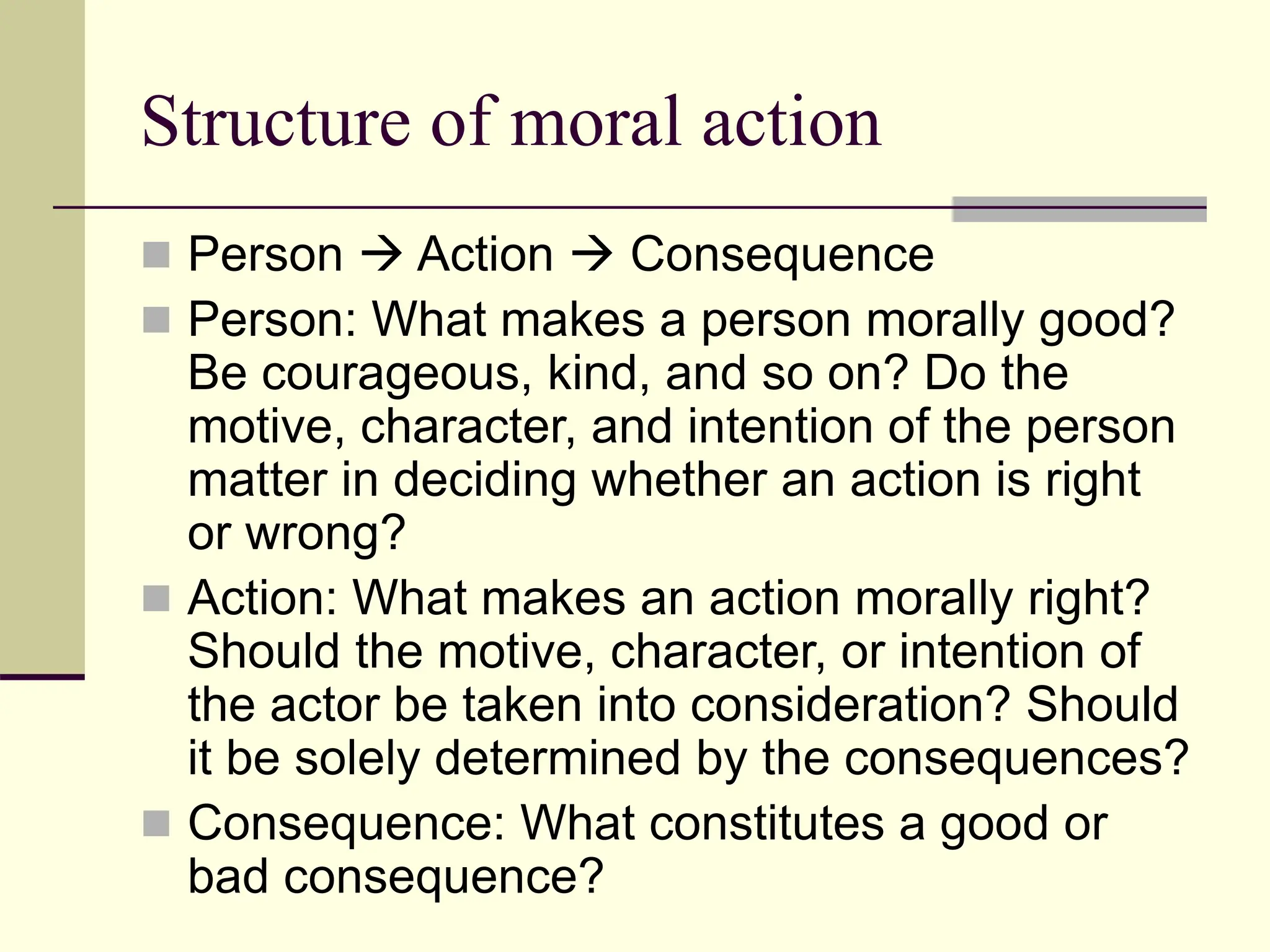
Structure of moral action
 Person  Action  Consequence
 Person: What makes a person morally good?
Be courageous, kind, and so on? Do the
motive, character, and intention of the person
matter in deciding whether an action is right
or wrong?
 Action: What makes an action morally right?
Should the motive, character, or intention of
the actor be taken into consideration? Should
it be solely determined by the consequences?
 Consequence: What constitutes a good or
bad consequence?
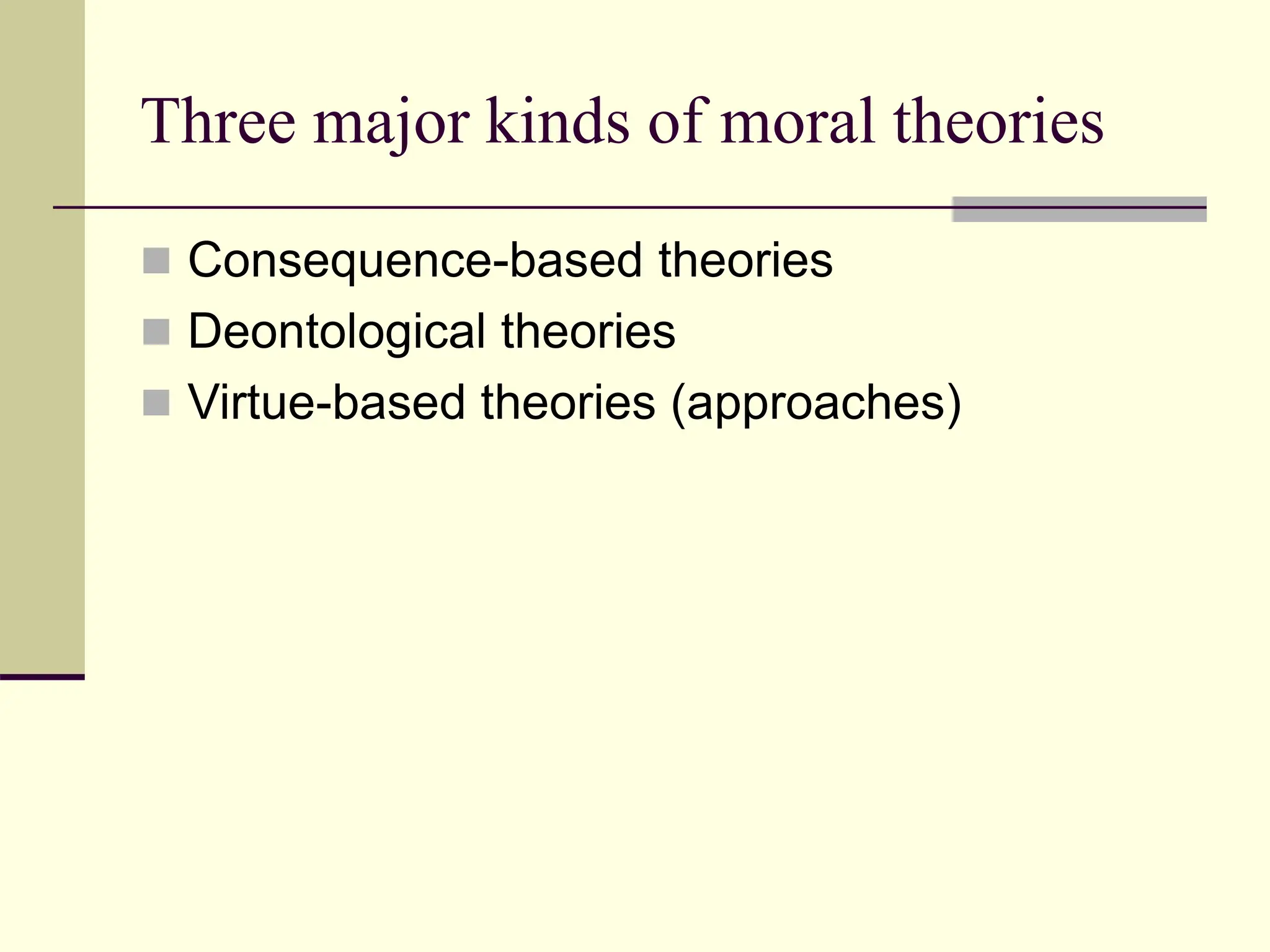
Three major kinds of moral theories
 Consequence-based theories
 Deontological theories
 Virtue-based theories (approaches)
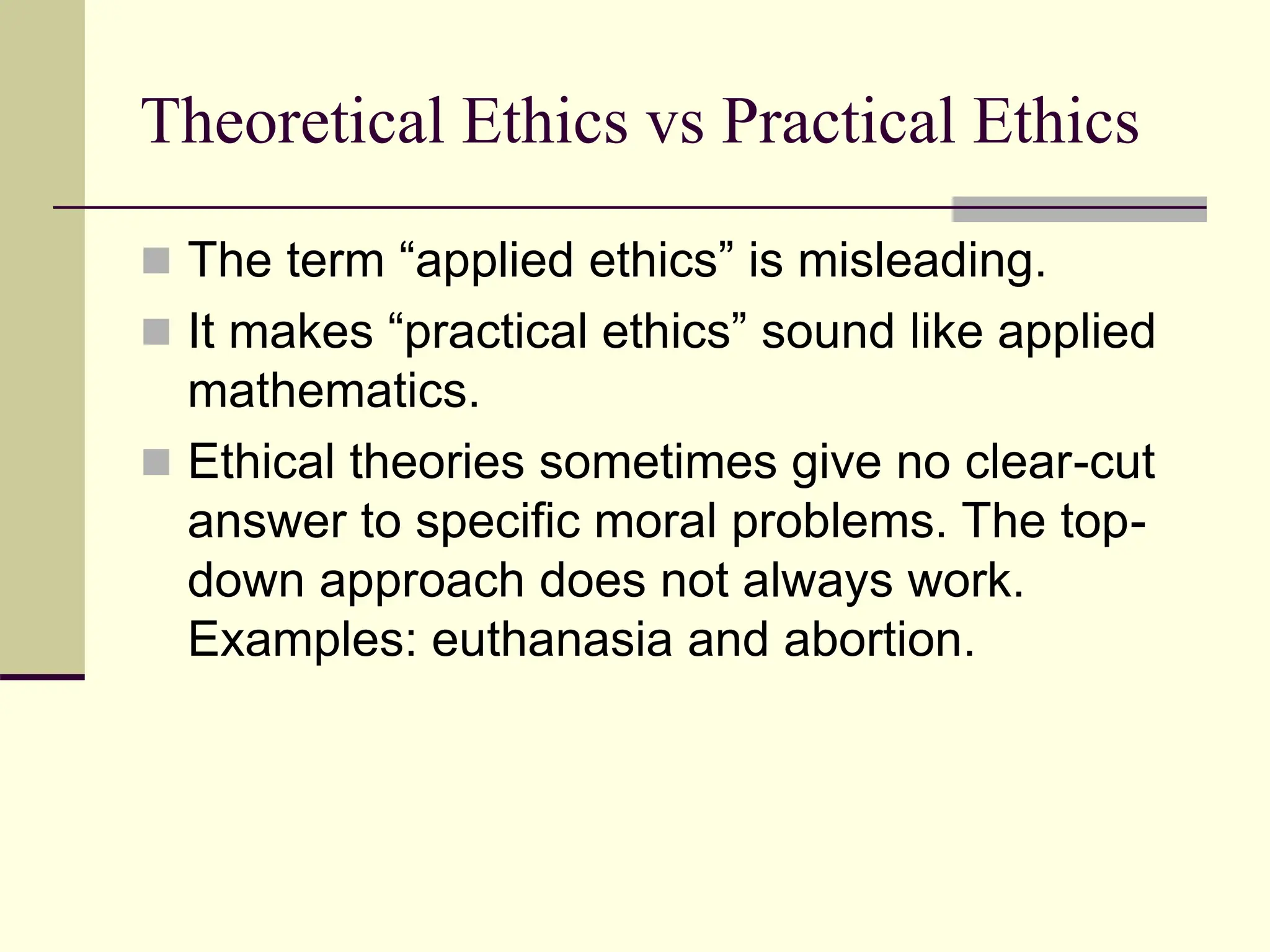
Theoretical Ethics vs Practical Ethics
 The term “applied ethics” is misleading.
 It makes “practical ethics” sound like applied
mathematics.
 Ethical theories sometimes give no clear-cut
answer to specific moral problems. The top-
down approach does not always work.
Examples: euthanasia and abortion.
 Bottom-up approach (Case-based approach):
 Start with an obvious (real or hypothetical)
case where we have the strong intuition or
considered judgement that it is morally right or
wrong.
 Analogical reasoning: compare it with a
problematic case that is structurally similar
and then draw the same conclusion.
 Example: Thomson’s arguments for and
Marquis’s argument against abortion.
Anti-theory Approach
 Cases have their own voices. This gives us a
very crucial criterion for evaluating moral
theories.
 A moral theory is accepted if it can make sense
of and be compatible with our various intuitively
appealing beliefs and ideas or firmly held
judgements about morality.
 Anti-theory approach (moral particularism):
 No theory can meet the above criterion.
 Moral precepts are only rules of thumbs with
lots of loopholes and exceptions. There is no
theory in ethics but only approaches.
 Something like the case law approach should
be adopted.
Challenges to Morality
 Egoism
 Psychological egoism: Human actions are
motivated by their self-interests.
 Ethical egoism: One should only promote
one’s own interests, or it is alright for everyone
to do so.
 Relativism
 Descriptive relativism: People of different
cultures follow different norms and have
different conceptions of the good.
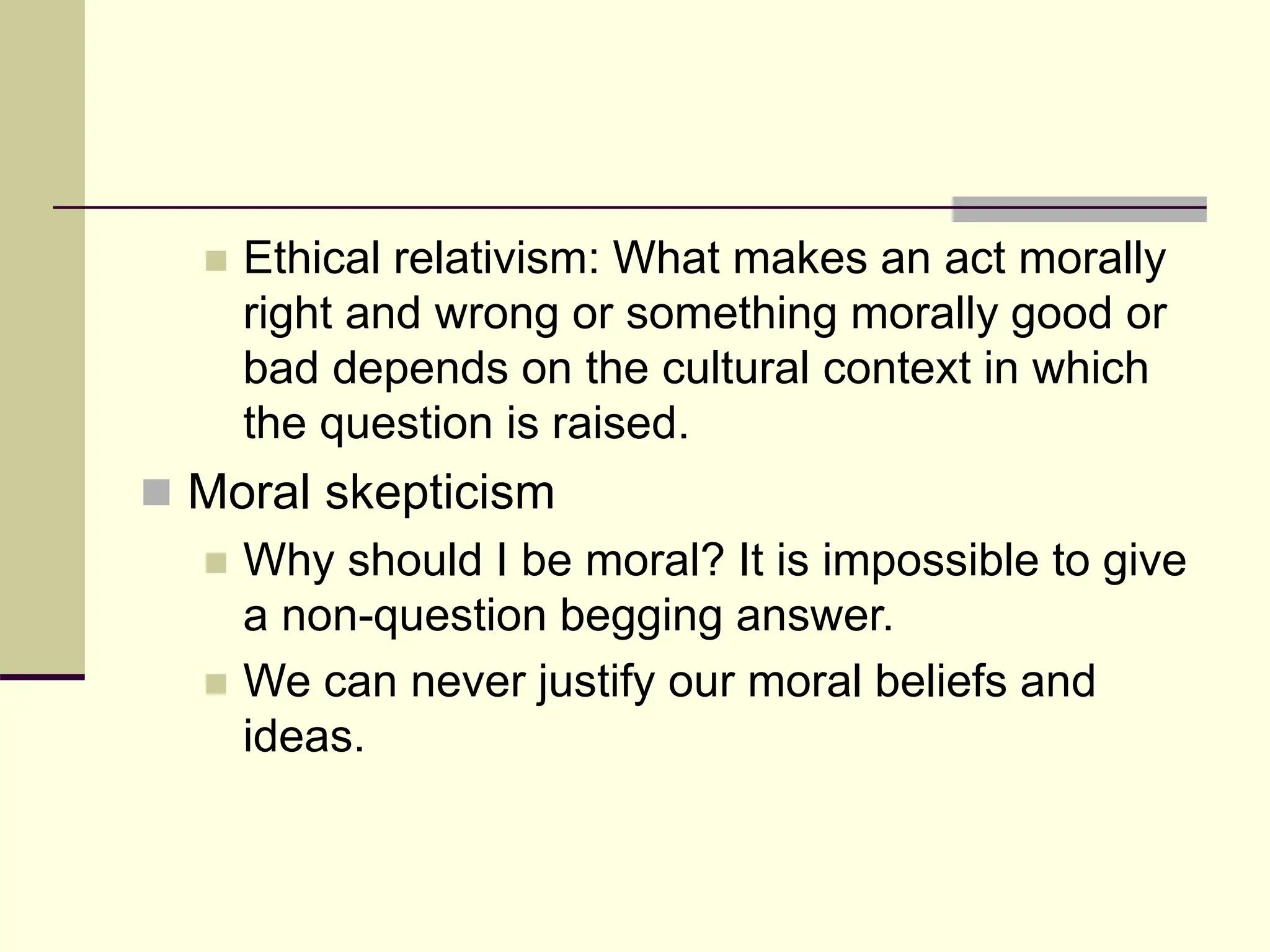
 Ethical relativism: What makes an act morally
right and wrong or something morally good or
bad depends on the cultural context in which
the question is raised.
 Moral skepticism
 Why should I be moral? It is impossible to give
a non-question begging answer.
 We can never justify our moral beliefs and
ideas.
 Moral Nihilism
 Ethical claims are either fictitious (according to
error theories) or neither true nor false.
 They are not answerable to any reality.
 There is no such thing called “morality”.
Suggested Readings:
 Elizabeth Burns & Stephen Law (eds.),
Philosophy for AS and A2, London:
Routledge, 2004.
 Julia Driver, Ethics: The Fundamentals,
Oxford: Blackwell Publishing, 2007.
 Christopher Hamilton, Understanding
Philosophy for AS Level, Cheltenham: Nelson
Thornes, 2003.
 James Rachels, The Elements of Moral
Philosophy, 4th ed., Boston: McGraw-Hill,
2003.
 Nina Rosenstand, The Moral of the Story: An
Introduction to Ethics, 5th ed., Boston:
McGraw-Hill, 2005.
 Mark Timmons, Moral Theory: An Introduction,
Lanham: Rowman & Littlefield, 2002.

Lesson_____1_introduction to ethics .ppt

  • 1.
    Session 1: Introductionto Ethics Dr. Chan Ho Mun Department of Public and Social Administration City University of Hong Kong June 6, 2007
  • 2.
    Cases Studies  Selectedmovie scene from “Vertical Limit”.  Should the son kill the father?  If you were the son,….  If you were the daughter,…  If you were the father,…  William’s story of Jim and the Indians  What should he do?  If you were Jim,...
  • 3.
     Four versionsof the trolley problem  What are your answers and justifications?  Would the answers be different if you were the person who need to make the decision and take the action?  Craniotomy (crushing the skull of the unborn child to save the life of a pregnant woman) vs Hysterectomy (save the life of a pregnant woman by the removal of cancerous uterus)  Is your response in this case consistent with the ones in other cases?
  • 4.
    What is ethics? (1) What makes an act morally right or wrong (a question of conduct)?  (2) What makes a person or something good or bad (a question of value)?  (3) How to draw the correct conclusion about what we ought to do or what kind of person we ought to be?  (1) and (2) are theoretical/conceptual questions and (3) is a practical question about moral reasoning.
  • 5.
    Characteristics of EthicalIssues  Moral disagreements are common. Moral issues are often controversial and open- ended. It is often difficult to arrive at some consensus.  How serious could people disagree with one another? Could the disagreement be radical and fundamental?  People even disagree about what and how much they disagree.
  • 6.
    Moral Theories  Amoral theory consists of a set of moral principles.  These principles specify the conditions under which an action is morally right or wrong, or what makes a person or something good or bad. (Theoretical questions (1) and (2))  They purport to guide our moral reasoning (Practical question (3)).
  • 7.
     Together withfacts about different moral situations, moral rules that guide the morality of specific kinds of actions could be derived.  Together with facts about an individual case, we can further judge whether an individual act is morally right or wrong, or whether a person or something is good or bad.
  • 8.
    Structure of moralaction  Person  Action  Consequence  Person: What makes a person morally good? Be courageous, kind, and so on? Do the motive, character, and intention of the person matter in deciding whether an action is right or wrong?  Action: What makes an action morally right? Should the motive, character, or intention of the actor be taken into consideration? Should it be solely determined by the consequences?  Consequence: What constitutes a good or bad consequence?
  • 9.
    Three major kindsof moral theories  Consequence-based theories  Deontological theories  Virtue-based theories (approaches)
  • 10.
    Theoretical Ethics vsPractical Ethics  The term “applied ethics” is misleading.  It makes “practical ethics” sound like applied mathematics.  Ethical theories sometimes give no clear-cut answer to specific moral problems. The top- down approach does not always work. Examples: euthanasia and abortion.
  • 11.
     Bottom-up approach(Case-based approach):  Start with an obvious (real or hypothetical) case where we have the strong intuition or considered judgement that it is morally right or wrong.  Analogical reasoning: compare it with a problematic case that is structurally similar and then draw the same conclusion.  Example: Thomson’s arguments for and Marquis’s argument against abortion.
  • 12.
    Anti-theory Approach  Caseshave their own voices. This gives us a very crucial criterion for evaluating moral theories.  A moral theory is accepted if it can make sense of and be compatible with our various intuitively appealing beliefs and ideas or firmly held judgements about morality.
  • 13.
     Anti-theory approach(moral particularism):  No theory can meet the above criterion.  Moral precepts are only rules of thumbs with lots of loopholes and exceptions. There is no theory in ethics but only approaches.  Something like the case law approach should be adopted.
  • 14.
    Challenges to Morality Egoism  Psychological egoism: Human actions are motivated by their self-interests.  Ethical egoism: One should only promote one’s own interests, or it is alright for everyone to do so.  Relativism  Descriptive relativism: People of different cultures follow different norms and have different conceptions of the good.
  • 15.
     Ethical relativism:What makes an act morally right and wrong or something morally good or bad depends on the cultural context in which the question is raised.  Moral skepticism  Why should I be moral? It is impossible to give a non-question begging answer.  We can never justify our moral beliefs and ideas.
  • 16.
     Moral Nihilism Ethical claims are either fictitious (according to error theories) or neither true nor false.  They are not answerable to any reality.  There is no such thing called “morality”.
  • 17.
    Suggested Readings:  ElizabethBurns & Stephen Law (eds.), Philosophy for AS and A2, London: Routledge, 2004.  Julia Driver, Ethics: The Fundamentals, Oxford: Blackwell Publishing, 2007.  Christopher Hamilton, Understanding Philosophy for AS Level, Cheltenham: Nelson Thornes, 2003.
  • 18.
     James Rachels,The Elements of Moral Philosophy, 4th ed., Boston: McGraw-Hill, 2003.  Nina Rosenstand, The Moral of the Story: An Introduction to Ethics, 5th ed., Boston: McGraw-Hill, 2005.  Mark Timmons, Moral Theory: An Introduction, Lanham: Rowman & Littlefield, 2002.