Preparation & Organization of
Lesson Planning
26.8.2023
PRESENTED BY
GHULAM HUSSAIN
ENGLISH LECTURER, CCJ
Workshop outline
 Introducing Planning (in this case lesson-s _ planning)
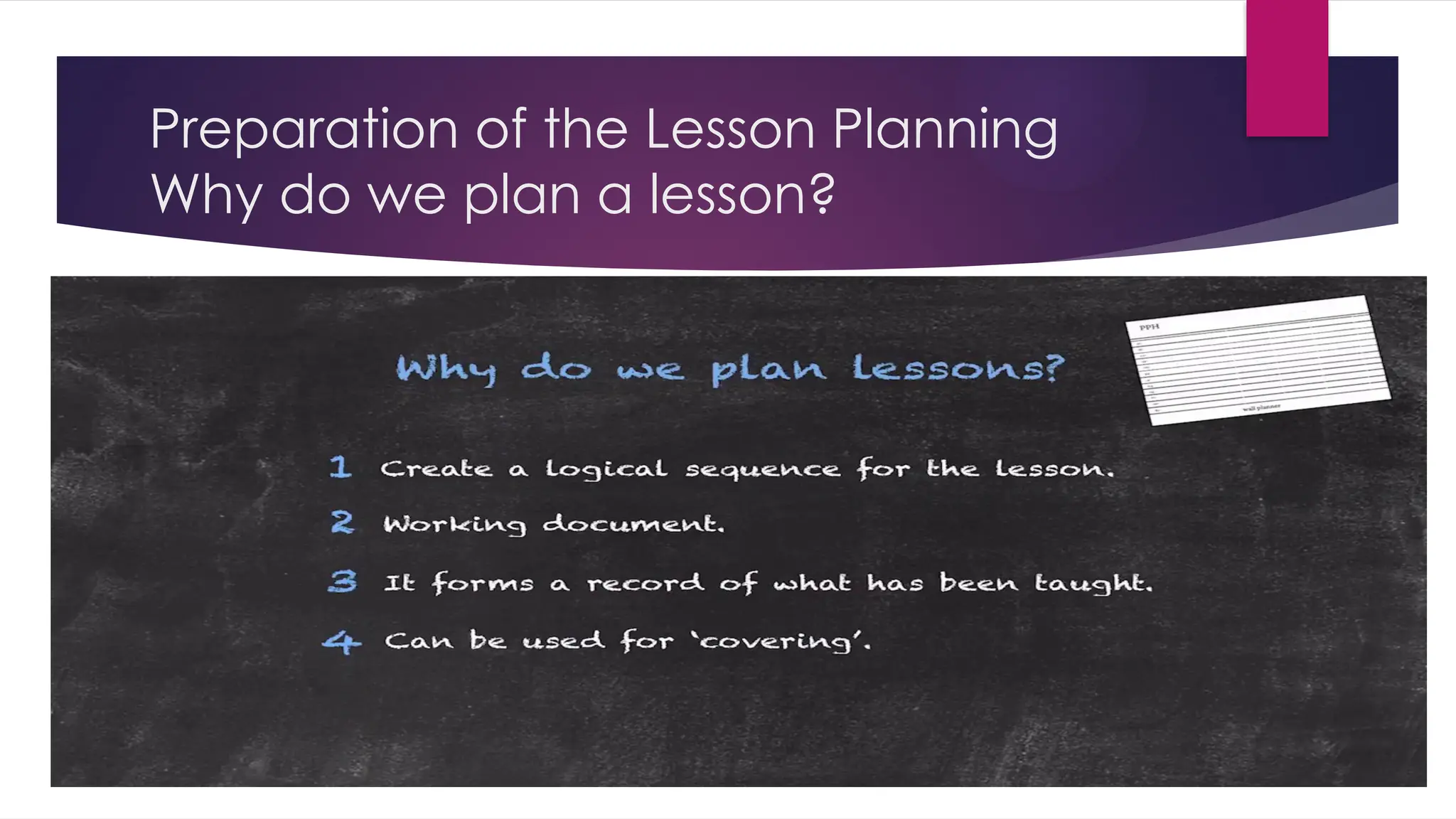
 Preparation of the Lesson Planning
 Why do we plan a lesson?
 Teachers as good lesson planners or- How to effectively plan a lesson as a
good teacher?
 The Do’s and Don’ts
 Lesson Plan: Before .. During & After the class
 3Qs : TEACHERS’ VIEWS
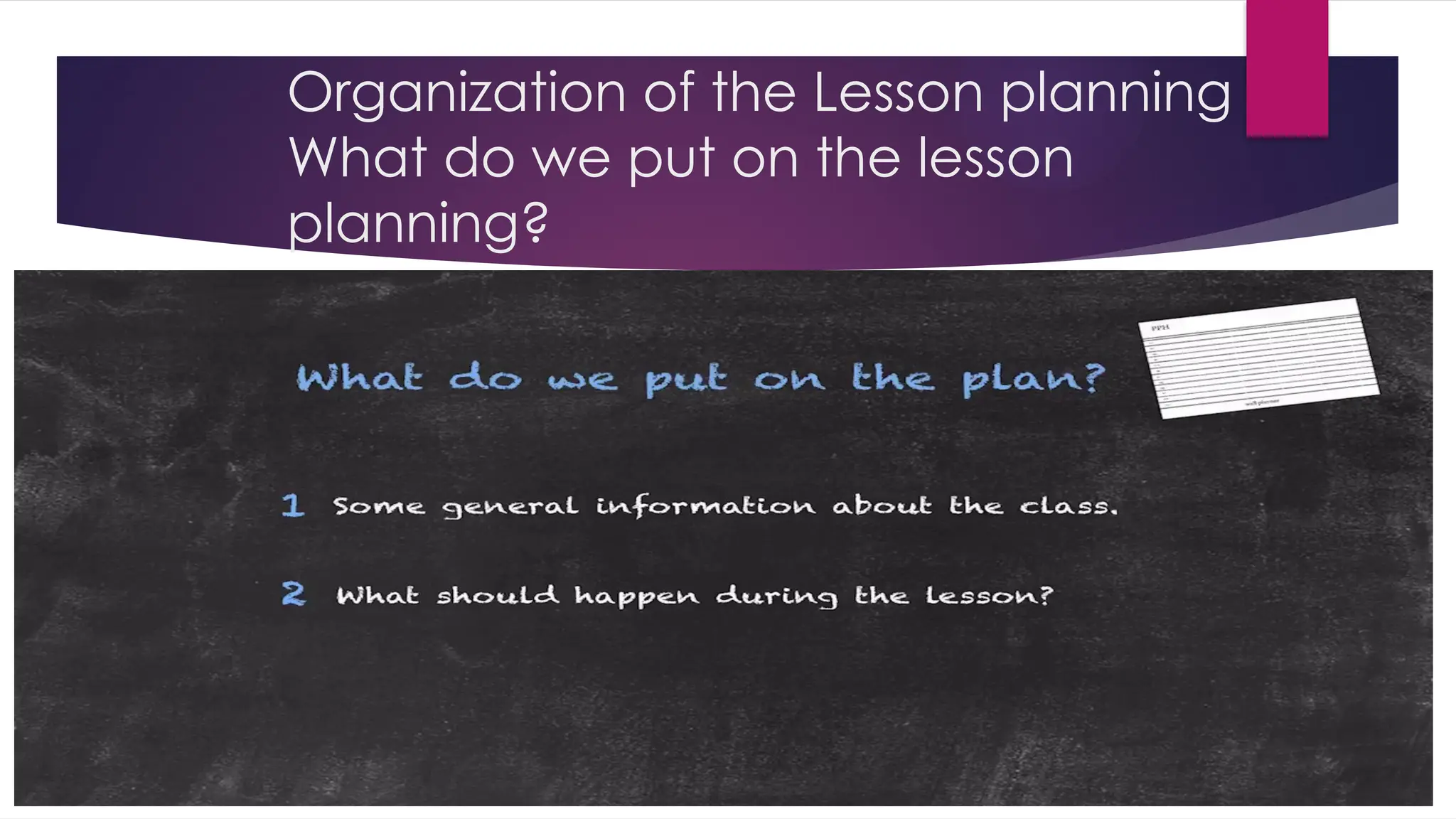
 Organization of the Lesson planning
 What do we put on the lesson planning?
LESSON PLAN IS THE FURNITURE OF TEACHER’S MIND
 According to Lester B.
Sands, "A lesson-plan is
actually a plan of
action. It, therefore,
includes the working
philosophy of the
teacher.
 According to Davis,
"Preparation of lesson is very
crucial. Nothing is more
dangerous for teacher's
progress than incomplete
Preparation."
 According to International
Dictionary of Education,
"Lesson-plan is outline of
tge important points of a
lesson arranged in the
order in which they are to
be presented to students
by the teacher"
Preparation of the Lesson Planning
Why do we plan a lesson?
Phases of Lesson Planning
 1. Pre-teaching phase
 2. Teaching phase
 3. Post-teaching phase
Teachers As Good Lesson Planners
 Our modern society demands competent and well educated students that can
shape the new world:
 the thinkers and strategists that can create and innovate, not the ‘robots’ that
can only follow instructions.
 At CCJ, we, teachers, must respond by putting learning skills development
before the rote memorisation of content:
 In this vein, We must plan FOR learning.
Know Your Lessons – What’s Your Plans?
 Lesson plan is a pre-prepared plan.
 It creates appropriate learning environment.
 It helps achieving instructional objectives.
 It prepares a systematic order of teaching process.
 It makes teaching learning process more effective.
Workshop Aims & Objectives:
Preparation of Lesson Planning
Before the Classroom
 One hour ago
 Moments before
 The previous night
 Weekends re-visions and pre-visions
KNOW THYSELF – BETWEEN THE LINES
Before the Classroom
DURING THE CLASSROOM
After the Classroom
 What do you want students to be able to do, know, or understand
by the end of the lesson?
PRE-PREPARED vs. POST-REPAIRED ASSESSMENT
3Qs: A Healthy Discussion
 1.What, in your views, should be considered a good lesson plan?
 What, in your views, is the Scope of your Lesson planning?
 What, in your views, needs to be the focus of your Lesson planning?
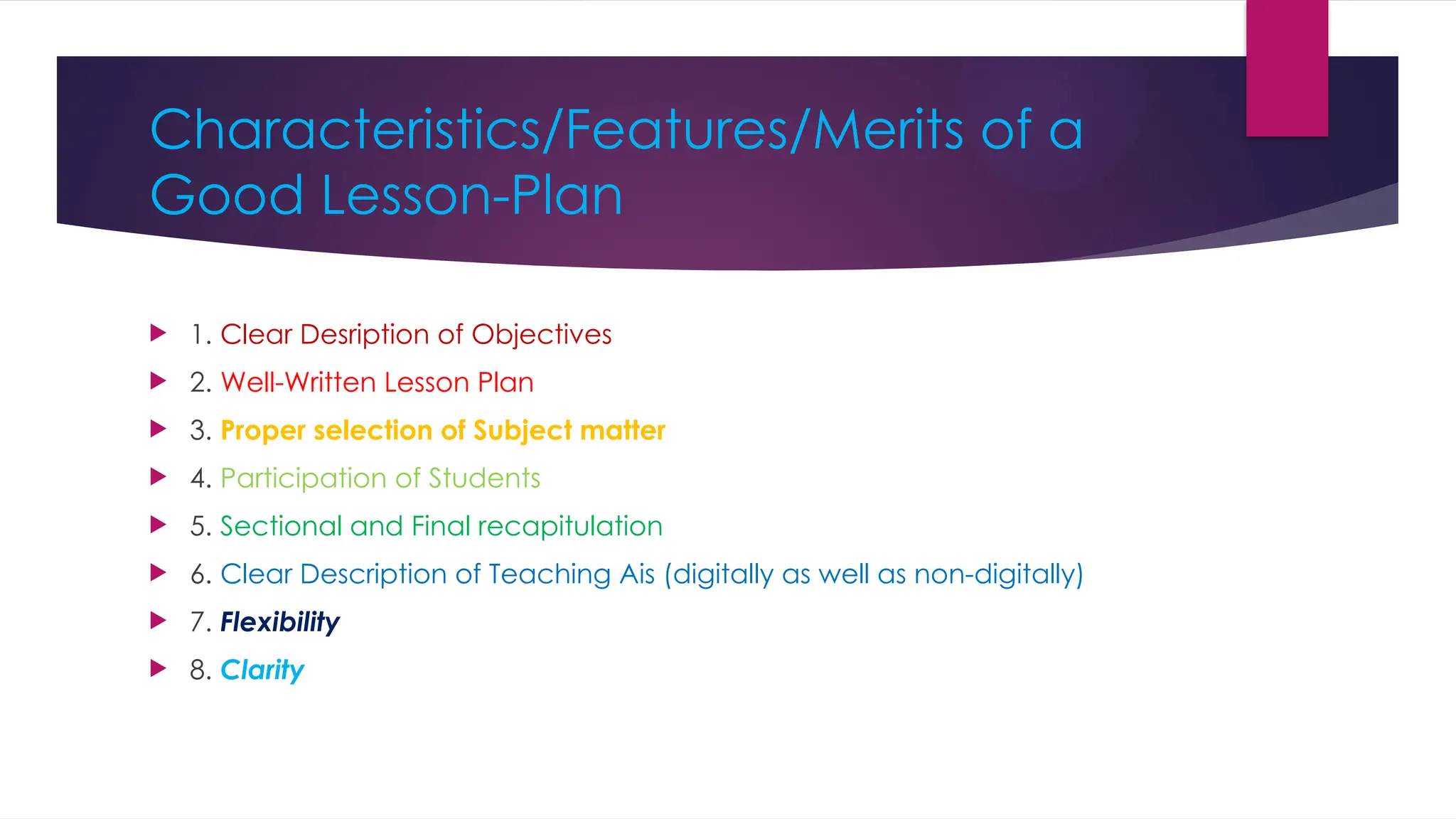
Characteristics/Features/Merits of a
Good Lesson-Plan
 1. Clear Desription of Objectives
 2. Well-Written Lesson Plan
 3. Proper selection of Subject matter
 4. Participation of Students
 5. Sectional and Final recapitulation
 6. Clear Description of Teaching Ais (digitally as well as non-digitally)
 7. Flexibility
 8. Clarity
Organization of the Lesson planning
What do we put on the lesson
planning?
3 Stages of Lesson Plan
 During the teaching process, the teacher has to plan a lot of things. Some
important plannings done by teacher are:
 1. Annual Curriculum Planning:
 2. Unit Planning:
 3. Daily Lesson Planning
PART-2: ORGANIZATION OF LESSON
PLAN
The intended outcomes for this workshop session.
COMPREHENSIVE SAMPLE MODEL OF EXISTING LP
Lesson Planning& crucial importance.pptx

Lesson Planning& crucial importance.pptx

  • 1.
    Preparation & Organizationof Lesson Planning 26.8.2023 PRESENTED BY GHULAM HUSSAIN ENGLISH LECTURER, CCJ
  • 2.
    Workshop outline  IntroducingPlanning (in this case lesson-s _ planning)  Preparation of the Lesson Planning  Why do we plan a lesson?  Teachers as good lesson planners or- How to effectively plan a lesson as a good teacher?  The Do’s and Don’ts  Lesson Plan: Before .. During & After the class  3Qs : TEACHERS’ VIEWS  Organization of the Lesson planning  What do we put on the lesson planning?
  • 3.
    LESSON PLAN ISTHE FURNITURE OF TEACHER’S MIND
  • 4.
     According toLester B. Sands, "A lesson-plan is actually a plan of action. It, therefore, includes the working philosophy of the teacher.
  • 5.
     According toDavis, "Preparation of lesson is very crucial. Nothing is more dangerous for teacher's progress than incomplete Preparation."
  • 6.
     According toInternational Dictionary of Education, "Lesson-plan is outline of tge important points of a lesson arranged in the order in which they are to be presented to students by the teacher"
  • 7.
    Preparation of theLesson Planning Why do we plan a lesson?
  • 8.
    Phases of LessonPlanning  1. Pre-teaching phase  2. Teaching phase  3. Post-teaching phase
  • 9.
    Teachers As GoodLesson Planners  Our modern society demands competent and well educated students that can shape the new world:  the thinkers and strategists that can create and innovate, not the ‘robots’ that can only follow instructions.  At CCJ, we, teachers, must respond by putting learning skills development before the rote memorisation of content:  In this vein, We must plan FOR learning.
  • 12.
    Know Your Lessons– What’s Your Plans?  Lesson plan is a pre-prepared plan.  It creates appropriate learning environment.  It helps achieving instructional objectives.  It prepares a systematic order of teaching process.  It makes teaching learning process more effective.
  • 14.
    Workshop Aims &Objectives: Preparation of Lesson Planning
  • 15.
    Before the Classroom One hour ago  Moments before  The previous night  Weekends re-visions and pre-visions
  • 16.
    KNOW THYSELF –BETWEEN THE LINES
  • 17.
  • 18.
  • 19.
    After the Classroom What do you want students to be able to do, know, or understand by the end of the lesson?
  • 20.
  • 21.
    3Qs: A HealthyDiscussion  1.What, in your views, should be considered a good lesson plan?  What, in your views, is the Scope of your Lesson planning?  What, in your views, needs to be the focus of your Lesson planning?
  • 22.
    Characteristics/Features/Merits of a GoodLesson-Plan  1. Clear Desription of Objectives  2. Well-Written Lesson Plan  3. Proper selection of Subject matter  4. Participation of Students  5. Sectional and Final recapitulation  6. Clear Description of Teaching Ais (digitally as well as non-digitally)  7. Flexibility  8. Clarity
  • 23.
    Organization of theLesson planning What do we put on the lesson planning?
  • 24.
    3 Stages ofLesson Plan  During the teaching process, the teacher has to plan a lot of things. Some important plannings done by teacher are:  1. Annual Curriculum Planning:  2. Unit Planning:  3. Daily Lesson Planning
  • 27.
    PART-2: ORGANIZATION OFLESSON PLAN The intended outcomes for this workshop session. COMPREHENSIVE SAMPLE MODEL OF EXISTING LP

Editor's Notes

  • #12 How presentation will benefit audience: Adult learners are more interested in a subject if they know how or why it is important to them. Presenter’s level of expertise in the subject: Briefly state your credentials in this area, or explain why participants should listen to you.
  • #14 Lesson descriptions should be brief.
  • #15 Example objectives At the end of this lesson, you will be able to: Save files to the team Web server. Move files to different locations on the team Web server. Share files on the team Web server.