WORLD
RELIGIONS
AND BELIEF
SYSTEMS
LIFE PERFORMANCE OUTCOME
I am a courageous, resourceful explorer and
problem solver demonstrating my creativity and
charism.
2
ESSENTIAL PERFORMANCE OUTCOME
Search voluntarily beyond readily available sources of
information, resources, and standard techniques to generate
new understandings towards workable solutions to existing
problems.
3
INTENDED LEARNING OUTCOME
Search voluntarily beyond readily available sources
of information about the basic beliefs and practices
in Shinto.
4
WHAT I KNOW
ABOUT SHINTO?
Activity
“
SHINTO
https://youtu.be/LoQqxdAbRS0
6
SHINTO
7
⬗ The name “Shinto”, while on ancient origin,
was used to designate the religion the Japanese
people only during the 8th century C.E.
⬗ The name is derived from two words, shin
(meaning kami or gods) and to (or do,
meaning path)
SHINTO
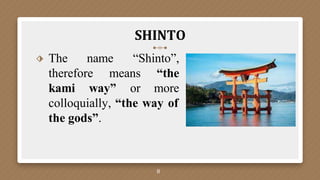
⬗ The name “Shinto”,
therefore means
kami way” or
“the
more
colloquially, “the way of
the gods”.
8
SHINTO
9
⬗ Prior to the 8th century it is believed that it had
no name at all, because of the rise of
Buddhism and Confucianism from China, it
was necessary to distinguish this mode of
religious practice.
SHINTO
10
⬗ Shinto is quite unique because it is nature-
centric.
⬗ Shinto does not recognize any book as its
authoritative scriptures, focusing instead on
temple worship and the maintenance of the
beauty of nature.
https://youtu.be/RWCSOzbdNoQ
SHINTO
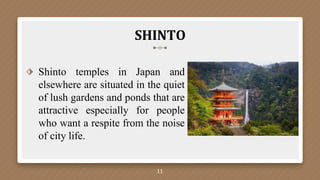
⬗ Shinto temples in Japan and
elsewhere are situated in the quiet
of lush gardens and ponds that are
attractive especially for people
who want a respite from the noise
of city life.
11
“
KAMI
https://youtu.be/iOynXOWvkU8
12
KAMI, THE SHINTO “GODS”
13
⬗ The divine principle in Shinto worship is the
kami, an honorific title for greatness and
benevolence
⬗ The kami can be a lot of things: it can be a
manifestations of the scared in nature or
extraordinary people.
KAMI, THE SHINTO “GODS”
14
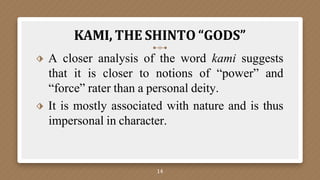
⬗ A closer analysis of the word kami suggests
that it is closer to notions of “power” and
“force” rater than a personal deity.
⬗ It is mostly associated with nature and is thus
impersonal in character.
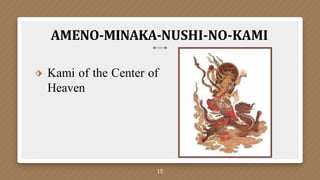
AMENO-MINAKA-NUSHI-NO-KAMI
⬗ Kami of the Center of
Heaven
15
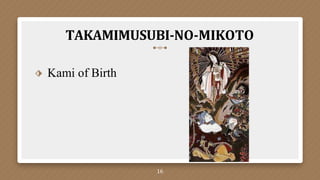
TAKAMIMUSUBI-NO-MIKOTO
⬗ Kami of Birth
16
KAMI-MISUBI-
N0-MIKOTO
17
⬗ Kami of Growth
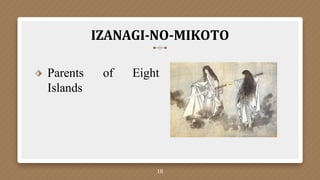
IZANAGI-NO-MIKOTO
of Eight
⬗ Parents
Islands
18
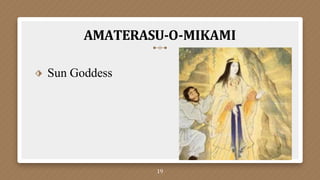
AMATERASU-O-MIKAMI
⬗ Sun Goddess
19
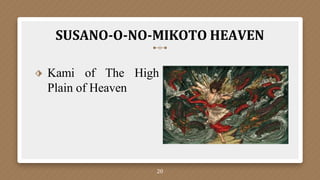
SUSANO-O-NO-MIKOTO HEAVEN
⬗ Kami of The High
Plain of Heaven
20
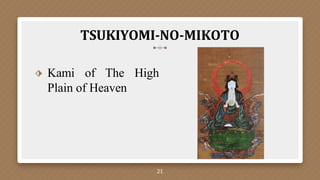
TSUKIYOMI-NO-MIKOTO
⬗ Kami of The High
Plain of Heaven
21
RELIGIOUS RITUALS
22
⬗ Sometimes done at home, but in temples the
priest takes the primary role as ritual expert,
officiating the act of worship of the kami by
offering it honor
RELIGIOUS RITUALS
23
⬗ Most of the rituals are public in character.
Although a few others involve having a Shinto
priest pray for a devotee’s personal intentions
(kito, kigan) or gan-gake (special prayers)
RELIGIOUS RITUALS
24
⬗ Prayer for well-being
⬗ For health and long life
⬗ For success in work
⬗ For happy relationships
⬗ For safe journeys
RELIGIOUS RITUALS
25
⬗ Public prayers are called norito.
⬗ The norito are especially dignified prayers
pronounced by the Shinto priest in the
presence of the kami
RELIGIOUS RITUALS
26
⬗ Norito is one of the four important elements of
Shinto worship.
⬗ The other three are harai (purification),
shinsen (offering), and naorai (symbolic
feast)
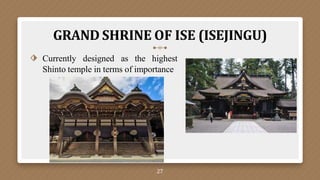
GRAND SHRINE OF ISE (ISEJINGU)
⬗ Currently designed as the highest
Shinto temple in terms of importance
27
“
SHINTO
FESTIVALS
https://youtu.be/wNm7w5bWHcY
28

Lesson 8_Shinto..........................pptx