SIMPLE AND
COMPOUND INTEREST
WHAT IS
SIMPLE
INTEREST?
Mathematics of finance is a branch of
applied mathematics that deals with
financial concepts and problems using
mathematical tools. It combines elements

of calculus, statistics, and probability to
analyze financial data and model financial
instruments.

Part I:SIMPLE AND COMPOUND INTEREST
Part II:CREDIT CARDS AND CONSUMER
LOANS
Part III:STOCK,BONDS AND MUTUAL
FUNDS
TYPES OF MATHIMATICS OF FINANCE
SIMPLE INTEREST
--simple interest is the interest charge on
borrowing that's calculated using an original
principal amount only.And an interest rate
that never changes.
--This is the interest in which only the
original principal bears interest for the
entire of term of the loan.
DEBTOR OR MARKER -- The person who barrows
money for any purpose
LENDER -- The person or institution which loans the
money
INTEREST --The payment for the use of borrowed
money
PRINCIPAL --The capital or sum of money invested
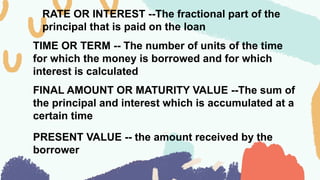
RATE OR INTEREST --The fractional part of the
principal that is paid on the loan
TIME OR TERM -- The number of units of the time
for which the money is borrowed and for which
interest is calculated
FINAL AMOUNT OR MATURITY VALUE --The sum of
the principal and interest which is accumulated at a
certain time
PRESENT VALUE -- the amount received by the
borrower
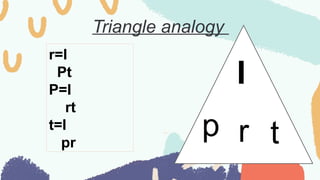
Triangle analogy
r=I
Pt
P=I
rt
t=I
pr r
I
p t
To buy a new smartphone for hes son's online
class,Sarah went to her friend Angie and barrowed
6,000 pesos at 10% for year since Sarah has to pay
6,500 pesos after a Year she.plans to sell mango as an
extra source of income.
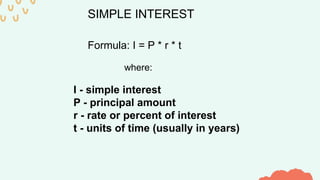
SIMPLE INTEREST
Formula: I = P * r * t
where:
I - simple interest
P - principal amount
r - rate or percent of interest
t - units of time (usually in years)
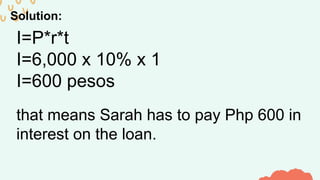
Solution:
I=P*r*t
I=6,000 x 10% x 1
I=600 pesos
that means Sarah has to pay Php 600 in
interest on the loan.
SIMPLE INTEREST
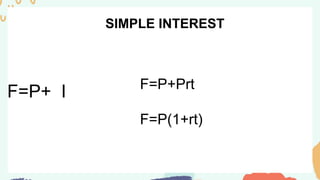
F=P+ I F=P+Prt
F=P(1+rt)
SIMPLE INTEREST
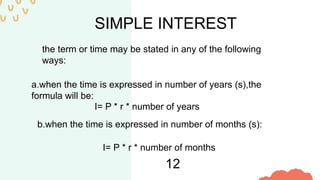
the term or time may be stated in any of the following
ways:
a.when the time is expressed in number of years (s),the
formula will be:
b.when the time is expressed in number of months (s):
I= P * r * number of months
12
I= P * r * number of years
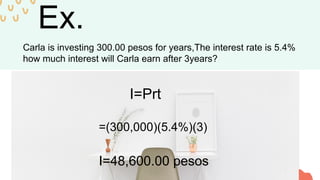
Ex.
Carla is investing 300.00 pesos for years,The interest rate is 5.4%
how much interest will Carla earn after 3years?
I=Prt
=(300,000)(5.4%)(3)
I=48,600.00 pesos
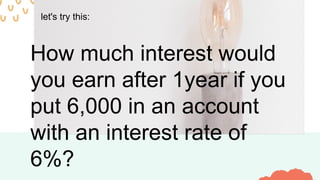
let's try this:
How much interest would
you earn after 1year if you
put 6,000 in an account
with an interest rate of
6%?
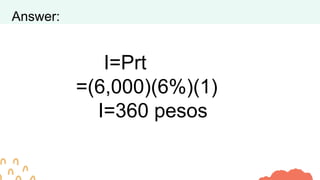
Answer:
I=Prt
=(6,000)(6%)(1)
I=360 pesos
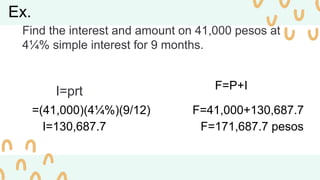
Ex.
Find the interest and amount on 41,000 pesos at
4¼% simple interest for 9 months.
I=prt
=(41,000)(4¼%)(9/12)
I=130,687.7
F=P+I
F=41,000+130,687.7
F=171,687.7 pesos
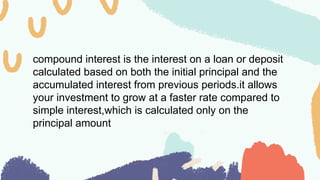
COMPOUND INTEREST
compound interest is the interest on a loan or deposit
calculated based on both the initial principal and the
accumulated interest from previous periods.it allows
your investment to grow at a faster rate compared to
simple interest,which is calculated only on the
principal amount
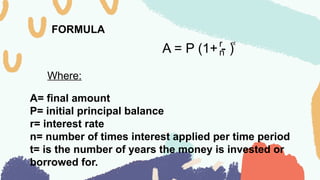
FORMULA
A = P (1+ - )
r
n
nt
Where:
A= final amount
P= initial principal balance
r= interest rate
n= number of times interest applied per time period
t= is the number of years the money is invested or
borrowed for.
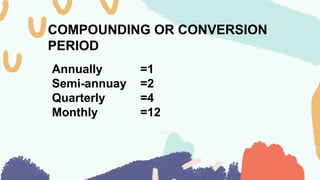
COMPOUNDING OR CONVERSION
PERIOD
Annually
Semi-annuay
Quarterly
Monthly
=1
=2
=4
=12
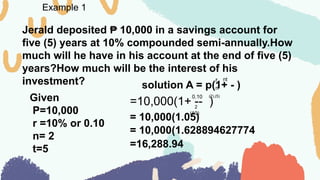
Example 1
Jerald deposited 10,000 in a savings account for
₱
five (5) years at 10% compounded semi-annually.How
much will he have in his account at the end of five (5)
years?How much will be the interest of his
investment?
Given
P=10,000
r =10% or 0.10
n= 2
t=5
solution A = p(1+ - )
r
n
nt
=10,000(1+ -- )
0.10
2
(2).(5)
= 10,000(1.05)
(10)
= 10,000(1.628894627774
=16,288.94
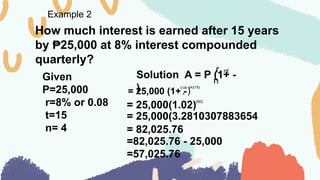
Example 2
How much interest is earned after 15 years
by 25,000 at 8% interest compounded
₱
quarterly?
Given
P=25,000
r=8% or 0.08
t=15
n= 4
Solution A = P (1+ -
)
r
n
nt
= 25,000 (1+ -
0.08
4 )
(4)(15)
= 25,000(1.02)
(60)
= 25,000(3.2810307883654
= 82,025.76
=82,025.76 - 25,000
=57,025.76
CREDIT CARD AND
CONSUMER LOANS
WHAT IS CREDIT
CARD?
CREDIT CARD
a plastic card that contains
information and authorizes the person
who's name appears on it to charges
purchases or services to his her
account for which he/she I will be
later billed.
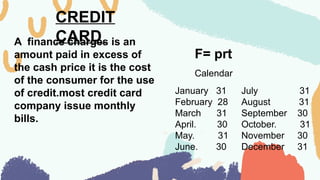
CREDIT
CARD
A finance charges is an
amount paid in excess of
the cash price it is the cost
of the consumer for the use
of credit.most credit card
company issue monthly
bills.
F= prt
Calendar
January 31
February 28
March 31
April. 30
May. 31
June. 30
July 31
August 31
September 30
October. 31
November 30
December 31
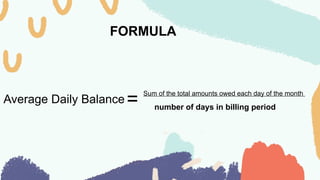
FORMULA
Average Daily Balance
Sum of the total amounts owed each day of the month
number of days in billing period
=
EXAMPLE
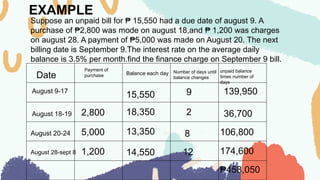
Suppose an unpaid bill for 15,550 had a due date of august 9. A
₱
purchase of 2,800 was mode on august 18,and 1,200 was charges
₱ ₱
on august 28. A payment of 5,000 was made on August 20. The next
₱
billing date is September 9.The interest rate on the average daily
balance is 3.5% per month.find the finance charge on September 9 bill.
Date
August 9-17
August 18-19
August 20-24
August 28-sept 8
Payment of
purchase
2,800
5,000
1,200
Balance each day
15,550
18,350
13,350
14,550
Number of days until
balance changes
9
2
8
12
unpaid balance
times number of
days
139,950
36,700
106,800
174,600
₱458,050
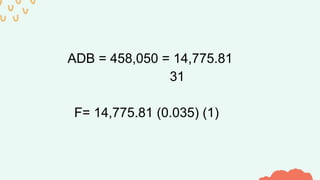
ADB = 458,050 = 14,775.81
31
F= 14,775.81 (0.035) (1)
EXAMPLE:
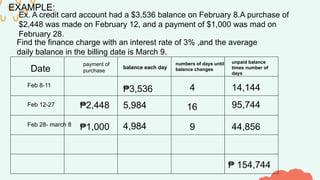
Ex. A credit card account had a $3,536 balance on February 8.A purchase of
$2,448 was made on February 12, and a payment of $1,000 was mad on
February 28.
Find the finance charge with an interest rate of 3% ,and the average
daily balance in the billing date is March 9.
Date
Feb 8-11
Feb 12-27
Feb 28- march 8
payment of
purchase
₱2,448
₱1,000
balance each day
₱3,536
5,984
4,984
numbers of days until
balance changes
4
16
9
unpaid balance
times number of
days
14,144
95,744
44,856
₱ 154,744
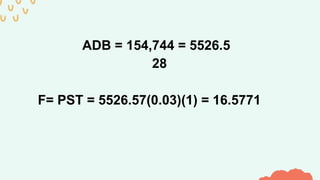
ADB = 154,744 = 5526.5
F= PST = 5526.57(0.03)(1) = 16.5771
28
CONSUMER LOANS
- it has a fixed date for monthly
repayments,where many
people know-how to control
their finances.
loan agreement have many
forms and with varied
terms,ranging from simple
promissory notes between
friends and family members to
more complex loans like
mortgage,auto,payday and
student loans.
TYPES OF LOANS
1. student loans
2. mortgages
3. car loans
4. personal loans
5. payday
6. borrowing from retirement and life
insurances
7. consolidated loans
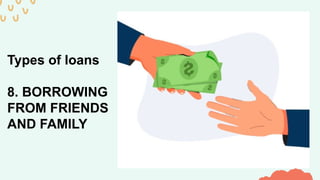
8. borrowing from friends and family
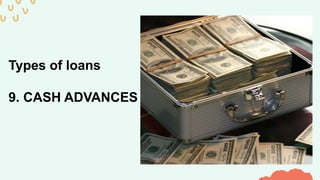
9. cash advances
Types of loans
1. STUDENT LOANS
Types of loan
2.
MORTGAGES
Types of loans
3. AUTO/CAR
Types of loans
4. PERSONAL
LOANS
Types of loans
5. PAYDAY
LOANS
Types of loans
6. BORROWING
FROM RETIREMENT
& LIFE INSURANCE
Types of loans
7. CONSOLIDATED LOANS
Types of loans
8. BORROWING
FROM FRIENDS
AND FAMILY
Types of loans
9. CASH ADVANCES
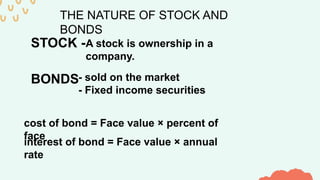
THE NATURE OF STOCK AND
BONDS
STOCK -A stock is ownership in a
company.
BONDS- sold on the market
- Fixed income securities
cost of bond = Face value × percent of
face
interest of bond = Face value × annual
rate
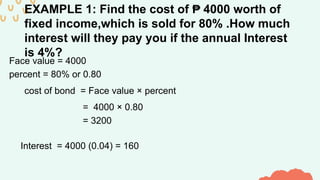
EXAMPLE 1: Find the cost of 4000 worth of
₱
fixed income,which is sold for 80% .How much
interest will they pay you if the annual Interest
is 4%?
Face value = 4000
percent = 80% or 0.80
cost of bond = Face value × percent
= 4000 × 0.80
= 3200
Interest = 4000 (0.04) = 160
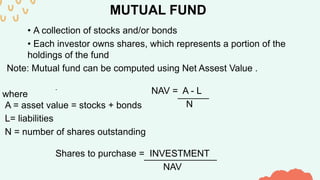
MUTUAL FUND
• A collection of stocks and/or bonds
• Each investor owns shares, which represents a portion of the
holdings of the fund
Note: Mutual fund can be computed using Net Assest Value .
NAV = A - L
-
______
N
where
A = asset value = stocks + bonds
L= liabilities
N = number of shares outstanding
Shares to purchase = INVESTMENT
______________
NAV
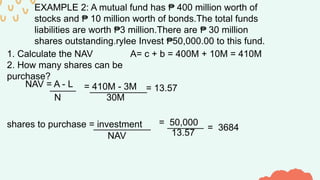
EXAMPLE 2: A mutual fund has 400 million worth of
₱
stocks and 10 million worth of bonds.The total funds
₱
liabilities are worth 3 million.There are 30 million
₱ ₱
shares outstanding.rylee Invest 50,000.00 to this fund.
₱
1. Calculate the NAV
2. How many shares can be
purchase?
A= c + b = 400M + 10M = 410M
NAV = A - L
_____
N
= 410M - 3M
___________
30M
= 13.57
shares to purchase = investment
___________
NAV
= 50,000
_______
13.57
= 3684
STOCK
WHAT IS
STOCK?
WHAT IS
STOCK?
- A stock (also known as equity)is a security
that represents the ownership of a fraction of a
corporation.
- This entitles the owner of the stock to a
proportions assets and profits equal to how
much stock they own
WHAT IS STOCK?
- A stock or equity is a share of individual
companies or persons.untis of stock are
called "shares"
- stock market is a place where stock are
bought and sold
-The Philippines stock exchange (PSE) is
the corporation that governs our local
stock markets
TYPES OF STOCK
PREFERRED STOCK
Is a class of corporate stock in which the
investor has preferential rights over the
common shareholders to dividends and a
company assets are categories.
NON - PARTICIPATING STOCKS
Nonparticipating stocks means that
shareholders received only fixed
dividend.
PARTICIPATING STOCKS
Participating stock means that
shareholders may receive additional
dividends if the company performs well.
COMMON STOCK
Is a class of corporate stock in which the
investor has voting rights and shares
directly in the success or failure of the
business.
TYPES OF PREFERRED STOCK
COMULATIVE PREFERRED STOCK
is a type of preferred stock that
receives a dividend each year.
means the stock may be exchanged
or a specified number of common
shares in the future.
MUTUAL FUNDS
WHAT IS MUTUAL FUNDS?
A mutual fund is a company that
pools money from many investment
and invest the money is securities
such as stocka,bonds,and short -
term debt.The combined holdings of
the mutual fund are known as it's
portfolio.investors buy shares in
mutual funds.
TYPES OF MUTUAL
FUNDS
MONEY MARKET FUNDS
A money market fund is a type of mutual fund that
has relatively low risk compared to other mutual
funds and most other investment and historically
has had lower returns,these funds invest in short -
term debt securities such as treasury bills and
commercial papers, with the objective of providing
liquidity and low -risk investment options.
BOND FUNDS
A bond fund is a mutual fund or an exchange -traded
fund (ETF) that buys and sells debt instruments like
government and corporate monthly income for
investors.for an investor,a bond fund is an alternative
to buying individuals bonds.
INCOME FUNDS
An income fund is mutual fund or a ULIP (unit-linked
investment plan) or any other type of investment that
aims at generating an income stream for investors by
investing in fixed income securities like government
securities or gsecs/gilts,bonds,debentures,fixed deposit
INTERNATIONAL FUNDS
These funds invest in stocks and bonds of
companies outside the investors home country, with
the objective of diversifying the portfolio and
generating higher returns.
SECTOR
FUNDS
These funds invest in stocks of companies
belonging to a particular sector,such as technology,
healthcare,or energy, with the objective of
generating high returns from that sector.
INDEX FUNDS
Index funds these funds invest in the stocks of a
specific index,such as the 5&P 500 or the BSE
sensex, with the objective of replicating the
performance of the index.
DEPT FUNDS
These funds invest in fixed income securities such
as bonds, treasury bills,and other debt instruments,
with the objective of generating regular income.
EQUITY FUNDS
These funds invest in stocks of various
companies with the objective of
generating long -term capital
appreciation.
BALANCE FUNDS
These funds invest in a mix of equuty
and debt securities, with the objective
of generating both capital appreciation
and regular income.
THANK YOU!

sIMPLE AND COMPOUND SIMPLE AND COMPOUND PPT

  • 1.
  • 2.
  • 3.
    Mathematics of financeis a branch of applied mathematics that deals with financial concepts and problems using mathematical tools. It combines elements of calculus, statistics, and probability to analyze financial data and model financial instruments.
  • 4.
    Part I:SIMPLE ANDCOMPOUND INTEREST Part II:CREDIT CARDS AND CONSUMER LOANS Part III:STOCK,BONDS AND MUTUAL FUNDS TYPES OF MATHIMATICS OF FINANCE
  • 5.
    SIMPLE INTEREST --simple interestis the interest charge on borrowing that's calculated using an original principal amount only.And an interest rate that never changes. --This is the interest in which only the original principal bears interest for the entire of term of the loan.
  • 6.
    DEBTOR OR MARKER-- The person who barrows money for any purpose LENDER -- The person or institution which loans the money INTEREST --The payment for the use of borrowed money PRINCIPAL --The capital or sum of money invested
  • 7.
    RATE OR INTEREST--The fractional part of the principal that is paid on the loan TIME OR TERM -- The number of units of the time for which the money is borrowed and for which interest is calculated FINAL AMOUNT OR MATURITY VALUE --The sum of the principal and interest which is accumulated at a certain time PRESENT VALUE -- the amount received by the borrower
  • 8.
  • 9.
    To buy anew smartphone for hes son's online class,Sarah went to her friend Angie and barrowed 6,000 pesos at 10% for year since Sarah has to pay 6,500 pesos after a Year she.plans to sell mango as an extra source of income.
  • 10.
    SIMPLE INTEREST Formula: I= P * r * t where: I - simple interest P - principal amount r - rate or percent of interest t - units of time (usually in years)
  • 11.
    Solution: I=P*r*t I=6,000 x 10%x 1 I=600 pesos that means Sarah has to pay Php 600 in interest on the loan.
  • 12.
    SIMPLE INTEREST F=P+ IF=P+Prt F=P(1+rt)
  • 13.
    SIMPLE INTEREST the termor time may be stated in any of the following ways: a.when the time is expressed in number of years (s),the formula will be: b.when the time is expressed in number of months (s): I= P * r * number of months 12 I= P * r * number of years
  • 14.
    Ex. Carla is investing300.00 pesos for years,The interest rate is 5.4% how much interest will Carla earn after 3years? I=Prt =(300,000)(5.4%)(3) I=48,600.00 pesos
  • 15.
    let's try this: Howmuch interest would you earn after 1year if you put 6,000 in an account with an interest rate of 6%?
  • 16.
  • 17.
    Ex. Find the interestand amount on 41,000 pesos at 4¼% simple interest for 9 months. I=prt =(41,000)(4¼%)(9/12) I=130,687.7 F=P+I F=41,000+130,687.7 F=171,687.7 pesos
  • 18.
  • 19.
    compound interest isthe interest on a loan or deposit calculated based on both the initial principal and the accumulated interest from previous periods.it allows your investment to grow at a faster rate compared to simple interest,which is calculated only on the principal amount
  • 20.
    FORMULA A = P(1+ - ) r n nt Where: A= final amount P= initial principal balance r= interest rate n= number of times interest applied per time period t= is the number of years the money is invested or borrowed for.
  • 21.
  • 22.
    Example 1 Jerald deposited10,000 in a savings account for ₱ five (5) years at 10% compounded semi-annually.How much will he have in his account at the end of five (5) years?How much will be the interest of his investment? Given P=10,000 r =10% or 0.10 n= 2 t=5 solution A = p(1+ - ) r n nt =10,000(1+ -- ) 0.10 2 (2).(5) = 10,000(1.05) (10) = 10,000(1.628894627774 =16,288.94
  • 23.
    Example 2 How muchinterest is earned after 15 years by 25,000 at 8% interest compounded ₱ quarterly? Given P=25,000 r=8% or 0.08 t=15 n= 4 Solution A = P (1+ - ) r n nt = 25,000 (1+ - 0.08 4 ) (4)(15) = 25,000(1.02) (60) = 25,000(3.2810307883654 = 82,025.76 =82,025.76 - 25,000 =57,025.76
  • 24.
  • 25.
  • 26.
    CREDIT CARD a plasticcard that contains information and authorizes the person who's name appears on it to charges purchases or services to his her account for which he/she I will be later billed.
  • 27.
    CREDIT CARD A finance chargesis an amount paid in excess of the cash price it is the cost of the consumer for the use of credit.most credit card company issue monthly bills. F= prt Calendar January 31 February 28 March 31 April. 30 May. 31 June. 30 July 31 August 31 September 30 October. 31 November 30 December 31
  • 28.
    FORMULA Average Daily Balance Sumof the total amounts owed each day of the month number of days in billing period =
  • 29.
    EXAMPLE Suppose an unpaidbill for 15,550 had a due date of august 9. A ₱ purchase of 2,800 was mode on august 18,and 1,200 was charges ₱ ₱ on august 28. A payment of 5,000 was made on August 20. The next ₱ billing date is September 9.The interest rate on the average daily balance is 3.5% per month.find the finance charge on September 9 bill. Date August 9-17 August 18-19 August 20-24 August 28-sept 8 Payment of purchase 2,800 5,000 1,200 Balance each day 15,550 18,350 13,350 14,550 Number of days until balance changes 9 2 8 12 unpaid balance times number of days 139,950 36,700 106,800 174,600 ₱458,050
  • 30.
    ADB = 458,050= 14,775.81 31 F= 14,775.81 (0.035) (1)
  • 31.
    EXAMPLE: Ex. A creditcard account had a $3,536 balance on February 8.A purchase of $2,448 was made on February 12, and a payment of $1,000 was mad on February 28. Find the finance charge with an interest rate of 3% ,and the average daily balance in the billing date is March 9. Date Feb 8-11 Feb 12-27 Feb 28- march 8 payment of purchase ₱2,448 ₱1,000 balance each day ₱3,536 5,984 4,984 numbers of days until balance changes 4 16 9 unpaid balance times number of days 14,144 95,744 44,856 ₱ 154,744
  • 32.
    ADB = 154,744= 5526.5 F= PST = 5526.57(0.03)(1) = 16.5771 28
  • 33.
    CONSUMER LOANS - ithas a fixed date for monthly repayments,where many people know-how to control their finances.
  • 34.
    loan agreement havemany forms and with varied terms,ranging from simple promissory notes between friends and family members to more complex loans like mortgage,auto,payday and student loans.
  • 35.
    TYPES OF LOANS 1.student loans 2. mortgages 3. car loans 4. personal loans 5. payday 6. borrowing from retirement and life insurances 7. consolidated loans 8. borrowing from friends and family 9. cash advances
  • 36.
    Types of loans 1.STUDENT LOANS
  • 37.
  • 38.
  • 39.
    Types of loans 4.PERSONAL LOANS
  • 40.
    Types of loans 5.PAYDAY LOANS
  • 41.
    Types of loans 6.BORROWING FROM RETIREMENT & LIFE INSURANCE
  • 42.
    Types of loans 7.CONSOLIDATED LOANS
  • 43.
    Types of loans 8.BORROWING FROM FRIENDS AND FAMILY
  • 44.
    Types of loans 9.CASH ADVANCES
  • 45.
    THE NATURE OFSTOCK AND BONDS STOCK -A stock is ownership in a company. BONDS- sold on the market - Fixed income securities cost of bond = Face value × percent of face interest of bond = Face value × annual rate
  • 46.
    EXAMPLE 1: Findthe cost of 4000 worth of ₱ fixed income,which is sold for 80% .How much interest will they pay you if the annual Interest is 4%? Face value = 4000 percent = 80% or 0.80 cost of bond = Face value × percent = 4000 × 0.80 = 3200 Interest = 4000 (0.04) = 160
  • 47.
    MUTUAL FUND • Acollection of stocks and/or bonds • Each investor owns shares, which represents a portion of the holdings of the fund Note: Mutual fund can be computed using Net Assest Value . NAV = A - L - ______ N where A = asset value = stocks + bonds L= liabilities N = number of shares outstanding Shares to purchase = INVESTMENT ______________ NAV
  • 48.
    EXAMPLE 2: Amutual fund has 400 million worth of ₱ stocks and 10 million worth of bonds.The total funds ₱ liabilities are worth 3 million.There are 30 million ₱ ₱ shares outstanding.rylee Invest 50,000.00 to this fund. ₱ 1. Calculate the NAV 2. How many shares can be purchase? A= c + b = 400M + 10M = 410M NAV = A - L _____ N = 410M - 3M ___________ 30M = 13.57 shares to purchase = investment ___________ NAV = 50,000 _______ 13.57 = 3684
  • 49.
  • 50.
  • 51.
    WHAT IS STOCK? - Astock (also known as equity)is a security that represents the ownership of a fraction of a corporation. - This entitles the owner of the stock to a proportions assets and profits equal to how much stock they own
  • 52.
    WHAT IS STOCK? -A stock or equity is a share of individual companies or persons.untis of stock are called "shares" - stock market is a place where stock are bought and sold -The Philippines stock exchange (PSE) is the corporation that governs our local stock markets
  • 53.
  • 54.
    PREFERRED STOCK Is aclass of corporate stock in which the investor has preferential rights over the common shareholders to dividends and a company assets are categories. NON - PARTICIPATING STOCKS Nonparticipating stocks means that shareholders received only fixed dividend.
  • 55.
    PARTICIPATING STOCKS Participating stockmeans that shareholders may receive additional dividends if the company performs well. COMMON STOCK Is a class of corporate stock in which the investor has voting rights and shares directly in the success or failure of the business.
  • 56.
  • 57.
    COMULATIVE PREFERRED STOCK isa type of preferred stock that receives a dividend each year. means the stock may be exchanged or a specified number of common shares in the future.
  • 58.
  • 59.
    WHAT IS MUTUALFUNDS? A mutual fund is a company that pools money from many investment and invest the money is securities such as stocka,bonds,and short - term debt.The combined holdings of the mutual fund are known as it's portfolio.investors buy shares in mutual funds.
  • 60.
    TYPES OF MUTUAL FUNDS MONEYMARKET FUNDS A money market fund is a type of mutual fund that has relatively low risk compared to other mutual funds and most other investment and historically has had lower returns,these funds invest in short - term debt securities such as treasury bills and commercial papers, with the objective of providing liquidity and low -risk investment options.
  • 61.
    BOND FUNDS A bondfund is a mutual fund or an exchange -traded fund (ETF) that buys and sells debt instruments like government and corporate monthly income for investors.for an investor,a bond fund is an alternative to buying individuals bonds. INCOME FUNDS An income fund is mutual fund or a ULIP (unit-linked investment plan) or any other type of investment that aims at generating an income stream for investors by investing in fixed income securities like government securities or gsecs/gilts,bonds,debentures,fixed deposit
  • 62.
    INTERNATIONAL FUNDS These fundsinvest in stocks and bonds of companies outside the investors home country, with the objective of diversifying the portfolio and generating higher returns. SECTOR FUNDS These funds invest in stocks of companies belonging to a particular sector,such as technology, healthcare,or energy, with the objective of generating high returns from that sector.
  • 63.
    INDEX FUNDS Index fundsthese funds invest in the stocks of a specific index,such as the 5&P 500 or the BSE sensex, with the objective of replicating the performance of the index. DEPT FUNDS These funds invest in fixed income securities such as bonds, treasury bills,and other debt instruments, with the objective of generating regular income.
  • 64.
    EQUITY FUNDS These fundsinvest in stocks of various companies with the objective of generating long -term capital appreciation. BALANCE FUNDS These funds invest in a mix of equuty and debt securities, with the objective of generating both capital appreciation and regular income.
  • 65.