HUMANITIES LESSON PLAN KS3                     Y7      GEOGRAPHY            NUMBER OF   2
                                                                            LESSONS
UNIT: Map Work                                         LESSON: Direction and distance

AIMS: To develop the ability to give and follow compass directions
      To develop the ability to measure distance on maps and convert using scale
OBJECTIVES ~ Pupils should learn
•    The four cardinal points of the compass
•    The next four main points
•    How to give and use compass directions on a map
•    The meaning of the idea of scale
•    How scale is shown on a map
•    How to measure straight line distance and convert into real distance
•    How to measure distances that are not in a straight line
RESOURCES:
J Drive – PowerPoint Lesson 5-6
Red laminated direction cards
Student Booklets including the following pages:
Banbury map – direction (FC)                        Direction in the park
Banbury map – measuring distance (FC)
From Sheffield – distance/direction (FC)            Making maps smaller (FC)
Plans – direction, scale and symbols                Foundations P109-111


LESSON STRUCTURE:
• Work out directions for class room/put them up on walls – get pupils to direct
  someone round the room using compass directions
• Give out the 8 main compass directions and give students 20 seconds to get into
  place. Place the next 8 students into position using the NNE, SSE etc. Give the
  students some examples of what is to the South (Africa) West (USA) East (Russia)
  and North (Pole).
• Do activities from Foundations P109
• Use student workbook as appropriate
• Split the class into two. Team 1 - Hand out 16 point compass cards and give the
  students 20 seconds to get into position. Record time taken. Do the same with
  other half of class. Can award a geography sticker to each member of winning group.
• Scale – discuss what it is and why it is necessary. (there is a video on the J drive to
  show how to work out distances using edge of piece of paper)
• Measuring distance – use Foundations P110-111 to show how its done
• Use student workbook as appropriate
KEY VOCABULARY
Compass points     direction     scale
DIFFERENTIATION:
Extension sheets indicated (X)
HOMEWORK/MARKING
Homeworks indicated (H)        Marking should be for Accuracy
NATIONAL CURRICULUM                                    Curriculum links: Maths
2c

Lesson 5 6 Map skills

  • 1.
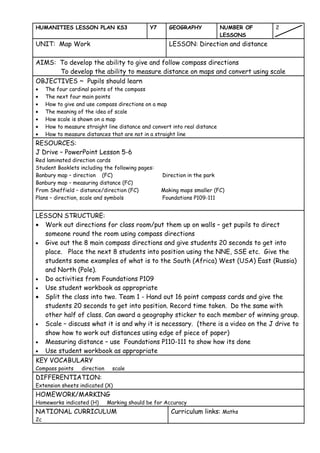
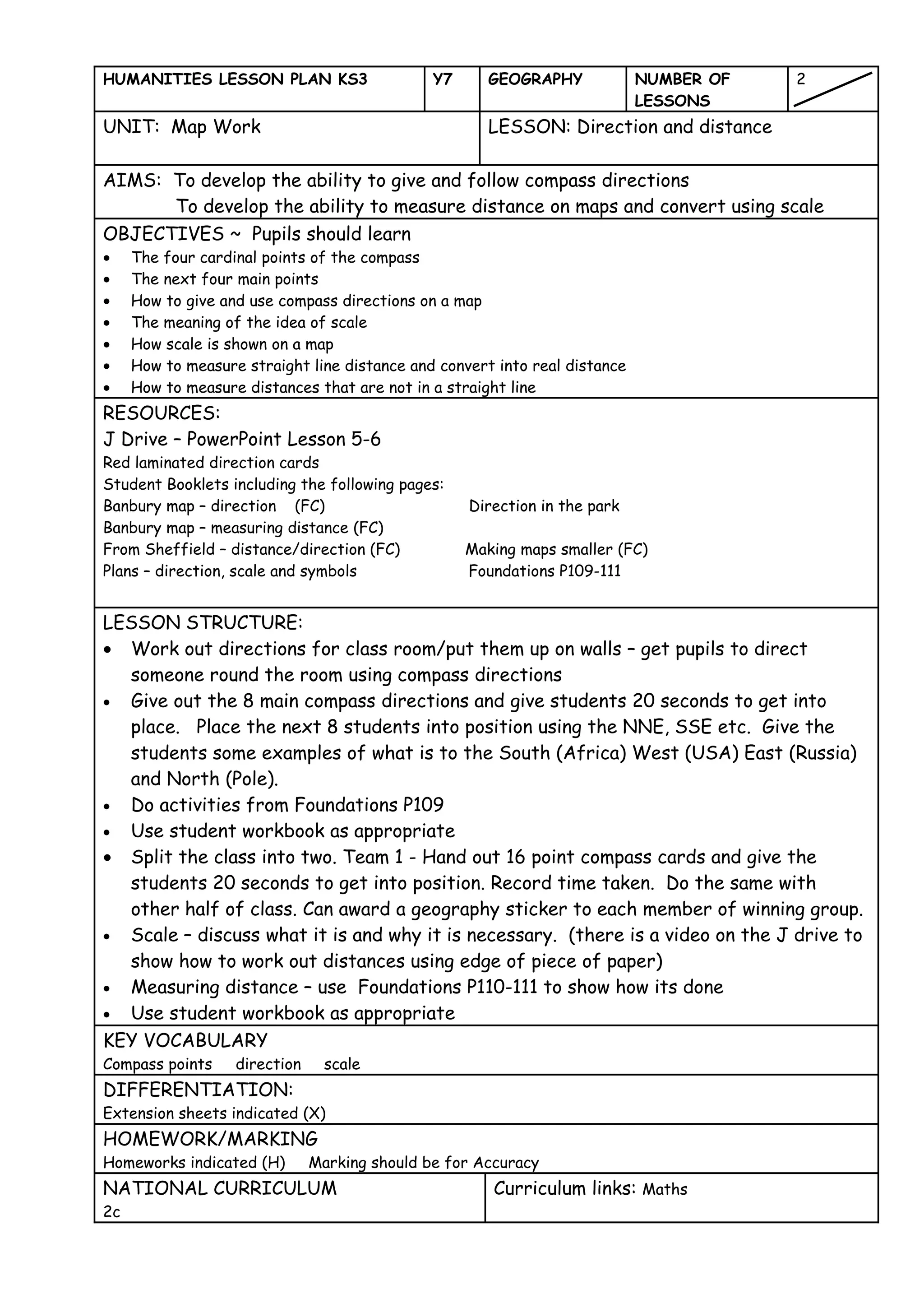
    HUMANITIES LESSON PLANKS3 Y7 GEOGRAPHY NUMBER OF 2 LESSONS UNIT: Map Work LESSON: Direction and distance AIMS: To develop the ability to give and follow compass directions To develop the ability to measure distance on maps and convert using scale OBJECTIVES ~ Pupils should learn • The four cardinal points of the compass • The next four main points • How to give and use compass directions on a map • The meaning of the idea of scale • How scale is shown on a map • How to measure straight line distance and convert into real distance • How to measure distances that are not in a straight line RESOURCES: J Drive – PowerPoint Lesson 5-6 Red laminated direction cards Student Booklets including the following pages: Banbury map – direction (FC) Direction in the park Banbury map – measuring distance (FC) From Sheffield – distance/direction (FC) Making maps smaller (FC) Plans – direction, scale and symbols Foundations P109-111 LESSON STRUCTURE: • Work out directions for class room/put them up on walls – get pupils to direct someone round the room using compass directions • Give out the 8 main compass directions and give students 20 seconds to get into place. Place the next 8 students into position using the NNE, SSE etc. Give the students some examples of what is to the South (Africa) West (USA) East (Russia) and North (Pole). • Do activities from Foundations P109 • Use student workbook as appropriate • Split the class into two. Team 1 - Hand out 16 point compass cards and give the students 20 seconds to get into position. Record time taken. Do the same with other half of class. Can award a geography sticker to each member of winning group. • Scale – discuss what it is and why it is necessary. (there is a video on the J drive to show how to work out distances using edge of piece of paper) • Measuring distance – use Foundations P110-111 to show how its done • Use student workbook as appropriate KEY VOCABULARY Compass points direction scale DIFFERENTIATION: Extension sheets indicated (X) HOMEWORK/MARKING Homeworks indicated (H) Marking should be for Accuracy NATIONAL CURRICULUM Curriculum links: Maths 2c