WRITING FIELD
AND
TECHNICAL
REPORTS
BASIC REPORT WRITING
PRINCIPLES
•Written Report- is a clear,
objective, and orderly
presentation of the details of a
research investigation or an
THE VALUE OF
REPORTS
•Written reports have different
purposes in the academe and
professional worlds.
•In school, teachers use your reports as
a gauge of your learning.
THE VALUE OF
REPORTS
•In the professional world, reports serve
as very important records of decisions
or as bases for decisions to be made.
•Knowing how to write a good report is
an essential skill for academic and
professional success.
WRITING STYLE FOR
REPORTS
•Regardless of type, your report
should be written in a language
that is concise, clear, objective,
and nondiscriminatory.
CONCISE WRITING
•It means efficient writing.
•Your text should state an idea
with the least number of words
without affecting meaning.
From:
All the participants in the study were
male who were 30 years old. They were
all residents of Brgy. 003, Ermita, Manila.
They were interviewed.
To:
The interviewees were 30-year-old male
residents of Brgy. 003, Ermita, Manila.
CLEAR WRITING
•It means writing that transmits to
the reader the exact idea that you
have in mind.
•Ideas are clear if they are expressed
in CONCRETE terms.
From:
Many of the participants reported being
“very satisfied” with the Barangay Health
Unit’s service.
To:
Fifty-five percent (55 out of 100) of the
participants reported being “very
OBJECTIVE WRITING
•It means writing that is free of
emotionally loaded or biased
words, so that the report
appears neutral or factual.
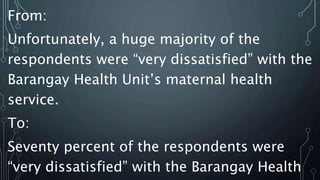
From:
Unfortunately, a huge majority of the
respondents were “very dissatisfied” with the
Barangay Health Unit’s maternal health
service.
To:
Seventy percent of the respondents were
“very dissatisfied” with the Barangay Health
•Being objective also includes removing
any hint of personal judgment in your
writing.
Example: The residents of Barangay X
hoarded basic goods just before the
super typhoon struck.
Objective: The residents of Barangay X
NONDISCRIMINATORY
WRITING
•This refers to writing
that treats all peoples all
equally and with respect.
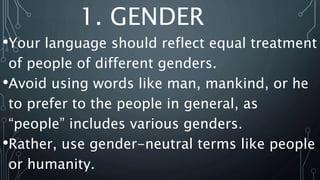
1. GENDER
•Your language should reflect equal treatment
of people of different genders.
•Avoid using words like man, mankind, or he
to prefer to the people in general, as
“people” includes various genders.
•Rather, use gender-neutral terms like people
or humanity.
•In addition, do not assume that the default
gender is MASCULINE.
Example:
A student must have his parents sign the waiver.
Revised:
-Students must have their parents sign the waiver
OR
-Parents must sign the student’s/child’s waiver.
Take note:
•Be careful with the use of the affixes
–man, -woman, -ess
•Use gender-neutral equivalents
instead.
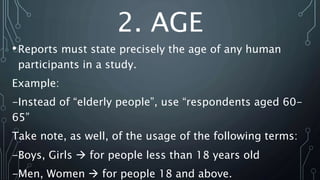
2. AGE
•Reports must state precisely the age of any human
participants in a study.
Example:
-Instead of “elderly people”, use “respondents aged 60-
65”
Take note, as well, of the usage of the following terms:
-Boys, Girls  for people less than 18 years old
-Men, Women  for people 18 and above.
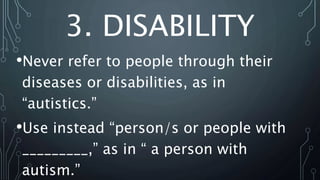
3. DISABILITY
•Never refer to people through their
diseases or disabilities, as in
“autistics.”
•Use instead “person/s or people with
_________,” as in “ a person with
autism.”
PARTS OF A
REPORT
1.Prefatory elements- are report
sections found before the actual
report.
Title page
Abstract or Executive Summary
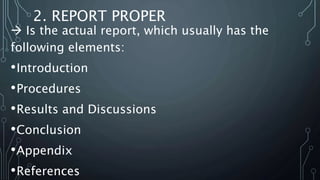
2. REPORT PROPER
 Is the actual report, which usually has the
following elements:
•Introduction
•Procedures
•Results and Discussions
•Conclusion
•Appendix
•References
I. INTRODUCTION
•The purpose of the introduction in
general is to present the objectives of
the report.
•The introduction that the readers need
to see may vary depending on whether
the report is a school or professional
The students are expected to:
-demonstrate thinking skills.
What should be written in the
introduction of an academic report?
-A brief discussion of relevant theories
-The purpose of the study.
•In the professional world, however, readers
of your report may be from other
departments, whose backgrounds totally
differ from yours.
•In professional fields, the introduction gives
important background information needed
for a fuller appreciation of the problem
taken up and the results to be presented.
•Such information will include:
The reason for writing the report (for
example, business problems like low sales
of a particular product)
Authorization details (e.g. identification
of the officials who told you to write the
report)
Relevant definitions of terms.
II. PROCEDURES
•This section details the actions done, and
as applicable, the materials used or the
participants involved in order to fulfill the
purpose of the report.
•In academic reports, the procedures section
serves as an important means of evaluating
the validity of the study.
•In the professional world, the procedure are
important as well.
•The procedures should contain enough
details so as “to allow your reader/s to judge”
the work you did and “to convince them that
your work was done competently.”
Take note:
The procedures section is usually written in
III. RESULTS AND
DISCUSSION
•This presents the findings that
resulted from the procedures
performed.
IV. CONCLUSION
•Depending on the report assigned, the
conclusion may contain any one or all of
the following:
A recap of key findings in the body.
A final answer to the main question
raised in the introduction.
PREFATORY ELEMENTS
1.Title Page
Formal reports usually require a
title page as some sort of cover to
“dress up” the report.
ELEMENTS OF A TITLE
PAGE
A. The report title- a phrase that captures the essence of the
report.
Example:
Report Purpose:
“This short report, prepared for 41 countries… presents the
major findings from the survey of key informants’ opinions on
health system responsiveness in their country.” (World Health
Organization, 2003, p.1)
Report Title: “Health system responsiveness survey results:
ELEMENTS OF A TITLE
PAGE
B. The name(s) of the person(s) who
conducted the experiment
Example: “A laboratory report submitted
by:”
C. Name of the person(s) to whom the
report is submitted
2. ABSTRACT
•This section summarizes your report by
reducing it to the most essential ideas, namely:
a.The purpose/ objective of the report
b.The procedures done
c.The results
d.The Conclusion

Lesson 3 Writing field and technical reports.pptx

  • 1.
  • 2.
    BASIC REPORT WRITING PRINCIPLES •WrittenReport- is a clear, objective, and orderly presentation of the details of a research investigation or an
  • 3.
    THE VALUE OF REPORTS •Writtenreports have different purposes in the academe and professional worlds. •In school, teachers use your reports as a gauge of your learning.
  • 4.
    THE VALUE OF REPORTS •Inthe professional world, reports serve as very important records of decisions or as bases for decisions to be made. •Knowing how to write a good report is an essential skill for academic and professional success.
  • 5.
    WRITING STYLE FOR REPORTS •Regardlessof type, your report should be written in a language that is concise, clear, objective, and nondiscriminatory.
  • 6.
    CONCISE WRITING •It meansefficient writing. •Your text should state an idea with the least number of words without affecting meaning.
  • 7.
    From: All the participantsin the study were male who were 30 years old. They were all residents of Brgy. 003, Ermita, Manila. They were interviewed. To: The interviewees were 30-year-old male residents of Brgy. 003, Ermita, Manila.
  • 8.
    CLEAR WRITING •It meanswriting that transmits to the reader the exact idea that you have in mind. •Ideas are clear if they are expressed in CONCRETE terms.
  • 9.
    From: Many of theparticipants reported being “very satisfied” with the Barangay Health Unit’s service. To: Fifty-five percent (55 out of 100) of the participants reported being “very
  • 10.
    OBJECTIVE WRITING •It meanswriting that is free of emotionally loaded or biased words, so that the report appears neutral or factual.
  • 11.
    From: Unfortunately, a hugemajority of the respondents were “very dissatisfied” with the Barangay Health Unit’s maternal health service. To: Seventy percent of the respondents were “very dissatisfied” with the Barangay Health
  • 12.
    •Being objective alsoincludes removing any hint of personal judgment in your writing. Example: The residents of Barangay X hoarded basic goods just before the super typhoon struck. Objective: The residents of Barangay X
  • 13.
    NONDISCRIMINATORY WRITING •This refers towriting that treats all peoples all equally and with respect.
  • 14.
    1. GENDER •Your languageshould reflect equal treatment of people of different genders. •Avoid using words like man, mankind, or he to prefer to the people in general, as “people” includes various genders. •Rather, use gender-neutral terms like people or humanity.
  • 15.
    •In addition, donot assume that the default gender is MASCULINE. Example: A student must have his parents sign the waiver. Revised: -Students must have their parents sign the waiver OR -Parents must sign the student’s/child’s waiver.
  • 16.
    Take note: •Be carefulwith the use of the affixes –man, -woman, -ess •Use gender-neutral equivalents instead.
  • 17.
    2. AGE •Reports muststate precisely the age of any human participants in a study. Example: -Instead of “elderly people”, use “respondents aged 60- 65” Take note, as well, of the usage of the following terms: -Boys, Girls  for people less than 18 years old -Men, Women  for people 18 and above.
  • 18.
    3. DISABILITY •Never referto people through their diseases or disabilities, as in “autistics.” •Use instead “person/s or people with _________,” as in “ a person with autism.”
  • 19.
    PARTS OF A REPORT 1.Prefatoryelements- are report sections found before the actual report. Title page Abstract or Executive Summary
  • 20.
    2. REPORT PROPER Is the actual report, which usually has the following elements: •Introduction •Procedures •Results and Discussions •Conclusion •Appendix •References
  • 21.
    I. INTRODUCTION •The purposeof the introduction in general is to present the objectives of the report. •The introduction that the readers need to see may vary depending on whether the report is a school or professional
  • 22.
    The students areexpected to: -demonstrate thinking skills. What should be written in the introduction of an academic report? -A brief discussion of relevant theories -The purpose of the study.
  • 23.
    •In the professionalworld, however, readers of your report may be from other departments, whose backgrounds totally differ from yours. •In professional fields, the introduction gives important background information needed for a fuller appreciation of the problem taken up and the results to be presented.
  • 24.
    •Such information willinclude: The reason for writing the report (for example, business problems like low sales of a particular product) Authorization details (e.g. identification of the officials who told you to write the report) Relevant definitions of terms.
  • 25.
    II. PROCEDURES •This sectiondetails the actions done, and as applicable, the materials used or the participants involved in order to fulfill the purpose of the report. •In academic reports, the procedures section serves as an important means of evaluating the validity of the study.
  • 26.
    •In the professionalworld, the procedure are important as well. •The procedures should contain enough details so as “to allow your reader/s to judge” the work you did and “to convince them that your work was done competently.” Take note: The procedures section is usually written in
  • 27.
    III. RESULTS AND DISCUSSION •Thispresents the findings that resulted from the procedures performed.
  • 28.
    IV. CONCLUSION •Depending onthe report assigned, the conclusion may contain any one or all of the following: A recap of key findings in the body. A final answer to the main question raised in the introduction.
  • 29.
    PREFATORY ELEMENTS 1.Title Page Formalreports usually require a title page as some sort of cover to “dress up” the report.
  • 30.
    ELEMENTS OF ATITLE PAGE A. The report title- a phrase that captures the essence of the report. Example: Report Purpose: “This short report, prepared for 41 countries… presents the major findings from the survey of key informants’ opinions on health system responsiveness in their country.” (World Health Organization, 2003, p.1) Report Title: “Health system responsiveness survey results:
  • 31.
    ELEMENTS OF ATITLE PAGE B. The name(s) of the person(s) who conducted the experiment Example: “A laboratory report submitted by:” C. Name of the person(s) to whom the report is submitted
  • 32.
    2. ABSTRACT •This sectionsummarizes your report by reducing it to the most essential ideas, namely: a.The purpose/ objective of the report b.The procedures done c.The results d.The Conclusion