Bus. Math
Markup and
Markdown
Lesson 3.2
Markup & Markdwon
The primary purpose of operating a
busienss is to generate profits. Some
businesses manufacture products and sell
them. Other businesses buy products from
someone else and then, sell these
products. Both types of businesses must
sell their products for more than it costs to
produce or purchase to earn some profit.
This is called markup, margin, or gross
profit.
Markup & Markdown
Markup is the amount of money
that businesses add to the cost they
manufactured or to an item they
purchased, so that when they sell
them, they can cover their initial
expenses and make a profit.
What is Selling
Price?
The selling price is the price at which the
item is actually sold. This is computed as
the cost for the business to manufacture or
purchase the item plus the markup. Thus,
Selling Price = Cost + Markup
Markup & Markdown
• For some businesses, cost may be the more logical base
for calculating markup. However, calculating markup
based on selling price is an advantageous method for
many retail stores.
• To compute the selling price based on cost, we must know
the rate of markup. We then multiply the rate of markup
and add the resulting product to teh cost.
Markup & Markdown
Steps to Compute Selling Price with Markup Based on Cost
1.Multiply the rate of markup to the cost to get the markup.
Markup = Rate of Markup x Cost
2. Add the markup to the cost to get the selling price.
Selling Price = Cost + Markup
on COST
Markup based
M
a
r
k
u
p
Using Money
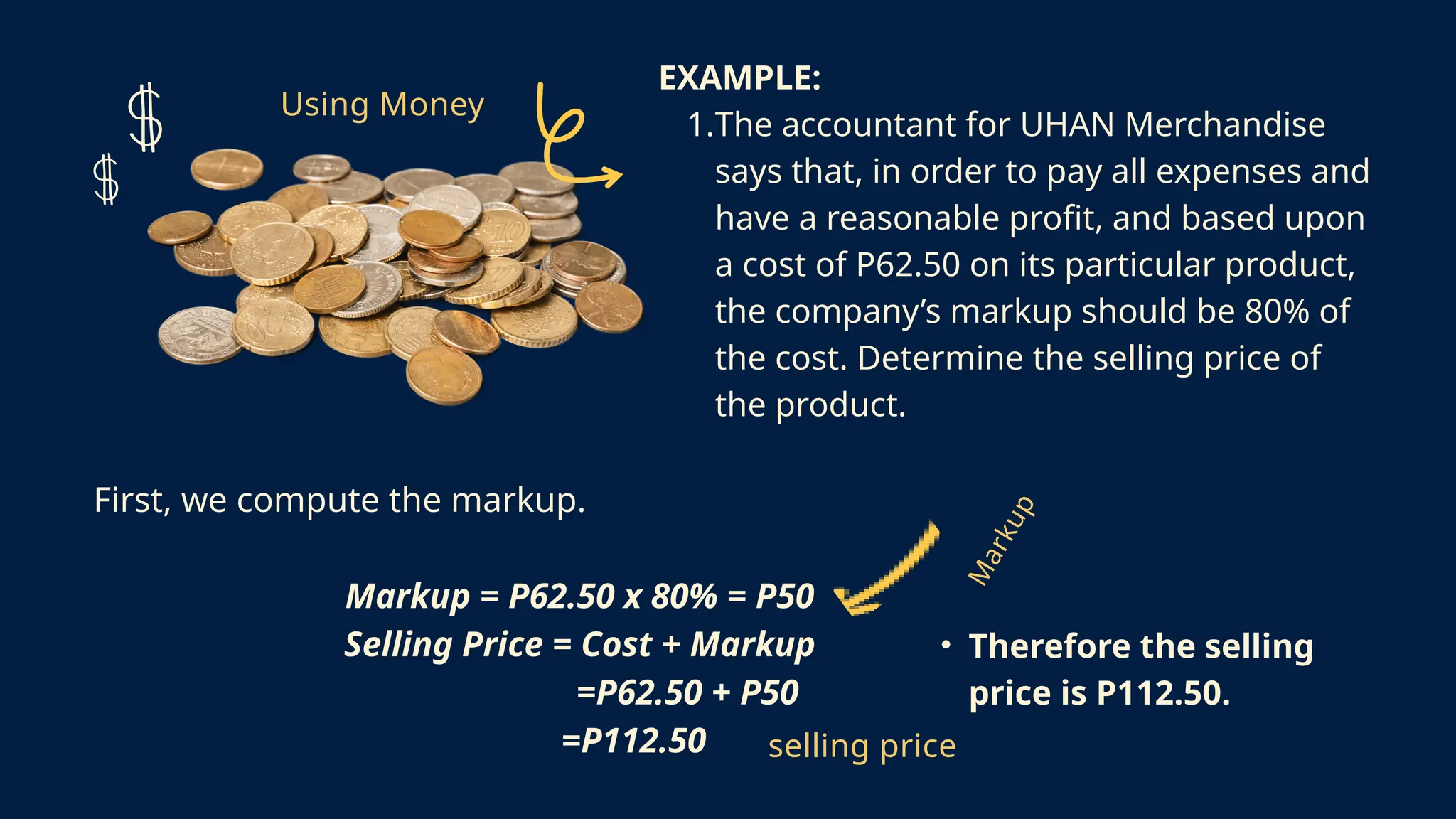
EXAMPLE:
1.The accountant for UHAN Merchandise
says that, in order to pay all expenses and
have a reasonable profit, and based upon
a cost of P62.50 on its particular product,
the company’s markup should be 80% of
the cost. Determine the selling price of
the product.
First, we compute the markup.
Markup = P62.50 x 80% = P50
Selling Price = Cost + Markup
=P62.50 + P50
=P112.50 selling price
• Therefore the selling
price is P112.50.
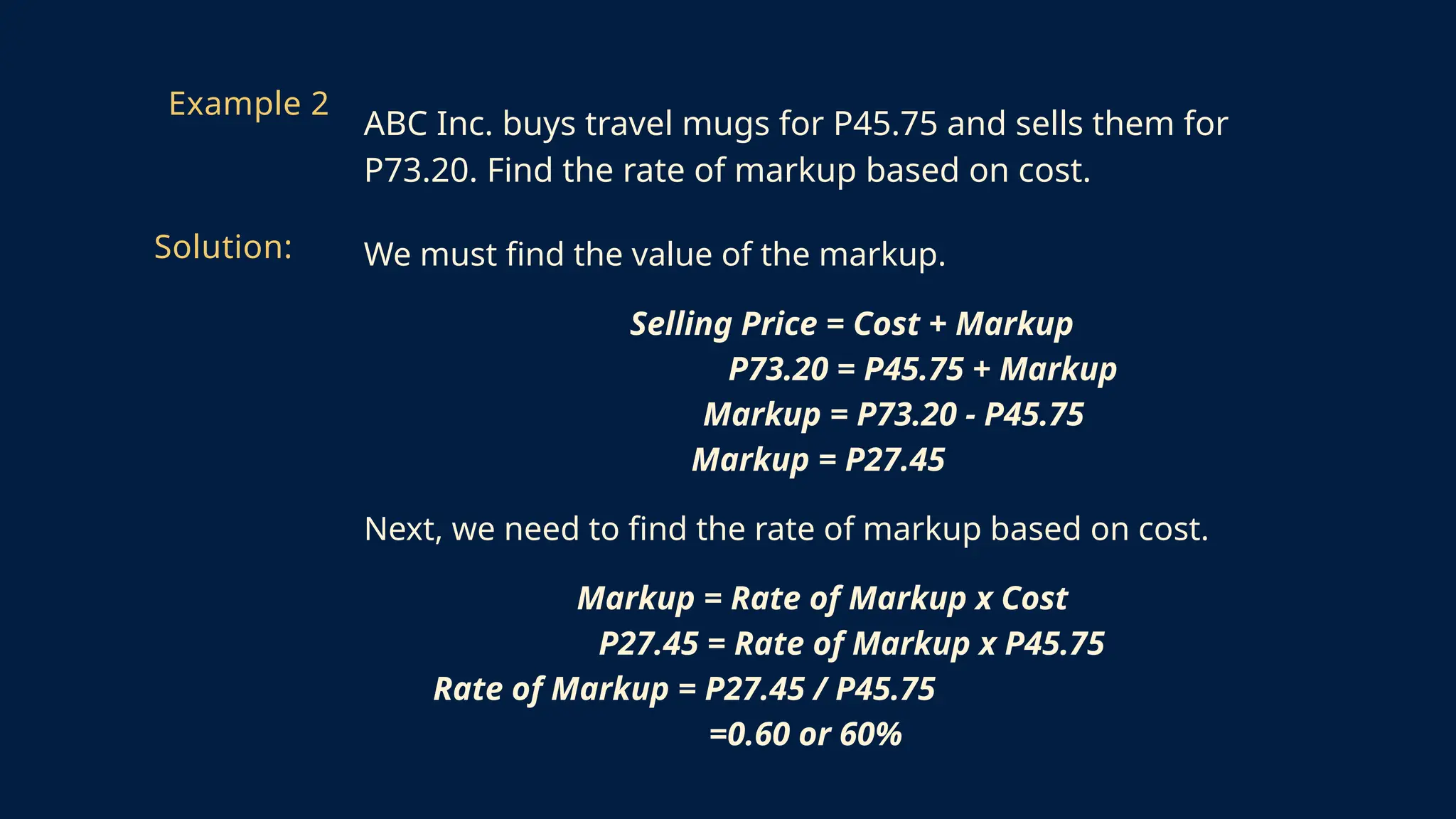
We must find the value of the markup.
Selling Price = Cost + Markup
P73.20 = P45.75 + Markup
Markup = P73.20 - P45.75
Markup = P27.45
Next, we need to find the rate of markup based on cost.
Markup = Rate of Markup x Cost
P27.45 = Rate of Markup x P45.75
Rate of Markup = P27.45 / P45.75
=0.60 or 60%
Example 2
ABC Inc. buys travel mugs for P45.75 and sells them for
P73.20. Find the rate of markup based on cost.
Solution:
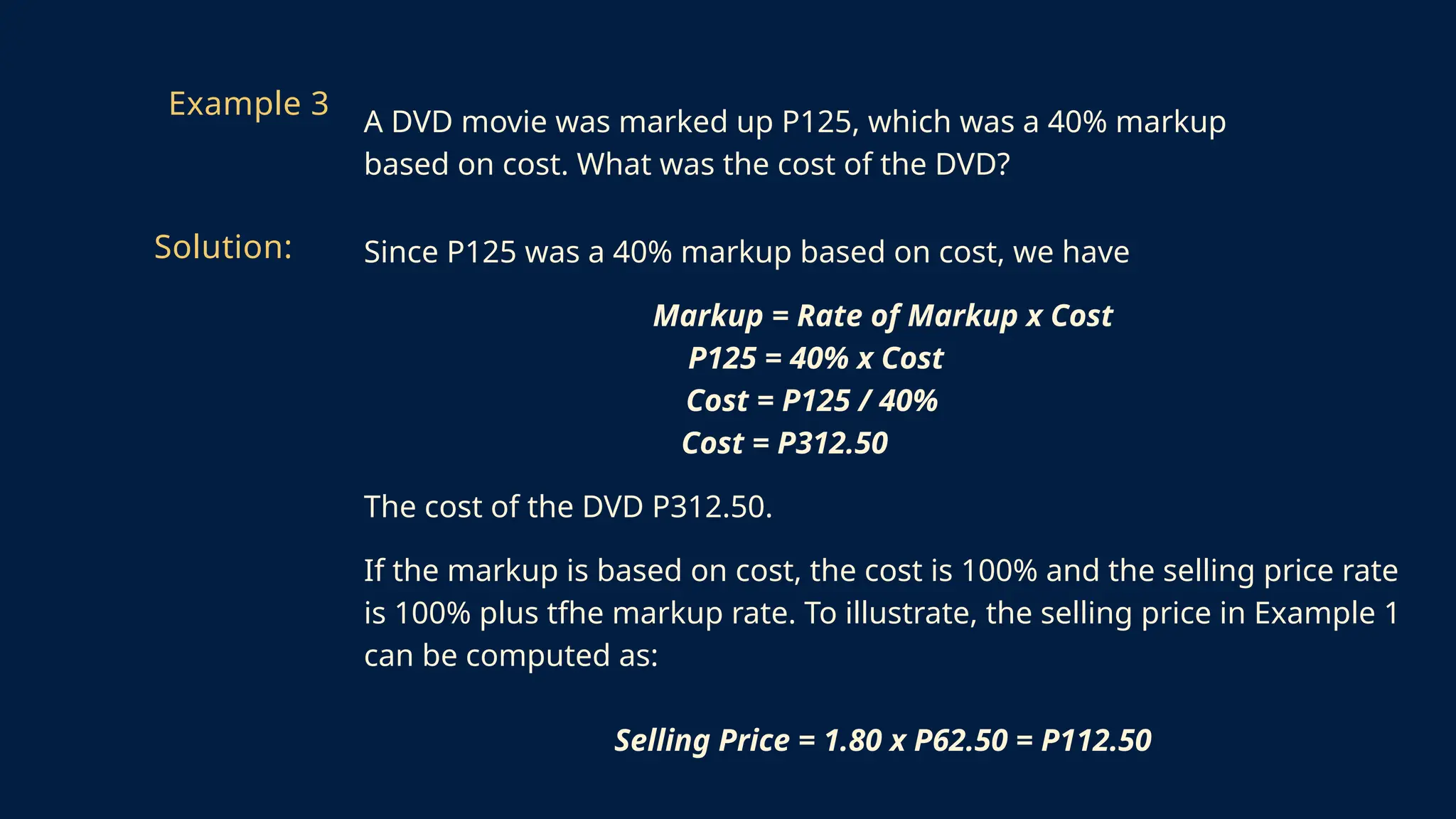
Since P125 was a 40% markup based on cost, we have
Markup = Rate of Markup x Cost
P125 = 40% x Cost
Cost = P125 / 40%
Cost = P312.50
The cost of the DVD P312.50.
If the markup is based on cost, the cost is 100% and the selling price rate
is 100% plus tfhe markup rate. To illustrate, the selling price in Example 1
can be computed as:
Selling Price = 1.80 x P62.50 = P112.50
Example 3
A DVD movie was marked up P125, which was a 40% markup
based on cost. What was the cost of the DVD?
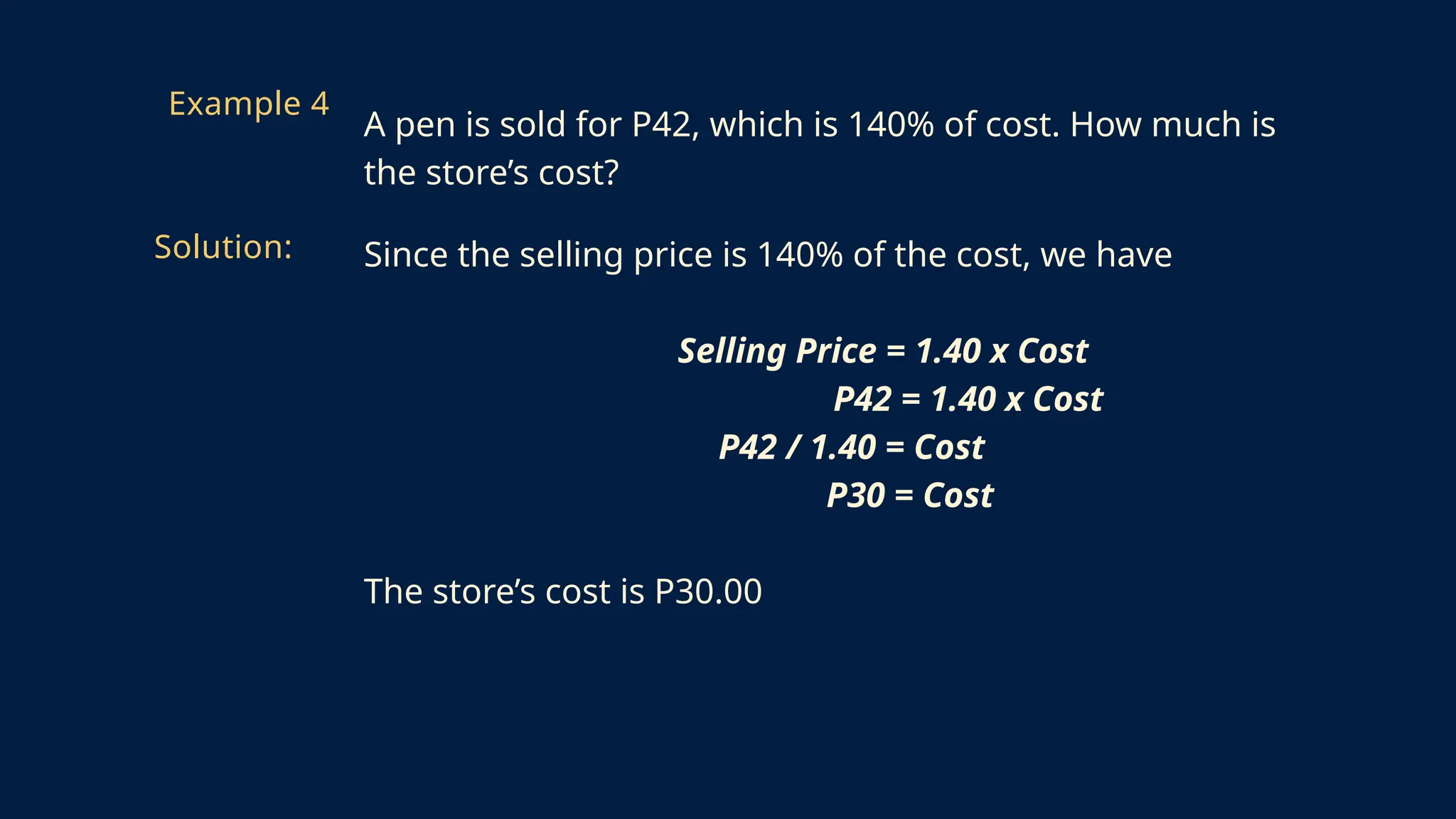
Solution:
Since the selling price is 140% of the cost, we have
Selling Price = 1.40 x Cost
P42 = 1.40 x Cost
P42 / 1.40 = Cost
P30 = Cost
The store’s cost is P30.00
Example 4
A pen is sold for P42, which is 140% of cost. How much is
the store’s cost?
Solution:
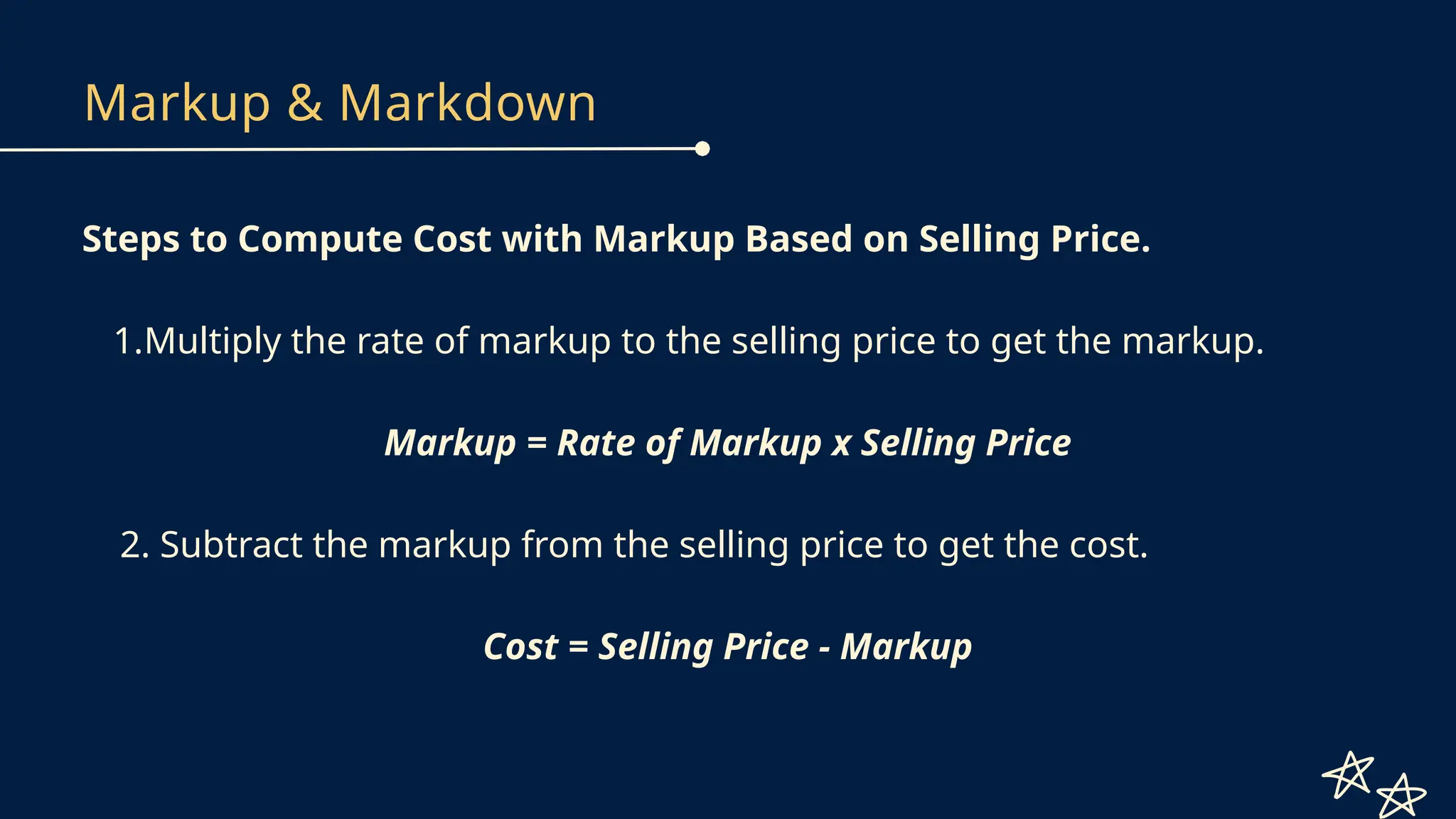
Markup & Markdown
Steps to Compute Cost with Markup Based on Selling Price.
1.Multiply the rate of markup to the selling price to get the markup.
Markup = Rate of Markup x Selling Price
2. Subtract the markup from the selling price to get the cost.
Cost = Selling Price - Markup
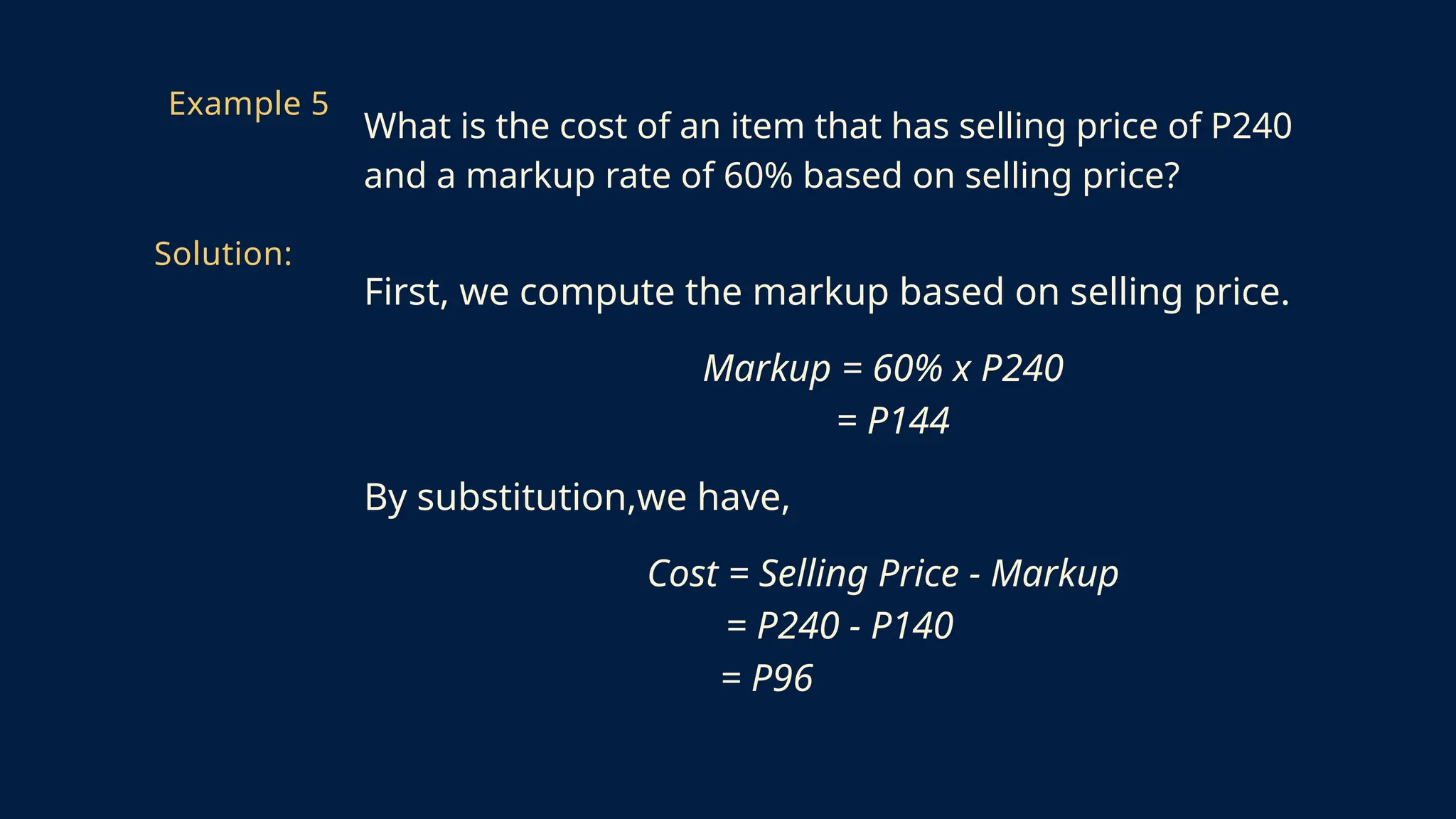
First, we compute the markup based on selling price.
Markup = 60% x P240
= P144
By substitution,we have,
Cost = Selling Price - Markup
= P240 - P140
= P96
Example 5
What is the cost of an item that has selling price of P240
and a markup rate of 60% based on selling price?
Solution:
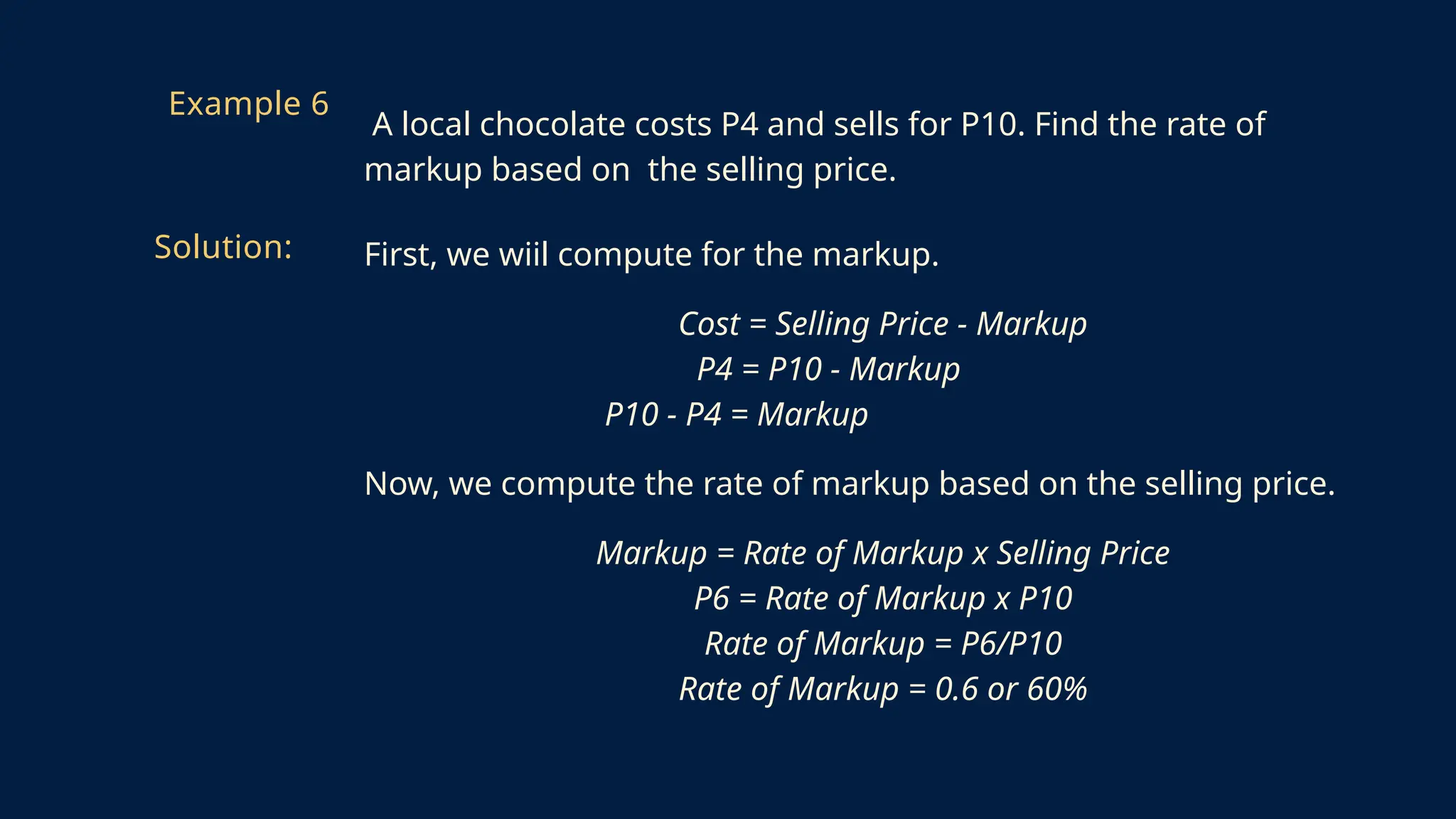
First, we wiil compute for the markup.
Cost = Selling Price - Markup
P4 = P10 - Markup
P10 - P4 = Markup
Now, we compute the rate of markup based on the selling price.
Markup = Rate of Markup x Selling Price
P6 = Rate of Markup x P10
Rate of Markup = P6/P10
Rate of Markup = 0.6 or 60%
Example 6
A local chocolate costs P4 and sells for P10. Find the rate of
markup based on the selling price.
Solution:
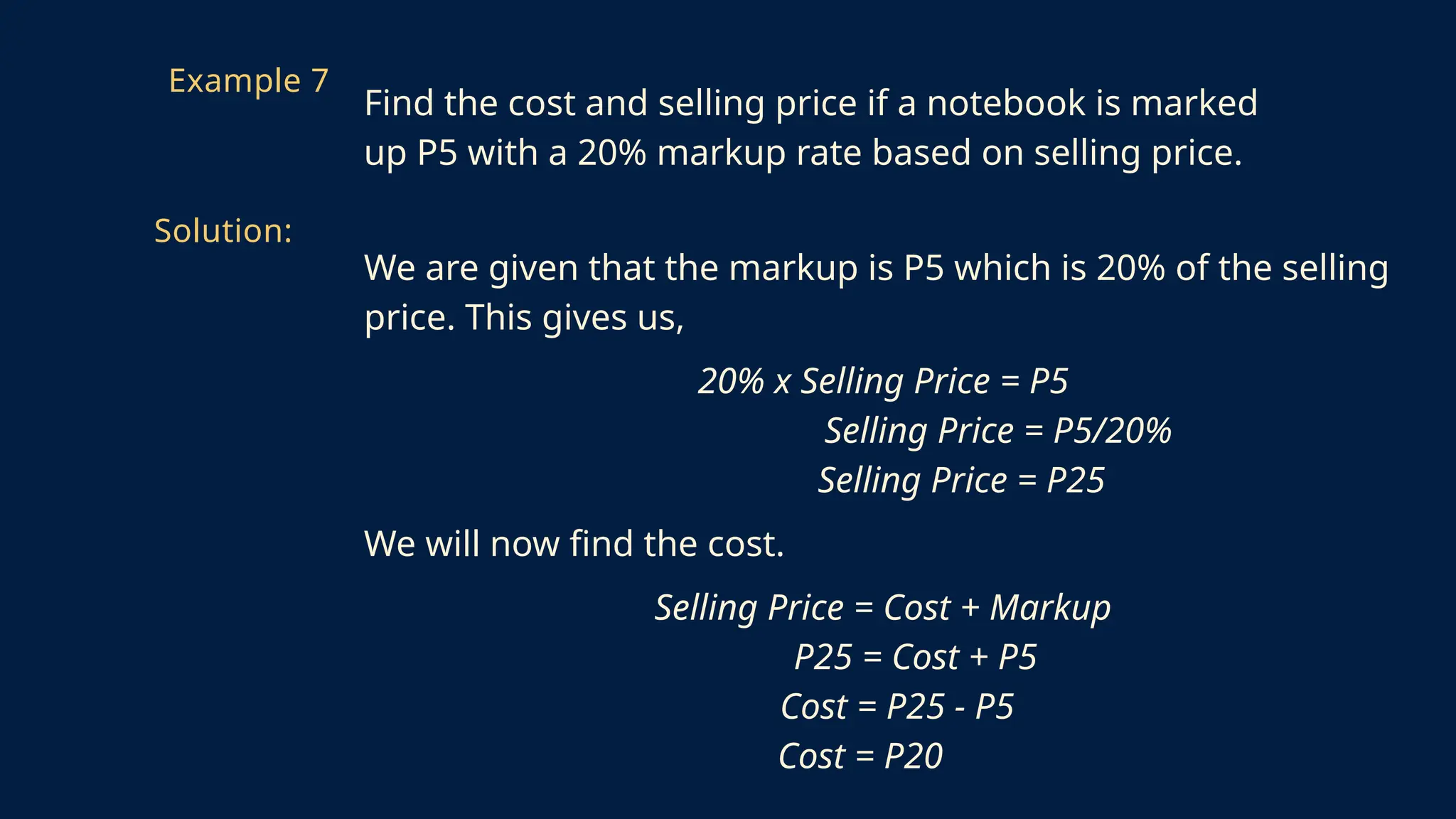
We are given that the markup is P5 which is 20% of the selling
price. This gives us,
20% x Selling Price = P5
Selling Price = P5/20%
Selling Price = P25
We will now find the cost.
Selling Price = Cost + Markup
P25 = Cost + P5
Cost = P25 - P5
Cost = P20
Example 7
Find the cost and selling price if a notebook is marked
up P5 with a 20% markup rate based on selling price.
Solution:
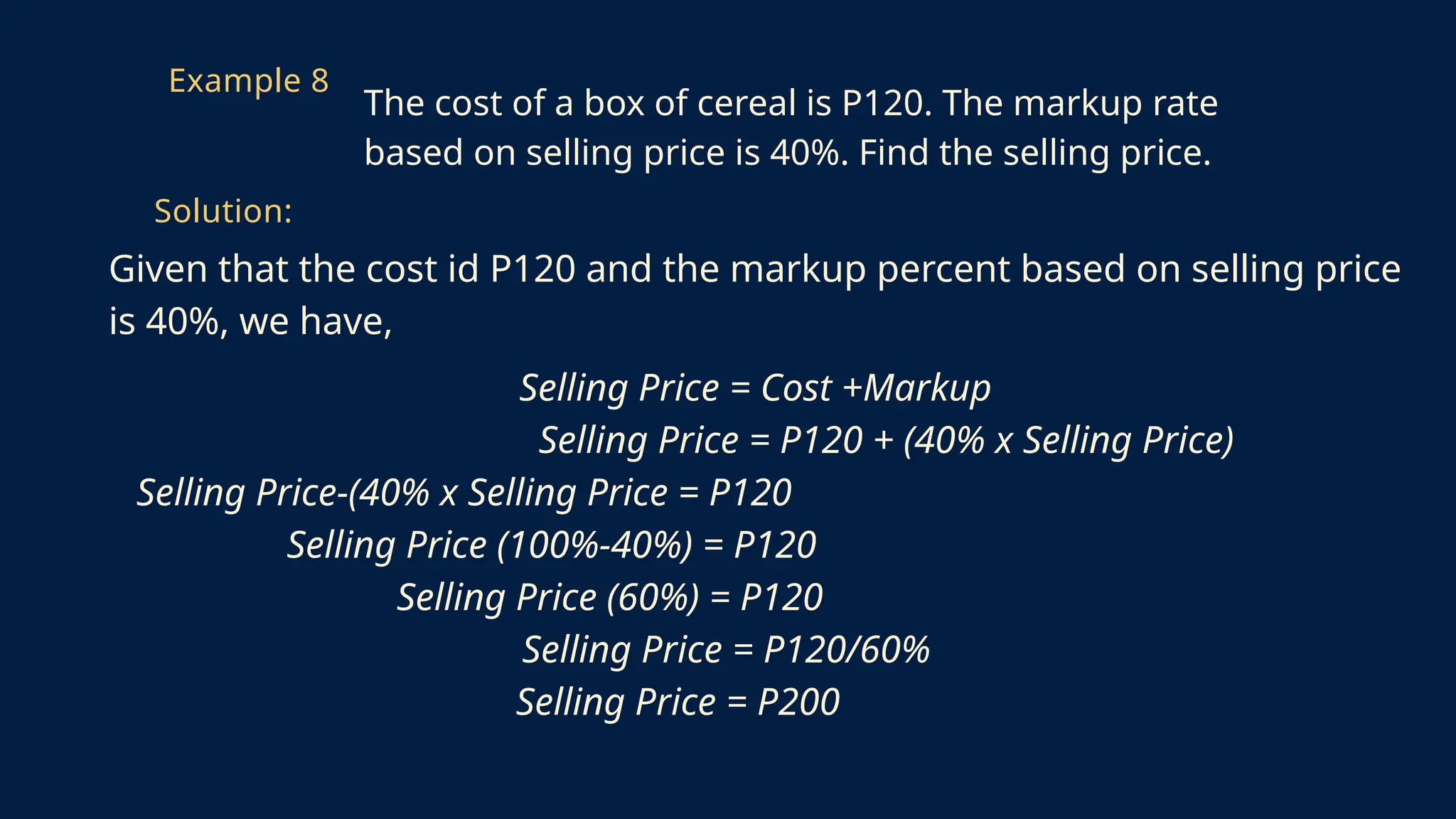
Given that the cost id P120 and the markup percent based on selling price
is 40%, we have,
Selling Price = Cost +Markup
Selling Price = P120 + (40% x Selling Price)
Selling Price-(40% x Selling Price = P120
Selling Price (100%-40%) = P120
Selling Price (60%) = P120
Selling Price = P120/60%
Selling Price = P200
Example 8
The cost of a box of cereal is P120. The markup rate
based on selling price is 40%. Find the selling price.
Solution:
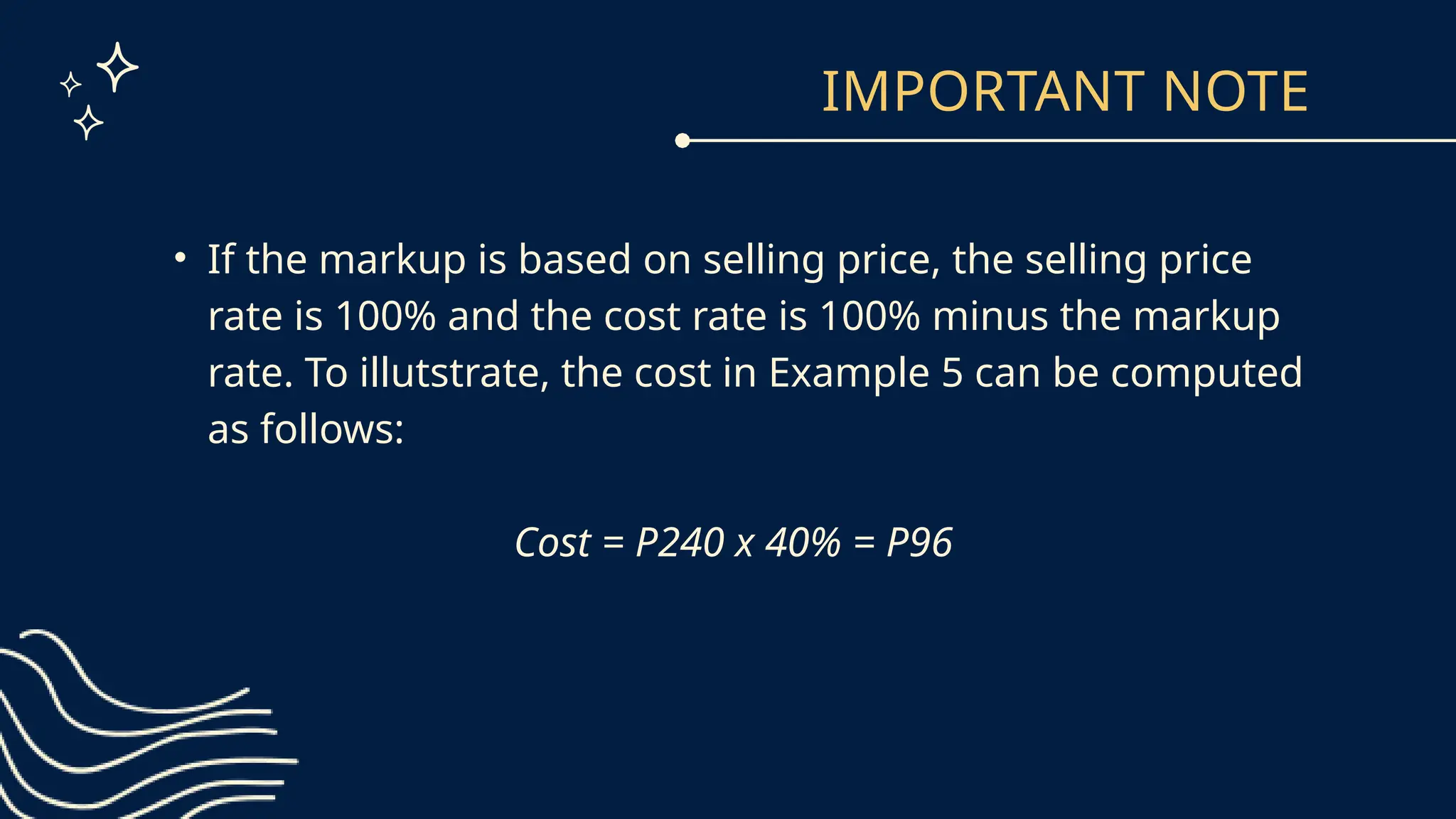
IMPORTANT NOTE
• If the markup is based on selling price, the selling price
rate is 100% and the cost rate is 100% minus the markup
rate. To illutstrate, the cost in Example 5 can be computed
as follows:
Cost = P240 x 40% = P96
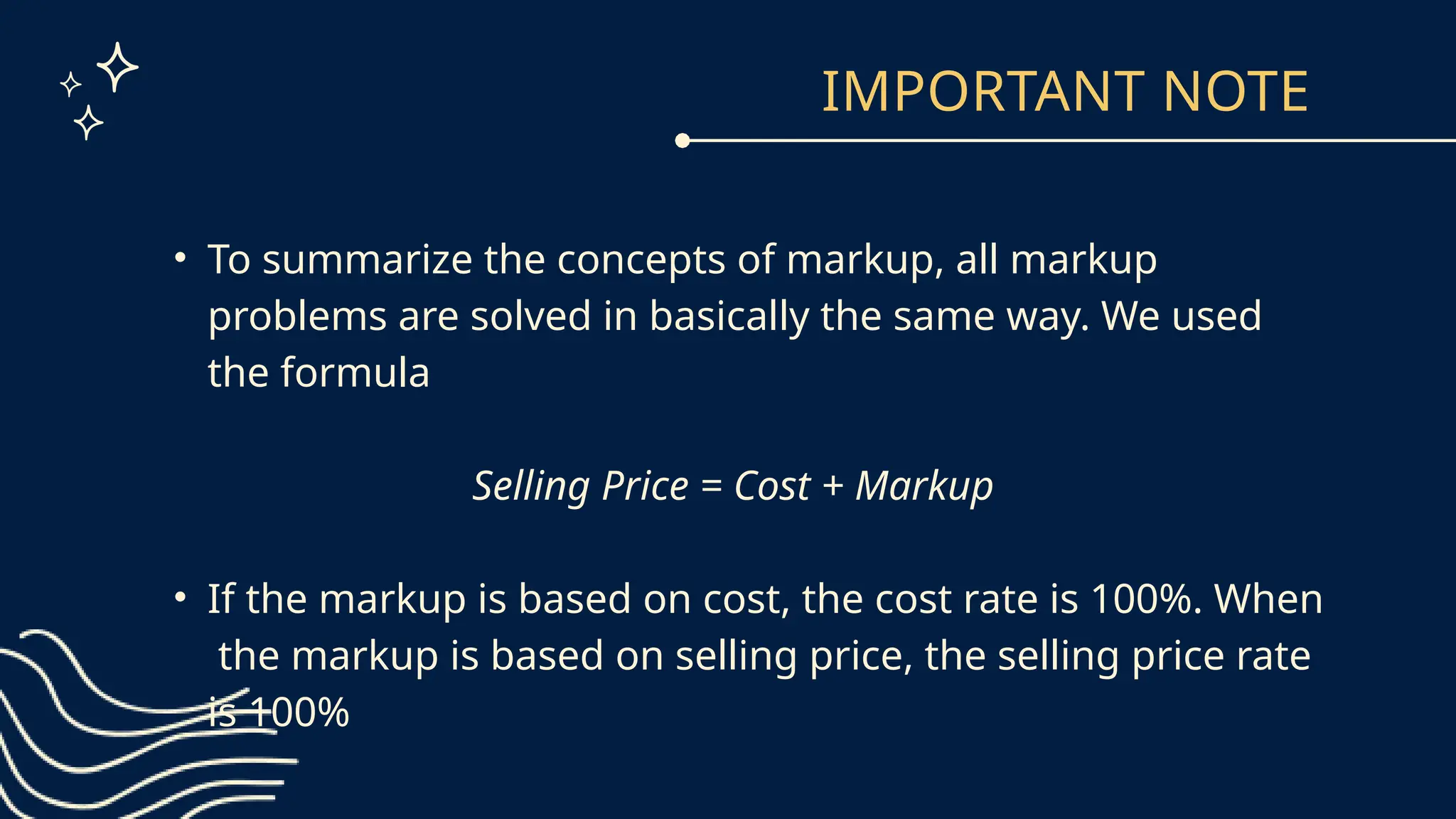
IMPORTANT NOTE
• To summarize the concepts of markup, all markup
problems are solved in basically the same way. We used
the formula
Selling Price = Cost + Markup
• If the markup is based on cost, the cost rate is 100%. When
the markup is based on selling price, the selling price rate
is 100%
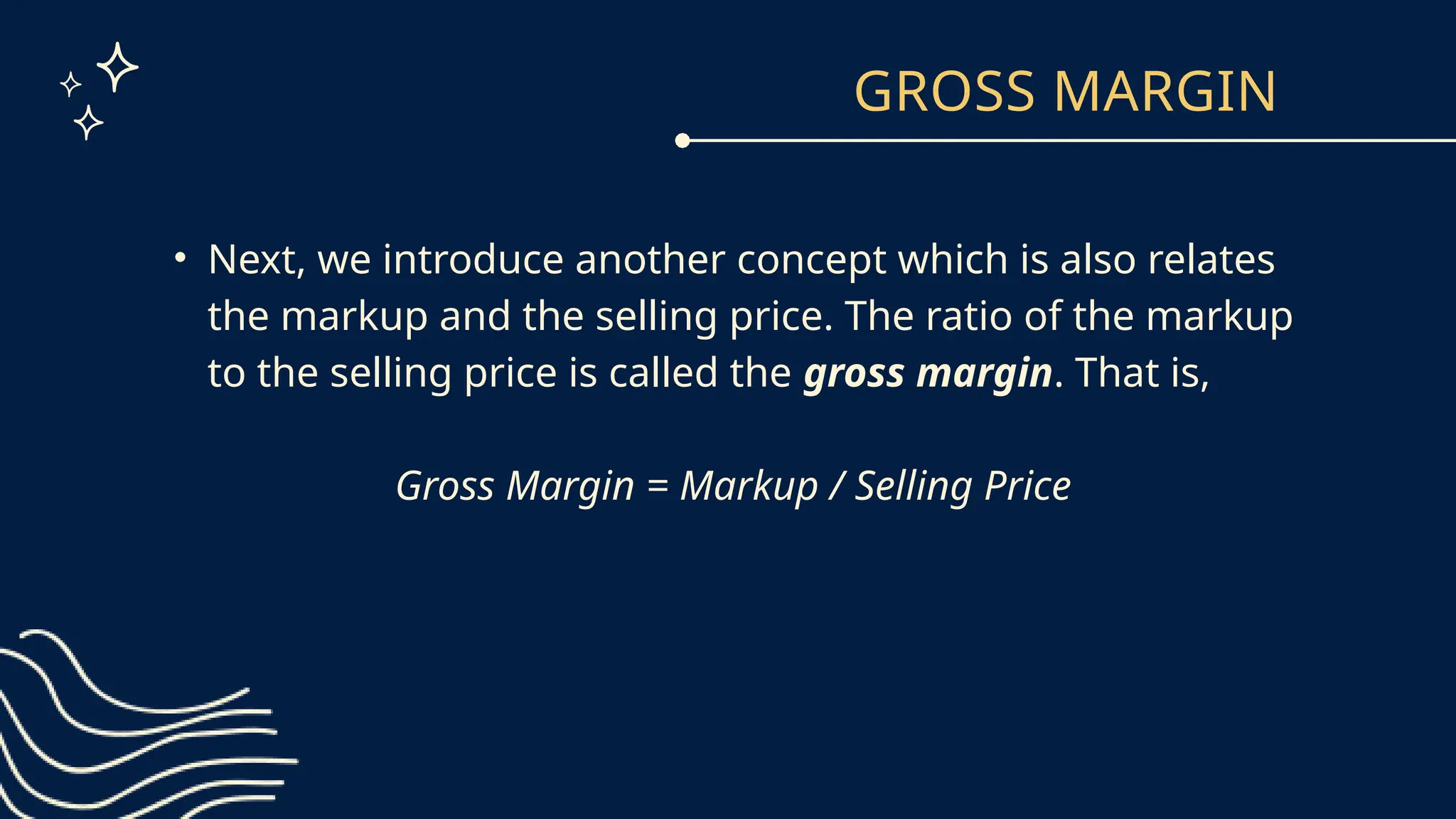
GROSS MARGIN
• Next, we introduce another concept which is also relates
the markup and the selling price. The ratio of the markup
to the selling price is called the gross margin. That is,
Gross Margin = Markup / Selling Price
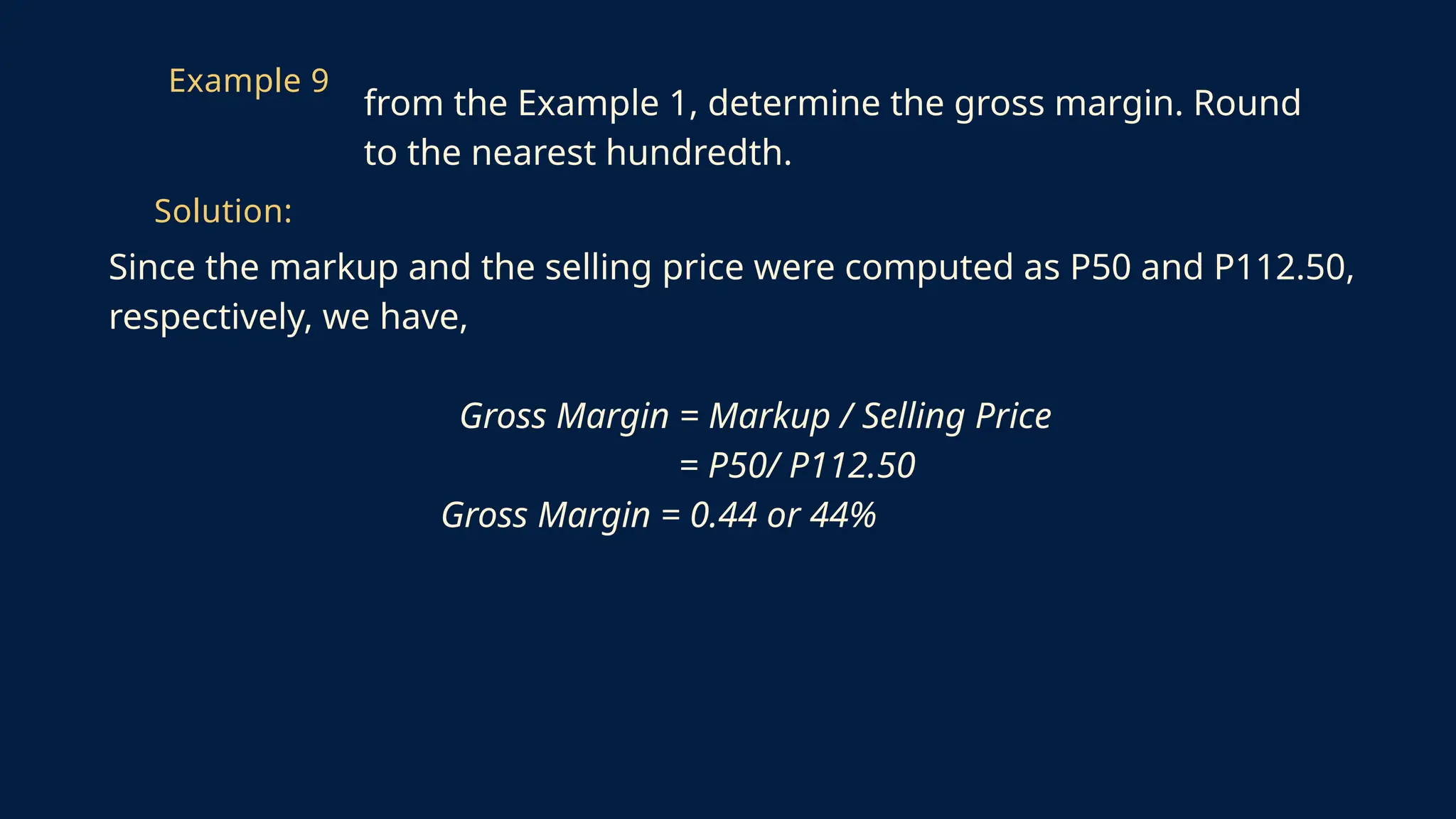
Since the markup and the selling price were computed as P50 and P112.50,
respectively, we have,
Gross Margin = Markup / Selling Price
= P50/ P112.50
Gross Margin = 0.44 or 44%
Example 9
from the Example 1, determine the gross margin. Round
to the nearest hundredth.
Solution:
Sale Price
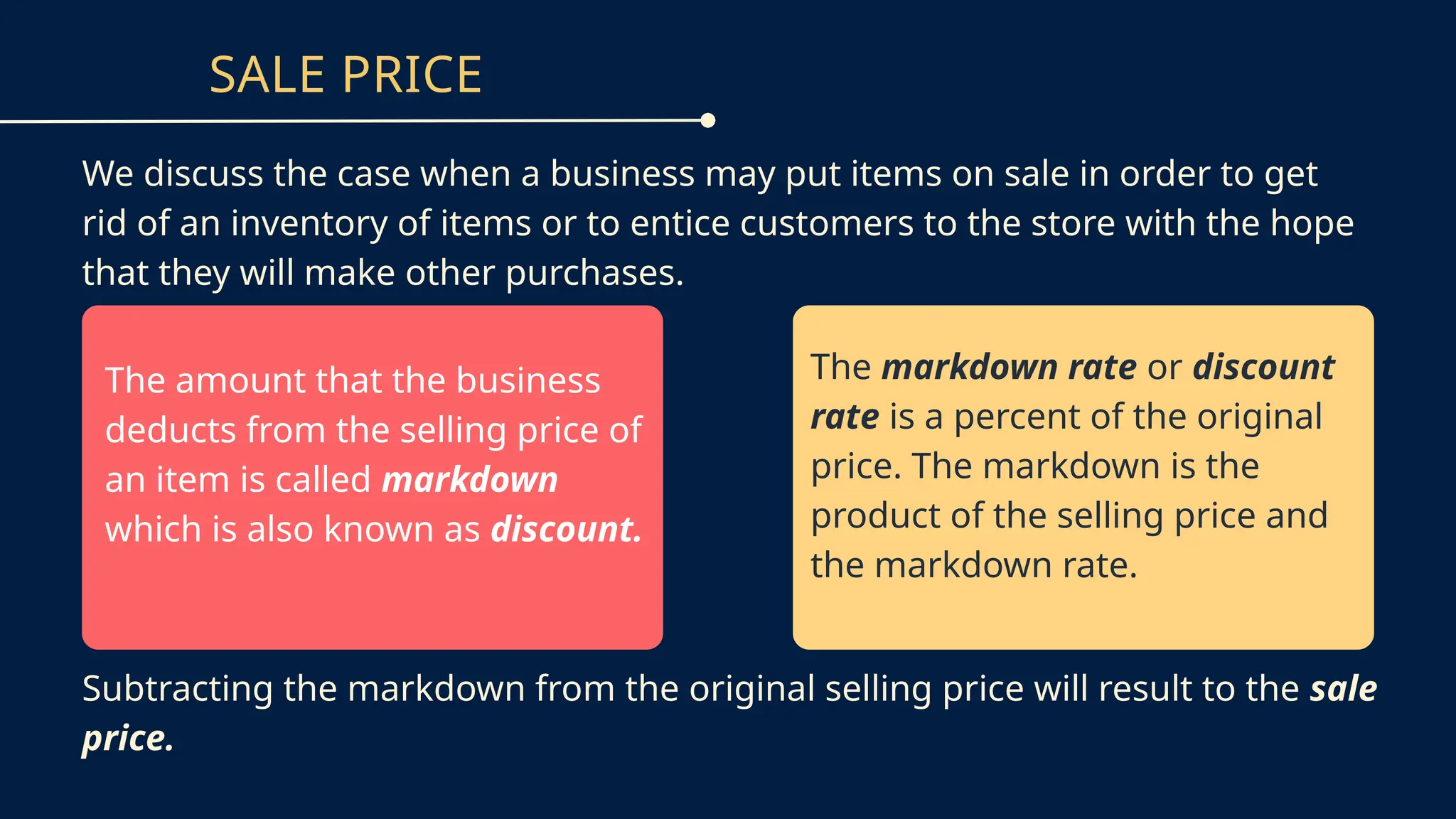
SALE PRICE
We discuss the case when a business may put items on sale in order to get
rid of an inventory of items or to entice customers to the store with the hope
that they will make other purchases.
The amount that the business
deducts from the selling price of
an item is called markdown
which is also known as discount.
The markdown rate or discount
rate is a percent of the original
price. The markdown is the
product of the selling price and
the markdown rate.
Subtracting the markdown from the original selling price will result to the sale
price.
Steps to
Compute Sale
Price
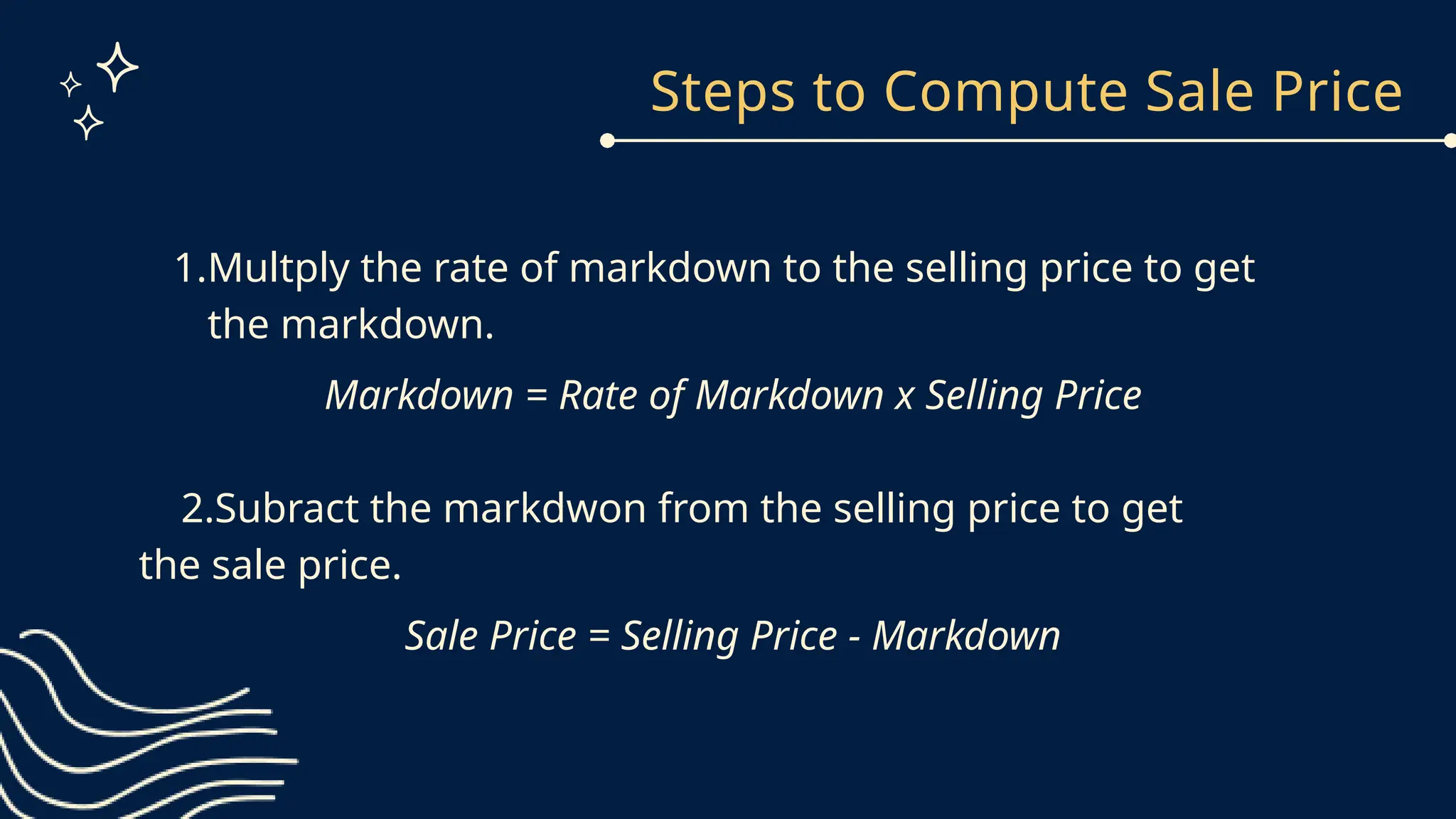
Steps to Compute Sale Price
1.Multply the rate of markdown to the selling price to get
the markdown.
Markdown = Rate of Markdown x Selling Price
2.Subract the markdwon from the selling price to get
the sale price.
Sale Price = Selling Price - Markdown
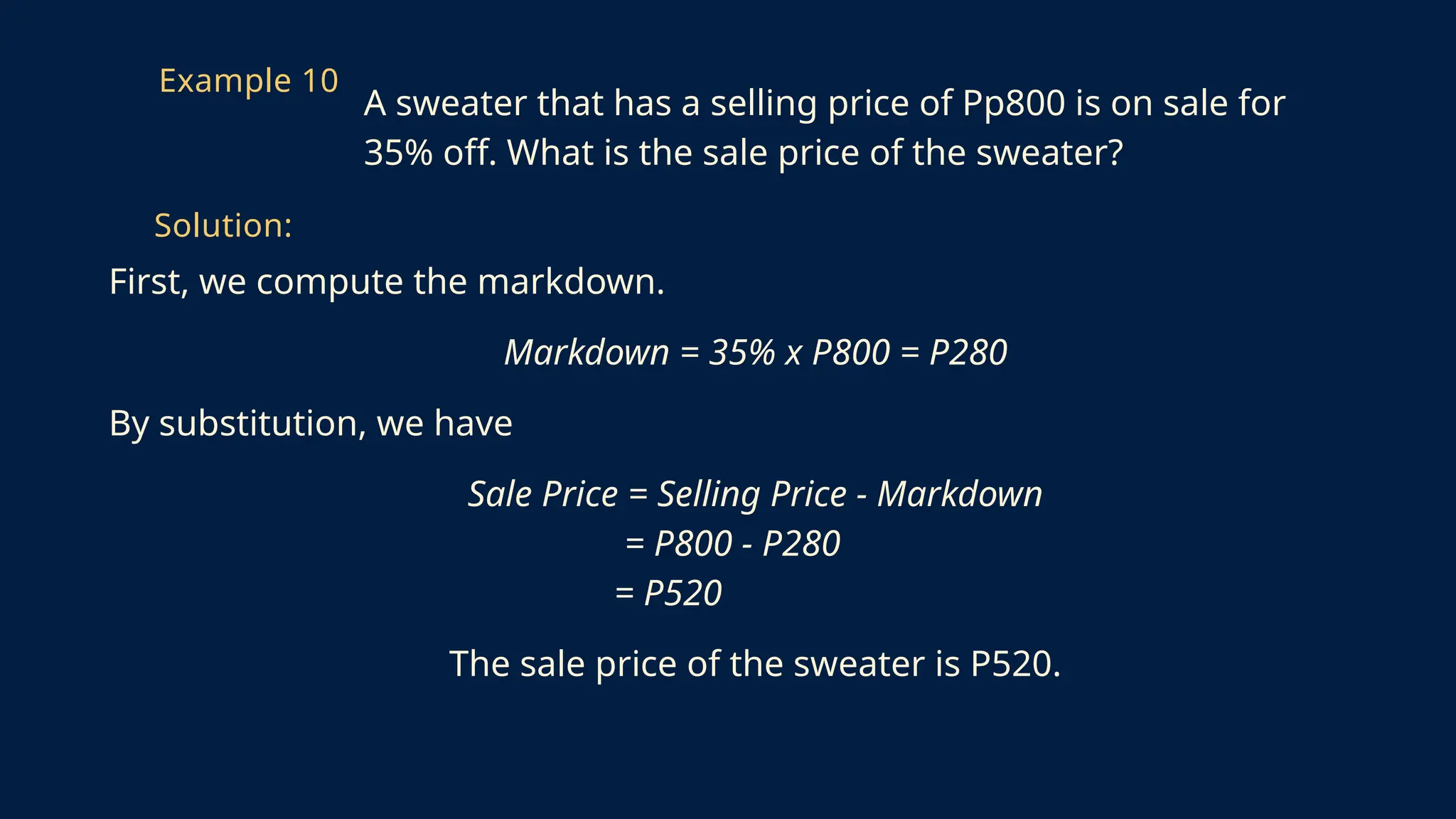
First, we compute the markdown.
Markdown = 35% x P800 = P280
By substitution, we have
Sale Price = Selling Price - Markdown
= P800 - P280
= P520
The sale price of the sweater is P520.
Example 10
A sweater that has a selling price of Pp800 is on sale for
35% off. What is the sale price of the sweater?
Solution:
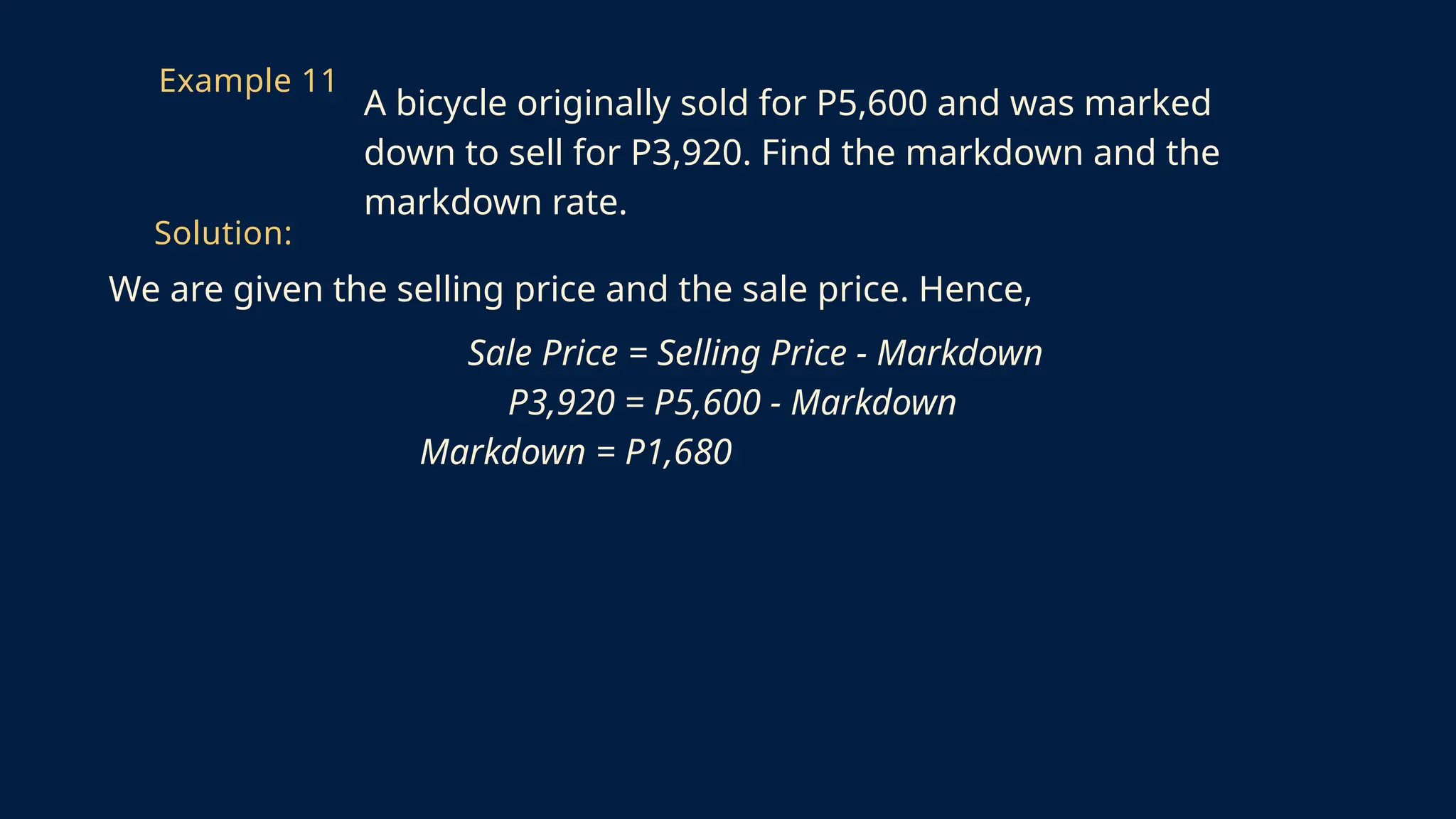
We are given the selling price and the sale price. Hence,
Sale Price = Selling Price - Markdown
P3,920 = P5,600 - Markdown
Markdown = P1,680
Example 11
A bicycle originally sold for P5,600 and was marked
down to sell for P3,920. Find the markdown and the
markdown rate.
Solution:
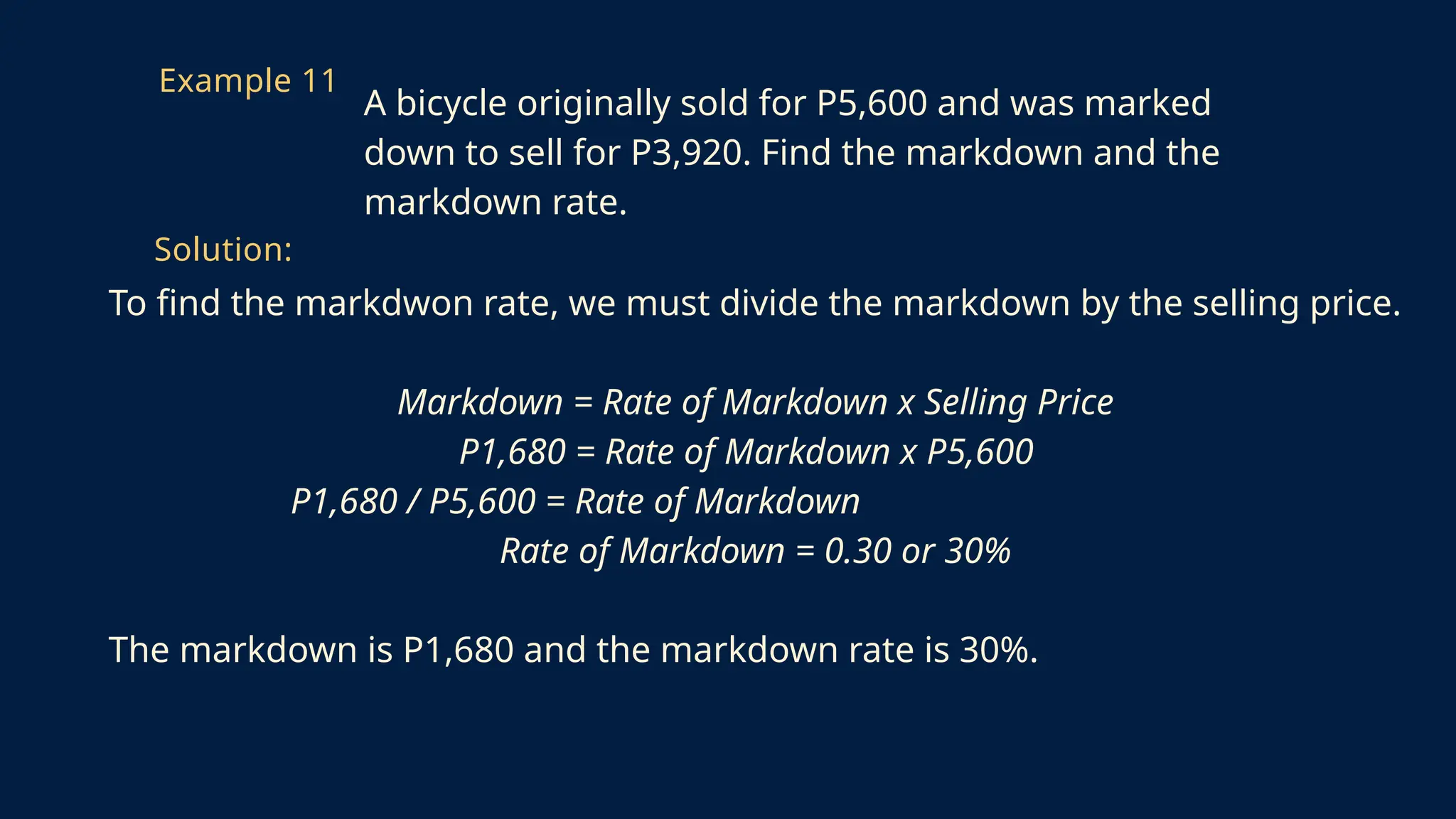
To find the markdwon rate, we must divide the markdown by the selling price.
Markdown = Rate of Markdown x Selling Price
P1,680 = Rate of Markdown x P5,600
P1,680 / P5,600 = Rate of Markdown
Rate of Markdown = 0.30 or 30%
The markdown is P1,680 and the markdown rate is 30%.
Example 11
A bicycle originally sold for P5,600 and was marked
down to sell for P3,920. Find the markdown and the
markdown rate.
Solution:
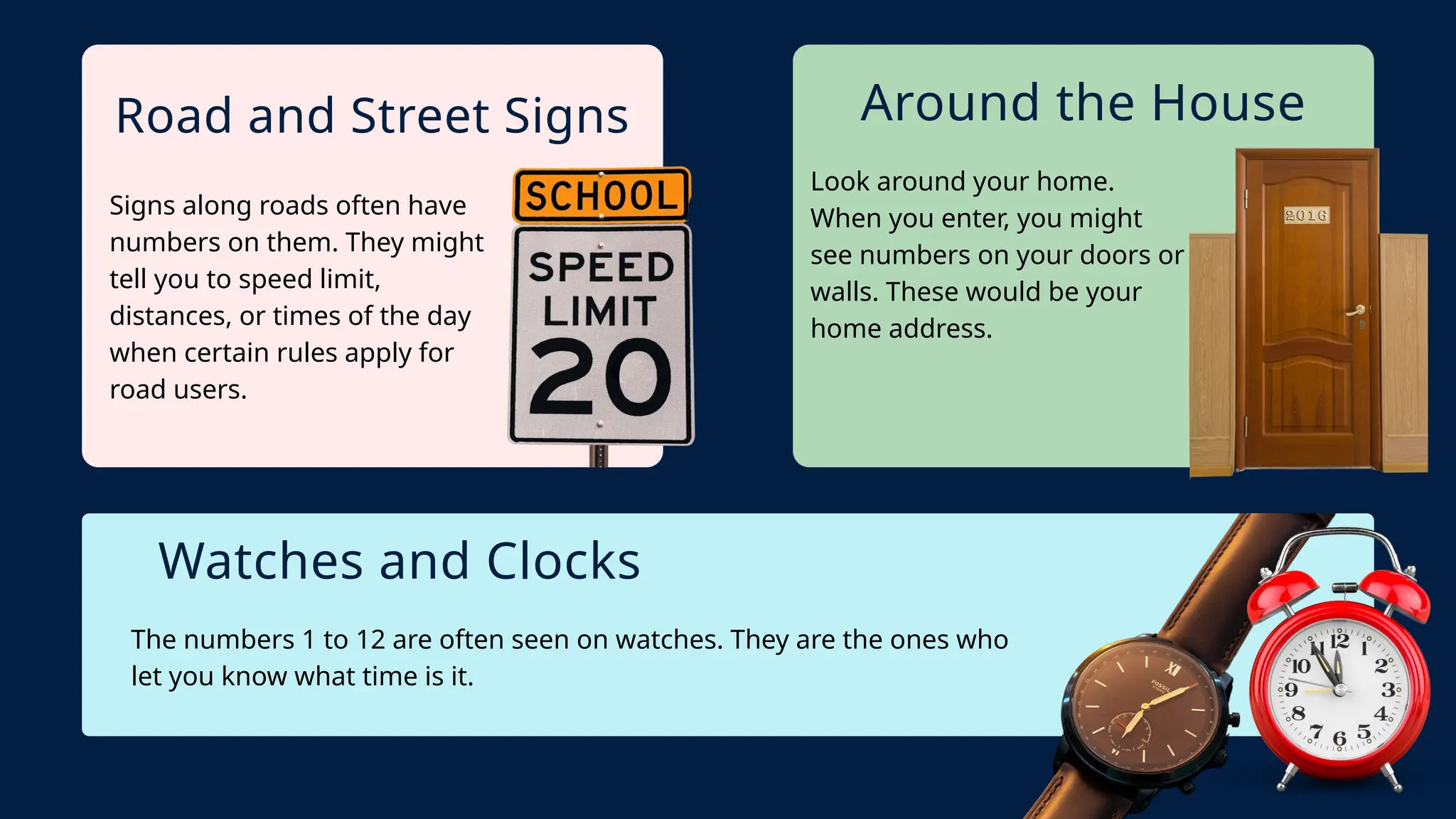
Road and Street Signs Around the House
Signs along roads often have
numbers on them. They might
tell you to speed limit,
distances, or times of the day
when certain rules apply for
road users.
Look around your home.
When you enter, you might
see numbers on your doors or
walls. These would be your
home address.
Watches and Clocks
The numbers 1 to 12 are often seen on watches. They are the ones who
let you know what time is it.
Importance of Math
Math is important because it helps us solve
problems, like counting, measuring, and sharing
things equally. We use math every day, from
figuring out how much something costs to
playing games. It makes our brains stronger and
helps us understand the world around us better.
Thank you for
LISTENING
Mr. Olive Wilson

Lesson-3.2- Markup-and-Markdwon (1).pptx

  • 1.
  • 2.
    Markup & Markdwon Theprimary purpose of operating a busienss is to generate profits. Some businesses manufacture products and sell them. Other businesses buy products from someone else and then, sell these products. Both types of businesses must sell their products for more than it costs to produce or purchase to earn some profit. This is called markup, margin, or gross profit.
  • 3.
    Markup & Markdown Markupis the amount of money that businesses add to the cost they manufactured or to an item they purchased, so that when they sell them, they can cover their initial expenses and make a profit.
  • 4.
    What is Selling Price? Theselling price is the price at which the item is actually sold. This is computed as the cost for the business to manufacture or purchase the item plus the markup. Thus, Selling Price = Cost + Markup
  • 5.
    Markup & Markdown •For some businesses, cost may be the more logical base for calculating markup. However, calculating markup based on selling price is an advantageous method for many retail stores. • To compute the selling price based on cost, we must know the rate of markup. We then multiply the rate of markup and add the resulting product to teh cost.
  • 6.
    Markup & Markdown Stepsto Compute Selling Price with Markup Based on Cost 1.Multiply the rate of markup to the cost to get the markup. Markup = Rate of Markup x Cost 2. Add the markup to the cost to get the selling price. Selling Price = Cost + Markup
  • 7.
  • 8.
    M a r k u p Using Money EXAMPLE: 1.The accountantfor UHAN Merchandise says that, in order to pay all expenses and have a reasonable profit, and based upon a cost of P62.50 on its particular product, the company’s markup should be 80% of the cost. Determine the selling price of the product. First, we compute the markup. Markup = P62.50 x 80% = P50 Selling Price = Cost + Markup =P62.50 + P50 =P112.50 selling price • Therefore the selling price is P112.50.
  • 9.
    We must findthe value of the markup. Selling Price = Cost + Markup P73.20 = P45.75 + Markup Markup = P73.20 - P45.75 Markup = P27.45 Next, we need to find the rate of markup based on cost. Markup = Rate of Markup x Cost P27.45 = Rate of Markup x P45.75 Rate of Markup = P27.45 / P45.75 =0.60 or 60% Example 2 ABC Inc. buys travel mugs for P45.75 and sells them for P73.20. Find the rate of markup based on cost. Solution:
  • 10.
    Since P125 wasa 40% markup based on cost, we have Markup = Rate of Markup x Cost P125 = 40% x Cost Cost = P125 / 40% Cost = P312.50 The cost of the DVD P312.50. If the markup is based on cost, the cost is 100% and the selling price rate is 100% plus tfhe markup rate. To illustrate, the selling price in Example 1 can be computed as: Selling Price = 1.80 x P62.50 = P112.50 Example 3 A DVD movie was marked up P125, which was a 40% markup based on cost. What was the cost of the DVD? Solution:
  • 11.
    Since the sellingprice is 140% of the cost, we have Selling Price = 1.40 x Cost P42 = 1.40 x Cost P42 / 1.40 = Cost P30 = Cost The store’s cost is P30.00 Example 4 A pen is sold for P42, which is 140% of cost. How much is the store’s cost? Solution:
  • 12.
    Markup & Markdown Stepsto Compute Cost with Markup Based on Selling Price. 1.Multiply the rate of markup to the selling price to get the markup. Markup = Rate of Markup x Selling Price 2. Subtract the markup from the selling price to get the cost. Cost = Selling Price - Markup
  • 13.
    First, we computethe markup based on selling price. Markup = 60% x P240 = P144 By substitution,we have, Cost = Selling Price - Markup = P240 - P140 = P96 Example 5 What is the cost of an item that has selling price of P240 and a markup rate of 60% based on selling price? Solution:
  • 14.
    First, we wiilcompute for the markup. Cost = Selling Price - Markup P4 = P10 - Markup P10 - P4 = Markup Now, we compute the rate of markup based on the selling price. Markup = Rate of Markup x Selling Price P6 = Rate of Markup x P10 Rate of Markup = P6/P10 Rate of Markup = 0.6 or 60% Example 6 A local chocolate costs P4 and sells for P10. Find the rate of markup based on the selling price. Solution:
  • 15.
    We are giventhat the markup is P5 which is 20% of the selling price. This gives us, 20% x Selling Price = P5 Selling Price = P5/20% Selling Price = P25 We will now find the cost. Selling Price = Cost + Markup P25 = Cost + P5 Cost = P25 - P5 Cost = P20 Example 7 Find the cost and selling price if a notebook is marked up P5 with a 20% markup rate based on selling price. Solution:
  • 16.
    Given that thecost id P120 and the markup percent based on selling price is 40%, we have, Selling Price = Cost +Markup Selling Price = P120 + (40% x Selling Price) Selling Price-(40% x Selling Price = P120 Selling Price (100%-40%) = P120 Selling Price (60%) = P120 Selling Price = P120/60% Selling Price = P200 Example 8 The cost of a box of cereal is P120. The markup rate based on selling price is 40%. Find the selling price. Solution:
  • 17.
    IMPORTANT NOTE • Ifthe markup is based on selling price, the selling price rate is 100% and the cost rate is 100% minus the markup rate. To illutstrate, the cost in Example 5 can be computed as follows: Cost = P240 x 40% = P96
  • 18.
    IMPORTANT NOTE • Tosummarize the concepts of markup, all markup problems are solved in basically the same way. We used the formula Selling Price = Cost + Markup • If the markup is based on cost, the cost rate is 100%. When the markup is based on selling price, the selling price rate is 100%
  • 19.
    GROSS MARGIN • Next,we introduce another concept which is also relates the markup and the selling price. The ratio of the markup to the selling price is called the gross margin. That is, Gross Margin = Markup / Selling Price
  • 20.
    Since the markupand the selling price were computed as P50 and P112.50, respectively, we have, Gross Margin = Markup / Selling Price = P50/ P112.50 Gross Margin = 0.44 or 44% Example 9 from the Example 1, determine the gross margin. Round to the nearest hundredth. Solution:
  • 21.
  • 22.
    SALE PRICE We discussthe case when a business may put items on sale in order to get rid of an inventory of items or to entice customers to the store with the hope that they will make other purchases. The amount that the business deducts from the selling price of an item is called markdown which is also known as discount. The markdown rate or discount rate is a percent of the original price. The markdown is the product of the selling price and the markdown rate. Subtracting the markdown from the original selling price will result to the sale price.
  • 23.
  • 24.
    Steps to ComputeSale Price 1.Multply the rate of markdown to the selling price to get the markdown. Markdown = Rate of Markdown x Selling Price 2.Subract the markdwon from the selling price to get the sale price. Sale Price = Selling Price - Markdown
  • 25.
    First, we computethe markdown. Markdown = 35% x P800 = P280 By substitution, we have Sale Price = Selling Price - Markdown = P800 - P280 = P520 The sale price of the sweater is P520. Example 10 A sweater that has a selling price of Pp800 is on sale for 35% off. What is the sale price of the sweater? Solution:
  • 26.
    We are giventhe selling price and the sale price. Hence, Sale Price = Selling Price - Markdown P3,920 = P5,600 - Markdown Markdown = P1,680 Example 11 A bicycle originally sold for P5,600 and was marked down to sell for P3,920. Find the markdown and the markdown rate. Solution:
  • 27.
    To find themarkdwon rate, we must divide the markdown by the selling price. Markdown = Rate of Markdown x Selling Price P1,680 = Rate of Markdown x P5,600 P1,680 / P5,600 = Rate of Markdown Rate of Markdown = 0.30 or 30% The markdown is P1,680 and the markdown rate is 30%. Example 11 A bicycle originally sold for P5,600 and was marked down to sell for P3,920. Find the markdown and the markdown rate. Solution:
  • 28.
    Road and StreetSigns Around the House Signs along roads often have numbers on them. They might tell you to speed limit, distances, or times of the day when certain rules apply for road users. Look around your home. When you enter, you might see numbers on your doors or walls. These would be your home address. Watches and Clocks The numbers 1 to 12 are often seen on watches. They are the ones who let you know what time is it.
  • 29.
    Importance of Math Mathis important because it helps us solve problems, like counting, measuring, and sharing things equally. We use math every day, from figuring out how much something costs to playing games. It makes our brains stronger and helps us understand the world around us better.
  • 30.