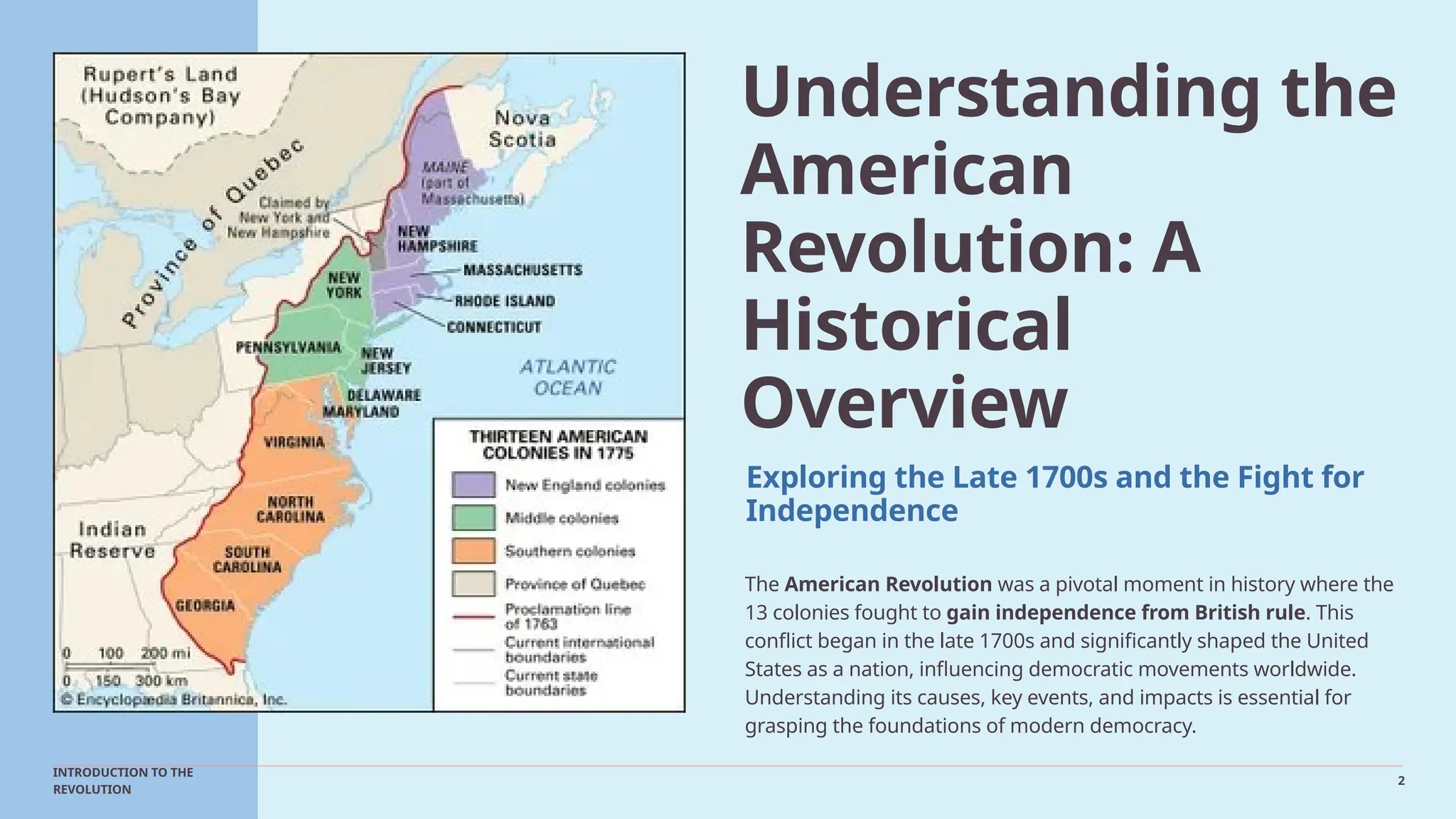
The American Revolutionwas a pivotal moment in history where the
13 colonies fought to gain independence from British rule. This
conflict began in the late 1700s and significantly shaped the United
States as a nation, influencing democratic movements worldwide.
Understanding its causes, key events, and impacts is essential for
grasping the foundations of modern democracy.
Exploring the Late 1700s and the Fight for
Independence
Understanding the
American
Revolution: A
Historical
Overview
INTRODUCTION TO THE
REVOLUTION
2
3.
Various laws, likethe Stamp Act and the Tea Act, angered
colonists. These acts imposed taxes and restrictions on
everyday items, leading to widespread protests across the
colonies.
British Laws and Acts
Colonists were frustrated by being taxed without a voice
in Parliament. They believed it was unfair to pay taxes
when they had no representatives to advocate for their
interests.
Taxation Without Representation
Desire for Independence
As tensions rose, many colonists began to yearn for
independence from British rule. They wanted to govern
themselves and make their own decisions free from
oppressive laws and taxes.
Causes of the
American
Revolution
ROOTS OF REVOLUTION 3
4.
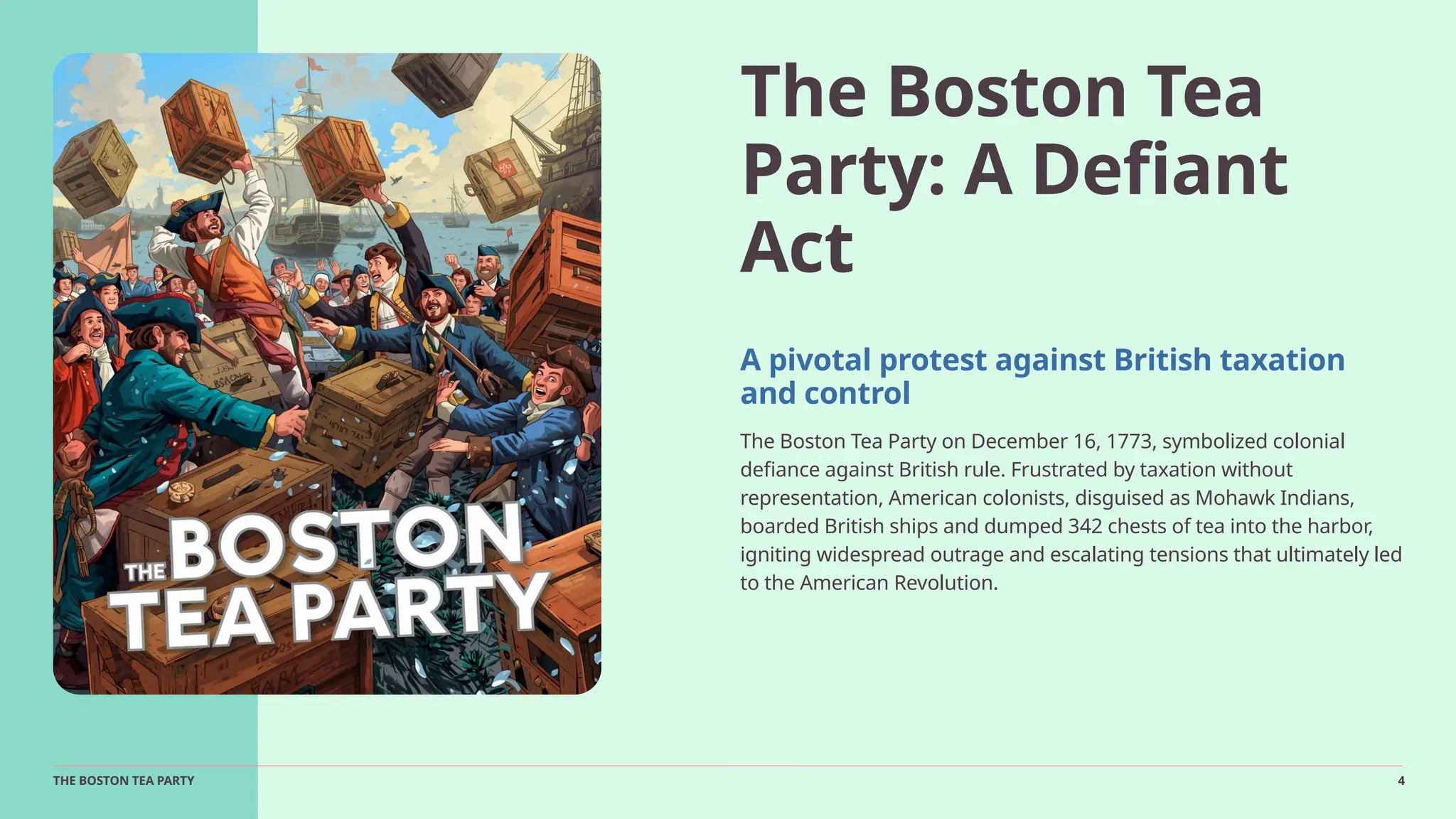
The Boston TeaParty on December 16, 1773, symbolized colonial
defiance against British rule. Frustrated by taxation without
representation, American colonists, disguised as Mohawk Indians,
boarded British ships and dumped 342 chests of tea into the harbor,
igniting widespread outrage and escalating tensions that ultimately led
to the American Revolution.
A pivotal protest against British taxation
and control
The Boston Tea
Party: A Defiant
Act
THE BOSTON TEA PARTY 4
5.
First Continental
Congress
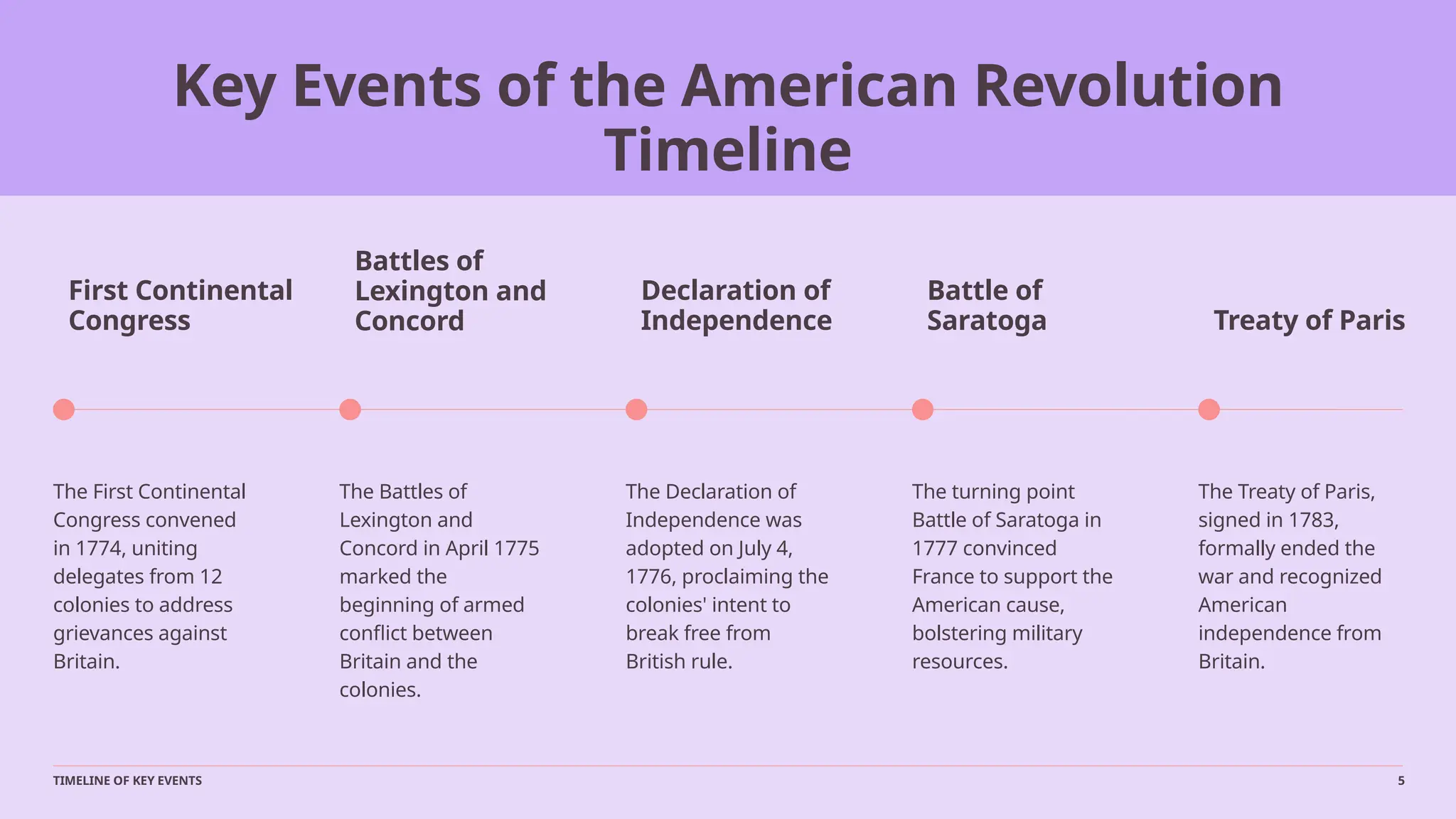
The FirstContinental
Congress convened
in 1774, uniting
delegates from 12
colonies to address
grievances against
Britain.
The Battles of
Lexington and
Concord in April 1775
marked the
beginning of armed
conflict between
Britain and the
colonies.
Battles of
Lexington and
Concord
Declaration of
Independence
Battle of
Saratoga Treaty of Paris
Key Events of the American Revolution
Timeline
The Declaration of
Independence was
adopted on July 4,
1776, proclaiming the
colonies' intent to
break free from
British rule.
The turning point
Battle of Saratoga in
1777 convinced
France to support the
American cause,
bolstering military
resources.
The Treaty of Paris,
signed in 1783,
formally ended the
war and recognized
American
independence from
Britain.
TIMELINE OF KEY EVENTS 5
6.
The American Revolutionwas marked by several significant battles.
The Battles of Lexington and Concord ignited the conflict, while the
Battle of Bunker Hill showcased colonial resilience. The Battle of
Saratoga proved pivotal, leading to French support. Each battle
contributed to the colonies' determination to secure independence
from British rule.
Key conflicts that shaped the fight for
independence
Major Battles of
the American
Revolution
KEY BATTLES OF THE REVOLUTION
6
7.
George Washington: TheFather of the United
States
Leader of the Continental
Army
Washington commanded the Continental
Army, leading the fight for independence with
strategic brilliance.
A Symbol of Unity and
Strength
He is remembered as a unifying figure who
inspired Americans during turbulent times.
First President of the United
States
After the war, Washington became the first
president, shaping the new nation’s
government.
GEORGE WASHINGTON 7
8.
King George III:The British Monarch
British Rule in the Colonies
King George III was seen as the face of British
oppression during the revolution.
The Role in the Revolution
King George III's decisions deepened the
divide between Britain and the colonies.
Taxation and Control
His policies, like new taxes, fueled the desire
for independence among colonists.
THE MONARCH'S IMPACT 8
9.
Effects and Legacyof the
American Revolution
Formation of the United States
The American Revolution led to the creation of the
United States, marking the birth of a nation based on
the principles of liberty and democracy. This newfound
independence inspired the drafting of foundational
documents such as the Constitution and the Bill of
Rights, establishing a framework for governance and
individual rights.
Inspiration for Global Revolutions
The ideals championed during the American Revolution
served as a beacon for other nations seeking
independence. Countries like France and those in Latin
America looked to the American example, igniting their
own revolutionary movements and shaping the global
fight for freedom and equality in the years to come.
LEGACY OF FREEDOM 9
10.
Before the AmericanRevolution, colonial life
was characterized by strict British control,
limited rights, and heavy taxation. Colonists
lived under laws that restricted their freedoms,
and any dissent was often met with harsh
penalties. Many relied on agriculture, and a
rigid social hierarchy dictated their daily lives.
The dream of independence fueled their desire
for change, leading to protests and ultimately
revolution.
Comparing Life in the Colonies and
the New Republic: A Transformative
Shift
After the revolution, the newly formed United
States embraced ideals of democracy and
individual liberties. The Constitution and Bill of
Rights established frameworks for governance,
ensuring representation and rights for citizens.
Society began to shift towards greater
inclusivity, though challenges remained for
various groups. The opportunity for self-
governance and the belief in liberty became
central to the American identity, shaping the
nation’s future.
The New Republic: Embracing
Freedom and Self-Governance
LIFE TRANSFORMATION 10
11.
Activity – Reflection& Connection (10 minutes)
1) Was the American Revolution inevitable? Why or
why not?
2) What was the most important cause of the
American Revolution according to your opinion?




![American Revolution[1]](https://cdn.slidesharecdn.com/ss_thumbnails/americanrevolution1-090514152109-phpapp01-thumbnail.jpg?width=640&height=640&fit=bounds)


