LEPs: A Primer
LOCAL ENTERPRISE PARTNERSHIP FOR THE FYLDE
COAST:
Workshop on LEPs
Marine Hall, Fleetwood FY7 76H
Thursday 26th
August, 2010
Ged Mirfin – Chief Data Officer, BLNW
Centripetal
Localism
Business led
Corporatism
Centrifugal
Localism
Municipal
Corporatism
Different Models of Local Economic
Partnerships
LocalGovernmentInfluence
Local Business Influence
LocalGovernmentInfluence
Local Business Influence
Clear demarcation between Nationally
Delivered and Financed Services & Tax
Raising and Locally Delivered and
Financed Services & Tax Raising.
National Priorities to be determined
centrally but Local Priorities to be
funded by enhanced Local Tax Raising
Powers provided the General Public
and Business can be persuaded
politically. (Layfield Principle)
Creation of “Keiretsu” like Enterprise
Partnerships with very high levels of
close knit co-operation cooperation
between manufacturers, suppliers,
distributors, banks and local
government with active acquiescence
of trade unions and employer
engagement and participation
Public Sector Dominated
Private Enterprise
Partnerships. Business
represented in an advisory
capacity. Invited/Nominated
Private Sector Boards.
Creation of Powerful Civic
Associations. Return to Civic
Improvement Model with
Public Sector & Big Business
Working in True Partnership
to 'park, pave, assize, market,
gas & water and improve'.
Public Sector Prominence or Business
Dominance?
A keiretsu is a grouping or family of affiliated companies that form a tight-knit alliance to work toward each other's
mutual success. The keiretsu system is also based on an intimate partnership between government and businesses.
LocalGovernmentInfluence
Local Business Influence
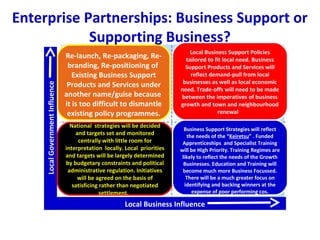
National strategies will be decided
and targets set and monitored
centrally with little room for
interpretation locally. Local priorities
and targets will be largely determined
by budgetary constraints and political
administrative regulation. Initiatives
will be agreed on the basis of
satisficing rather than negotiated
settlement.
Business Support Strategies will reflect
the needs of the “Keiretsu” . Funded
Apprenticeships and Specialist Training
will be High Priority. Training Regimes are
likely to reflect the needs of the Growth
Businesses. Education and Training will
become much more Business Focussed.
There will be a much greater focus on
identifying and backing winners at the
expense of poor performing cos.
Re-launch, Re-packaging, Re-
branding, Re-positioning of
Existing Business Support
Products and Services under
another name/guise because
it is too difficult to dismantle
existing policy programmes.
Local Business Support Policies
tailored to fit local need. Business
Support Products and Services will
reflect demand-pull from local
businesses as well as local economic
need. Trade-offs will need to be made
between the imperatives of business
growth and town and neighbourhood
renewal
Enterprise Partnerships: Business Support or
Supporting Business?
LocalGovernmentInfluence
Local Business Influence
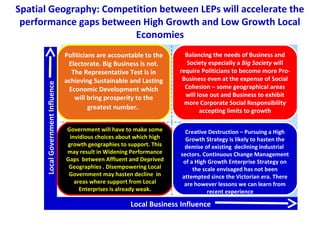
Government will have to make some
invidious choices about which high
growth geographies to support. This
may result in Widening Performance
Gaps between Affluent and Deprived
Geographies . Disempowering Local
Government may hasten decline in
areas where support from Local
Enterprises is already weak.
Creative Destruction – Pursuing a High
Growth Strategy is likely to hasten the
demise of existing declining industrial
sectors. Continuous Change Management
of a High Growth Enterprise Strategy on
the scale envisaged has not been
attempted since the Victorian era. There
are however lessons we can learn from
recent experience
Politicians are accountable to the
Electorate. Big Business is not.
The Representative Test is in
achieving Sustainable and Lasting
Economic Development which
will bring prosperity to the
greatest number.
Balancing the needs of Business and
Society especially a Big Society will
require Politicians to become more Pro-
Business even at the expense of Social
Cohesion – some geographical areas
will lose out and Business to exhibit
more Corporate Social Responsibility
accepting limits to growth
Spatial Geography: Competition between LEPs will accelerate the
performance gaps between High Growth and Low Growth Local
Economies
LocalGovernmentInfluence
Local Business Influence
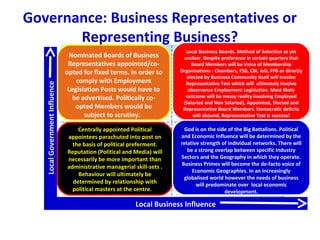
Centrally appointed Political
appointees parachuted into post on
the basis of political preferment.
Reputation (Political and Media) will
necessarily be more important than
administrative managerial skill-sets .
Behaviour will ultimately be
determined by relationship with
political masters at the centre.
God is on the side of the Big Battalions. Political
and Economic Influence will be determined by the
relative strength of individual networks. There will
be a strong overlap between specific Industry
Sectors and the Geography in which they operate.
Business Primes will become the de-facto voice of
Economic Geographies. In an increasingly
globalised world however the needs of business
will predominate over local economic
development.
Nominated Boards of Business
Representatives appointed/co-
opted for fixed terms. In order to
comply with Employment
Legislation Posts would have to
be advertised. Politically co-
opted Members would be
subject to scrutiny.
Local Business Boards. Method of Selection as yet
unclear. Despite preference in certain quarters that
Board Members will be Voice of Membership
Organisations : Chambers, FSB, CBI, IoD, FPB or directly
elected by Business Community itself will involve
Representative Test which will ultimately involve
observance Employment Legislation. Most likely
outcome will be messy reality involving Employed
(Salaried and Non Salaried), Appointed, Elected and
Representative Board Members. Democratic deficits
will abound. Representative Test is success!
Governance: Business Representatives or
Representing Business?
LocalGovernmentInfluence
Local Business Influence
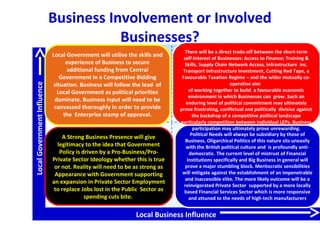
A Strong Business Presence will give
legitimacy to the idea that Government
Policy is driven by a Pro-Business/Pro-
Private Sector Ideology whether this is true
or not. Reality will need to be as strong as
Appearance with Government supporting
an expansion in Private Sector Employment
to replace Jobs lost in the Public Sector as
spending cuts bite.
Political Needs will always be subsidiary by those of
Business. Oligarchical Politics of this nature sits uneasily
with the British political culture and is profoundly anti-
democratic. The current level of mistrust of Financial
Institutions specifically and Big Business in general will
prove a major stumbling block. Meritocratic sensibilities
will mitigate against the establishment of an impenetrable
and inaccessible elite. The more likely outcome will be a
reinvigorated Private Sector supported by a more locally
based Financial Services Sector which is more responsive
and attuned to the needs of high-tech manufacturers
Local Government will utilise the skills and
experience of Business to secure
additional funding from Central
Government in a Competitive Bidding
situation. Business will follow the lead of
Local Government as political priorities
dominate. Business input will need to be
canvassed thoroughly in order to provide
the Enterprise stamp of approval.
There will be a direct trade-off between the short-term
self-interest of Businesses: Access to Finance; Training &
Skills, Supply Chain Network Access, Infrastructure inc.
Transport Infrastructure Investment, Cutting Red Tape, a
Favourable Taxation Regime – and the wider mutually co-
operative aim
of working together to build a favourable economic
environment in which Businesses can grow. Such an
enduring level of political commitment may ultimately
prove frustrating, conflictual and politically divisive against
the backdrop of a competitive political landscape
particularly competition between individual LEPs. Business
participation may ultimately prove unrewarding.
Business Involvement or Involved
Businesses?

LEPs: A Primer

  • 1.
    LEPs: A Primer LOCALENTERPRISE PARTNERSHIP FOR THE FYLDE COAST: Workshop on LEPs Marine Hall, Fleetwood FY7 76H Thursday 26th August, 2010 Ged Mirfin – Chief Data Officer, BLNW
  • 2.
    Centripetal Localism Business led Corporatism Centrifugal Localism Municipal Corporatism Different Modelsof Local Economic Partnerships LocalGovernmentInfluence Local Business Influence
  • 3.
    LocalGovernmentInfluence Local Business Influence Cleardemarcation between Nationally Delivered and Financed Services & Tax Raising and Locally Delivered and Financed Services & Tax Raising. National Priorities to be determined centrally but Local Priorities to be funded by enhanced Local Tax Raising Powers provided the General Public and Business can be persuaded politically. (Layfield Principle) Creation of “Keiretsu” like Enterprise Partnerships with very high levels of close knit co-operation cooperation between manufacturers, suppliers, distributors, banks and local government with active acquiescence of trade unions and employer engagement and participation Public Sector Dominated Private Enterprise Partnerships. Business represented in an advisory capacity. Invited/Nominated Private Sector Boards. Creation of Powerful Civic Associations. Return to Civic Improvement Model with Public Sector & Big Business Working in True Partnership to 'park, pave, assize, market, gas & water and improve'. Public Sector Prominence or Business Dominance? A keiretsu is a grouping or family of affiliated companies that form a tight-knit alliance to work toward each other's mutual success. The keiretsu system is also based on an intimate partnership between government and businesses.
  • 4.
    LocalGovernmentInfluence Local Business Influence Nationalstrategies will be decided and targets set and monitored centrally with little room for interpretation locally. Local priorities and targets will be largely determined by budgetary constraints and political administrative regulation. Initiatives will be agreed on the basis of satisficing rather than negotiated settlement. Business Support Strategies will reflect the needs of the “Keiretsu” . Funded Apprenticeships and Specialist Training will be High Priority. Training Regimes are likely to reflect the needs of the Growth Businesses. Education and Training will become much more Business Focussed. There will be a much greater focus on identifying and backing winners at the expense of poor performing cos. Re-launch, Re-packaging, Re- branding, Re-positioning of Existing Business Support Products and Services under another name/guise because it is too difficult to dismantle existing policy programmes. Local Business Support Policies tailored to fit local need. Business Support Products and Services will reflect demand-pull from local businesses as well as local economic need. Trade-offs will need to be made between the imperatives of business growth and town and neighbourhood renewal Enterprise Partnerships: Business Support or Supporting Business?
  • 5.
    LocalGovernmentInfluence Local Business Influence Governmentwill have to make some invidious choices about which high growth geographies to support. This may result in Widening Performance Gaps between Affluent and Deprived Geographies . Disempowering Local Government may hasten decline in areas where support from Local Enterprises is already weak. Creative Destruction – Pursuing a High Growth Strategy is likely to hasten the demise of existing declining industrial sectors. Continuous Change Management of a High Growth Enterprise Strategy on the scale envisaged has not been attempted since the Victorian era. There are however lessons we can learn from recent experience Politicians are accountable to the Electorate. Big Business is not. The Representative Test is in achieving Sustainable and Lasting Economic Development which will bring prosperity to the greatest number. Balancing the needs of Business and Society especially a Big Society will require Politicians to become more Pro- Business even at the expense of Social Cohesion – some geographical areas will lose out and Business to exhibit more Corporate Social Responsibility accepting limits to growth Spatial Geography: Competition between LEPs will accelerate the performance gaps between High Growth and Low Growth Local Economies
  • 6.
    LocalGovernmentInfluence Local Business Influence Centrallyappointed Political appointees parachuted into post on the basis of political preferment. Reputation (Political and Media) will necessarily be more important than administrative managerial skill-sets . Behaviour will ultimately be determined by relationship with political masters at the centre. God is on the side of the Big Battalions. Political and Economic Influence will be determined by the relative strength of individual networks. There will be a strong overlap between specific Industry Sectors and the Geography in which they operate. Business Primes will become the de-facto voice of Economic Geographies. In an increasingly globalised world however the needs of business will predominate over local economic development. Nominated Boards of Business Representatives appointed/co- opted for fixed terms. In order to comply with Employment Legislation Posts would have to be advertised. Politically co- opted Members would be subject to scrutiny. Local Business Boards. Method of Selection as yet unclear. Despite preference in certain quarters that Board Members will be Voice of Membership Organisations : Chambers, FSB, CBI, IoD, FPB or directly elected by Business Community itself will involve Representative Test which will ultimately involve observance Employment Legislation. Most likely outcome will be messy reality involving Employed (Salaried and Non Salaried), Appointed, Elected and Representative Board Members. Democratic deficits will abound. Representative Test is success! Governance: Business Representatives or Representing Business?
  • 7.
    LocalGovernmentInfluence Local Business Influence AStrong Business Presence will give legitimacy to the idea that Government Policy is driven by a Pro-Business/Pro- Private Sector Ideology whether this is true or not. Reality will need to be as strong as Appearance with Government supporting an expansion in Private Sector Employment to replace Jobs lost in the Public Sector as spending cuts bite. Political Needs will always be subsidiary by those of Business. Oligarchical Politics of this nature sits uneasily with the British political culture and is profoundly anti- democratic. The current level of mistrust of Financial Institutions specifically and Big Business in general will prove a major stumbling block. Meritocratic sensibilities will mitigate against the establishment of an impenetrable and inaccessible elite. The more likely outcome will be a reinvigorated Private Sector supported by a more locally based Financial Services Sector which is more responsive and attuned to the needs of high-tech manufacturers Local Government will utilise the skills and experience of Business to secure additional funding from Central Government in a Competitive Bidding situation. Business will follow the lead of Local Government as political priorities dominate. Business input will need to be canvassed thoroughly in order to provide the Enterprise stamp of approval. There will be a direct trade-off between the short-term self-interest of Businesses: Access to Finance; Training & Skills, Supply Chain Network Access, Infrastructure inc. Transport Infrastructure Investment, Cutting Red Tape, a Favourable Taxation Regime – and the wider mutually co- operative aim of working together to build a favourable economic environment in which Businesses can grow. Such an enduring level of political commitment may ultimately prove frustrating, conflictual and politically divisive against the backdrop of a competitive political landscape particularly competition between individual LEPs. Business participation may ultimately prove unrewarding. Business Involvement or Involved Businesses?