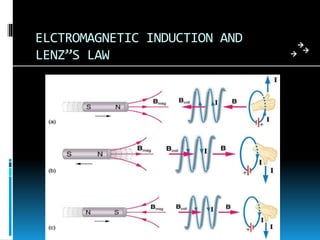
ELCTROMAGNETIC INDUCTION AND
LENZ”S LAW
Current give rise to a magnetic field so
scientists started working for its converse
process i-e
Magnetic field should give rise to
electric current
Introduction
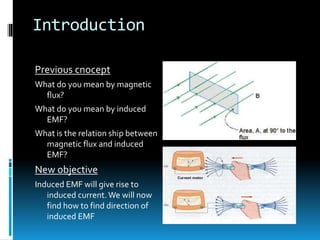
Previous cnocept
What do you mean by magnetic
flux?
What do you mean by induced
EMF?
What is the relation ship between
magnetic flux and induced
EMF?
New objective
Induced EMF will give rise to
induced current.We will now
find how to find direction of
induced EMF
ELCTROMAGNETIC INDUCTION AND
LENZ”S LAW
Lesson content
Effcts of induction
Lenz’s Law
Electromagnetic induction
Examples
uses
Electro-Magnetic Induction
An EMF is induced in the coil, when it is
rotated in an uniform magnetic field due to
change in magnetic flux.
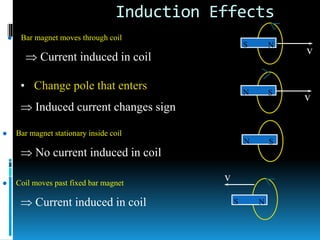
Induction Effects
v
v
S N
v
N S
N S
S N
 Bar magnet moves through coil
 Current induced in coil
• Change pole that enters
 Induced current changes sign
 Bar magnet stationary inside coil
 No current induced in coil
 Coil moves past fixed bar magnet
 Current induced in coil
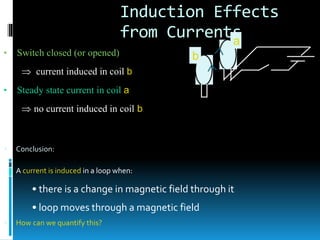
Induction Effects
from Currents
• Switch closed (or opened)
 current induced in coil b
• Steady state current in coil a
 no current induced in coil b
a
b
 Conclusion:
A current is induced in a loop when:
• there is a change in magnetic field through it
• loop moves through a magnetic field
 How can we quantify this?
EXPERIMENT
Faraday's Law
:
 Faraday's Law:
The emf induced in a circuit is determined by the time rate of
change of the magnetic flux through that circuit.
The minus sign indicates direction of induced current (given by Lenz's
Law).
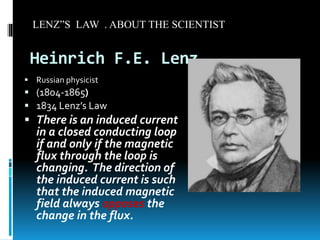
Heinrich F.E. Lenz
 Russian physicist
 (1804-1865)
 1834 Lenz’s Law
 There is an induced current
in a closed conducting loop
if and only if the magnetic
flux through the loop is
changing. The direction of
the induced current is such
that the induced magnetic
field always opposes the
change in the flux.
LENZ”S LAW . ABOUT THE SCIENTIST
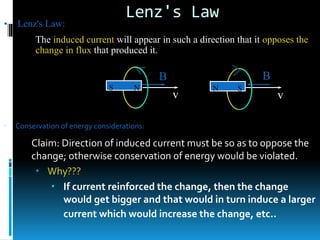
Lenz's Law
• Lenz's Law:
The induced current will appear in such a direction that it opposes the
change in flux that produced it.
 Conservation of energy considerations:
Claim: Direction of induced current must be so as to oppose the
change; otherwise conservation of energy would be violated.
 Why???
 If current reinforced the change, then the change
would get bigger and that would in turn induce a larger
current which would increase the change, etc..
v
B
S N
v
B
N S
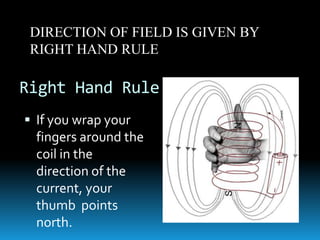
Right Hand Rule
 If you wrap your
fingers around the
coil in the
direction of the
current, your
thumb points
north.
DIRECTION OF FIELD IS GIVEN BY
RIGHT HAND RULE
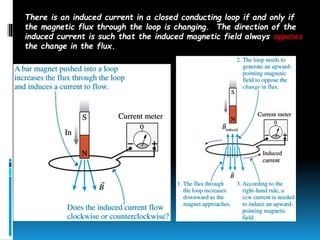
There is an induced current in a closed conducting loop if and only if
the magnetic flux through the loop is changing. The direction of the
induced current is such that the induced magnetic field always opposes
the change in the flux.
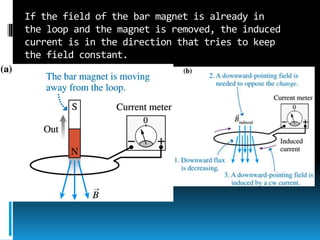
If the field of the bar magnet is already in
the loop and the magnet is removed, the induced
current is in the direction that tries to keep
the field constant.
,
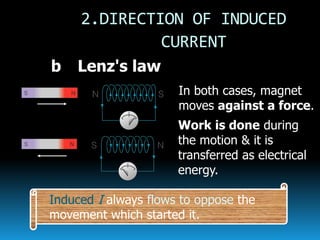
2.DIRECTION OF INDUCED
CURRENT
In both cases, magnet
moves against a force.
Work is done during
the motion & it is
transferred as electrical
energy.
Induced I always flows to oppose the
movement which started it.
b Lenz's law
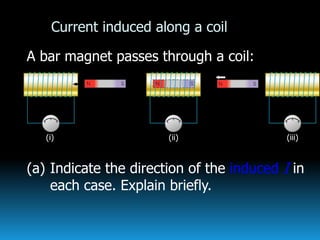
Current induced along a coil
A bar magnet passes through a coil:
(a) Indicate the direction of the induced I in
each case. Explain briefly.
(i) (ii) (iii)
Current induced along a coil
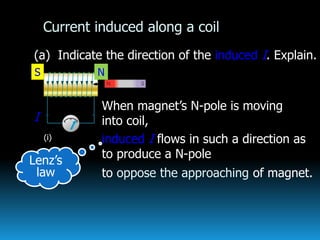
(a) Indicate the direction of the induced I. Explain.
(i)
When magnet’s N-pole is moving
into coil,
induced I flows in such a direction as
to produce a N-pole
to oppose the approaching of magnet.
Lenz’s
law
I
S N
Current induced along a coil
(a) Indicate the direction of the induced I. Explain.
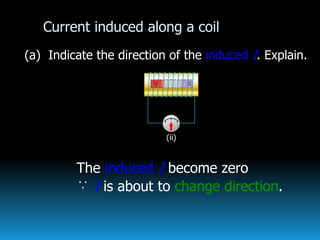
(ii)
The induced I become zero

I is about to change direction.
Current induced along a coil
(a) Indicate the direction of the induced I. Explain.
(iii)
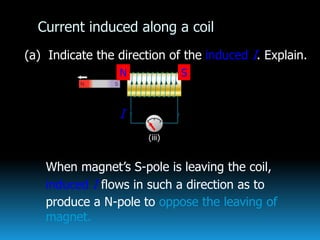
When magnet’s S-pole is leaving the coil,
induced I flows in such a direction as to
produce a N-pole to oppose the leaving of
magnet.
I
N S
Lenz’s Law
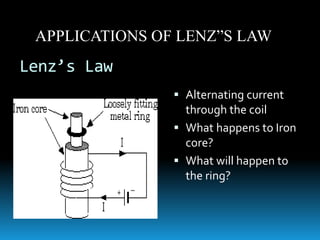
 Alternating current
through the coil
 What happens to Iron
core?
 What will happen to
the ring?
APPLICATIONS OF LENZ”S LAW
LENZ LAW
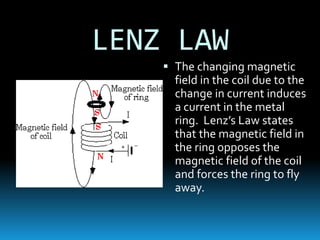
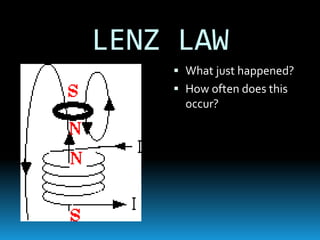
 The changing magnetic
field in the coil due to the
change in current induces
a current in the metal
ring. Lenz’s Law states
that the magnetic field in
the ring opposes the
magnetic field of the coil
and forces the ring to fly
away.
LENZ LAW
 What just happened?
 How often does this
occur?
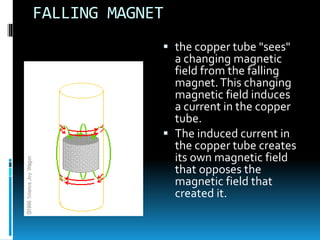
FALLING MAGNET
 the copper tube "sees"
a changing magnetic
field from the falling
magnet.This changing
magnetic field induces
a current in the copper
tube.
 The induced current in
the copper tube creates
its own magnetic field
that opposes the
magnetic field that
created it.
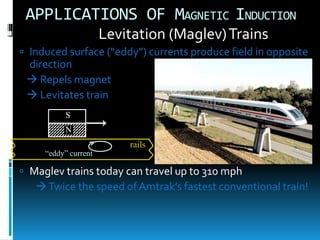
APPLICATIONS OF MAGNETIC INDUCTION
 Levitation (Maglev)Trains
 Induced surface (“eddy”) currents produce field in opposite
direction
 Repels magnet
 Levitates train
 Maglev trains today can travel up to 310 mph
Twice the speed of Amtrak’s fastest conventional train!
N
S
rails
“eddy” current
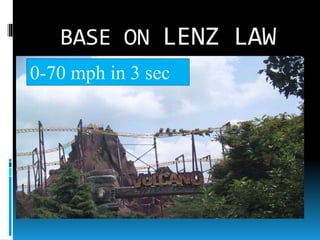
BASE ON LENZ LAW
0-70 mph in 3 sec
Recapitulation
Effcts of induction
Lenz’s Law
Electromagnetic induction
Examples
uses
lenzes law presentatiovn.ppt

lenzes law presentatiovn.ppt

  • 2.
  • 3.
    Current give riseto a magnetic field so scientists started working for its converse process i-e Magnetic field should give rise to electric current
  • 4.
    Introduction Previous cnocept What doyou mean by magnetic flux? What do you mean by induced EMF? What is the relation ship between magnetic flux and induced EMF? New objective Induced EMF will give rise to induced current.We will now find how to find direction of induced EMF
  • 5.
    ELCTROMAGNETIC INDUCTION AND LENZ”SLAW Lesson content Effcts of induction Lenz’s Law Electromagnetic induction Examples uses
  • 6.
    Electro-Magnetic Induction An EMFis induced in the coil, when it is rotated in an uniform magnetic field due to change in magnetic flux.
  • 7.
    Induction Effects v v S N v NS N S S N  Bar magnet moves through coil  Current induced in coil • Change pole that enters  Induced current changes sign  Bar magnet stationary inside coil  No current induced in coil  Coil moves past fixed bar magnet  Current induced in coil
  • 8.
    Induction Effects from Currents •Switch closed (or opened)  current induced in coil b • Steady state current in coil a  no current induced in coil b a b  Conclusion: A current is induced in a loop when: • there is a change in magnetic field through it • loop moves through a magnetic field  How can we quantify this?
  • 9.
  • 10.
    Faraday's Law :  Faraday'sLaw: The emf induced in a circuit is determined by the time rate of change of the magnetic flux through that circuit. The minus sign indicates direction of induced current (given by Lenz's Law).
  • 11.
    Heinrich F.E. Lenz Russian physicist  (1804-1865)  1834 Lenz’s Law  There is an induced current in a closed conducting loop if and only if the magnetic flux through the loop is changing. The direction of the induced current is such that the induced magnetic field always opposes the change in the flux. LENZ”S LAW . ABOUT THE SCIENTIST
  • 12.
    Lenz's Law • Lenz'sLaw: The induced current will appear in such a direction that it opposes the change in flux that produced it.  Conservation of energy considerations: Claim: Direction of induced current must be so as to oppose the change; otherwise conservation of energy would be violated.  Why???  If current reinforced the change, then the change would get bigger and that would in turn induce a larger current which would increase the change, etc.. v B S N v B N S
  • 13.
    Right Hand Rule If you wrap your fingers around the coil in the direction of the current, your thumb points north. DIRECTION OF FIELD IS GIVEN BY RIGHT HAND RULE
  • 14.
    There is aninduced current in a closed conducting loop if and only if the magnetic flux through the loop is changing. The direction of the induced current is such that the induced magnetic field always opposes the change in the flux.
  • 15.
    If the fieldof the bar magnet is already in the loop and the magnet is removed, the induced current is in the direction that tries to keep the field constant. ,
  • 16.
    2.DIRECTION OF INDUCED CURRENT Inboth cases, magnet moves against a force. Work is done during the motion & it is transferred as electrical energy. Induced I always flows to oppose the movement which started it. b Lenz's law
  • 17.
    Current induced alonga coil A bar magnet passes through a coil: (a) Indicate the direction of the induced I in each case. Explain briefly. (i) (ii) (iii)
  • 18.
    Current induced alonga coil (a) Indicate the direction of the induced I. Explain. (i) When magnet’s N-pole is moving into coil, induced I flows in such a direction as to produce a N-pole to oppose the approaching of magnet. Lenz’s law I S N
  • 19.
    Current induced alonga coil (a) Indicate the direction of the induced I. Explain. (ii) The induced I become zero  I is about to change direction.
  • 20.
    Current induced alonga coil (a) Indicate the direction of the induced I. Explain. (iii) When magnet’s S-pole is leaving the coil, induced I flows in such a direction as to produce a N-pole to oppose the leaving of magnet. I N S
  • 21.
    Lenz’s Law  Alternatingcurrent through the coil  What happens to Iron core?  What will happen to the ring? APPLICATIONS OF LENZ”S LAW
  • 22.
    LENZ LAW  Thechanging magnetic field in the coil due to the change in current induces a current in the metal ring. Lenz’s Law states that the magnetic field in the ring opposes the magnetic field of the coil and forces the ring to fly away.
  • 23.
    LENZ LAW  Whatjust happened?  How often does this occur?
  • 24.
    FALLING MAGNET  thecopper tube "sees" a changing magnetic field from the falling magnet.This changing magnetic field induces a current in the copper tube.  The induced current in the copper tube creates its own magnetic field that opposes the magnetic field that created it.
  • 25.
    APPLICATIONS OF MAGNETICINDUCTION  Levitation (Maglev)Trains  Induced surface (“eddy”) currents produce field in opposite direction  Repels magnet  Levitates train  Maglev trains today can travel up to 310 mph Twice the speed of Amtrak’s fastest conventional train! N S rails “eddy” current
  • 26.
    BASE ON LENZLAW 0-70 mph in 3 sec
  • 27.
    Recapitulation Effcts of induction Lenz’sLaw Electromagnetic induction Examples uses