More Related Content

PPT

PPT

PPT

PDF

PPT

PPT

PPT
SQL manages and queries database data.ppt 
PPT
The SQL data-definition language (DDL) allows the specification of informatio... Similar to Lecturrrrrrrrrrrrrrrrrrrrrrrrre-4 SQL.ppt

PPT
ER model and diagram in database system 
PPT

PPT
ch3 - Introduction to SQL_236e5f36d33e8314f8cb023702f2b23f.ppt 
PPTX
ch3.pptx SQL in DBMS all Chapter with details 
PPT

PPT

PPT
Introduction to SQL.ppt DATA BASE SYSTEMS 
PPT
UNIT 2 Structured query language commands 
PPT
Structured Query Language in detail chapter 3 
PPTX
Intonation to SQL using the query language postgresSQL.pptx 
PPT
sql- introduction-notmine- uploading share 
PPT

PDF
Introduction to sql.pdf Database Systems 
PPTX
SQL data types: INT, VARCHAR, CHAR,.pptx ![ch3[1].ppt](https://cdn.slidesharecdn.com/ss_thumbnails/ch31-230417055355-765568bc-thumbnail.jpg?width=640&height=640&fit=bounds)
PPT

PPT
04 Introduction to SQ(Structural Query Language)L.ppt 
PPTX

PPT

PPT
Relational Algebra and relational queries .ppt 
PDF
04-Intro-SQL database management systems More from scrollinside07

PPTX
Lectwwwwwwwwwwwwwwwwwwwwwwwwwwwwwwwwwwure 8.pptx 
PPT
Lectureddddddddddddddddddddddddddddddddddd 6.ppt 
PPTX
Lecture 6_Introductrrrrrrrrrrrrrrion to Transformer.pptx 
PPT
3.Relational M333333333333333333333333333333odel.ppt 
PPT
Lectureeeeeeeeeeeeeeeeeeeeeeeeeeeeeeeeeeee 2.ppt 
PPT
Lectfffffffffffffffffffffffffure-1 Introduction.ppt 
PPTX
relationalfffffffffffffffffffffffff algebra.pptx 
PPTX
joffffffffffffffffffffffffffffffin (1).pptx 
PPT
5.EeeeeeeeeeeeeeeeeeeeeeeeeeR Diagram.ppt 
PPT
Lecturereeeeeeeeeeeeeeeeeeeeee-4 SQL.ppt 
PPT
3.Relationrrrrrrrrrrrrrrrrrrrrrrrrral Model.ppt 
PPT
Lecture222222222222222222222222222 2.ppt 
PPT
Lecture-1 dataaaaaaaaaa Introduction.ppt Recently uploaded

PDF
WORLD-LITERATURE-2ND-SEMESTER2025-2026.pdf 
PPT
Microsoft_SQL_ServerConsolidationTWP.ppt 
PDF
US Digital Fan Engagement Index 2026: Benchmarking Online Demand for Sports T... 
PDF
Unlocking the Future of Logistics & Supply Chain 
PPTX
Top Institute for Data Analyst Course in Navi Mumbai 
PDF
chapter one introduction to Probability theory.pdf 
PDF
LECTURE - Overcoming the AI Failure Rate - AIG, DQM.pdf 
PDF
Trustworthy AI : Governance of AI through Ethics 
PPT
data collection tool ppt.ppttttdataadfttg 
PDF
Step by Step Guide to Buying a Old or Aged Verified Paxful Accounts in US.pdf 
PDF
PathRAG rag pipeline PathRAG rag pipeline .pdf 
DOCX
Data Analyst Training Course | Advanced Data Analytics Certification | GVT Ac... 
PPTX
The Singularity Sprint (2026): Neuralink + the AI Arms Race — Ridwan Sassman 
PPTX
End to End Supply Chain Management- Analytics Case Study. 
PPTX
Lecture 14- Introduction to Hypothesis Testing.pptx 
PDF
Analysis of Union Budget 2026-27: Major Announcements and their Impact 
PPTX
Social Media Audit of Starbucks Coffee Company.pptx 
PDF
Understanding Data Analytics: Concepts, Types, and Use Cases 
PPTX
Organizational Structure and Design Topic 4 
PDF
Columbus Data and Analytics Wednesday - People Analytics 101: Making Sense of... Lecturrrrrrrrrrrrrrrrrrrrrrrrre-4 SQL.ppt
- 1.
- 2.
©Silberschatz, Korth andSudarshan
3.2
Database System Concepts - 6th
Edition
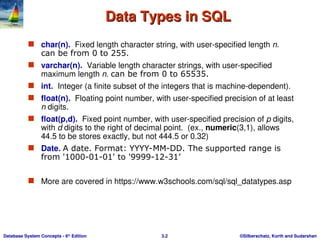
Data Types in SQL
Data Types in SQL
char(n). Fixed length character string, with user-specified length n.
can be from 0 to 255.
varchar(n). Variable length character strings, with user-specified
maximum length n. can be from 0 to 65535.
int. Integer (a finite subset of the integers that is machine-dependent).
float(n). Floating point number, with user-specified precision of at least
n digits.
float(p,d). Fixed point number, with user-specified precision of p digits,
with d digits to the right of decimal point. (ex., numeric(3,1), allows
44.5 to be stores exactly, but not 444.5 or 0.32)
Date. A date. Format: YYYY-MM-DD. The supported range is
from '1000-01-01' to '9999-12-31’
More are covered in https://www.w3schools.com/sql/sql_datatypes.asp
- 3.
©Silberschatz, Korth andSudarshan
3.3
Database System Concepts - 6th
Edition
SQL Commands
SQL Commands
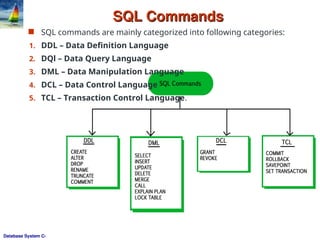
SQL commands are mainly categorized into following categories:
1. DDL – Data Definition Language
2. DQl – Data Query Language
3. DML – Data Manipulation Language
4. DCL – Data Control Language
5. TCL – Transaction Control Language.
- 4.
©Silberschatz, Korth andSudarshan
3.4
Database System Concepts - 6th
Edition
Create Table Construct
Create Table Construct
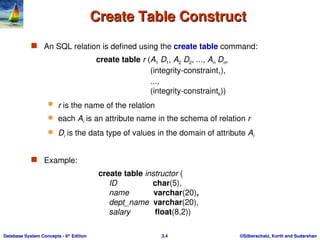
An SQL relation is defined using the create table command:
create table r (A1 D1, A2 D2, ..., An Dn,
(integrity-constraint1),
...,
(integrity-constraintk))
r is the name of the relation
each Ai is an attribute name in the schema of relation r
Di is the data type of values in the domain of attribute Ai
Example:
create table instructor (
ID char(5),
name varchar(20),
dept_name varchar(20),
salary float(8,2))
- 5.
©Silberschatz, Korth andSudarshan
3.5
Database System Concepts - 6th
Edition
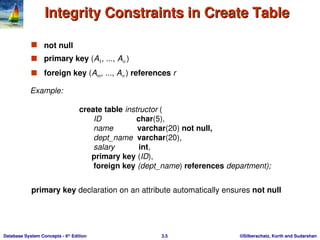
Integrity Constraints in Create Table
Integrity Constraints in Create Table
not null
primary key (A1, ..., An )
foreign key (Am, ..., An ) references r
Example:
create table instructor (
ID char(5),
name varchar(20) not null,
dept_name varchar(20),
salary int,
primary key (ID),
foreign key (dept_name) references department);
primary key declaration on an attribute automatically ensures not null
- 6.
©Silberschatz, Korth andSudarshan
3.6
Database System Concepts - 6th
Edition
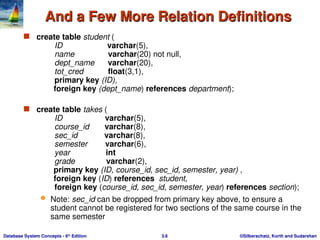
And a Few More Relation Definitions
And a Few More Relation Definitions
create table student (
ID varchar(5),
name varchar(20) not null,
dept_name varchar(20),
tot_cred float(3,1),
primary key (ID),
foreign key (dept_name) references department);
create table takes (
ID varchar(5),
course_id varchar(8),
sec_id varchar(8),
semester varchar(6),
year int
grade varchar(2),
primary key (ID, course_id, sec_id, semester, year) ,
foreign key (ID) references student,
foreign key (course_id, sec_id, semester, year) references section);
Note: sec_id can be dropped from primary key above, to ensure a
student cannot be registered for two sections of the same course in the
same semester
- 7.
©Silberschatz, Korth andSudarshan
3.7
Database System Concepts - 6th
Edition
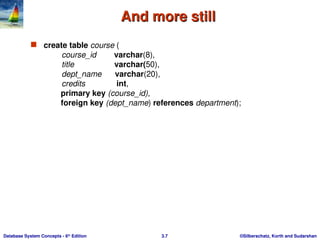
And more still
And more still
create table course (
course_id varchar(8),
title varchar(50),
dept_name varchar(20),
credits int,
primary key (course_id),
foreign key (dept_name) references department);
- 8.
©Silberschatz, Korth andSudarshan
3.8
Database System Concepts - 6th
Edition
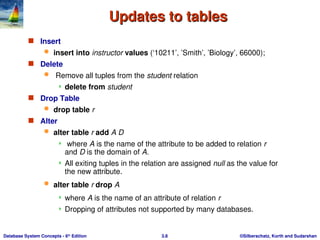
Updates to tables
Updates to tables
Insert
insert into instructor values (‘10211’, ’Smith’, ’Biology’, 66000);
Delete
Remove all tuples from the student relation
delete from student
Drop Table
drop table r
Alter
alter table r add A D
where A is the name of the attribute to be added to relation r
and D is the domain of A.
All exiting tuples in the relation are assigned null as the value for
the new attribute.
alter table r drop A
where A is the name of an attribute of relation r
Dropping of attributes not supported by many databases.
- 9.
©Silberschatz, Korth andSudarshan
3.9
Database System Concepts - 6th
Edition
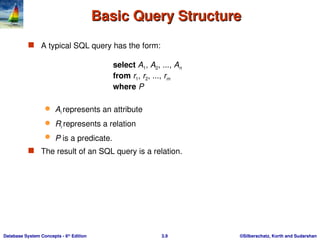
Basic Query Structure
Basic Query Structure
A typical SQL query has the form:
select A1, A2, ..., An
from r1, r2, ..., rm
where P
Ai represents an attribute
Ri represents a relation
P is a predicate.
The result of an SQL query is a relation.
- 10.
©Silberschatz, Korth andSudarshan
3.10
Database System Concepts - 6th
Edition
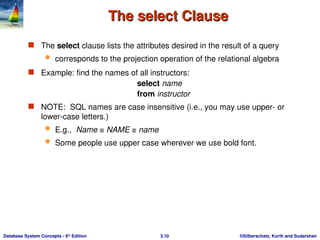
The select Clause
The select Clause
The select clause lists the attributes desired in the result of a query
corresponds to the projection operation of the relational algebra
Example: find the names of all instructors:
select name
from instructor
NOTE: SQL names are case insensitive (i.e., you may use upper- or
lower-case letters.)
E.g., Name ≡ NAME ≡ name
Some people use upper case wherever we use bold font.
- 11.
©Silberschatz, Korth andSudarshan
3.11
Database System Concepts - 6th
Edition
The select Clause (Cont.)
The select Clause (Cont.)
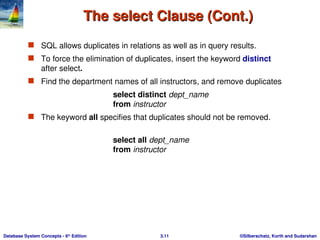
SQL allows duplicates in relations as well as in query results.
To force the elimination of duplicates, insert the keyword distinct
after select.
Find the department names of all instructors, and remove duplicates
select distinct dept_name
from instructor
The keyword all specifies that duplicates should not be removed.
select all dept_name
from instructor
- 12.
©Silberschatz, Korth andSudarshan
3.12
Database System Concepts - 6th
Edition
The select Clause (Cont.)
The select Clause (Cont.)
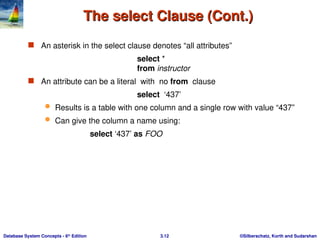
An asterisk in the select clause denotes “all attributes”
select *
from instructor
An attribute can be a literal with no from clause
select ‘437’
Results is a table with one column and a single row with value “437”
Can give the column a name using:
select ‘437’ as FOO
- 13.
©Silberschatz, Korth andSudarshan
3.13
Database System Concepts - 6th
Edition
The select Clause (Cont.)
The select Clause (Cont.)
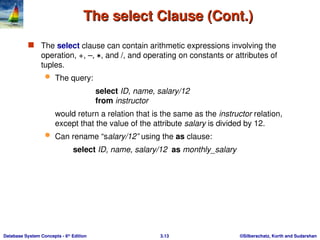
The select clause can contain arithmetic expressions involving the
operation, +, –, , and /, and operating on constants or attributes of
tuples.
The query:
select ID, name, salary/12
from instructor
would return a relation that is the same as the instructor relation,
except that the value of the attribute salary is divided by 12.
Can rename “salary/12” using the as clause:
select ID, name, salary/12 as monthly_salary
- 14.
©Silberschatz, Korth andSudarshan
3.14
Database System Concepts - 6th
Edition
The where Clause
The where Clause
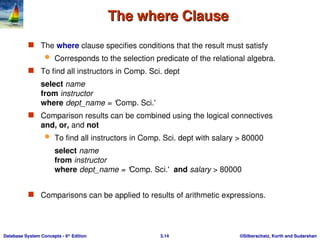
The where clause specifies conditions that the result must satisfy
Corresponds to the selection predicate of the relational algebra.
To find all instructors in Comp. Sci. dept
select name
from instructor
where dept_name = ‘Comp. Sci.'
Comparison results can be combined using the logical connectives
and, or, and not
To find all instructors in Comp. Sci. dept with salary > 80000
select name
from instructor
where dept_name = ‘Comp. Sci.' and salary > 80000
Comparisons can be applied to results of arithmetic expressions.
- 15.
©Silberschatz, Korth andSudarshan
3.15
Database System Concepts - 6th
Edition
The from Clause
The from Clause
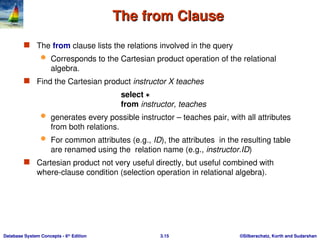
The from clause lists the relations involved in the query
Corresponds to the Cartesian product operation of the relational
algebra.
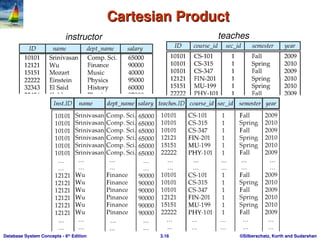
Find the Cartesian product instructor X teaches
select
from instructor, teaches
generates every possible instructor – teaches pair, with all attributes
from both relations.
For common attributes (e.g., ID), the attributes in the resulting table
are renamed using the relation name (e.g., instructor.ID)
Cartesian product not very useful directly, but useful combined with
where-clause condition (selection operation in relational algebra).
- 16.
©Silberschatz, Korth andSudarshan
3.16
Database System Concepts - 6th
Edition
Cartesian Product
Cartesian Product
instructor teaches
- 17.
©Silberschatz, Korth andSudarshan
3.17
Database System Concepts - 6th
Edition
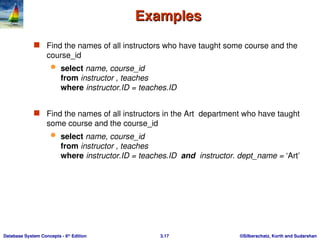
Examples
Examples
Find the names of all instructors who have taught some course and the
course_id
select name, course_id
from instructor , teaches
where instructor.ID = teaches.ID
Find the names of all instructors in the Art department who have taught
some course and the course_id
select name, course_id
from instructor , teaches
where instructor.ID = teaches.ID and instructor. dept_name = ‘Art’
- 18.
©Silberschatz, Korth andSudarshan
3.18
Database System Concepts - 6th
Edition
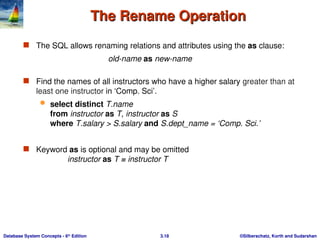
The Rename Operation
The Rename Operation
The SQL allows renaming relations and attributes using the as clause:
old-name as new-name
Find the names of all instructors who have a higher salary greater than at
least one instructor in ‘Comp. Sci’.
select distinct T.name
from instructor as T, instructor as S
where T.salary > S.salary and S.dept_name = ‘Comp. Sci.’
Keyword as is optional and may be omitted
instructor as T ≡ instructor T
- 19.
©Silberschatz, Korth andSudarshan
3.19
Database System Concepts - 6th
Edition
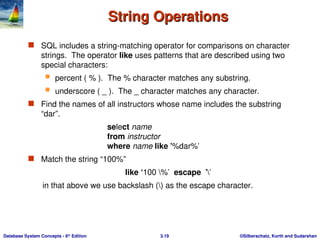
String Operations
String Operations
SQL includes a string-matching operator for comparisons on character
strings. The operator like uses patterns that are described using two
special characters:
percent ( % ). The % character matches any substring.
underscore ( _ ). The _ character matches any character.
Find the names of all instructors whose name includes the substring
“dar”.
select name
from instructor
where name like '%dar%'
Match the string “100%”
like ‘100 %' escape ''
in that above we use backslash () as the escape character.
- 20.
©Silberschatz, Korth andSudarshan
3.20
Database System Concepts - 6th
Edition
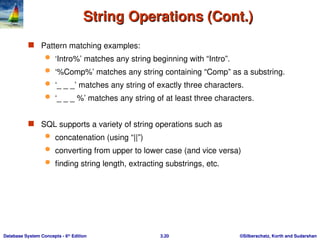
String Operations (Cont.)
String Operations (Cont.)
Pattern matching examples:
‘Intro%’ matches any string beginning with “Intro”.
‘%Comp%’ matches any string containing “Comp” as a substring.
‘_ _ _’ matches any string of exactly three characters.
‘_ _ _ %’ matches any string of at least three characters.
SQL supports a variety of string operations such as
concatenation (using “||”)
converting from upper to lower case (and vice versa)
finding string length, extracting substrings, etc.
- 21.
©Silberschatz, Korth andSudarshan
3.21
Database System Concepts - 6th
Edition
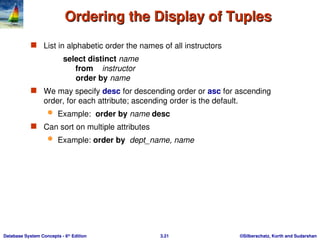
Ordering the Display of Tuples
Ordering the Display of Tuples
List in alphabetic order the names of all instructors
select distinct name
from instructor
order by name
We may specify desc for descending order or asc for ascending
order, for each attribute; ascending order is the default.
Example: order by name desc
Can sort on multiple attributes
Example: order by dept_name, name
- 22.
©Silberschatz, Korth andSudarshan
3.22
Database System Concepts - 6th
Edition
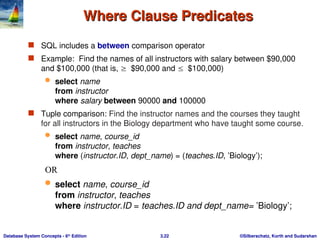
Where Clause Predicates
Where Clause Predicates
SQL includes a between comparison operator
Example: Find the names of all instructors with salary between $90,000
and $100,000 (that is, $90,000 and $100,000)
select name
from instructor
where salary between 90000 and 100000
Tuple comparison: Find the instructor names and the courses they taught
for all instructors in the Biology department who have taught some course.
select name, course_id
from instructor, teaches
where (instructor.ID, dept_name) = (teaches.ID, ’Biology’);
OR
select name, course_id
from instructor, teaches
where instructor.ID = teaches.ID and dept_name= ’Biology’;
- 23.
©Silberschatz, Korth andSudarshan
3.23
Database System Concepts - 6th
Edition
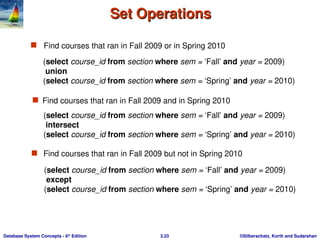
Set Operations
Set Operations
Find courses that ran in Fall 2009 or in Spring 2010
Find courses that ran in Fall 2009 but not in Spring 2010
(select course_id from section where sem = ‘Fall’ and year = 2009)
union
(select course_id from section where sem = ‘Spring’ and year = 2010)
Find courses that ran in Fall 2009 and in Spring 2010
(select course_id from section where sem = ‘Fall’ and year = 2009)
intersect
(select course_id from section where sem = ‘Spring’ and year = 2010)
(select course_id from section where sem = ‘Fall’ and year = 2009)
except
(select course_id from section where sem = ‘Spring’ and year = 2010)
- 24.
©Silberschatz, Korth andSudarshan
3.24
Database System Concepts - 6th
Edition
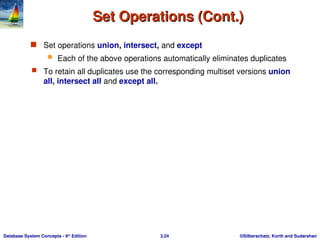
Set Operations (Cont.)
Set Operations (Cont.)
Set operations union, intersect, and except
Each of the above operations automatically eliminates duplicates
To retain all duplicates use the corresponding multiset versions union
all, intersect all and except all.
- 25.
©Silberschatz, Korth andSudarshan
3.25
Database System Concepts - 6th
Edition
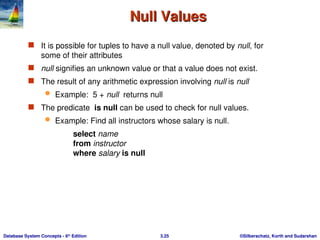
Null Values
Null Values
It is possible for tuples to have a null value, denoted by null, for
some of their attributes
null signifies an unknown value or that a value does not exist.
The result of any arithmetic expression involving null is null
Example: 5 + null returns null
The predicate is null can be used to check for null values.
Example: Find all instructors whose salary is null.
select name
from instructor
where salary is null
- 26.
©Silberschatz, Korth andSudarshan
3.26
Database System Concepts - 6th
Edition
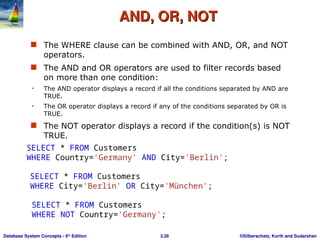
AND, OR, NOT
AND, OR, NOT
The WHERE clause can be combined with AND, OR, and NOT
operators.
The AND and OR operators are used to filter records based
on more than one condition:
• The AND operator displays a record if all the conditions separated by AND are
TRUE.
• The OR operator displays a record if any of the conditions separated by OR is
TRUE.
The NOT operator displays a record if the condition(s) is NOT
TRUE.
SELECT * FROM Customers
WHERE Country='Germany' AND City='Berlin';
SELECT * FROM Customers
WHERE City='Berlin' OR City='München';
SELECT * FROM Customers
WHERE NOT Country='Germany';
- 27.
©Silberschatz, Korth andSudarshan
3.27
Database System Concepts - 6th
Edition
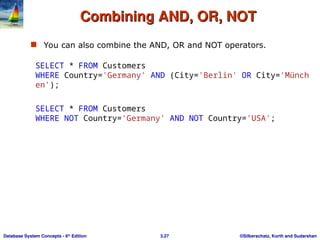
Combining AND, OR, NOT
Combining AND, OR, NOT
You can also combine the AND, OR and NOT operators.
SELECT * FROM Customers
WHERE Country='Germany' AND (City='Berlin' OR City='Münch
en');
SELECT * FROM Customers
WHERE NOT Country='Germany' AND NOT Country='USA';
- 28.
©Silberschatz, Korth andSudarshan
3.28
Database System Concepts - 6th
Edition
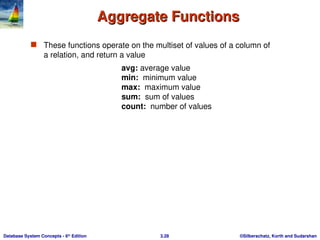
Aggregate Functions
Aggregate Functions
These functions operate on the multiset of values of a column of
a relation, and return a value
avg: average value
min: minimum value
max: maximum value
sum: sum of values
count: number of values
- 29.
©Silberschatz, Korth andSudarshan
3.29
Database System Concepts - 6th
Edition
Aggregate Functions (Cont.)
Aggregate Functions (Cont.)
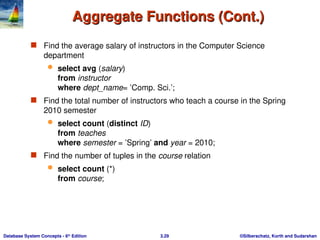
Find the average salary of instructors in the Computer Science
department
select avg (salary)
from instructor
where dept_name= ’Comp. Sci.’;
Find the total number of instructors who teach a course in the Spring
2010 semester
select count (distinct ID)
from teaches
where semester = ’Spring’ and year = 2010;
Find the number of tuples in the course relation
select count (*)
from course;
- 30.
©Silberschatz, Korth andSudarshan
3.30
Database System Concepts - 6th
Edition
Aggregate Functions – Group By
Aggregate Functions – Group By
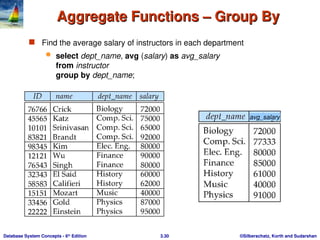
Find the average salary of instructors in each department
select dept_name, avg (salary) as avg_salary
from instructor
group by dept_name;
avg_salary
- 31.
©Silberschatz, Korth andSudarshan
3.31
Database System Concepts - 6th
Edition
Aggregation (Cont.)
Aggregation (Cont.)
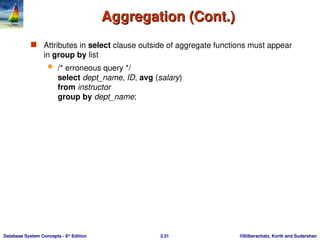
Attributes in select clause outside of aggregate functions must appear
in group by list
/* erroneous query */
select dept_name, ID, avg (salary)
from instructor
group by dept_name;
- 32.
©Silberschatz, Korth andSudarshan
3.32
Database System Concepts - 6th
Edition
Aggregate Functions – Having Clause
Aggregate Functions – Having Clause
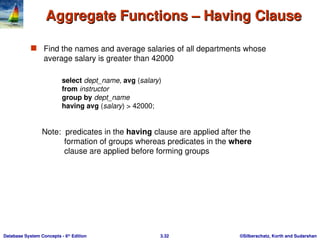
Find the names and average salaries of all departments whose
average salary is greater than 42000
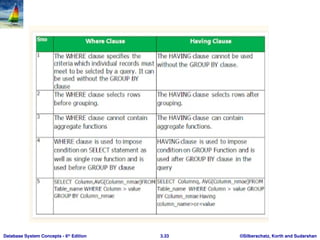
Note: predicates in the having clause are applied after the
formation of groups whereas predicates in the where
clause are applied before forming groups
select dept_name, avg (salary)
from instructor
group by dept_name
having avg (salary) > 42000;
- 33.
- 34.
©Silberschatz, Korth andSudarshan
3.34
Database System Concepts - 6th
Edition
Nested Subqueries
Nested Subqueries
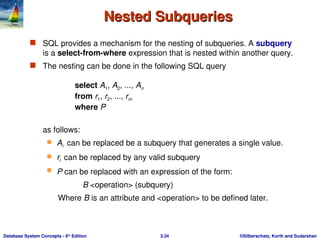
SQL provides a mechanism for the nesting of subqueries. A subquery
is a select-from-where expression that is nested within another query.
The nesting can be done in the following SQL query
select A1, A2, ..., An
from r1, r2, ..., rm
where P
as follows:
Ai can be replaced be a subquery that generates a single value.
ri can be replaced by any valid subquery
P can be replaced with an expression of the form:
B <operation> (subquery)
Where B is an attribute and <operation> to be defined later.
- 35.
©Silberschatz, Korth andSudarshan
3.35
Database System Concepts - 6th
Edition
Subqueries in the Where Clause
Subqueries in the Where Clause
- 36.
©Silberschatz, Korth andSudarshan
3.36
Database System Concepts - 6th
Edition
Subqueries in the Where Clause
Subqueries in the Where Clause
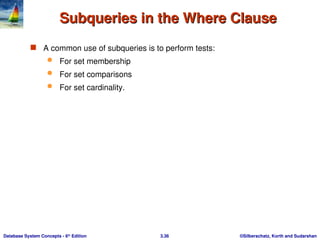
A common use of subqueries is to perform tests:
For set membership
For set comparisons
For set cardinality.
- 37.
©Silberschatz, Korth andSudarshan
3.37
Database System Concepts - 6th
Edition
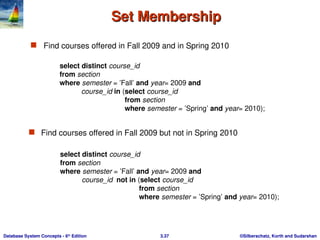
Set Membership
Set Membership
Find courses offered in Fall 2009 and in Spring 2010
Find courses offered in Fall 2009 but not in Spring 2010
select distinct course_id
from section
where semester = ’Fall’ and year= 2009 and
course_id in (select course_id
from section
where semester = ’Spring’ and year= 2010);
select distinct course_id
from section
where semester = ’Fall’ and year= 2009 and
course_id not in (select course_id
from section
where semester = ’Spring’ and year= 2010);
- 38.
©Silberschatz, Korth andSudarshan
3.38
Database System Concepts - 6th
Edition
Set Membership (Cont.)
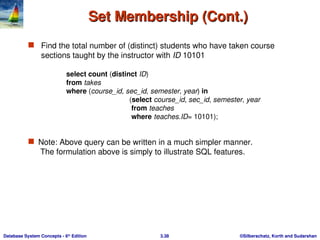
Set Membership (Cont.)
Find the total number of (distinct) students who have taken course
sections taught by the instructor with ID 10101
Note: Above query can be written in a much simpler manner.
The formulation above is simply to illustrate SQL features.
select count (distinct ID)
from takes
where (course_id, sec_id, semester, year) in
(select course_id, sec_id, semester, year
from teaches
where teaches.ID= 10101);
- 39.
©Silberschatz, Korth andSudarshan
3.39
Database System Concepts - 6th
Edition
Set Comparison – “some” Clause
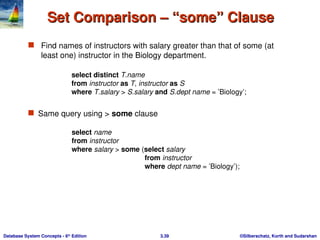
Set Comparison – “some” Clause
Find names of instructors with salary greater than that of some (at
least one) instructor in the Biology department.
Same query using > some clause
select name
from instructor
where salary > some (select salary
from instructor
where dept name = ’Biology’);
select distinct T.name
from instructor as T, instructor as S
where T.salary > S.salary and S.dept name = ’Biology’;
- 40.
©Silberschatz, Korth andSudarshan
3.40
Database System Concepts - 6th
Edition
Definition of “some” Clause
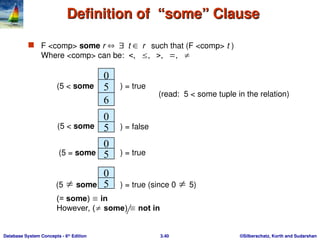
Definition of “some” Clause
F <comp> some r t r such that (F <comp> t )
Where <comp> can be:
0
5
6
(5 < some ) = true
0
5
0
) = false
5
0
5
(5 some ) = true (since 0 5)
(read: 5 < some tuple in the relation)
(5 < some
) = true
(5 = some
(= some) in
However, ( some) not in
- 41.
©Silberschatz, Korth andSudarshan
3.41
Database System Concepts - 6th
Edition
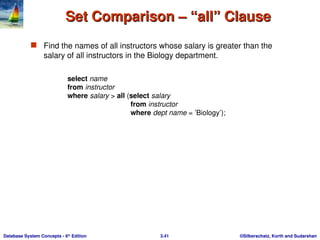
Set Comparison – “all” Clause
Set Comparison – “all” Clause
Find the names of all instructors whose salary is greater than the
salary of all instructors in the Biology department.
select name
from instructor
where salary > all (select salary
from instructor
where dept name = ’Biology’);
- 42.
©Silberschatz, Korth andSudarshan
3.42
Database System Concepts - 6th
Edition
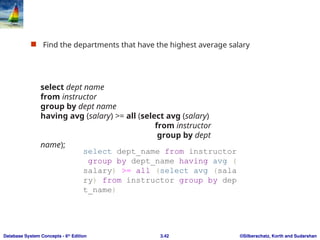
Find the departments that have the highest average salary
select dept name
from instructor
group by dept name
having avg (salary) >= all (select avg (salary)
from instructor
group by dept
name);
select dept_name from instructor
group by dept_name having avg (
salary) >= all (select avg (sala
ry) from instructor group by dep
t_name)
- 43.
©Silberschatz, Korth andSudarshan
3.43
Database System Concepts - 6th
Edition
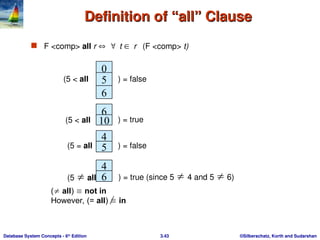
Definition of “all” Clause
Definition of “all” Clause
F <comp> all r t r (F <comp> t)
0
5
6
(5 < all ) = false
6
10
4
) = true
5
4
6
(5 all ) = true (since 5 4 and 5 6)
(5 < all
) = false
(5 = all
( all) not in
However, (= all) in
- 44.
©Silberschatz, Korth andSudarshan
3.44
Database System Concepts - 6th
Edition
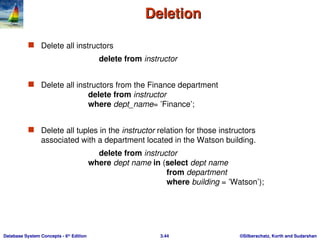
Deletion
Deletion
Delete all instructors
delete from instructor
Delete all instructors from the Finance department
delete from instructor
where dept_name= ’Finance’;
Delete all tuples in the instructor relation for those instructors
associated with a department located in the Watson building.
delete from instructor
where dept name in (select dept name
from department
where building = ’Watson’);
- 45.
©Silberschatz, Korth andSudarshan
3.45
Database System Concepts - 6th
Edition
Deletion (Cont.)
Deletion (Cont.)
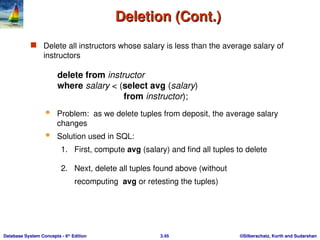
Delete all instructors whose salary is less than the average salary of
instructors
delete from instructor
where salary < (select avg (salary)
from instructor);
Problem: as we delete tuples from deposit, the average salary
changes
Solution used in SQL:
1. First, compute avg (salary) and find all tuples to delete
2. Next, delete all tuples found above (without
recomputing avg or retesting the tuples)
- 46.
©Silberschatz, Korth andSudarshan
3.46
Database System Concepts - 6th
Edition
Insertion
Insertion
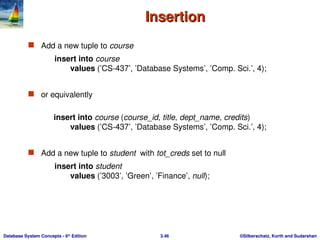
Add a new tuple to course
insert into course
values (’CS-437’, ’Database Systems’, ’Comp. Sci.’, 4);
or equivalently
insert into course (course_id, title, dept_name, credits)
values (’CS-437’, ’Database Systems’, ’Comp. Sci.’, 4);
Add a new tuple to student with tot_creds set to null
insert into student
values (’3003’, ’Green’, ’Finance’, null);
- 47.
©Silberschatz, Korth andSudarshan
3.47
Database System Concepts - 6th
Edition
Insertion (Cont.)
Insertion (Cont.)
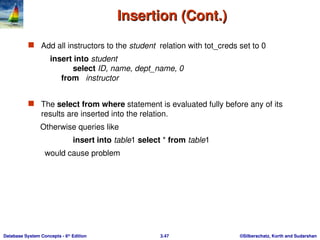
Add all instructors to the student relation with tot_creds set to 0
insert into student
select ID, name, dept_name, 0
from instructor
The select from where statement is evaluated fully before any of its
results are inserted into the relation.
Otherwise queries like
insert into table1 select * from table1
would cause problem
- 48.
©Silberschatz, Korth andSudarshan
3.48
Database System Concepts - 6th
Edition
Updates
Updates
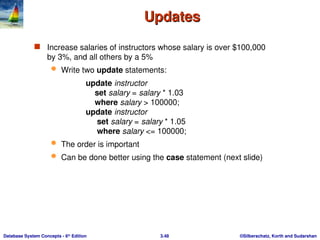
Increase salaries of instructors whose salary is over $100,000
by 3%, and all others by a 5%
Write two update statements:
update instructor
set salary = salary * 1.03
where salary > 100000;
update instructor
set salary = salary * 1.05
where salary <= 100000;
The order is important
Can be done better using the case statement (next slide)
- 49.
©Silberschatz, Korth andSudarshan
3.49
Database System Concepts - 6th
Edition
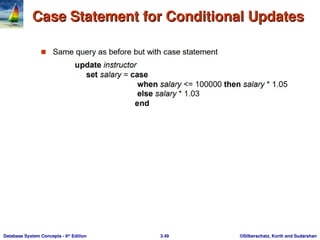
Case Statement for Conditional Updates
Case Statement for Conditional Updates
- 50.
Database System Concepts,6th
Ed.
©Silberschatz, Korth and Sudarshan
See www.db-book.com for conditions on re-use
End of Chapter 3
End of Chapter 3
Editor's Notes
- #1 The slides for this text are organized into chapters. This lecture covers Chapter 1.
Chapter 1: Introduction to Database Systems
Chapter 2: The Entity-Relationship Model
Chapter 3: The Relational Model
Chapter 4 (Part A): Relational Algebra
Chapter 4 (Part B): Relational Calculus
Chapter 5: SQL: Queries, Programming, Triggers
Chapter 6: Query-by-Example (QBE)
Chapter 7: Storing Data: Disks and Files
Chapter 8: File Organizations and Indexing
Chapter 9: Tree-Structured Indexing
Chapter 10: Hash-Based Indexing
Chapter 11: External Sorting
Chapter 12 (Part A): Evaluation of Relational Operators
Chapter 12 (Part B): Evaluation of Relational Operators: Other Techniques
Chapter 13: Introduction to Query Optimization
Chapter 14: A Typical Relational Optimizer
Chapter 15: Schema Refinement and Normal Forms
Chapter 16 (Part A): Physical Database Design
Chapter 16 (Part B): Database Tuning
Chapter 17: Security
Chapter 18: Transaction Management Overview
Chapter 19: Concurrency Control
Chapter 20: Crash Recovery
Chapter 21: Parallel and Distributed Databases
Chapter 22: Internet Databases
Chapter 23: Decision Support
Chapter 24: Data Mining
Chapter 25: Object-Database Systems
Chapter 26: Spatial Data Management
Chapter 27: Deductive Databases
Chapter 28: Additional Topics