1
Polymorphism
2
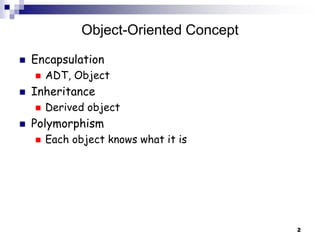
Object-Oriented Concept
 Encapsulation
 ADT, Object
 Inheritance
 Derived object
 Polymorphism
 Each object knows what it is
3
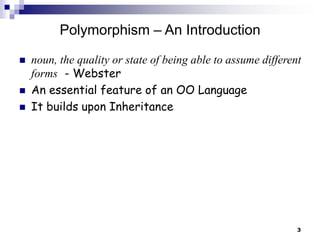
Polymorphism – An Introduction
 noun, the quality or state of being able to assume different
forms - Webster
 An essential feature of an OO Language
 It builds upon Inheritance
4
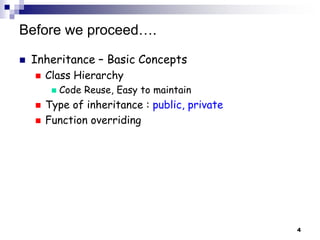
Before we proceed….
 Inheritance – Basic Concepts
 Class Hierarchy
 Code Reuse, Easy to maintain
 Type of inheritance : public, private
 Function overriding
5
Class Interface Diagram
Protected data:
hrs
mins
secs
ExtTime class
Set
Increment
Write
Time
Time
Set
Increment
Write
ExtTime
ExtTime
Private data:
zone
Time class
6
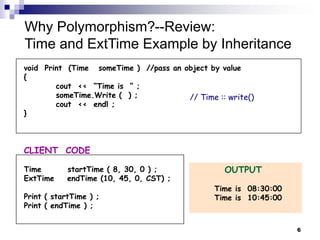
Why Polymorphism?--Review:
Time and ExtTime Example by Inheritance
void Print (Time someTime ) //pass an object by value
{
cout << “Time is “ ;
someTime.Write ( ) ;
cout << endl ;
}
CLIENT CODE
Time startTime ( 8, 30, 0 ) ;
ExtTime endTime (10, 45, 0, CST) ;
Print ( startTime ) ;
Print ( endTime ) ;
OUTPUT
Time is 08:30:00
Time is 10:45:00
// Time :: write()
7
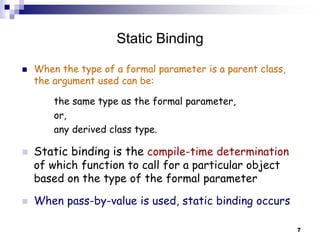
Static Binding
 When the type of a formal parameter is a parent class,
the argument used can be:
the same type as the formal parameter,
or,
any derived class type.
 Static binding is the compile-time determination
of which function to call for a particular object
based on the type of the formal parameter
 When pass-by-value is used, static binding occurs
8
Can we do better?
void Print (Time someTime ) //pass an object by value
{
cout << “Time is “ ;
someTime.Write ( ) ;
cout << endl ;
}
CLIENT CODE
Time startTime ( 8, 30, 0 ) ;
ExtTime endTime (10, 45, 0, CST) ;
Print ( startTime ) ;
Print ( endTime ) ;
OUTPUT
Time is 08:30:00
Time is 10:45:00
// Time :: write()
9
Polymorphism – An Introduction
 noun, the quality or state of being able to assume different
forms - Webster
 An essential feature of an OO Language
 It builds upon Inheritance
 Allows run-time interpretation of object type for
a given class hierarchy
 Also Known as “Late Binding”
 Implemented in C++ using virtual functions
10
Dynamic Binding
 Is the run-time determination of which function to
call for a particular object of a derived class based
on the type of the argument
 Declaring a member function to be virtual instructs
the compiler to generate code that guarantees
dynamic binding
 Dynamic binding requires pass-by-reference
11
Virtual Member Function
// SPECIFICATION FILE ( time.h )
class Time
{
public :
. . .
virtual void Write ( ) ; // for dynamic binding
virtual ~Time(); // destructor
private :
int hrs ;
int mins ;
int secs ;
} ;
12
This is the way we like to see…
void Print (Time * someTime )
{
cout << “Time is “ ;
someTime->Write ( ) ;
cout << endl ;
}
CLIENT CODE
Time startTime( 8, 30, 0 ) ;
ExtTime endTime(10, 45, 0, CST) ;
Time *timeptr;
timeptr = &startTime;
Print ( timeptr ) ;
timeptr = &endTime;
Print ( timeptr ) ;
OUTPUT
Time is 08:30:00
Time is 10:45:00 CST
Time::write()
ExtTime::write()
13
Virtual Functions
 Virtual Functions overcome the problem of run time object
determination
 Keyword virtual instructs the compiler to use late binding
and delay the object interpretation
 How ?
 Define a virtual function in the base class. The word virtual
appears only in the base class
 If a base class declares a virtual function, it must
implement that function, even if the body is empty
 Virtual function in base class stays virtual in all the derived
classes
 It can be overridden in the derived classes
 But, a derived class is not required to re-implement a
virtual function. If it does not, the base class version
is used
14
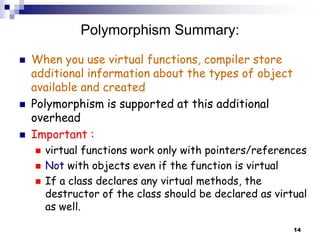
Polymorphism Summary:
 When you use virtual functions, compiler store
additional information about the types of object
available and created
 Polymorphism is supported at this additional
overhead
 Important :
 virtual functions work only with pointers/references
 Not with objects even if the function is virtual
 If a class declares any virtual methods, the
destructor of the class should be declared as virtual
as well.
15
Abstract Classes & Pure Virtual Functions
 Some classes exist logically but not physically.
 Example : Shape
 Shape s; // Legal but silly..!! : “Shapeless shape”
 Shape makes sense only as a base of some classes
derived from it. Serves as a “category”
 Hence instantiation of such a class must be prevented
class Shape //Abstract
{
public :
//Pure virtual Function
virtual void draw() = 0;
}
 A class with one or more pure virtual
functions is an Abstract Class
 Objects of abstract class can’t be
created
Shape s; // error : variable of an abstract class
16
Example
Shape
virtual void draw()
Circle
public void draw()
Triangle
public void draw()
17
 A pure virtual function not defined in the derived
class remains a pure virtual function.
 Hence derived class also becomes abstract
class Circle : public Shape { //No draw() - Abstract
public :
void print(){
cout << “I am a circle” << endl;
}
class Rectangle : public Shape {
public :
void draw(){ // Override Shape::draw()
cout << “Drawing Rectangle” << endl;
}
Rectangle r; // Valid
Circle c; // error : variable of an abstract class
18
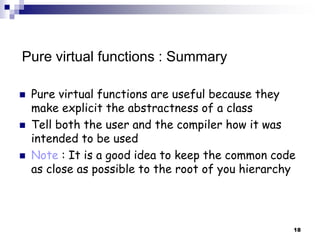
Pure virtual functions : Summary
 Pure virtual functions are useful because they
make explicit the abstractness of a class
 Tell both the user and the compiler how it was
intended to be used
 Note : It is a good idea to keep the common code
as close as possible to the root of you hierarchy
19
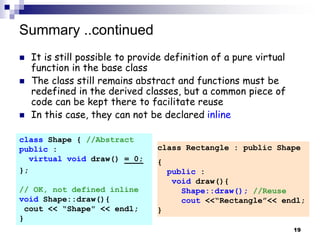
Summary ..continued
 It is still possible to provide definition of a pure virtual
function in the base class
 The class still remains abstract and functions must be
redefined in the derived classes, but a common piece of
code can be kept there to facilitate reuse
 In this case, they can not be declared inline
class Shape { //Abstract
public :
virtual void draw() = 0;
};
// OK, not defined inline
void Shape::draw(){
cout << “Shape" << endl;
}
class Rectangle : public Shape
{
public :
void draw(){
Shape::draw(); //Reuse
cout <<“Rectangle”<< endl;
}
20
Take Home Message
 Polymorphism is built upon class inheritance
 It allows different versions of a function to be
called in the same manner, with some overhead
 Polymorphism is implemented with virtual
functions, and requires pass-by-reference

Lecture6.ppt

  • 1.
  • 2.
    2 Object-Oriented Concept  Encapsulation ADT, Object  Inheritance  Derived object  Polymorphism  Each object knows what it is
  • 3.
    3 Polymorphism – AnIntroduction  noun, the quality or state of being able to assume different forms - Webster  An essential feature of an OO Language  It builds upon Inheritance
  • 4.
    4 Before we proceed…. Inheritance – Basic Concepts  Class Hierarchy  Code Reuse, Easy to maintain  Type of inheritance : public, private  Function overriding
  • 5.
    5 Class Interface Diagram Protecteddata: hrs mins secs ExtTime class Set Increment Write Time Time Set Increment Write ExtTime ExtTime Private data: zone Time class
  • 6.
    6 Why Polymorphism?--Review: Time andExtTime Example by Inheritance void Print (Time someTime ) //pass an object by value { cout << “Time is “ ; someTime.Write ( ) ; cout << endl ; } CLIENT CODE Time startTime ( 8, 30, 0 ) ; ExtTime endTime (10, 45, 0, CST) ; Print ( startTime ) ; Print ( endTime ) ; OUTPUT Time is 08:30:00 Time is 10:45:00 // Time :: write()
  • 7.
    7 Static Binding  Whenthe type of a formal parameter is a parent class, the argument used can be: the same type as the formal parameter, or, any derived class type.  Static binding is the compile-time determination of which function to call for a particular object based on the type of the formal parameter  When pass-by-value is used, static binding occurs
  • 8.
    8 Can we dobetter? void Print (Time someTime ) //pass an object by value { cout << “Time is “ ; someTime.Write ( ) ; cout << endl ; } CLIENT CODE Time startTime ( 8, 30, 0 ) ; ExtTime endTime (10, 45, 0, CST) ; Print ( startTime ) ; Print ( endTime ) ; OUTPUT Time is 08:30:00 Time is 10:45:00 // Time :: write()
  • 9.
    9 Polymorphism – AnIntroduction  noun, the quality or state of being able to assume different forms - Webster  An essential feature of an OO Language  It builds upon Inheritance  Allows run-time interpretation of object type for a given class hierarchy  Also Known as “Late Binding”  Implemented in C++ using virtual functions
  • 10.
    10 Dynamic Binding  Isthe run-time determination of which function to call for a particular object of a derived class based on the type of the argument  Declaring a member function to be virtual instructs the compiler to generate code that guarantees dynamic binding  Dynamic binding requires pass-by-reference
  • 11.
    11 Virtual Member Function //SPECIFICATION FILE ( time.h ) class Time { public : . . . virtual void Write ( ) ; // for dynamic binding virtual ~Time(); // destructor private : int hrs ; int mins ; int secs ; } ;
  • 12.
    12 This is theway we like to see… void Print (Time * someTime ) { cout << “Time is “ ; someTime->Write ( ) ; cout << endl ; } CLIENT CODE Time startTime( 8, 30, 0 ) ; ExtTime endTime(10, 45, 0, CST) ; Time *timeptr; timeptr = &startTime; Print ( timeptr ) ; timeptr = &endTime; Print ( timeptr ) ; OUTPUT Time is 08:30:00 Time is 10:45:00 CST Time::write() ExtTime::write()
  • 13.
    13 Virtual Functions  VirtualFunctions overcome the problem of run time object determination  Keyword virtual instructs the compiler to use late binding and delay the object interpretation  How ?  Define a virtual function in the base class. The word virtual appears only in the base class  If a base class declares a virtual function, it must implement that function, even if the body is empty  Virtual function in base class stays virtual in all the derived classes  It can be overridden in the derived classes  But, a derived class is not required to re-implement a virtual function. If it does not, the base class version is used
  • 14.
    14 Polymorphism Summary:  Whenyou use virtual functions, compiler store additional information about the types of object available and created  Polymorphism is supported at this additional overhead  Important :  virtual functions work only with pointers/references  Not with objects even if the function is virtual  If a class declares any virtual methods, the destructor of the class should be declared as virtual as well.
  • 15.
    15 Abstract Classes &Pure Virtual Functions  Some classes exist logically but not physically.  Example : Shape  Shape s; // Legal but silly..!! : “Shapeless shape”  Shape makes sense only as a base of some classes derived from it. Serves as a “category”  Hence instantiation of such a class must be prevented class Shape //Abstract { public : //Pure virtual Function virtual void draw() = 0; }  A class with one or more pure virtual functions is an Abstract Class  Objects of abstract class can’t be created Shape s; // error : variable of an abstract class
  • 16.
    16 Example Shape virtual void draw() Circle publicvoid draw() Triangle public void draw()
  • 17.
    17  A purevirtual function not defined in the derived class remains a pure virtual function.  Hence derived class also becomes abstract class Circle : public Shape { //No draw() - Abstract public : void print(){ cout << “I am a circle” << endl; } class Rectangle : public Shape { public : void draw(){ // Override Shape::draw() cout << “Drawing Rectangle” << endl; } Rectangle r; // Valid Circle c; // error : variable of an abstract class
  • 18.
    18 Pure virtual functions: Summary  Pure virtual functions are useful because they make explicit the abstractness of a class  Tell both the user and the compiler how it was intended to be used  Note : It is a good idea to keep the common code as close as possible to the root of you hierarchy
  • 19.
    19 Summary ..continued  Itis still possible to provide definition of a pure virtual function in the base class  The class still remains abstract and functions must be redefined in the derived classes, but a common piece of code can be kept there to facilitate reuse  In this case, they can not be declared inline class Shape { //Abstract public : virtual void draw() = 0; }; // OK, not defined inline void Shape::draw(){ cout << “Shape" << endl; } class Rectangle : public Shape { public : void draw(){ Shape::draw(); //Reuse cout <<“Rectangle”<< endl; }
  • 20.
    20 Take Home Message Polymorphism is built upon class inheritance  It allows different versions of a function to be called in the same manner, with some overhead  Polymorphism is implemented with virtual functions, and requires pass-by-reference