1. Introduction
2. ProcessIdentification
3. Essential Process Modeling
4. Advanced Process Modeling
5. Process Discovery
6. Qualitative Process Analysis
7. Quantitative Process Analysis
8. Process Redesign
9. Process Automation
10.Process Intelligence
4.
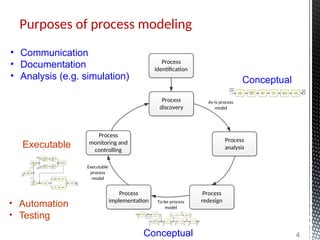
Purposes of processmodeling
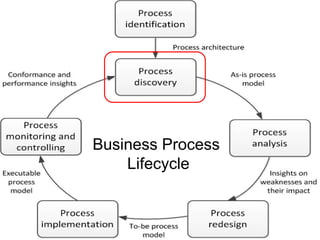
Process
identification
Conformance and
performance insights
Conformance and
performance insights
Process
monitoring and
controlling
Executable
process
model
Executable
process
model
Process
implementation To-be process
model
To-be process
model
Process
analysis
As-is process
model
As-is process
model
Process
discovery
Process architecture
Process architecture
Process
redesign
Insights on
weaknesses and
their impact
Insights on
weaknesses and
their impact
4
• Communication
• Documentation
• Analysis (e.g. simulation)
• Automation
• Testing
Conceptual
Conceptual
Executable
5.
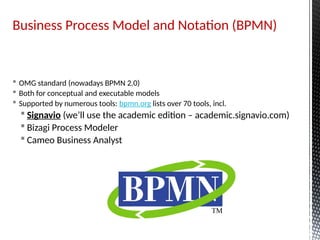
Business Process Modeland Notation (BPMN)
OMG standard (nowadays BPMN 2.0)
Both for conceptual and executable models
Supported by numerous tools: bpmn.org lists over 70 tools, incl.
Signavio (we’ll use the academic edition – academic.signavio.com)
Bizagi Process Modeler
Cameo Business Analyst
6.
BPMN from 10,000miles…
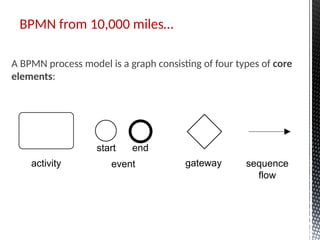
A BPMN process model is a graph consisting of four types of core
elements:
activity gateway
event sequence
flow
start end
7.
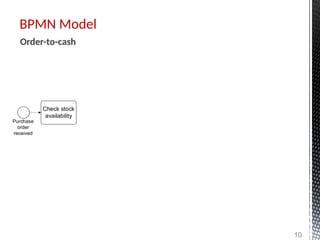
An order-to-cash processis triggered by the receipt of a
purchase order from a customer. Upon receipt, the purchase
order has to be checked against the stock to determine if the
the requested item(s) are available. Depending on stock
availability the purchase order may be confirmed or rejected.
If the purchase order is confirmed, an invoice is emitted and the
goods requested are shipped. The process completes by
archiving the order.
Let’s start modeling
Order-to-cash
8.
• An order-to-cashprocess is triggered by the receipt of a
purchase order from a customer.
• Upon receipt, the purchase order has to be checked against
the stock to determine if the the requested item(s) are
available.
• Depending on stock availability the purchase order may be
confirmed or rejected.
• If the purchase order is confirmed, an invoice is emitted and
the goods requested are shipped. The process completes by
archiving the order.
Let’s start modeling – break it down
Order-to-cash
9.
• An order-to-cashprocess is triggered by the receipt of a
purchase order from a customer.
• Upon receipt, the purchase order has to be checked against
the stock to determine if the the requested item(s) are
available.
Let’s start modeling – break it down
Order-to-cash
• An order-to-cashprocess is triggered by the receipt of a
purchase order from a customer.
• Upon receipt, the purchase order has to be checked against
the stock to determine if the the requested item(s) are
available.
• Depending on stock availability the purchase order may be
confirmed or rejected.
• If the purchase order is confirmed, an invoice is emitted and
the goods requested are shipped. The process completes by
archiving the order.
Let’s start modeling – break it down
Order-to-cash
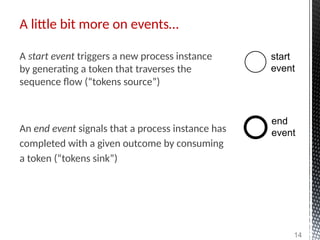
A start eventtriggers a new process instance
by generating a token that traverses the
sequence flow (“tokens source”)
An end event signals that a process instance has
completed with a given outcome by consuming
a token (“tokens sink”)
A little bit more on events…
14
start
event
end
event
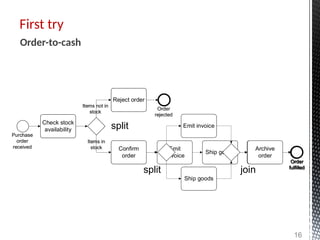
15.
[…] If thepurchase order is confirmed, an invoice is emitted and
the goods requested are shipped (in any order). The process
completes by archiving the order. […]
Order-to-cash example revisited…
15
Check stock
availability
Reject order
Confirm
order
Emit
invoice
Ship goods
Purchase
order
received
Items in
stock
Items not in
stock
Order
rejected
Order
fulfilled
Archive
order
16.
Check stock
availability
Reject order
Confirm
order
Emit
invoice
Shipgoods
Purchase
order
received
Items in
stock
Items not in
stock
Order
rejected
Order
fulfilled
Archive
order
Check stock
availability
Reject order
Confirm
order
Purchase
order
received
Items in
stock
Items not in
stock
Order
rejected
Order
fulfilled
Archive
order
Emit invoice
Ship goods
First try
split
split join
16
Order-to-cash
17.
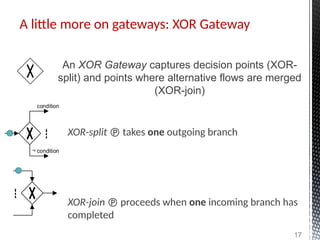
XOR-split takesone outgoing branch
XOR-join proceeds when one incoming branch has
completed
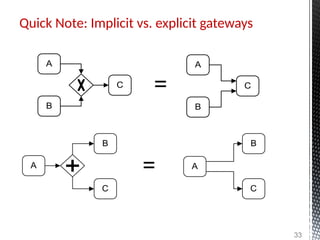
A little more on gateways: XOR Gateway
condition
¬ condition
17
An XOR Gateway captures decision points (XOR-
split) and points where alternative flows are merged
(XOR-join)
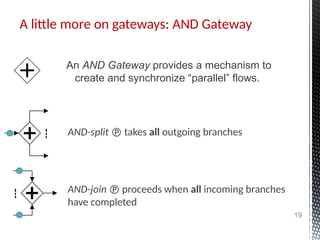
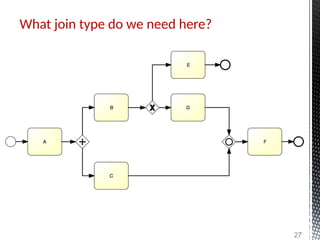
A little moreon gateways: AND Gateway
19
An AND Gateway provides a mechanism to
create and synchronize “parallel” flows.
AND-split takes all outgoing branches
AND-join proceeds when all incoming branches
have completed
Check stock
availability
Reject order
Confirmorder
Send invoice
Ship goods
Purchase
order
received
Items in
stock
Items not in
stock Order
rejected
Order
fulfilled
Archive
order
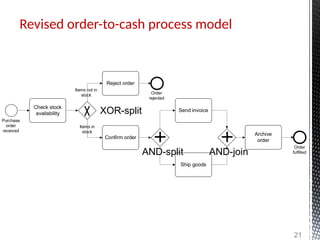
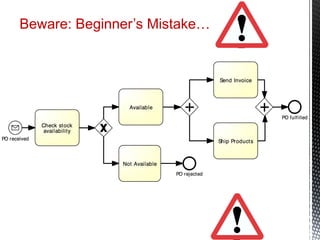
Revised order-to-cash process model
XOR-split
AND-split AND-join
21
22.
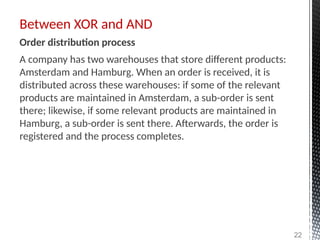
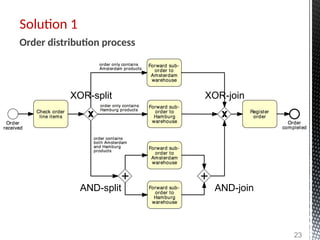
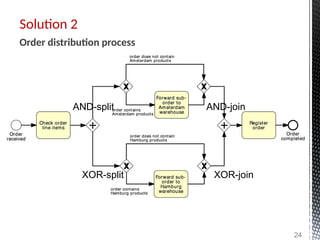
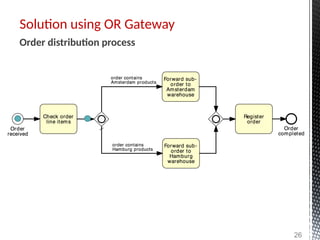
A company hastwo warehouses that store different products:
Amsterdam and Hamburg. When an order is received, it is
distributed across these warehouses: if some of the relevant
products are maintained in Amsterdam, a sub-order is sent
there; likewise, if some relevant products are maintained in
Hamburg, a sub-order is sent there. Afterwards, the order is
registered and the process completes.
Between XOR and AND
22
Order distribution process
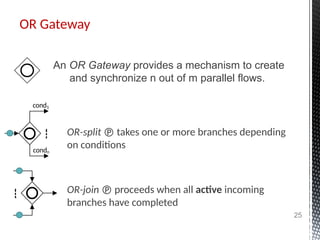
OR Gateway
25
An ORGateway provides a mechanism to create
and synchronize n out of m parallel flows.
OR-split takes one or more branches depending
on conditions
OR-join proceeds when all active incoming
branches have completed
cond1
condn
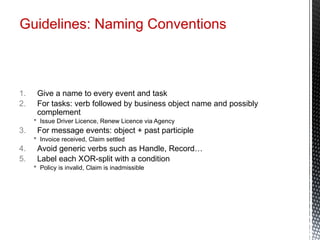
Guidelines: Naming Conventions
1.Give a name to every event and task
2. For tasks: verb followed by business object name and possibly
complement
Issue Driver Licence, Renew Licence via Agency
3. For message events: object + past participle
Invoice received, Claim settled
4. Avoid generic verbs such as Handle, Record…
5. Label each XOR-split with a condition
Policy is invalid, Claim is inadmissible
One more guideline…
•Model in blocks
• Pair up each AND-split with an AND-join and each XOR-split with a XOR-
join, whenever possible
• Exception: sometimes a XOR-split leads to two end events – different
outcomes (cf. order management example)
32.
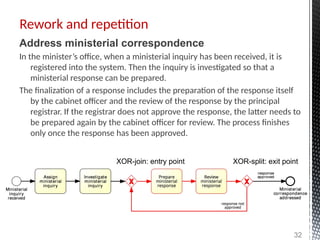
Rework and repetition
Addressministerial correspondence
In the minister’s office, when a ministerial inquiry has been received, it is
registered into the system. Then the inquiry is investigated so that a
ministerial response can be prepared.
The finalization of a response includes the preparation of the response itself
by the cabinet officer and the review of the response by the principal
registrar. If the registrar does not approve the response, the latter needs to
be prepared again by the cabinet officer for review. The process finishes
only once the response has been approved.
XOR-join: entry point XOR-split: exit point
32
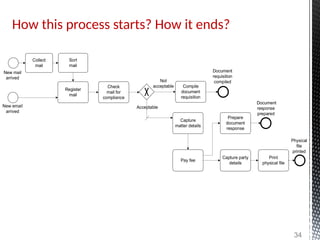
How this processstarts? How it ends?
Collect
mail
New mail
arrived
Sort
mail
Register
mail
Check
mail for
compliance
Compile
document
requisition
Capture
matter details
Acceptable
Not
acceptable
Pay fee
Capture party
details
Print
physical file
Prepare
document
response
Document
requisition
compiled
Document
response
prepared
Physical
file
printed
New email
arrived
34
Organizational Elements inBPMN – Pools & Lanes
37
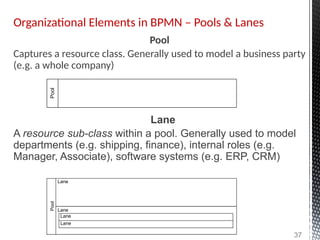
Pool
Captures a resource class. Generally used to model a business party
(e.g. a whole company)
Pool
Pool
Lane
Lane
Lane
Lane
Lane
A resource sub-class within a pool. Generally used to model
departments (e.g. shipping, finance), internal roles (e.g.
Manager, Associate), software systems (e.g. ERP, CRM)
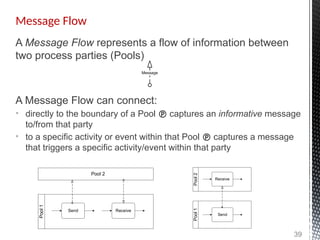
A Message Flowrepresents a flow of information between
two process parties (Pools)
Message
Message Flow
39
Pool 2
Pool
1
Pool
2
Pool
1
Send
Receive
Send Receive
A Message Flow can connect:
• directly to the boundary of a Pool captures an informative message
to/from that party
• to a specific activity or event within that Pool captures a message
that triggers a specific activity/event within that party
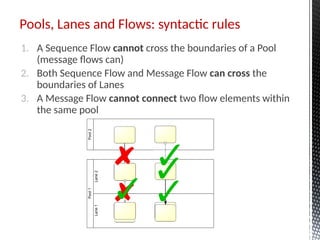
1. A SequenceFlow cannot cross the boundaries of a Pool
(message flows can)
2. Both Sequence Flow and Message Flow can cross the
boundaries of Lanes
3. A Message Flow cannot connect two flow elements within
the same pool
Pools, Lanes and Flows: syntactic rules
42.
One more guideline…
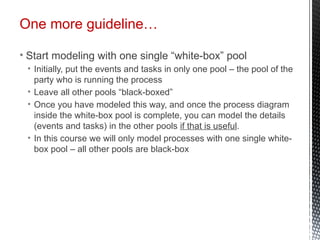
•Start modeling with one single “white-box” pool
• Initially, put the events and tasks in only one pool – the pool of the
party who is running the process
• Leave all other pools “black-boxed”
• Once you have modeled this way, and once the process diagram
inside the white-box pool is complete, you can model the details
(events and tasks) in the other pools if that is useful.
• In this course we will only model processes with one single white-
box pool – all other pools are black-box
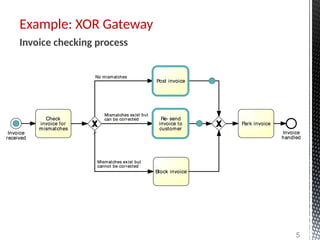
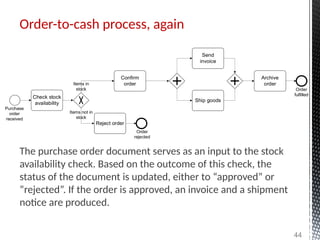
The purchase orderdocument serves as an input to the stock
availability check. Based on the outcome of this check, the
status of the document is updated, either to “approved” or
“rejected”. If the order is approved, an invoice and a shipment
notice are produced.
Order-to-cash process, again
44
Check stock
availability
Confirm
order
Reject order
Send
invoice
Ship goods
Purchase
order
received
Items not in
stock
Items in
stock
Order
rejected
Order
fulfilled
Archive
order
45.
Purchase
Order
Invoice
Check stock
availability
Confirm
order
Reject order
Send
invoice
Shipgoods
Purchase
order
received
Items not in
stock
Items in
stock
Order
rejected
Order
fulfilled
Archive
order
Model with information artifacts
Purchase
Order
45
Purchase
Order
[checked]
Purchase
Order
[rejected]
Purchase
Order
[approved]
Purchase
Order
Shipment
notice
Warehouse DB
Orders DB
Purchase
Order
46.
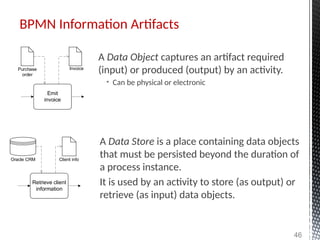
A Data Objectcaptures an artifact required
(input) or produced (output) by an activity.
• Can be physical or electronic
BPMN Information Artifacts
46
Emit
invoice
Purchase
order
Invoice
Retrieve client
information
Oracle CRM Client info
A Data Store is a place containing data objects
that must be persisted beyond the duration of
a process instance.
It is used by an activity to store (as output) or
retrieve (as input) data objects.
47.
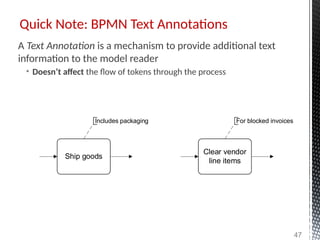
A Text Annotationis a mechanism to provide additional text
information to the model reader
• Doesn’t affect the flow of tokens through the process
Quick Note: BPMN Text Annotations
47
Clear vendor
line items
For blocked invoices
Ship goods
Includes packaging
#5 To model our business processes, we will use the BPMN language. BPMN stands for Business Process Model and Notation,
BPMN 1.0 specification released in May 2004, Put forward as a standard proposal in Feb 2006, BPMN 2.0 released in Jan 2011
There’s a strong industry push for using BPMN, with over 70 tools supporting the standard
Bizagi Process Modeller (free)
Signavio (http://www.signavio.com/) - subscription
For academic purposes: http://academic.signavio.com
Oracle BPA – “kind of free”
ARIS – very sophisticated but the opposite of free
Logizian – reasonable tradeoff
MS Visio – You might already have this
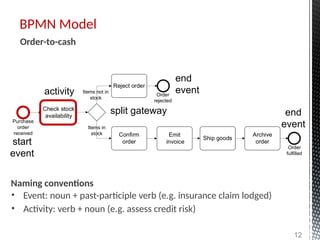
#10 Start event: trigger
End event: process outcome
Split gateway: this is where the control flow is split into two or more branches. In this case the flow is split into two mutually exclusive branches (one taken when items are not in stock, the other when the items are in stock).
Talk about triggers and outcomes: this process has one trigger and two possible outcomes. Without reading the content, I can already see this process can end up in an order being fulfilled (which in this case is a positive outcome) or rejected (negative outcome)
Clearly, for the organization running this process, like a seller or supplier, the goal is to fulfil the order, so that value can be generated for the customer who submitted the order.
It is important to ensure consistency across all our models. One way of doing this is to establish some conventions for labelling events and activities.
#12 Start event: trigger
End event: process outcome
Split gateway: this is where the control flow is split into two or more branches. In this case the flow is split into two mutually exclusive branches (one taken when items are not in stock, the other when the items are in stock).
Talk about triggers and outcomes: this process has one trigger and two possible outcomes. Without reading the content, I can already see this process can end up in an order being fulfilled (which in this case is a positive outcome) or rejected (negative outcome)
Clearly, for the organization running this process, like a seller or supplier, the goal is to fulfil the order, so that value can be generated for the customer who submitted the order.
It is important to ensure consistency across all our models. One way of doing this is to establish some conventions for labelling events and activities.
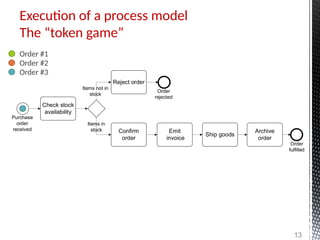
#13 One important notion we need to understand when creating process models is the difference between a process model and its process instances, or in other words, the difference between design-time and run-time. In order to understand this difference, we need to know more about start and end events.
#15 Clearly, we need to archive the order once both the emission of the invoice and the shipment of the goods have been done, but there’s nothing preventing us from emitting the invoice necessarily BEFORE shipping the goods. In other words, we are not concerned about the specific order in which these two activities can take place, so long as they are BOTH completed. I can first emit the invoice or ship the goods. Or event these two activities could start at the same time. Thus, we need to use gateways to model this condition.
#17 The term “Gateway” implies that there is a gating mechanism that either allows or disallows passage of tokens through the Gateway. As Tokens arrive at a Gateway, they can be split apart on output or merged together on input, as the Gateway mechanisms are invoked.
Decision points, where the flow is splitted between two or more alternatives,
#18 A default flow is the default branch to be chosen from an (X)OR-split if all other conditions evaluate to false
#19 By “parallel” we intend flows which can proceed indipendendly of each other
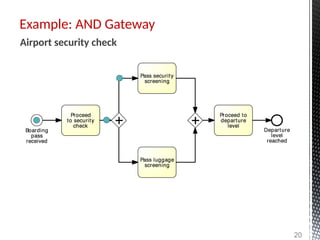
#20 Let’s take, as an example, the security check at an airport. Depending on the layout of the airport, on its passengers traffic at the moment we approach the security check, we may first pass through the security screening and then our luggage will pass through screening, or, for example, luggage screening may start first, and while this is being done, we quickly pass through security screening (as most often happens). However, in order to proceed to the departure level, we first have to pass both screenings: security and luggage
#21 So, coming back to our example, in order to disambiguate these gateways, and assigning a proper behavior to our model, we need to use…
#22 Sometimes, the number of branches to be taken varies from one instance to another:
#25 By “parallel” we intend flows which can proceed indipendendly of each other
For OR-join make difference with AND-join: “active”
#26 Similar to the XOR-split, the OR-split can be equipped with a default flow which is taken if the conditions on all other branches are false
#28 It is worth emphasizing here that activities located in two parallel paths do not need to be performed simultaneously. For example, “Send invoice” and “Ship goods” need not occur both at the same time, although due to a cosmic coincidence, they could happen at the same time. Instead, it might happen that first the invoice is sent and later the goods are shipped. Or things may happen in the reverse order.
#32 So far we have seen structures that are linear, i.e., each activity is performed at most once. However, sometimes we may require to repeat one or several activities, for instance because of a failed check.
Repetition block, a block between an XOR-join (entry point) and an XOR-split (exit point), where the last activity is a decision activity, that allows us to repeat the block or get out of the block.
A cycle is a flow that goes back to an “earlier” point of the process. It is used to model parts of the process that can be repeated.
#34 Also point to the two triggers (new mail and new email).
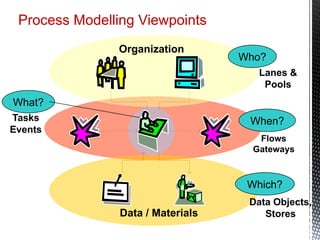
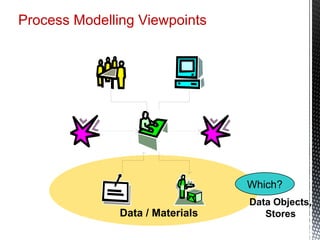
#36 The Functional perspective, indicates What tasks/function are happening in the process?
The Control-flow perspective, indicates when should an activity be performed, that is, in what order should activities and events occur?
The resource perspective (also called organisational perspective) indicates Who performs which activity?
Finally, the data perspective indicate which data are necessary to perform each activity and which data are produced by each activity in the process?
#37 A Pool acts as the container for the Sequence Flow between activities. The Sequence Flow cannot cross the boundaries of a Pool
Lanes can be nested (e.g. an outer set of Lanes for company departments and an inner set for roles within each department)
Complement your BPMN models with organizational charts, role-responsibility matrices, RACI diagrams
#39 The interaction between Pools, e.g., between two collaborating organizations, is shown through the Message Flow
Depicted by a dashed line with an open arrowhead
Describe send and receive activity and their semantics in terms of data tokens
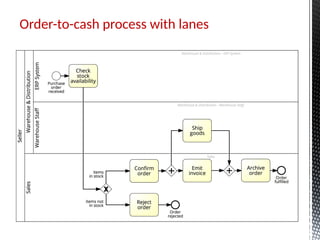
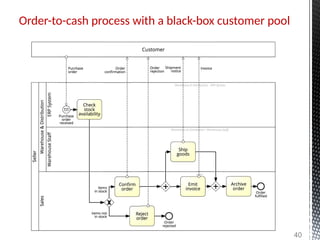
#40 Now we have all ingredients to capture our order to cash example
#43 The Functional perspective, indicates What tasks/function are happening in the process?
The Control-flow perspective, indicates when should an activity be performed, that is, in what order should activities and events occur?
The resource perspective (also called organisational perspective) indicates Who performs which activity?
Finally, the data perspective indicate which data are necessary to perform each activity and which data are produced by each activity in the process?
#46 Represent input and output of a process activity.
, e.g. a database for electronic artifacts or a filing cabinet for physical ones.
#47 Sometimes we may need to provide additional information to the process model reader, for the sake of improving the understanding of the model. For example, in the order-to-cash process we may want to specifcy that activity “Ship goods” also includes the packaging of the products. Also, we may want to clarify what business rule is followed behind the choice of suppliers or the approval of an order. All this information is provided via text annotations which do not affect the flow of the process model.
Say that in a text annotation the connection, called association in BPMN, is undirected
A text annotation is depicted as an open-ended rectangle encapsulating the text of the annotation, and is linked to a process modeling element via a dotted line
![[…] If the purchase order is confirmed, an invoice is emitted and
the goods requested are shipped (in any order). The process
completes by archiving the order. […]
Order-to-cash example revisited…
15
Check stock
availability
Reject order
Confirm
order
Emit
invoice
Ship goods
Purchase
order
received
Items in
stock
Items not in
stock
Order
rejected
Order
fulfilled
Archive
order](https://image.slidesharecdn.com/lecture3-processmodeling1-250614042243-47979964/85/Lecture3-ProcessModeling1_Lecture3-ProcessModeling1-pptx-15-320.jpg)
![Purchase
Order
Invoice
Check stock
availability
Confirm
order
Reject order
Send
invoice
Ship goods
Purchase
order
received
Items not in
stock
Items in
stock
Order
rejected
Order
fulfilled
Archive
order
Model with information artifacts
Purchase
Order
45
Purchase
Order
[checked]
Purchase
Order
[rejected]
Purchase
Order
[approved]
Purchase
Order
Shipment
notice
Warehouse DB
Orders DB
Purchase
Order](https://image.slidesharecdn.com/lecture3-processmodeling1-250614042243-47979964/85/Lecture3-ProcessModeling1_Lecture3-ProcessModeling1-pptx-45-320.jpg)