Department of Computer Science & Engineering (AI)
Course Name: PYTHON PROGRAMMING
Course Code: BCC 402
Faculty Name: Dr. Pawan Kumar Mall
Email : pawan.mall@glbitm.ac.in
Outline:
• Course Outcome
• Detailed syllabus
• Course Overview
• Marks Breakup
• Course Objectives
• Why languages?
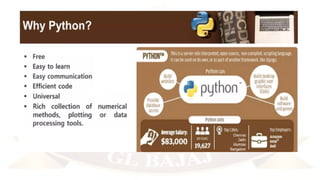
• Why Python?
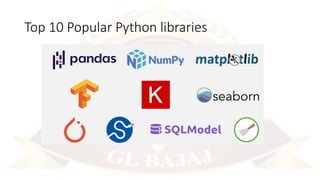
• Top 10 Popular Python libraries
Course Outcome
Detailed Syllabus
Unit Topics
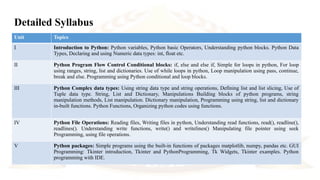
I Introduction to Python: Python variables, Python basic Operators, Understanding python blocks. Python Data
Types, Declaring and using Numeric data types: int, float etc.
II Python Program Flow Control Conditional blocks: if, else and else if, Simple for loops in python, For loop
using ranges, string, list and dictionaries. Use of while loops in python, Loop manipulation using pass, continue,
break and else. Programming using Python conditional and loop blocks.
III Python Complex data types: Using string data type and string operations, Defining list and list slicing, Use of
Tuple data type. String, List and Dictionary, Manipulations Building blocks of python programs, string
manipulation methods, List manipulation. Dictionary manipulation, Programming using string, list and dictionary
in-built functions. Python Functions, Organizing python codes using functions.
IV Python File Operations: Reading files, Writing files in python, Understanding read functions, read(), readline(),
readlines(). Understanding write functions, write() and writelines() Manipulating file pointer using seek
Programming, using file operations.
V Python packages: Simple programs using the built-in functions of packages matplotlib, numpy, pandas etc. GUI
Programming: Tkinter introduction, Tkinter and PythonProgramming, Tk Widgets, Tkinter examples. Python
programming with IDE.
Course Overview
• L T P :
• Credit: 2
• Text Book:
Wesley J. Chun, “Core Python Applications Programming”, 3rd Edition ,
Pearson Education, 2016
• References Book:
Lambert, Fundamentals of Python: First Programs with MindTap, 2nd 1st
edition , Cengage Learning publication
Charles Dierbach, “Introduction to Computer Science using Python”, Wiley,
2015
3 0 0
Marks Breakup
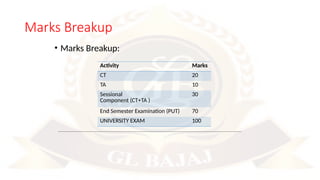
• Marks Breakup:
Activity Marks
CT 20
TA 10
Sessional
Component (CT+TA )
30
End Semester Examination (PUT) 70
UNIVERSITY EXAM 100
Course Objectives
• Define the installation of python environment and basics of
Python language.
• Apply the condition and iteration statements for evaluating the
appropriate alternates.
• Apply to formulate Regular Expressions and use them for
Pattern Matching .
• Construct the core data structures like lists, dictionaries, tuples
and sets in Python to store, process and sort the data.
• Apply the concepts of Object-oriented programming as used in
Python using encapsulation, polymorphism, and inheritance .
• Apply the external modules for creating and writing data to
excel files and inspect the file operations to navigate the file
systems.
Why languages?
COMPUTER IS SMART ?????
https://www.youtube.com/watch?v=lfuUiBanVDM
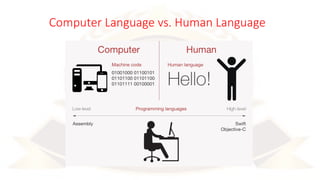
Computer Language vs. Human Language
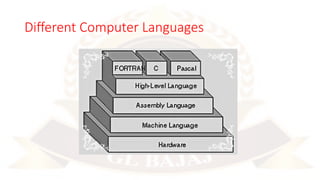
Different Computer Languages
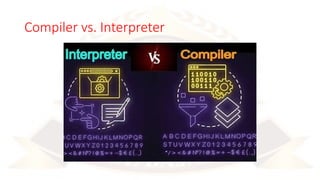
Compiler vs. Interpreter
Make language your Friend
Six Reason to Learn Python
Top 10 Popular Python libraries
Different Python IDEs and Code Editors
IDE Size in MB Developed in
PyCharm BIG JAVA, PYTHON
Spyder BIG PYTHON
PyDev MEDIUM JAVA, PYTHON
Idle MEDIUM PYTHON
Wing BIG C, C++,
PYTHON
Python Version : 3
Colaboratory, or "Colab" for short, allows you to write and execute Python in your
browser, with
• Zero configuration required
• Free access to GPUs
• Easy sharing
Lecture Zero Python 0000_datastructur.pptx

Lecture Zero Python 0000_datastructur.pptx

  • 1.
    Department of ComputerScience & Engineering (AI) Course Name: PYTHON PROGRAMMING Course Code: BCC 402 Faculty Name: Dr. Pawan Kumar Mall Email : pawan.mall@glbitm.ac.in
  • 2.
    Outline: • Course Outcome •Detailed syllabus • Course Overview • Marks Breakup • Course Objectives • Why languages? • Why Python? • Top 10 Popular Python libraries
  • 3.
  • 4.
    Detailed Syllabus Unit Topics IIntroduction to Python: Python variables, Python basic Operators, Understanding python blocks. Python Data Types, Declaring and using Numeric data types: int, float etc. II Python Program Flow Control Conditional blocks: if, else and else if, Simple for loops in python, For loop using ranges, string, list and dictionaries. Use of while loops in python, Loop manipulation using pass, continue, break and else. Programming using Python conditional and loop blocks. III Python Complex data types: Using string data type and string operations, Defining list and list slicing, Use of Tuple data type. String, List and Dictionary, Manipulations Building blocks of python programs, string manipulation methods, List manipulation. Dictionary manipulation, Programming using string, list and dictionary in-built functions. Python Functions, Organizing python codes using functions. IV Python File Operations: Reading files, Writing files in python, Understanding read functions, read(), readline(), readlines(). Understanding write functions, write() and writelines() Manipulating file pointer using seek Programming, using file operations. V Python packages: Simple programs using the built-in functions of packages matplotlib, numpy, pandas etc. GUI Programming: Tkinter introduction, Tkinter and PythonProgramming, Tk Widgets, Tkinter examples. Python programming with IDE.
  • 5.
    Course Overview • LT P : • Credit: 2 • Text Book: Wesley J. Chun, “Core Python Applications Programming”, 3rd Edition , Pearson Education, 2016 • References Book: Lambert, Fundamentals of Python: First Programs with MindTap, 2nd 1st edition , Cengage Learning publication Charles Dierbach, “Introduction to Computer Science using Python”, Wiley, 2015 3 0 0
  • 6.
    Marks Breakup • MarksBreakup: Activity Marks CT 20 TA 10 Sessional Component (CT+TA ) 30 End Semester Examination (PUT) 70 UNIVERSITY EXAM 100
  • 7.
    Course Objectives • Definethe installation of python environment and basics of Python language. • Apply the condition and iteration statements for evaluating the appropriate alternates. • Apply to formulate Regular Expressions and use them for Pattern Matching . • Construct the core data structures like lists, dictionaries, tuples and sets in Python to store, process and sort the data. • Apply the concepts of Object-oriented programming as used in Python using encapsulation, polymorphism, and inheritance . • Apply the external modules for creating and writing data to excel files and inspect the file operations to navigate the file systems.
  • 8.
  • 9.
    COMPUTER IS SMART????? https://www.youtube.com/watch?v=lfuUiBanVDM
  • 10.
    Computer Language vs.Human Language
  • 11.
  • 12.
  • 13.
  • 15.
    Six Reason toLearn Python
  • 17.
    Top 10 PopularPython libraries
  • 29.
    Different Python IDEsand Code Editors IDE Size in MB Developed in PyCharm BIG JAVA, PYTHON Spyder BIG PYTHON PyDev MEDIUM JAVA, PYTHON Idle MEDIUM PYTHON Wing BIG C, C++, PYTHON Python Version : 3
  • 30.
    Colaboratory, or "Colab"for short, allows you to write and execute Python in your browser, with • Zero configuration required • Free access to GPUs • Easy sharing