SUSTAINABILITY AND INNOVATIONIN AN
INDUSTRIAL CONTEXT
LECTURE SCRIPT/FOR INTERNAL USE ONLY
SUMMER SEMESTER 2025
31.03.2025 / EDITION F.00
DR. MARKUS SEIDEL
MARKUS.SEIDEL@TUM.DE
THE „HOW TO?“-PLATFORM
2.
- 2 -
TUM| Sustainability and Innovation in an Industrial Context | Summer Semester 2025 | Dr. Markus Seidel
PREFACE.
50 years ago the Club of Rome published it´s landmark report „The limits to growth“. Until today it stands out as one of the
most influential books ever published. But did it really change things? In 1972 the United States had a population of 210
million people and a Gross Domestic Product (GDP) of 1,3 trillion USD. China´s population reached 860 million people and
it´s GDP was worth only 114 billion USD. The world population in 1972 climbed to 3,8 billion people. Today 338 million
people live in the United States that have a GDP worth 25 trillion USD [2022]. China now has a population of 1,43 billion
people and it´s GDP reaches 18 trillion USD [2022]. The world population has more than doubled to 8 billion people during
the last 50 years.
The results: From 1972 to 2022 the athmospheric carbon dioxid (CO2)-level climbed from 330 to 420 ppm [2022], what
further accelerated climate change. Precious rain forests have diminished, species extinction has accelerated and while
going swimming at a beach it is not uncommon to collide with plastic garbage in the water.
How could this happen though we have the knowledge, the resources and the technologies available to manage the
situation more professionally?
3.
- 3 -
TUM| Sustainability and Innovation in an Industrial Context | Summer Semester 2025 | Dr. Markus Seidel
PREFACE.
After being involved in more than 100 innovation projects in Europe, Asia and the United States in various industries - many
of them in sustainability space - I believe the answer is pretty simple: Human genius, hard work, legal frameworks,
incentives, the power of markets and capital have not yet met in the necessary form and magnitude to change things for the
better at the necessary speed. Warnings, how bad the situation already is, dark scenarios about the future, famous
environmental activists, gatherings of thousands of peoples to protest against the status quo and even environmental
disasters are important to increase awareness, to generate the necessary public knowledge, to influence the political
agenda and to change resource allocation strategies on public and private level.
But the real key is activity in the form of innovations and new technologies that solve the problems, will change behavioral
patterns and can be scaled industrially by companies in a way that many customers use them because they are better than
existing solutions that are less sustainable than the new ones.
This will only happen if the companies that embrace sustainabilty can financially benefit from doing so. This simple relation
has been overseen in the last 50 years and it is the reason why we ended up where we stand now. Governments must
establish the right legal frameworks and incentives that high profits are possible. This will attract companies, entrepreneurs,
investors and ambitious people that want to make a career and earn a decent living.
4.
- 4 -
TUM| Sustainability and Innovation in an Industrial Context | Summer Semester 2025 | Dr. Markus Seidel
PREFACE.
Thus the power of capitalism can unfold and companies will create convincing sustainable products, that are so attractive,
cool, appealing and affordable that eventually many costumers will buy and use them. Then sustainabilty will happen as a
result of this economically, rationally driven process and will stay no vision but becomes reality.
This lecture intends to give insights and guidance how innovation and sustainability can be combined to develop
irresistable, scalable, affordable and profitable products that customers, companies, NGOs and governments will like so
much, that the world will automatically becomes a better place ☺.
Munich, September 2023.
5.
1 Introduction, ReasonWhy / Course Targets, Methodology / Structure
3 Sustainable Business Model- and Ecosystem-Innovation
4 Innovation-Portfolios & -Roadmaps, Business Plans, External Effects
5 Summary
2 Innovation Management and Sustainability
CONTENT.
- 5 -
6 Outlook: Merging Kondratieff Cycles & Spiral Dynamics and Outlook for 2100 and beyond.
TUM | Sustainability and Innovation in an Industrial Context | Winter Semester 2024 / 2025 | Dr. Markus Seidel
6.
- 6 -
TUM| Sustainability and Innovation in an Industrial Context | Summer Semester 2025 | Dr. Markus Seidel
Education:
• Diplom-Wirtschafts-Ingenieur, Karlsruhe Institute of Technology, Germany
• Ph.D. in International Innovation Management, University of St. Gallen, Switzerland
• Executive Education R&D Strategy, INSEAD, France
• Certified Mediator, University of Hagen, Germany
Current Positions:
• BMW AG, Head of Research Circular Economy, Munich, Germany (joined BMW in 1994)
• European Council for Automotive R&D (EUCAR), Brussels, Belgium: Leader Expert-Group Circular Economy
• European Road Transport Research Advisory Council (ERTRAC), Brussels, Belgium: Co-Leader Working Group
Circularity and Competitiveness
• Lecturer@TUM and Mentor@Hochschule St. Gallen, Switzerland
Micellaneous:
• > 100 innovation projects with project budgets up to one billion USD in various industries
• > 15 years international work and project experience in the US, Greater China, Italy, United Kingdom, Austria
• > 40 years freelance/entrepreneurial expertise in software development, teaching, consulting, startups since age 16.
Personal Information:
• Married, two daughters (19 years old)
• Resident in Munich (Germany) & Zell-am-See District (Austria)
• 10+ publications and books on innovation management and on special topics such as BitCoins, Circular Economy
• Hobbies: Innovation, Skiing, Hiking, Travelling, Capital Markets & Asymmetric Investing
INTRODUCTION.
DR. MARKUS SEIDEL.
7.
- 7 -
TUM| Sustainability and Innovation in an Industrial Context | Summer Semester 2025 | Dr. Markus Seidel
REASON WHY / COURSE TARGETS.
Module 1: Theoretical Base (2 days) Module 2: Implementation Training (2 x 1 day) +
Individual Team Coaching
Module 1 creates the theoretical base on what an innovation
really is and which various types of innovations exist. Moreover it
shows how an innovation project and an innovation portfolio can
be managed successfully through roadmaps, project and
portfolio management techniques and business plans. It will offer
insights on why and how sustainability has emerged and evolved
to one of the currently “hottest” topics. Moreover the first part will
offer insights to sustainability driven industrial innovation
ecosystems based on case studies such as electric mobility or
circular economy. The gained knowledge will enable the
participants to identify promising innovation projects in the
sustainability area, how to manage them and how to “sell” them
to potential investors and decision makers.
Module 2 will give the participants - while working in teams - the
chance to work on existing innovation projects or companies in
the sustainability area in a simulation setup. They describe their
innovation proposal, analyze it in terms of underlaying
technologies, market potential, USPs, supplier network,
ecosystem fit, production system, financial needs etc., potentially
even prototype it and create am updated business model and - if
possible - a business plan to attract attention from potential
investors and decision makers. The teams will present their idea
twice and get structured feedback to make sure that participants
have a steep learning curve and maximum knowledge building
can be achieved. In between the teams will receive coaching.
In the last few years sustainability has become a major policy and business topic around the world. International organizations, govern-
ments, non-profit organizations, private companies, influential networks and individuals are working on and pushing frameworks,
regulations, business imperatives, new technologies and finally innovations at very high speed that address currently unresolved
problems in the sustainability field. This creates a strong momentum to shape and scale mankind´s next large innovation wave.
Reason Why
YOUR TRAINING CHALLENGE
THE „HOW TO?“-PLATFORM
8.
- 8 -
TUM| Sustainability and Innovation in an Industrial Context | Summer Semester 2025 | Dr. Markus Seidel
COURSE METHODOLOGY / STRUCTURE
Module 1: Theoretical Base Module 2: Implementation Training
Innovation-
management
Sustainability/
ESG
Creation and
management
of ESG-driven
Innovation-
• Portfolios
• Roadmaps
• Business
Plans
Sustainable
Business
Model-
and
Ecosystem-
Innovation
Deep Dive
analysis of
selected
innovation
frameworks
and ESG
driven
innovations
proposals
Design-
Thinking
driven
optimisation
/ideation
Concept
develop-
ment,
prototyping
and
business
planning
Presentation
4 Semester Hours Per Week
2 Day Block Lecture
2 x 1 Day Block Lecture (Review, Final Presentation) +
Individual Team Coaching Sessions
9.
- 9 -
TUM| Sustainability and Innovation in an Industrial Context | Summer Semester 2025 | Dr. Markus Seidel
COST DECREASE THROUGH INDUSTRIAL SCALING.
EXAMPLES (1/3): RENEWABLE ENERGY AND BATTERY COST.
SOURCE: DESERTEC.ORG
10.
- 10 -
TUM| Sustainability and Innovation in an Industrial Context | Summer Semester 2025 | Dr. Markus Seidel
COST DECREASE THROUGH INDUSTRIAL SCALING.
EXAMPLES (2/3): WATER DESALINATION.
https://unchartedterritories.tomaspueyo.com/p/does-desalination-promise-a-future
11.
- 11 -
TUM| Sustainability and Innovation in an Industrial Context | Summer Semester 2025 | Dr. Markus Seidel
COST DECREASE THROUGH INDUSTRIAL SCALING.
EXAMPLES (3/3): DIRECT AIR CAPTURE.
Additional Interesting articles:
https://www.iea.org/reports/direct-air-capture-2022/executive-summary
https://www.nature.com/articles/s44172-023-00152-6
Source: https://www.grandviewresearch.com/industry-analysis/direct-air-capture-market-report
Source: https://ieaghg-publications.s3.eu-north-1.amazonaws.com/Technical+Reports/2021-
05+Global+Assessment+of+Direct+Air+Capture+Costs.pdf
12.
- 12 -
TUM| Sustainability and Innovation in an Industrial Context | Summer Semester 2025 | Dr. Markus Seidel
1 Introduction, Reason Why / Course Targets, Methodology / Structure
3 Sustainable Business Model- and Ecosystem-Innovation
4 Innovation-Portfolios & -Roadmaps, Business Plans, External Effects
5 Summary
2 Innovation Management and Sustainability
CONTENT.
- 12 -
6 Outlook: Merging Kondratieff Cycles & Spiral Dynamics and Outlook for 2100 and beyond.
13.
- 13 -
TUM| Sustainability and Innovation in an Industrial Context | Summer Semester 2025 | Dr. Markus Seidel
TECHNOLOGY MANAGEMENT.
WHAT IS A TECHNOLOGY?
CAN
NICE-TO-HAVE
READINGS
RECOMMENDED
• A precise and consistent definition of what a technology is doesn’t exist. It can be
defined as the set of knowledge, skills, processes and tools to achieve a
practical goal in a reproducable way. It includes tangible tools such as machines
or intangible ones such as software. It plays a crucial role in science, engineering
and everyday life, too.
• Every innovation is based on a technology even it is not explicity expressed. A
technology could be described as a recipy and the set of kitchen utensils to
produce a meal (= product which sometimes is an innovation) in a restaurant a
customer would pay for. A customer doesn´t pay for technologies but for
products based on a certain technology or a set of technologies.
• Various technologies can produce the same product usually at a different price,
different time horizon or different quality level. The same technology can produce
different products.
• Technology plays the key role in any industrialization effort – without large
investments into technology most products we buy today would be unaffordable.
Therefore technology is often linked to the industrialization and production
process of a product.
• Technology management includes the planning, implementation and control of the
development and application of technologies to create competitive advantages.
• https://www.youtube.com/watch?v=GkjF8cTxB
40
• https://www.youtube.com/watch?v=zmU9j0l9O
RA
• https://www.youtube.com/watch?v=k_RtS3sag
1Y
• https://www.youtube.com/watch?v=KrahQlLAz
44
• Gochermann, Josef: Technology Management:
Recognizing, evaluating and successfully using
technologies; Springer 2022
• Albers, Sönke; Gassmann, Oliver: Handbuch
Technologie- und Innovationsmanagement:
Strategie - Umsetzung – Controlling; 2. Edition;
Gabler 2011
• https://www.boxabl.com
14.
- 14 -
TUM| Sustainability and Innovation in an Industrial Context | Summer Semester 2025 | Dr. Markus Seidel
INNOVATION MANAGEMENT.
WHAT IS AN INNOVATION?
CAN
NICE-TO-HAVE
READINGS
• Various definitions are available – Innovation is an unclear “buzzword” and must
be defined precisely:
- Important: Innovation is not an invention or idea – it is the result of a hard process.
- Innovation is a product of technologies, people, money, time and many other
inputs / resources.
- What precisely is new? (Product, Component, Process, Business Model ,…)
- Which benefits for whom? (Unique selling propositions)
- How new? (incremental or radical, disruptive vs. non-disruptive)
- For whom it is new? (The market, the individual customer, the organization, the
actors, ..)
- Normative Perspective: Is every innovation successful?
• Uncertainty and resistance against innovation are the two most important inherent
self reinforcing properties of any innovation project - the larger the uncertainty the
larger the resistance and the larger the resistance the larger the uncertainty.
• Innovations are the outcome of a complex process with many pitfalls. Much more
innovation projects fail than are eventually successful: The larger the degree of risk
is the more difficult it is to bring its product to the market successfully.
• People or organisations tend to prioritize incremental innovations but sell it as a
“big step forward” – real breakthroughs / disruptions happen rarely.
RECOMMENDED
• Hauschildt, Jürgen; Salomo, Sören et al
(2016): Innovationsmanagement, pp. 1 – 59
• Dodgson, Mark; Gann, David M.; Phillips,
Nelson (2015): The Oxford Handbook of
Innovation Management, Oxford University
Press, pp. 26-49, Paperback Edition
15.
- 15 -
TUM| Sustainability and Innovation in an Industrial Context | Summer Semester 2025 | Dr. Markus Seidel
INCREMENTAL VS. RADICAL/DISRUPTIVE INNOVATION
THE UNCERTAINTY RIDDLE – CAN YOU CONTROL INNOVATION PROJECTS?
Uncertainty
Low High
Symbol:Checklist Symbol: Maze
• Incremental innovation
• Few pitfalls
• Plannable / manageable
• Established Customer Base
• Characteristics: In-Time / In-Budget / In Quality
• Target: Evolution
• Mind Set: Make good things better, Diversify
• Optimize market postion
• „The friend of large organisations“
• Disruptive innovations
• Many pitfalls - „You don´t know what you don´t know“
• Chaotic / Many Pivots
• Not-Established Customer Base
• Delays / budget overruns / quality problems
• Target: Disruptions
• Mind Set: Start smal, very focussed, grow big
• Create a new winner
• „The friend of Start-Ups“
16.
- 16 -
TUM| Sustainability and Innovation in an Industrial Context | Summer Semester 2025 | Dr. Markus Seidel
INNOVATION MANAGEMENT.
THE DYNAMICS OF INNOVATION.
CAN
NICE-TO-HAVE
READINGS
• The Utterback-Model of industrial innovation differentiates between three phase
every innovation goes through over time - from the startup to the maturity phase.
It offers a holistic, dynamic perspective on the innovation process based on the
S-Curve Modell. It was a real milestone to innovation management.
• Phase 1 (“Fluid Phase”): In this phase technological and market uncertainties are
very high. Changes of strategies, product concepts and designs, staff, investors
etc. happen frequently. Manufacturing relies on manual labor or semi-automation
and automation with high investments doesn´t exist. Trail and Error is frequent.
Many companies appear and vanish. A lot of money “is burned”. In the beginning
there is little growth as an established market does not exist.
• Phase 2 (“Transitional Phase”): In this phase the number is companies in the
industry shrinks. Producers learn more about the technology and specific
costumer demands. The industry starts to grow faster and faster. Eventually a so
called “dominant design” emerges – a standard of the product architecture and
design. Production is starting to scale that will enable lower prices that further
fuel market demand.
• Phase 3 (“Specific Phase”): Once the dominant design has been established
competitors focus on process innovation and incremental product improvements
at high speed. Less and less competitors are around. The dangers of monopolies
and oligopolies are emerging.
RECOMMENDED
Utterback, James M. (1996).: Mastering the
dynamics of innovation, 2nd Edition, Harvard
Business Review Press
Rauch, Sebastian (2019): Procedure to sustain
competitive advantage in an era of changing dominant
design, 52nd CIRP Conference on Manufacturing
Systems, Procedia CIRP 81 (2019), pp. 838–843
17.
- 17 -
TUM| Sustainability and Innovation in an Industrial Context | Summer Semester 2025 | Dr. Markus Seidel
INNOVATION MANAGEMENT.
THE DYNAMICS OF INNOVATION.
18.
- 18 -
TUM| Sustainability and Innovation in an Industrial Context | Summer Semester 2025 | Dr. Markus Seidel
INNOVATION MANAGEMENT.
THE INNOVATOR´S DILEMMA – WHY INDUSTRY DISRUPTION CAN HAPPEN
AND WHY THIS IS YOUR CHANCE!
CAN
NICE-TO-HAVE
READINGS
RECOMMENDED
Christensen, Clayton M. (2016): The Innovator's
Dilemma: When New Technologies Cause Great
Firms to Fail, Reprint Edition, Harvard Business
Review Press
• Disruptive innovation is the introduction of a product or service into an
established industry that eventually performs better. In general products are less
cost intensive than existing products. Eventually market leaders can be replaced
and thus the industry will be transformed.
• Disruptors initially usually address niche markets with specific sometimes unique
market needs - frequently overlooked by industry leaders as they are too small
and/or strategically unattractive. They start to develop and scale their product for
customers in this niche markets. Established businesses focus on incremental
product improvements to meet the needs of their biggest and most profitable
customers (and sometimes overshoot expectations). As a result they don´t
address the needs of the niche market. This opens a window of opportunity.
• Eventually the market offer becomes the main choice of customers. This process
usually takes (a long) time but is very powerful: Eventually the whole industry is
disrupted and a set of different companies might eventually lead the industry.
• Examples for disruptors are Apple, Tesla, Netflix, Amazon, Microsoft based on
various disruptive technologies such as the electric powertrain, the internet, …
• In many cases industry disruptors did not only reshape a specific industry but the
whole industry business model and industrial ecosystem in which a certain
product has been embedded. Stockmarkets love disruptors.
https://www.christenseninstitute.org/disruptive-
innovations/
https://hbr.org/2015/12/what-is-disruptive-
innovation
19.
- 19 -
TUM| Sustainability and Innovation in an Industrial Context | Summer Semester 2025 | Dr. Markus Seidel
INNOVATION MANAGEMENT.
THE DYNAMICS OF INNOVATION.
Source: https://hbr.org/2015/12/what-is-disruptive-innovation
20.
- 20 -
TUM| Sustainability and Innovation in an Industrial Context | Summer Semester 2025 | Dr. Markus Seidel
DISRUPTIVE INNOVATION: DISRUPTORS CAN GET SUPERSTARS AND
VERY RICH - AS WELL AS THEIR INVESTORS.
Microsoft 1978
Would you have invested?
Source: https://www.businessinsider.com/microsoft-1978-photo-2011-1 https://ceoworld.biz/2022/09/29/the-worlds-wealthiest-people-september-28-2022/
21.
- 21 -
TUM| Sustainability and Innovation in an Industrial Context | Summer Semester 2025 | Dr. Markus Seidel
VARIOUS STRATEGIES: MARKET PULL VS. TECHNOLOGY PUSH; FIRST
MOVER VS. FAST FOLLOWER, BUY THEN BUILD VS. FOUND.
CAN
NICE-TO-HAVE
READINGS
• Market-Pull vs. Technology-Push: Market Pull is an innovation strategy where the
market (usually immediately) needs a certain product or service but it doesn´t exist
yet. The innovation focusses on these specific customer demands. Technology Push
is a strategy when R&D in new technology drives the development of new products
and costumer benefits must be identified. Usually Market-Pull and Technology-Push
are intervowen with each other. Disruptive innovations frequently follow the techno-
logy-push path and address unmet but not explicitly formulated market demands.
• First Mover vs. Fast Follower: A first mover is a company that launches a product
or service to gain a competitive advantage by being the first to market it. Being first
can enable the company to establish a strong brand, customer loyalty before
competitors enter the arena, set the prices and to build/utilize intellectual property. A
Fast Follower is a company that rapidly copies an innovation of it’s competitors,
improves the product pr service and to avoid the mistakes of the First Mover. First
Movers are frequently caught in a cost expensive “trial-and-error-loop” which makes
the Fast Follower Strategy usually less risky especially in cost intensive industries.
• Buy then build: Most Startups fail or never reach the 1 Mio. USD annual revenue
size. Creating a company from scratch is very risky and a bold race against
statistics. A socalled “acquisition entrepreneur” can skip the first dangerous 3-5 years
where most start ups fail by buying a profitable company with a solid cash flow and
then start to expand the business from there. However many “life changing
disruptors” such as Google, Tesla, Apple, Facebook, etc. were built from scratch.
RECOMMENDED
• Deibel, Walker (2018): Buy Then Build: How
Acquisition Entrepreneurs Outsmart the
Startup Game, Lioncrest Publishing
• Markides, Constatinos; Geroski, Paul (2004):
Fast Second: How Smart Companies Bypass
Radical Innovation to Enter and Dominate New
Markets, Jossey-Bass
• Ramirez, Rafael; Wallin, Johan (2000): Prime
Movers – Define Your Business or Have
Someone Define it against you, John Wiley &
Sons
(
• https://www.youtube.com/watch?v=tpHaN2YrEiM
22.
- 22 -
TUM| Sustainability and Innovation in an Industrial Context | Summer Semester 2025 | Dr. Markus Seidel
TWO IMPORTANT GROUPS FOR ANY INNOVATION PROJECT.
LEAD USERS AND LEAD ENEMIES.
CAN
NICE-TO-HAVE
READINGS
• Lead Users are individuals or companies that deal intensively with a problem in a
special area for which there is no suitable solution existing on the market. In many
cases they are experts, understand the market segments that will be addressed and
the technologies that are needed to fulfill customer expectations. They are a
valuable resource that can be directly engaged in the product definition and
development process and that help to define the right USPs and to allocate (tight
budgets) effectively and efficiently. Lead users are frequently front runners and
eventually the crowd / mass market will follow with a certain time lag.
Author´s statement: I personally would recommend to identify lead users first before
starting any cost intensive innovation project. If you don´t find a lead user rethink
your project at least twice before starting – it might be the wrong approach. Lead
user help you to save time, money and energy.
• “Lead Enemies” are the spearhead of resistance to any type of innovation process.
Mostly they are well connected and have a lot of influence. By identifying the lead
enemies, their arguments and actions against an innovation can greatly improve
process performance and avoid deadly traps that exist in any venture. It also can
help to fight against the tricky “tunnel vision” that usually innovation teams develop
over time by ignoring risks, facts and figures that might question the project, team
members and/or it´s achievements so far.
Author´s statement: Even if it is tough to install a regular dialogue format it can help
a lot to install a dialogue with your lead enemies to get feedback and learn from
them. Innovations address uncertain future scenarios.
RECOMMENDED
• https://www.youtube.com/watch?v=tNKrX1QxN6U
• https://www.youtube.com/watch?v=3fW4xYBXdGo
• Hippel, Eric von (1986): Lead Users. A Source
of novel product concepts. In: Management
Science, Vol. 32, pp. 791–805.
• Diener, Kathleen, Piller, Frank T. (2010): The
Market for Open Innovation Increasing the
efficiency and effectiveness of the innovation
process, RWTH Aachen University, pp. 15-21
23.
- 23 -
TUM| Sustainability and Innovation in an Industrial Context | Summer Semester 2025 | Dr. Markus Seidel
LEAD USERS AND INNOVATION DIFFUSSION TIME.
Source: Diener, Kathleen; Piller, Frank (2010): The Market for Open Innovation Increasing the efficiency and effectiveness of the innovation process, Aachen RWTH Aachen University, pp. 16
24.
- 24 -
TUM| Sustainability and Innovation in an Industrial Context | Summer Semester 2025 | Dr. Markus Seidel
CUSTOMER SEGMENTS AND MARKET SHARE.
Market
Share
100%
Early
Adopters/
Trend-
Setters
Early
Majority
Late
Majority
Laggards
Lead Users
as Innovators
and Pioneer
Customers
25.
- 25 -
TUM| Sustainability and Innovation in an Industrial Context | Summer Semester 2025 | Dr. Markus Seidel
ONE MORE THING: TEN IMPORTANT EMPIRICAL INSIGHTS TO MANAGE
INNOVATION PROJECTS SUCCESSFULLY YOU CANNOT READ IN MOST
BOOKS ON INNOVATIONS (1/2).
• The future cannot be predicted by market research: Market research is a helpful tool – but to predict the future it
usually completely fails. Peter Drucker said “The best way to predict the future is to create it” – so create it based on
well thought out scenarios and try not to calculate it!
• Work in teams and get independent feedback: Regular feedback loops and thought exchange are necessary to
master the upcoming challenges and to avoid dangerous misjudgements and “tunnel visions”.
• Fast termination und no punishment in case of failure: Failure is system inherent to innovation - the faster a failing
innovation project is stopped the better it is. However: People involved in failing innovation project usually must not be
punished.
• Be able to stay isolated from the mainstream and be able to see failures as a great learning experience: Most
innovations start in small niches and scale from here. Innovators must be able to stay isolated sometimes even
rejected from the mainstream for a long time. Most of the time you are an outsider. Innovation projects offer fast track
learning experiences – every failure is a great step ahead. Stay cool when you fail! Next project!
• No fear but respect: Innovation can be trained like any other skill – the most two important qualifications any
innovation manager needs is “No Fear of Failure!” and on the other side “Don´t Ignore Risks!”. Having no respect for
the innovation task and it´s complexity means guaranteed failure in most cases.
26.
- 26 -
TUM| Sustainability and Innovation in an Industrial Context | Summer Semester 2025 | Dr. Markus Seidel
ONE MORE THING: TEN IMPORTANT EMPIRICAL INSIGHTS TO MANAGE
INNOVATION PROJECTS SUCCESSFULLY YOU CANNOT READ IN MOST
BOOKS ON INNOVATIONS (2/2).
• Don´t give up: Innovation projects are usually very difficult to manage – emotions such as frustration, anger, fear,
demotivation, conflicts, etc. are completely normal but must be overcome professionally. A good coach/mentor can
help a lot. If you see your project doesn´t work out finally – don´t take it personally. Pivot or restart from scratch!
• Start early in life: Innovation management cannot be learned by reading many books only – the earlier you start
practicing “real” innovation the higher are the chances that you will become a successful innovation manager/
entrepreneur –and finally can become a (wealthy) person with deep expertise and interesting stories to tell.
• Patience and tolerance: The higher the degree of uncertainty is the more patience and tolerance is needed as many
unforeseen things will happen. Listen to your staff frequently and try to help your team whenever possible.
• Networks are more important than genius: A well connected innovation manager/entrepreneur is likely more
successful than an isolated genius in the “ivory tower”.
• Focus: Innovation projects usually cannot be done as a part time assignment – the more intense you work on YOUR
INNOVATION together with potential customers the higher the success chance is.
27.
- 27 -
TUM| Sustainability and Innovation in an Industrial Context | Summer Semester 2025 | Dr. Markus Seidel
SUSTAINABILITY.
THE SIXTH KONDRATIEFF-CYCLE.
CAN
NICE-TO-HAVE
READINGS
• The Russian economist Nikolai Dmitriyevich Kondratieff (1892 –1938) developed a
theory that capitalist economies develop themselves in socalled „Long Waves“ or
„Long Economic Cycles“. He published his theory in 1925 in his book “The Major
Economic Cycles”. The famous economist Joseph Schumpeter called these long
waves “Kondratieff-Cycles” in 1939. This waves/cycles range from 40 to 60 years
and are driven by basic innovations that launch and drive long lasting technological
revolutions that trigger high economic growth and will finally reshape societies.
• Since the 18th century six Kondratieff Waves can be identified – the first wave was
driven by the invention of the steam engine and lasting from 1780 to 1830. The fifth
cycle started in the 1970s. It was triggered by computer-based information
technology which transformed the industrial society into the information society and
finally turned the world into a global village through the internet. For the 5th
cycle it
was projected that it will end at the start of the 21st century, but this forecast turned
out to be too early.
• The 6th
cycle that started around 2005 is fueled by advances in biotechnology,
environmental technology, psychology and brain research. They would trigger an
economic supercycle around “Holistic Health/Sustainabilty”.
• The theory is not accepted by many economists. However it offers clear insights into
the emergence of economic cycles and how important research and innovation is.
RECOMMENDED
• Nefiodow, Leo; Nefiodow, Simone (2017): The Sixth
Kondratieff: The New Long Wave in the Global
Economy
28.
- 28 -
TUM| Sustainability and Innovation in an Industrial Context | Summer Semester 2025 | Dr. Markus Seidel
SUSTAINABILITY.
THE SIXTH KONDRATIEFF-CYCLE.
29.
- 29 -
TUM| Sustainability and Innovation in an Industrial Context | Summer Semester 2025 | Dr. Markus Seidel
WHAT HAPPENED SINCE THE STEAM ENGINE?
GLOBAL POPULATION GROWTH AND GLOBAL GDP GROWTH.
From 190 millon (in year 0) to 8 billion (in 2023)
= 42 x / 0,185 % CAGR
From 600 million (in 1700) to 8 billion (in 2023)
= 13 x / 0,8% CAGR
From 1,65 (in 1900) to 8 billion (in 2023)
= 4,85x / 1,29% CAGR
The „Fossil Age“ tipping point
The fossil age in combination with continuous industrial innovation has speeded up economic growth
significantly. In the first solar age before the fossil tipping point economic growth was very slow and on a
GDP/capital level almost non-existent!
-) Key question of the class: How can the obvious dilemma “growth and next renewable age” be resolved?
The „Oil Age“ tipping Point
From 200 billion (in year 1) to 134 trillion (in year 2021)
= 670 x / 0,32 % CAGR / Energy Density Wood (dry) 15 MJ/kg
From 727 billion (in 1700) to 134 trillion (in 2023)
= 184 x / 1,64% CAGR / Energy Density Hard Black Coal 24-25 MJ/kg
From 4,06 trillion (in 1900) to 134 trillion (in 2023)
= 33x / 2,88% CAGR / Energy Density Crude Oil 42-47 MJ/kg
30.
- 30 -
TUM| Sustainability and Innovation in an Industrial Context | Summer Semester 2025 | Dr. Markus Seidel
ENERGY DENSITY OF VARIOUS SOURCES.
COMPARISON OF THE KEY PARAMETERS VOLUMEN AND WEIGHT.
CAN
NICE-TO-HAVE
READINGS
• Bradley, E. Layton: A comparison of energy
densities of prevalent energy sources in units of
joules per cubic meter, in: International Journal of
Green Energy, Vol. 8, 2008, pp. 438-455
• https://www.thphys.uni-
heidelberg.de/~stamatescu/DIDEPG/WiSe23/TEXTE23/K
ernfusion.pdf
• https://world-nuclear.org/information-library/facts-
and-figures/heat-values-of-various-fuels.aspx
RECOMMENDED
Li-Ion Battery: 0,46-0,72MJ/kg
H2 (Gas, 700 bar/20°) 142 MJ/kg
H2 (liquified, 1 bar/20 K) 142 MJ/kg
Uranium (natural, ca. 0,7%) ca. 500 GJ/kg (normal reactor)
Uranium (3,5% U-235) ca. 3.900 GJ/kg (in fast neutron reactor)
Fusion (Deuterium-Tritium) ca. 340.000 GJ/kg
Current Energy System (Energy densities, Source: Cutler Cleveland, 2024, Boston University) • Fang, Huayu : Challenges with the Ultimate Energy
Density with Li-ion Batteries; IOP Conf. Ser.: Earth
Environ. Sci. 781 042023
• https://visualizingenergy.org/fuel-energy-density-
what-is-it-and-why-is-it-important/
Future? (Source: various, pls.see readings)
31.
- 31 -
TUM| Sustainability and Innovation in an Industrial Context | Summer Semester 2025 | Dr. Markus Seidel
SUSTAINABILITY AS A MIND SET / VALUE SYSTEM: SPIRAL DYNAMICS.
SUSTAINABILITY IS A VALUE BASED APPROACH THAT DEVELOPS OVER
TIME.
CAN
NICE-TO-HAVE
READINGS
RECOMMENDED
• Spiral Dynamics is a model of the evolutionary development of individuals,
organizations and societies developed by Don Beck. It describes how human
value systems evolved in the past and could evolve in the future – from clans to
tribes to modern human societies. It is based in on Clare W. Graves´ concept of
„Emergent cyclical levels of existence”: The human view on the world and the
creation of value systems to survive and flourish is an ongoing, interactive, cyclical
“biopsychosocial” process between humans and life conditions of a certain time.
• Values systems are a response to the local environment - Each distinct set of
values is developed to solve the problems of the previous level of human
development.
• A person, an organization or a society can incorporate characteristics of many
stages – but usually have a “center of gravitvy” at a specific point of time.
Motivational incentives only work when they address the current development level
of human societies or individuals.
• Stages can´t be skipped and the development through various stages is an
irreversible process.
• It is usually not possible to “step down” from a higher to a lower level as an
individual, organisation or a society – unless radical changes in the composition of
an organization will be made.
• Beck, Don E.; Cowan, Christopher: Spiral Dynamics
(2005): Mastering Values, Leadership and Change,
Wiley-Blackwell
• Graves, Clare W. (1974): Human Nature Prepares
for a Momentous Leap; in: The Futurist, April 1974,
pp. 72-87
• Clare W. Graves (2004): Levels of Human
Existence, FisicalBook
• https://www.youtube.com/watch?v=23aDNBvn_2g
• https://www.youtube.com/watch?v=RiZ3kRD4
GfQ
• https://www.youtube.com/watch?v=RRB6Ym8
wQeM
• https://www.youtube.com/watch?v=lLhlgUtwvV
U
32.
- 32 -
TUM| Sustainability and Innovation in an Industrial Context | Summer Semester 2025 | Dr. Markus Seidel
SUSTAINABILITY AS A MIND SET / VALUE SYSTEM: SPIRAL DYNAMICS.
SPIRAL DYNAMICS ® EVOLUTIONARY LEVELS.
Source: https://spiraldynamics.net/, own additions
Increasing
sustainability
awareness
33.
- 33 -
TUM| Sustainability and Innovation in an Industrial Context | Summer Semester 2025 | Dr. Markus Seidel
SUSTAINABILITY AS AN COMPUTATIONAL IMPERATIVE.
THOUGHT FRAMEWORK: CLUB-OF-ROME.
CAN
NICE-TO-HAVE
• https://www.clubofrome.org/
• https://www.clubofrome.org/publication/earth4all-
book/
READINGS
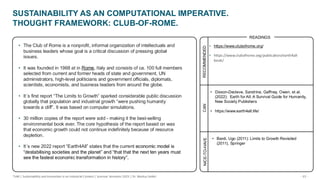
• The Club of Rome is a nonprofit, informal organization of intellectuals and
business leaders whose goal is a critical discussion of pressing global
issues.
• It was founded in 1968 at in Rome, Italy and consists of ca. 100 full members
selected from current and former heads of state and government, UN
administrators, high-level politicians and government officials, diplomats,
scientists, economists, and business leaders from around the globe.
• It´s first report “The Limits to Growth” sparked considerable public discussion
globally that population and industrial growth “were pushing humanity
towards a cliff”. It was based on computer simulations.
• 30 million copies of the report were sold - making it the best-selling
environmental book ever. The core hypothesis of the report based on was
that economic growth could not continue indefinitely because of resource
depletion.
• It´s new 2022 report “Earth4All” states that the current economic model is
“destabilising societies and the planet” and “that that the next ten years must
see the fastest economic transformation in history”.
• Dixson-Decleve, Sandrine, Gaffney, Owen, et al.
(2022): Earth for All: A Survival Guide for Humanity,
New Society Publishers
• https://www.earth4all.life/
• Bardi, Ugo (2011): Limits to Growth Revisited
(2011), Springer
RECOMMENDED
34.
- 34 -
TUM| Sustainability and Innovation in an Industrial Context | Summer Semester 2025 | Dr. Markus Seidel
SUSTAINABILITY AS A BUSINESS AND ECONOMIC TOPIC.
ECONOMIC FRAMEWORK: WORLD ECONOMIC FORUM (WEF).
RECOMMENDED
CAN
NICE-TO-HAVE
• https://www3.weforum.org/docs/WEF_Sustainability
_Strategy_2021.pdf
READINGS
• https://www3.weforum.org/docs/WEF_Sustainability
_Policy_EN.pdf
• https://www3.weforum.org/docs/WEF_InstitutionalBr
ochure.pdf
• The World Economic Forum is “an independent international organization
committed to improving the state of the world by engaging business, political,
academic and other leaders of society to shape global, regional and industry
agendas”.
• It is “committed to supporting global efforts in the private and public sectors to limit
global temperature rise and stave off disaster.”
• Annual meetings in Davos, Switzerland.
• Special focus on sustainability.
• Initiates and invites impact organizations such as “Circle-Economy” that regularily
publishes the Circularity Gap Report (CGR) that shows that the world economy is
hardly circular.
• https://www.weforum.org/events/sustainable-
development-impact-meetings-2022
• https://www.circularity-gap.world/
35.
- 35 -
TUM| Sustainability and Innovation in an Industrial Context | Summer Semester 2025 | Dr. Markus Seidel
SUSTAINABILITY AS A BUSINESS AND ECONOMIC TOPIC.
EXAMPLE CIRCULARITY GAP REPORT – MOBILITY SECTOR (2022)
KEY FACTS & FIGURES
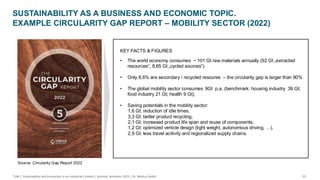
• The world economy consumes ~ 101 Gt raw materials annually (92 Gt „extracted
resources“, 8,65 Gt „cycled sources“).
• Only 8,6% are secondary / recycled resoures – the circularity gap is larger than 90%
• The global mobility sector consumes 9Gt p.a. (benchmark: housing industry 39 Gt;
food industry 21 Gt; health 9 Gt),
• Saving potentials in the mobility sector:
1,6 Gt: reduction of idle times,
3,3 Gt: better product recycling,
2,1 Gt: increased product life span and reuse of components,
1,2 Gt: optimized vehicle design (light weight, autonomous driving, …),
2,9 Gt: less travel acitivity and regionalized supply chains.
Source: Circularity Gap Report 2022
36.
- 36 -
TUM| Sustainability and Innovation in an Industrial Context | Summer Semester 2025 | Dr. Markus Seidel
SUSTAINABILITY AS A GLOBAL MANAGEMENT SYSTEM.
UNITED NATIONS SUSTAINABLE DEVELOPMENT GOALS.
CAN
NICE-TO-HAVE
• https://www.undp.org/sustainable-development-
goals
READINGS
• 2015: Adoption by the United Nations as Universal Goals to Action
• Mission: „End Poverty“, „Protect the Planet“ and „Ensure that by 2030 all People
Enjoy Peace and Prosperity“
• 17 Highly Integrated Sustainable Development Goals (SDG), that are broken down
to various targets/indicators, publications, events and actions.
(1) No Poverty (9) Industry, Innovation and Infrastructure
(2) Zero Hunger (10) Reduce Inqualities
(3) Good Health and Well-Being (11) Sustainble Cities and Communities
(4) Quality Education (12) Responsible Consumption and Production
(5) Gender Equality (13) Climate Action
(6) Clean Water and Sanitation (14) Life Below Water
(7) Affordable and Clean Energy (15) Life on Land
(8) Decent Work and Economic (16) Peace Justice and Strong Institutions
Growth (17) Partnerships for the Goals
• Regular Reports
• Covid, high inflation and other global crisises showed that progress regarding SDGs
is very fragile
• https://unstats.un.org/sdgs/report/2022/The-
Sustainable-Development-Goals-Report-2022.pdf
RECOMMENDED
37.
- 37 -
TUM| Sustainability and Innovation in an Industrial Context | Summer Semester 2025 | Dr. Markus Seidel
SUSTAINABILITY AS A GLOBAL LEGAL IMPERATIVE.
POLICY FRAMEWORK: PARIS AGREEMENT.
CAN
NICE-TO-HAVE
• https://unfccc.int/process-and-meetings/the-paris-
agreement/the-paris-agreement
READINGS
• The Paris Agreement is a legally binding international treaty on climate change. It
was adopted by 196 Parties at COP 21 (“Conference of the Parties”) in Paris on
December 12th, 2015 and came into effect on November 4th, 2016.
• The Paris Agreement is part of the United Framework Convention of Climate
Change.
• Goal: Limit global warming to well below 2, preferably to 1.5 degrees Celsius,
compared to pre-industrial levels.
• To achieve this goal, countries aim to reach the global peak of greenhouse gas
emissions as soon as possible to achieve a climate neutral world by 2050.
• Regular follow-up conferences took and will take place.
RECOMMENDED
38.
- 38 -
TUM| Sustainability and Innovation in an Industrial Context | Summer Semester 2025 | Dr. Markus Seidel
SUSTAINABILITY AS A CONTINENTAL LEGAL IMPERATIVE.
POLICY FRAMEWORK: EUROPEAN GREEN DEAL.
CAN
NICE-TO-HAVE
• https://ec.europa.eu/info/strategy/priorities-2019-
2024/european-green-deal_en
READINGS
• The European Green is a complex set of policy initiatives by the European
Commission. It was presented publicly at the end of 2019. It is based in accordance
with the parameters set by the Paris Agreement (2016).
• Goal: Make the European Union (EU) climate neutral in 2050.
• Prove that economies will develop without increasing resource usage
• Ursula von der Leyen, President of the European Commission: „Europe's man on
the moon moment”.
• Main Elements (Policy Areas / Actions) of the European Green Deal are:
(1) Climate Action (6) Eliminating Pollution
(2) Clean Energy (7) Sustainable Mobility
(3) Sustainable Industry (8) Biodiversity
(4) Building and Renovation (9) Sustainable Finance
(5) Farm to Fork
• The European Grean Deal has influenced Horizon Europe, which is the EU key´s
funding programme for research and innovation running from 2021-2027, with a
total budget of €90+ billion.
• https://research-and-
innovation.ec.europa.eu/funding/funding-
opportunities/funding-programmes-and-open-
calls/horizon-europe_en
• https://www.nortonrosefulbright.com/en/knowledge/
publications/c50c4cd9/the-eu-green-deal-explained
• Deloitte: Fit for 55: Maßnahmenpaket der EU zur
Umsetzung des Green Deal (2022), Deloitte
RECOMMENDED
39.
- 39 -
TUM| Sustainability and Innovation in an Industrial Context | Summer Semester 2025 | Dr. Markus Seidel
THE EUROPEAN GREEN DEAL.
POLICY INITIATIVES – EXAMPLE AUTOMOTIVE INDUSTRY.
MISSION TO ZERO
Business Model
Vehicle
System/Component
(Raw) Material
CO2 Waste
Hazardous
Substances
Rare Earth
Materials
Battery Regulation
REACH
Plastic
Taxation
Circular Economy Action Plan (CEAP):
Eco-Design-Framework / ELV & 3R-Type-Approval-Directives
Land
Use
Deforestation
Regulation
Paris
Climate
Agreement
ETS /
CBAM
Mission: Extended Producer Responsibility (EPR) / Extended Due Diligence Requirements
(Human Rights, Social and Environmental Standards) – Supply Chain Due Diligence Law
CBAM = Carbon Border Adjustment Mechanism; ELV = End-of-Life Vehicle; ETS= Emissions Trading System; REACH = Registration, Evaluation, Authorisation & Restriction of chemicals
40.
- 40 -
TUM| Sustainability and Innovation in an Industrial Context | Summer Semester 2025 | Dr. Markus Seidel
SUSTAINABILITY AS „WHAT YOU MEASURE IS WHAT YOU GET“-IMPERATIVE.
HOW TO MEASURE SUSTAINABILITY?
CAN
NICE-TO-HAVE
READINGS
• Currently no standard set of parameters/criterions does exist how to measure
the sustainability of organisations, companies and/or specific products.
• There are various proposals and ongoing discussions but no clear decisions on
a supraindustrial, supranational, industrial or national level have been made,
how to simplify efforts and optimize transparency. So currently it is hard to
compare the sustainability of products and organisations and track their
improvement over a long time.
• Some rating agencies or index publishing companies offer unified external
evaluations services which eventually leads to rankings.
• The current situation of non-standardized measurement systems is imposing the
risks to open the doors for “Greenwashing” and “Randomness” – there is the risk
that companies chose some sustainability criterions they feel comfortable with a
and reject others where they don´t.
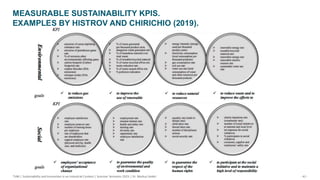
• For environmental issues are a couple of parameters available that work quite
well such as carbon footprint, energy consumption, product recycling rate,
secondary material quota, supplier environmental sustainability index, supply
chain miles, water footprint, waste creation and reduction rate.
RECOMMENDED
• Histrov, Ivo; Chirico; Antonio; The Role of
Sustainability Key Performance Indicators
(KPIs) in Implementing Sustainable Strategies
(2019), in: Sustainability 2019, Vol.11, 5742;
pp. 1-19
• https://unstats.un.org/sdgs/indicators/Global%20
Indicator%20Framework%20after%202022%20r
efinement_Eng.pdf
41.
- 41 -
TUM| Sustainability and Innovation in an Industrial Context | Summer Semester 2025 | Dr. Markus Seidel
MEASURABLE SUSTAINABILITY KPIS.
EXAMPLES BY HISTROV AND CHIRICHIO (2019).
42.
- 42 -
TUM| Sustainability and Innovation in an Industrial Context | Summer Semester 2025 | Dr. Markus Seidel
MEASURABLE SUSTAINABILITY KPIS.
EXAMPLES BY HISTROV AND CHIRICHIO (2019).
43.
- 43 -
TUM| Sustainability and Innovation in an Industrial Context | Summer Semester 2025 | Dr. Markus Seidel
1 Introduction, Reason Why / Course Targets, Methodology / Structure
3 Sustainable Business Model- and Ecosystem-Innovation
4 Innovation-Portfolios & -Roadmaps, Business Plans, External Effects
5 Summary
2 Innovation Management and Sustainability
CONTENT.
- 43 -
6 Outlook: Merging Kondratieff Cycles & Spiral Dynamics and Outlook for 2100 and beyond.
44.
- 44 -
TUM| Sustainability and Innovation in an Industrial Context | Summer Semester 2025 | Dr. Markus Seidel
SUSTAINABLE BUSINESS MODELL INNOVATIONS.
OVERVIEW.
• A business model is the framework how a company creates value for its
customers and for itself (by making money). It describes the structure of the value
creation process. It is the foundation of any company and describes how it works.
Business Model Innovations are one of the most complex, most difficult type of
innovations – they usually will take a lot of time, energy and resources to create and
establish them. However, once succeeding they can be very rewarding and game
changing. It can be described using the “Business Modell Canvas”.
• Established organizations usually avoid business model innovations as they
are hard to manage, require entrepreneurial energy, decision making under very high
uncertainty and failure tolerance. Only when they realized their own business model
is under existential threat they start to move – sometimes too late.
• If a business model innovation is being created many parts of the existing business
model ecosystem have to be changed – thus it is required to think holistically, to act
on many levels at the same time and change many things that are out of your direct
control. Most disruptions are business model innovations.
• For sustainable business models the ESG-beneficiaries and benefits can be
added to describe the additional benefits besides making money.
Author´s remark:
Please study the GOOGLE, MICROSOFT, AIRBNB UND TESLA business models
listed as Youtube-Links in the “Recommended Box”
CAN
READINGS
RECOMMENDED
• https://hbr.org/2015/01/what-is-a-business-
model
• https://hbr.org/2011/01/how-to-design-a-
winning-business-model
• https://www.youtube.com/watch?v=QoAOzMT
LP5s
• https://www.youtube.com/watch?v=-
uifGqu3iRE
• https://www.youtube.com/watch?v=zS49a0_Us
Xg
• https://www.youtube.com/watch?v=gV300O8H
yoY
• https://www.youtube.com/watch?v=FiG43YmW
ouE
• https://www.youtube.com/watch?v=870XJRCN
wgY
• https://www.youtube.com/watch?v=gVimMEI2u
2w
• Osterwalder, Alexander; Pigneur, Yves (2010):
Business Model Generation (2010), John Wiley
& Sons
45.
- 45 -
TUM| Sustainability and Innovation in an Industrial Context | Summer Semester 2025 | Dr. Markus Seidel
CAN
NICE-TO-HAVE
READINGS
• An ecosystem in it´s original meaning is a biological community of organisms that
interact with each other and their physical environment. It usually describes a
geographic area where plants, animals, and other organisms, as well as weather and
landscapes, work together to form the “bubble of life”. An ecosystem is a concept
that recognizes and influences all entities of the system in way that the must
collaborate with each other directly or indirectly to keep the system running. In a
perfect ecosystem every member can benefit from it. There a many ecosystems in
the natural world that can be easily destroyed when imbalances occur.
• The term ecosystem has been reinterpreted for the business context: “A business
ecosystem is a purposeful business arrangement between two or more entities (the
members) to create and share in collective value for a common set of customers.
Every business ecosystem has participants, and at least one member acts as the
orchestrator of the participants. All members in a business ecosystem, whether
orchestrators or participants, have their brands present in the value propositions.”
(Sarafin, Greg: What business ecosystem means and why it matters (2022), EY
online publication).
• An innovation ecosystem is a more or less loosely interconnected network of
companies sometimes even competitors and other entities such as government
agencies that develop capabilities around a shared set of technologies, knowledge,
or skills to develop new products and services.
RECOMMENDED
• https://www.youtube.com/watch?v=K-bi90Vuvaw
• Sarafin, Greg: What business ecosystem means
and why it matters (2022), EY online publication
https://www.ey.com/en_jp/alliances/what-
business-ecosystem-means-and-why-it-matters
• Bassis, Nihad Faissal; Armellini, Fabiano (2018):
Systems of innovation and innovation ecosystems:
a literature review in search of complementarities.
Journal of Evolutionary Economics, 28 (5), pp.
1053-1080.
• Reeves, Martin, Pidun. Ulrich (Ed.): Business
Ecosystems (2022), De Gruyter
What business ecosystem means and why it matters
What business ecosystem means and why it matters
What business ecosystem means and why it matters
INNOVATION ECOSYSTEM – A STEP BEYOND THE BUSINESS MODEL.
OVERVIEW.
46.
- 46 -
TUM| Sustainability and Innovation in an Industrial Context | Summer Semester 2025 | Dr. Markus Seidel
BEFORE YOU START DEFINE YOUR ACTIVITY SCOPE.
COMPONENT, SYSTEM, PRODUCT, BUSINESS MODELL, ECOSYSTEM
Component
System
Product
Business
Model
Non influencable
Ecosystem
Influencable
Ecosystem
THE INNOVATION FOCUS FRAMEWORK
47.
- 47 -
TUM| Sustainability and Innovation in an Industrial Context | Summer Semester 2025 | Dr. Markus Seidel
INNOVATION FOCUS FRAMEWORK EXAMPLES (1/2).
CASESTUDIES BMW I3 / MICROSOFT OFFICE365.
Battery Cell
BMW i3
Agency
Sales
Model
Green Energy Supply
Charging
Network
Electric
Powertrain
Grammar Check
MS Office365
Subscription
Model
Great Chinese Internet
Firewall
External
Cloud
Backup
Word
Sources: https://www.bmw.com, https://ionity.eu/
Source: https://www.microsoft.com,
https://www.barracuda.com/products/email-protection/zero-trust-access-for-microsoft-365/features
48.
- 48 -
TUM| Sustainability and Innovation in an Industrial Context | Summer Semester 2025 | Dr. Markus Seidel
BUSINESS MODEL CANVAS (BMC) FOR SUSTAINABLY BUSINESSES.
OVERVIEW AND SOME SELECTED KEY QUESTIONS TO ANSWER.
Key Partners Key Activities Value
Propositions
Customer
Relationships
Customer
Segments
Key Resources Channels
Cost Structure Revenue Streams
Source: Original version: Strategyzer.com; Questions based on own experiences
• What are the key
partners? Which key
resources and
activities do they
supply?
• What are the key
suppliers? Which key
resources and
activities do they
supply?
• What values do we
deliver to our
costumers?
• What are the products
we sell to our
costumer segments?
• Who are our core
competitors? what
products do they
offer?
• Where are you better
or worse then your
competition (USP /
UAPs)
• Which customer
needs are we
addressing?
• Which key ressources
do we need to deliver
our value proposition-
sitions/products,
conduct our key
activities and use our
distribution channels.
• What are the key
activities that our
value propositions
require to be
successful? Why?
• For whom are we
creating value?
• Which are the
relevant costumer
segments that we
address?
• What is the TAM
(Total Adressable
Market) of our
costumer segments?
• Which type or market
segment are we
adressring: Niche,
Premium, Mass.
• Which type of relation-
ship does each of our
customer segments
expects us to establish
and to maintain?
• Through which channels
do our customer
segments expect to be
reached? Why?
• Which distribution
channels do we use to
deliver our products?
Why
• For which of our value proposition will our costumers pay and
how much? How much of their income are they currently
allocating to our type of product? What is the percentage of
their available income? What is the percentage of their income
we need to be successful and profitable
• What are the most important cost of our business model?
• Which key resources and activities are the most important and
how much will they cost?
• How cost intensive is the distribution of your products and the
marketing / sales effort?
Sustainability
Benefits
Beneficiaries
• Which ESG-
parameters will
improve and how
much?
• Who are beneficiaries
from an ESG-
perspectives?
(people,
organisations,
stakeholders, areas)
• When, where and
how will this groups
benefit?
49.
- 49 -
TUM| Sustainability and Innovation in an Industrial Context | Summer Semester 2025 | Dr. Markus Seidel
BUSINESS MODEL CANVAS (BMC).
RESULTS OF A REGULAR WORKSHOP SESSION – LOGIC.
businessmodelanalyst.com
Partners
Activity 1
Activity n
USP 1
Relationship Client 1
Client n
Channel 1
Channel n
Revenue
Source 1
Cost 1 Cost 2
Resource 1
Resource n
Key Partners Key Activities Value
Propositions
Customer
Relationships
Customer
Segments
Key Resources Channels
Cost Structure Revenue Streams
Original version: Strategyzer.com
Source:
USP n
Beneficiaries
Beneficiary 1
Beneficiary n
Benefit 1
Revenue
Source n
Benefit n
50.
- 50 -
TUM| Sustainability and Innovation in an Industrial Context | Summer Semester 2025 | Dr. Markus Seidel
CASE STUDY: END OF LIVE VEHICLE RECYCLING.
51.
- 51 -
TUM| Sustainability and Innovation in an Industrial Context | Summer Semester 2025 | Dr. Markus Seidel
CASE STUDY: AUTOMOTIVE RECYCLING ECOSYSTEM.
TOPOLOGY.
Electronics Polymers Aluminium
Steel /
Iron
Copper Glas Light
shredder
residue
Lead Battery
D1
Mandatory
disassemly
End-of-Life-vehicle
D2
Advanced
disassembly
„Remaining body“ / stripped
vehicle
Shredder + PST
Recycling
SOURCE: BMW AG PST = Post-Shredder-Treatment
https://www.youtube.com/watch?v=AlYw9WBr6hs
https://www.youtube.com/watch?v=IKo4r6d5x8M
52.
- 52 -
TUM| Sustainability and Innovation in an Industrial Context | Summer Semester 2025 | Dr. Markus Seidel
Electronics Polymers Aluminium
Steel /
Iron
Copper Glas Light
shredder
residue
Lead Battery
D1
Mandatory
disassemly
End-of-Life-vehicle
D2
Advanced
disassembly
„Remaining body“ / stripped
vehicle
Shredder + PST
Recycling
SOURCE: BMW AG PST = Post-Shredder-Treatment
ELV-Reverse
Logistics to ATFs
Automated Dismantling
Reverse Logistics to
Shredder Companies
Digital Twins / Cloud Infrastructure
Design for Circularity
Polymer
Recycling
Vehicle Concepts
Post-Shredder
Material Separation
CASE STUDY: AUTOMOTIVE RECYCLING ECOSYSTEM.
SOME IMPROVEMENT AREAS TO OPTIMIZE PARTS AND MATERIAL REUSE
AND RECOVERY.
53.
- 53 -
TUM| Sustainability and Innovation in an Industrial Context | Summer Semester 2025 | Dr. Markus Seidel
CASE STUDY: END OF LIVE VEHICLE RECYCLING. INNOVATION FOCUS
FRAMEWORK FROM ATF-PERSPECTIVE
Fork Lifts, Excavators
Dismantling Robots
…
Srap Press Vehicle
Vehicle Drainage System
Dismantling
Services
Collaboration with
Shredding
Companies
• Legal Framwork: ELV / RRR
• Raw Material Pricing
• Used Part Demands / Prices
• Energy Costs Standard
ATF-Business
Modell
54.
- 54 -
TUM| Sustainability and Innovation in an Industrial Context | Summer Semester 2025 | Dr. Markus Seidel
EXTENDED BUSINESS MODEL CANVAS (BMC).
CASE STUDY: AUTHORIZED TREATMENT FACILITY (FICTITIOUS EXAMPLE)
businessmodelanalyst.com
Shredding
Companies
Vehicle
Drainage
Mandatory
Dissasembly
Low Cost
Dismantling
Spontaneous for
Private Cars Private
Car Owners
Fleet Car
Owners
Online Web
Site
ELV-
Shredder
Transport
Used Parts
Revenues
Junkyard
Bank Loan
Worker
Wages
Junkyard
Excavator
Key Partners Key Activities Value
Propositions
Customer
Relationships
Customer
Segments
Key Resources Channels
Cost Structure Revenue Streams
Original version: Strategyzer.com
Source:
High
Quality
Used Parts
Economic
Dissmantling
Vehicle
Press
Vehicle
Transport
Companies
Drainage
System
Online
Used Part
Shops
Reman
Companies
Fleet
Providers
ELV-Vehicle
Pick UP
Service
Long Term
Contracts with
Fleet Car Owner
Vehilce
Scrap Fee
Rent
Income
Secondary
Material
Sales
Telephone
Brokerage
Sustainability
Benefits
Beneficiaries
Atmosphere
/Climate
ReUse of
Parts
Increases
Less CO2-
emissions
Less
Garbage
Duming
Sites
ReMan
Workers
Higher
Salaries
55.
- 55 -
TUM| Sustainability and Innovation in an Industrial Context | Summer Semester 2025 | Dr. Markus Seidel
CASESTUDY 1: HUF HAUS.
MODULAR PREMIUM ARCHITECTURE AND SUSTAINABILITY..
https://www.huf-haus.com/en-uk/
56.
- 56 -
TUM| Sustainability and Innovation in an Industrial Context | Summer Semester 2025 | Dr. Markus Seidel
• Is HUF Haus a leader in innovation, a first mover / pioneer or fast or slow follower?
• What are the USPs of HUF homes? Are there any specific innovations HUF Haus has created?
• What current focus / degree of innovation activity is the company pursuing?
• In which industry phase does HUF Haus operate and why (Fluid, Transitional, Specific)?
• Which type of costumer does HUF Haus attract (Early Adopters, ---)?
• Is there a potential for disruption in the industry HUF Haus operates in?
• What are the UN sustainability goals HUF Haus addresses as a company and through it´s
products?
• Which policy areas of the European Green Deal does HUF Haus address?
• Are there any sustainability USPs of HUF Haus or some specific products?
• Which level in the system dynamics model of human evolution does HUF Haus address?
• Who are the beneficiaries of HUF HAUS´ sustainability efforts and which benefits will this create?
• Is the company regularly reporting it´s carbon footprint, it´s secondary material quota or other
sustainability KPIs as a company or it´s products such as product recyclability?
• Does the company has sustainability targets and is the achievement status regularity reported to
the public?
INNOVATION & SUSTAINABILITY CHECK.
57.
- 57 -
TUM| Sustainability and Innovation in an Industrial Context | Summer Semester 2025 | Dr. Markus Seidel
INNOVATION FOCUS FRAMEWORK TRAINING SESSION.
HUF HAUS LOW ENERGY HOUSE.
Evaporator
Low Energy
House Art 4
Heat Pump Supplier
Heat
Pump
Direct
Sales
Solar Panel
Producer
https://www.huf-haus.com/en-uk/
58.
- 58 -
TUM| Sustainability and Innovation in an Industrial Context | Summer Semester 2025 | Dr. Markus Seidel
EXTENDED BUSINESS MODEL CANVAS TRAINING SESSION.
HUF HAUS LOW ENERGY HOUSE (INCLUSIONS)
businessmodelanalyst.com
Partners
Activity 1
Activity n
USP 1
Relationship Client 1
Client n
Channel 1
Channel n
Revenue
Source
Cost 1 Cost 2
Resource 1
Resource n
Key Partners Key Activities Value
Propositions
Customer
Relationships
Customer
Segments
Key Resources Channels
Cost Structure Revenue Streams
Original version: Strategyzer.com
Source:
USP n
Beneficiaries
Beneficiary 1
Beneficiary n
Benefit 1
Benefit n
59.
- 59 -
TUM| Sustainability and Innovation in an Industrial Context | Summer Semester 2025 | Dr. Markus Seidel
CASESTUDY 2: TUBE SOLAR.
AGRI PHOTOVOLTAICS.
https://taspo.de/kategorien/sonderveroeffentlichungen/unternehmen/kombination-aus-gruendach-systemen-und-photovoltaik-roehren/
60.
- 60 -
TUM| Sustainability and Innovation in an Industrial Context | Summer Semester 2025 | Dr. Markus Seidel
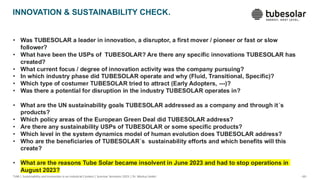
• Was TUBESOLAR a leader in innovation, a disruptor, a first mover / pioneer or fast or slow
follower?
• What have been the USPs of TUBESOLAR? Are there any specific innovations TUBESOLAR has
created?
• What current focus / degree of innovation activity was the company pursuing?
• In which industry phase did TUBESOLAR operate and why (Fluid, Transitional, Specific)?
• Which type of costumer TUBESOLAR tried to attract (Early Adopters, ---)?
• Was there a potential for disruption in the industry TUBESOLAR operates in?
• What are the UN sustainability goals TUBESOLAR addressed as a company and through it´s
products?
• Which policy areas of the European Green Deal did TUBESOLAR address?
• Are there any sustainability USPs of TUBESOLAR or some specific products?
• Which level in the system dynamics model of human evolution does TUBESOLAR address?
• Who are the beneficiaries of TUBESOLAR´s sustainability efforts and which benefits will this
create?
• What are the reasons Tube Solar became insolvent in June 2023 and had to stop operations in
August 2023?
INNOVATION & SUSTAINABILITY CHECK.
61.
- 61 -
TUM| Sustainability and Innovation in an Industrial Context | Summer Semester 2025 | Dr. Markus Seidel
INNOVATION FOCUS FRAMEWORK TRAINING SESSION.
TUBESOLAR AGRI PHOTOVOLTAICS.
?
?
?
Perowskit-
Solarcell
?
?
http://tubesolar.de/en/the-future-of-photovoltaics/
62.
- 62 -
TUM| Sustainability and Innovation in an Industrial Context | Summer Semester 2025 | Dr. Markus Seidel
EXTENDED BUSINESS MODEL CANVAS TRAINING SESSION.
TUBESOLAR AGRI PHOTOVOLTAICS (INCLUSIONS)
businessmodelanalyst.com
Partners
Activity 1
Activity n
USP 1
Relationship Client 1
Client n
Channel 1
Channel n
Revenue
Source
Cost 1 Cost 2
Resource 1
Resource n
Key Partners Key Activities Value
Propositions
Customer
Relationships
Customer
Segments
Key Resources Channels
Cost Structure Revenue Streams
Original version: Strategyzer.com
Source:
USP n
Beneficiaries
Beneficiary 1
Beneficiary n
Benefit 1
Benefit n
63.
- 63 -
TUM| Sustainability and Innovation in an Industrial Context | Summer Semester 2025 | Dr. Markus Seidel
CASESTUDY 3: ECOVATIVE.
SUSTAINABLE MATERIALS BASED ON MUSHROOMS.
Ecovative.com
64.
- 64 -
TUM| Sustainability and Innovation in an Industrial Context | Summer Semester 2025 | Dr. Markus Seidel
• Is ECOVATIVE a leader in innovation, a disruptor, a first mover / pioneer or fast or slow follower?
• What are the USPs of ECOVATIVE? Are there any specific innovations ECOVATIVE has created?
• What current focus / degree of innovation activity is the company pursuing?
• In which industry phase does ECOVATIVE operate and why (Fluid, Transitional, Specific)?
• Which type of costumer does ECOVATIVE attract (Early Adopters, ---)?
• Is there a potential for disruption in the industry ECOVATIVE operates in?
• What are the UN sustainability goals ECOVATIVE addresses as a company and through it´s
products?
• Which policy areas of the European Green Deal does ECOVATIVCE address?
• Are there any sustainability USPs of ECOVATIVE or some specific products?
• Which level in the system dynamics model of human evolution does ECOVATIV address?
• Who are the beneficiaries of ECOVATIVE sustainability efforts and which benefits will this
create?
• Is the company regularly reporting it´s carbon footprint, it´s secondary material quota or other
sustainability KPIs as a company or it´s products such as product recyclability?
• Does the company has sustainability targets and is the achievement status regularity reported
to the public?
https://www.huf-haus.com/en-uk/
INNOVATION & SUSTAINABILITY CHECK.
65.
- 65 -
TUM| Sustainability and Innovation in an Industrial Context | Summer Semester 2025 | Dr. Markus Seidel
INNOVATION FOCUS FRAMEWORK TRAINING SESSION.
ECOVATIVE.
?
?
?
?
?
https://www.huf-haus.com/en-uk/
?
66.
- 66 -
TUM| Sustainability and Innovation in an Industrial Context | Summer Semester 2025 | Dr. Markus Seidel
EXTENDED BUSINESS MODEL CANVAS TRAINING SESSION.
ECOVATIVE (INCLUSIONS).
businessmodelanalyst.com
Partners
Activity 1
Activity n
USP 1
Relationship Client 1
Client n
Channel 1
Channel n
Revenue
Source
Cost 1 Cost 2
Resource 1
Resource n
Key Partners Key Activities Value
Propositions
Customer
Relationships
Customer
Segments
Key Resources Channels
Cost Structure Revenue Streams
Original version: Strategyzer.com
Source:
USP n
Beneficiaries
Beneficiary 1
Beneficiary n
Benefit 1
Benefit n
67.
- 67 -
TUM| Sustainability and Innovation in an Industrial Context | Summer Semester 2025 | Dr. Markus Seidel
CONTENT.
1 Introduction, Reason Why / Course Targets, Methodology / Structure
3 Sustainable Business Model- and Ecosystem-Innovation
4 Innovation-Portfolios & -Roadmaps, Business Plan, External Effects
5 Summary
2 Innovation Management and Sustainability
6 Outlook: Merging Kondratieff Cycles & Spiral Dynamics and Outlook for 2100 and beyond.
68.
- 68 -
TUM| Sustainability and Innovation in an Industrial Context | Summer Semester 2025 | Dr. Markus Seidel
INNOVATION PORTFOLIOS.
DEFINITION AND DIMENSIONS FOR STRUCTURING THEM.
/
RECOMMENDED
CAN
NICE-TO-HAVE
• https://www.youtube.com/watch?v=no8IwNJfGtE
• https://www.youtube.com/watch?v=DN9hpJUCZGY
• https://www.youtube.com/watch?v=cwwAswmJ_yE
• https://hbr.org/2019/02/mckinseys-three-horizons-
model-defined-innovation-for-years-heres-why-it-no-
longer-applies
READINGS
• An innovation portfolio is set of ideas, projects, and programs that organizations
are managing as set of different investments, in order to obtain explicit results and
reach certain targets usually defined in an innovation strategy that is part of the
company strategy.
• It is a tool to orchestrate and create the future of a company, to balance risks and
chances, to ensure the efficacy of R&D budget allocation and eventually to improve
profitability, revenue generation and growth.
• The creation and management of an innovation portfolio is usually an
interdisciplinary and ongoing process that usually is overseen by senior
management as frequently large sums and capacities are being allocated.
• Based on the degree of maturity of a company several innovation portfolios can
coexists within a single company. Also the dimensions to structure portfolios might
vary based on the selection criterions to identify promising projects or sort out “lame
ducks”.
• Popular Innovation portfolio differentiate between the following dimensions:
risk vs. chance, cost vs. profit potential, urgency vs. importance, market vs.
technology drivenness etc. A popular example is the McKinsey Three Horizons
Model that can help to structure innovation activity in an existing company.
69.
- 69 -
TUM| Sustainability and Innovation in an Industrial Context | Summer Semester 2025 | Dr. Markus Seidel
INNOVATION PORTFOLIOS.
MCKINSEY THREE HORIZON MODELL FOR BUSINESS TRANSFORMATION.
time
value
Horizon 1
Maintain & Defend Core Business
1-2 years (Depending on Industry)
Horizon 2
Nuture Emerging Business
2-5 years (Depending on Industry)
Horizon 3
Create Genuinely New Businesses
> 5 years (Depending on Industry)
70.
- 70 -
TUM| Sustainability and Innovation in an Industrial Context | Summer Semester 2025 | Dr. Markus Seidel
THREE HORINZON MODELL AND SUSTAINABLE TRANSFORMATION.
EXAMPLE: BMW FROM ICE TO BEV.
time
value
Horizon 1
• Increase fuel efficiency through
various technologies
• Increase profitability through
sales and cost optimization
• 2-5 years
Horizon 2
• Light-House BEV BMW i3 (2013)
• Hybrid Electric Vehicle Product
Range
BMW X6e (2010), …
• Further increase profitability
through expansion through product
redesign, portfolio redesign ,
development of component kits,
etc…
• 5-8 years
Horizon 3
• Battery drive train innovations to
for further cost improvements
• Battery Electric Vehicle Product
Range BMW MINI Electric, iX3, i4,
iX, …
• 8-12 years
71.
- 71 -
TUM| Sustainability and Innovation in an Industrial Context | Summer Semester 2025 | Dr. Markus Seidel
INNOVATION PORTFOLIOS.
EXAMPLES.
PCF-Reduktion
Costs
PCF = Product/Component Carbon Footprint
Hybrid
Materials
(Bio + Fossil)
Mechanical
Polymer-
Recycling
Scalable
Biopolymers
Use of
Wood
as Material
Product
Redesign
No Leather
PCF-Reduktion
Time
Hybrid
Materials
(Bio + Fossil)
Mechanical
Polymer-
Recycling
Scalable
Biopolymers
Use of
Wood
as Material
Product
Redesign
No Leather
72.
- 72 -
TUM| Sustainability and Innovation in an Industrial Context | Summer Semester 2025 | Dr. Markus Seidel
INNOVATION AND TECHNOLOGY ROADMAPS.
OVERVIEW.
RECOMMENDED
CAN
NICE-TO-HAVE
• https://www.youtube.com/watch?v=BVZ4RUc-CgY
• https://www.youtube.com/watch?v=cVQfLt3NMBE
• https://www.youtube.com/watch?v=K7QS1t1tRWM
READINGS
• An innovation roadmap is a visualization of how a company will implement and
achieve it´s innovation strategy and overall targets such as growth and
profitability. .
• The innovation roadmap helps to structure innovation activities inside an
organization and to balance available budgets, capacities and top management
time. It also helps to avoid an innovation “overkill” on the costumer and
employee side: Costumers and employees might not understand the product and
are not frustrated because it has too many features.
• As long as an innovation roadmap is easy to understand it is a very important
tool of management alignment and it´s commitment to the future.
• Innovations need technologies to work and become convincing products. A
technology roadmap is the underlaying roadmap of technology development in a
way that product and service innovation can be built on certain technologies.
• It´s graphical representation is very similar than the one of the Three Horizons
Modell.
Simonse, Liane; Hultink, Eric Jan, Buijs, Jan A.:
Innovation Roadmapping: Building Concepts from
Practitioners’ Insights (2015), in: Journal of
Product Innovation Management; Vol. 32 (6); pp.
904-924
73.
- 73 -
TUM| Sustainability and Innovation in an Industrial Context | Summer Semester 2025 | Dr. Markus Seidel
BUSINESS PLANS FOR SUSTAINABLE INNOVATIONS.
RECOMMENDED
CAN
NICE-TO-HAVE
READINGS
• A business plan is the central, written document that descibes in detail a
company's objectives and how it plans to achieve its goals.
• It describes the vision & nature of the business, provides background information
on the organization, the organization's financial projections, and the strategies
and road maps it will implement to achieve its goals. It provides direction to them
team that works on specific innovation projects.
• There is no standard structure of a business plan. However it usually should
include 10 different parts:
- Executive summary
- Business description incl. business model
- Description of management, the organization and key personnel
- Products & services, their USPs and competitor analysis
- Market analysis inkl. total addressable market (TAM)
- Marketing plan and sales strategy
- Business operations (production, logistics, sourcing, sales, …)
- Sustainability beneficiaries and benefits (= positive externalities)
- Funding needs
- Financial projections
• Both, sartups and established companies, use business plans.
74.
- 74 -
TUM| Sustainability and Innovation in an Industrial Context | Summer Semester 2025 | Dr. Markus Seidel
POSITIVE AND NEGATIVE EXTERNALITIES PLAY A CRUCIAL ROLE
TO ASSESS SUSTAINABILITY EFFECTS OF INNOVATIONS.
RECOMMENDED
CAN
NICE-TO-HAVE
READINGS
• An externality is a positive or negative outcome of an economic activity that
affects a third party which is not directly involved in that activity.
• Examples for negative externalities:
- Erosion or soil pollution caused by building highways;
- Lower groundwater level through mining activies;
- Air and noise pollution caused by a new factory;
- Industrial CO2-emissions that accelerated climate change;
- Increased accident frequency through a new road where people can drive
much faster than before
• Examples for positive externalities:
- Creation of jobs and increase social welfare level through consumption
- Lower prices for customers caused by an increase of of productivity through a
new software system
- A vaccination campaign decreases the risk of infections
• The economic quantification of positive and negative externalities is difficult in
many cases. They are frequently no part of the financial plan of a venture.
Public goods such as “Clean Air” or “Ground Water” currently ave no price tag
and therefore are being used excessively. Through carbon pricing or plastic
taxation negative external effects must be taken into account and might change
decision making on the long run and accelerated the upcoming transformation.
• https://scholar.harvard.edu/files/stantcheva/files/le
cture7.pdf
75.
- 75 -
TUM| Sustainability and Innovation in an Industrial Context | Summer Semester 2025 | Dr. Markus Seidel
CONTENT.
1 Introduction, Reason Why / Course Targets, Methodology / Structure
3 Sustainable Business Model- and Ecosystem-Innovation
4 Innovation-Portfolios & -Roadmaps, Business Plans, External Effects
5 Summary
2 Innovation Management and Sustainability
6 Outlook: Merging Kondratieff Cycles & Spiral Dynamics and Outlook for 2100 and beyond.
76.
- 76 -
TUM| Sustainability and Innovation in an Industrial Context | Summer Semester 2025 | Dr. Markus Seidel
SUMMARY.
• Innovation is the result of a process starting with ideation and professional execution. Inventions and
Innovations are different things: 1% Inspiration (►Invention), 99% Transpiration (►Innovation)
• The key of any innovation activity is to manage and master uncertainty. Failure is system-inherent.
• Various types of innovations exists but every innovation is a challenge even if it seems to be a “home run”.
• Innovation can be learned like any other practical skill but must be trained – talking doesn´t create an innovator.
• Sustainability (Health) is the next long wave of innovation.
• The emerging focus on sustainabilty is the consequence of an existential threat to mankind and therefore will
create a new values system and a new level of social development.
• Important sustainabilty stakeholders are the Untited Nations (UNSDG), the EU (GREEN DEAL), the World
Economic Form (WEF) and others.
• Sustainability is a very broad concept and currently no standard measurement instrument exist - yet.
• Sustainable innovations can be perfectly described in the Extended Business Model Canvas. It is the basis for
innovation portfolios, roadmaps and business plans.
• (Quantified) Externalities play a major role in business plans of sustainable innovations.
77.
- 77 -
TUM| Sustainability and Innovation in an Industrial Context | Summer Semester 2025 | Dr. Markus Seidel
CONTENT.
1 Introduction, Reason Why / Course Targets, Methodology / Structure
3 Sustainable Business Model- and Ecosystem-Innovation
4 Innovation-Portfolios & -Roadmaps, Business Plans, External Effects
5 Summary
2 Innovation Management and Sustainability
6 Outlook: Merging Kondratieff Cycles & Spiral Dynamics and Outlook for 2100 and beyond.
78.
- 78 -
TUM| Sustainability and Innovation in an Industrial Context | Summer Semester 2025 | Dr. Markus Seidel
time
1780 2020
1840 1990
Information
Technology
• Main Frames
• PC
• Internet
• Smart Phones
• Cloud Computing
• AI
• Autonomous
Systems
• …
Human Development Level
(Spiral Dynamics)
Sustainability
• Green Energy
• Genetic Engeering
• Personalized Medical Care
• Sustainble Mobility
• Geo-/Climate Engineering
• Green Buildings
• Eternal Life
• Circular Economy
• Biobased Polymers
• Synthetic Fuels
• UNSDG Targets
• „Earth for All“
• …
Outlook: Space Age?
• Interplanetary Travel
• Human Mars / Moon Colonies
• Asteroid Mining
• Planet Engineering
• Discovery of Extra
Terrestrial Intelligence
• …
Steam
Engine,
Cotton
Energy Demand
Complexity (Spatial / Information / Skills / …)
Management Systems
2100
MERGING KONDRATIEFF CYCLES AND SPIRAL DYNAMICS.
OUTLOOK 2100.
Railway,
Steel
Electrification,
Chemicals
Automobiles,
Petrochemicals
1
2
3
4
5
6
7
79.
- 79 -
TUM| Sustainability and Innovation in an Industrial Context | Summer Semester 2025 | Dr. Markus Seidel
1. Kondratieff Cycle n is a prerequisite to reach Kondratieff Cycle n+1: There are no short cuts?!
Examples 1: AI based, robotized dismantling of products is a prerequisite of closed material loops
Daisy Robot of Apple: https://www.youtube.com/watch?v=2Bu-gl7v-P8
Example 2: Cloud based digital twins are a necessity for material recycling and the successful creation of a real
circular economy
Circular Economy Use Case of CATENA-X; https://catena-x.net/en/mehrwerte/circular-economy
2. The development of Human Value Systems is the underlying platform for innovation activities and the next
Kondratieff Cycle, too.
Example: Spircal Dynamics Value System Green was a prerequisite for the evolution of the computer industry
Article 1: https://eandt.theiet.org/content/articles/2017/07/california-inspired-from-flower-power-to-silicon-valley/
Article 2: https://www.datadriveninvestor.com/2018/05/28/
the-1960s-hippie-movement-and-how-it-gave-rise-to-silicon-valley/
Article 3: https://www.wired.com/insights/2014/09/sputnik-hippies-silicon-valley/
GENERAL OBSERVATIONS.
80.
- 80 -
TUM| Sustainability and Innovation in an Industrial Context | Winter Semester 2023 / 2024 | Dr. Markus Seidel
WHAT´S NEXT? A HYPOTHETICAL PERSPECTIVE.
MANKIND IS ON THE TRANSFORMATION PATH TO BECOME A
KARDASHEV FULL TYPE I AND LATER TYPE II CIVILISATION.
Source: https://www.esa.int/Enabling_Support/Space_Engineering_Technology/SOLARIS/SOLARIS2
“A Type I or K1 civilization has mastered all the energy available to their home planet, available
from a neighboring star. It extracts its energy, information, and raw materials
from fission and fusion power, and renewable resources; is capable of interplanetary spaceflight
and communication; mega-scale planetary engineering; medical breakthroughs to eliminate
disease and slow ageing; multiplanetary government and interplanetary trade; species is tech
augmented; but is still vulnerable to extinction.”
Source https://kardashev.fandom.com/wiki/Type_I
“A Type II or K2 civilization has control over their solar system, and may be able to harness
the power equivalent of a single star. It extracts fusion energy, information, and raw-materials from
multiple solar systems; it is capable of evolutionary intervention, interstellar travel, interstellar
communication, stellar engineering, terraforming, and star cluster-scale influence; the resulting
proliferation and diversification may negate the probability of extinction. Complete control of the
fate of its home planet where threats like ice ages and global warming can be avoided.“
Source https://kardashev.fandom.com/wiki/Type_II
81.
- 81 -
TUM| Sustainability and Innovation in an Industrial Context | Summer Semester 2025 | Dr. Markus Seidel
SUSTAINABILITY IS THE PREREQUISITE FOR MANKIND TO BECOME A TYPE II
STELLAR CIVILISATION.
RECOMMENDED
CAN
NICE-TO-HAVE
READINGS
• https://www.youtube.com/watch?v=0twrjeaje4Y
• https://www.youtube.com/watch?v=omScpI80PCo
• https://futurism.com/the-kardashev-scale-type-i-ii-
iii-iv-v-civilization
• https://en.wikipedia.org/wiki/Kardashev_scale
• The Kardashev Scale is a hypothetical concept developed by the Soviet
astronomer Nikolai Kardashev in 1964. It is a method to measure a civilization´s
level of technological advancement based on the amount of energy it is
capable of using. Originally it proposed three types of civilization.
- Type I civilization: It can access and utilize all energy on its planet and store it
for later consumption. It can control natural events such as wheather,
earthquakes, volcano erruptions etc. Its energy consumption rate is ~ 1016
W
- Type II civilization: It can directly access and utilize it´s star´s energy, most likely
through the use of a socalled Dyson sphere – a physical structure in space that
“collects” energy emitted by it´s star. Energy consumption rate is ~ 1026
W.
- Type III civilization: Is able to capture and utilize all the energy emitted by
its galaxy and every source within it (stars, black holes, etc. ). Energy
consumption is ~ 1036 W.
Later more types have been added.
• Currently humanity stands at ~ 0,72 on the logarithmic Kardashev scale. It
might take 100-200 more years to reach 1.
• Hypothesis: To become a “full” Type II civilization humanity has to be able to
control aging processes & health to be able to travel for years in space. It has to
be able to “engineer” climate, weather and environments as we have to ensure the
living conditions on other planets. Earth is the pilot ground to develop these skills
to maximise sustainability.
• Jiang , Jonathan H. ; Feng, Fuyang ; Rosen, Philip E.
Fahy, Kristen A.; Das, Prithwis; Obacz, Piotr; Zhang,
Antong; Zhu, Zong-Hong: Avoiding the Great Filter:
Predicting the Timeline for Humanity to Reach
Kardashev Type I Civilization, in: Galaxies 2022, 10
• Zhang, Antong; Yang, Jiani; Luo, Yangcheng; Fan,
Siteng : Forecasting the progression of human
civilization on the Kardashev Scale through 2060
with a machine learning approach, in: Scientific
Reports 2023, 13,11305
82.
- 82 -
TUM| Sustainability and Innovation in an Industrial Context | Summer Semester 2025 | Dr. Markus Seidel
THANKS FOR YOUR ATTENTION!
READY FOR YOUR SUSTAINABLE INNOVATION
CHALLENGE?

![- 2 -
TUM | Sustainability and Innovation in an Industrial Context | Summer Semester 2025 | Dr. Markus Seidel
PREFACE.
50 years ago the Club of Rome published it´s landmark report „The limits to growth“. Until today it stands out as one of the
most influential books ever published. But did it really change things? In 1972 the United States had a population of 210
million people and a Gross Domestic Product (GDP) of 1,3 trillion USD. China´s population reached 860 million people and
it´s GDP was worth only 114 billion USD. The world population in 1972 climbed to 3,8 billion people. Today 338 million
people live in the United States that have a GDP worth 25 trillion USD [2022]. China now has a population of 1,43 billion
people and it´s GDP reaches 18 trillion USD [2022]. The world population has more than doubled to 8 billion people during
the last 50 years.
The results: From 1972 to 2022 the athmospheric carbon dioxid (CO2)-level climbed from 330 to 420 ppm [2022], what
further accelerated climate change. Precious rain forests have diminished, species extinction has accelerated and while
going swimming at a beach it is not uncommon to collide with plastic garbage in the water.
How could this happen though we have the knowledge, the resources and the technologies available to manage the
situation more professionally?](https://image.slidesharecdn.com/lecturescript-250615115527-220ecd23/85/Lecture-Script-for-Innovation-and-Sustainability-2-320.jpg)