Most important constituent of construction management.
A mental process (thinking ) to decide about the future line of action.
In future , for the project:
Three “Ws” are important ( as discussed)
What to do?
Construction? Type? Needs Planning ?
When to do?
Starting Date? / Completing Date??
Who will do? Besides that where to do?
Construction Engineer / Civil Engineer
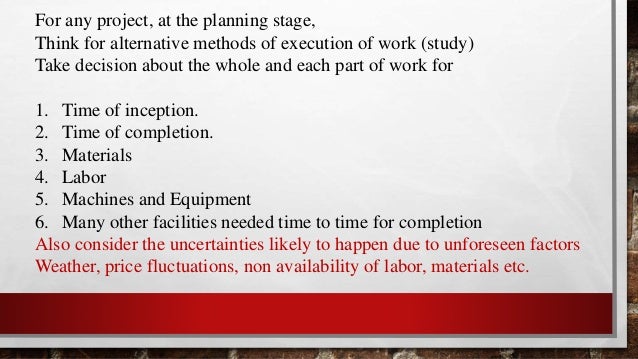
For any project, at the planning stage,
Think for alternative methods of execution of work (study)
Take decision about the whole and each part of work for
1. Time of inception.
2. Time of completion.
3. Materials
4. Labor
5. Machines and Equipment
6. Many other facilities needed time to time for completion
Also consider the uncertainties likely to happen due to unforeseen factors
Weather, price fluctuations, non availability of labor, materials etc.
STEPS IN PLANNING
1. Identifying the problem in execution, obtaining necessary information.
2. Ascertain alternative facility , optimum plan
3. Fixing the time of starting the execution of work.
4. Time of delivering the material on site.
5. Deciding the quantities and duration of various types machines etc.
6. Deciding the number of different types of labor for various works
7. Deciding the estimation of financial help needed.
8. Deciding the duration of completion of the work.
9. Evaluation of the effectiveness of plan adopted.
Proper Design
Proper Selection Of Machinery
Proper Arrangement Of Repairs Of Machinery
Procurement Of Material Well In Advance
Proper Employment Of Trained & Experienced Staff
Proper Welfare Scheme For Staff And Workers(medical )
Proper Availability Of Funds For Completion
Proper Safety Measures For Staff, (Ventilation, Light, Water, Drainage)
Proper Arrangement Of Communication And Feed Back
1. The plan should be readily understandable. It should be in simple and lucid
language. It should be able to convey the correct message at each complex
level.
2. The Plan must be realistic.
3. The Plan should be flexible.
4. The plan should be comprehensive.
5. The plan should be such as it can be used as the basis for monitoring and

Lecture Project Planning

  • 2.
    Most important constituentof construction management. A mental process (thinking ) to decide about the future line of action. In future , for the project: Three “Ws” are important ( as discussed) What to do? Construction? Type? Needs Planning ? When to do? Starting Date? / Completing Date?? Who will do? Besides that where to do? Construction Engineer / Civil Engineer
  • 3.
    For any project,at the planning stage, Think for alternative methods of execution of work (study) Take decision about the whole and each part of work for 1. Time of inception. 2. Time of completion. 3. Materials 4. Labor 5. Machines and Equipment 6. Many other facilities needed time to time for completion Also consider the uncertainties likely to happen due to unforeseen factors Weather, price fluctuations, non availability of labor, materials etc.
  • 4.
    STEPS IN PLANNING 1.Identifying the problem in execution, obtaining necessary information. 2. Ascertain alternative facility , optimum plan 3. Fixing the time of starting the execution of work. 4. Time of delivering the material on site. 5. Deciding the quantities and duration of various types machines etc. 6. Deciding the number of different types of labor for various works 7. Deciding the estimation of financial help needed. 8. Deciding the duration of completion of the work. 9. Evaluation of the effectiveness of plan adopted.
  • 6.
    Proper Design Proper SelectionOf Machinery Proper Arrangement Of Repairs Of Machinery Procurement Of Material Well In Advance Proper Employment Of Trained & Experienced Staff Proper Welfare Scheme For Staff And Workers(medical ) Proper Availability Of Funds For Completion Proper Safety Measures For Staff, (Ventilation, Light, Water, Drainage) Proper Arrangement Of Communication And Feed Back
  • 8.
    1. The planshould be readily understandable. It should be in simple and lucid language. It should be able to convey the correct message at each complex level. 2. The Plan must be realistic. 3. The Plan should be flexible. 4. The plan should be comprehensive. 5. The plan should be such as it can be used as the basis for monitoring and