Geology for Engineers
Planet Earth
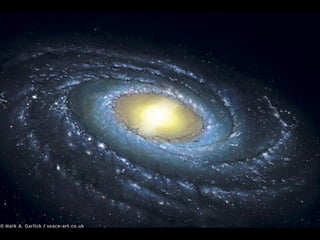
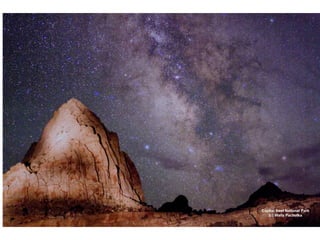
THE UNIVERSE
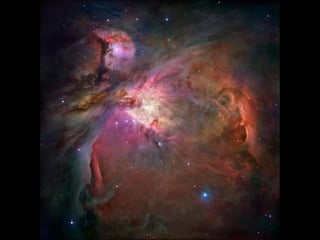
The Universe is the totality of all matter and
energy that exists in the vastness of space,
whether known to human beings or not.
Formation of the Solar System
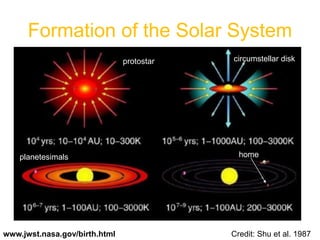
• The stages of solar system formation start
with a protostar embedded in a gas cloud,
then to an early star with a circumstellar
disk, to a star surrounded by small
"planetesimals" that are starting to clump
together to a solar system like ours today.
Formation of the Solar System
www.jwst.nasa.gov/birth.html Credit: Shu et al. 1987
protostar circumstellar disk
planetesimals home
Composition of the Solar System
Composed of Eight Planets grouped under
the following
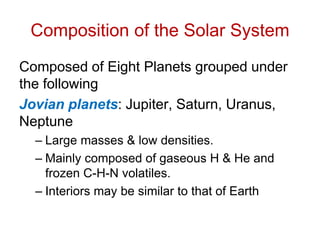
Jovian planets: Jupiter, Saturn, Uranus,
Neptune
– Large masses & low densities.
– Mainly composed of gaseous H & He and
frozen C-H-N volatiles.
– Interiors may be similar to that of Earth
Composition of the Solar System
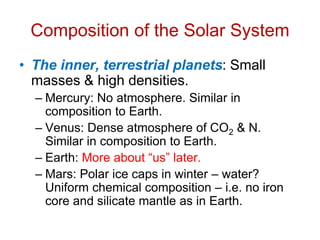
• The inner, terrestrial planets: Small
masses & high densities.
– Mercury: No atmosphere. Similar in
composition to Earth.
– Venus: Dense atmosphere of CO2 & N.
Similar in composition to Earth.
– Earth: More about “us” later.
– Mars: Polar ice caps in winter – water?
Uniform chemical composition – i.e. no iron
core and silicate mantle as in Earth.
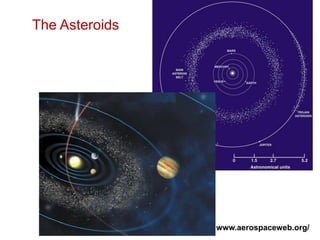
The Asteroids
www.aerospaceweb.org/
Composition of the Solar System
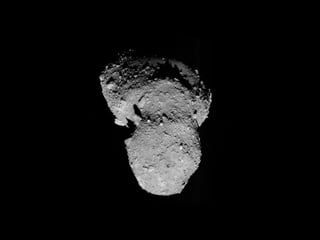
• The asteroids: Located in a belt between
the terrestrial and Jovian planets e.g.
Pluto.
• Meteorites: Most are probably fragments
from the asteroid belt of our solar system.
– Siderites, or “irons” (98% metal)
– Siderolites, or “stony irons” (50% metal, 50%
silicate)
– Aerolite, or “stones” (silicate > metal)
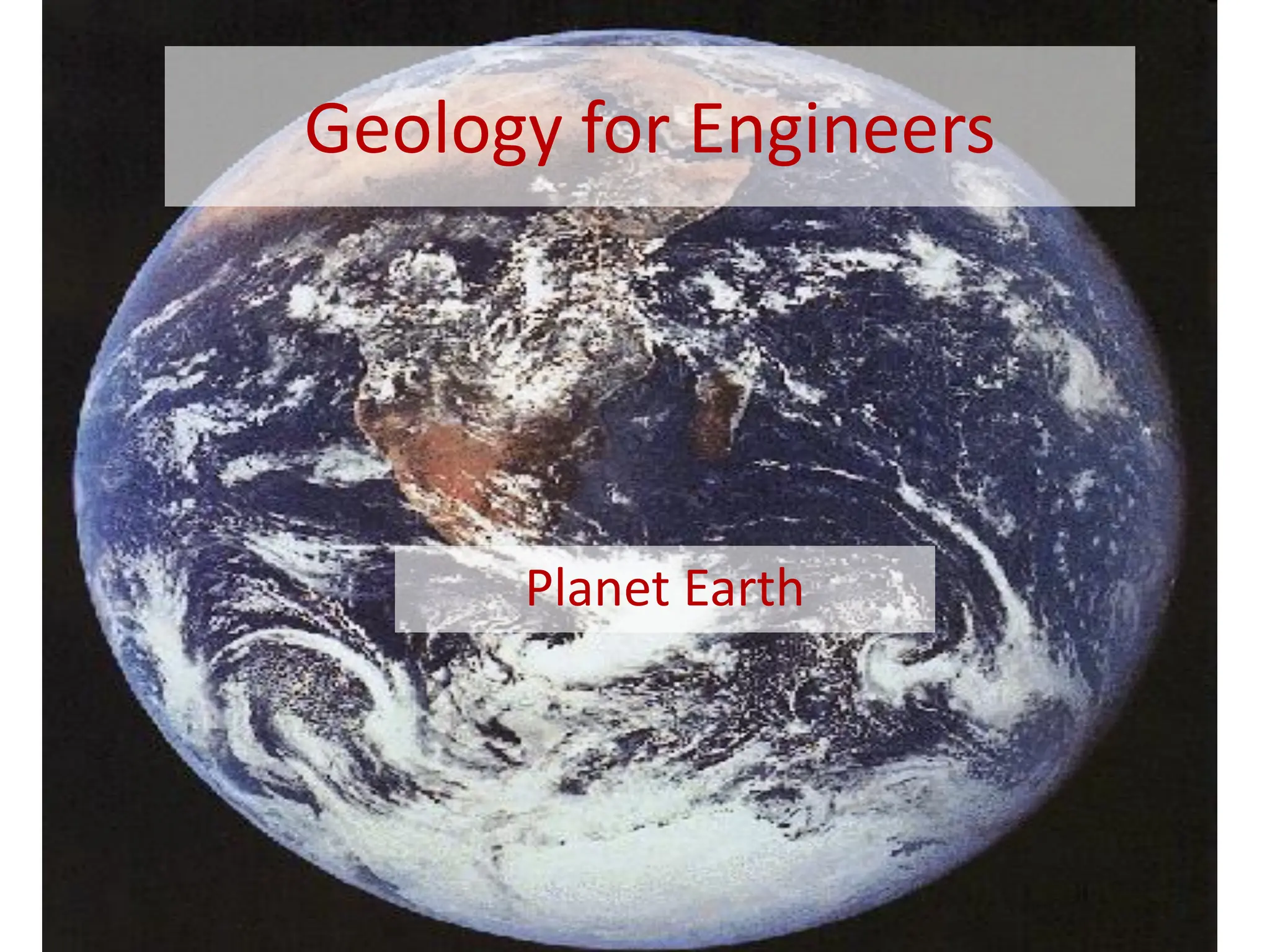
Planet Earth
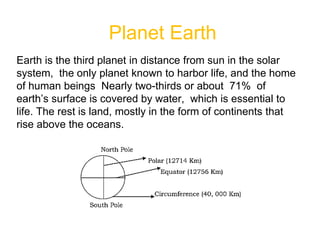
Earth is the third planet in distance from sun in the solar
system, the only planet known to harbor life, and the home
of human beings Nearly two-thirds or about 71% of
earth’s surface is covered by water, which is essential to
life. The rest is land, mostly in the form of continents that
rise above the oceans.
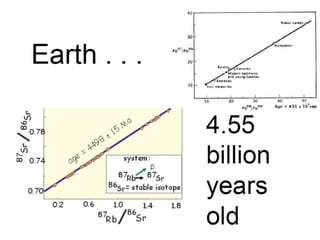
The Age of the Earth
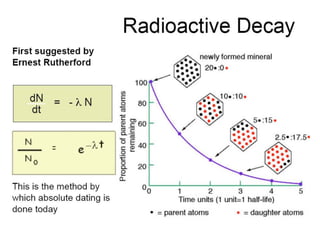
Geochronologists are responsible for
determining the age of the earth
using radioactivity technique (radiometric
dating technique).
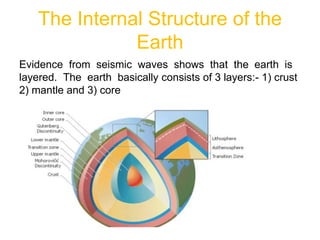
The Internal Structure of the
Earth
Evidence from seismic waves shows that the earth is
layered. The earth basically consists of 3 layers:- 1) crust
2) mantle and 3) core
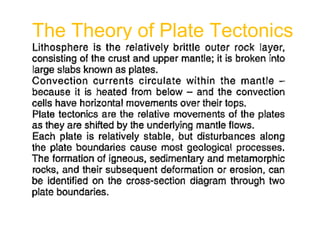
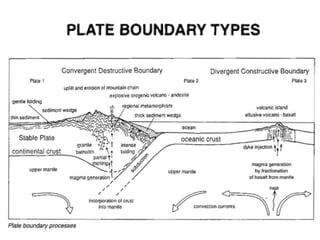
The Theory of Plate Tectonics
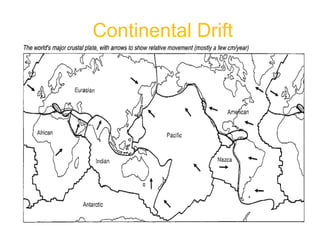
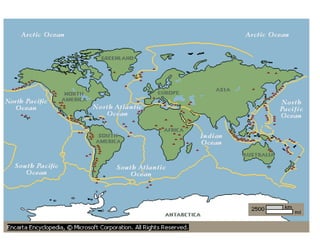
Continental Drift
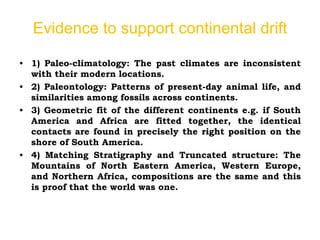
Evidence to support continental drift
• 1) Paleo-climatology: The past climates are inconsistent
with their modern locations.
• 2) Paleontology: Patterns of present-day animal life, and
similarities among fossils across continents.
• 3) Geometric fit of the different continents e.g. if South
America and Africa are fitted together, the identical
contacts are found in precisely the right position on the
shore of South America.
• 4) Matching Stratigraphy and Truncated structure: The
Mountains of North Eastern America, Western Europe,
and Northern Africa, compositions are the same and this
is proof that the world was one.
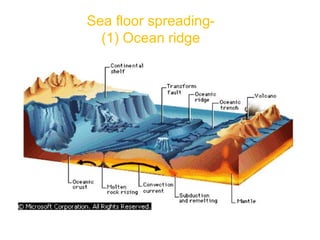
Sea floor spreading-
(1) Ocean ridge
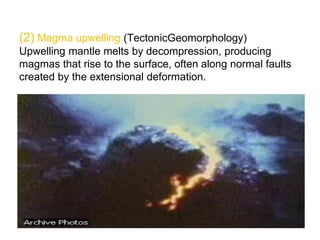
(2) Magma upwelling (TectonicGeomorphology)
Upwelling mantle melts by decompression, producing
magmas that rise to the surface, often along normal faults
created by the extensional deformation.
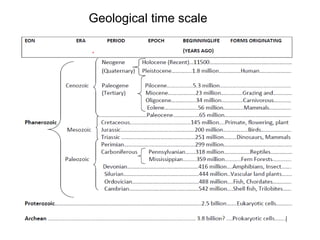
Geological time scale

Lecture Note PPt Lecture TWO prepared by Nyende Copy.pdf

  • 1.
  • 3.
    THE UNIVERSE The Universeis the totality of all matter and energy that exists in the vastness of space, whether known to human beings or not.
  • 7.
    Formation of theSolar System • The stages of solar system formation start with a protostar embedded in a gas cloud, then to an early star with a circumstellar disk, to a star surrounded by small "planetesimals" that are starting to clump together to a solar system like ours today.
  • 8.
    Formation of theSolar System www.jwst.nasa.gov/birth.html Credit: Shu et al. 1987 protostar circumstellar disk planetesimals home
  • 9.
    Composition of theSolar System Composed of Eight Planets grouped under the following Jovian planets: Jupiter, Saturn, Uranus, Neptune – Large masses & low densities. – Mainly composed of gaseous H & He and frozen C-H-N volatiles. – Interiors may be similar to that of Earth
  • 10.
    Composition of theSolar System • The inner, terrestrial planets: Small masses & high densities. – Mercury: No atmosphere. Similar in composition to Earth. – Venus: Dense atmosphere of CO2 & N. Similar in composition to Earth. – Earth: More about “us” later. – Mars: Polar ice caps in winter – water? Uniform chemical composition – i.e. no iron core and silicate mantle as in Earth.
  • 11.
  • 13.
    Composition of theSolar System • The asteroids: Located in a belt between the terrestrial and Jovian planets e.g. Pluto. • Meteorites: Most are probably fragments from the asteroid belt of our solar system. – Siderites, or “irons” (98% metal) – Siderolites, or “stony irons” (50% metal, 50% silicate) – Aerolite, or “stones” (silicate > metal)
  • 14.
    Planet Earth Earth isthe third planet in distance from sun in the solar system, the only planet known to harbor life, and the home of human beings Nearly two-thirds or about 71% of earth’s surface is covered by water, which is essential to life. The rest is land, mostly in the form of continents that rise above the oceans.
  • 15.
    The Age ofthe Earth Geochronologists are responsible for determining the age of the earth using radioactivity technique (radiometric dating technique).
  • 18.
    The Internal Structureof the Earth Evidence from seismic waves shows that the earth is layered. The earth basically consists of 3 layers:- 1) crust 2) mantle and 3) core
  • 19.
    The Theory ofPlate Tectonics
  • 21.
  • 23.
    Evidence to supportcontinental drift • 1) Paleo-climatology: The past climates are inconsistent with their modern locations. • 2) Paleontology: Patterns of present-day animal life, and similarities among fossils across continents. • 3) Geometric fit of the different continents e.g. if South America and Africa are fitted together, the identical contacts are found in precisely the right position on the shore of South America. • 4) Matching Stratigraphy and Truncated structure: The Mountains of North Eastern America, Western Europe, and Northern Africa, compositions are the same and this is proof that the world was one.
  • 24.
  • 25.
    (2) Magma upwelling(TectonicGeomorphology) Upwelling mantle melts by decompression, producing magmas that rise to the surface, often along normal faults created by the extensional deformation.
  • 26.