Applying Drug Literature to Patient
Care
Evidenced Based Medicine (EBM)
• The best method of caring for patients
• Application is complicated by:
– Patient-specific factors
– Clinician-specific judgment and expertise
– Availability of evidence
– Assessment of evidence
Applying Evidence to Patient Care
• Two underlying principles:
1. Care is patient-centered
2. Decisions based on most applicable and highest
quality evidence
• Both principles must be weighed to make a patient
care decision
Patient-Centered Considerations
• Quality of life
– Cost
– Risk versus benefit
– Lifestyle changes
• Values and preferences
• Collaborating with the patient
Patient-Centered Considerations
• Adherence
• Health literacy
• Biological factors (e.g., race)
Considerations for Making a Treatment
Decision
• Gather applicable evidence
• Assess quality of evidence
• Share evidence with patient
• Collaborate with patient
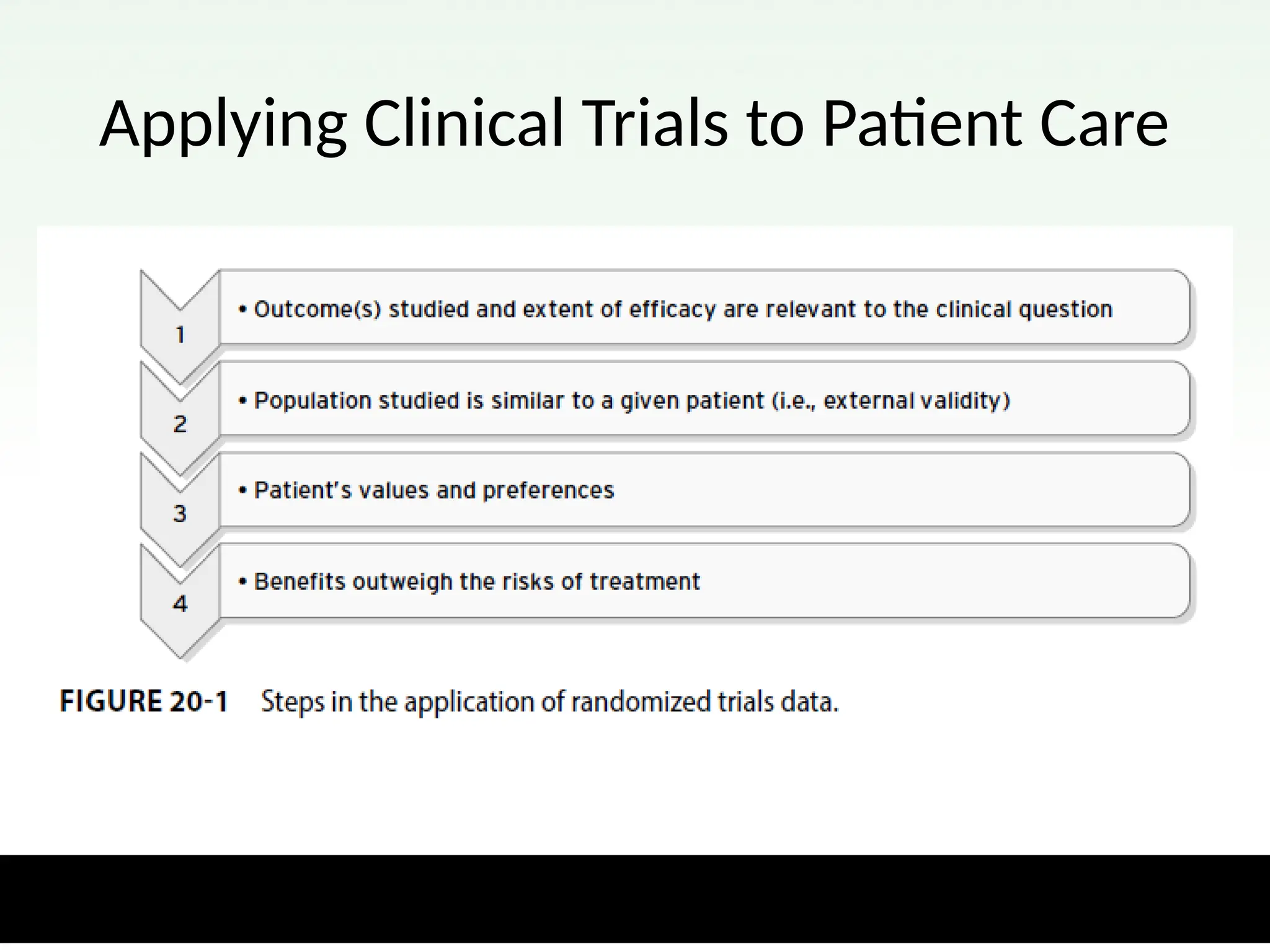
Applying Clinical Trials to Patient Care
Applying Guidelines to Patient Care
• Ideally, the practice guideline should:
– Be objective and have a scope aligned with the
clinical scenario
– Review all issues relevant to the clinical scenario
– Comprehensively review all treatment options
– Systematically review the literature
– Clearly define the process for reviewing the
literature and making recommendations
Practice Guideline Considerations
• Not always up to date
– Determine when they were last updated
• Sometimes based on expert opinion
– Check level AND type of evidence on which
recommendations are based
Practice Guideline Considerations
• Based on value judgments
– Determine if based on perspective of patient,
society, guideline author
– Ideally consider patient perspective
Staying Up with Drug Information
1. Focus on your scope of practice
2. Identify a method that works best for your
preferred learning style
3. Incorporate a system into your usual routine
POEM
• Patient-oriented evidence that matters
• Evaluates the effect of an intervention (e.g., test, drug)
on an outcome that matters to patients
• Studies a “common” medical problem with a feasible
intervention in a given setting
• Supplies information with potential to induce a practice
change
Other Methods to Stay Up To Date
• Search online databases (e.g., pubmed.gov)
• Foraging tools
– Summaries of literature in a given field
• Journal clubs
Other Methods to Stay Up To Date
• Precepting
• Continuing education

Lecture-Applying evidence to patien care

  • 1.
    Applying Drug Literatureto Patient Care
  • 2.
    Evidenced Based Medicine(EBM) • The best method of caring for patients • Application is complicated by: – Patient-specific factors – Clinician-specific judgment and expertise – Availability of evidence – Assessment of evidence
  • 3.
    Applying Evidence toPatient Care • Two underlying principles: 1. Care is patient-centered 2. Decisions based on most applicable and highest quality evidence • Both principles must be weighed to make a patient care decision
  • 4.
    Patient-Centered Considerations • Qualityof life – Cost – Risk versus benefit – Lifestyle changes • Values and preferences • Collaborating with the patient
  • 5.
    Patient-Centered Considerations • Adherence •Health literacy • Biological factors (e.g., race)
  • 6.
    Considerations for Makinga Treatment Decision • Gather applicable evidence • Assess quality of evidence • Share evidence with patient • Collaborate with patient
  • 7.
    Applying Clinical Trialsto Patient Care
  • 8.
    Applying Guidelines toPatient Care • Ideally, the practice guideline should: – Be objective and have a scope aligned with the clinical scenario – Review all issues relevant to the clinical scenario – Comprehensively review all treatment options – Systematically review the literature – Clearly define the process for reviewing the literature and making recommendations
  • 9.
    Practice Guideline Considerations •Not always up to date – Determine when they were last updated • Sometimes based on expert opinion – Check level AND type of evidence on which recommendations are based
  • 10.
    Practice Guideline Considerations •Based on value judgments – Determine if based on perspective of patient, society, guideline author – Ideally consider patient perspective
  • 11.
    Staying Up withDrug Information 1. Focus on your scope of practice 2. Identify a method that works best for your preferred learning style 3. Incorporate a system into your usual routine
  • 12.
    POEM • Patient-oriented evidencethat matters • Evaluates the effect of an intervention (e.g., test, drug) on an outcome that matters to patients • Studies a “common” medical problem with a feasible intervention in a given setting • Supplies information with potential to induce a practice change
  • 13.
    Other Methods toStay Up To Date • Search online databases (e.g., pubmed.gov) • Foraging tools – Summaries of literature in a given field • Journal clubs
  • 14.
    Other Methods toStay Up To Date • Precepting • Continuing education