PLATE HEAT
EXCHANGERS
INTRODUCTION
 Sondex Plate Heat Exchanger - Working Principles – YouTube
 Heat Exchanger Plates Explained (Industrial Engineering) – YouTube
 Gasketed Plate Heat Exchangers
 A gasketed plate heat exchanger consists of a stack of closely spaced thin plates clamped
together in a frame.
 A thin gasket seals the plates around their edges.
 The plates are normally between 0.5 and 3 mm thick, and the gap between them is 1.5 to 5
mm.
 Plate surface areas range from 0.03 to 1.5 m2 , with a plate length:width ratio from 2.0 to 3.0.
 The size of plate heat exchangers can vary from very small, 0.03 m2 , to very large, 1500 m2 .
 The maximum flow rate of fluid is limited to around 2500 m3 /h.
 Corner ports in the plates direct the flow from plate to plate.
 The plates are embossed with a pattern of ridges, which increase the rigidity of the plate and improve
the heat transfer performance.
 Plates are available in a wide range of metals and alloys, including stainless steel, aluminum, and
titanium.
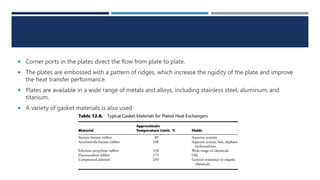
 A variety of gasket materials is also used
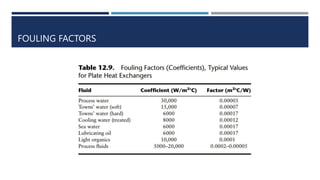
FOULING FACTORS
 Plate heat exchangers are used extensively in the food and beverage
industries, as they can be readily taken apart for cleaning and inspection.
 Their use in the chemical industry will depend on the relative cost for the
application compared with a conventional shell and tube exchanger.
FLOW ARRANGEMENTS
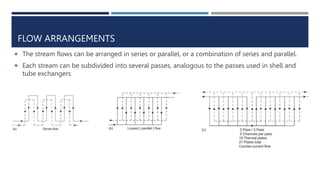
 The stream flows can be arranged in series or parallel, or a combination of series and parallel.
 Each stream can be subdivided into several passes, analogous to the passes used in shell and
tube exchangers
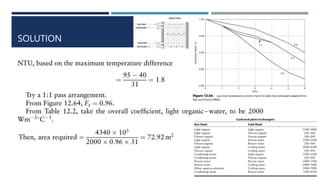
CORRECTION FACTOR
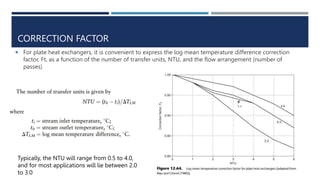
 For plate heat exchangers, it is convenient to express the log mean temperature difference correction
factor, Ft, as a function of the number of transfer units, NTU, and the flow arrangement (number of
passes)
Typically, the NTU will range from 0.5 to 4.0,
and for most applications will lie between 2.0
to 3.0
HEAT TRANSFER COEFFICIENT
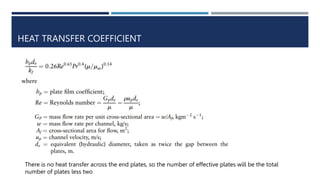
There is no heat transfer across the end plates, so the number of effective plates will be the total
number of plates less two
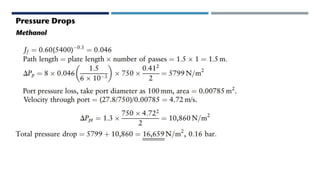
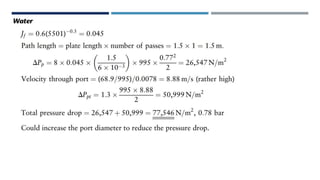
PRESSURE DROP
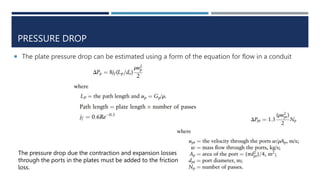
 The plate pressure drop can be estimated using a form of the equation for flow in a conduit
The pressure drop due the contraction and expansion losses
through the ports in the plates must be added to the friction
loss.
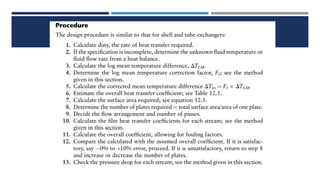
PLATE HEAT EXCHANGER DESIGN
 It is not possible to give exact design methods for plate heat exchangers.
 They are proprietary designs and will normally be specified in consultation
with the manufacturers.
 Information on the performance of the various patterns of plates used is not
generally available.
 The approximate method given here can be used to size an exchanger for
comparison with a shell and tube exchanger, and to check performance of an
existing exchanger for new duties.
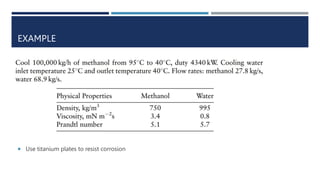
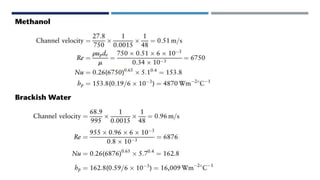
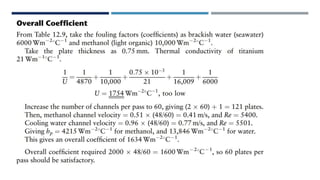
EXAMPLE
 Use titanium plates to resist corrosion
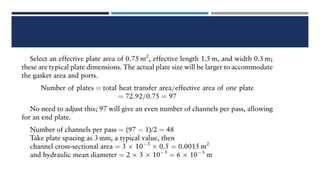
SOLUTION
DESIGN OF HEAT EXCHANGERS USING ASPEN HYSYS
 https://youtu.be/5fVdueuRZ1o (Plate and Frame)
 https://youtu.be/Yz1xemF0Pfc (Shell and Tube)

Lecture 8.pptx

  • 1.
  • 2.
    INTRODUCTION  Sondex PlateHeat Exchanger - Working Principles – YouTube  Heat Exchanger Plates Explained (Industrial Engineering) – YouTube
  • 4.
     Gasketed PlateHeat Exchangers  A gasketed plate heat exchanger consists of a stack of closely spaced thin plates clamped together in a frame.  A thin gasket seals the plates around their edges.  The plates are normally between 0.5 and 3 mm thick, and the gap between them is 1.5 to 5 mm.  Plate surface areas range from 0.03 to 1.5 m2 , with a plate length:width ratio from 2.0 to 3.0.  The size of plate heat exchangers can vary from very small, 0.03 m2 , to very large, 1500 m2 .  The maximum flow rate of fluid is limited to around 2500 m3 /h.
  • 5.
     Corner portsin the plates direct the flow from plate to plate.  The plates are embossed with a pattern of ridges, which increase the rigidity of the plate and improve the heat transfer performance.  Plates are available in a wide range of metals and alloys, including stainless steel, aluminum, and titanium.  A variety of gasket materials is also used
  • 6.
  • 7.
     Plate heatexchangers are used extensively in the food and beverage industries, as they can be readily taken apart for cleaning and inspection.  Their use in the chemical industry will depend on the relative cost for the application compared with a conventional shell and tube exchanger.
  • 8.
    FLOW ARRANGEMENTS  Thestream flows can be arranged in series or parallel, or a combination of series and parallel.  Each stream can be subdivided into several passes, analogous to the passes used in shell and tube exchangers
  • 9.
    CORRECTION FACTOR  Forplate heat exchangers, it is convenient to express the log mean temperature difference correction factor, Ft, as a function of the number of transfer units, NTU, and the flow arrangement (number of passes) Typically, the NTU will range from 0.5 to 4.0, and for most applications will lie between 2.0 to 3.0
  • 10.
    HEAT TRANSFER COEFFICIENT Thereis no heat transfer across the end plates, so the number of effective plates will be the total number of plates less two
  • 11.
    PRESSURE DROP  Theplate pressure drop can be estimated using a form of the equation for flow in a conduit The pressure drop due the contraction and expansion losses through the ports in the plates must be added to the friction loss.
  • 12.
    PLATE HEAT EXCHANGERDESIGN  It is not possible to give exact design methods for plate heat exchangers.  They are proprietary designs and will normally be specified in consultation with the manufacturers.  Information on the performance of the various patterns of plates used is not generally available.  The approximate method given here can be used to size an exchanger for comparison with a shell and tube exchanger, and to check performance of an existing exchanger for new duties.
  • 14.
    EXAMPLE  Use titaniumplates to resist corrosion
  • 15.
  • 21.
    DESIGN OF HEATEXCHANGERS USING ASPEN HYSYS  https://youtu.be/5fVdueuRZ1o (Plate and Frame)  https://youtu.be/Yz1xemF0Pfc (Shell and Tube)