Introduction to algorithms
1
University of Technology and Engineering
Vietnam National University Hanoi
Algorithms?
What is an algorithm?
An algorithm is a step by step procedure to solve a problem. An algorithm
can be described by nature languages or programming languages.
Example: How to cook rice?
❖ Step 1: Get rice
❖ Step 2: Rinse the rice
❖ Step 3: Put the rice and water into a rice cooker
❖ Step 4: Turn on the rice cooker
❖ Step 5: Check the rice when the rice cooker turns off
2
Algorithms?
What is a good algorithm?
❖Correctness
❖Efficiency
❖Simple/understandable
❖Implementable
3
Algorithms
4
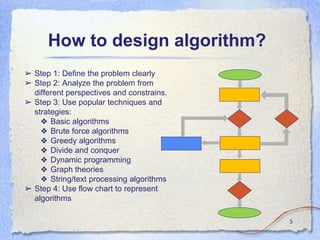
How to design algorithm?
➢ Step 1: Define the problem clearly
➢ Step 2: Analyze the problem from
different perspectives and constrains.
➢ Step 3: Use popular techniques and
strategies:
❖ Basic algorithms
❖ Brute force algorithms
❖ Greedy algorithms
❖ Divide and conquer
❖ Dynamic programming
❖ Graph theories
❖ String/text processing algorithms
➢ Step 4: Use flow chart to represent
algorithms
5
Searching problem
Problem: Given a list A consisting of n items. Check if an item X
exists on list A?
Simple search algorithm: Iterate from the begin to the end of A to
check if X equals to any item of A.
Complexity: O(n)
6
Sorting problem
Problem: Given a list A consisting of n items. Sort items of list
A increasingly?
Example:
A = (1, 2, 5, 3, 8, 9, 2)
Sorting result:
A = (1, 2, 2, 3, 5, 8, 9)
7
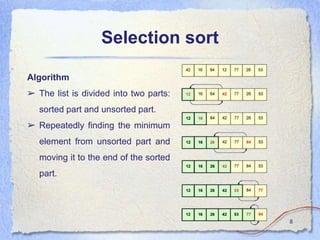
Selection sort
Algorithm
➢ The list is divided into two parts:
sorted part and unsorted part.
➢ Repeatedly finding the minimum
element from unsorted part and
moving it to the end of the sorted
part.
8
Selection sort
Algorithm selection_sort (A, n):
for iter from 0 to n - 2 do
min_idx = iter;
for idx from (iter + 1) to n - 1 do
if A[idx] < A[min_idx] then
min_idx = idx;
swap (a[iter], a[min_idx]);
Complexity:
9
Searching on sorted list
Problem: Given a list A consisting of n items sorted increasingly.
Check if an item X exists on list A?
Binary search algorithm (A):
❖ If A is empty, return False
❖ Compare X with the item Y at the middle of A.
• If X = Y, return True.
• If X < Y, Perform binary search on the left half of A
• If X > Y, Perform binary search on the right half of A
Complexity: 10
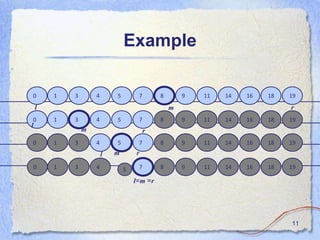
Example
11
1 3 4 5 7 8 9 11 14 16 18 19
1 3 4 5 7 8 9 11 14 16 18 19
1 3 4 5 7 8 9 11 14 16 18 19
1 3 4 5 7 8 9 11 14 16 18 19
0
0
0
0
m
l r
m
l
r
m
l r
l=m =r
Brute Force Search
Systematically evaluate all possible solutions for the
problem to determine objective solutions.
Example:
❖ Find all prime numbers smaller than 100
❖ Find all binary numbers of length n
12
The largest row
Problem: Given a matrix A of m rows and n columns
containing integer numbers. Your task is to find the
row with the largest sum.
Method Find_largest_row (A, m, n):
Complexity:
13
The largest rectangle
Problem: Given a matrix of A of m rows and n
columns containing integer numbers. Your task is to
find the rectangle in the matrix with the largest sum.
Method Find_largest_rectangle (A, m, n):
Complexity:
14
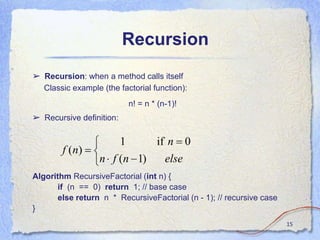
Recursion
➢ Recursion: when a method calls itself
Classic example (the factorial function):
n! = n * (n-1)!
➢ Recursive definition:
Algorithm RecursiveFactorial (int n) {
if (n == 0) return 1; // base case
else return n * RecursiveFactorial (n - 1); // recursive case
}
15
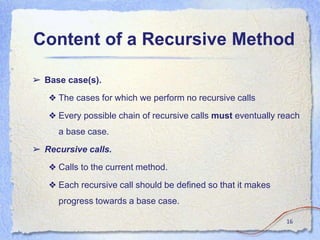
Content of a Recursive Method
➢ Base case(s).
❖ The cases for which we perform no recursive calls
❖ Every possible chain of recursive calls must eventually reach
a base case.
➢ Recursive calls.
❖ Calls to the current method.
❖ Each recursive call should be defined so that it makes
progress towards a base case.
16
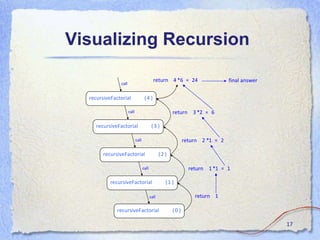
Visualizing Recursion
recursiveFactorial (4 )
recursiveFactorial (3 )
recursiveFactorial (2 )
recursiveFactorial (1 )
recursiveFactorial (0 )
return 1
call
call
call
call
return 1 *1 = 1
return 2 *1 = 2
return 3 *2 = 6
return 4 *6 = 24 final answer
call
17
Computing Powers
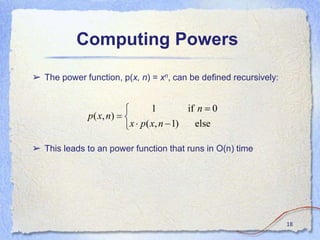
➢ The power function, p(x, n) = xn, can be defined recursively:
➢ This leads to an power function that runs in O(n) time
18
Recursive Squaring
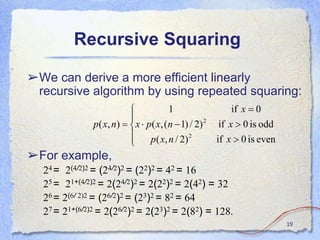
➢We can derive a more efficient linearly
recursive algorithm by using repeated squaring:
➢For example,
24 = 2(4/2)2 = (24/2)2 = (22)2 = 42 = 16
25 = 21+(4/2)2 = 2(24/2)2 = 2(22)2 = 2(42) = 32
26 = 2(6/ 2)2 = (26/2)2 = (23)2 = 82 = 64
27 = 21+(6/2)2 = 2(26/2)2 = 2(23)2 = 2(82) = 128.
19
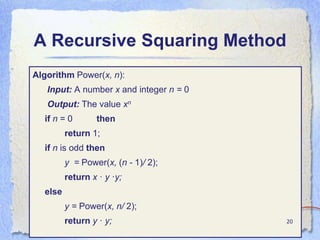
A Recursive Squaring Method
Algorithm Power(x, n):
Input: A number x and integer n = 0
Output: The value xn
if n = 0 then
return 1;
if n is odd then
y = Power(x, (n - 1)/ 2);
return x · y ·y;
else
y = Power(x, n/ 2);
return y · y; 20
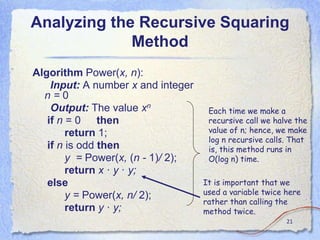
Analyzing the Recursive Squaring
Method
Algorithm Power(x, n):
Input: A number x and integer
n = 0
Output: The value xn
if n = 0 then
return 1;
if n is odd then
y = Power(x, (n - 1)/ 2);
return x · y · y;
else
y = Power(x, n/ 2);
return y · y;
It is important that we
used a variable twice here
rather than calling the
method twice.
Each time we make a
recursive call we halve the
value of n; hence, we make
log n recursive calls. That
is, this method runs in
O(log n) time.
21
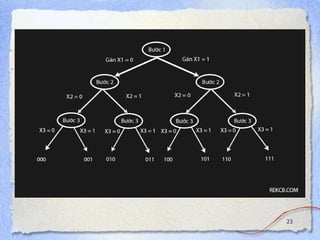
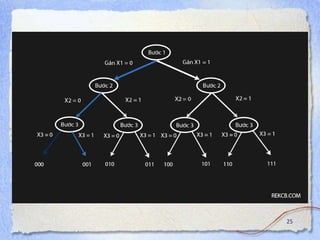
Find all binary numbers
Problem: Find all binary numbers of length n.
Example: n = 3
000,001,010,011,100,101,110,111
Algorithm binary_number(b, k, n):
for v for 0 to 1 do
b[k] = v;
if (k==n) then
print b;
else
binary number (b, k + 1, n);
Complexity: 22
23
24
25
26
Find permutations
Problem: Find all permutations of length n.
Example: n = 3
123, 132, 213, 231, 312, 321
Algorithm: Find_permutations (n):
Complexity:
23

Lecture 7_introduction_algorithms.pptx

  • 1.
    Introduction to algorithms 1 Universityof Technology and Engineering Vietnam National University Hanoi
  • 2.
    Algorithms? What is analgorithm? An algorithm is a step by step procedure to solve a problem. An algorithm can be described by nature languages or programming languages. Example: How to cook rice? ❖ Step 1: Get rice ❖ Step 2: Rinse the rice ❖ Step 3: Put the rice and water into a rice cooker ❖ Step 4: Turn on the rice cooker ❖ Step 5: Check the rice when the rice cooker turns off 2
  • 3.
    Algorithms? What is agood algorithm? ❖Correctness ❖Efficiency ❖Simple/understandable ❖Implementable 3
  • 4.
  • 5.
    How to designalgorithm? ➢ Step 1: Define the problem clearly ➢ Step 2: Analyze the problem from different perspectives and constrains. ➢ Step 3: Use popular techniques and strategies: ❖ Basic algorithms ❖ Brute force algorithms ❖ Greedy algorithms ❖ Divide and conquer ❖ Dynamic programming ❖ Graph theories ❖ String/text processing algorithms ➢ Step 4: Use flow chart to represent algorithms 5
  • 6.
    Searching problem Problem: Givena list A consisting of n items. Check if an item X exists on list A? Simple search algorithm: Iterate from the begin to the end of A to check if X equals to any item of A. Complexity: O(n) 6
  • 7.
    Sorting problem Problem: Givena list A consisting of n items. Sort items of list A increasingly? Example: A = (1, 2, 5, 3, 8, 9, 2) Sorting result: A = (1, 2, 2, 3, 5, 8, 9) 7
  • 8.
    Selection sort Algorithm ➢ Thelist is divided into two parts: sorted part and unsorted part. ➢ Repeatedly finding the minimum element from unsorted part and moving it to the end of the sorted part. 8
  • 9.
    Selection sort Algorithm selection_sort(A, n): for iter from 0 to n - 2 do min_idx = iter; for idx from (iter + 1) to n - 1 do if A[idx] < A[min_idx] then min_idx = idx; swap (a[iter], a[min_idx]); Complexity: 9
  • 10.
    Searching on sortedlist Problem: Given a list A consisting of n items sorted increasingly. Check if an item X exists on list A? Binary search algorithm (A): ❖ If A is empty, return False ❖ Compare X with the item Y at the middle of A. • If X = Y, return True. • If X < Y, Perform binary search on the left half of A • If X > Y, Perform binary search on the right half of A Complexity: 10
  • 11.
    Example 11 1 3 45 7 8 9 11 14 16 18 19 1 3 4 5 7 8 9 11 14 16 18 19 1 3 4 5 7 8 9 11 14 16 18 19 1 3 4 5 7 8 9 11 14 16 18 19 0 0 0 0 m l r m l r m l r l=m =r
  • 12.
    Brute Force Search Systematicallyevaluate all possible solutions for the problem to determine objective solutions. Example: ❖ Find all prime numbers smaller than 100 ❖ Find all binary numbers of length n 12
  • 13.
    The largest row Problem:Given a matrix A of m rows and n columns containing integer numbers. Your task is to find the row with the largest sum. Method Find_largest_row (A, m, n): Complexity: 13
  • 14.
    The largest rectangle Problem:Given a matrix of A of m rows and n columns containing integer numbers. Your task is to find the rectangle in the matrix with the largest sum. Method Find_largest_rectangle (A, m, n): Complexity: 14
  • 15.
    Recursion ➢ Recursion: whena method calls itself Classic example (the factorial function): n! = n * (n-1)! ➢ Recursive definition: Algorithm RecursiveFactorial (int n) { if (n == 0) return 1; // base case else return n * RecursiveFactorial (n - 1); // recursive case } 15
  • 16.
    Content of aRecursive Method ➢ Base case(s). ❖ The cases for which we perform no recursive calls ❖ Every possible chain of recursive calls must eventually reach a base case. ➢ Recursive calls. ❖ Calls to the current method. ❖ Each recursive call should be defined so that it makes progress towards a base case. 16
  • 17.
    Visualizing Recursion recursiveFactorial (4) recursiveFactorial (3 ) recursiveFactorial (2 ) recursiveFactorial (1 ) recursiveFactorial (0 ) return 1 call call call call return 1 *1 = 1 return 2 *1 = 2 return 3 *2 = 6 return 4 *6 = 24 final answer call 17
  • 18.
    Computing Powers ➢ Thepower function, p(x, n) = xn, can be defined recursively: ➢ This leads to an power function that runs in O(n) time 18
  • 19.
    Recursive Squaring ➢We canderive a more efficient linearly recursive algorithm by using repeated squaring: ➢For example, 24 = 2(4/2)2 = (24/2)2 = (22)2 = 42 = 16 25 = 21+(4/2)2 = 2(24/2)2 = 2(22)2 = 2(42) = 32 26 = 2(6/ 2)2 = (26/2)2 = (23)2 = 82 = 64 27 = 21+(6/2)2 = 2(26/2)2 = 2(23)2 = 2(82) = 128. 19
  • 20.
    A Recursive SquaringMethod Algorithm Power(x, n): Input: A number x and integer n = 0 Output: The value xn if n = 0 then return 1; if n is odd then y = Power(x, (n - 1)/ 2); return x · y ·y; else y = Power(x, n/ 2); return y · y; 20
  • 21.
    Analyzing the RecursiveSquaring Method Algorithm Power(x, n): Input: A number x and integer n = 0 Output: The value xn if n = 0 then return 1; if n is odd then y = Power(x, (n - 1)/ 2); return x · y · y; else y = Power(x, n/ 2); return y · y; It is important that we used a variable twice here rather than calling the method twice. Each time we make a recursive call we halve the value of n; hence, we make log n recursive calls. That is, this method runs in O(log n) time. 21
  • 22.
    Find all binarynumbers Problem: Find all binary numbers of length n. Example: n = 3 000,001,010,011,100,101,110,111 Algorithm binary_number(b, k, n): for v for 0 to 1 do b[k] = v; if (k==n) then print b; else binary number (b, k + 1, n); Complexity: 22
  • 23.
  • 24.
  • 25.
  • 26.
  • 27.
    Find permutations Problem: Findall permutations of length n. Example: n = 3 123, 132, 213, 231, 312, 321 Algorithm: Find_permutations (n): Complexity: 23