Lecture 5: Image Enhancement
Image Filtering
Computer Vision In MATLAB
By. Assist. Prof. Ielaf O.Abdul Majjed
2022-2023
Image filtering is a technique for modifying or enhancing an image
and its useful for many applications, including smoothing, sharpening,
removing noise, and edge detection. A filter is defined by a kernel or
mask , which is a small array applied to each pixel and its neighbors
within an image.
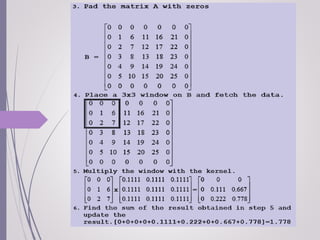
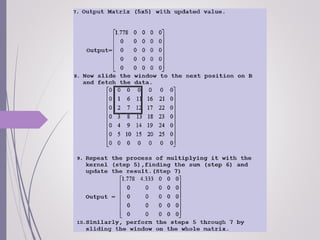
The process used to apply filters to an image is known as
convolution, and may be applied in either the spatial or frequency
domain.
Convolution is a mathematical operation on two signals that forms a
third signal. It expresses how the form of one is changed by the other
using the integral of the product of two functions after one is moved
over the other.
Convolution relates three signals of interest:
 input signal: an array of pixels (input image).
 filtering kernel: a small matrix of numbers that contains specific
coefficients
 output signal: a new modified filtered image
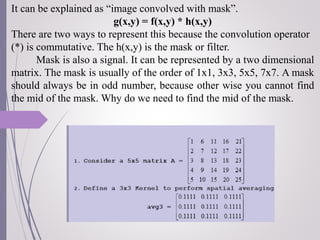
It can be explained as “image convolved with mask”.
g(x,y) = f(x,y) * h(x,y)
There are two ways to represent this because the convolution operator
(*) is commutative. The h(x,y) is the mask or filter.
Mask is also a signal. It can be represented by a two dimensional
matrix. The mask is usually of the order of 1x1, 3x3, 5x5, 7x7. A mask
should always be in odd number, because other wise you cannot find
the mid of the mask. Why do we need to find the mid of the mask.
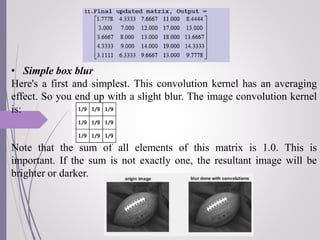
• Simple box blur
Here's a first and simplest. This convolution kernel has an averaging
effect. So you end up with a slight blur. The image convolution kernel
is:
Note that the sum of all elements of this matrix is 1.0. This is
important. If the sum is not exactly one, the resultant image will be
brighter or darker.
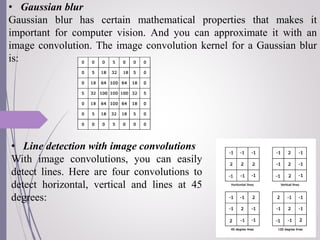
• Gaussian blur
Gaussian blur has certain mathematical properties that makes it
important for computer vision. And you can approximate it with an
image convolution. The image convolution kernel for a Gaussian blur
is:
• Line detection with image convolutions
With image convolutions, you can easily
detect lines. Here are four convolutions to
detect horizontal, vertical and lines at 45
degrees:
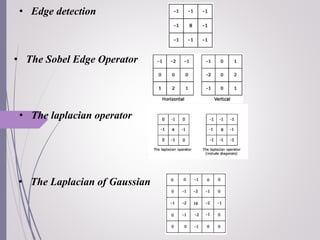
• Edge detection
• The Sobel Edge Operator
• The laplacian operator
• The Laplacian of Gaussian
H.W:
• Low Pass Filter
• High Pass Filter

Lecture 5-2023.pdf

  • 1.
    Lecture 5: ImageEnhancement Image Filtering Computer Vision In MATLAB By. Assist. Prof. Ielaf O.Abdul Majjed 2022-2023
  • 2.
    Image filtering isa technique for modifying or enhancing an image and its useful for many applications, including smoothing, sharpening, removing noise, and edge detection. A filter is defined by a kernel or mask , which is a small array applied to each pixel and its neighbors within an image. The process used to apply filters to an image is known as convolution, and may be applied in either the spatial or frequency domain. Convolution is a mathematical operation on two signals that forms a third signal. It expresses how the form of one is changed by the other using the integral of the product of two functions after one is moved over the other. Convolution relates three signals of interest:  input signal: an array of pixels (input image).  filtering kernel: a small matrix of numbers that contains specific coefficients  output signal: a new modified filtered image
  • 3.
    It can beexplained as “image convolved with mask”. g(x,y) = f(x,y) * h(x,y) There are two ways to represent this because the convolution operator (*) is commutative. The h(x,y) is the mask or filter. Mask is also a signal. It can be represented by a two dimensional matrix. The mask is usually of the order of 1x1, 3x3, 5x5, 7x7. A mask should always be in odd number, because other wise you cannot find the mid of the mask. Why do we need to find the mid of the mask.
  • 6.
    • Simple boxblur Here's a first and simplest. This convolution kernel has an averaging effect. So you end up with a slight blur. The image convolution kernel is: Note that the sum of all elements of this matrix is 1.0. This is important. If the sum is not exactly one, the resultant image will be brighter or darker.
  • 7.
    • Gaussian blur Gaussianblur has certain mathematical properties that makes it important for computer vision. And you can approximate it with an image convolution. The image convolution kernel for a Gaussian blur is: • Line detection with image convolutions With image convolutions, you can easily detect lines. Here are four convolutions to detect horizontal, vertical and lines at 45 degrees:
  • 8.
    • Edge detection •The Sobel Edge Operator • The laplacian operator • The Laplacian of Gaussian
  • 9.
    H.W: • Low PassFilter • High Pass Filter