DIE CASTING
Lecture 3
RECAP
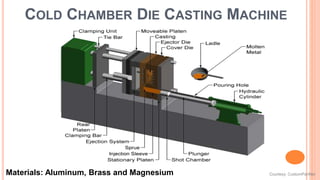
Courtesy: CustomPartNet
Materials: Aluminum, Brass and Magnesium
COLD CHAMBER DIE CASTING MACHINE
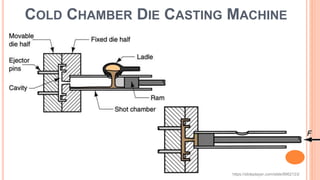
https://slideplayer.com/slide/8962123/
 Cold chamber die casting is a type of die casting that is used for alloys with
high melting temperatures (i.e. Aluminum and Magnesium alloys).
 Molten metal is poured into unheated chamber from external melting
container, and a piston injects metal under high pressure into die cavity
 Molten metal is ladled from the furnace into the shot chamber through a
pouring hole.
 High production but not usually as fast as hot - chamber machines because of
pouring step
 Casting metals: aluminum, brass, and magnesium alloys
COLD CHAMBER DIE CASTING MACHINE
https://cwmdiecast.com/2016/05/27/die-casting-101-hot-chamber-vs-cold-chamber/
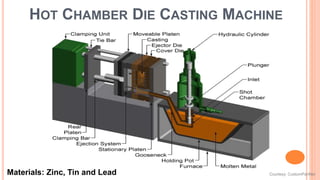
Courtesy: CustomPartNet
Materials: Zinc, Tin and Lead
HOT CHAMBER DIE CASTING MACHINE
https://cwmdiecast.com/2016/05/27/die-casting-101-hot-chamber-vs-cold-chamber/
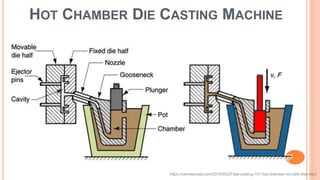
 Hot chamber die casting is a type of die casting that uses alloys with low
melting temperatures (i.e. Zinc, some Magnesium alloys).
 Using alloys with high melting temperatures would result in damage to the
gooseneck, nozzle, and other components.
 Hot-Chamber Die Casting Metal is melted in a container, and a piston
injects liquid metal under high pressure into the die
 High production rates - 500 parts per hour not uncommon
 Applications limited to low melting - point metals that do not chemically
attack plunger and other mechanical components
 Casting metals: zinc, tin, lead, and magnesium
HOT CHAMBER DIE CASTING MACHINE
https://slideplayer.com/slide/8962123/
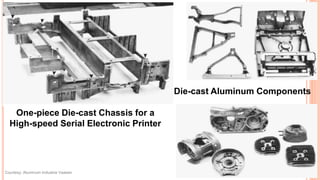
One-piece Die-cast Chassis for a
High-speed Serial Electronic Printer
Die-cast Aluminum Components
Courtesy: Aluminum Industrie Vaasen
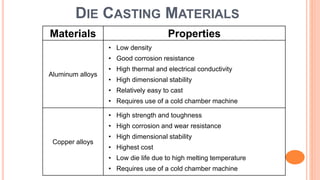
Materials Properties
Aluminum alloys
• Low density
• Good corrosion resistance
• High thermal and electrical conductivity
• High dimensional stability
• Relatively easy to cast
• Requires use of a cold chamber machine
Copper alloys
• High strength and toughness
• High corrosion and wear resistance
• High dimensional stability
• Highest cost
• Low die life due to high melting temperature
• Requires use of a cold chamber machine
DIE CASTING MATERIALS
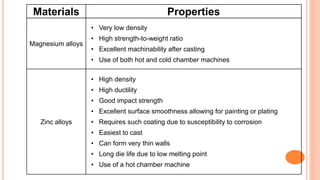
Magnesium alloys
• Very low density
• High strength-to-weight ratio
• Excellent machinability after casting
• Use of both hot and cold chamber machines
Zinc alloys
• High density
• High ductility
• Good impact strength
• Excellent surface smoothness allowing for painting or plating
• Requires such coating due to susceptibility to corrosion
• Easiest to cast
• Can form very thin walls
• Long die life due to low melting point
• Use of a hot chamber machine
Materials Properties
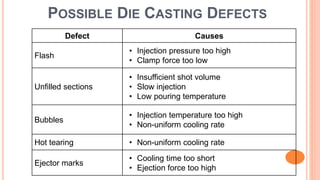
Defect Causes
Flash
• Injection pressure too high
• Clamp force too low
Unfilled sections
• Insufficient shot volume
• Slow injection
• Low pouring temperature
Bubbles
• Injection temperature too high
• Non-uniform cooling rate
Hot tearing • Non-uniform cooling rate
Ejector marks
• Cooling time too short
• Ejection force too high
POSSIBLE DIE CASTING DEFECTS
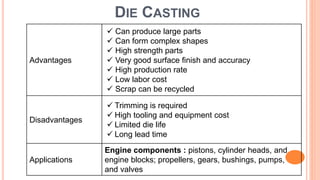
Advantages
 Can produce large parts
 Can form complex shapes
 High strength parts
 Very good surface finish and accuracy
 High production rate
 Low labor cost
 Scrap can be recycled
Disadvantages
 Trimming is required
 High tooling and equipment cost
 Limited die life
 Long lead time
Applications
Engine components : pistons, cylinder heads, and
engine blocks; propellers, gears, bushings, pumps,
and valves
DIE CASTING

Lecture 3_Die Casting,sand casting .pptx

  • 1.
  • 2.
  • 3.
    Courtesy: CustomPartNet Materials: Aluminum,Brass and Magnesium COLD CHAMBER DIE CASTING MACHINE
  • 4.
    COLD CHAMBER DIECASTING MACHINE https://slideplayer.com/slide/8962123/
  • 6.
     Cold chamberdie casting is a type of die casting that is used for alloys with high melting temperatures (i.e. Aluminum and Magnesium alloys).  Molten metal is poured into unheated chamber from external melting container, and a piston injects metal under high pressure into die cavity  Molten metal is ladled from the furnace into the shot chamber through a pouring hole.  High production but not usually as fast as hot - chamber machines because of pouring step  Casting metals: aluminum, brass, and magnesium alloys COLD CHAMBER DIE CASTING MACHINE https://cwmdiecast.com/2016/05/27/die-casting-101-hot-chamber-vs-cold-chamber/
  • 7.
    Courtesy: CustomPartNet Materials: Zinc,Tin and Lead HOT CHAMBER DIE CASTING MACHINE
  • 8.
    HOT CHAMBER DIECASTING MACHINE https://cwmdiecast.com/2016/05/27/die-casting-101-hot-chamber-vs-cold-chamber/
  • 10.
     Hot chamberdie casting is a type of die casting that uses alloys with low melting temperatures (i.e. Zinc, some Magnesium alloys).  Using alloys with high melting temperatures would result in damage to the gooseneck, nozzle, and other components.  Hot-Chamber Die Casting Metal is melted in a container, and a piston injects liquid metal under high pressure into the die  High production rates - 500 parts per hour not uncommon  Applications limited to low melting - point metals that do not chemically attack plunger and other mechanical components  Casting metals: zinc, tin, lead, and magnesium HOT CHAMBER DIE CASTING MACHINE https://slideplayer.com/slide/8962123/
  • 11.
    One-piece Die-cast Chassisfor a High-speed Serial Electronic Printer Die-cast Aluminum Components Courtesy: Aluminum Industrie Vaasen
  • 12.
    Materials Properties Aluminum alloys •Low density • Good corrosion resistance • High thermal and electrical conductivity • High dimensional stability • Relatively easy to cast • Requires use of a cold chamber machine Copper alloys • High strength and toughness • High corrosion and wear resistance • High dimensional stability • Highest cost • Low die life due to high melting temperature • Requires use of a cold chamber machine DIE CASTING MATERIALS
  • 13.
    Magnesium alloys • Verylow density • High strength-to-weight ratio • Excellent machinability after casting • Use of both hot and cold chamber machines Zinc alloys • High density • High ductility • Good impact strength • Excellent surface smoothness allowing for painting or plating • Requires such coating due to susceptibility to corrosion • Easiest to cast • Can form very thin walls • Long die life due to low melting point • Use of a hot chamber machine Materials Properties
  • 14.
    Defect Causes Flash • Injectionpressure too high • Clamp force too low Unfilled sections • Insufficient shot volume • Slow injection • Low pouring temperature Bubbles • Injection temperature too high • Non-uniform cooling rate Hot tearing • Non-uniform cooling rate Ejector marks • Cooling time too short • Ejection force too high POSSIBLE DIE CASTING DEFECTS
  • 15.
    Advantages  Can producelarge parts  Can form complex shapes  High strength parts  Very good surface finish and accuracy  High production rate  Low labor cost  Scrap can be recycled Disadvantages  Trimming is required  High tooling and equipment cost  Limited die life  Long lead time Applications Engine components : pistons, cylinder heads, and engine blocks; propellers, gears, bushings, pumps, and valves DIE CASTING