EE392m - Winter 2003 Control Engineering 3-1
Lecture 3 - Model-based Control
Engineering
• Control application and a platform
• Systems platform: hardware, systems software.
Development steps
• Model-based design
• Control solution deployment and support
• Control application areas
EE392m - Winter 2003 Control Engineering 3-2
Generality of control
• Modeling abstraction
• Computing element - software
• System, actuator, and sensor physics might be very
different
• Control and system engineering is used across many
applications
– similar principles
– transferable skills
– mind the application!
EE392m - Winter 2003 Control Engineering 3-3
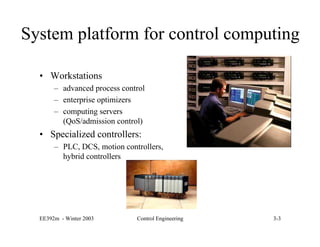
System platform for control computing
• Workstations
– advanced process control
– enterprise optimizers
– computing servers
(QoS/admission control)
• Specialized controllers:
– PLC, DCS, motion controllers,
hybrid controllers
EE392m - Winter 2003 Control Engineering 3-4
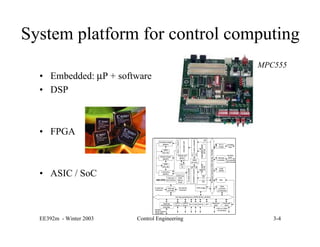
System platform for control computing
• Embedded: µP + software
• DSP
• FPGA
• ASIC / SoC
MPC555
EE392m - Winter 2003 Control Engineering 3-5
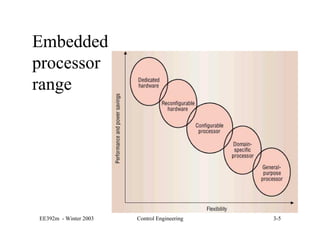
Embedded
processor
range
EE392m - Winter 2003 Control Engineering 3-6
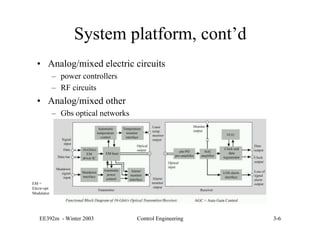
System platform, cont’d
• Analog/mixed electric circuits
– power controllers
– RF circuits
• Analog/mixed other
– Gbs optical networks
AGC = Auto Gain Control
EM =
Electr-opt
Modulator
EE392m - Winter 2003 Control Engineering 3-7
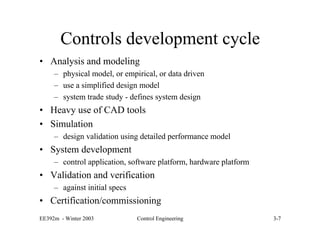
Controls development cycle
• Analysis and modeling
– physical model, or empirical, or data driven
– use a simplified design model
– system trade study - defines system design
• Heavy use of CAD tools
• Simulation
– design validation using detailed performance model
• System development
– control application, software platform, hardware platform
• Validation and verification
– against initial specs
• Certification/commissioning
EE392m - Winter 2003 Control Engineering 3-8
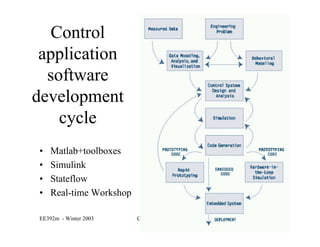
Control
application
software
development
cycle
• Matlab+toolboxes
• Simulink
• Stateflow
• Real-time Workshop
EE392m - Winter 2003 Control Engineering 3-9
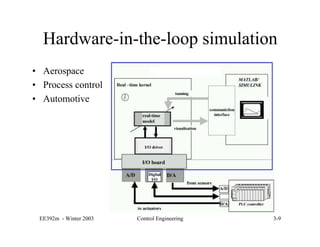
Hardware-in-the-loop simulation
• Aerospace
• Process control
• Automotive
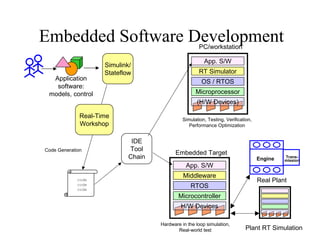
Code Generation
code
code
code
Simulink/
Stateflow
Application
software:
models, control
IDE
Tool
Chain
OS / RTOS
(H/W Devices)
Microprocessor
App. S/W
RT Simulator
Simulation, Testing, Verification,
Performance Optimization
PC/workstation
Embedded Target
RTOS
H/W Devices
Microcontroller
App. S/W
Middleware
Plant RT Simulation
Trans-
mission
Engine
Real Plant
Hardware in the loop simulation,
Real-world test
Real-Time
Workshop
Embedded Software Development
EE392m - Winter 2003 Control Engineering 3-11
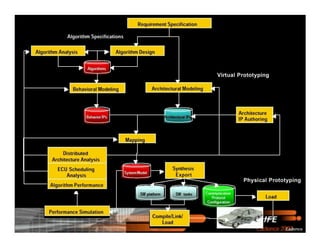
System development cycle
Ford Motor Company
EE392m - Winter 2003 Control Engineering 3-12
System development cycle
Cadence
EE392m - Winter 2003 Control Engineering 3-13
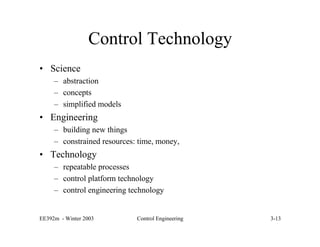
Control Technology
• Science
– abstraction
– concepts
– simplified models
• Engineering
– building new things
– constrained resources: time, money,
• Technology
– repeatable processes
– control platform technology
– control engineering technology
EE392m - Winter 2003 Control Engineering 3-14
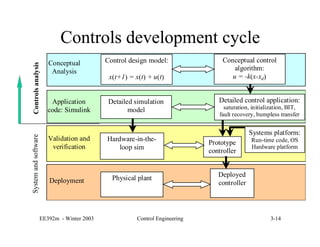
Controls development cycle
Control design model:
x(t+1) = x(t) + u(t)
Detailed simulation
model
Conceptual control
algorithm:
u = -k(x-xd)
Detailed control application:
saturation, initialization, BIT,
fault recovery, bumpless transfer
Conceptual
Analysis
Application
code: Simulink
Hardware-in-the-
loop sim
Deployed
controller
Deployment
Systems platform:
Run-time code, OS
Hardware platform
Physical plant
Prototype
controller
Validation and
verification
System
and
software
Controls
analysis
EE392m - Winter 2003 Control Engineering 3-15
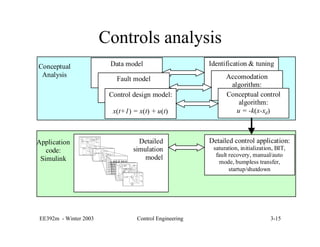
Controls analysis
Data model
x(t+1) = x(t) + u(t)
Identification & tuning
Detailed control application:
saturation, initialization, BIT,
fault recovery, manual/auto
mode, bumpless transfer,
startup/shutdown
Conceptual
Analysis
Application
code:
Simulink
Fault model Accomodation
algorithm:
u = -k(x-xd)
Control design model:
x(t+1) = x(t) + u(t)
Conceptual control
algorithm:
u = -k(x-xd)
Detailed
simulation
model
EE392m - Winter 2003 Control Engineering 3-16
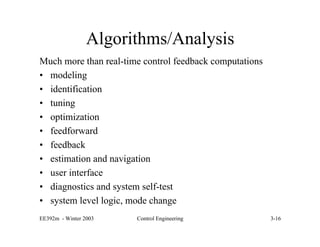
Algorithms/Analysis
Much more than real-time control feedback computations
• modeling
• identification
• tuning
• optimization
• feedforward
• feedback
• estimation and navigation
• user interface
• diagnostics and system self-test
• system level logic, mode change
EE392m - Winter 2003 Control Engineering 3-17
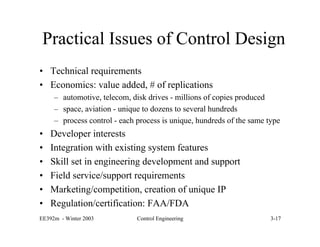
Practical Issues of Control Design
• Technical requirements
• Economics: value added, # of replications
– automotive, telecom, disk drives - millions of copies produced
– space, aviation - unique to dozens to several hundreds
– process control - each process is unique, hundreds of the same type
• Developer interests
• Integration with existing system features
• Skill set in engineering development and support
• Field service/support requirements
• Marketing/competition, creation of unique IP
• Regulation/certification: FAA/FDA
EE392m - Winter 2003 Control Engineering 3-18
Major control applications
Specialized control groups, formal development processes
• Aviation
– avionics: Guidance, Navigation, & Control
– propulsion - engines
– vehicle power and environmental control
• Automotive
– powertrain
– suspension, traction, braking, steering
• Disk drives
• Industrial automation and process control
– process industries: refineries, pulp and paper, chemical
– semiconductor manufacturing processes
– home and buildings
EE392m - Winter 2003 Control Engineering 3-19
Commercial applications
Advanced design - commercial
• Embedded mechanical
– mechatronics/drive control
• Robotics
– lab automation
– manufacturing plant robots (e.g., automotive)
– semiconductors
• Power
– generation and transmission
• Transportation
– locomotives, elevators
– marine
• Nuclear engineering
EE392m - Winter 2003 Control Engineering 3-20
High-performance applications
Advanced design
• Defense and space
– aero, ground, space vehicles - piloted and unmanned
– missiles/munitions
– comm and radar: ground, aero, space
– campaign control: C4ISR
– directed energy
• Science instruments
– astronomy
– accelerators
– fusion: TOKAMAKs, LLNL ignition
EE392m - Winter 2003 Control Engineering 3-21
Embedded applications
No specialized control groups
• Embedded controllers
– consumer
– test and measurement
– power/current
– thermal control
• Telecom
– PLLs, equalizers
– antennas, wireless, las comm
– flow/congestion control
– optical networks - analog, physics
EE392m - Winter 2003 Control Engineering 3-22
Emerging control applications
A few selected cases
• Biomedical
– life support: pacemakers anesthesia
– diagnostics: MRI scanners, etc
– ophthalmology
– bio-informatics equipment
– robotics surgery
• Computing
– task/load balancing
• Finance and economics
– trading

Lecture 3 - Model-based control engineering

  • 1.
    EE392m - Winter2003 Control Engineering 3-1 Lecture 3 - Model-based Control Engineering • Control application and a platform • Systems platform: hardware, systems software. Development steps • Model-based design • Control solution deployment and support • Control application areas
  • 2.
    EE392m - Winter2003 Control Engineering 3-2 Generality of control • Modeling abstraction • Computing element - software • System, actuator, and sensor physics might be very different • Control and system engineering is used across many applications – similar principles – transferable skills – mind the application!
  • 3.
    EE392m - Winter2003 Control Engineering 3-3 System platform for control computing • Workstations – advanced process control – enterprise optimizers – computing servers (QoS/admission control) • Specialized controllers: – PLC, DCS, motion controllers, hybrid controllers
  • 4.
    EE392m - Winter2003 Control Engineering 3-4 System platform for control computing • Embedded: µP + software • DSP • FPGA • ASIC / SoC MPC555
  • 5.
    EE392m - Winter2003 Control Engineering 3-5 Embedded processor range
  • 6.
    EE392m - Winter2003 Control Engineering 3-6 System platform, cont’d • Analog/mixed electric circuits – power controllers – RF circuits • Analog/mixed other – Gbs optical networks AGC = Auto Gain Control EM = Electr-opt Modulator
  • 7.
    EE392m - Winter2003 Control Engineering 3-7 Controls development cycle • Analysis and modeling – physical model, or empirical, or data driven – use a simplified design model – system trade study - defines system design • Heavy use of CAD tools • Simulation – design validation using detailed performance model • System development – control application, software platform, hardware platform • Validation and verification – against initial specs • Certification/commissioning
  • 8.
    EE392m - Winter2003 Control Engineering 3-8 Control application software development cycle • Matlab+toolboxes • Simulink • Stateflow • Real-time Workshop
  • 9.
    EE392m - Winter2003 Control Engineering 3-9 Hardware-in-the-loop simulation • Aerospace • Process control • Automotive
  • 10.
    Code Generation code code code Simulink/ Stateflow Application software: models, control IDE Tool Chain OS/ RTOS (H/W Devices) Microprocessor App. S/W RT Simulator Simulation, Testing, Verification, Performance Optimization PC/workstation Embedded Target RTOS H/W Devices Microcontroller App. S/W Middleware Plant RT Simulation Trans- mission Engine Real Plant Hardware in the loop simulation, Real-world test Real-Time Workshop Embedded Software Development
  • 11.
    EE392m - Winter2003 Control Engineering 3-11 System development cycle Ford Motor Company
  • 12.
    EE392m - Winter2003 Control Engineering 3-12 System development cycle Cadence
  • 13.
    EE392m - Winter2003 Control Engineering 3-13 Control Technology • Science – abstraction – concepts – simplified models • Engineering – building new things – constrained resources: time, money, • Technology – repeatable processes – control platform technology – control engineering technology
  • 14.
    EE392m - Winter2003 Control Engineering 3-14 Controls development cycle Control design model: x(t+1) = x(t) + u(t) Detailed simulation model Conceptual control algorithm: u = -k(x-xd) Detailed control application: saturation, initialization, BIT, fault recovery, bumpless transfer Conceptual Analysis Application code: Simulink Hardware-in-the- loop sim Deployed controller Deployment Systems platform: Run-time code, OS Hardware platform Physical plant Prototype controller Validation and verification System and software Controls analysis
  • 15.
    EE392m - Winter2003 Control Engineering 3-15 Controls analysis Data model x(t+1) = x(t) + u(t) Identification & tuning Detailed control application: saturation, initialization, BIT, fault recovery, manual/auto mode, bumpless transfer, startup/shutdown Conceptual Analysis Application code: Simulink Fault model Accomodation algorithm: u = -k(x-xd) Control design model: x(t+1) = x(t) + u(t) Conceptual control algorithm: u = -k(x-xd) Detailed simulation model
  • 16.
    EE392m - Winter2003 Control Engineering 3-16 Algorithms/Analysis Much more than real-time control feedback computations • modeling • identification • tuning • optimization • feedforward • feedback • estimation and navigation • user interface • diagnostics and system self-test • system level logic, mode change
  • 17.
    EE392m - Winter2003 Control Engineering 3-17 Practical Issues of Control Design • Technical requirements • Economics: value added, # of replications – automotive, telecom, disk drives - millions of copies produced – space, aviation - unique to dozens to several hundreds – process control - each process is unique, hundreds of the same type • Developer interests • Integration with existing system features • Skill set in engineering development and support • Field service/support requirements • Marketing/competition, creation of unique IP • Regulation/certification: FAA/FDA
  • 18.
    EE392m - Winter2003 Control Engineering 3-18 Major control applications Specialized control groups, formal development processes • Aviation – avionics: Guidance, Navigation, & Control – propulsion - engines – vehicle power and environmental control • Automotive – powertrain – suspension, traction, braking, steering • Disk drives • Industrial automation and process control – process industries: refineries, pulp and paper, chemical – semiconductor manufacturing processes – home and buildings
  • 19.
    EE392m - Winter2003 Control Engineering 3-19 Commercial applications Advanced design - commercial • Embedded mechanical – mechatronics/drive control • Robotics – lab automation – manufacturing plant robots (e.g., automotive) – semiconductors • Power – generation and transmission • Transportation – locomotives, elevators – marine • Nuclear engineering
  • 20.
    EE392m - Winter2003 Control Engineering 3-20 High-performance applications Advanced design • Defense and space – aero, ground, space vehicles - piloted and unmanned – missiles/munitions – comm and radar: ground, aero, space – campaign control: C4ISR – directed energy • Science instruments – astronomy – accelerators – fusion: TOKAMAKs, LLNL ignition
  • 21.
    EE392m - Winter2003 Control Engineering 3-21 Embedded applications No specialized control groups • Embedded controllers – consumer – test and measurement – power/current – thermal control • Telecom – PLLs, equalizers – antennas, wireless, las comm – flow/congestion control – optical networks - analog, physics
  • 22.
    EE392m - Winter2003 Control Engineering 3-22 Emerging control applications A few selected cases • Biomedical – life support: pacemakers anesthesia – diagnostics: MRI scanners, etc – ophthalmology – bio-informatics equipment – robotics surgery • Computing – task/load balancing • Finance and economics – trading