History of Bangladesh and Bangla Language
Ancient Bengal.
Part – 2.
Md. Khaled Sifullah
Department of Development Studies.
Daffodil International University.
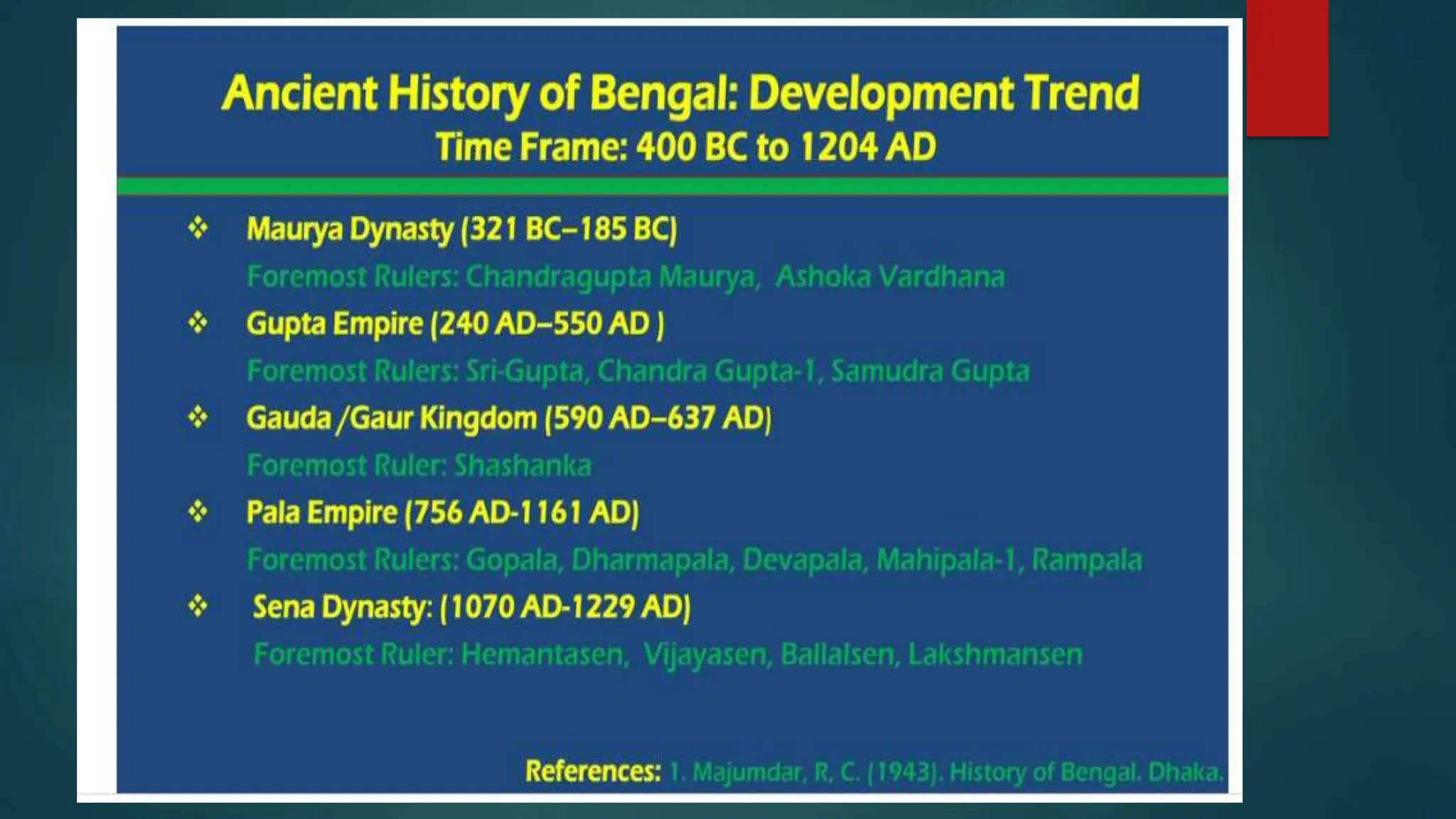
Chronological Development Trend of
Ancient History
The Maurya Empire
PROMINET RULER
 Chandragupta Maurya
(321-298B.C.).
 Bidhusara (298-273
B.C.)
 Ashoka (273-232
B.C.).
Chandragupta Maurya (321-298B.C.).
 FIRST ALL INDIAN RULER.
 Founder of Mauryan Dynasty.
 Kautilya or Chanakya was his Chief-Minister.
 He defeated the Greeks, Alexader’s army led by Seleucus.
 Megasthenes, the greek ambassador at his court.
 Kutillya’s thought and Chandragupta’s power made the Maurya
empire one of the largest and powerful kingdom of that time.
Ashoka the great
.
 Son of Bindusara, the second
king of the Mauryan and the
Governor of Ujjian/Ujjain.
 Ambitious, diplomatic and
aggressive character.
 War of Kalinga (262-261 B.C.).
 Embrace Buddism.
Maurya Dynasty it it’s height.
Background Kalinga War
1. Kalinga was a state that prided itself on its sovereignty.
2. Business Port
3. Failed the ruler of before
4. Asoke wanted to prove himself as a most perfect,
worthy and intellectual ruler of Muryan
5. Source:
https://www.youtube.com/watch?v=A6y2Ris6IkE
Result/impact of Kalinga War
 While he maintained a large and powerful army to keep the peace,
Ashoka expanded friendly relations with states across Asia and
Europe, and sponsored Buddhist missions.
 As a Buddhist emperor, Ashoka believed that Buddhism is
beneficial for all human beings, as well as animals and plants, so he
built a number of stupas, Sangharama, viharas, chaitya, and
residences for Buddhist monks all over South Asia and Central Asia.
According to the Ashokavadana, he ordered the construction of
84,000 stupas to house the Buddhas relics. He gave donations to
viharas and mathas. He sent his only daughter,Sanghamitra, and
son, Mahindra, to spread Buddhism in Srilanka.
Present existence the Mauryan Rule
Mahastangar still bears their memory as Pundranagar was their
provincial capital.
The Gupta age of Bengal
(275-551 A.C.)
Sri Gupta, the founder. (275-300 A.C.)
Chandra Gupta - I, the real founder. (32-340 A.C.)
Samudra Gupta, the Napoleon of India, Best Ruler.
Political Activity.
Cultural and Scientific Contribution.
Cultural and Scientific Contribution of Gupta Empire.
Mathematics:
• Developments of Decimal system, innovation of ‘Zero’, development
of ‘Trigonometry’,
Astronomy • Aryabhatta(আর্ য
ভট্ট) discovered ‘Diurnal and Annual motions’.
Brihastangia, a book on astronomy written by Brahimir.
Literature
• Sanskrit and Hindu literature flourished.
Kalidash was a poet of Gupta court.
Medicine
• Use of Mercury and iron in medicine started during this
period. Operation system developed
Education
• The Nalanda University established by the Gupta king Kumara Gupta
I. Nalanda and Takshila University became a center of education and
they provide residential facilities.
Art &
Architechture
• Architecture, Sculpture, Painting developed. Varansi,
Mathura, Pataliputra were the center of those activities.
Politics and Administration
 Political Stability
 Dominance over Bengal except
Samata.
 All Indian Empire.
 Golden Age of India.
 Decentralization of Power
 Separation of Judiciary.
The Independent kingdom of Bongo
(525-600 A.C.)
 Three kings of Bongo ‘Gopachandra, Dharmaditta and
Samachardeve’ ruled the Independent kingdom of Bongo. They
titled themselves ‘Maharadhiraj’.
 Gold coin of Samachardeve proved this sovereign and independent
kingdom.
 Inscription of Gopachandra indicates its territory.
 The Banga Kingdom fell at the hands of the king Kirtivarmana of
the Chalukya Dynasty of the Deccan.
 Several independent feudal kingdom: Bhdra, Khagra, Rarh etc.
The Independent kingdom of Gaur
 The Later Gupta’s: extended their rule over North Bengal,
Northern portion of West Bengal and Magadha
 Mukhari Dynasty: Northern India was their main land. They were
the feud of the Gupta’s. Chalukkya dynasty destroyed them.
Years of political instability.
 Shashanka took advantage of the political instability and conqured
the kingdom of Gaur.
Shashanka
(606-650)
Shashanka
(606-650)
 First Independent and Sovereign king of Bengal.
 He titled with ‘Mahasamanta’ and ‘Gaud-ishwar’ or ‘the lord of
Gaud’.
 Founder of Gauda kingdom.
 His kingdom was made up of the North and the West Bengal. He
conquered the Northern India.
 Karnashubarna of Murshidabad was his capital.
Matsyanayam:
 After the death of Sasanka, almost 100 years
there came a dark and disastrous age in the
history of Bengal. Bengal remained without any
competent ruler for a long time. As a result, there
was anarchy,disorder and external enemy attacks
continued in Bengal. At that time there was no
system of government existed in Bengal. There
was no one to take care of the central power with
an iron hand. This period of anarchy has been
called Matsyanayam.
 https://www.youtube.com/watch?v=GchNdK5e54
I
Matsyanayam
 According to Kautilya and Lama Taranath,
Matsyanayam refers to a condition of anarchy and
disorder like when the big fishes catch and
swallow the small fishes in a pond. The powerful
kings of Bengal took complete control over small
regions in such a way. This period of anarchy
lasted for one hundred years. In the middle of the
eigth century this anarchy and disorder came to
an end with the rise of the Pala reign.
The Pala Dynasty (750-1161) AD
 Gopala (750-770) AD
 Dharmapala (770-810) AD - He was the most famous of
all Palaakings.
 Devapala (810-850) AD
 Mahipala I (988-1038) AD
 Mahipala II (1072-1077 ) AD
 Rampala (1077-1130) AD – Last powerful king.
 Madanpala (1144-1161) AD (Last Empire)
The importance of the Pala dynasty:
 The pala kings increased their contact with the outside
world.
 The incredible Buddhist complex of Paharpur was
created under the Pala dynasty in Bengal.
 They built magnificent monasteries and temples:
Somapura Mahavihara (in Bangladesh), Odantapuri
Monastery.
 They also patronised Buddhist centres of learning like
Nalanda University and the Vikramshila University.
The importance of the Pala dynasty:
 During this time, the Bengali language
developed. The first Bengali literary work
Charyapada is attributed to this period.
 Sanskrit scholars were also patronised by
the Pala kings.
 The Pala art influence is seen in the art
of Nepal, Sri Lanka, Burma and Java.
Administration :
The foundation of feudal system was very strong in
Pala period. In the Pala period, land revenue was
one sixth of the total crop. There was no
constitutional control over the power of the king.
In the Pala period, the ministers worked from
generation to generation.
Frequently Asked Questions about Pala
Empire
For how long did the Pala Empire rule the region of
Bengal?
Ans: The Pala dynasty ruled the regions of Bengal
and Bihar for about 400 years, from the 8th century
until the end of the 11th century.
Who ended the Pala Dynasty?
Sena dynasty.
The Sena Dynasty (1098-1204) AD
Taking advantage of the weakness of the Pala kings, the Sena dynasty
established in Bengal. Samanta Sen was the ancestor of the Sena
dynasty
 Sena Dynasty– Rulers
 Samanta Sena (Ancestor)
 Hemanta Sena (Real Founder)
 Bijoy Sena (1098-1160) AD – (First Independent King)
 Ballal Sena (1160-1178) AD
 Lakhsmana Sena (1178-1205) AD ( Last Independent
King
Importance of the Senas
 The credit of safeguarding Bengal from anarchy after the
fall of the Pala Dynasty goes to the Senas.
 Established political Unity.
 The Senas believed in Hinduism. They contributed
towards the revival of Hinduism and Sanskrit literature in
Bengal.
 Ballal Sena and Lakshmana Sena were great
intellectuals and both patronized scholars and education.
 Jayadeva, the writer of Halayudha and Gita Govinda,
was patronized by them.
Decline of Sena Dynasty :
 In 1204 AD, Turkish general Ikhtiyar Uddin
Muhammad bin Bakhtiyar Khalji invaded Bengal. At
that time Lakshman Sen was the king of Sen dynasty.
He could not defend the capital Nadia from Turkish
invasion. When Bakhtiyar Khalji attacked Nadia,
Laxman Sena and his family fled to East Bengal.
After his death, his two sons, Bishwarup Sen and
Keshab sen ruled for some time, but finally the Sena
dynasty collapsed in 1206/1207 due to Turkish
invasion and internal revolt.
Some reasons behind the Scene
 Natural role of history (Ibna khaldun says………….one hundred years can…..)
 Internal conflict ( Local Lords vs Lakhsmana Sena)
 The Sena dynasty's demise was predetermined by the dynasty's weak
rulers.
 During Lakshmana Sena's reign, this dynasty began to
decline. Fatalism and superstition eroded the people's patriotic zeal
during his reign. He never instilled in the people a spirit of tenacious
resistance.
 Lakshmana Sena never reformed his army in the manner of the Turks.
Military science was not as important as astrology.
 Several factors can be attributed to the disintegration process.
Lakshmanasena and his successors were incapable of halting
the disintegration of the Sena kingdom's strong foundation.
The end result was utter chaos. Dommanapala captured Khadi
Mandala and twenty-four Parganas near the end of Lakshmana
Sena's rule. Tippera was ruled by the Sena dynasty until the
thirteenth century, when it gained independence.
 The Deva family ruled over the entire Meghna region.
Vikramapura, Senas' capital city, was captured by King
Danujamardana Dasharathadeva, a member of the same family.
Question Pattern
 Why people came here / migrate to another land?
 What was the first dynasty to establish political dominance in Bengal.
 Who was Kautillya, what was his masterpiece?
 Who was the first independent king of Bengal?
 Which dynasty represents Golden Age of Bengal?
 Discuss the contributions of Gupta empire to science and technology.
 Why Gupta age called the Golden Age of Bengal?
 Who was the founder of …. Dynasty?
Bye Bye the Ancient Period
THANK YOU!

Lecture 3-4 ----Ancient Period Slid.pptx

  • 1.
    History of Bangladeshand Bangla Language Ancient Bengal. Part – 2. Md. Khaled Sifullah Department of Development Studies. Daffodil International University.
  • 2.
  • 3.
    The Maurya Empire PROMINETRULER  Chandragupta Maurya (321-298B.C.).  Bidhusara (298-273 B.C.)  Ashoka (273-232 B.C.).
  • 4.
    Chandragupta Maurya (321-298B.C.). FIRST ALL INDIAN RULER.  Founder of Mauryan Dynasty.  Kautilya or Chanakya was his Chief-Minister.  He defeated the Greeks, Alexader’s army led by Seleucus.  Megasthenes, the greek ambassador at his court.  Kutillya’s thought and Chandragupta’s power made the Maurya empire one of the largest and powerful kingdom of that time.
  • 5.
    Ashoka the great . Son of Bindusara, the second king of the Mauryan and the Governor of Ujjian/Ujjain.  Ambitious, diplomatic and aggressive character.  War of Kalinga (262-261 B.C.).  Embrace Buddism. Maurya Dynasty it it’s height.
  • 6.
    Background Kalinga War 1.Kalinga was a state that prided itself on its sovereignty. 2. Business Port 3. Failed the ruler of before 4. Asoke wanted to prove himself as a most perfect, worthy and intellectual ruler of Muryan 5. Source: https://www.youtube.com/watch?v=A6y2Ris6IkE
  • 7.
  • 8.
    Result/impact of KalingaWar  While he maintained a large and powerful army to keep the peace, Ashoka expanded friendly relations with states across Asia and Europe, and sponsored Buddhist missions.  As a Buddhist emperor, Ashoka believed that Buddhism is beneficial for all human beings, as well as animals and plants, so he built a number of stupas, Sangharama, viharas, chaitya, and residences for Buddhist monks all over South Asia and Central Asia. According to the Ashokavadana, he ordered the construction of 84,000 stupas to house the Buddhas relics. He gave donations to viharas and mathas. He sent his only daughter,Sanghamitra, and son, Mahindra, to spread Buddhism in Srilanka.
  • 9.
    Present existence theMauryan Rule Mahastangar still bears their memory as Pundranagar was their provincial capital.
  • 10.
    The Gupta ageof Bengal (275-551 A.C.) Sri Gupta, the founder. (275-300 A.C.) Chandra Gupta - I, the real founder. (32-340 A.C.) Samudra Gupta, the Napoleon of India, Best Ruler. Political Activity. Cultural and Scientific Contribution.
  • 11.
    Cultural and ScientificContribution of Gupta Empire. Mathematics: • Developments of Decimal system, innovation of ‘Zero’, development of ‘Trigonometry’, Astronomy • Aryabhatta(আর্ য ভট্ট) discovered ‘Diurnal and Annual motions’. Brihastangia, a book on astronomy written by Brahimir. Literature • Sanskrit and Hindu literature flourished. Kalidash was a poet of Gupta court. Medicine • Use of Mercury and iron in medicine started during this period. Operation system developed Education • The Nalanda University established by the Gupta king Kumara Gupta I. Nalanda and Takshila University became a center of education and they provide residential facilities. Art & Architechture • Architecture, Sculpture, Painting developed. Varansi, Mathura, Pataliputra were the center of those activities.
  • 12.
    Politics and Administration Political Stability  Dominance over Bengal except Samata.  All Indian Empire.  Golden Age of India.  Decentralization of Power  Separation of Judiciary.
  • 13.
    The Independent kingdomof Bongo (525-600 A.C.)  Three kings of Bongo ‘Gopachandra, Dharmaditta and Samachardeve’ ruled the Independent kingdom of Bongo. They titled themselves ‘Maharadhiraj’.  Gold coin of Samachardeve proved this sovereign and independent kingdom.  Inscription of Gopachandra indicates its territory.  The Banga Kingdom fell at the hands of the king Kirtivarmana of the Chalukya Dynasty of the Deccan.  Several independent feudal kingdom: Bhdra, Khagra, Rarh etc.
  • 14.
    The Independent kingdomof Gaur  The Later Gupta’s: extended their rule over North Bengal, Northern portion of West Bengal and Magadha  Mukhari Dynasty: Northern India was their main land. They were the feud of the Gupta’s. Chalukkya dynasty destroyed them. Years of political instability.  Shashanka took advantage of the political instability and conqured the kingdom of Gaur.
  • 15.
  • 16.
    Shashanka (606-650)  First Independentand Sovereign king of Bengal.  He titled with ‘Mahasamanta’ and ‘Gaud-ishwar’ or ‘the lord of Gaud’.  Founder of Gauda kingdom.  His kingdom was made up of the North and the West Bengal. He conquered the Northern India.  Karnashubarna of Murshidabad was his capital.
  • 17.
    Matsyanayam:  After thedeath of Sasanka, almost 100 years there came a dark and disastrous age in the history of Bengal. Bengal remained without any competent ruler for a long time. As a result, there was anarchy,disorder and external enemy attacks continued in Bengal. At that time there was no system of government existed in Bengal. There was no one to take care of the central power with an iron hand. This period of anarchy has been called Matsyanayam.  https://www.youtube.com/watch?v=GchNdK5e54 I
  • 18.
    Matsyanayam  According toKautilya and Lama Taranath, Matsyanayam refers to a condition of anarchy and disorder like when the big fishes catch and swallow the small fishes in a pond. The powerful kings of Bengal took complete control over small regions in such a way. This period of anarchy lasted for one hundred years. In the middle of the eigth century this anarchy and disorder came to an end with the rise of the Pala reign.
  • 19.
    The Pala Dynasty(750-1161) AD  Gopala (750-770) AD  Dharmapala (770-810) AD - He was the most famous of all Palaakings.  Devapala (810-850) AD  Mahipala I (988-1038) AD  Mahipala II (1072-1077 ) AD  Rampala (1077-1130) AD – Last powerful king.  Madanpala (1144-1161) AD (Last Empire)
  • 20.
    The importance ofthe Pala dynasty:  The pala kings increased their contact with the outside world.  The incredible Buddhist complex of Paharpur was created under the Pala dynasty in Bengal.  They built magnificent monasteries and temples: Somapura Mahavihara (in Bangladesh), Odantapuri Monastery.  They also patronised Buddhist centres of learning like Nalanda University and the Vikramshila University.
  • 21.
    The importance ofthe Pala dynasty:  During this time, the Bengali language developed. The first Bengali literary work Charyapada is attributed to this period.  Sanskrit scholars were also patronised by the Pala kings.  The Pala art influence is seen in the art of Nepal, Sri Lanka, Burma and Java.
  • 22.
    Administration : The foundationof feudal system was very strong in Pala period. In the Pala period, land revenue was one sixth of the total crop. There was no constitutional control over the power of the king. In the Pala period, the ministers worked from generation to generation.
  • 23.
    Frequently Asked Questionsabout Pala Empire For how long did the Pala Empire rule the region of Bengal? Ans: The Pala dynasty ruled the regions of Bengal and Bihar for about 400 years, from the 8th century until the end of the 11th century. Who ended the Pala Dynasty? Sena dynasty.
  • 24.
    The Sena Dynasty(1098-1204) AD Taking advantage of the weakness of the Pala kings, the Sena dynasty established in Bengal. Samanta Sen was the ancestor of the Sena dynasty  Sena Dynasty– Rulers  Samanta Sena (Ancestor)  Hemanta Sena (Real Founder)  Bijoy Sena (1098-1160) AD – (First Independent King)  Ballal Sena (1160-1178) AD  Lakhsmana Sena (1178-1205) AD ( Last Independent King
  • 25.
    Importance of theSenas  The credit of safeguarding Bengal from anarchy after the fall of the Pala Dynasty goes to the Senas.  Established political Unity.  The Senas believed in Hinduism. They contributed towards the revival of Hinduism and Sanskrit literature in Bengal.  Ballal Sena and Lakshmana Sena were great intellectuals and both patronized scholars and education.  Jayadeva, the writer of Halayudha and Gita Govinda, was patronized by them.
  • 26.
    Decline of SenaDynasty :  In 1204 AD, Turkish general Ikhtiyar Uddin Muhammad bin Bakhtiyar Khalji invaded Bengal. At that time Lakshman Sen was the king of Sen dynasty. He could not defend the capital Nadia from Turkish invasion. When Bakhtiyar Khalji attacked Nadia, Laxman Sena and his family fled to East Bengal. After his death, his two sons, Bishwarup Sen and Keshab sen ruled for some time, but finally the Sena dynasty collapsed in 1206/1207 due to Turkish invasion and internal revolt.
  • 27.
    Some reasons behindthe Scene  Natural role of history (Ibna khaldun says………….one hundred years can…..)  Internal conflict ( Local Lords vs Lakhsmana Sena)  The Sena dynasty's demise was predetermined by the dynasty's weak rulers.  During Lakshmana Sena's reign, this dynasty began to decline. Fatalism and superstition eroded the people's patriotic zeal during his reign. He never instilled in the people a spirit of tenacious resistance.  Lakshmana Sena never reformed his army in the manner of the Turks. Military science was not as important as astrology.
  • 28.
     Several factorscan be attributed to the disintegration process. Lakshmanasena and his successors were incapable of halting the disintegration of the Sena kingdom's strong foundation. The end result was utter chaos. Dommanapala captured Khadi Mandala and twenty-four Parganas near the end of Lakshmana Sena's rule. Tippera was ruled by the Sena dynasty until the thirteenth century, when it gained independence.  The Deva family ruled over the entire Meghna region. Vikramapura, Senas' capital city, was captured by King Danujamardana Dasharathadeva, a member of the same family.
  • 29.
    Question Pattern  Whypeople came here / migrate to another land?  What was the first dynasty to establish political dominance in Bengal.  Who was Kautillya, what was his masterpiece?  Who was the first independent king of Bengal?  Which dynasty represents Golden Age of Bengal?  Discuss the contributions of Gupta empire to science and technology.  Why Gupta age called the Golden Age of Bengal?  Who was the founder of …. Dynasty?
  • 30.
    Bye Bye theAncient Period THANK YOU!