Transfer Function in
Sensors
Kholis Nurhanafi
Introduction
• Sensors convert non-electrical stimuli into electrical
signals.
• The transfer function describes the relationship
between stimulus (input) and electrical signal
(output).
• Main goal: Determine the stimulus from the electrical
signal produced by the sensor.
• Understanding the transfer function enhances sensor
performance in various applications.
Definition of Transfer Function
• A static transfer function is an input-output relationship that does not
change over time.
• General notation:
• is the electrical output of the sensor (voltage, current, etc.).
• is the measured input stimulus.
• An ideal transfer function ensures the sensor produces accurate and reliable
output.
Inverse Transfer Function
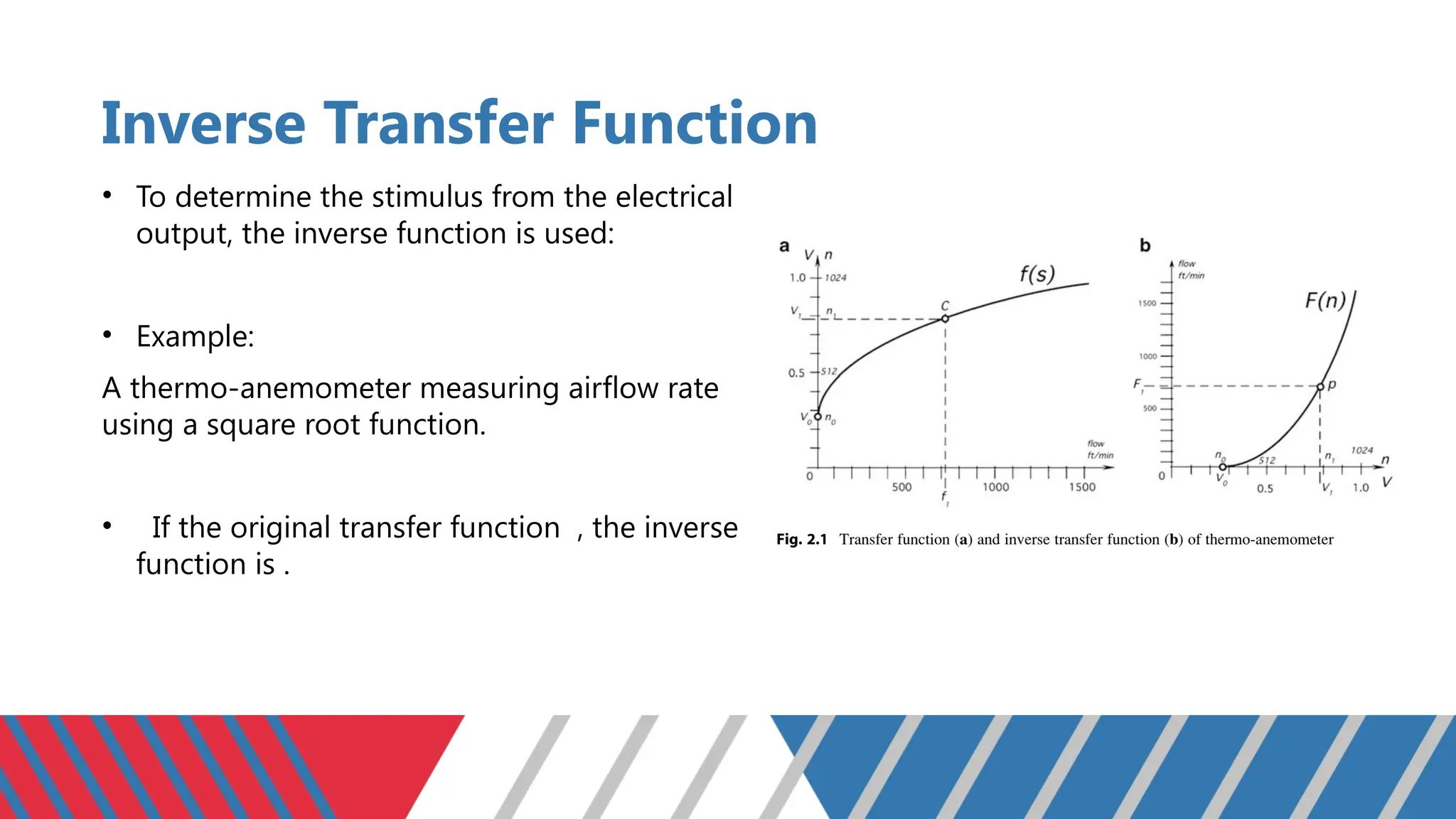
• To determine the stimulus from the electrical
output, the inverse function is used:
• Example:
A thermo-anemometer measuring airflow rate
using a square root function.
• If the original transfer function , the inverse
function is .
Mathematical Model of Transfer Function
• A mathematical model formally represents the input-output
relationship of a sensor.
• Models can be in the form of:
1) Value tables.
2) Graphs depicting stimulus-output relationships.
3) Explicit mathematical equations.
• If the transfer function does not change over time, it is called a static
transfer function.
• Common mathematical models include linear, exponential,
logarithmic, and polynomial equations.
Example of a Linear Transfer Function
- A linear model represents a direct relationship between stimulus and
output:
is the intercept, the output value when the input is zero.
is the sensor sensitivity (slope of the graph).
- Example:
1. A resistive potentiometer for position measurement.
2. Temperature sensors based on RTDs (Resistance Temperature Detectors).
Example of a Linear Transfer Function
Linear Transfer Function with Reference
- If a reference is used, the transfer function becomes:
are the reference input-output points.
- The inverse transfer function is:
-
Used in sensors with a reference point, such as force sensors with zero calibration
Example of a Nonlinear Transfer Function
- Many sensors exhibit nonlinear transfer functions, such as:
Logarithmic:
Exponential:
Power function:
- Examples:
1. Light sensors based on photodiodes.
2. Thermistors for temperature measurement.
Approximation Approaches for Transfer
Functions
- Not all sensors have explicit mathematical models.
- Approximation methods include:
a) Linear regression for nearly linear functions.
b) Polynomial approximation for nonlinear relationships.
c) Piecewise linear approximation for unpredictable behavior.
- Used for sensors with complex characteristics.
Linear Regression for Approximation
- If the sensor relationship is not exact, use linear regression:
- is the number of measurements.
- Applied in pressure or humidity sensors.
Polynomial Approximation
- If data does not fit basic functions, use polynomials:
- Example applications:
- Gas sensors with nonlinear concentration-output voltage relationships.
• Polynomial approximation is useful when sensor responses cannot be accurately described by
simple equations.
• Higher-order polynomials can provide better approximations but may increase computational
complexity.
• The best choice of polynomial order depends on the required accuracy and available
computational resources.
Sensor Sensitivity
• - Sensitivity is defined as the first derivative of the transfer function:
• In nonlinear sensors, sensitivity varies across the stimulus range.
• High sensitivity means small changes in stimulus result in large changes in
output.
Piecewise Linear Approximation
• Divides a nonlinear transfer function into multiple linear segments.
• Each segment is defined by a simple linear equation.
• Used in: pressure sensors with nonlinear output.
Considerations for Piecewise
Approximation
• It makes sense to select knots only for the input range of interest (span) to reduce
complexity.
• The error of a piecewise approximation is characterized by a maximum deviation from the
real curve.
• The larger the deviation , the greater the number of segments needed to maintain
accuracy.
• Knots should be closer in regions of high nonlinearity and further apart where the
function is more linear.
• The signal processor must store knot coordinates in memory and perform linear
interpolation to compute the input stimulus .
Spline Interpolation
• Uses piecewise polynomials to create smoother curves.
• Example: Temperature sensors where data needs interpolation over a wide
range.
Multidimensional Transfer Functions
• Some sensors depend on more than one input variable.
• Example:
- A humidity sensor's output depends on both humidity and temperature.
- An infrared thermal radiation sensor follows the Stefan-Boltzmann law.
The transfer function of an infrared sensor involves two temperature variables:
, the absolute temperature of an object of measurement and , the absolute
temperature of thesensing element.
•
Calibration
• Calibration is required to enhance sensor accuracy by correcting deviations.
• It involves applying known stimuli and measuring the corresponding output.
• Methods of calibration:
• Modifying the transfer function: Compute new coefficients to fit experimental data, ensuring a
unique transfer function without modifying the sensor.
• Adjusting the data acquisition system: Modify output signals to fit a normalized transfer
function (e.g., scaling and shifting data).
• Modifying sensor properties: Physically alter the sensor to match a predetermined transfer
function.
• Using sensor-specific reference devices: Employ a matching reference to compensate for
inaccuracies.
• Example: Thermistor calibration methods using controlled liquid baths and precision thermometers.
Conclusion
• Transfer functions are fundamental in sensor
analysis.
• Approximation methods enhance measurement
accuracy.
• Understanding transfer functions aids in
designing better sensor systems.
• Modern sensors often use nonlinear approaches
and calibration for improved accuracy.
Reference
Thank you
Everything is controlled by probabilities.
I would like to know—who controls probabilities?
Stanisław Jerzy Lec
Polish Poet

Lecture 2 - Transfer Function in Sensors.pptx

  • 1.
  • 2.
    Introduction • Sensors convertnon-electrical stimuli into electrical signals. • The transfer function describes the relationship between stimulus (input) and electrical signal (output). • Main goal: Determine the stimulus from the electrical signal produced by the sensor. • Understanding the transfer function enhances sensor performance in various applications.
  • 3.
    Definition of TransferFunction • A static transfer function is an input-output relationship that does not change over time. • General notation: • is the electrical output of the sensor (voltage, current, etc.). • is the measured input stimulus. • An ideal transfer function ensures the sensor produces accurate and reliable output.
  • 4.
    Inverse Transfer Function •To determine the stimulus from the electrical output, the inverse function is used: • Example: A thermo-anemometer measuring airflow rate using a square root function. • If the original transfer function , the inverse function is .
  • 5.
    Mathematical Model ofTransfer Function • A mathematical model formally represents the input-output relationship of a sensor. • Models can be in the form of: 1) Value tables. 2) Graphs depicting stimulus-output relationships. 3) Explicit mathematical equations. • If the transfer function does not change over time, it is called a static transfer function. • Common mathematical models include linear, exponential, logarithmic, and polynomial equations.
  • 6.
    Example of aLinear Transfer Function - A linear model represents a direct relationship between stimulus and output: is the intercept, the output value when the input is zero. is the sensor sensitivity (slope of the graph). - Example: 1. A resistive potentiometer for position measurement. 2. Temperature sensors based on RTDs (Resistance Temperature Detectors).
  • 7.
    Example of aLinear Transfer Function
  • 8.
    Linear Transfer Functionwith Reference - If a reference is used, the transfer function becomes: are the reference input-output points. - The inverse transfer function is: - Used in sensors with a reference point, such as force sensors with zero calibration
  • 9.
    Example of aNonlinear Transfer Function - Many sensors exhibit nonlinear transfer functions, such as: Logarithmic: Exponential: Power function: - Examples: 1. Light sensors based on photodiodes. 2. Thermistors for temperature measurement.
  • 12.
    Approximation Approaches forTransfer Functions - Not all sensors have explicit mathematical models. - Approximation methods include: a) Linear regression for nearly linear functions. b) Polynomial approximation for nonlinear relationships. c) Piecewise linear approximation for unpredictable behavior. - Used for sensors with complex characteristics.
  • 13.
    Linear Regression forApproximation - If the sensor relationship is not exact, use linear regression: - is the number of measurements. - Applied in pressure or humidity sensors.
  • 14.
    Polynomial Approximation - Ifdata does not fit basic functions, use polynomials: - Example applications: - Gas sensors with nonlinear concentration-output voltage relationships. • Polynomial approximation is useful when sensor responses cannot be accurately described by simple equations. • Higher-order polynomials can provide better approximations but may increase computational complexity. • The best choice of polynomial order depends on the required accuracy and available computational resources.
  • 15.
    Sensor Sensitivity • -Sensitivity is defined as the first derivative of the transfer function: • In nonlinear sensors, sensitivity varies across the stimulus range. • High sensitivity means small changes in stimulus result in large changes in output.
  • 16.
    Piecewise Linear Approximation •Divides a nonlinear transfer function into multiple linear segments. • Each segment is defined by a simple linear equation. • Used in: pressure sensors with nonlinear output.
  • 18.
    Considerations for Piecewise Approximation •It makes sense to select knots only for the input range of interest (span) to reduce complexity. • The error of a piecewise approximation is characterized by a maximum deviation from the real curve. • The larger the deviation , the greater the number of segments needed to maintain accuracy. • Knots should be closer in regions of high nonlinearity and further apart where the function is more linear. • The signal processor must store knot coordinates in memory and perform linear interpolation to compute the input stimulus .
  • 19.
    Spline Interpolation • Usespiecewise polynomials to create smoother curves. • Example: Temperature sensors where data needs interpolation over a wide range.
  • 20.
    Multidimensional Transfer Functions •Some sensors depend on more than one input variable. • Example: - A humidity sensor's output depends on both humidity and temperature. - An infrared thermal radiation sensor follows the Stefan-Boltzmann law. The transfer function of an infrared sensor involves two temperature variables: , the absolute temperature of an object of measurement and , the absolute temperature of thesensing element. •
  • 22.
    Calibration • Calibration isrequired to enhance sensor accuracy by correcting deviations. • It involves applying known stimuli and measuring the corresponding output. • Methods of calibration: • Modifying the transfer function: Compute new coefficients to fit experimental data, ensuring a unique transfer function without modifying the sensor. • Adjusting the data acquisition system: Modify output signals to fit a normalized transfer function (e.g., scaling and shifting data). • Modifying sensor properties: Physically alter the sensor to match a predetermined transfer function. • Using sensor-specific reference devices: Employ a matching reference to compensate for inaccuracies. • Example: Thermistor calibration methods using controlled liquid baths and precision thermometers.
  • 24.
    Conclusion • Transfer functionsare fundamental in sensor analysis. • Approximation methods enhance measurement accuracy. • Understanding transfer functions aids in designing better sensor systems. • Modern sensors often use nonlinear approaches and calibration for improved accuracy.
  • 25.
  • 26.
    Thank you Everything iscontrolled by probabilities. I would like to know—who controls probabilities? Stanisław Jerzy Lec Polish Poet