Plant tissues aremade of three basic cell types.
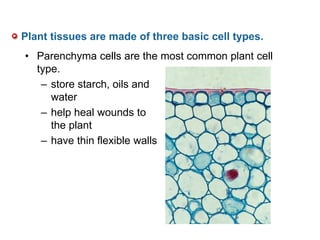
• Parenchyma cells are the most common plant cell
type.
– store starch, oils and
water
– help heal wounds to
the plant
– have thin flexible walls
4.
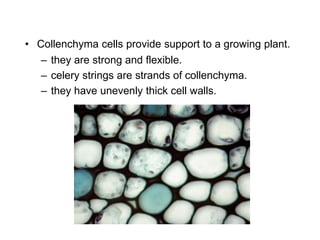
– they arestrong and flexible.
– celery strings are strands of collenchyma.
– they have unevenly thick cell walls.
• Collenchyma cells provide support to a growing plant.
5.
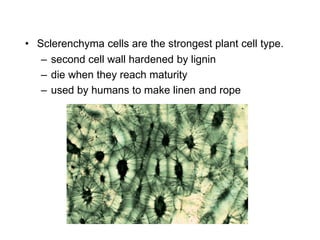
– second cellwall hardened by lignin
– die when they reach maturity
– used by humans to make linen and rope
• Sclerenchyma cells are the strongest plant cell type.
6.
Plant organs aremade of three tissue systems.
• Dermal tissue covers the outside of a plant.
– protects the plant
– secretes cuticle of leaves
– forms outer bark of trees
7.
– provides support
–stores materials in roots and stems
– most commonly made of parenchyma
• Ground tissue is found inside a plant.
8.
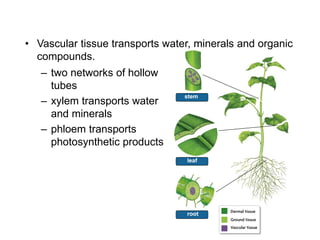
stem
leaf
root
– two networksof hollow
tubes
– xylem transports water
and minerals
– phloem transports
photosynthetic products
• Vascular tissue transports water, minerals and organic
compounds.
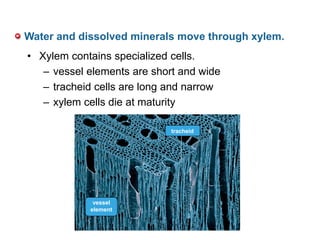
Water and dissolvedminerals move through xylem.
• Xylem contains specialized cells.
– vessel elements are short and wide
– tracheid cells are long and narrow
– xylem cells die at maturity
vessel
element
tracheid
11.
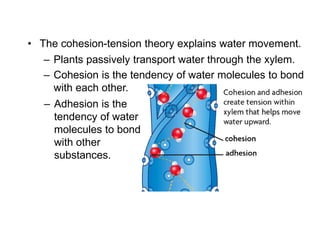
– Plants passivelytransport water through the xylem.
– Cohesion is the tendency of water molecules to bond
with each other.
• The cohesion-tension theory explains water movement.
– Adhesion is the
tendency of water
molecules to bond
with other
substances.
12.
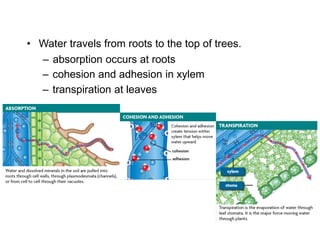
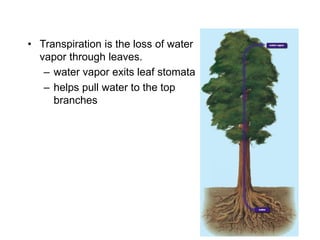
– absorption occursat roots
• Water travels from roots to the top of trees.
– cohesion and adhesion in xylem
– transpiration at leaves
13.
– water vaporexits leaf stomata
– helps pull water to the top
branches
• Transpiration is the loss of water
vapor through leaves.
14.
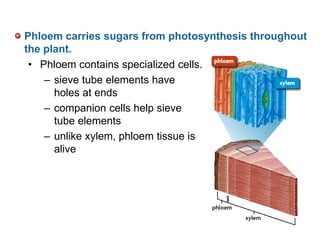
Phloem carries sugarsfrom photosynthesis throughout
the plant.
• Phloem contains specialized cells.
– sieve tube elements have
holes at ends
– companion cells help sieve
tube elements
– unlike xylem, phloem tissue is
alive
15.
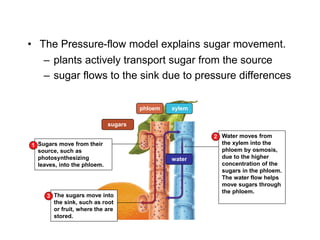
– plants activelytransport sugar from the source
– sugar flows to the sink due to pressure differences
sugars
phloem xylem
water
Sugars move from their
source, such as
photosynthesizing
leaves, into the phloem.
1
The sugars move into
the sink, such as root
or fruit, where the are
stored.
3
Water moves from
the xylem into the
phloem by osmosis,
due to the higher
concentration of the
sugars in the phloem.
The water flow helps
move sugars through
the phloem.
2
• The Pressure-flow model explains sugar movement.
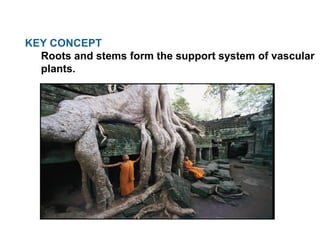
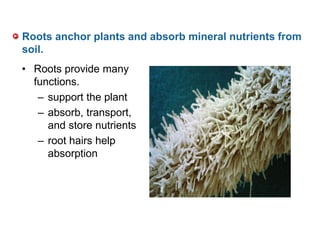
Roots anchor plantsand absorb mineral nutrients from
soil.
• Roots provide many
functions.
– support the plant
– absorb, transport,
and store nutrients
– root hairs help
absorption
18.
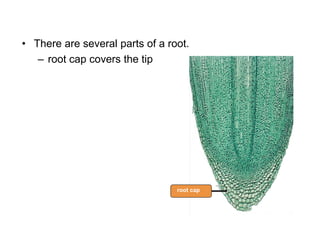
root cap
– rootcap covers the tip
• There are several parts of a root.
19.
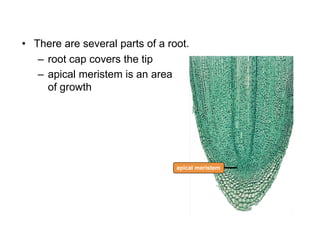
apical meristem
– rootcap covers the tip
• There are several parts of a root.
– apical meristem is an area
of growth
20.
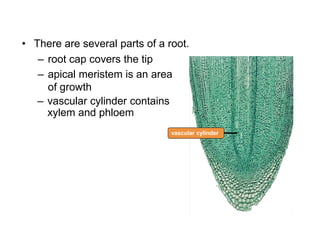
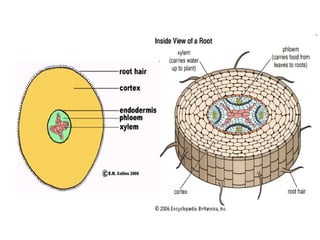
– vascular cylindercontains
xylem and phloem
vascular cylinder
– root cap covers the tip
• There are several parts of a root.
– apical meristem is an area
of growth
21.
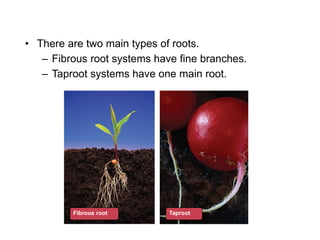
– Fibrous rootsystems have fine branches.
Fibrous root Taproot
• There are two main types of roots.
– Taproot systems have one main root.
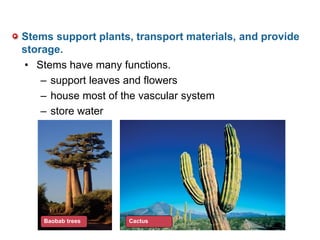
Stems support plants,transport materials, and provide
storage.
• Stems have many functions.
– support leaves and flowers
– house most of the vascular system
– store water
Baobab trees Cactus
25.
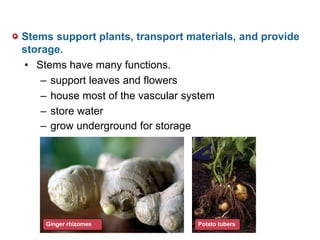
– grow undergroundfor storage
Ginger rhizomes Potato tubers
Stems support plants, transport materials, and provide
storage.
• Stems have many functions.
– support leaves and flowers
– house most of the vascular system
– store water
26.
– grow undergroundfor storage
Stems support plants, transport materials, and provide
storage.
• Stems have many functions.
– support leaves and flowers
– house most of the vascular system
– store water
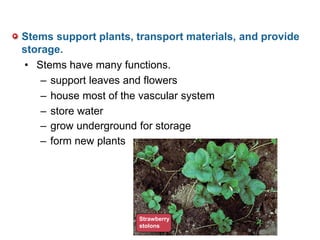
– form new plants
Strawberry
stolons
27.
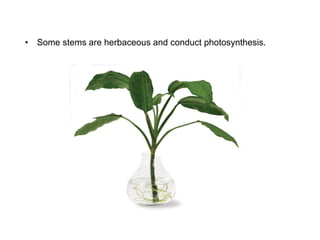
• Some stemsare herbaceous and conduct photosynthesis.
28.
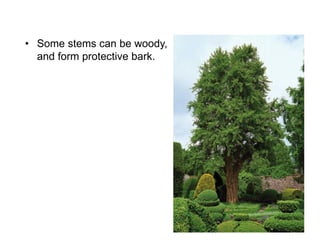
• Some stemscan be woody,
and form protective bark.
29.
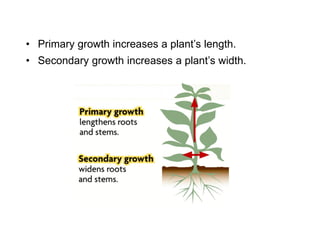
• Secondary growthincreases a plant’s width.
• Primary growth increases a plant’s length.
30.
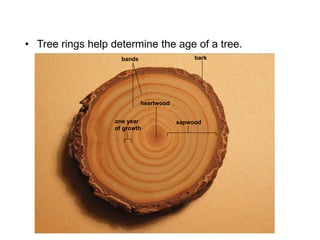
• Tree ringshelp determine the age of a tree.
heartwood
bands bark
one year
of growth
sapwood
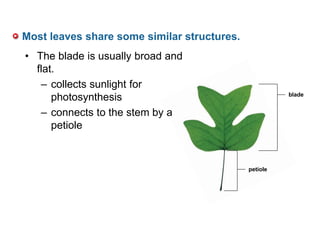
Most leaves sharesome similar structures.
• The blade is usually broad and
flat.
– collects sunlight for
photosynthesis
– connects to the stem by a
petiole
blade
petiole
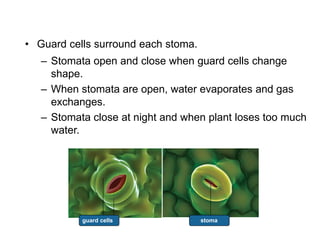
– Stomata openand close when guard cells change
shape.
– When stomata are open, water evaporates and gas
exchanges.
– Stomata close at night and when plant loses too much
water.
guard cells stoma
• Guard cells surround each stoma.
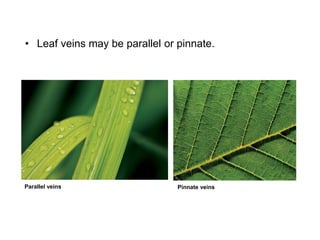
• Leaf veinsmay be parallel or pinnate.
Pinnate veins
Parallel veins
38.
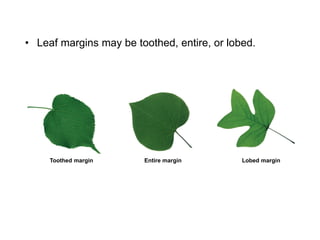
• Leaf marginsmay be toothed, entire, or lobed.
Toothed margin Entire margin Lobed margin
39.
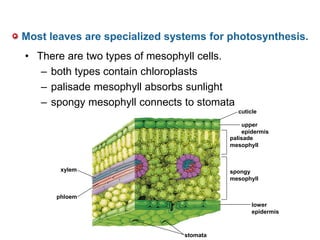
Most leaves arespecialized systems for photosynthesis.
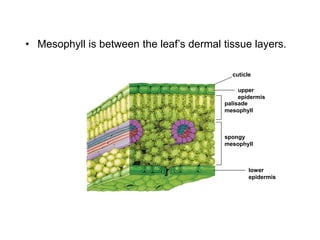
• There are two types of mesophyll cells.
– both types contain chloroplasts
– palisade mesophyll absorbs sunlight
– spongy mesophyll connects to stomata
xylem
phloem
cuticle
upper
epidermis
palisade
mesophyll
spongy
mesophyll
stomata
lower
epidermis
40.
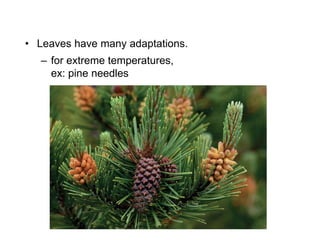
– for extremetemperatures,
ex: pine needles
• Leaves have many adaptations.
41.
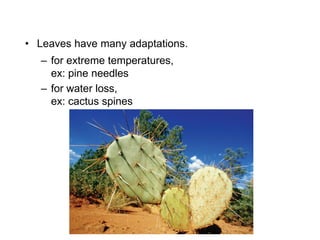
• Leaves havemany adaptations.
– for extreme temperatures,
ex: pine needles
– for water loss,
ex: cactus spines
42.
– for aquaticenvironments,
ex: water lily
• Leaves have many adaptations.
– for extreme temperatures,
ex: pine needles
– for water loss,
ex: cactus spines
43.
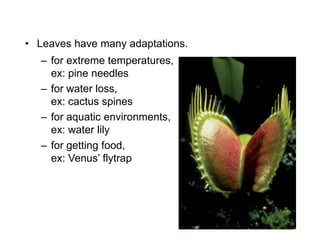
– for aquaticenvironments,
ex: water lily
– for getting food,
ex: Venus’ flytrap
• Leaves have many adaptations.
– for extreme temperatures,
ex: pine needles
– for water loss,
ex: cactus spines