DISCOVER . LEARN . EMPOWER
2D-Arrays
UNIVERSITY INSTITUTE OF ENGINEERING
DEPARTMENT- ACADEMIC UNITS
FIRST YEAR ENGINEERING PROGRAMMES
Subject Name : Introduction to Problem Solving
Subject Code: 24CSH-101
2
Introduction to
Problem Solving
Course Objectives
The course aims to provide exposure to problem-
solving through programming.
The course aims to raise the programming skills
of students via logic building capability.
With knowledge of C programming language,
students would be able to model real world
problems.
3
CO
Number
Course Outcome
CO1 Remember the concepts related to fundamentals of C language,
draw flowcharts and write algorithm/pseudocode.
CO2 Understand the way of execution and debug programs in C
language.
CO3 Apply various constructs, loops, functions to solve mathematical
and scientific problem.
CO4 Analyze the dynamic behavior of memory by the use of pointers.
CO5 Design and develop modular programs for real world problems
using control structure and selection structure.
Course
Outcomes
4
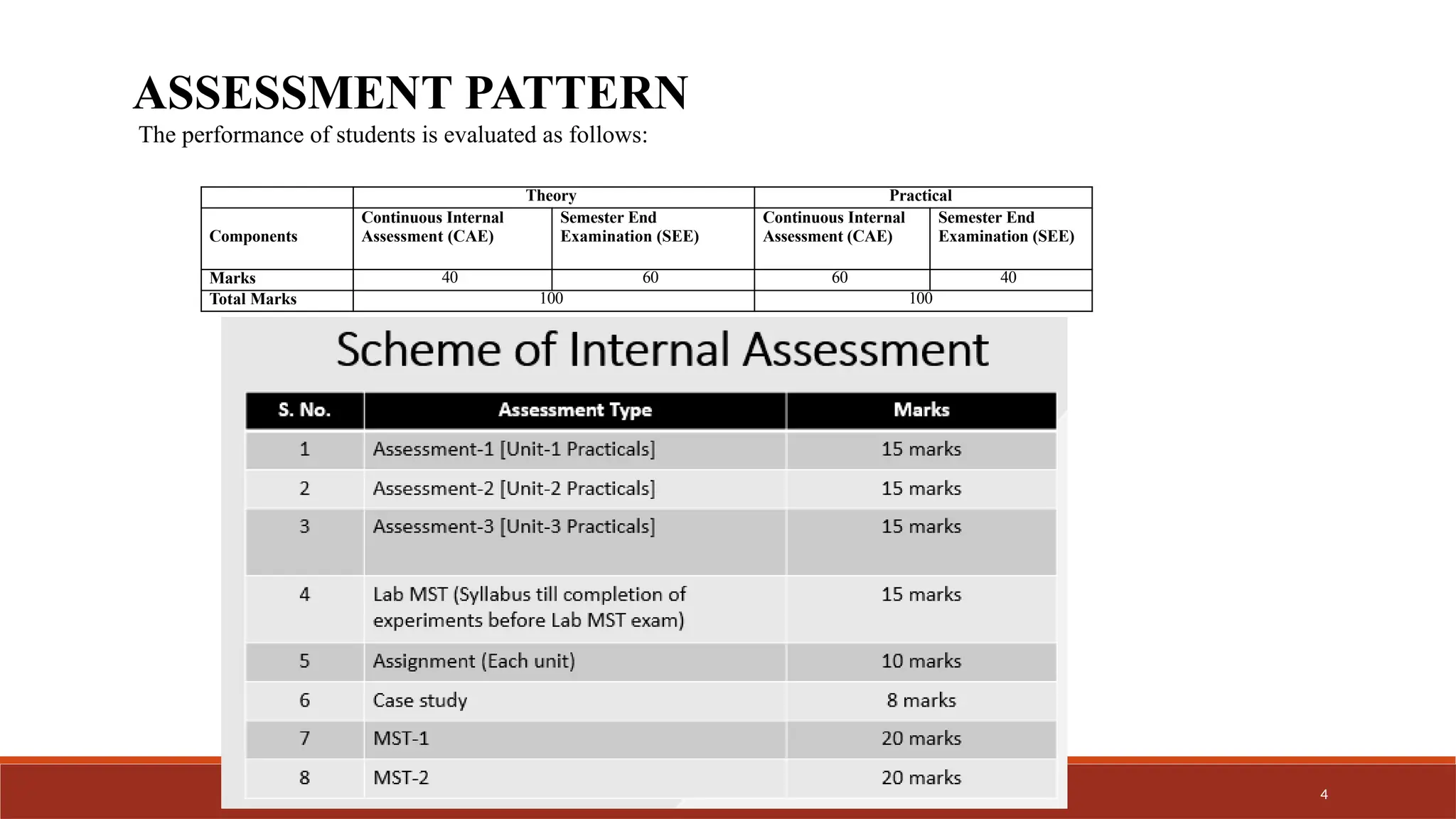
ASSESSMENT PATTERN
The performance of students is evaluated as follows:
Theory Practical
Components
Continuous Internal
Assessment (CAE)
Semester End
Examination (SEE)
Continuous Internal
Assessment (CAE)
Semester End
Examination (SEE)
Marks 40 60 60 40
Total Marks 100 100
Content
• Two Dimensional Array
• Initialization of Two Dimensional Array
• Memory Representation of 2D Array
• Examples
• References
2-Dimensional
Array
A two-dimensional array is an array where its elements are selected
(identified) using two indices. In 2-D array, to declare and access
elements of a 2-D array we use 2 subscripts instead of 1.
Syntax: data_type array_name[ROW][COL];
The total number of elements in a 2-D array is ROW*COL.
Example: int a[m][n];
In rectangular 2-dimensional arrays, m number of rows and n number of
columns in the array has the same number of array elements.
A conceptual representation of 2D array
Initialization of two-dimensional array: Initialization of 2-D array is
similar to a 1-D array.
Example:
Initialization
2-D Array
After this initialization, each element is as follows:
temp[0][0] : 1
temp[0][1] : 2
temp[0][2] : 3
temp[1][0] : 11
temp[1][1] : 22
temp[1][2] : 33
Memory
Representation
2-D Array
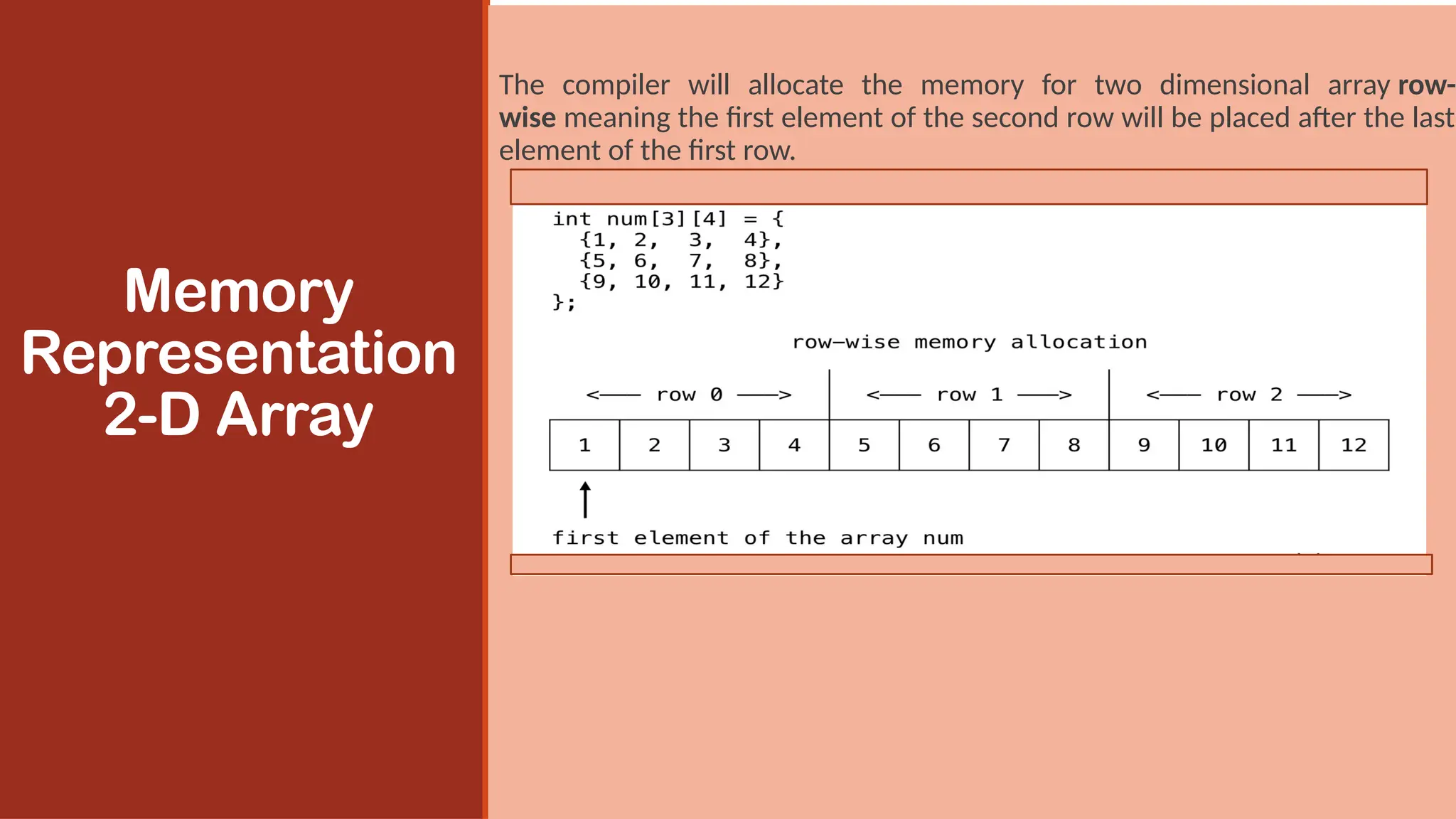
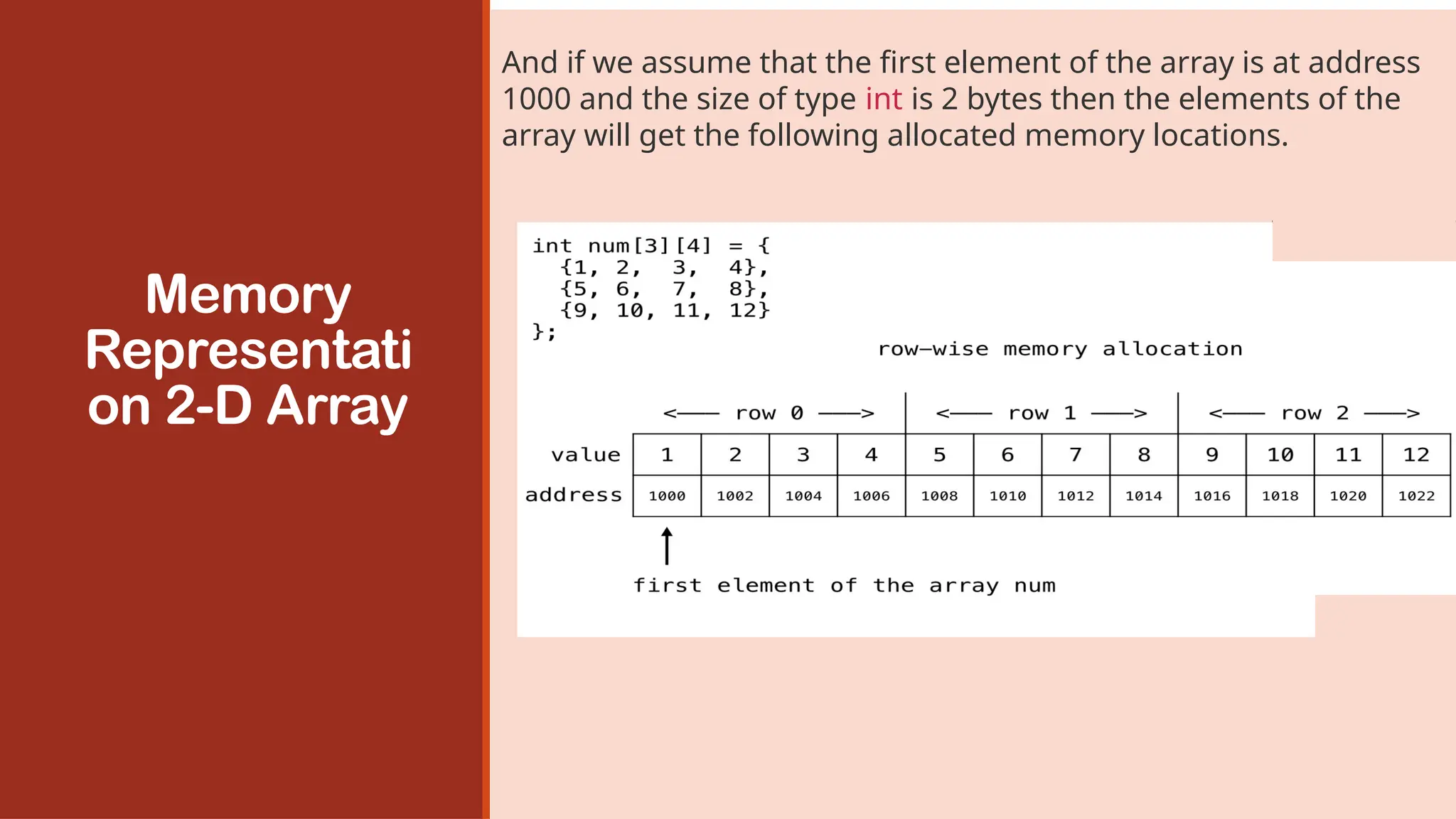
The compiler will allocate the memory for two dimensional array row-
wise meaning the first element of the second row will be placed after the last
element of the first row.
Memory
Representati
on 2-D Array
And if we assume that the first element of the array is at address
1000 and the size of type int is 2 bytes then the elements of the
array will get the following allocated memory locations.
1. Program to store the elements from the user
and store them in an 2D array.
#include<stdio.h>
int main()
{
int disp[2][3], i, j;
for(i=0; i<2; i++)
{
for(j=0;j<3;j++)
{
printf("Enter value for disp[%d][%d]:", i, j);
scanf("%d", &disp[i][j]);
}
}
printf("Two Dimensional array elements:n");
Examples of
2-D Array
for(i=0; i<2; i++)
{
for(j=0;j<3;j++)
{
printf("%d ", disp[i][j]);
if(j==2){ printf("n");
}
}
}
return 0;
}
2.. Program to sum of even and odd of 2D
array.
#include<stdio.h>
int main()
{
int i=0,j=0;
int arr[3][4]={{1,2,3,4},{2,3,4,5},
{3,4,5,6}};
int even=0;int odd=0;
for(i=0;i<3;i++)
{
for(j=0;j<4;j++)
{
if(arr[i][j]%2==0)
{
Examples of
2-D Array
even=even+arr[i][j];
}
else
{
odd=odd+arr[i][j];
}
}
}
printf("Sum of even =%d n",even);
printf("Sum of odd =%d",odd);
return 0; }
SUMMARY
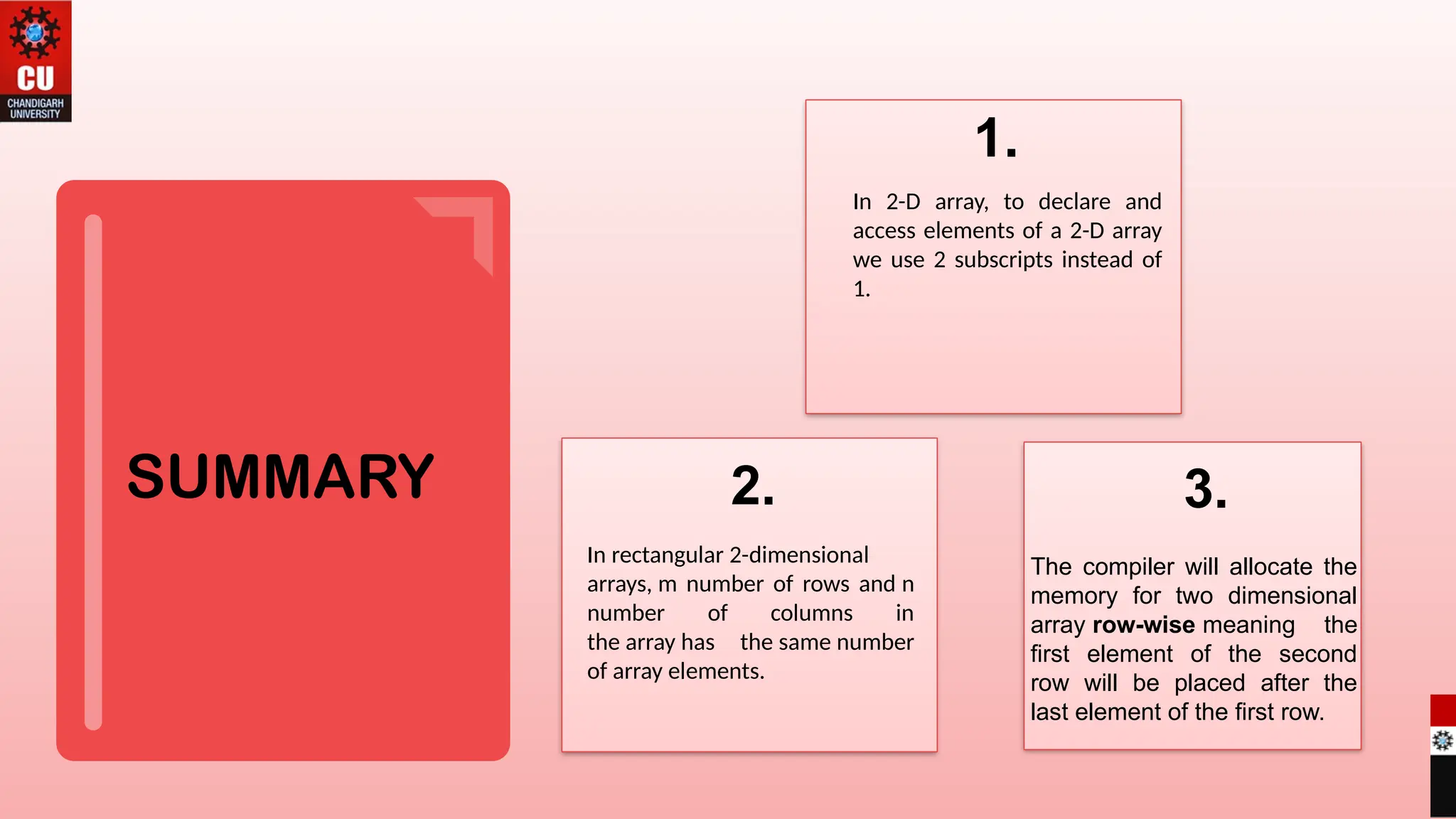
In rectangular 2-dimensional
arrays, m number of rows and n
number of columns in
the array has the same number
of array elements.
The compiler will allocate the
memory for two dimensional
array row-wise meaning the
first element of the second
row will be placed after the
last element of the first row.
2. 3.
1.
In 2-D array, to declare and
access elements of a 2-D array
we use 2 subscripts instead of
1.
FREQUENTLY
ASKED
QUESTIONS
PROGRAMS
1. Write a C Program to addition of two matrices.
2. Write a program in C to calculate determinant of a 3 x 3 matrix.
3. Write a program in C to accept two matrices and check whether
they are equal.
4. Write a C program to transpose of two matrices.
5. Program to multiply two matrices.
UTILISE
YOUR
KNOWLEDGE
TO ANSWER
1.Which of the following is true about arrays in C.
(A) For every type T, there can be an array of T.
(B) For every type T except void and function type, there can be an array of T.
(C) When an array is passed to a function, C compiler creates a copy of array.
(D) 2D arrays are stored in column major form
2. What will be the output of the following C code?
#include <stdio.h>
void f(int a[][3])
{
a[0][1] = 3;
int i = 0, j = 0;
for (i = 0; i < 2; i++)
for (j = 0; j < 3; j++)
printf("%d", a[i][j]);
}
void main()
{
int a[2][3] = {0};
f(a);
}
a) 0 3 0 0 0 0
b) Junk 3 junk junk junk junk
c) Compile time error
d) All junk values
Let us see how much you have
learned from the lecture and
how effectively you can apply
your knowledge…!!
UTILISE
YOUR
KNOWLEDGE
TO ANSWER
3. What will be the output of the following C code?
#include <stdio.h>
void main()
{
int a[2][3] = {1, 2, 3, 4, 5};
int i = 0, j = 0;
for (i = 0; i < 2; i++)
for (j = 0; j < 3; j++)
printf("%d", a[i][j]);
}
a) 1 2 3 4 5 0
b) 1 2 3 4 5 junk
c) 1 2 3 4 5 5
d) Run time error
Let us see how much you have
learned from the lecture and
how effectively you can apply
your knowledge…!!
REFERENCES
Book References:
[1] Thareja Reema (2014) Programming in C. 2nd
ed.
[2] Zed A. Shaw, Learn C the Hard Way’
[3] https://en.wikibooks.org/wiki/C_Programming
Vedio Lecture: https://nptel.ac.in/courses/106/105/106105171/
https://nptel.ac.in/courses/106/106/106106127/
https://spoken-tutorial.org/watch/C+and+Cpp/Working+With+2D+Arrays/E
nglish/
Websites: https://beginnersbook.com/2014/01/2d-arrays-in-c-example/
https://processing.org/tutorials/2darray/
https://www.programiz.com/c-programming/c-multi-dimensional-arrays
BOOKS
WEBSITES
COURSES
THANK YOU

lecture 2.2.2 2D array.pptx IUGLFHLHFJFY

  • 1.
    DISCOVER . LEARN. EMPOWER 2D-Arrays UNIVERSITY INSTITUTE OF ENGINEERING DEPARTMENT- ACADEMIC UNITS FIRST YEAR ENGINEERING PROGRAMMES Subject Name : Introduction to Problem Solving Subject Code: 24CSH-101
  • 2.
    2 Introduction to Problem Solving CourseObjectives The course aims to provide exposure to problem- solving through programming. The course aims to raise the programming skills of students via logic building capability. With knowledge of C programming language, students would be able to model real world problems.
  • 3.
    3 CO Number Course Outcome CO1 Rememberthe concepts related to fundamentals of C language, draw flowcharts and write algorithm/pseudocode. CO2 Understand the way of execution and debug programs in C language. CO3 Apply various constructs, loops, functions to solve mathematical and scientific problem. CO4 Analyze the dynamic behavior of memory by the use of pointers. CO5 Design and develop modular programs for real world problems using control structure and selection structure. Course Outcomes
  • 4.
    4 ASSESSMENT PATTERN The performanceof students is evaluated as follows: Theory Practical Components Continuous Internal Assessment (CAE) Semester End Examination (SEE) Continuous Internal Assessment (CAE) Semester End Examination (SEE) Marks 40 60 60 40 Total Marks 100 100
  • 5.
    Content • Two DimensionalArray • Initialization of Two Dimensional Array • Memory Representation of 2D Array • Examples • References
  • 6.
    2-Dimensional Array A two-dimensional arrayis an array where its elements are selected (identified) using two indices. In 2-D array, to declare and access elements of a 2-D array we use 2 subscripts instead of 1. Syntax: data_type array_name[ROW][COL]; The total number of elements in a 2-D array is ROW*COL. Example: int a[m][n]; In rectangular 2-dimensional arrays, m number of rows and n number of columns in the array has the same number of array elements. A conceptual representation of 2D array
  • 7.
    Initialization of two-dimensionalarray: Initialization of 2-D array is similar to a 1-D array. Example: Initialization 2-D Array After this initialization, each element is as follows: temp[0][0] : 1 temp[0][1] : 2 temp[0][2] : 3 temp[1][0] : 11 temp[1][1] : 22 temp[1][2] : 33
  • 8.
    Memory Representation 2-D Array The compilerwill allocate the memory for two dimensional array row- wise meaning the first element of the second row will be placed after the last element of the first row.
  • 9.
    Memory Representati on 2-D Array Andif we assume that the first element of the array is at address 1000 and the size of type int is 2 bytes then the elements of the array will get the following allocated memory locations.
  • 10.
    1. Program tostore the elements from the user and store them in an 2D array. #include<stdio.h> int main() { int disp[2][3], i, j; for(i=0; i<2; i++) { for(j=0;j<3;j++) { printf("Enter value for disp[%d][%d]:", i, j); scanf("%d", &disp[i][j]); } } printf("Two Dimensional array elements:n"); Examples of 2-D Array for(i=0; i<2; i++) { for(j=0;j<3;j++) { printf("%d ", disp[i][j]); if(j==2){ printf("n"); } } } return 0; }
  • 11.
    2.. Program tosum of even and odd of 2D array. #include<stdio.h> int main() { int i=0,j=0; int arr[3][4]={{1,2,3,4},{2,3,4,5}, {3,4,5,6}}; int even=0;int odd=0; for(i=0;i<3;i++) { for(j=0;j<4;j++) { if(arr[i][j]%2==0) { Examples of 2-D Array even=even+arr[i][j]; } else { odd=odd+arr[i][j]; } } } printf("Sum of even =%d n",even); printf("Sum of odd =%d",odd); return 0; }
  • 12.
    SUMMARY In rectangular 2-dimensional arrays,m number of rows and n number of columns in the array has the same number of array elements. The compiler will allocate the memory for two dimensional array row-wise meaning the first element of the second row will be placed after the last element of the first row. 2. 3. 1. In 2-D array, to declare and access elements of a 2-D array we use 2 subscripts instead of 1.
  • 13.
    FREQUENTLY ASKED QUESTIONS PROGRAMS 1. Write aC Program to addition of two matrices. 2. Write a program in C to calculate determinant of a 3 x 3 matrix. 3. Write a program in C to accept two matrices and check whether they are equal. 4. Write a C program to transpose of two matrices. 5. Program to multiply two matrices.
  • 14.
    UTILISE YOUR KNOWLEDGE TO ANSWER 1.Which ofthe following is true about arrays in C. (A) For every type T, there can be an array of T. (B) For every type T except void and function type, there can be an array of T. (C) When an array is passed to a function, C compiler creates a copy of array. (D) 2D arrays are stored in column major form 2. What will be the output of the following C code? #include <stdio.h> void f(int a[][3]) { a[0][1] = 3; int i = 0, j = 0; for (i = 0; i < 2; i++) for (j = 0; j < 3; j++) printf("%d", a[i][j]); } void main() { int a[2][3] = {0}; f(a); } a) 0 3 0 0 0 0 b) Junk 3 junk junk junk junk c) Compile time error d) All junk values Let us see how much you have learned from the lecture and how effectively you can apply your knowledge…!!
  • 15.
    UTILISE YOUR KNOWLEDGE TO ANSWER 3. Whatwill be the output of the following C code? #include <stdio.h> void main() { int a[2][3] = {1, 2, 3, 4, 5}; int i = 0, j = 0; for (i = 0; i < 2; i++) for (j = 0; j < 3; j++) printf("%d", a[i][j]); } a) 1 2 3 4 5 0 b) 1 2 3 4 5 junk c) 1 2 3 4 5 5 d) Run time error Let us see how much you have learned from the lecture and how effectively you can apply your knowledge…!!
  • 16.
    REFERENCES Book References: [1] TharejaReema (2014) Programming in C. 2nd ed. [2] Zed A. Shaw, Learn C the Hard Way’ [3] https://en.wikibooks.org/wiki/C_Programming Vedio Lecture: https://nptel.ac.in/courses/106/105/106105171/ https://nptel.ac.in/courses/106/106/106106127/ https://spoken-tutorial.org/watch/C+and+Cpp/Working+With+2D+Arrays/E nglish/ Websites: https://beginnersbook.com/2014/01/2d-arrays-in-c-example/ https://processing.org/tutorials/2darray/ https://www.programiz.com/c-programming/c-multi-dimensional-arrays BOOKS WEBSITES COURSES
  • 17.