Social Capital, Economics of Religion, and Happiness
ECON 306: Development Economics
BSS (Honours) third year, Department of Economics, University of Dhaka
Lecture by: Dr. Rubaiya Murshed
PhD and MPhil, Faculty of Education (Economics of Education), University of Cambridge
Lecturer, Department of Economics, University of Dhaka
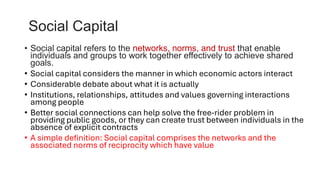
Social Capital
• Social capital refers to the networks, norms, and trust that enable
individuals and groups to work together effectively to achieve shared
goals.
• Social capital considers the manner in which economic actors interact
• Considerable debate about what it is actually
• Institutions, relationships, attitudes and values governing interactions
among people
• Better social connections can help solve the free-rider problem in
providing public goods, or they can create trust between individuals in the
absence of explicit contracts
• A simple definition: Social capital comprises the networks and the
associated norms of reciprocity which have value
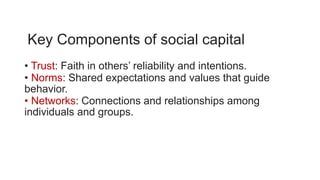
Key Components of social capital
• Trust: Faith in others’ reliability and intentions.
• Norms: Shared expectations and values that guide
behavior.
• Networks: Connections and relationships among
individuals and groups.
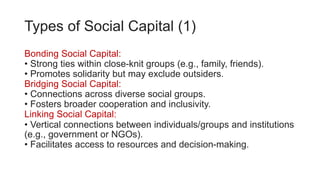
Types of Social Capital (1)
Bonding Social Capital:
• Strong ties within close-knit groups (e.g., family, friends).
• Promotes solidarity but may exclude outsiders.
Bridging Social Capital:
• Connections across diverse social groups.
• Fosters broader cooperation and inclusivity.
Linking Social Capital:
• Vertical connections between individuals/groups and institutions
(e.g., government or NGOs).
• Facilitates access to resources and decision-making.
Types of Social Capital (2)
• Formal and informal social capital develop reciprocity
• Formal social capital (PTA, labour union) and informal social capital (friends)
• ‘Bonding' social capital or ‘strong ties’
• ‘Bonding’ social capital links sameness and enables cooperation between
groups
• For example, horizontal associations such as networks and clubs
• The bigger the group that sustains it, the more powerful is bonding social
capital
• ‘Bridging' social capital or ‘weak ties’
• Links between disparate social sub-groups – the strength of weak ties
• Returns to social capital rise in the level of community investment in social
capital
Does social capital have an impact empirically on
economic growth?
• Membership
• Northern Italy’s economic success relative to southern Italy as a consequence of
higher density of voluntary associations among northern people (Putnam, 1993)
• Trust and economic growth
• Studies using World Value Survey data show that trust is important (Knack and
Keefer, 1997)
• Knack and Keefer: A one standard deviation increase in country-level trust increases
economic growth by more than one-half of a standard deviation
• Transition economies in Eastern Europe and the former USSR: 'A hundred friends are
worth more than a hundred roubles.‘
• Ethnic diversity
• Affects public goods choice (Poterba 1996) and leads to weaker social
participation (Alesina and LeFerrara 2000; Iyer, Kitson and Toh, 2005)
Social Capital and Economic Development
Benefits for Development:
• Facilitates Collective Action: Eases coordination for public goods
(e.g., irrigation systems, schools).
• Reduces Transaction Costs: Trust lowers costs of enforcement in
economic exchanges.
• Encourages Innovation and Knowledge Sharing: Strong networks
promote the diffusion of ideas.
• Improves Governance: Higher social capital often correlates with
better institutional performance.
Challenges:
• Exclusive Networks: Can entrench inequality and marginalization.
• Corruption Risks: Strong intra-group trust may foster nepotism or
collusion.
Social capital: Empirical evidence
Robert Putnam (1993):
• Making Democracy Work: Demonstrates how social capital in
northern Italy led to better governance and economic
performance compared to southern Italy.
Narayan and Pritchett (1999):
• Found a strong relationship between social capital and
household income in rural Tanzania.
Case Study – Bangladesh:
• Role of community-based organizations (CBOs) in microfinance
and disaster management.
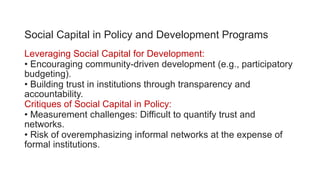
Social Capital in Policy and Development Programs
Leveraging Social Capital for Development:
• Encouraging community-driven development (e.g., participatory
budgeting).
• Building trust in institutions through transparency and
accountability.
Critiques of Social Capital in Policy:
• Measurement challenges: Difficult to quantify trust and
networks.
• Risk of overemphasizing informal networks at the expense of
formal institutions.
Example: Religion as one form of social capital
• Economics of religion: New and exciting area of research in economics
(Iyer 2016 and 2018)
• Max Weber (1904) argued that the Protestant ethic fostered virtues which
encouraged capitalist development in northern Europe in the 16th century.
The Protestant ethic, which arose from the Reformation, encouraged
diligence, discipline, self-denial and thrift
• These virtues encouraged savings, investment, entrepreneurship, and
literacy
• Remember: Correlation does not mean causation
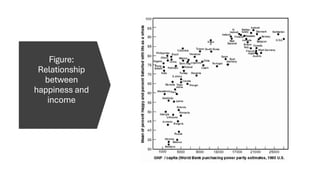
Figure:
Relationship
between
happiness and
income
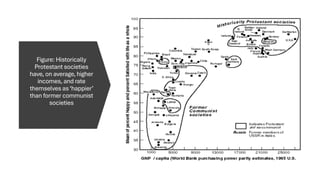
Figure: Historically
Protestant societies
have, on average, higher
incomes, and rate
themselves as‘happier’
than former communist
societies
Have economists neglected the study of religion?
• ‘Economics is not only a branch of theology. All along it has been
striving to escape from sentiment and to win for itself the status of a
science.’
- Joan Robinson, Economic Philosophy, 1962.
• ‘Economists like to claim that their discipline is “value-free”. In this
view, an economist is a technician, like a plumber or electrician.
Hence religious values are no more a factor in preparing economic
proposals than they are in repairing a furnace.’
- Robert H. Nelson, The Theological Meaning of Economics, 1993.
Economics of Religion
The Economics of Religion studies how religious beliefs,
behaviors, and institutions influence economic outcomes and
vice versa.
Key questions:
• How do religious values shape economic behavior?
• What is the economic impact of religious institutions?
• Does religion promote or hinder economic development?
Religion and Economic Behavior
Influence on Work Ethic:
• Example: Max Weber’s Protestant Ethic and the Spirit of
Capitalism—argues that Protestant values (e.g., frugality, hard
work) fostered early capitalist development.
Risk Aversion and Savings:
• Religious beliefs about the afterlife or divine punishment can
encourage or discourage financial risk-taking.
Charity and Redistribution:
• Many religions emphasize almsgiving (e.g., Zakat in Islam,
Tithing in Christianity), affecting income distribution and poverty
alleviation.
Religion and Economic Development
Social Capital:
• Religious institutions build trust, networks, and norms that facilitate
economic transactions.
• Example: Temples, mosques, and churches as centers for
community finance or information dissemination.
Human Capital:
• Religious organizations often play a role in education and health
provision, especially in low-income countries.
• Example: Missionary schools in sub-Saharan Africa significantly
improved literacy rates.
Gender Roles:
• Religious norms can influence labor force participation, fertility
decisions, and educational attainment of women.
Religion and Institutional Development
Governance and Institutions:
• Religion can shape political structures (e.g., separation of
church and state, theocracy).
• Historical example: The role of the Catholic Church in medieval
Europe’s governance.
Conflict and Cooperation:
• Religious diversity can either lead to social cohesion or conflict,
depending on institutional frameworks.
Case study: Sectarian conflicts in certain countries versus
religious pluralism in others.
Religion in Empirical Development Economics
Key Studies
• Barro & McCleary (2003): The relationship between religious
beliefs and economic growth; stronger religious beliefs correlate
with higher growth, but higher religious attendance does not.
• Berman (2000): Examined the economic rationality of religious
extremism and collective action.
Data Challenges:
• Measuring religiosity: Self-reported beliefs vs. attendance.
• Isolating causality: Does religion influence economics, or do
economic conditions shape religiosity?
Policy Implications and Critiques
Harnessing Religious Institutions:
• Governments and NGOs can leverage religious networks for
development programs (e.g., vaccination campaigns in
partnership with mosques).
Critiques:
• Risk of entrenching inequality or exclusionary practices.
• Over-reliance on religion may divert attention from secular
institutional development.
Economics of religion: Case studies
Bangladesh:
• Role of Islamic institutions in microfinance (e.g., Islami Bank
Bangladesh Ltd.) and charity (Zakat).
India:
• Hindu temples as providers of free meals and education.
• Sub-Saharan Africa:
• The economic and social impact of missionary-led schools.
Professor Sriya Iyer’s Contributions to the
Economics of Religion
Focus on Religion and Development: Explores how religious beliefs
and institutions affect social outcomes like education, health, and
inequality, particularly in developing countries.
Book: The Economics of Religion in India (2018):
• Examines the intersection of religion, economics, and public policy in
India.
• Highlights how religious diversity and institutions influence economic
development, social welfare, and communal harmony.
Key Findings:
• Religious institutions often compensate for weak state capacity by
providing education, healthcare, and welfare.
• Economic shocks can lead to increased religious participation, as
people seek support and meaning during crises.
Empirical Work: Uses large-scale data from India to analyze the
interplay between religion, economic growth, and social cohesion.
Food for thought:
• How do religious institutions contribute to or hinder economic
development in your region?
• Can religious norms be aligned with development goals such
as gender equality or poverty alleviation?
• Should governments involve religious organizations in
delivering public goods like education and health care?
Happiness and Economics
Happiness, or subjective well-being, refers to an individual’s self-
reported life satisfaction and emotional state.
Relevance to Development Economics:
• Goes beyond traditional measures like GDP to assess the quality
of life and human development.
• Recognized in frameworks like the UN’s Sustainable
Development Goals (SDGs) and Bhutan’s Gross National
Happiness (GNH).
Measuring Happiness
Subjective Measures:
• Surveys asking individuals to rate their life satisfaction or
emotional well-being (e.g., World Happiness Report, Gallup
World Poll).
Objective Indicators:
• Proxy indicators like income, health, education, and social
connections.
Challenges in Measurement:
• Cultural differences in expressing happiness.
• The reliability of self-reported data.
Determinants of Happiness
Economic Factors:
• Income: Higher income is associated with greater happiness, but with
diminishing returns (Easterlin Paradox).
• Employment: Job security and meaningful work contribute significantly to
well-being.
Social Factors:
• Social capital: Trust, community ties, and strong relationships enhance
happiness.
• Inequality: High levels of inequality can lower overall happiness, even
among wealthier individuals.
Non-Economic Factors:
• Health: Physical and mental well-being are critical determinants of
happiness.
• Freedom: Political freedom and personal autonomy improve happiness.
• Culture and religion: Cultural norms and religious practices influence
subjective well-being.
Happiness and Development
Beyond GDP:
• Traditional development metrics focus on economic growth,
while happiness emphasizes broader well-being.
• Example: Bhutan’s GNH includes factors like cultural
preservation, ecological resilience, and good governance.
Policy Implications:
• Investments in health, education, and social protection
programs to enhance well-being.
• Urban planning to create happier living environments (e.g.,
green spaces, reduced commuting times).
Empirical Evidence (1)
Easterlin Paradox (1974):
• Found that happiness increases with income, but only up to a
point. Long-term economic growth does not always lead to higher
happiness.
World Happiness Report:
• Rankings based on GDP per capita, social support, life
expectancy, freedom, generosity, and corruption levels.
Case Study – Bangladesh:
• Despite being a low-income country, social cohesion and strong
family ties contribute to relatively high happiness levels
compared to other nations with similar income.
Empirical Evidence (2)
World Happiness Report Findings:
• Scandinavian countries (e.g., Finland, Denmark) consistently rank high due
to strong social welfare systems, trust, and work-life balance.
Happiness Research Institute (Copenhagen): Key Insights
• Focus Areas: Studies life satisfaction, happiness, and quality of life,
emphasizing well-being beyond economic indicators like GDP.
• Happiness Factors: Identifies key drivers of happiness, including mental
health, social connections, financial security, work-life balance, and trust.
• Workplace Happiness: Explores the role of job satisfaction, autonomy, and
work culture in fostering happiness at work.
• Impact of Technology: Examines how digital habits and social media usage
influence overall well-being.
• Global Comparisons: Contributes to international reports (e.g., World
Happiness Report) comparing happiness levels across countries.
• Policy Relevance: Provides evidence-based recommendations for
governments and organizations to enhance societal well-being.
Critiques and Challenges
Cultural Relativity:
• Perceptions of happiness vary across cultures and may not
align with universal standards.
Trade-offs:
• Policies aimed at increasing happiness (e.g., reducing work
hours) may have unintended economic consequences.
Data Limitations:
• Short-term vs. long-term happiness measures can be
inconsistent.
Food for thought
• How does happiness differ as a development indicator
compared to GDP?
• Can public policy prioritize happiness without sacrificing
economic growth?
• Discuss the role of inequality in shaping happiness in
developing countries.
Useful Reading
 Barro, Robert and Rachel McCleary (2003) ‘Religion and Economic Growth across Countries,’ American
Sociological Review, 68(5): 760-781.
 Iyer, Sriya (2016) ‘The New Economics of Religion.’ Journal of Economic Literature 54: 2, June: 395-
441.
 Putnam, R. (1995), `Bowling alone: America's declining social capital', Journal of Democracy 6:1.
 OECD. (2013). Measuring happiness: The economics of well-being. Organisation for Economic Co-
operation and Development.
Retrieved from https://www.oecd.org
 PositivePsychology.com. (n.d.). Happiness economics: Can money buy happiness?
Retrieved from https://positivepsychology.com/happiness-economics/
 Veenhoven, R., & Ouweneel, P. (1991). Economic development and happiness: Evidence from 32 nations.
Social Indicators Research, 24(1), 1–34.

Lecture 19_Topic 10 Development economics .pdf

  • 1.
    Social Capital, Economicsof Religion, and Happiness ECON 306: Development Economics BSS (Honours) third year, Department of Economics, University of Dhaka Lecture by: Dr. Rubaiya Murshed PhD and MPhil, Faculty of Education (Economics of Education), University of Cambridge Lecturer, Department of Economics, University of Dhaka
  • 2.
    Social Capital • Socialcapital refers to the networks, norms, and trust that enable individuals and groups to work together effectively to achieve shared goals. • Social capital considers the manner in which economic actors interact • Considerable debate about what it is actually • Institutions, relationships, attitudes and values governing interactions among people • Better social connections can help solve the free-rider problem in providing public goods, or they can create trust between individuals in the absence of explicit contracts • A simple definition: Social capital comprises the networks and the associated norms of reciprocity which have value
  • 3.
    Key Components ofsocial capital • Trust: Faith in others’ reliability and intentions. • Norms: Shared expectations and values that guide behavior. • Networks: Connections and relationships among individuals and groups.
  • 4.
    Types of SocialCapital (1) Bonding Social Capital: • Strong ties within close-knit groups (e.g., family, friends). • Promotes solidarity but may exclude outsiders. Bridging Social Capital: • Connections across diverse social groups. • Fosters broader cooperation and inclusivity. Linking Social Capital: • Vertical connections between individuals/groups and institutions (e.g., government or NGOs). • Facilitates access to resources and decision-making.
  • 5.
    Types of SocialCapital (2) • Formal and informal social capital develop reciprocity • Formal social capital (PTA, labour union) and informal social capital (friends) • ‘Bonding' social capital or ‘strong ties’ • ‘Bonding’ social capital links sameness and enables cooperation between groups • For example, horizontal associations such as networks and clubs • The bigger the group that sustains it, the more powerful is bonding social capital • ‘Bridging' social capital or ‘weak ties’ • Links between disparate social sub-groups – the strength of weak ties • Returns to social capital rise in the level of community investment in social capital
  • 6.
    Does social capitalhave an impact empirically on economic growth? • Membership • Northern Italy’s economic success relative to southern Italy as a consequence of higher density of voluntary associations among northern people (Putnam, 1993) • Trust and economic growth • Studies using World Value Survey data show that trust is important (Knack and Keefer, 1997) • Knack and Keefer: A one standard deviation increase in country-level trust increases economic growth by more than one-half of a standard deviation • Transition economies in Eastern Europe and the former USSR: 'A hundred friends are worth more than a hundred roubles.‘ • Ethnic diversity • Affects public goods choice (Poterba 1996) and leads to weaker social participation (Alesina and LeFerrara 2000; Iyer, Kitson and Toh, 2005)
  • 7.
    Social Capital andEconomic Development Benefits for Development: • Facilitates Collective Action: Eases coordination for public goods (e.g., irrigation systems, schools). • Reduces Transaction Costs: Trust lowers costs of enforcement in economic exchanges. • Encourages Innovation and Knowledge Sharing: Strong networks promote the diffusion of ideas. • Improves Governance: Higher social capital often correlates with better institutional performance. Challenges: • Exclusive Networks: Can entrench inequality and marginalization. • Corruption Risks: Strong intra-group trust may foster nepotism or collusion.
  • 8.
    Social capital: Empiricalevidence Robert Putnam (1993): • Making Democracy Work: Demonstrates how social capital in northern Italy led to better governance and economic performance compared to southern Italy. Narayan and Pritchett (1999): • Found a strong relationship between social capital and household income in rural Tanzania. Case Study – Bangladesh: • Role of community-based organizations (CBOs) in microfinance and disaster management.
  • 9.
    Social Capital inPolicy and Development Programs Leveraging Social Capital for Development: • Encouraging community-driven development (e.g., participatory budgeting). • Building trust in institutions through transparency and accountability. Critiques of Social Capital in Policy: • Measurement challenges: Difficult to quantify trust and networks. • Risk of overemphasizing informal networks at the expense of formal institutions.
  • 10.
    Example: Religion asone form of social capital • Economics of religion: New and exciting area of research in economics (Iyer 2016 and 2018) • Max Weber (1904) argued that the Protestant ethic fostered virtues which encouraged capitalist development in northern Europe in the 16th century. The Protestant ethic, which arose from the Reformation, encouraged diligence, discipline, self-denial and thrift • These virtues encouraged savings, investment, entrepreneurship, and literacy • Remember: Correlation does not mean causation
  • 11.
  • 12.
    Figure: Historically Protestant societies have,on average, higher incomes, and rate themselves as‘happier’ than former communist societies
  • 13.
    Have economists neglectedthe study of religion? • ‘Economics is not only a branch of theology. All along it has been striving to escape from sentiment and to win for itself the status of a science.’ - Joan Robinson, Economic Philosophy, 1962. • ‘Economists like to claim that their discipline is “value-free”. In this view, an economist is a technician, like a plumber or electrician. Hence religious values are no more a factor in preparing economic proposals than they are in repairing a furnace.’ - Robert H. Nelson, The Theological Meaning of Economics, 1993.
  • 14.
    Economics of Religion TheEconomics of Religion studies how religious beliefs, behaviors, and institutions influence economic outcomes and vice versa. Key questions: • How do religious values shape economic behavior? • What is the economic impact of religious institutions? • Does religion promote or hinder economic development?
  • 15.
    Religion and EconomicBehavior Influence on Work Ethic: • Example: Max Weber’s Protestant Ethic and the Spirit of Capitalism—argues that Protestant values (e.g., frugality, hard work) fostered early capitalist development. Risk Aversion and Savings: • Religious beliefs about the afterlife or divine punishment can encourage or discourage financial risk-taking. Charity and Redistribution: • Many religions emphasize almsgiving (e.g., Zakat in Islam, Tithing in Christianity), affecting income distribution and poverty alleviation.
  • 16.
    Religion and EconomicDevelopment Social Capital: • Religious institutions build trust, networks, and norms that facilitate economic transactions. • Example: Temples, mosques, and churches as centers for community finance or information dissemination. Human Capital: • Religious organizations often play a role in education and health provision, especially in low-income countries. • Example: Missionary schools in sub-Saharan Africa significantly improved literacy rates. Gender Roles: • Religious norms can influence labor force participation, fertility decisions, and educational attainment of women.
  • 17.
    Religion and InstitutionalDevelopment Governance and Institutions: • Religion can shape political structures (e.g., separation of church and state, theocracy). • Historical example: The role of the Catholic Church in medieval Europe’s governance. Conflict and Cooperation: • Religious diversity can either lead to social cohesion or conflict, depending on institutional frameworks. Case study: Sectarian conflicts in certain countries versus religious pluralism in others.
  • 18.
    Religion in EmpiricalDevelopment Economics Key Studies • Barro & McCleary (2003): The relationship between religious beliefs and economic growth; stronger religious beliefs correlate with higher growth, but higher religious attendance does not. • Berman (2000): Examined the economic rationality of religious extremism and collective action. Data Challenges: • Measuring religiosity: Self-reported beliefs vs. attendance. • Isolating causality: Does religion influence economics, or do economic conditions shape religiosity?
  • 19.
    Policy Implications andCritiques Harnessing Religious Institutions: • Governments and NGOs can leverage religious networks for development programs (e.g., vaccination campaigns in partnership with mosques). Critiques: • Risk of entrenching inequality or exclusionary practices. • Over-reliance on religion may divert attention from secular institutional development.
  • 20.
    Economics of religion:Case studies Bangladesh: • Role of Islamic institutions in microfinance (e.g., Islami Bank Bangladesh Ltd.) and charity (Zakat). India: • Hindu temples as providers of free meals and education. • Sub-Saharan Africa: • The economic and social impact of missionary-led schools.
  • 21.
    Professor Sriya Iyer’sContributions to the Economics of Religion Focus on Religion and Development: Explores how religious beliefs and institutions affect social outcomes like education, health, and inequality, particularly in developing countries. Book: The Economics of Religion in India (2018): • Examines the intersection of religion, economics, and public policy in India. • Highlights how religious diversity and institutions influence economic development, social welfare, and communal harmony. Key Findings: • Religious institutions often compensate for weak state capacity by providing education, healthcare, and welfare. • Economic shocks can lead to increased religious participation, as people seek support and meaning during crises. Empirical Work: Uses large-scale data from India to analyze the interplay between religion, economic growth, and social cohesion.
  • 22.
    Food for thought: •How do religious institutions contribute to or hinder economic development in your region? • Can religious norms be aligned with development goals such as gender equality or poverty alleviation? • Should governments involve religious organizations in delivering public goods like education and health care?
  • 23.
    Happiness and Economics Happiness,or subjective well-being, refers to an individual’s self- reported life satisfaction and emotional state. Relevance to Development Economics: • Goes beyond traditional measures like GDP to assess the quality of life and human development. • Recognized in frameworks like the UN’s Sustainable Development Goals (SDGs) and Bhutan’s Gross National Happiness (GNH).
  • 24.
    Measuring Happiness Subjective Measures: •Surveys asking individuals to rate their life satisfaction or emotional well-being (e.g., World Happiness Report, Gallup World Poll). Objective Indicators: • Proxy indicators like income, health, education, and social connections. Challenges in Measurement: • Cultural differences in expressing happiness. • The reliability of self-reported data.
  • 25.
    Determinants of Happiness EconomicFactors: • Income: Higher income is associated with greater happiness, but with diminishing returns (Easterlin Paradox). • Employment: Job security and meaningful work contribute significantly to well-being. Social Factors: • Social capital: Trust, community ties, and strong relationships enhance happiness. • Inequality: High levels of inequality can lower overall happiness, even among wealthier individuals. Non-Economic Factors: • Health: Physical and mental well-being are critical determinants of happiness. • Freedom: Political freedom and personal autonomy improve happiness. • Culture and religion: Cultural norms and religious practices influence subjective well-being.
  • 26.
    Happiness and Development BeyondGDP: • Traditional development metrics focus on economic growth, while happiness emphasizes broader well-being. • Example: Bhutan’s GNH includes factors like cultural preservation, ecological resilience, and good governance. Policy Implications: • Investments in health, education, and social protection programs to enhance well-being. • Urban planning to create happier living environments (e.g., green spaces, reduced commuting times).
  • 27.
    Empirical Evidence (1) EasterlinParadox (1974): • Found that happiness increases with income, but only up to a point. Long-term economic growth does not always lead to higher happiness. World Happiness Report: • Rankings based on GDP per capita, social support, life expectancy, freedom, generosity, and corruption levels. Case Study – Bangladesh: • Despite being a low-income country, social cohesion and strong family ties contribute to relatively high happiness levels compared to other nations with similar income.
  • 28.
    Empirical Evidence (2) WorldHappiness Report Findings: • Scandinavian countries (e.g., Finland, Denmark) consistently rank high due to strong social welfare systems, trust, and work-life balance. Happiness Research Institute (Copenhagen): Key Insights • Focus Areas: Studies life satisfaction, happiness, and quality of life, emphasizing well-being beyond economic indicators like GDP. • Happiness Factors: Identifies key drivers of happiness, including mental health, social connections, financial security, work-life balance, and trust. • Workplace Happiness: Explores the role of job satisfaction, autonomy, and work culture in fostering happiness at work. • Impact of Technology: Examines how digital habits and social media usage influence overall well-being. • Global Comparisons: Contributes to international reports (e.g., World Happiness Report) comparing happiness levels across countries. • Policy Relevance: Provides evidence-based recommendations for governments and organizations to enhance societal well-being.
  • 29.
    Critiques and Challenges CulturalRelativity: • Perceptions of happiness vary across cultures and may not align with universal standards. Trade-offs: • Policies aimed at increasing happiness (e.g., reducing work hours) may have unintended economic consequences. Data Limitations: • Short-term vs. long-term happiness measures can be inconsistent.
  • 30.
    Food for thought •How does happiness differ as a development indicator compared to GDP? • Can public policy prioritize happiness without sacrificing economic growth? • Discuss the role of inequality in shaping happiness in developing countries.
  • 31.
    Useful Reading  Barro,Robert and Rachel McCleary (2003) ‘Religion and Economic Growth across Countries,’ American Sociological Review, 68(5): 760-781.  Iyer, Sriya (2016) ‘The New Economics of Religion.’ Journal of Economic Literature 54: 2, June: 395- 441.  Putnam, R. (1995), `Bowling alone: America's declining social capital', Journal of Democracy 6:1.  OECD. (2013). Measuring happiness: The economics of well-being. Organisation for Economic Co- operation and Development. Retrieved from https://www.oecd.org  PositivePsychology.com. (n.d.). Happiness economics: Can money buy happiness? Retrieved from https://positivepsychology.com/happiness-economics/  Veenhoven, R., & Ouweneel, P. (1991). Economic development and happiness: Evidence from 32 nations. Social Indicators Research, 24(1), 1–34.