Macroeconomics
Lecture 12
Unemployment
Questions
Exam 2
Review
Exam 3
Thursday
November 17
Unemployment


The Monetary System
Money Growth and
Inflation
Unemployment
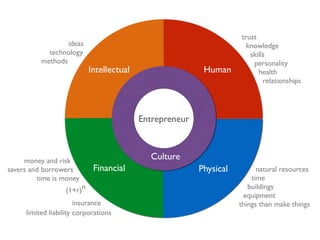
Intellectual
Financial Physical
Human
Culture
Entrepreneur
trust
knowledge
skills
personality
health
relationships
natural resources
time
buildings
equipment
things than make things
money and risk
savers and borrowers
time is money
(1+r)n
insurance  
limited liability corporations
ideas
technology
methods
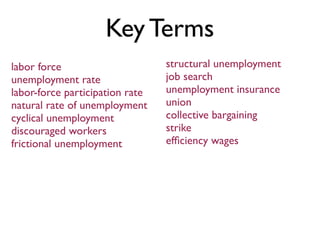
Key Terms
labor force
unemployment rate
labor-force participation rate
natural rate of unemployment
cyclical unemployment
discouraged workers
frictional unemployment
structural unemployment
job search
unemployment insurance
union
collective bargaining
strike
efficiency wages
Unemployment
How is it measured?
Who measures it?
Adult Population
Population age 16
and older
Labor Force
the total number of
workers, including
employed and
unemployed
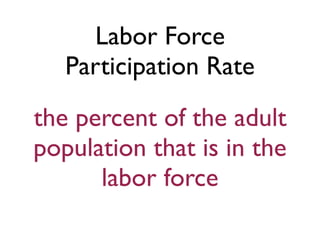
Labor Force
Participation Rate
the percent of the adult
population that is in the
labor force
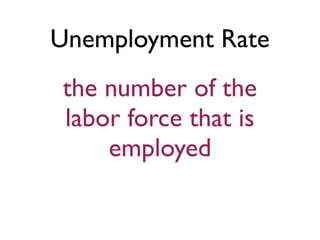
Unemployment Rate
the number of the
labor force that is
employed
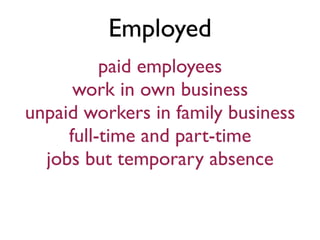
Employed
paid employees
work in own business
unpaid workers in family business
full-time and part-time
jobs but temporary absence
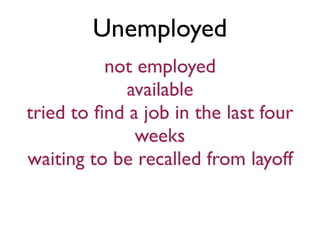
Unemployed
not employed
available
tried to find a job in the last four
weeks
waiting to be recalled from layoff
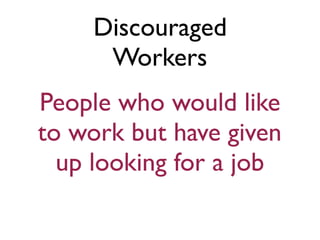
Discouraged
Workers
People who would like
to work but have given
up looking for a job
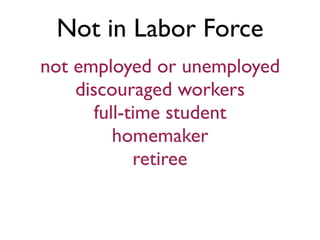
Not in Labor Force
not employed or unemployed
discouraged workers
full-time student
homemaker
retiree
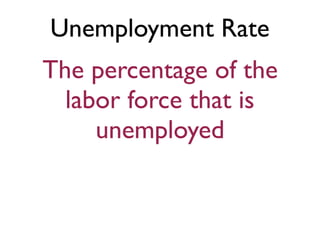
Unemployment Rate
The percentage of the
labor force that is
unemployed
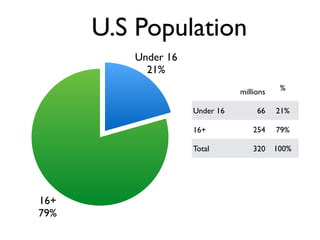
16+
79%
Under 16
21%
U.S Population
millions %
Under 16 66 21%
16+ 254 79%
Total 320 100%
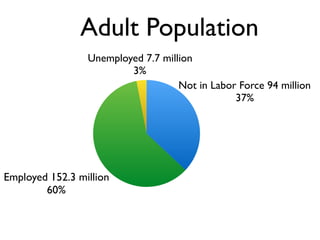
Unemployed 7.7 million
3%
Employed 152.3 million
60%
Not in Labor Force 94 million
37%
Adult Population
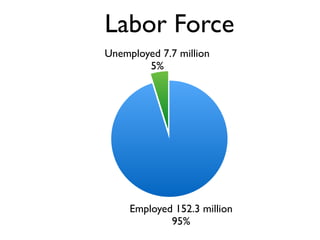
Unemployed 7.7 million
5%
Employed 152.3 million
95%
Labor Force
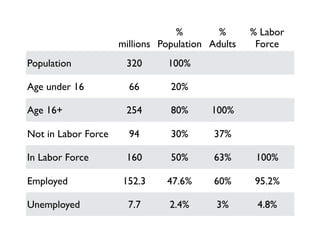
millions
%
Population
%
Adults
% Labor
Force
Population 320 100%
Age under 16 66 20%
Age 16+ 254 80% 100%
Not in Labor Force 94 30% 37%
In Labor Force 160 50% 63% 100%
Employed 152.3 47.6% 60% 95.2%
Unemployed 7.7 2.4% 3% 4.8%
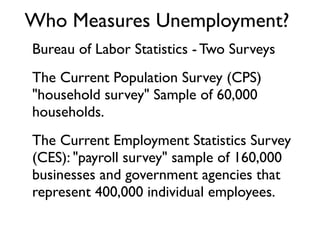
Bureau of Labor Statistics - Two Surveys
The Current Population Survey (CPS)
"household survey" Sample of 60,000
households.
The Current Employment Statistics Survey
(CES): "payroll survey" sample of 160,000
businesses and government agencies that
represent 400,000 individual employees.
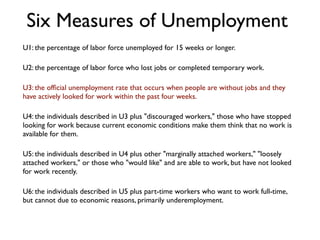
Who Measures Unemployment?
U1: the percentage of labor force unemployed for 15 weeks or longer.
U2: the percentage of labor force who lost jobs or completed temporary work.
U3: the official unemployment rate that occurs when people are without jobs and they
have actively looked for work within the past four weeks.
U4: the individuals described in U3 plus "discouraged workers," those who have stopped
looking for work because current economic conditions make them think that no work is
available for them.
U5: the individuals described in U4 plus other "marginally attached workers," "loosely
attached workers," or those who "would like" and are able to work, but have not looked
for work recently.
U6: the individuals described in U5 plus part-time workers who want to work full-time,
but cannot due to economic reasons, primarily underemployment.
Six Measures of Unemployment
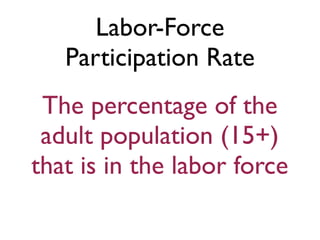
Labor-Force
Participation Rate
The percentage of the
adult population (15+)
that is in the labor force
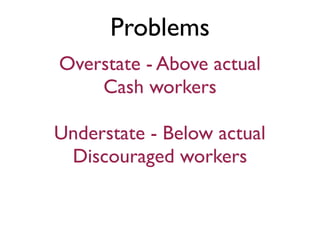
Problems
Overstate - Above actual
Cash workers
Understate - Below actual
Discouraged workers
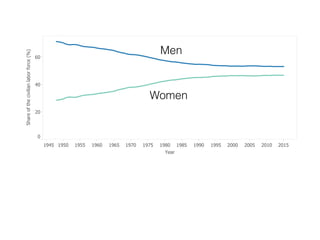
1945 1950 1955 1960 1965 1970 1975 1980 1985 1990 1995 2000 2005 2010 2015
Year
0
Numb
1945 1950 1955 1960 1965 1970 1975 1980 1985 1990 1995 2000 2005 2010 2015
Year
0
20
40
60
Shareofthecivilianlaborforce(%) Hover ov
Adjust ye
data disp
Notes: Inc
civilian no
that are e
looking fo
persons 1
The comp
data has b
times by m
changes in
Survey.
Source: 1
averages,
Survey, U
Statistics
Graph by
Men
Women
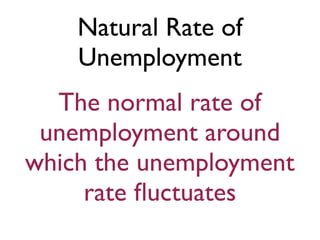
Natural Rate of
Unemployment
The normal rate of
unemployment around
which the unemployment
rate fluctuates
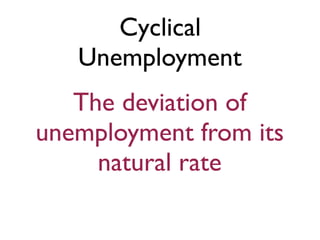
Cyclical
Unemployment
The deviation of
unemployment from its
natural rate
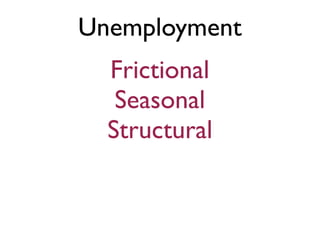
Unemployment
Frictional
Seasonal
Structural

Lecture 12 unemployment