Data Mining Engineering
Outline
• Process Model and Methodology
• SE Process Models
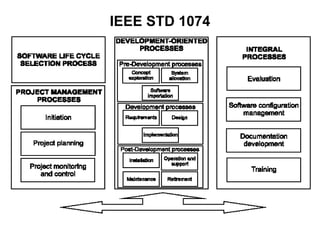
– IEEE STD 1074
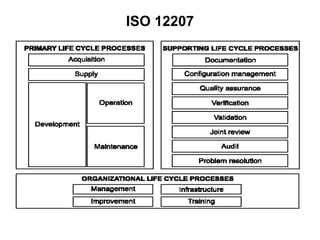
– ISO 12207
• CRISP-DM
• SE Process Model vs CRSP-DM
• Process Model for Data Mining Engineering
• Comparison of KDD process model vs
CRISP-DM
Process Model
• Set of tasks to be performed to develop a
particular element, as well as the elements
that are produced in each task (outputs)
and the elements that are necessary to do
a task (inputs
• Ultimate goal of process model is to make
the process
– Repeatable
– Manageable
– Measurable
Process Model should be …
• Effective
• Maintainable
• Predictable
• Repeatable
• Quality
• Improvable
• Traceable
Methodology
• Instance of a Process Model
• Lists
– Tasks
– Inputs
– Outputs
– Specifies how to do the tasks
• Technique to do specified task
• Tools used to improve technique
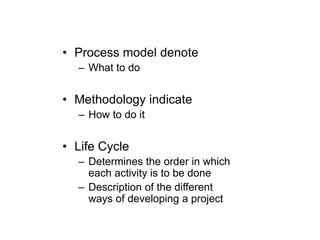
• Process model denote
– What to do
• Methodology indicate
– How to do it
• Life Cycle
– Determines the order in which
each activity is to be done
– Description of the different
ways of developing a project
• What do we have in Data Mining ….?
– Process Model ?
– Methodology ?
– Life Cycle ?
from engineering point of view …..
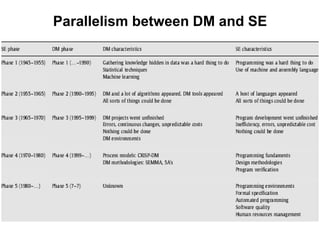
Parallelism between DM and SE
Software Engineering Process Model
• IEEE STD 1074
• ISO 12207
IEEE STD 1074
ISO 12207
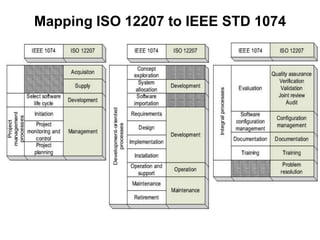
Mapping ISO 12207 to IEEE STD 1074
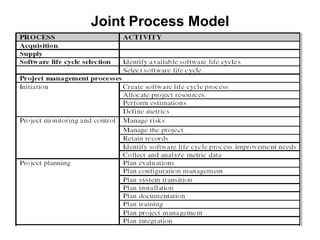
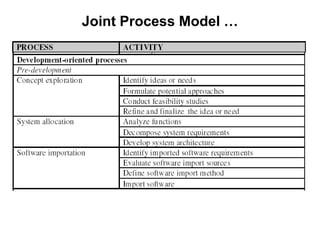
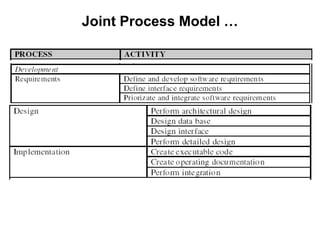
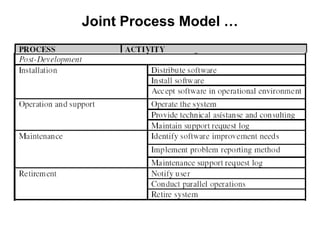
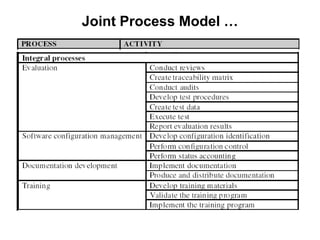
Joint Process Model
Joint Process Model …
CRISP-DM
• CRoss Industry Standard Process
for Data Mining
• Guideline proposed by enterprises
– Teradata (NCR)
– SPSS (ISL)
– Daimler-Chrysler
– OHRA
• based on their experiences
CRISP-DM
CRISP-DM …
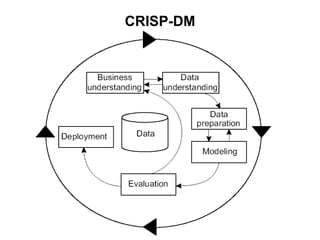
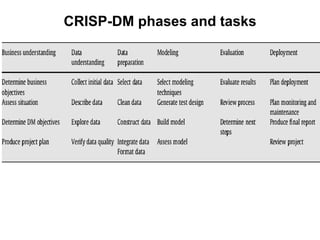
• Business Understanding
This initial phase focuses on understanding the project
objectives and requirements from a business
perspective, and then converting this knowledge into a
data mining problem definition, and a preliminary plan
designed to achieve the objectives.
• Data Understanding
The data understanding phase starts with an initial data
collection and proceeds with activities in order to get
familiar with the data, to identify data quality problems, to
discover first insights into the data, or to detect
interesting subsets to form hypotheses for hidden
information.
CRISP-DM …
• Data Preparation
The data preparation phase covers all activities to
construct the final dataset (data that will be fed into the
modeling tool(s)) from the initial raw data. Data
preparation tasks are likely to be performed multiple
times, and not in any prescribed order. Tasks include
table, record, and attribute selection as well as
transformation and cleaning of data for modeling tools.
• Modeling
In this phase, various modeling techniques are selected
and applied, and their parameters are calibrated to
optimal values. Typically, there are several techniques
for the same data mining problem type. Some
techniques have specific requirements on the form of
data. Therefore, stepping back to the data preparation
phase is often needed.
CRISP-DM …
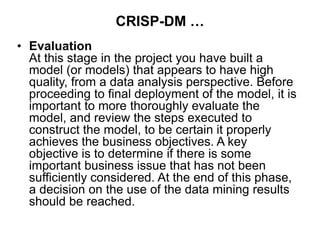
• Evaluation
At this stage in the project you have built a
model (or models) that appears to have high
quality, from a data analysis perspective. Before
proceeding to final deployment of the model, it is
important to more thoroughly evaluate the
model, and review the steps executed to
construct the model, to be certain it properly
achieves the business objectives. A key
objective is to determine if there is some
important business issue that has not been
sufficiently considered. At the end of this phase,
a decision on the use of the data mining results
should be reached.
CRISP-DM …
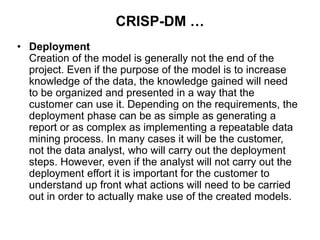
• Deployment
Creation of the model is generally not the end of the
project. Even if the purpose of the model is to increase
knowledge of the data, the knowledge gained will need
to be organized and presented in a way that the
customer can use it. Depending on the requirements, the
deployment phase can be as simple as generating a
report or as complex as implementing a repeatable data
mining process. In many cases it will be the customer,
not the data analyst, who will carry out the deployment
steps. However, even if the analyst will not carry out the
deployment effort it is important for the customer to
understand up front what actions will need to be carried
out in order to actually make use of the created models.
CRISP-DM phases and tasks
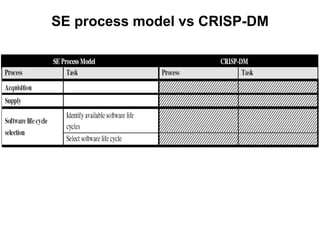
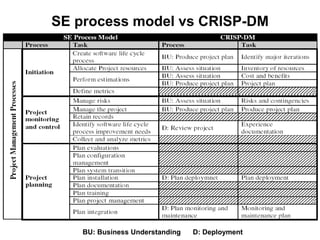
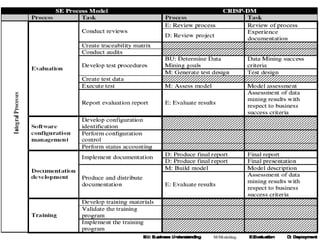
SE process model vs CRISP-DM
BU: Business Understanding D: Deployment
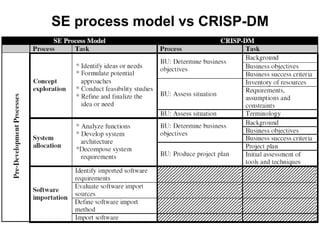
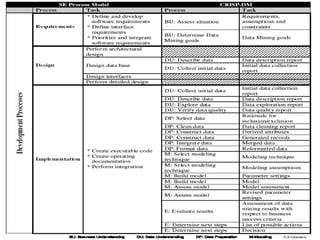
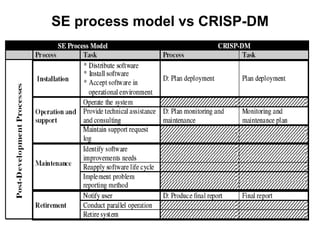
SE process model vs CRISP-DM
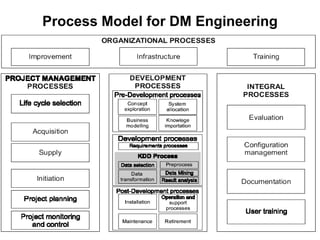
Process Model for DM Engineering
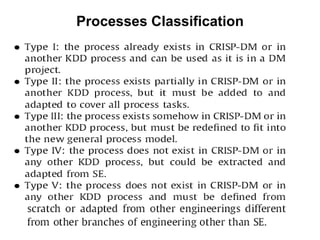
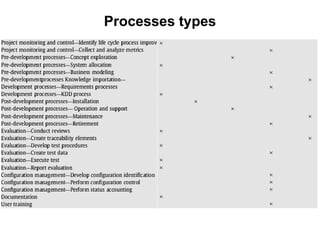
Processes Classification
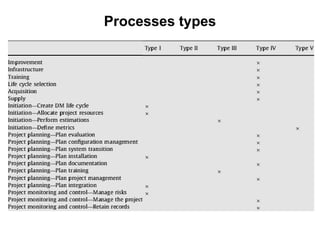
Processes types
Processes types
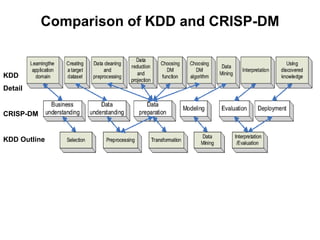
Comparison of KDD and CRISP-DM
KDD
Detail
CRISP-DM
KDD Outline

Lecture 10 - DataMiningEngineering.ppt

  • 1.
  • 2.
    Outline • Process Modeland Methodology • SE Process Models – IEEE STD 1074 – ISO 12207 • CRISP-DM • SE Process Model vs CRSP-DM • Process Model for Data Mining Engineering • Comparison of KDD process model vs CRISP-DM
  • 3.
    Process Model • Setof tasks to be performed to develop a particular element, as well as the elements that are produced in each task (outputs) and the elements that are necessary to do a task (inputs • Ultimate goal of process model is to make the process – Repeatable – Manageable – Measurable
  • 4.
    Process Model shouldbe … • Effective • Maintainable • Predictable • Repeatable • Quality • Improvable • Traceable
  • 5.
    Methodology • Instance ofa Process Model • Lists – Tasks – Inputs – Outputs – Specifies how to do the tasks • Technique to do specified task • Tools used to improve technique
  • 6.
    • Process modeldenote – What to do • Methodology indicate – How to do it • Life Cycle – Determines the order in which each activity is to be done – Description of the different ways of developing a project
  • 7.
    • What dowe have in Data Mining ….? – Process Model ? – Methodology ? – Life Cycle ? from engineering point of view …..
  • 8.
  • 9.
    Software Engineering ProcessModel • IEEE STD 1074 • ISO 12207
  • 10.
  • 11.
  • 12.
    Mapping ISO 12207to IEEE STD 1074
  • 13.
  • 14.
  • 15.
  • 16.
  • 17.
  • 18.
    CRISP-DM • CRoss IndustryStandard Process for Data Mining • Guideline proposed by enterprises – Teradata (NCR) – SPSS (ISL) – Daimler-Chrysler – OHRA • based on their experiences
  • 19.
  • 20.
    CRISP-DM … • BusinessUnderstanding This initial phase focuses on understanding the project objectives and requirements from a business perspective, and then converting this knowledge into a data mining problem definition, and a preliminary plan designed to achieve the objectives. • Data Understanding The data understanding phase starts with an initial data collection and proceeds with activities in order to get familiar with the data, to identify data quality problems, to discover first insights into the data, or to detect interesting subsets to form hypotheses for hidden information.
  • 21.
    CRISP-DM … • DataPreparation The data preparation phase covers all activities to construct the final dataset (data that will be fed into the modeling tool(s)) from the initial raw data. Data preparation tasks are likely to be performed multiple times, and not in any prescribed order. Tasks include table, record, and attribute selection as well as transformation and cleaning of data for modeling tools. • Modeling In this phase, various modeling techniques are selected and applied, and their parameters are calibrated to optimal values. Typically, there are several techniques for the same data mining problem type. Some techniques have specific requirements on the form of data. Therefore, stepping back to the data preparation phase is often needed.
  • 22.
    CRISP-DM … • Evaluation Atthis stage in the project you have built a model (or models) that appears to have high quality, from a data analysis perspective. Before proceeding to final deployment of the model, it is important to more thoroughly evaluate the model, and review the steps executed to construct the model, to be certain it properly achieves the business objectives. A key objective is to determine if there is some important business issue that has not been sufficiently considered. At the end of this phase, a decision on the use of the data mining results should be reached.
  • 23.
    CRISP-DM … • Deployment Creationof the model is generally not the end of the project. Even if the purpose of the model is to increase knowledge of the data, the knowledge gained will need to be organized and presented in a way that the customer can use it. Depending on the requirements, the deployment phase can be as simple as generating a report or as complex as implementing a repeatable data mining process. In many cases it will be the customer, not the data analyst, who will carry out the deployment steps. However, even if the analyst will not carry out the deployment effort it is important for the customer to understand up front what actions will need to be carried out in order to actually make use of the created models.
  • 24.
  • 25.
    SE process modelvs CRISP-DM
  • 26.
    SE process modelvs CRISP-DM BU: Business Understanding D: Deployment
  • 27.
    SE process modelvs CRISP-DM
  • 29.
    SE process modelvs CRISP-DM
  • 31.
    Process Model forDM Engineering
  • 32.
  • 33.
  • 34.
  • 35.
    Comparison of KDDand CRISP-DM KDD Detail CRISP-DM KDD Outline