UML (Unified Modeling
Language)
Use Cases
• What is a Use Case
 A formal way of representing how a
business system interacts with its
environment
 Illustrates the activities that are performed
by the users of the system
 A scenario-based technique in the UML
 A sequence of actions a system performs that
yields a valuable result for a particular actor.
Use Cases
• A use case is a summary of scenarios for a
single task or goal.
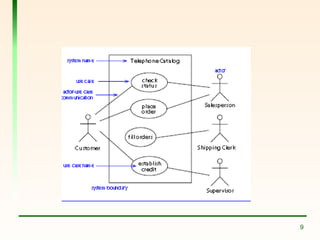
• An actor is who or what initiates the events
involved in the task of the use case. Actors
are simply roles that people or objects play.
• So as we read our scenario, what or who is
the actor????
4
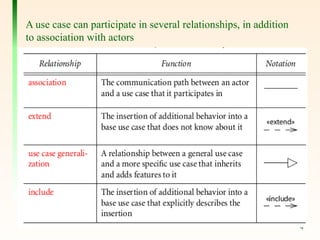
A use case can participate in several relationships, in addition
to association with actors
5
Types of Use-case
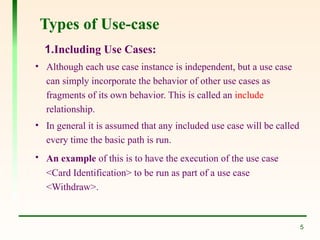
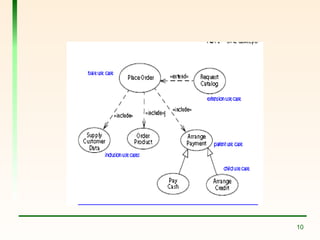
1.Including Use Cases:
• Although each use case instance is independent, but a use case
can simply incorporate the behavior of other use cases as
fragments of its own behavior. This is called an include
relationship.
• In general it is assumed that any included use case will be called
every time the basic path is run.
• An example of this is to have the execution of the use case
<Card Identification> to be run as part of a use case
<Withdraw>.
6
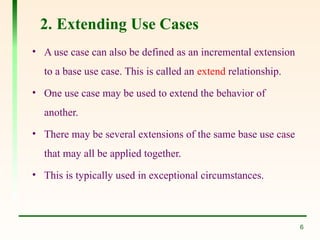
2. Extending Use Cases
• A use case can also be defined as an incremental extension
to a base use case. This is called an extend relationship.
• One use case may be used to extend the behavior of
another.
• There may be several extensions of the same base use case
that may all be applied together.
• This is typically used in exceptional circumstances.
7
2. Extending Use Cases
• For example, if before modifying a particular type of
customer order, a user must get approval from some higher
authority, then the <Get Approval> use case may
optionally extend the regular <Modify Order> use case.
8
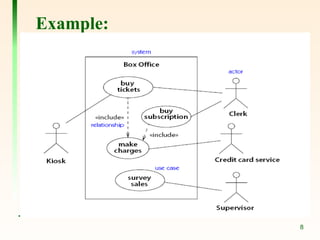
Example:
9
10
11
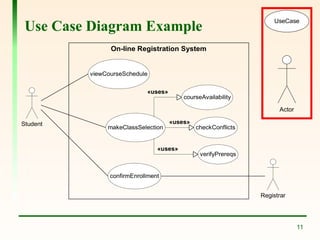
Use Case Diagram Example
On-line Registration System
Student
viewCourseSchedule
makeClassSelection
courseAvailability
checkConflicts
verifyPrereqs
«uses»
«uses»
«uses»
confirmEnrollment
Registrar
Actor
UseCase
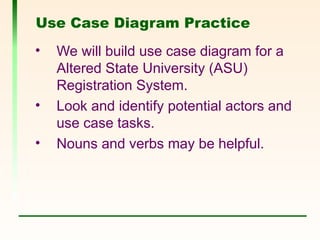
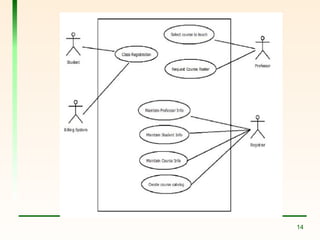
Use Case Diagram Practice
• We will build use case diagram for a
Altered State University (ASU)
Registration System.
• Look and identify potential actors and
use case tasks.
• Nouns and verbs may be helpful.
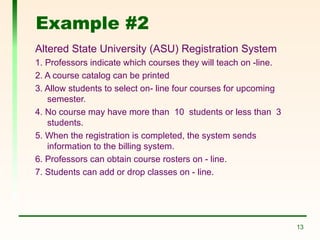
Example #2
Altered State University (ASU) Registration System
1. Professors indicate which courses they will teach on -line.
2. A course catalog can be printed
3. Allow students to select on- line four courses for upcoming
semester.
4. No course may have more than 10 students or less than 3
students.
5. When the registration is completed, the system sends
information to the billing system.
6. Professors can obtain course rosters on - line.
7. Students can add or drop classes on - line.
13
14

Lect_07_Use Case Diagram.ppt use case diagram

  • 1.
  • 2.
    Use Cases • Whatis a Use Case  A formal way of representing how a business system interacts with its environment  Illustrates the activities that are performed by the users of the system  A scenario-based technique in the UML  A sequence of actions a system performs that yields a valuable result for a particular actor.
  • 3.
    Use Cases • Ause case is a summary of scenarios for a single task or goal. • An actor is who or what initiates the events involved in the task of the use case. Actors are simply roles that people or objects play. • So as we read our scenario, what or who is the actor????
  • 4.
    4 A use casecan participate in several relationships, in addition to association with actors
  • 5.
    5 Types of Use-case 1.IncludingUse Cases: • Although each use case instance is independent, but a use case can simply incorporate the behavior of other use cases as fragments of its own behavior. This is called an include relationship. • In general it is assumed that any included use case will be called every time the basic path is run. • An example of this is to have the execution of the use case <Card Identification> to be run as part of a use case <Withdraw>.
  • 6.
    6 2. Extending UseCases • A use case can also be defined as an incremental extension to a base use case. This is called an extend relationship. • One use case may be used to extend the behavior of another. • There may be several extensions of the same base use case that may all be applied together. • This is typically used in exceptional circumstances.
  • 7.
    7 2. Extending UseCases • For example, if before modifying a particular type of customer order, a user must get approval from some higher authority, then the <Get Approval> use case may optionally extend the regular <Modify Order> use case.
  • 8.
  • 9.
  • 10.
  • 11.
    11 Use Case DiagramExample On-line Registration System Student viewCourseSchedule makeClassSelection courseAvailability checkConflicts verifyPrereqs «uses» «uses» «uses» confirmEnrollment Registrar Actor UseCase
  • 12.
    Use Case DiagramPractice • We will build use case diagram for a Altered State University (ASU) Registration System. • Look and identify potential actors and use case tasks. • Nouns and verbs may be helpful.
  • 13.
    Example #2 Altered StateUniversity (ASU) Registration System 1. Professors indicate which courses they will teach on -line. 2. A course catalog can be printed 3. Allow students to select on- line four courses for upcoming semester. 4. No course may have more than 10 students or less than 3 students. 5. When the registration is completed, the system sends information to the billing system. 6. Professors can obtain course rosters on - line. 7. Students can add or drop classes on - line. 13
  • 14.

Editor's Notes

  • #12 Video Rental System Actors Customer Video distributer Use cases Enroll as member Check out video Return video Order new video