Factors Affecting Screening
1) Presence of near mesh particles
2) Shape of particles
3) Size of Particles
4) Motion
5) Nature of particles
6) Humidity or moisture
7) Mesh size and wire diameter
8) Capacity
9) Blinding
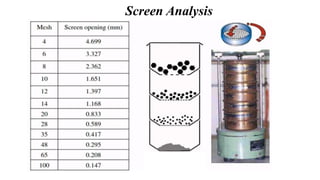
Screen Analysis
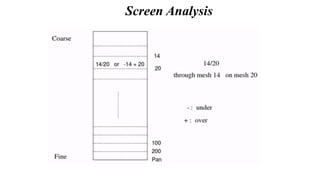
Screen Analysis
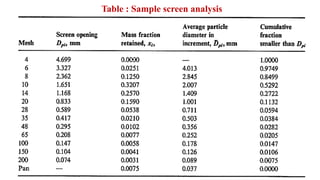
Table : Sample screen analysis
Methods of Tabulation & Plotting Screen Analysis Data
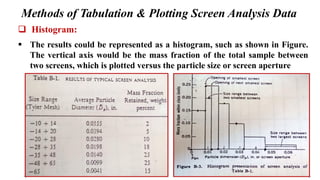
❑ Histogram:
▪ The results could be represented as a histogram, such as shown in Figure.
The vertical axis would be the mass fraction of the total sample between
two screens, which is plotted versus the particle size or screen aperture
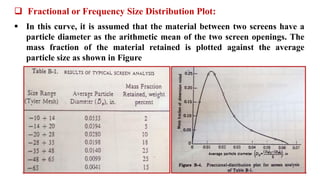
❑ Fractional or Frequency Size Distribution Plot:
▪ In this curve, it is assumed that the material between two screens have a
particle diameter as the arithmetic mean of the two screen openings. The
mass fraction of the material retained is plotted against the average
particle size as shown in Figure
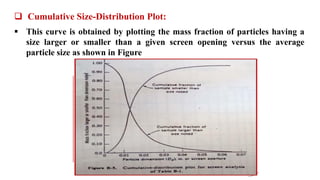
❑ Cumulative Size-Distribution Plot:
▪ This curve is obtained by plotting the mass fraction of particles having a
size larger or smaller than a given screen opening versus the average
particle size as shown in Figure
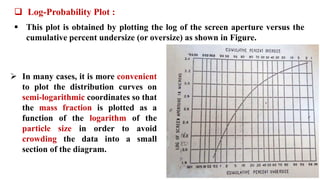
❑ Log-Probability Plot :
▪ This plot is obtained by plotting the log of the screen aperture versus the
cumulative percent undersize (or oversize) as shown in Figure.
➢ In many cases, it is more convenient
to plot the distribution curves on
semi-logarithmic coordinates so that
the mass fraction is plotted as a
function of the logarithm of the
particle size in order to avoid
crowding the data into a small
section of the diagram.
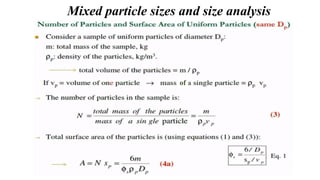
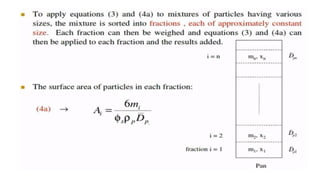
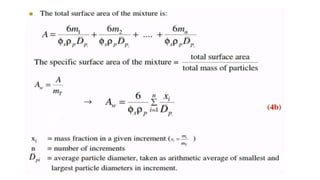
Mixed particle sizes and size analysis
of
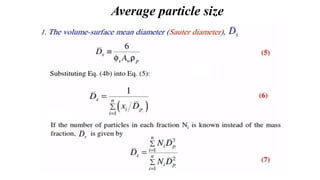
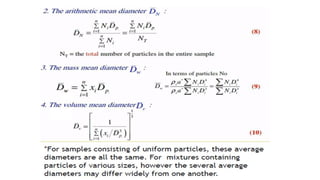
Average particle size
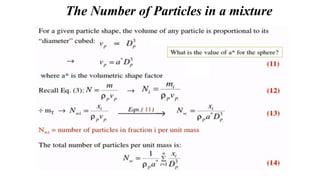
The Number of Particles in a mixture
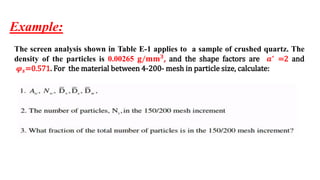
Example:
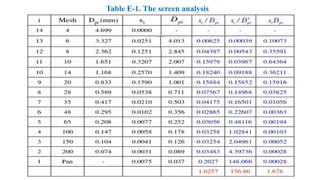
The screen analysis shown in Table E-1 applies to a sample of crushed quartz. The
density of the particles is 0.00265 𝐠/𝐦𝐦𝟑
, and the shape factors are 𝒂∗
=2 and
𝝋𝒔=0.571. For the material between 4-200- mesh in particle size, calculate:
Table E-1. The screen analysis
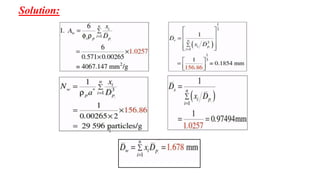
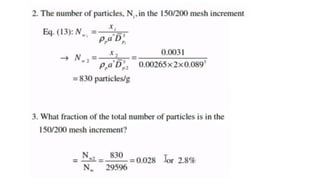
Solution:
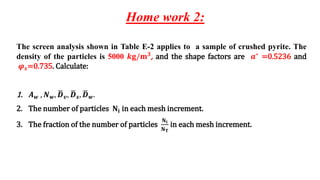
Home work 2:
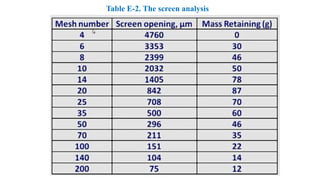
The screen analysis shown in Table E-2 applies to a sample of crushed pyrite. The
density of the particles is 5000 𝒌𝐠/𝐦𝟑, and the shape factors are 𝒂∗ =0.5236 and
𝝋𝒔=0.735. Calculate:
1. 𝑨𝒘 , 𝑵𝒘, ഥ
𝑫𝒗, ഥ
𝑫𝒔, ഥ
𝑫𝒘.
2. The number of particles 𝐍𝐢 in each mesh increment.
3. The fraction of the number of particles
𝐍𝐢
𝐍𝐓
in each mesh increment.
Table E-2. The screen analysis
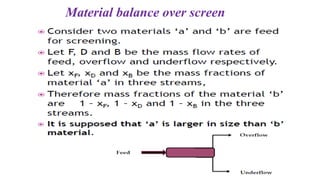
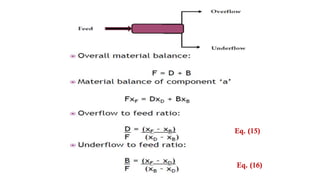
Material balance over screen
Eq. (15)
Eq. (16)
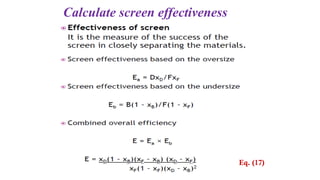
Calculate screen effectiveness
Eq. (17)
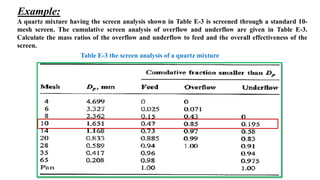
Example:
A quartz mixture having the screen analysis shown in Table E-3 is screened through a standard 10-
mesh screen. The cumulative screen analysis of overflow and underflow are given in Table E-3.
Calculate the mass ratios of the overflow and underflow to feed and the overall effectiveness of the
screen.
Table E-3 the screen analysis of a quartz mixture
Solution:
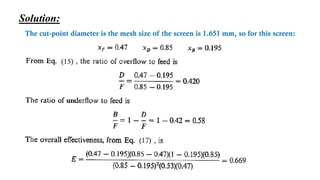
The cut-point diameter is the mesh size of the screen is 1.651 mm, so for this screen:
(15)
(17)
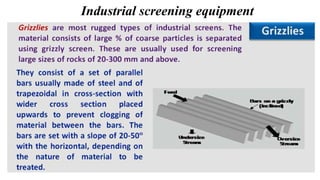
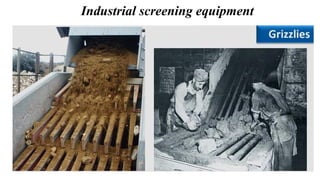
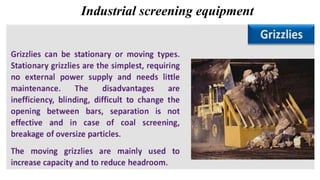
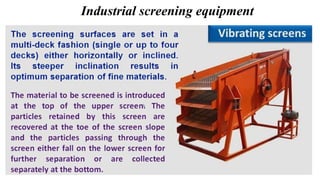
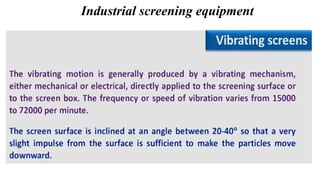
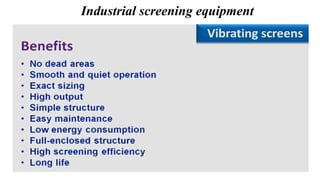
Industrial screening equipment
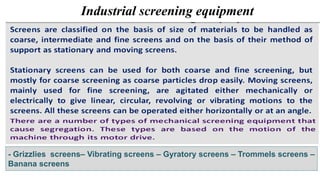
- Grizzlies screens– Vibrating screens – Gyratory screens – Trommels screens –
Banana screens
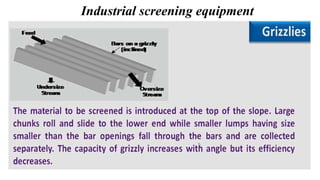
Industrial screening equipment

Lect3&4-Seperation Process 1 Dr. ALI AL-SHATRI .pdf