Introduction to
Electrical Elements
Electric Current
 An electric current is a flow of charge.
 In metals, current is the movement of negative charge,
i.e. electrons
 In gases and electrolytes (NaCl solution), both positive
and negative charges may be involved.
Electric Current
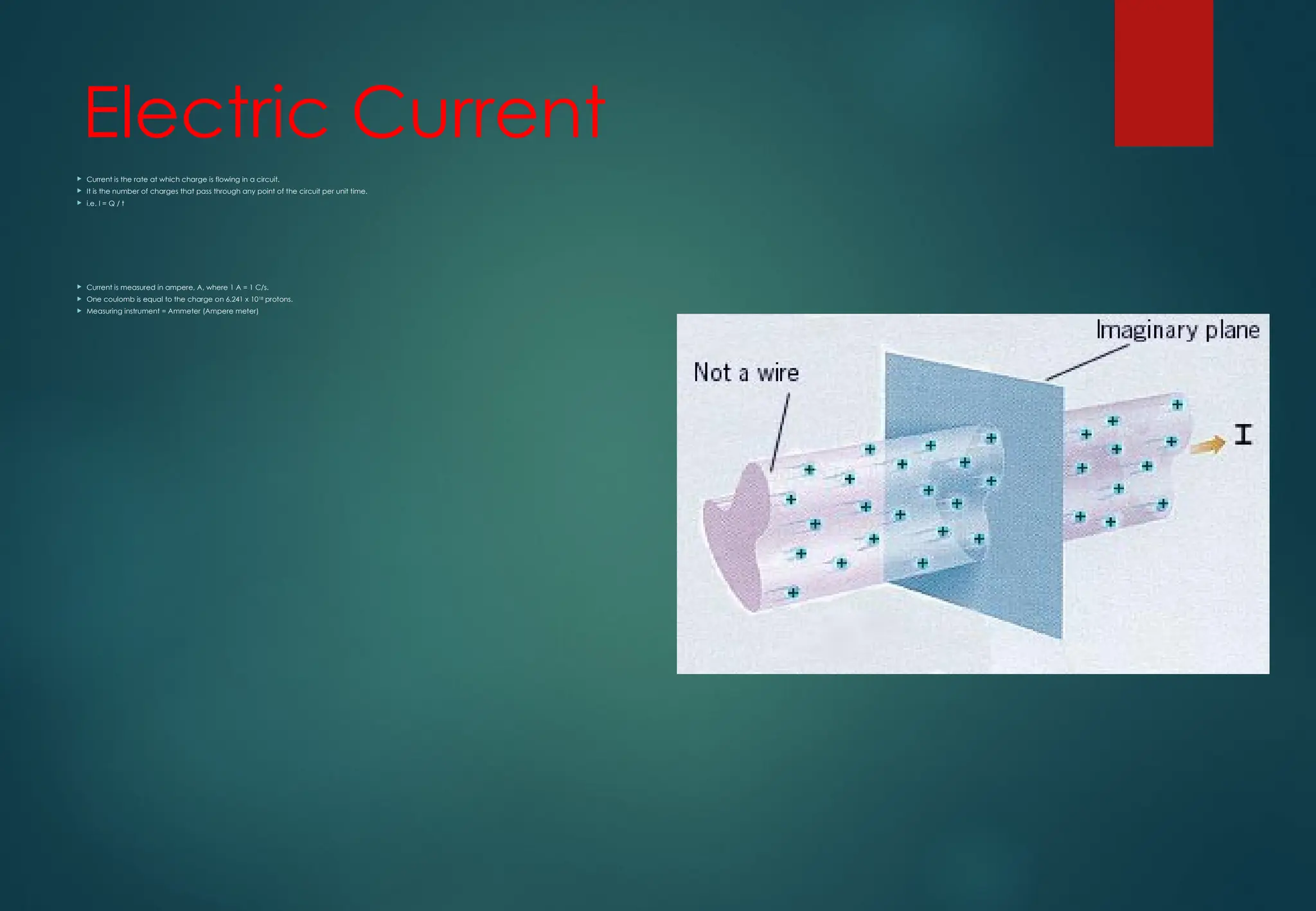
 Current is the rate at which charge is flowing in a circuit.
 It is the number of charges that pass through any point of the circuit per unit time.
 i.e. I = Q / t
 Current is measured in ampere, A, where 1 A = 1 C/s.
 One coulomb is equal to the charge on 6.241 x 10¹⁸
protons.
 Measuring instrument = Ammeter (Ampere meter)
Conventional current
 Scientist first thought that positive charges flow from
the positive terminal of a source to the negative
terminal. This is called the conventional current
direction.
 However, it was found that a current in a metal wire
is in fact a flow of negatively-charged electrons in
the opposite direction. Nevertheless, the
conventional current is still used.
+ –
electron
flow
convention
current
Problem 1
A hair dryer draws a current of 3 A. If it is switched on
for 5 minutes,
(a)how many charges, and
(b) how many electrons have passed through it?
 Solution:
(a) by equation
I = Q / t
3 = Q / (5 x 60)
Q = 900 C
(b) charge of 1 electron = 1.6 x 10⁻¹⁹
Coulombs
no. of electron = number of charges / charge per electron
no. of electron = 900 / (1.6 x 10⁻¹⁹
) = 5.625 x 10²¹
Practice Problem:
A hair dryer draws a current of 2A. If it is switched on for
7mins,
(a) how many charges, and
(b) how many electrons have passed through it?
 Solution:
(a) by equation
I = Q / t
2 = Q / (7 x 60)
Q = 840 C
(b) charge of 1 electron = 1.6 x 10⁻¹⁹
Coulombs
no. of electron = number of charges / charge per electron
no. of electron = 840 / (1.6 x 10⁻¹⁹
) = 5.25 x 10²¹
H.W. practice:
a laptop charger plugged-in for 10 minuets and 1900C of
charges have passed through it. Calculate:
(a) Current consumed by charger, also
(b) electrons passed through it during given time.
 Solution:
(a) by equation
I = Q / t
I = 1900 / (10 x 60)
I = 3.1 A
(b) charge of 1 electron = 1.6 x 10⁻¹⁹
Coulombs
no. of electron = number of charges / charge per electron
no. of electron = 1900 / (1.6 x 10⁻¹⁹
) = 1.187 x 10²²
Resistance
 It may be defined as “the property of a substance
due to which it opposes (or restricts) the flow of
electricity (i.e. electrons) through it”.
 When the same p.d. is applied across different
conductors, different currents flow.
 Some conductors offer more opposition or
resistance to the passage of current than others.
Unit of Resistance
• The practical unit of resistance is ohm (Ω).
• A conductor is said to have a resistance of one ohm if it
permits one ampere current to flow through it when one
volt is impressed across its terminals.
Resistance
 The resistance R of a conductor is defined as the
ratio of the potential difference V across it to the
current I flowing through it.
conductor
through
current
conductor
across
.
d
.
p
resistance 
I
V
R 
+ –
A
V
• •
Lect 1 Introduction to basic electrical engineering .ppt

Lect 1 Introduction to basic electrical engineering .ppt

  • 1.
  • 2.
    Electric Current  Anelectric current is a flow of charge.  In metals, current is the movement of negative charge, i.e. electrons  In gases and electrolytes (NaCl solution), both positive and negative charges may be involved.
  • 3.
    Electric Current  Currentis the rate at which charge is flowing in a circuit.  It is the number of charges that pass through any point of the circuit per unit time.  i.e. I = Q / t  Current is measured in ampere, A, where 1 A = 1 C/s.  One coulomb is equal to the charge on 6.241 x 10¹⁸ protons.  Measuring instrument = Ammeter (Ampere meter)
  • 4.
    Conventional current  Scientistfirst thought that positive charges flow from the positive terminal of a source to the negative terminal. This is called the conventional current direction.  However, it was found that a current in a metal wire is in fact a flow of negatively-charged electrons in the opposite direction. Nevertheless, the conventional current is still used. + – electron flow convention current
  • 5.
    Problem 1 A hairdryer draws a current of 3 A. If it is switched on for 5 minutes, (a)how many charges, and (b) how many electrons have passed through it?  Solution: (a) by equation I = Q / t 3 = Q / (5 x 60) Q = 900 C (b) charge of 1 electron = 1.6 x 10⁻¹⁹ Coulombs no. of electron = number of charges / charge per electron no. of electron = 900 / (1.6 x 10⁻¹⁹ ) = 5.625 x 10²¹
  • 6.
    Practice Problem: A hairdryer draws a current of 2A. If it is switched on for 7mins, (a) how many charges, and (b) how many electrons have passed through it?  Solution: (a) by equation I = Q / t 2 = Q / (7 x 60) Q = 840 C (b) charge of 1 electron = 1.6 x 10⁻¹⁹ Coulombs no. of electron = number of charges / charge per electron no. of electron = 840 / (1.6 x 10⁻¹⁹ ) = 5.25 x 10²¹
  • 7.
    H.W. practice: a laptopcharger plugged-in for 10 minuets and 1900C of charges have passed through it. Calculate: (a) Current consumed by charger, also (b) electrons passed through it during given time.  Solution: (a) by equation I = Q / t I = 1900 / (10 x 60) I = 3.1 A (b) charge of 1 electron = 1.6 x 10⁻¹⁹ Coulombs no. of electron = number of charges / charge per electron no. of electron = 1900 / (1.6 x 10⁻¹⁹ ) = 1.187 x 10²²
  • 8.
    Resistance  It maybe defined as “the property of a substance due to which it opposes (or restricts) the flow of electricity (i.e. electrons) through it”.  When the same p.d. is applied across different conductors, different currents flow.  Some conductors offer more opposition or resistance to the passage of current than others. Unit of Resistance • The practical unit of resistance is ohm (Ω). • A conductor is said to have a resistance of one ohm if it permits one ampere current to flow through it when one volt is impressed across its terminals.
  • 10.
    Resistance  The resistanceR of a conductor is defined as the ratio of the potential difference V across it to the current I flowing through it. conductor through current conductor across . d . p resistance  I V R  + – A V • •