Lecture 1
Database System (INFT-4006)
Course Overview
• Introduction to data, database, data models
• File organization and Transaction Processing
• Concurrency Control
• Backup and Recovery
• Query processing and optimization
• Database Programming (with SQL)
• Integrity and Security
• Database Administration
• Physical Database design and Tuning
• Distributed Database
• Emerging Research trends in Database Systems (NoSQL, GraphQL, Blockchain)
Course overview
• 4 assignments (2 assignments before Midterm exam, 2
assignments after Midterm exam)
• 4 Quizzes
• Database Project Presentation
• Viva Voce activity
Reference Books
• Database Systems: A Practical Approach to Design,
Implementation and Management, 6ᵗʰ Edition by Thomas
Connolly and Carolyn Begg (AKA C&B)
• Database Systems: The Complete Book, 2ⁿᵈ Edition by
Hector-Gracia Molina, Jeffery D. Ullman, Jennifer Widom
• Database System Concepts, 6ᵗʰ Edition by Avi Silberschatz,
Henry F. Korth and S. Sundarshan
• Database Management Systems, 3ʳᵈ Edition by Raghu
Ramakrishnan, Johannes Gehrke
Outlines
• Database System
• File-Based Systems
• Limitations of File-Based Systems
Data, Data,
Data……
What is Data?
Data is a
collection of raw
facts and figures
It is collected
from different
sources
It is collected for
different
purposes
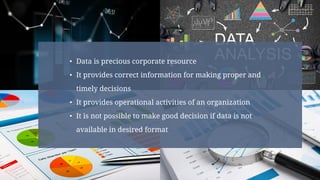
• Data is precious corporate resource
• It provides correct information for making proper and
timely decisions
• It provides operational activities of an organization
• It is not possible to make good decision if data is not
available in desired format
Metadata
The description of data (data about data) is
called “Metadata” or “System catalog” or “Data
dictionary”
File
A file is a collection of records, which
contains logically related data
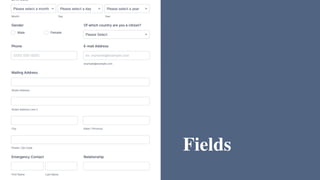
Fields
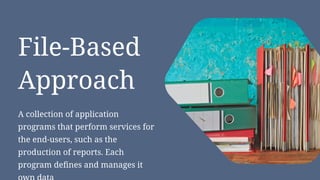
A collection of application
programs that perform services for
the end-users, such as the
production of reports. Each
program defines and manages it
File-Based
Approach
• Data is divided into separate files, each file
containing specific information
• Files have specific format and structure
based on application program being used e.
g. text, images, documents etc.
• Files are organized into directories (or
folders) to create a hierarchical structure
• Application program directly access and
manipulate these files
How it
works
Limitation of File-based System
• Separation and Isolation of Data
• Duplication of Data
• Data dependance
• Incompatible File formats
• Fixed Queries
Separation and
Isolation of Data
• Data is stored in separate files,
often with no inherent
relationships between them
• Retrieving information that spans
multiple files can be complex and
time-consuming
• Sharing data between different
applications or departments is
challenging due to data isolation
Duplication of
Data
(Redundancy)
• The same data can exist in
multiple files, leading to
inconsistencies if updates are not
synchronized
• Duplicate data consumes
unnecessary storage resources
• Keeping multiple copies of data
Data
Dependency
• Data items often depend on
other data items, creating
complex relationships
• Modifying one piece of data
may require changes in
multiple files, leading to errors
• Applications must handle
complex data dependencies,
making development more
Incompatible File
Formats
• Different applications may use
different file formats, hindering
data sharing and integration
• Converting data from one format
to another can be time-consuming
and error-prone
• Systems using different file
formats may have difficulty
exchanging data
Fixed Queries
Complex
queries can be
slow and
inefficient to
execute
Users are
restricted to
predefined data
access patterns
File-based
systems
typically
support
predefined
queries,
limiting ad-hoc
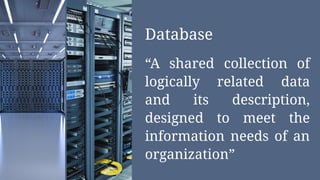
Database
“A shared collection of
logically related data
and its description,
designed to meet the
information needs of an
organization”
Database • Database is collection of information
managed by Database management
system
• It is a single large collection (repository)
of data shared among users
• All data items are integrated with
minimum duplication
• Database is shared corporate resource
• Database not only contains operational
Database • The self describing nature of database
provides “program-data independence”
• The definition of data is separated from the
application program
• The structure of data is not affected by the
program and vice versa
• If new data structures are added or existing
data structures are modified, they do not
affect the application program (if program
does not directly depend on what has been
modified)
Branch Staff
PropertyForRent Client
Lease
PrivateOwner
Ha
s
Oversees
Views
Offers
Own
s
Leased
By
Hold
s
What is meant by
logically related?
ANY QUESTIONS?

Lec_1_database_vs_file_system_basic_concept

  • 1.
  • 2.
    Course Overview • Introductionto data, database, data models • File organization and Transaction Processing • Concurrency Control • Backup and Recovery • Query processing and optimization • Database Programming (with SQL) • Integrity and Security • Database Administration • Physical Database design and Tuning • Distributed Database • Emerging Research trends in Database Systems (NoSQL, GraphQL, Blockchain)
  • 3.
    Course overview • 4assignments (2 assignments before Midterm exam, 2 assignments after Midterm exam) • 4 Quizzes • Database Project Presentation • Viva Voce activity
  • 4.
    Reference Books • DatabaseSystems: A Practical Approach to Design, Implementation and Management, 6ᵗʰ Edition by Thomas Connolly and Carolyn Begg (AKA C&B) • Database Systems: The Complete Book, 2ⁿᵈ Edition by Hector-Gracia Molina, Jeffery D. Ullman, Jennifer Widom • Database System Concepts, 6ᵗʰ Edition by Avi Silberschatz, Henry F. Korth and S. Sundarshan • Database Management Systems, 3ʳᵈ Edition by Raghu Ramakrishnan, Johannes Gehrke
  • 5.
    Outlines • Database System •File-Based Systems • Limitations of File-Based Systems
  • 6.
  • 7.
    What is Data? Datais a collection of raw facts and figures It is collected from different sources It is collected for different purposes
  • 8.
    • Data isprecious corporate resource • It provides correct information for making proper and timely decisions • It provides operational activities of an organization • It is not possible to make good decision if data is not available in desired format
  • 9.
    Metadata The description ofdata (data about data) is called “Metadata” or “System catalog” or “Data dictionary”
  • 10.
    File A file isa collection of records, which contains logically related data
  • 11.
  • 12.
    A collection ofapplication programs that perform services for the end-users, such as the production of reports. Each program defines and manages it File-Based Approach
  • 13.
    • Data isdivided into separate files, each file containing specific information • Files have specific format and structure based on application program being used e. g. text, images, documents etc. • Files are organized into directories (or folders) to create a hierarchical structure • Application program directly access and manipulate these files How it works
  • 14.
    Limitation of File-basedSystem • Separation and Isolation of Data • Duplication of Data • Data dependance • Incompatible File formats • Fixed Queries
  • 15.
    Separation and Isolation ofData • Data is stored in separate files, often with no inherent relationships between them • Retrieving information that spans multiple files can be complex and time-consuming • Sharing data between different applications or departments is challenging due to data isolation
  • 16.
    Duplication of Data (Redundancy) • Thesame data can exist in multiple files, leading to inconsistencies if updates are not synchronized • Duplicate data consumes unnecessary storage resources • Keeping multiple copies of data
  • 17.
    Data Dependency • Data itemsoften depend on other data items, creating complex relationships • Modifying one piece of data may require changes in multiple files, leading to errors • Applications must handle complex data dependencies, making development more
  • 18.
    Incompatible File Formats • Differentapplications may use different file formats, hindering data sharing and integration • Converting data from one format to another can be time-consuming and error-prone • Systems using different file formats may have difficulty exchanging data
  • 19.
    Fixed Queries Complex queries canbe slow and inefficient to execute Users are restricted to predefined data access patterns File-based systems typically support predefined queries, limiting ad-hoc
  • 20.
    Database “A shared collectionof logically related data and its description, designed to meet the information needs of an organization”
  • 21.
    Database • Databaseis collection of information managed by Database management system • It is a single large collection (repository) of data shared among users • All data items are integrated with minimum duplication • Database is shared corporate resource • Database not only contains operational
  • 22.
    Database • Theself describing nature of database provides “program-data independence” • The definition of data is separated from the application program • The structure of data is not affected by the program and vice versa • If new data structures are added or existing data structures are modified, they do not affect the application program (if program does not directly depend on what has been modified)
  • 23.
  • 24.
    What is meantby logically related?
  • 25.