In the name of ALLAH, the most Gracious, the most
Merciful
Environmental Engineering - II
Asst. Prof. Dr. Muhammad Amjad
Introduction
Instructor
◊ Name: Dr. Muhammad Amjad
◊ Designation: Asst. Prof.
◊ Qualification:
Post-Doc – 2020 – METU, Ankara (Turkey)
Ph.D. Civil Engineering – 2020 – METU, Ankara (Turkey)
M.Sc. Water Resources Management – 2013 – UET, Lahore
B.Sc. Agriculture Engineering – 2010 – BZU, Multan
◊ Specialization: Hydrometeorology (Hydrological Simulations, Precipitation Data
Analyses, Weather Forecasting, Nowcasting), Climate Change
◊ Experience: Teaching and Research Projects at MCE, NUST
Research at TÜBİTAK (Turkey)
Freelance Research for Asian Development Bank
◊ Office: 1st floor, CE Wing, MCE
◊ Office Hours: Mon-Thu 14:15-15:00
◊ Contact: muhamjad@mce.nust.edu.pk
Course Overview
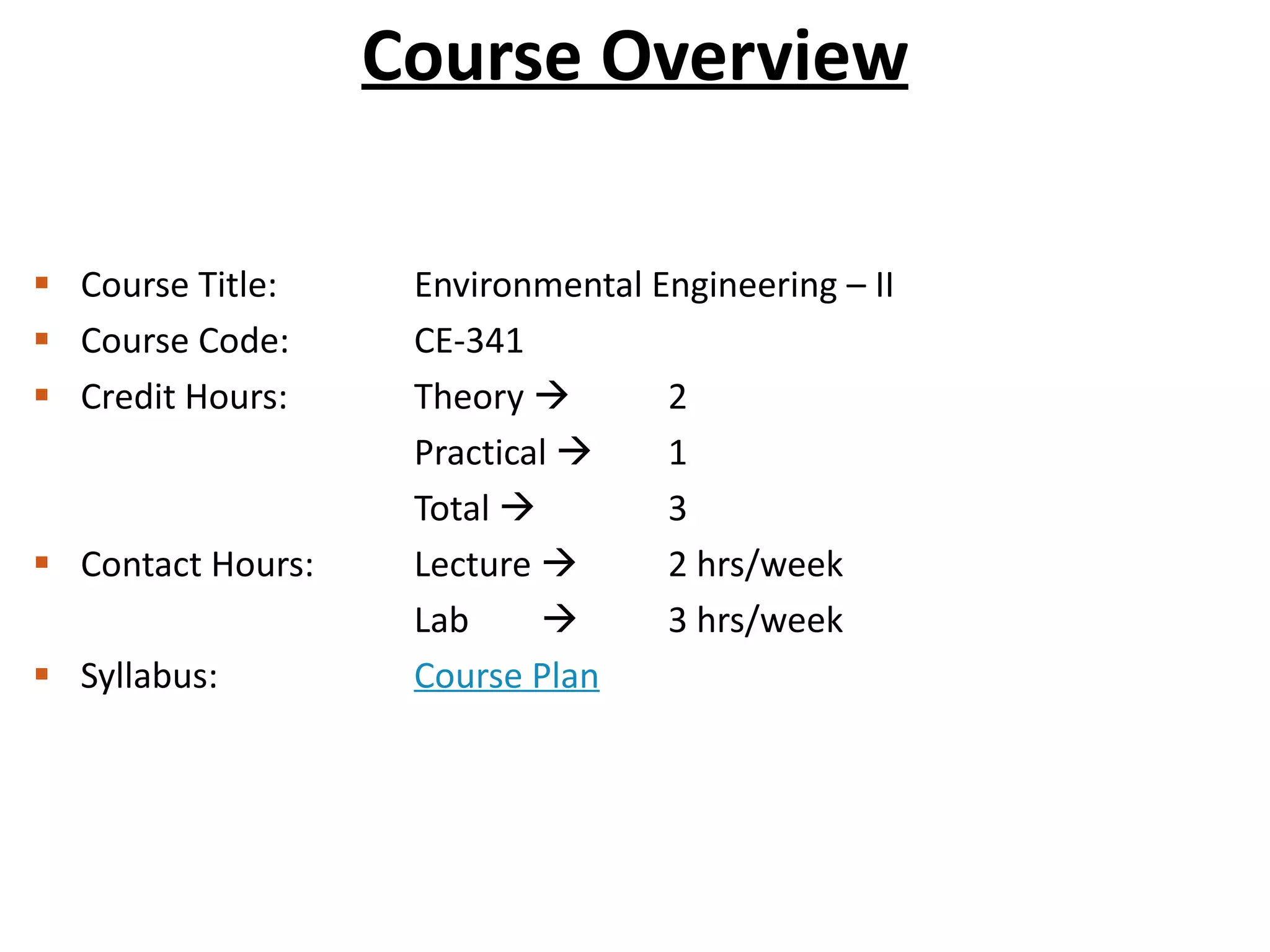
 Course Title: Environmental Engineering – II
 Course Code: CE-341
 Credit Hours: Theory  2
Practical  1
Total  3
 Contact Hours: Lecture  2 hrs/week
Lab  3 hrs/week
 Syllabus: Course Plan
Course Outline
 Introduction to Env Engg - II
 Humans and Environment
 Selection of the Treatment Processes
 Water Treatment Processes
 Wastewater Treatment
• Objectives of Wastewater Treatment
• Design of Pre-Requisites Units (sanitary sewer)
• Pre-Treatment of Water (screening, neutralization/pH adjustment, aeration, chemical pre-
treatment, grit chamber, communitors, and skimming tank)
• Primary Treatment (coagulation and flocculation, lime-Soda water softening process,
sedimentation, solids-contact units)
• Secondary Treatment of Water (Filtration)
• Concept of Biological Wastewater Treatment of Wastewater
• Classification of Biological Wastewater Treatment Processes
• Design of UASB Reactor (Anaerobic Digestion)
• Design of Trickling Filter (or Percolating Filter)
• Design of Oxidation Ponds (or Waste Stabilization Ponds)
• Sludge Treatment and Disposal
• Design of an Activated Sludge Process
 Environmental Impact Assessment
• Environmental impact of urban and industrial development
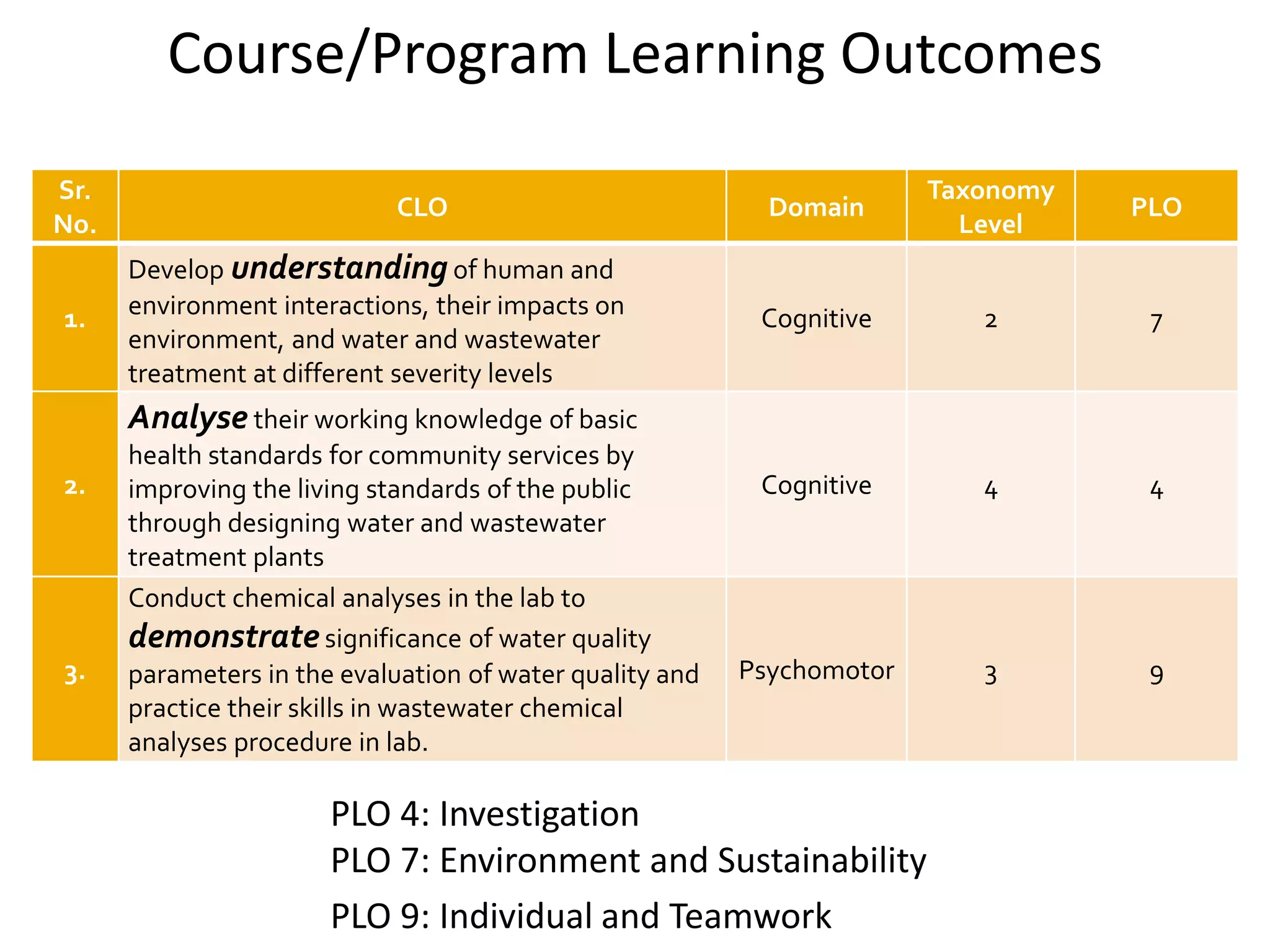
Course/Program Learning Outcomes
PLO 4: Investigation
PLO 7: Environment and Sustainability
PLO 9: Individual and Teamwork
Sr.
No.
CLO Domain
Taxonomy
Level
PLO
1.
Develop understandingof human and
environment interactions, their impacts on
environment, and water and wastewater
treatment at different severity levels
Cognitive 2 7
2.
Analyse their working knowledge of basic
health standards for community services by
improving the living standards of the public
through designing water and wastewater
treatment plants
Cognitive 4 4
3.
Conduct chemical analyses in the lab to
demonstratesignificance of water quality
parameters in the evaluation of water quality and
practice their skills in wastewater chemical
analyses procedure in lab.
Psychomotor 3 9
Books and Reference
Textbooks
1. Water Supply and Sewerage (6th Edn.) by Terence J McGhee, McGraw Hill, 1991, ISBN:
0070609381
2. Water Supply and Sewerage, by E.W. Steel, McGraw Hill.
3. Fundamentals of Water Supply and Sanitary Engineering by S. C. Rangwala
References Material:
1. Environmental Engineering (4th Edition), by Ruth F. Weiner and Robin Mattews
2. PHEngg Handouts and Workbook by Dr. Arshad Ali
3. Case Studies (Handouts)
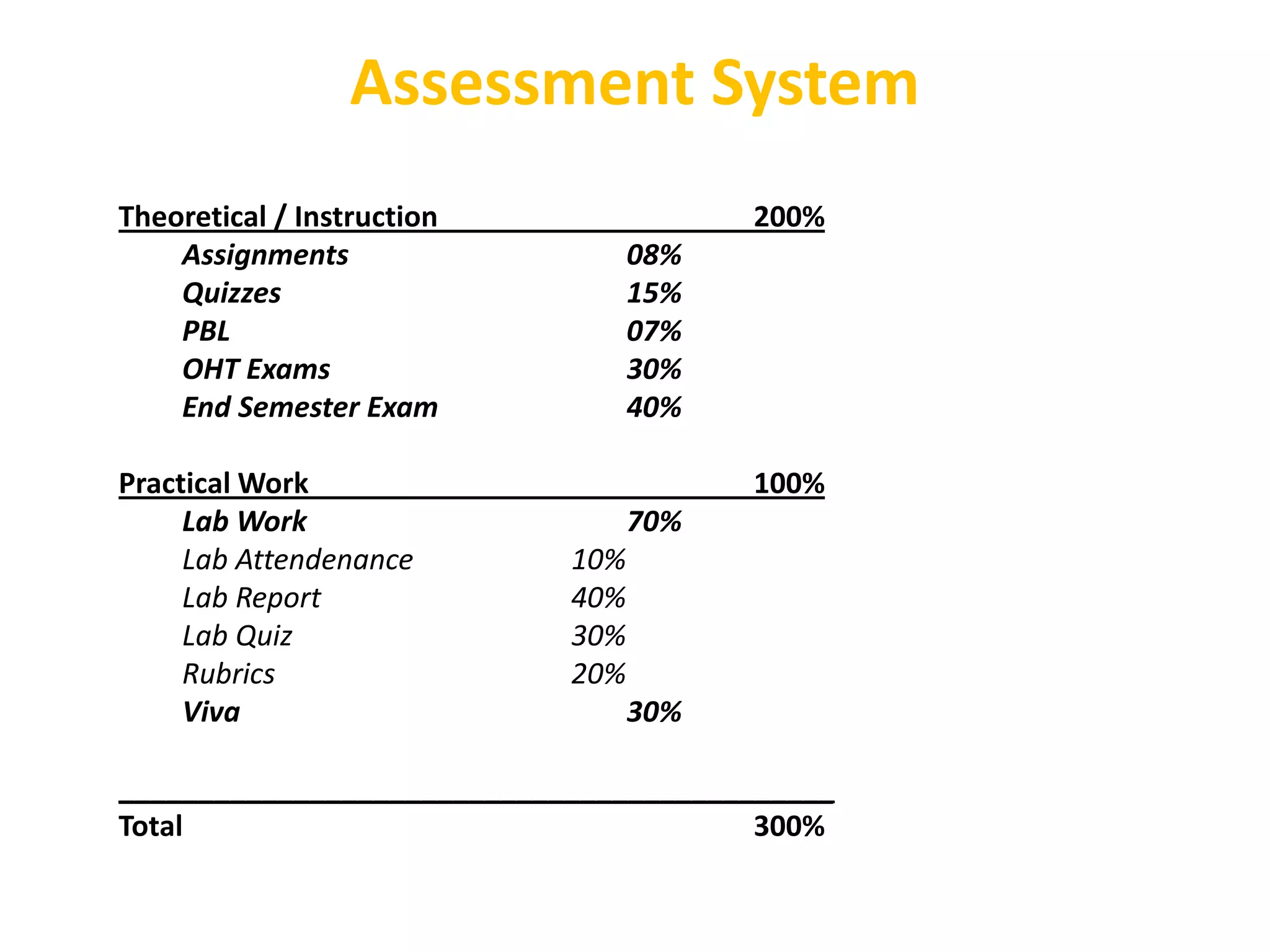
Theoretical / Instruction 200%
Assignments 08%
Quizzes 15%
PBL 07%
OHT Exams 30%
End Semester Exam 40%
Practical Work 100%
Lab Work 70%
Lab Attendenance 10%
Lab Report 40%
Lab Quiz 30%
Rubrics 20%
Viva 30%
_____________________________________________
Total 300%
Assessment System
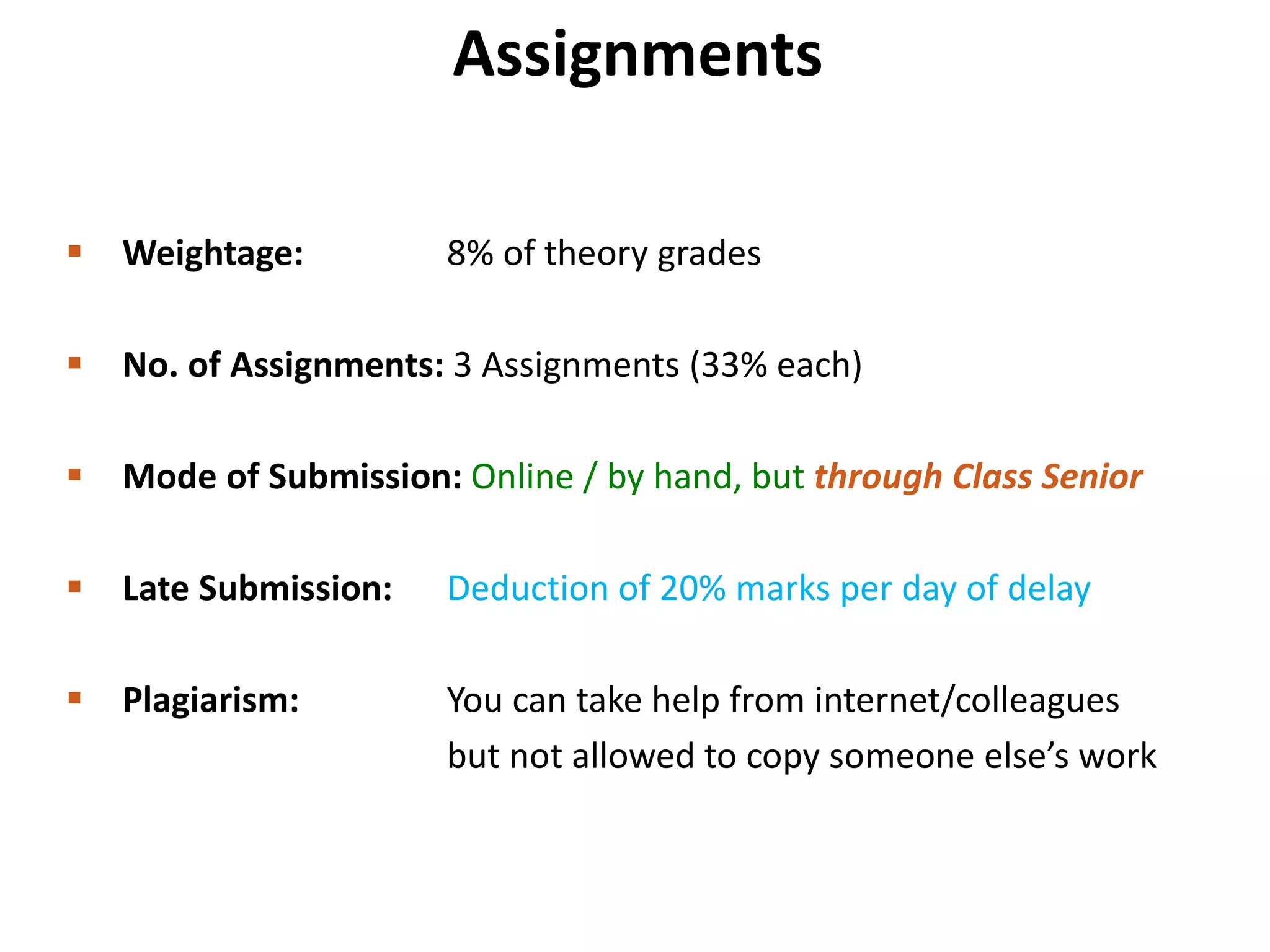
Assignments
 Weightage: 8% of theory grades
 No. of Assignments: 3 Assignments (33% each)
 Mode of Submission: Online / by hand, but through Class Senior
 Late Submission: Deduction of 20% marks per day of delay
 Plagiarism: You can take help from internet/colleagues
but not allowed to copy someone else’s work
Quizzes
 Weightage: 15% of theory grades
 No. of Quizzes: 4 Quizzes (25% each)
 Can be announced or unannounced
 Conduct: The following actions will result in cancelation of quiz
• Using helping material
• Copying from a fellow colleague / sharing calculators
• Writing once you are asked you to stop
Class Rules
 Class contribution is very important; always be active
 During the lecture, if anyone found disturbing the class, he will be marked
absent and will be no longer allowed to sit in the class until the Course
Officer approves
 If you are not present during the lecture for any reason, you’ll be marked
absent
 If you are called by any other instructor/ staff during my class, ask
him/her to write a statement that you are with them
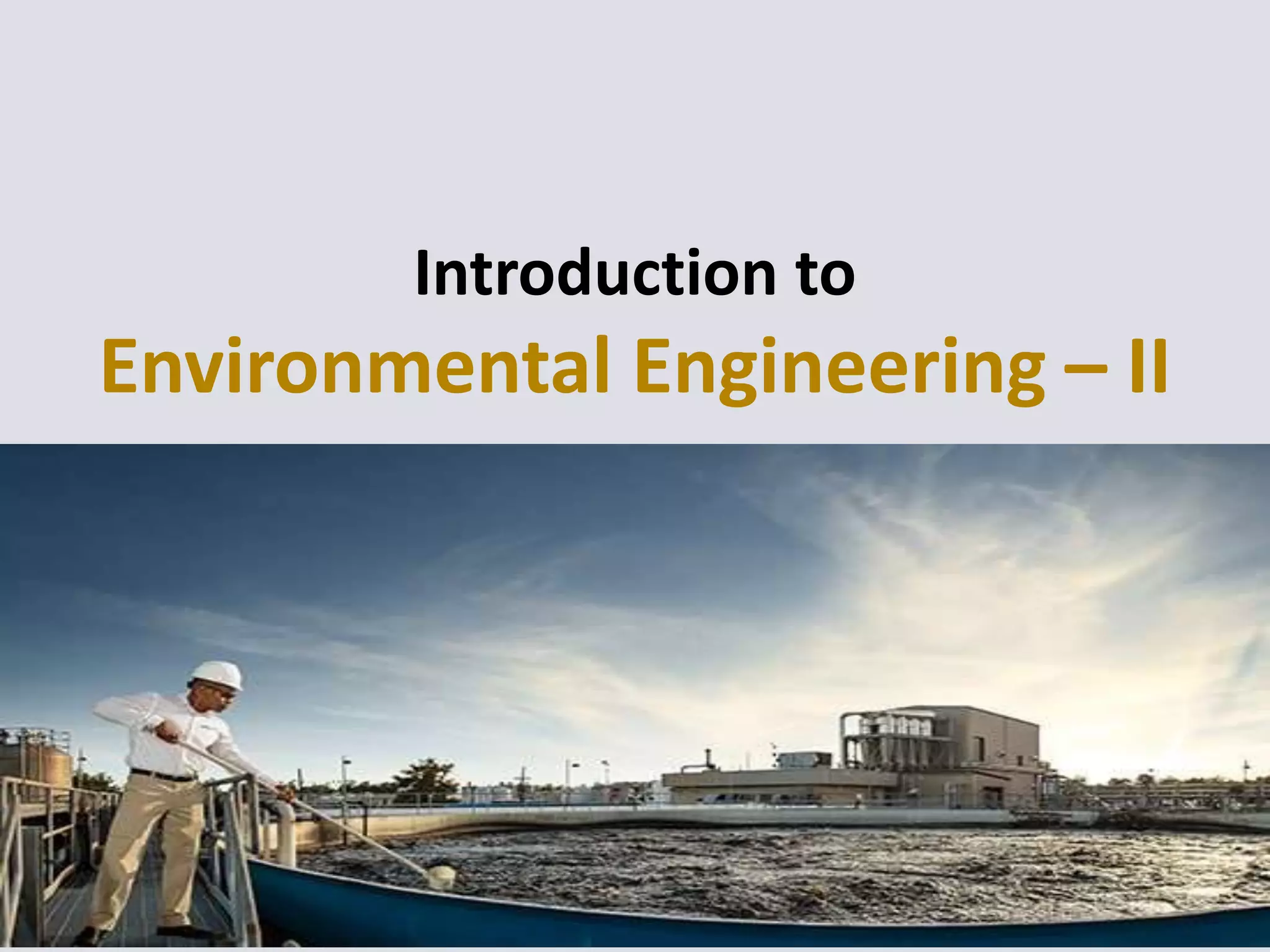
Introduction to
Environmental Engineering – II
It is the application of science and engineering principles to
improve the environment (air, water, and/or land
resources), to provide healthy water, air, and land for
human habitation and for other organisms, and to
remediate polluted sites.
Environmental engineering involves water and air pollution
control, recycling, waste disposal, and public health issues
as well as a knowledge of environmental engineering law. It
also includes studies on the environmental impact of
human development projects.
Environmental Engineering
 Population growth
 Water and air pollution
 Global climate change
 Ozone layer depletion
 Transboundary shipment of hazardous wastes
 Loss of biodiversity
 Land erosion
 Desertification
 Deforestation
 Destruction of wetlands
 Solid waste management problem
Environmental Engineering Problems
Perhaps the most significant force behind large-scale environmental
problems is the nature of consciousness itself, that we might not be
as rational as we suppose or as we are supposed to be.
Human consciousness is characterized by a dialectic of
environmental destruction.
Enabled by consciousness and scientific rationality, humans produce
and externalize their being into the world thus creating
environmental damage.
While it is true that humans theoretically have agency and the
ability to address large-scale environmental problems, they
infrequently make choices before the consequences of
environmental inattention grow.
Humans and Environment
Gehlen (1988) points out there is no “human world” in the
same sense there is a “horse world” or “salmon world.”
Humans exist in a state he calls “world openness,” a state
not defined by instinct (Berger and Luckmann, 1966;
Thomason, 1982). The human world is a social world – a
constructed world (Berger, 1967).
When humans came to consciousness, they left behind the
instinctually predefined world of other animals for one in
which choices are at least theoretically possible.
Humans and Environment
Reason: Fundamental anxiety
We want to state that the whole system of relevance which
governs us within the natural attitude is founded upon the basic
experience of each of us: I know that I shall die, and I fear to
die. This basic experience we suggest calling the fundamental
anxiety. It is the primordial anticipation from which all the others
originate. From the fundamental anxiety spring the many
interrelated systems of hopes and fears, of wants and
satisfactions, of chances and risks which incite man [sic] within
the natural attitude to attempt the mastery of the world, to
overcome obstacles, to draft projects, and to realize them.
Externalization
Reason: Fundamental anxiety
The fundamental anxiety is an important motivation for human
social action. Without such an all-informing anxiety humans
would do little else other than fulfill basic, biological human
needs such as need for food, clothing, and shelter.
For certain, birds make nests, ants make anthills, and people
build cities. Yet because of the intricacy and technological
sophistication of human systems it seems quite appropriate to
make a distinction between human and natural systems.
Insecurity characterizes our thoughts about humanity…
Externalization
The second moment of the dialectic of environmental
destruction is the internalization of the already externalized
world. Internalization is the process of making the humanly
constructed world part of our conscious being.
Human beings externalize themselves into the natural world as
we have just mentioned, and then “reappropriate” what they
have made into their very consciousness – the world “out there”
becomes the world “in here” (Berger and Luckmann, 1966).
 Example: Automobiles
Internalization
Idealism on environmental concerns does not solve the
problems; it may cause increased severity in the future.
We must confront the passivity and inertia of taken-for-
grantedness as expressed in our own nature. In a real sense if we
are to address environmental problems, we must revise our
humanity; we must become different people.
Idealism and Environment
Hypothetically it is possible to translate remote environmental threats
such as global warming into immediate consequences in several
important ways.
First, it is important to connect global environmental problems with
their local consequences. As people feel local environmental
consequences, global warming will be transformed from an abstract
threat to a tangible danger in need of immediate action.
The second way in which large-scale environmental problems like
global warming can be translated into immediate consequences is by
addressing them at their foundation, the consumptive behavior of
individuals. For example, the cost of fossil fuels paid by humans only
represent a small share of their actual cost when scarcity and
environmental damage are considered.
What needs to be done?
 Learn to solve environmental problems at local level
 Allocate thoughts and efforts for remedies for environmental
concerns
 Build qualitative and quantitative understandings about
water, air, and land pollutions as well as about the available
waste management processes
Inferences… for us

Lec_1.pptx

  • 1.
    In the nameof ALLAH, the most Gracious, the most Merciful
  • 2.
    Environmental Engineering -II Asst. Prof. Dr. Muhammad Amjad Introduction
  • 3.
    Instructor ◊ Name: Dr.Muhammad Amjad ◊ Designation: Asst. Prof. ◊ Qualification: Post-Doc – 2020 – METU, Ankara (Turkey) Ph.D. Civil Engineering – 2020 – METU, Ankara (Turkey) M.Sc. Water Resources Management – 2013 – UET, Lahore B.Sc. Agriculture Engineering – 2010 – BZU, Multan ◊ Specialization: Hydrometeorology (Hydrological Simulations, Precipitation Data Analyses, Weather Forecasting, Nowcasting), Climate Change ◊ Experience: Teaching and Research Projects at MCE, NUST Research at TÜBİTAK (Turkey) Freelance Research for Asian Development Bank ◊ Office: 1st floor, CE Wing, MCE ◊ Office Hours: Mon-Thu 14:15-15:00 ◊ Contact: muhamjad@mce.nust.edu.pk
  • 4.
    Course Overview  CourseTitle: Environmental Engineering – II  Course Code: CE-341  Credit Hours: Theory  2 Practical  1 Total  3  Contact Hours: Lecture  2 hrs/week Lab  3 hrs/week  Syllabus: Course Plan
  • 5.
    Course Outline  Introductionto Env Engg - II  Humans and Environment  Selection of the Treatment Processes  Water Treatment Processes  Wastewater Treatment • Objectives of Wastewater Treatment • Design of Pre-Requisites Units (sanitary sewer) • Pre-Treatment of Water (screening, neutralization/pH adjustment, aeration, chemical pre- treatment, grit chamber, communitors, and skimming tank) • Primary Treatment (coagulation and flocculation, lime-Soda water softening process, sedimentation, solids-contact units) • Secondary Treatment of Water (Filtration) • Concept of Biological Wastewater Treatment of Wastewater • Classification of Biological Wastewater Treatment Processes • Design of UASB Reactor (Anaerobic Digestion) • Design of Trickling Filter (or Percolating Filter) • Design of Oxidation Ponds (or Waste Stabilization Ponds) • Sludge Treatment and Disposal • Design of an Activated Sludge Process  Environmental Impact Assessment • Environmental impact of urban and industrial development
  • 6.
    Course/Program Learning Outcomes PLO4: Investigation PLO 7: Environment and Sustainability PLO 9: Individual and Teamwork Sr. No. CLO Domain Taxonomy Level PLO 1. Develop understandingof human and environment interactions, their impacts on environment, and water and wastewater treatment at different severity levels Cognitive 2 7 2. Analyse their working knowledge of basic health standards for community services by improving the living standards of the public through designing water and wastewater treatment plants Cognitive 4 4 3. Conduct chemical analyses in the lab to demonstratesignificance of water quality parameters in the evaluation of water quality and practice their skills in wastewater chemical analyses procedure in lab. Psychomotor 3 9
  • 7.
    Books and Reference Textbooks 1.Water Supply and Sewerage (6th Edn.) by Terence J McGhee, McGraw Hill, 1991, ISBN: 0070609381 2. Water Supply and Sewerage, by E.W. Steel, McGraw Hill. 3. Fundamentals of Water Supply and Sanitary Engineering by S. C. Rangwala References Material: 1. Environmental Engineering (4th Edition), by Ruth F. Weiner and Robin Mattews 2. PHEngg Handouts and Workbook by Dr. Arshad Ali 3. Case Studies (Handouts)
  • 8.
    Theoretical / Instruction200% Assignments 08% Quizzes 15% PBL 07% OHT Exams 30% End Semester Exam 40% Practical Work 100% Lab Work 70% Lab Attendenance 10% Lab Report 40% Lab Quiz 30% Rubrics 20% Viva 30% _____________________________________________ Total 300% Assessment System
  • 9.
    Assignments  Weightage: 8%of theory grades  No. of Assignments: 3 Assignments (33% each)  Mode of Submission: Online / by hand, but through Class Senior  Late Submission: Deduction of 20% marks per day of delay  Plagiarism: You can take help from internet/colleagues but not allowed to copy someone else’s work
  • 10.
    Quizzes  Weightage: 15%of theory grades  No. of Quizzes: 4 Quizzes (25% each)  Can be announced or unannounced  Conduct: The following actions will result in cancelation of quiz • Using helping material • Copying from a fellow colleague / sharing calculators • Writing once you are asked you to stop
  • 11.
    Class Rules  Classcontribution is very important; always be active  During the lecture, if anyone found disturbing the class, he will be marked absent and will be no longer allowed to sit in the class until the Course Officer approves  If you are not present during the lecture for any reason, you’ll be marked absent  If you are called by any other instructor/ staff during my class, ask him/her to write a statement that you are with them
  • 12.
  • 13.
    It is theapplication of science and engineering principles to improve the environment (air, water, and/or land resources), to provide healthy water, air, and land for human habitation and for other organisms, and to remediate polluted sites. Environmental engineering involves water and air pollution control, recycling, waste disposal, and public health issues as well as a knowledge of environmental engineering law. It also includes studies on the environmental impact of human development projects. Environmental Engineering
  • 14.
     Population growth Water and air pollution  Global climate change  Ozone layer depletion  Transboundary shipment of hazardous wastes  Loss of biodiversity  Land erosion  Desertification  Deforestation  Destruction of wetlands  Solid waste management problem Environmental Engineering Problems
  • 15.
    Perhaps the mostsignificant force behind large-scale environmental problems is the nature of consciousness itself, that we might not be as rational as we suppose or as we are supposed to be. Human consciousness is characterized by a dialectic of environmental destruction. Enabled by consciousness and scientific rationality, humans produce and externalize their being into the world thus creating environmental damage. While it is true that humans theoretically have agency and the ability to address large-scale environmental problems, they infrequently make choices before the consequences of environmental inattention grow. Humans and Environment
  • 16.
    Gehlen (1988) pointsout there is no “human world” in the same sense there is a “horse world” or “salmon world.” Humans exist in a state he calls “world openness,” a state not defined by instinct (Berger and Luckmann, 1966; Thomason, 1982). The human world is a social world – a constructed world (Berger, 1967). When humans came to consciousness, they left behind the instinctually predefined world of other animals for one in which choices are at least theoretically possible. Humans and Environment
  • 17.
    Reason: Fundamental anxiety Wewant to state that the whole system of relevance which governs us within the natural attitude is founded upon the basic experience of each of us: I know that I shall die, and I fear to die. This basic experience we suggest calling the fundamental anxiety. It is the primordial anticipation from which all the others originate. From the fundamental anxiety spring the many interrelated systems of hopes and fears, of wants and satisfactions, of chances and risks which incite man [sic] within the natural attitude to attempt the mastery of the world, to overcome obstacles, to draft projects, and to realize them. Externalization
  • 18.
    Reason: Fundamental anxiety Thefundamental anxiety is an important motivation for human social action. Without such an all-informing anxiety humans would do little else other than fulfill basic, biological human needs such as need for food, clothing, and shelter. For certain, birds make nests, ants make anthills, and people build cities. Yet because of the intricacy and technological sophistication of human systems it seems quite appropriate to make a distinction between human and natural systems. Insecurity characterizes our thoughts about humanity… Externalization
  • 19.
    The second momentof the dialectic of environmental destruction is the internalization of the already externalized world. Internalization is the process of making the humanly constructed world part of our conscious being. Human beings externalize themselves into the natural world as we have just mentioned, and then “reappropriate” what they have made into their very consciousness – the world “out there” becomes the world “in here” (Berger and Luckmann, 1966).  Example: Automobiles Internalization
  • 20.
    Idealism on environmentalconcerns does not solve the problems; it may cause increased severity in the future. We must confront the passivity and inertia of taken-for- grantedness as expressed in our own nature. In a real sense if we are to address environmental problems, we must revise our humanity; we must become different people. Idealism and Environment
  • 21.
    Hypothetically it ispossible to translate remote environmental threats such as global warming into immediate consequences in several important ways. First, it is important to connect global environmental problems with their local consequences. As people feel local environmental consequences, global warming will be transformed from an abstract threat to a tangible danger in need of immediate action. The second way in which large-scale environmental problems like global warming can be translated into immediate consequences is by addressing them at their foundation, the consumptive behavior of individuals. For example, the cost of fossil fuels paid by humans only represent a small share of their actual cost when scarcity and environmental damage are considered. What needs to be done?
  • 22.
     Learn tosolve environmental problems at local level  Allocate thoughts and efforts for remedies for environmental concerns  Build qualitative and quantitative understandings about water, air, and land pollutions as well as about the available waste management processes Inferences… for us