Computer Vision
Lecture 11 – Self-Supervised Learning
Prof. Dr.-Ing. Andreas Geiger
Autonomous Vision Group
University of Tübingen / MPI-IS
Agenda
11.1 Preliminaries
11.2 Task-specific Models
11.3 Pretext Tasks
11.4 Contrastive Learning
2
11.1
Preliminaries
Data Annotation
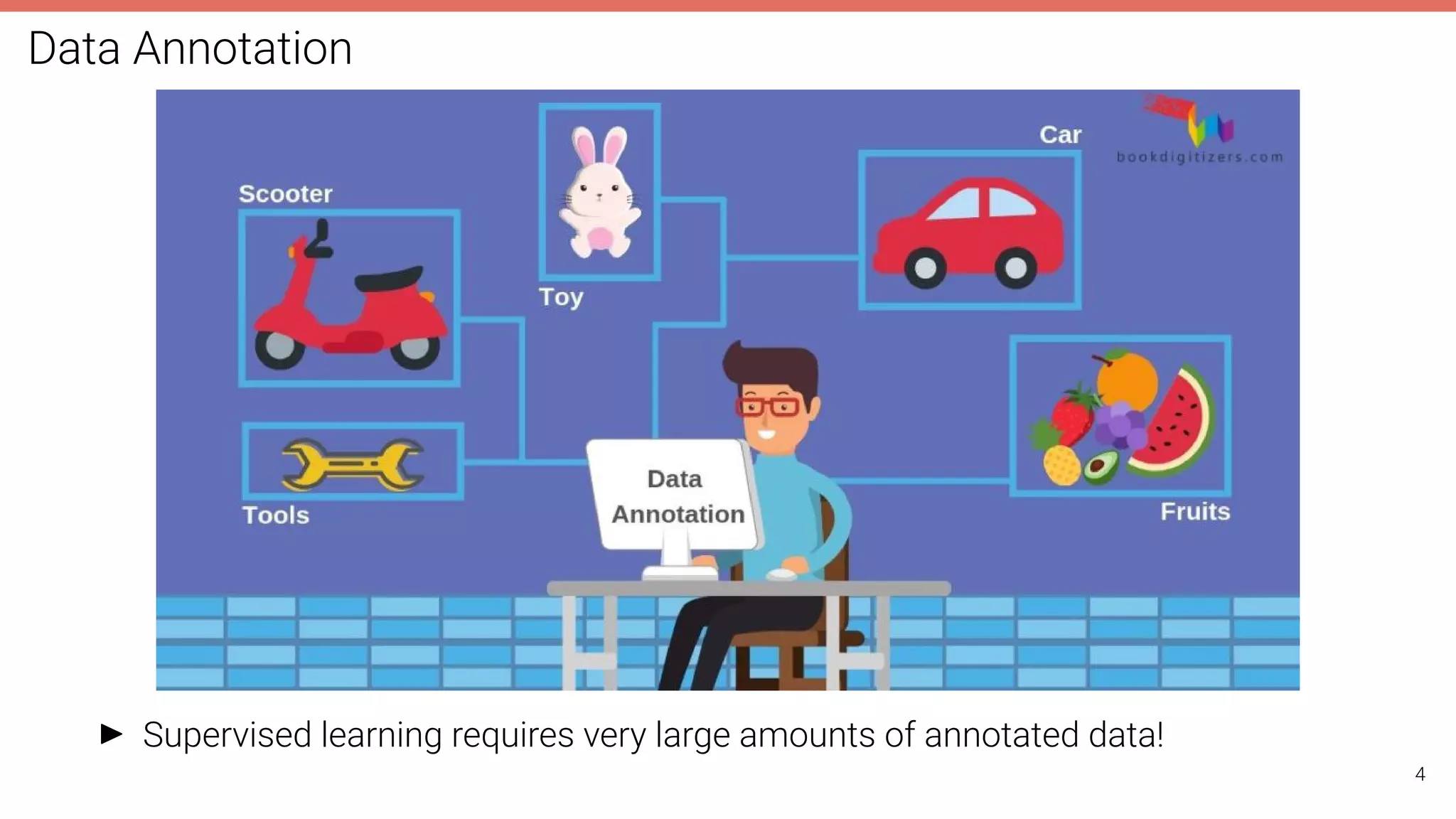
I Supervised learning requires very large amounts of annotated data!
4
Data Annotation
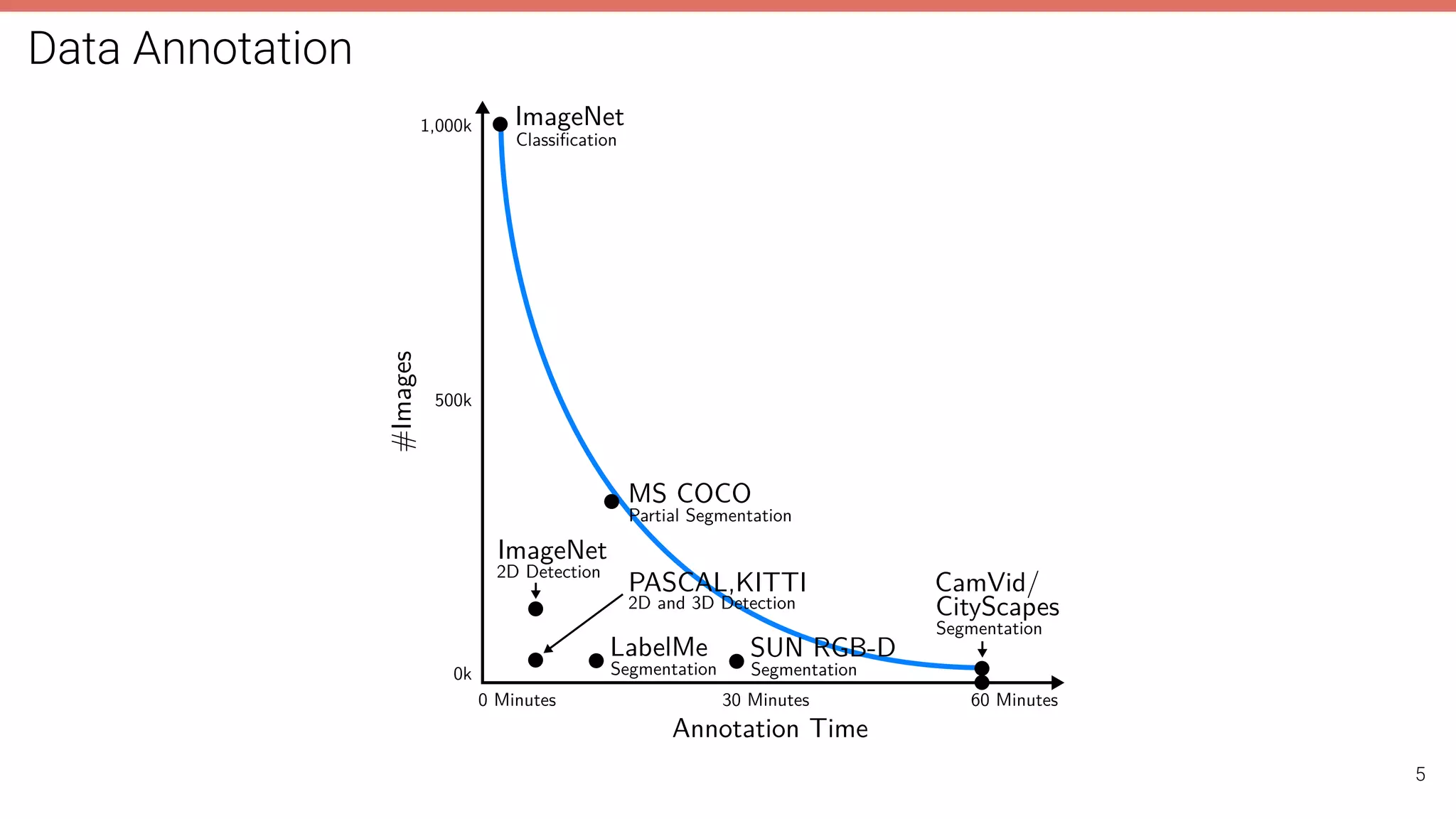
Annotation Time
0 Minutes 30 Minutes 60 Minutes
#Images
1,000k
500k
0k
ImageNet
Classification
MS COCO
Partial Segmentation
ImageNet
2D Detection
PASCAL,KITTI
2D and 3D Detection
LabelMe
Segmentation
SUN RGB-D
Segmentation
CityScapes
Segmentation
CamVid/
5
Image Classification
Types of human error:
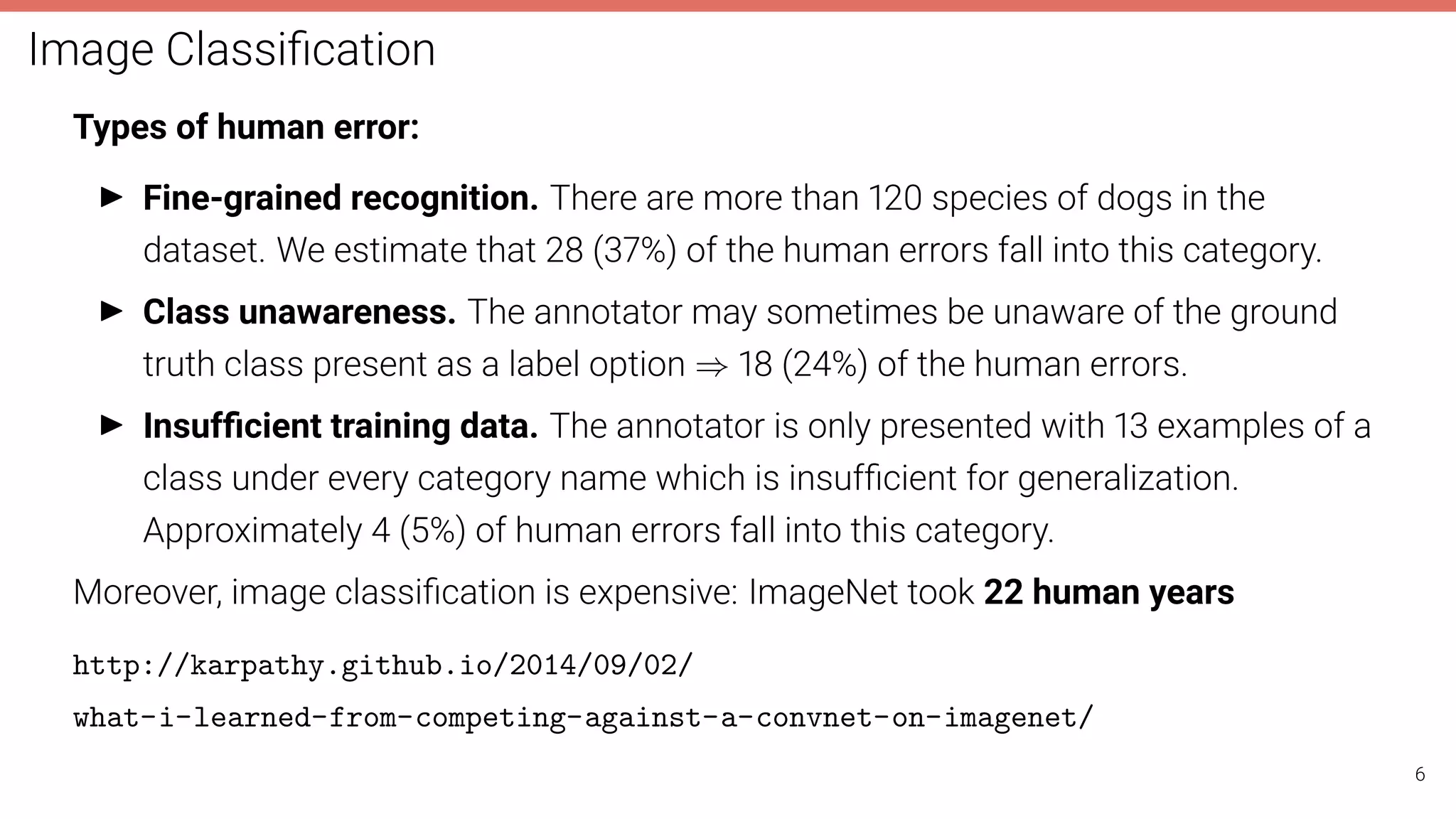
I Fine-grained recognition. There are more than 120 species of dogs in the
dataset. We estimate that 28 (37%) of the human errors fall into this category.
I Class unawareness. The annotator may sometimes be unaware of the ground
truth class present as a label option ⇒ 18 (24%) of the human errors.
I Insufficient training data. The annotator is only presented with 13 examples of a
class under every category name which is insufficient for generalization.
Approximately 4 (5%) of human errors fall into this category.
Moreover, image classification is expensive: ImageNet took 22 human years
http://karpathy.github.io/2014/09/02/
what-i-learned-from-competing-against-a-convnet-on-imagenet/
6
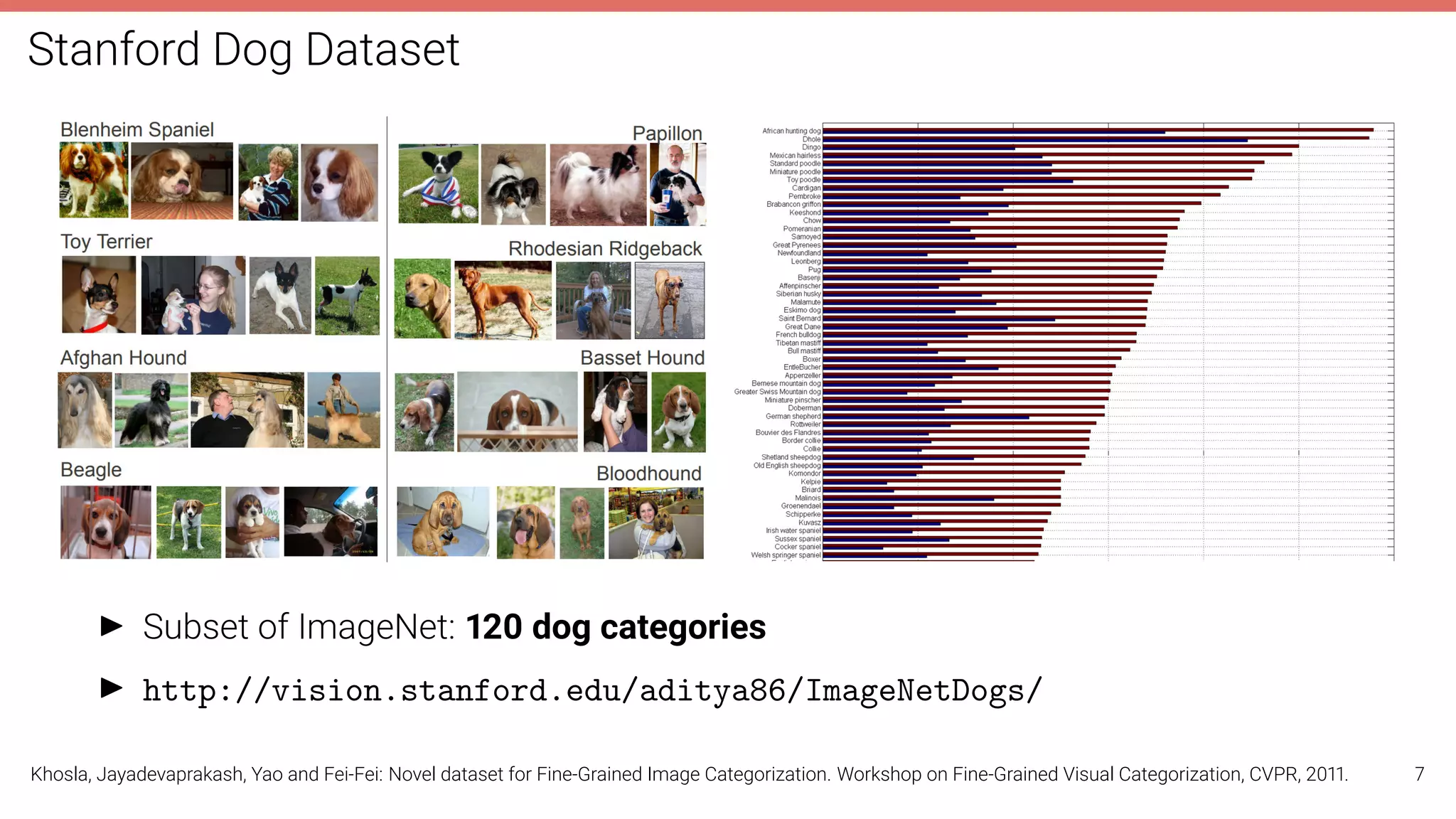
Stanford Dog Dataset
I Subset of ImageNet: 120 dog categories
I http://vision.stanford.edu/aditya86/ImageNetDogs/
Khosla, Jayadevaprakash, Yao and Fei-Fei: Novel dataset for Fine-Grained Image Categorization. Workshop on Fine-Grained Visual Categorization, CVPR, 2011. 7
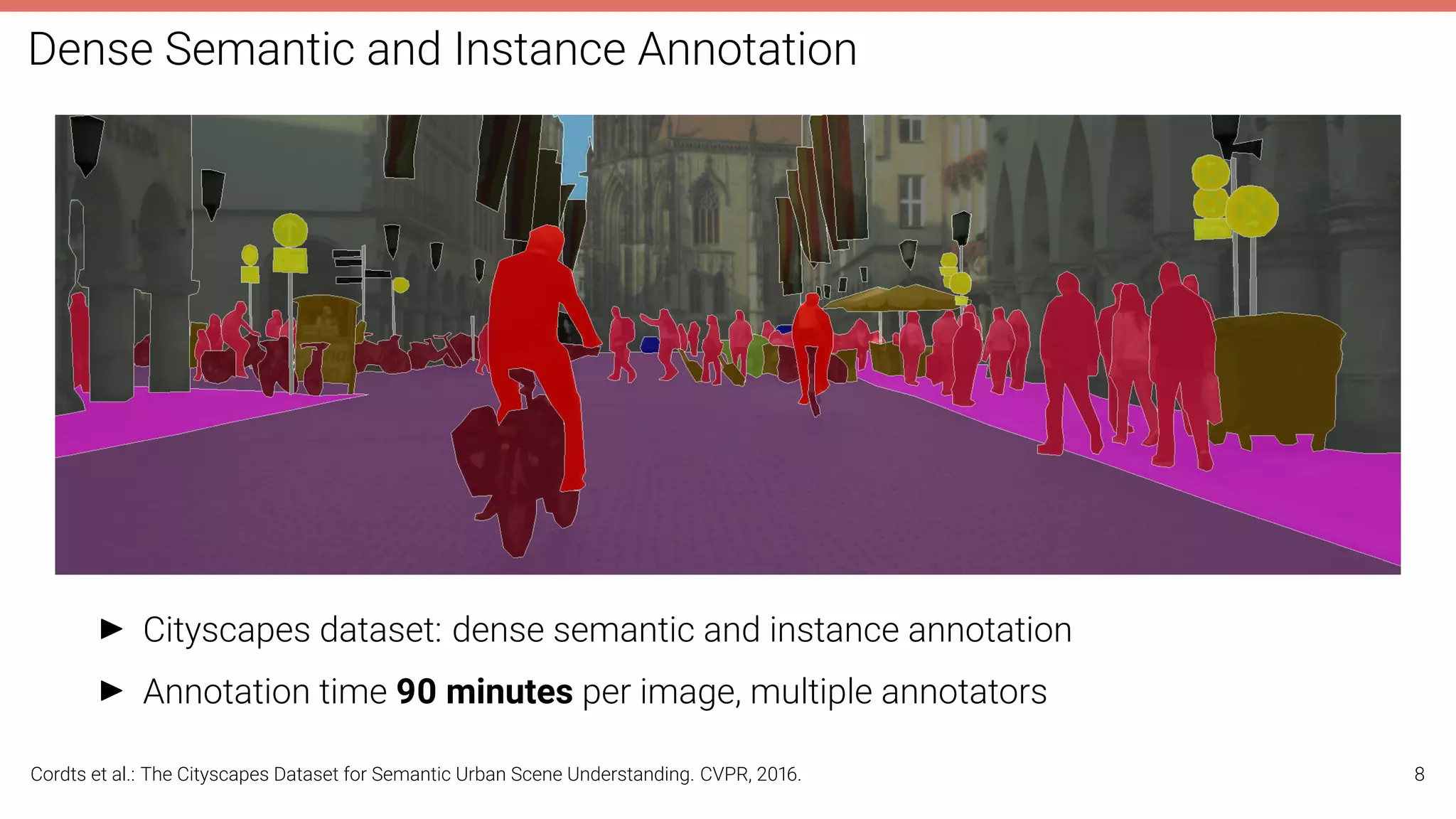
Dense Semantic and Instance Annotation
I Cityscapes dataset: dense semantic and instance annotation
I Annotation time 90 minutes per image, multiple annotators
Cordts et al.: The Cityscapes Dataset for Semantic Urban Scene Understanding. CVPR, 2016. 8
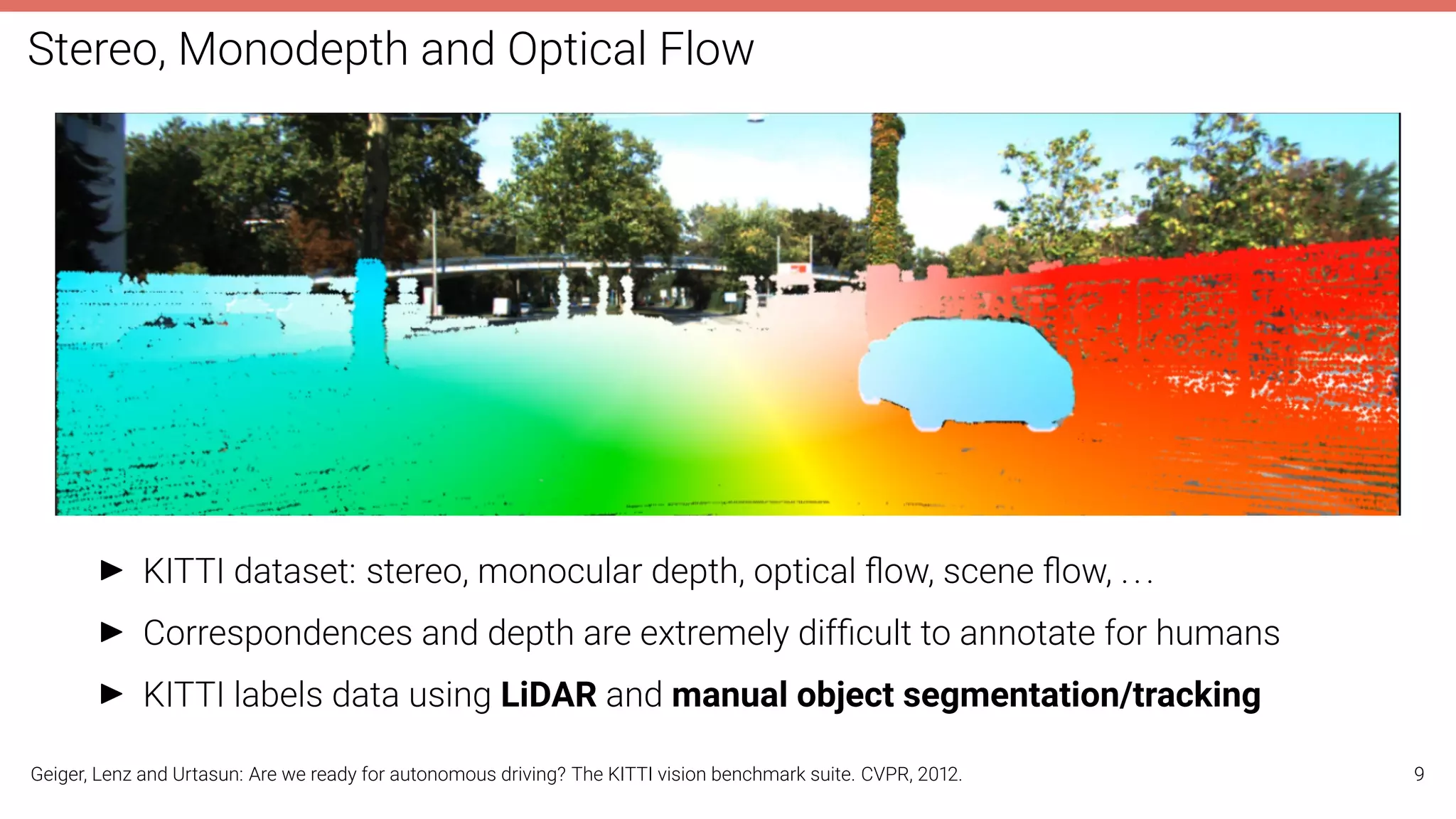
Stereo, Monodepth and Optical Flow
I KITTI dataset: stereo, monocular depth, optical flow, scene flow, ...
I Correspondences and depth are extremely difficult to annotate for humans
I KITTI labels data using LiDAR and manual object segmentation/tracking
Geiger, Lenz and Urtasun: Are we ready for autonomous driving? The KITTI vision benchmark suite. CVPR, 2012. 9
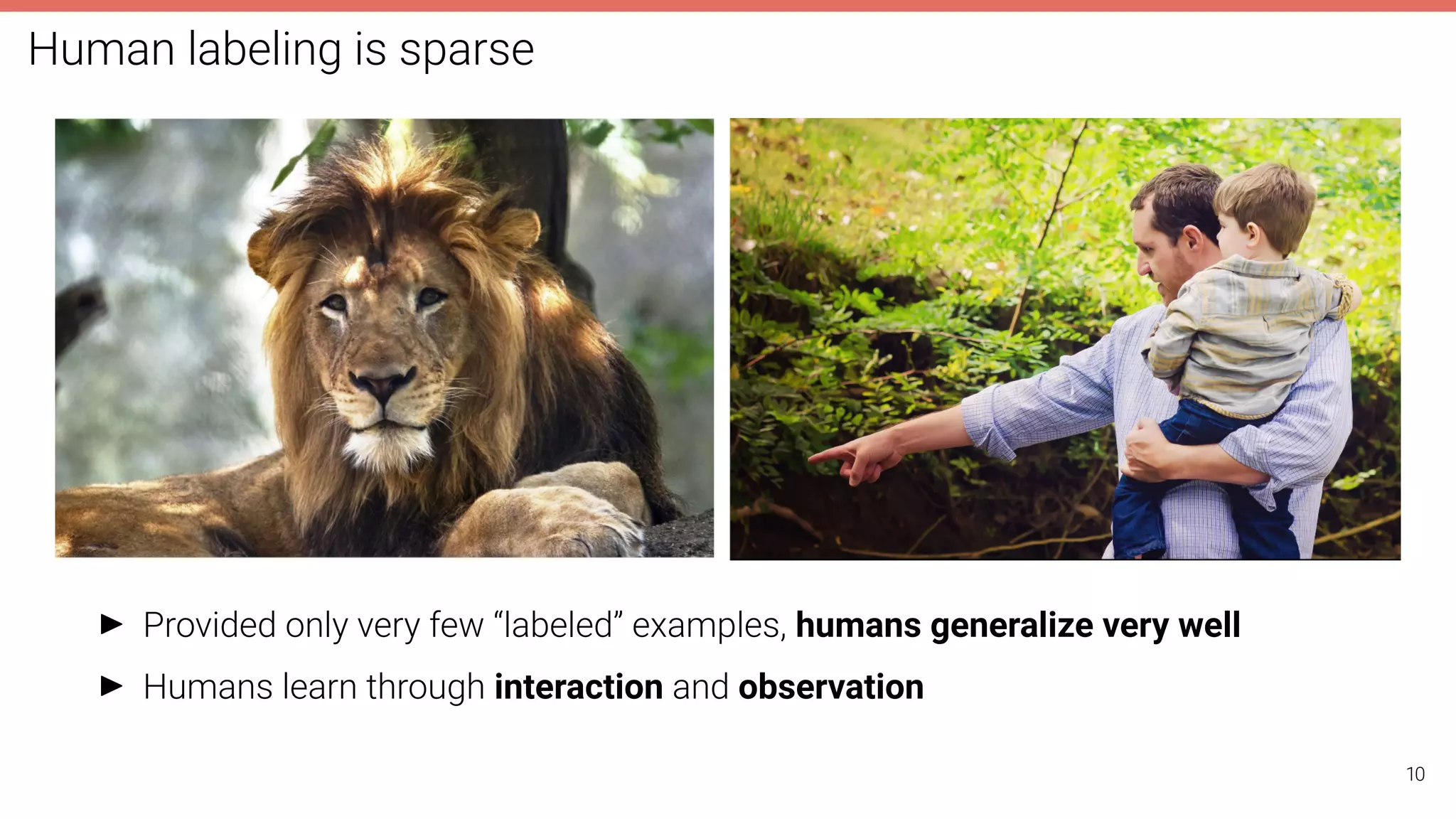
Human labeling is sparse
I Provided only very few “labeled” examples, humans generalize very well
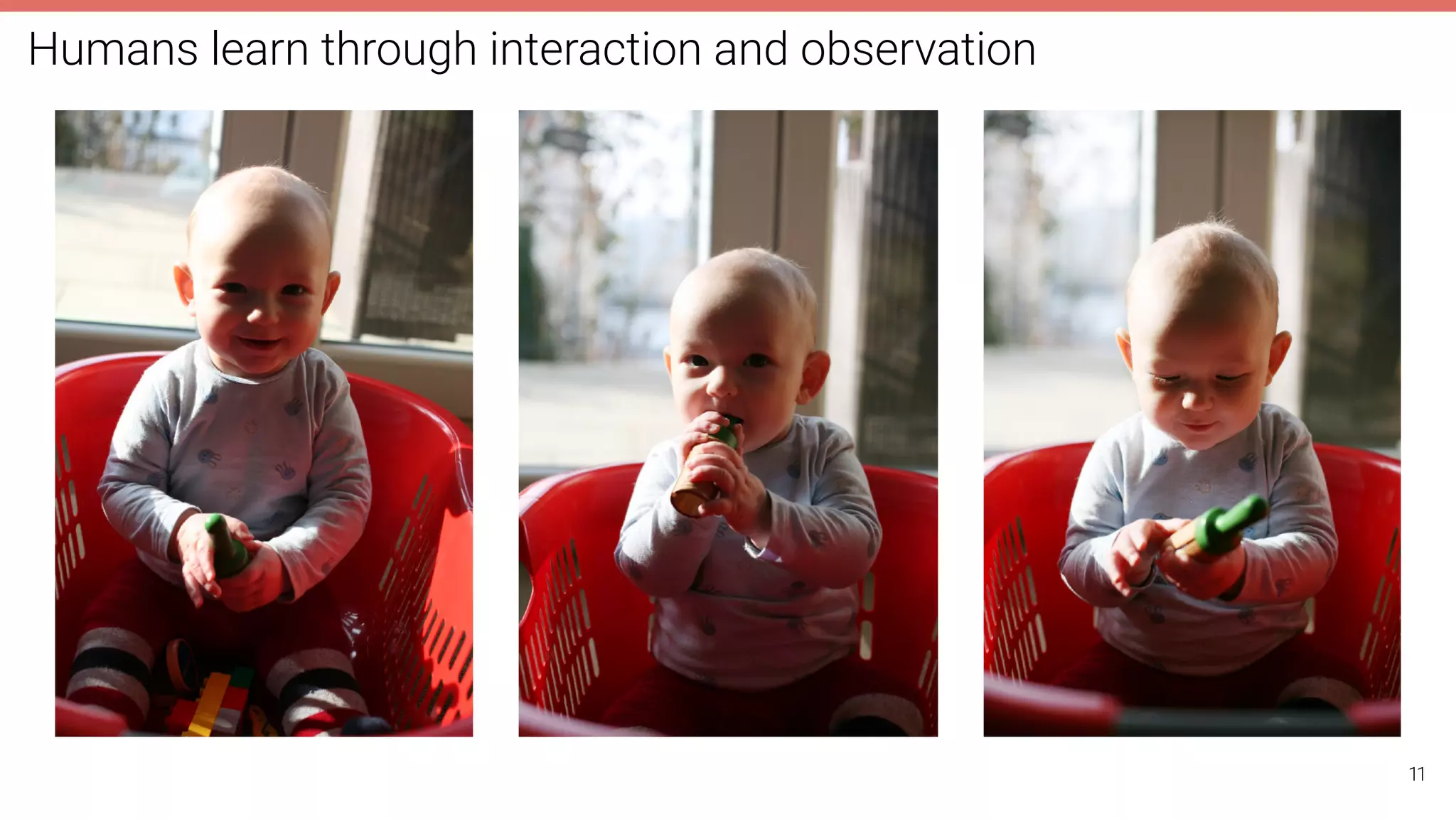
I Humans learn through interaction and observation
10
Humans learn through interaction and observation
11
Self-Supervision
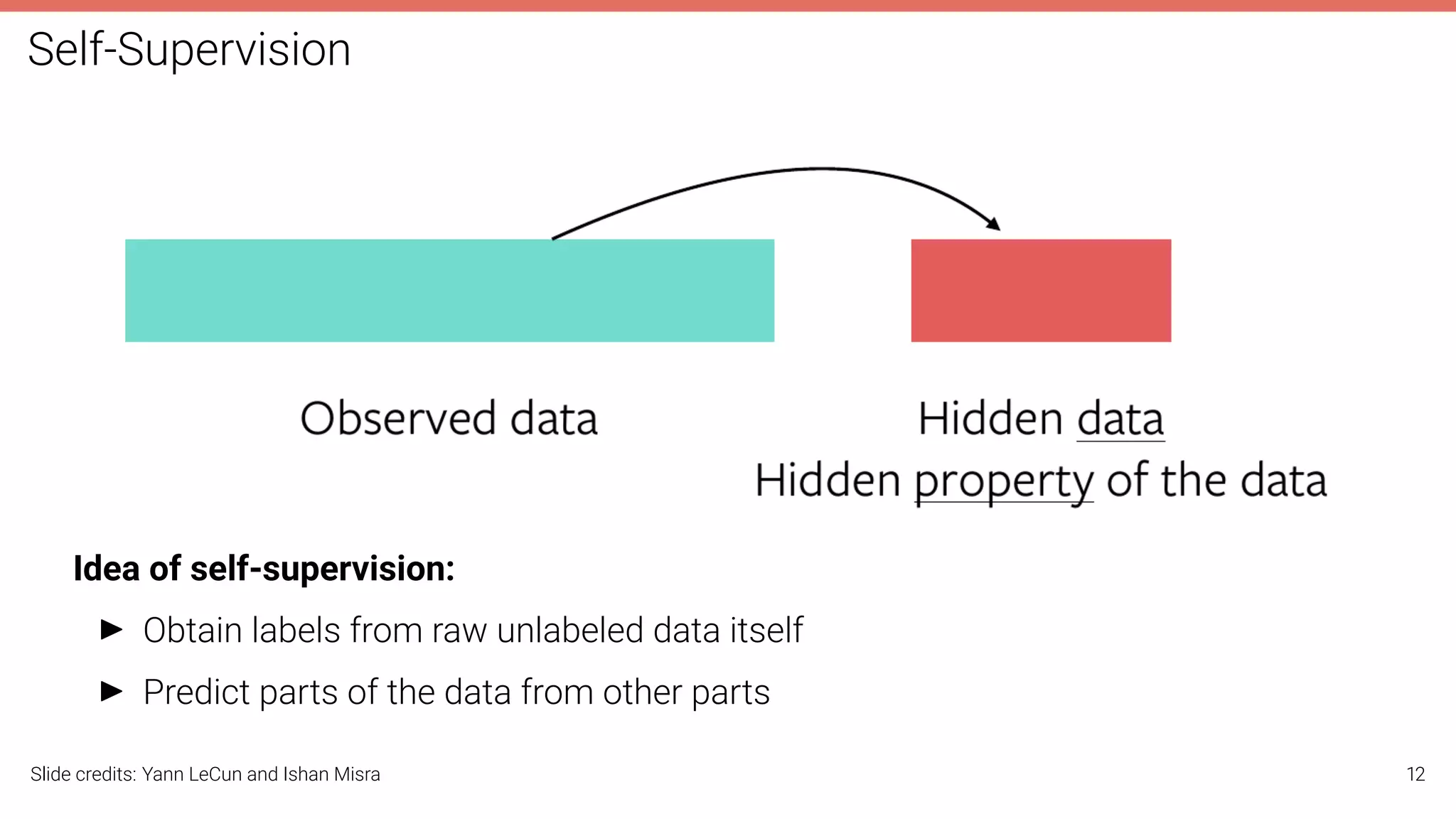
Idea of self-supervision:
I Obtain labels from raw unlabeled data itself
I Predict parts of the data from other parts
Slide credits: Yann LeCun and Ishan Misra 12
Self-Supervision
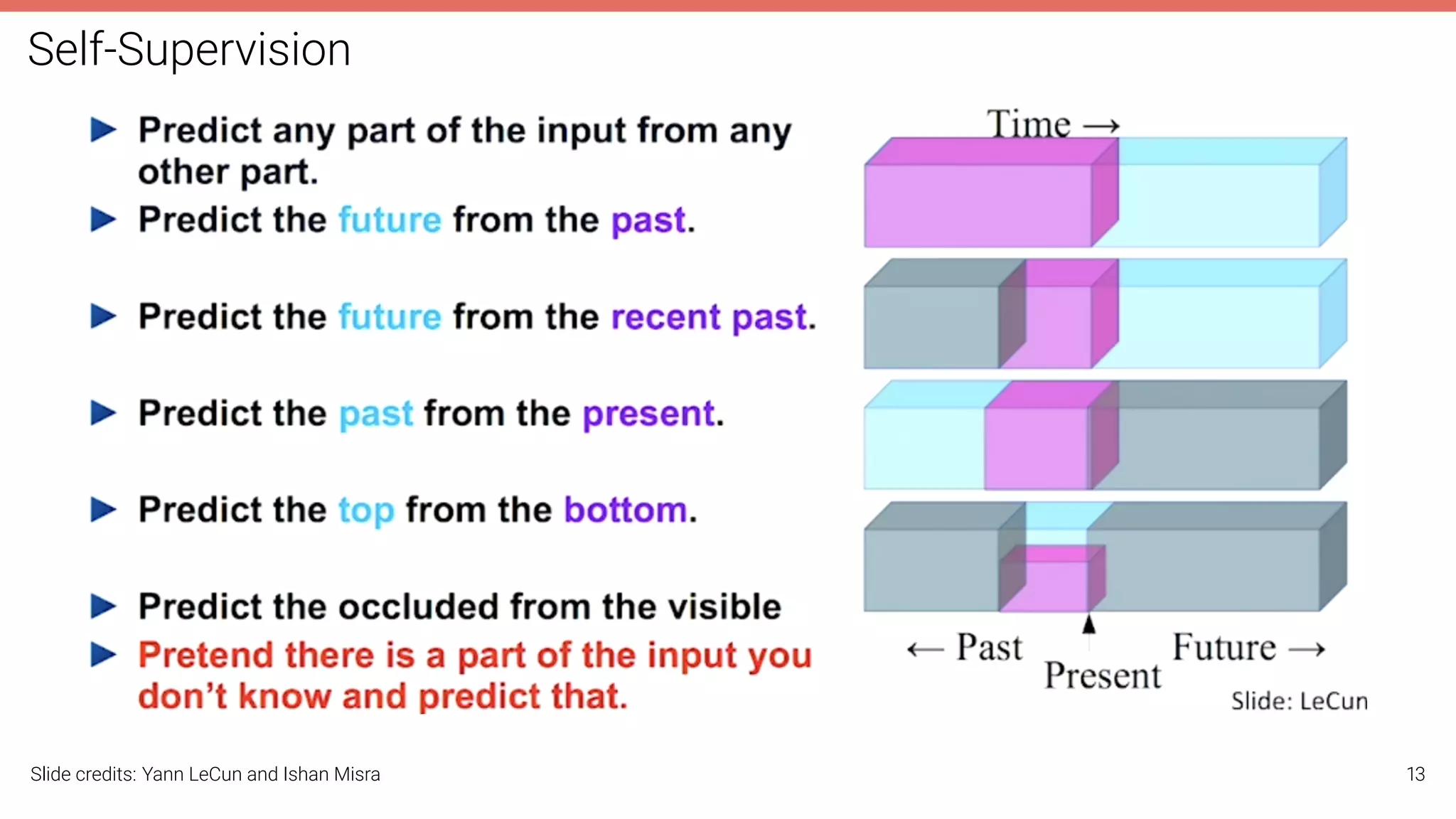
Slide credits: Yann LeCun and Ishan Misra 13
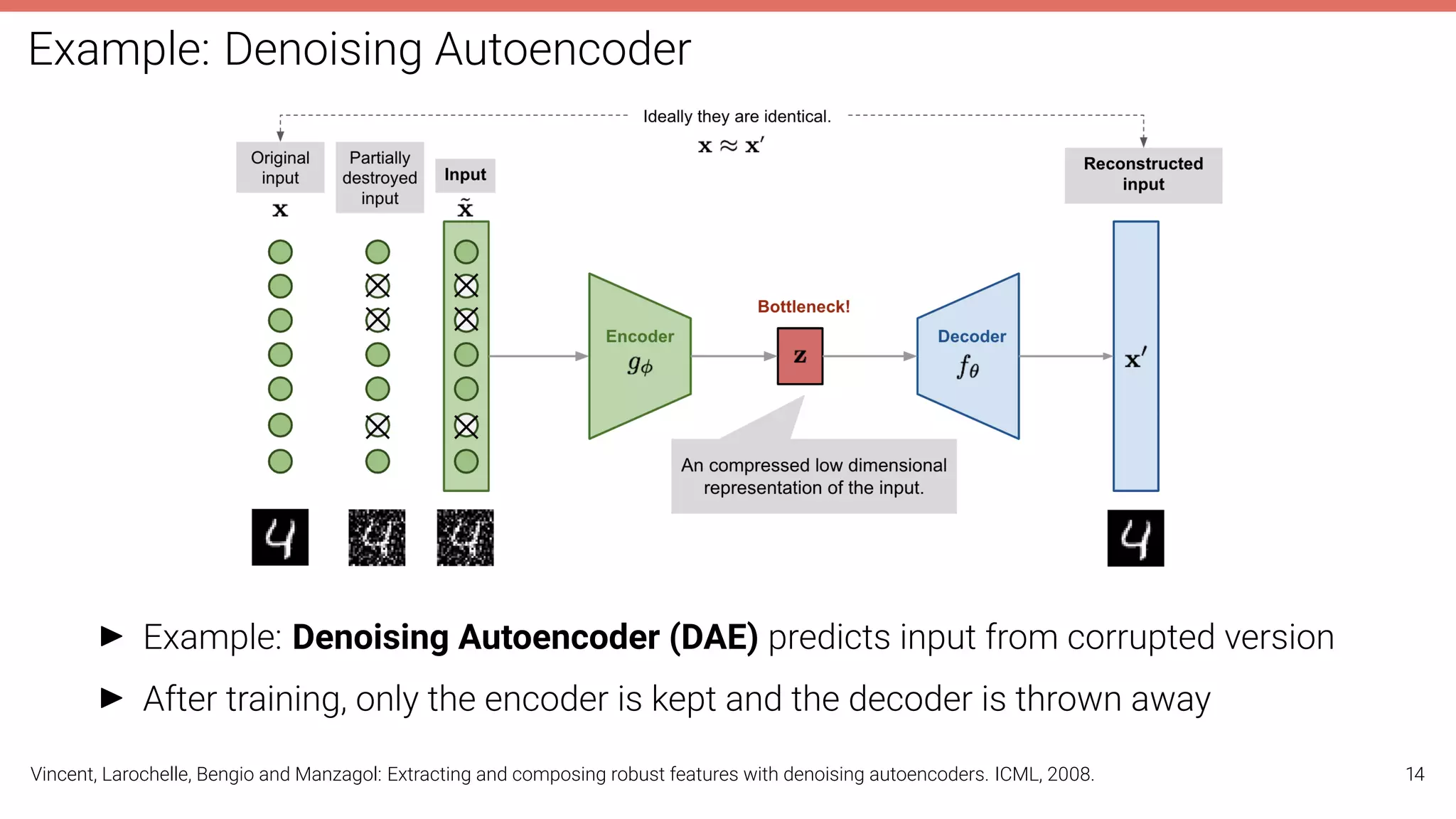
Example: Denoising Autoencoder
I Example: Denoising Autoencoder (DAE) predicts input from corrupted version
I After training, only the encoder is kept and the decoder is thrown away
Vincent, Larochelle, Bengio and Manzagol: Extracting and composing robust features with denoising autoencoders. ICML, 2008. 14
Learning Problems
I Reinforcement learning
I Learn model parameters using active exploration from sparse rewards
I Examples: deep q learning, gradient policy, actor critique
I Unsupervised learning
I Learn model parameters using dataset without labels {xi}N
i=1
I Examples: Clustering, dimensionality reduction, generative models
I Supervised learning
I Learn model parameters using dataset of data-label pairs {(xi, yi)}N
i=1
I Examples: Classification, regression, structured prediction
I Self-supervised learning
I Learn model parameters using dataset of data-data pairs {(xi, x0
i)}N
i=1
I Examples: Self-supervised stereo/flow, contrastive learning
15
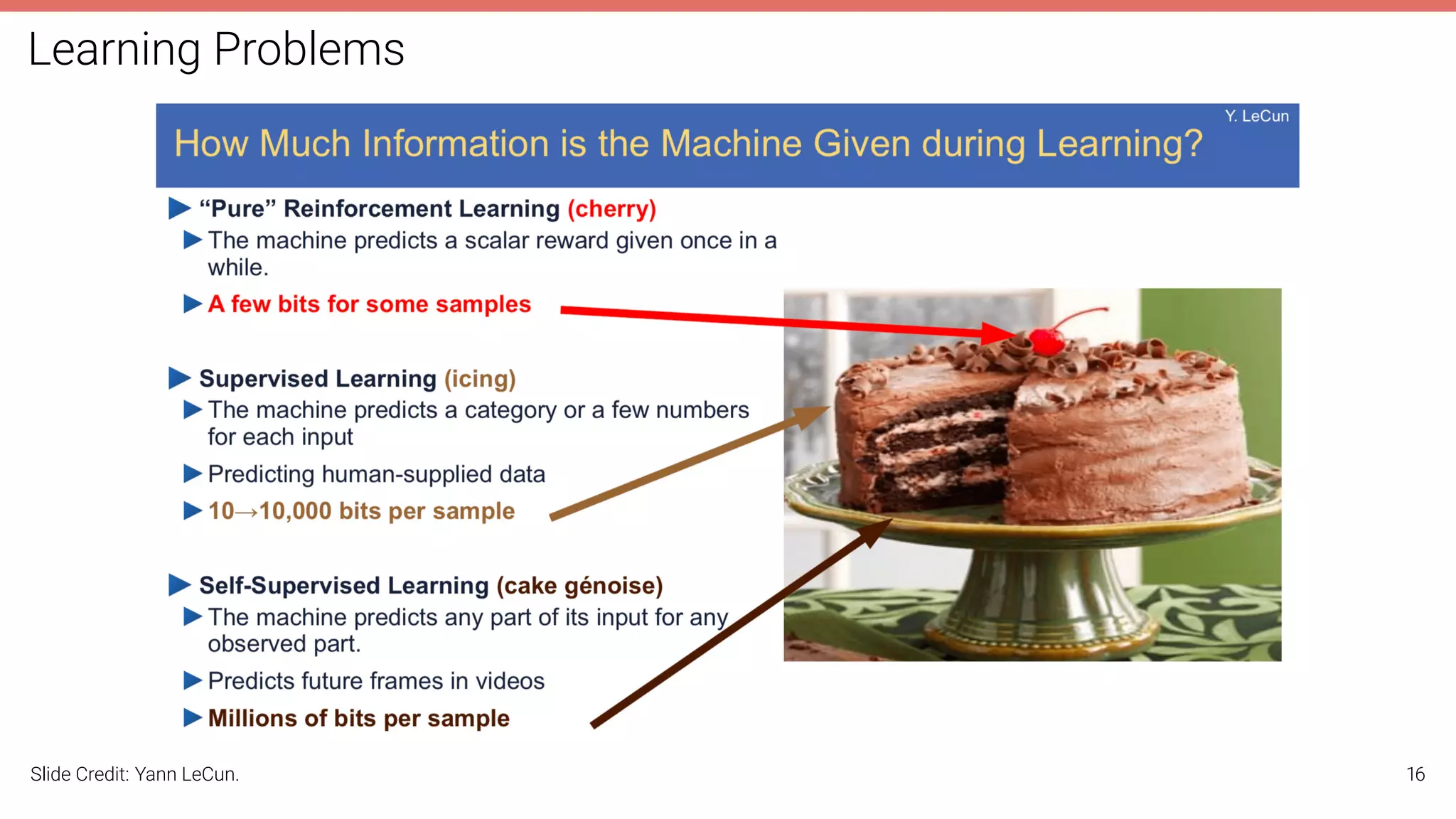
Learning Problems
Slide Credit: Yann LeCun. 16
Credits
I Ishan Misra — Self-supervised learning in computer vision
https://youtu.be/8L10w1KoOU8, https://bit.ly/DLSP21-10L
I Stanford CS231n — Convolutional Neural Networks for Visual Recognition
http://cs231n.stanford.edu/
I Y. LeCun and I. Misra — Self-supervised learning: Dark matter of intelligence
https://ai.facebook.com/blog/
self-supervised-learning-the-dark-matter-of-intelligence
I Lilian Weng — Self-Supervised Representation Learning
https://lilianweng.github.io/lil-log/2019/11/10/
self-supervised-learning.html
17
11.2
Task-specific Models
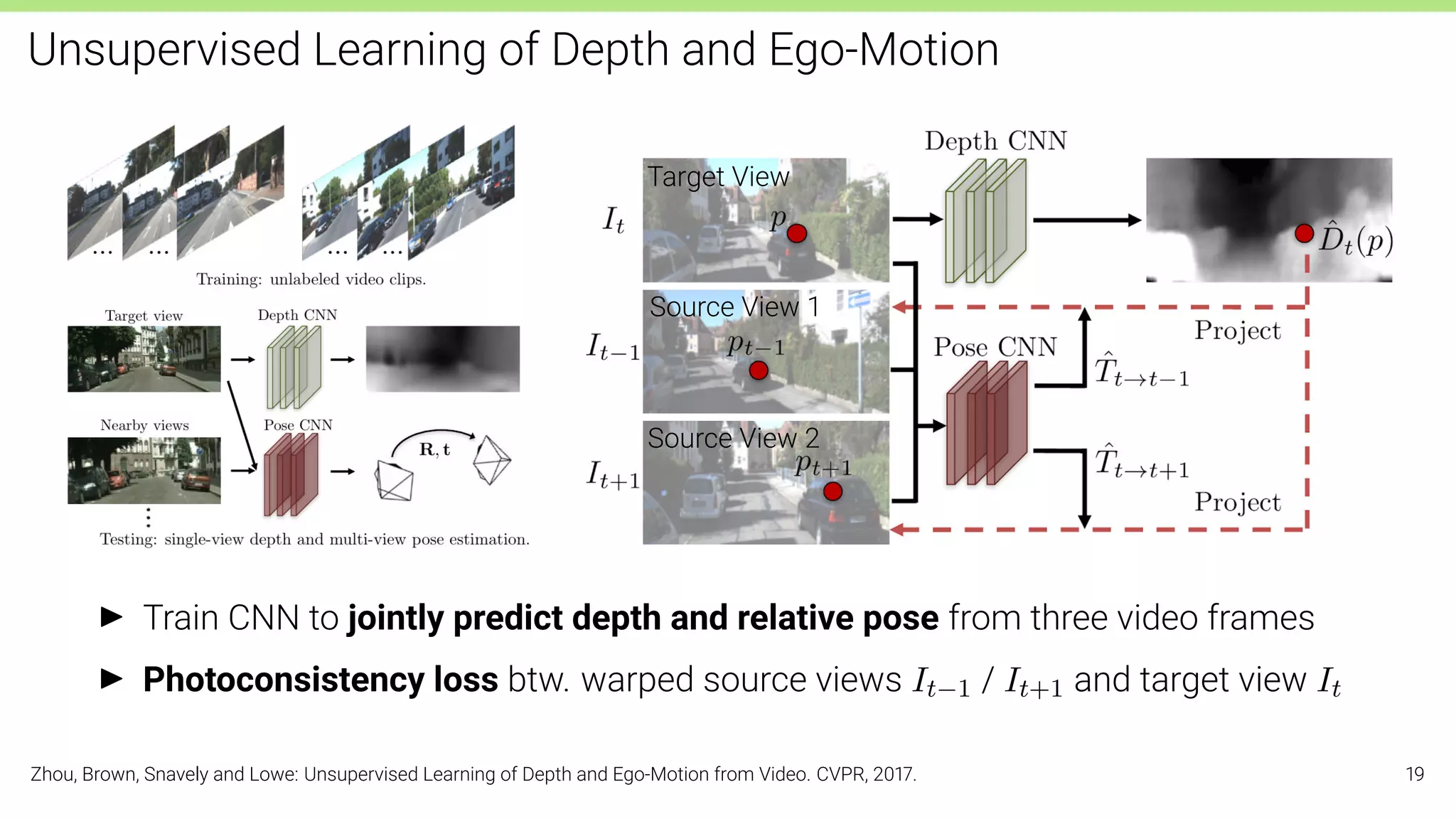
Unsupervised Learning of Depth and Ego-Motion
Target View
Source View 1
Source View 2
I Train CNN to jointly predict depth and relative pose from three video frames
I Photoconsistency loss btw. warped source views It−1 / It+1 and target view It
Zhou, Brown, Snavely and Lowe: Unsupervised Learning of Depth and Ego-Motion from Video. CVPR, 2017. 19
Unsupervised Learning of Depth and Ego-Motion
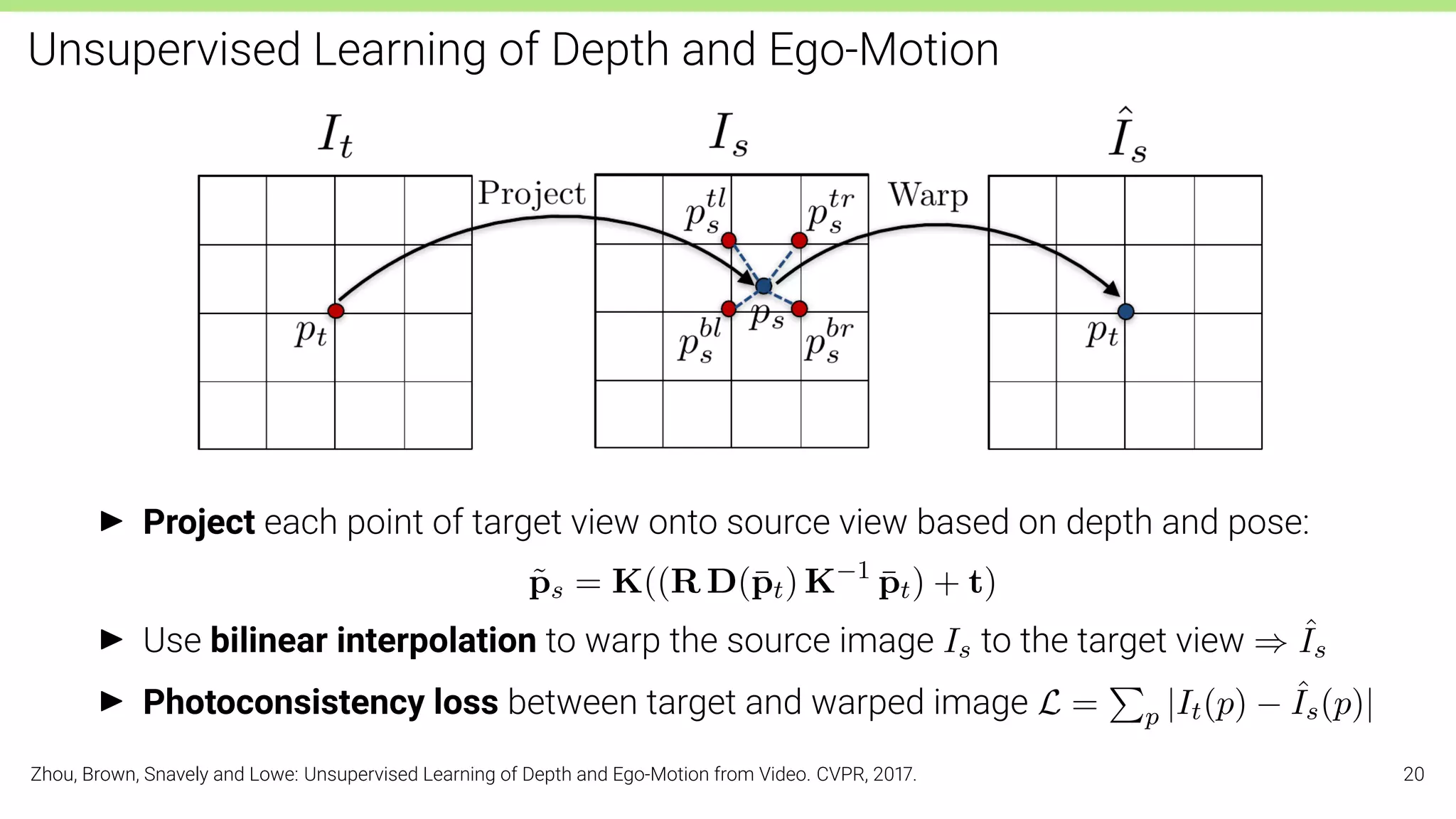
I Project each point of target view onto source view based on depth and pose:
p̃s = K((R D(p̄t) K−1
p̄t) + t)
I Use bilinear interpolation to warp the source image Is to the target view ⇒ ˆ
Is
I Photoconsistency loss between target and warped image L =
P
p |It(p) − ˆ
Is(p)|
Zhou, Brown, Snavely and Lowe: Unsupervised Learning of Depth and Ego-Motion from Video. CVPR, 2017. 20
Unsupervised Learning of Depth and Ego-Motion
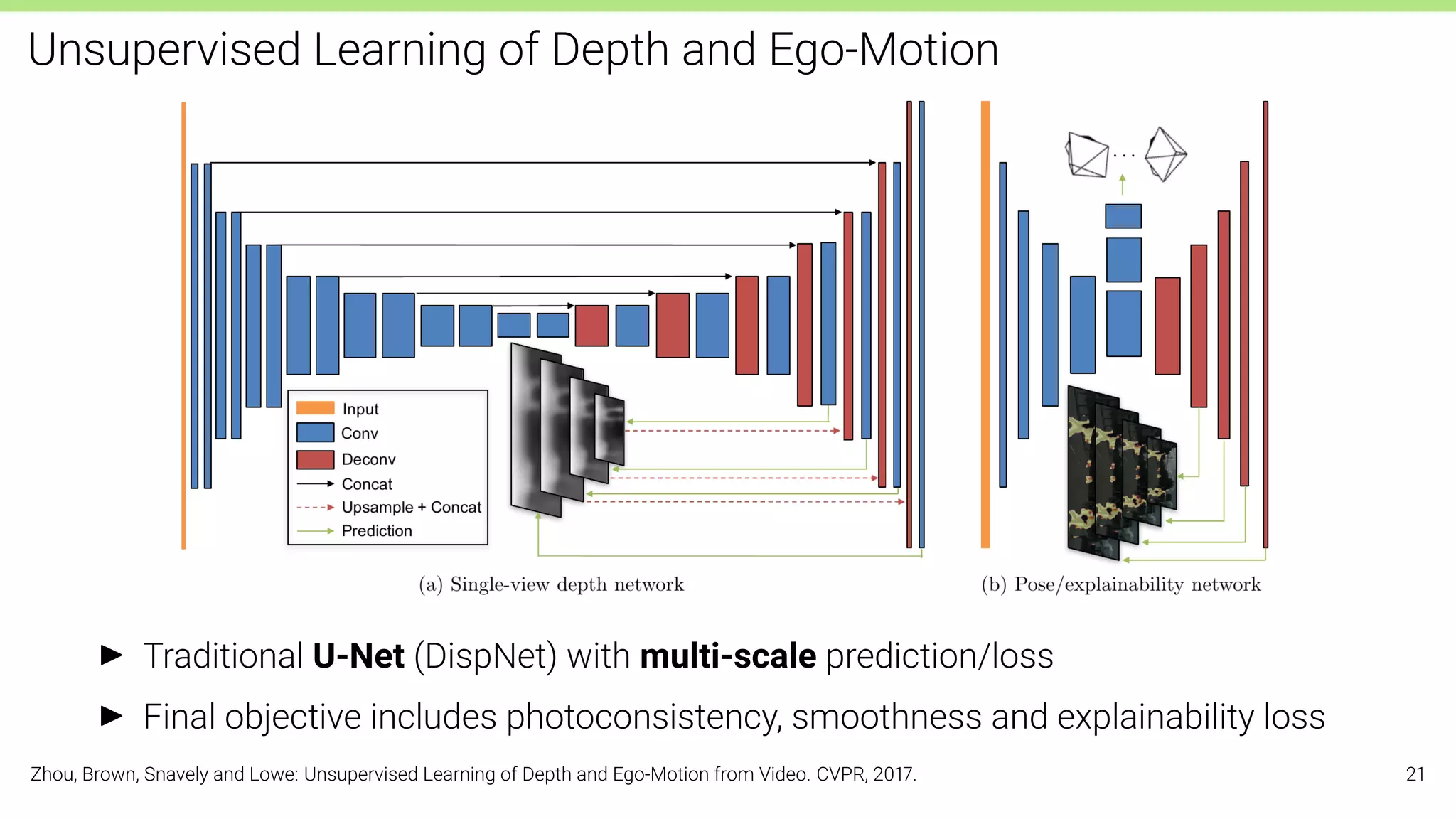
I Traditional U-Net (DispNet) with multi-scale prediction/loss
I Final objective includes photoconsistency, smoothness and explainability loss
Zhou, Brown, Snavely and Lowe: Unsupervised Learning of Depth and Ego-Motion from Video. CVPR, 2017. 21
Unsupervised Learning of Depth and Ego-Motion
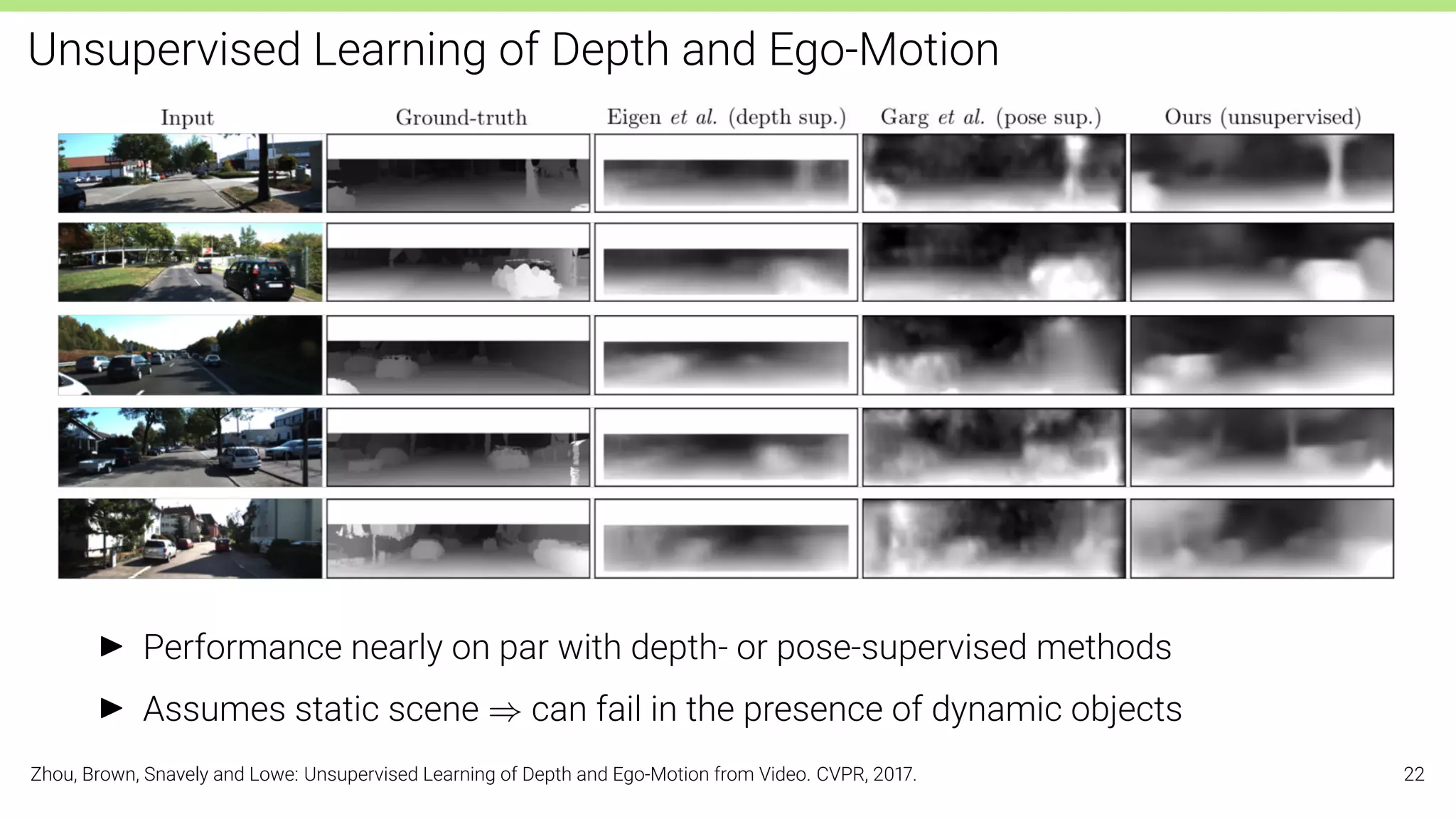
I Performance nearly on par with depth- or pose-supervised methods
I Assumes static scene ⇒ can fail in the presence of dynamic objects
Zhou, Brown, Snavely and Lowe: Unsupervised Learning of Depth and Ego-Motion from Video. CVPR, 2017. 22
Unsupervised Monocular Depth Estimation from Stereo
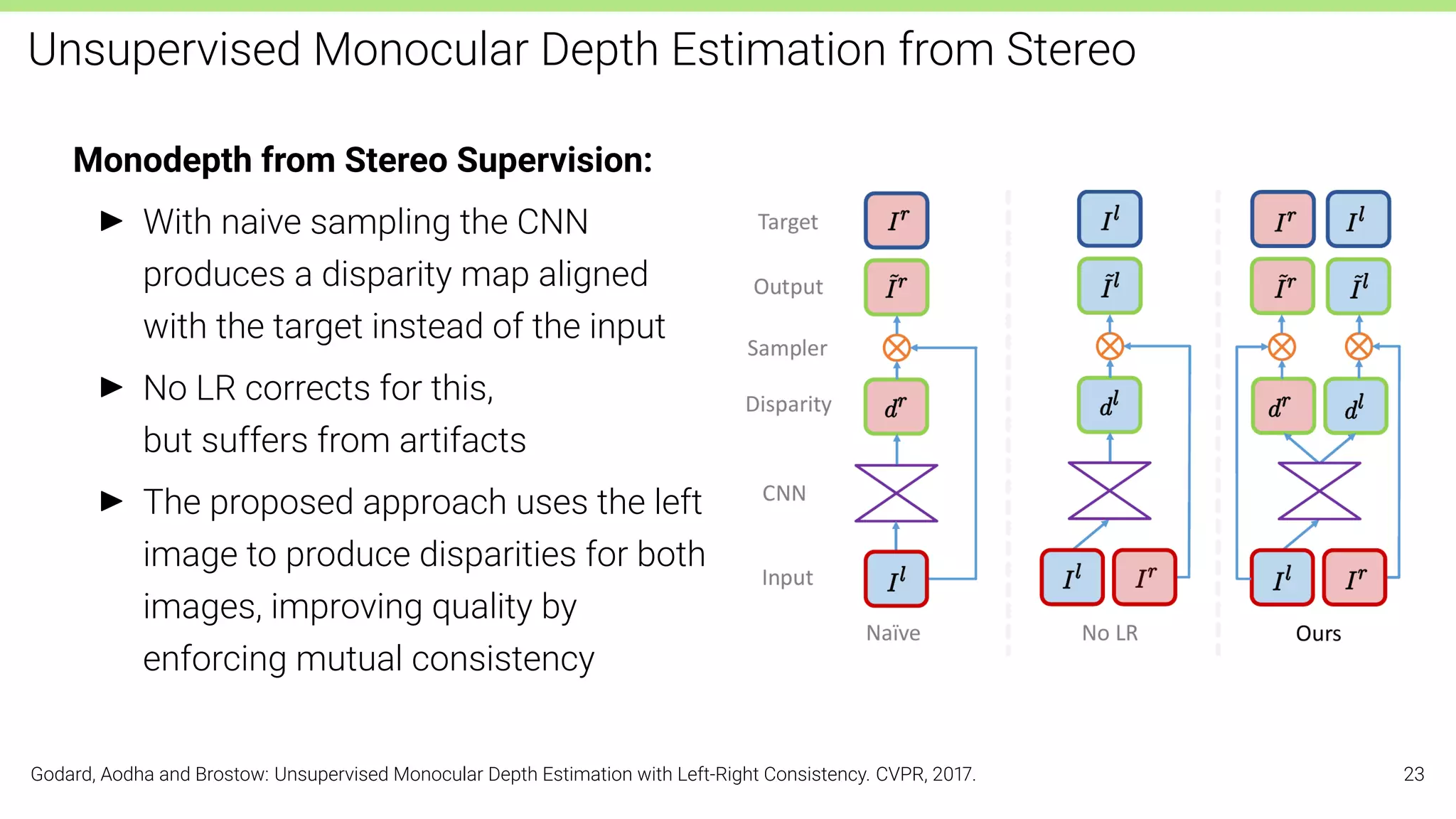
Monodepth from Stereo Supervision:
I With naive sampling the CNN
produces a disparity map aligned
with the target instead of the input
I No LR corrects for this,
but suffers from artifacts
I The proposed approach uses the left
image to produce disparities for both
images, improving quality by
enforcing mutual consistency
Godard, Aodha and Brostow: Unsupervised Monocular Depth Estimation with Left-Right Consistency. CVPR, 2017. 23
Unsupervised Monocular Depth Estimation from Stereo
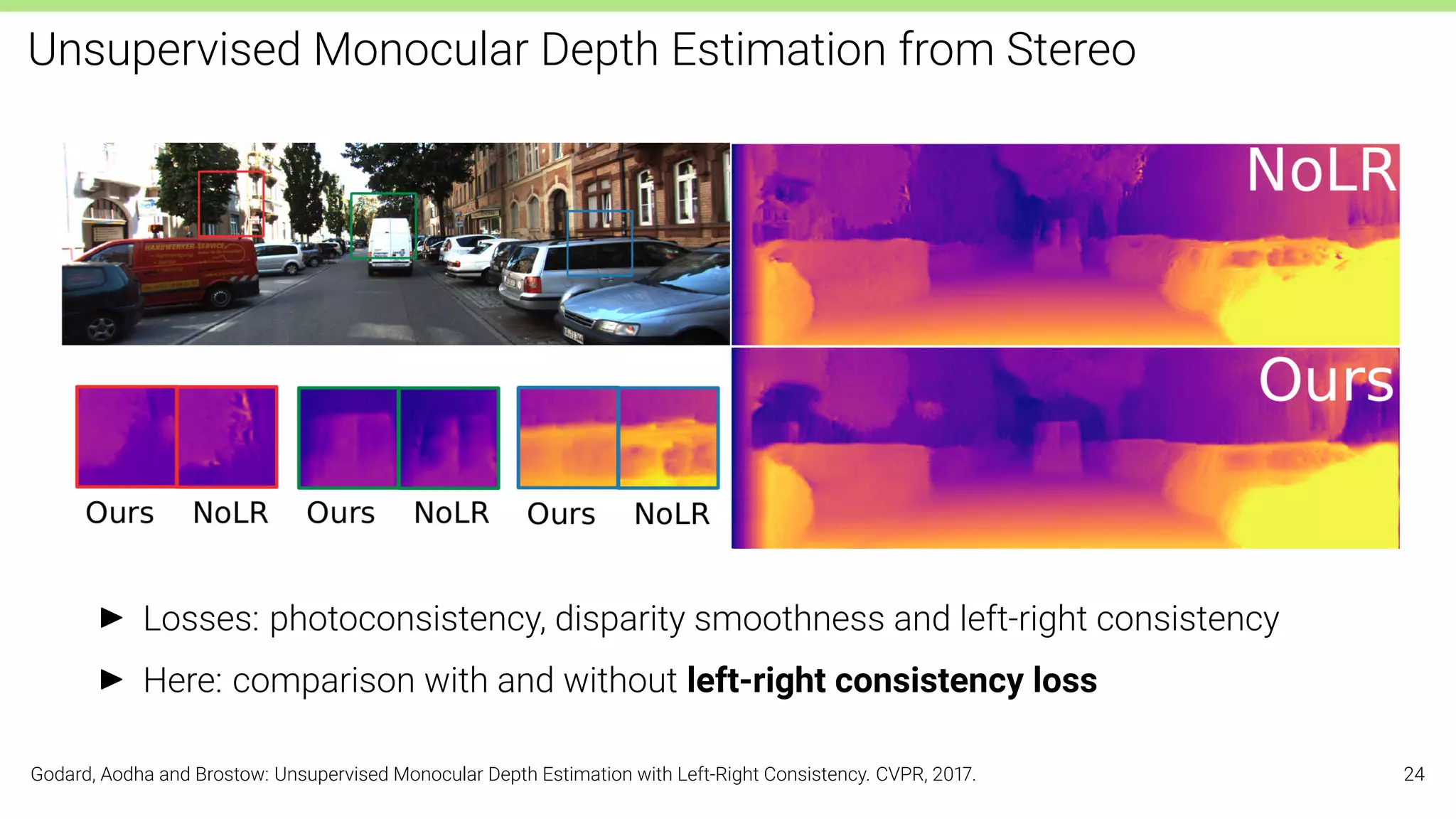
I Losses: photoconsistency, disparity smoothness and left-right consistency
I Here: comparison with and without left-right consistency loss
Godard, Aodha and Brostow: Unsupervised Monocular Depth Estimation with Left-Right Consistency. CVPR, 2017. 24
Digging Into Self-Supervised Monocular Depth Estimation
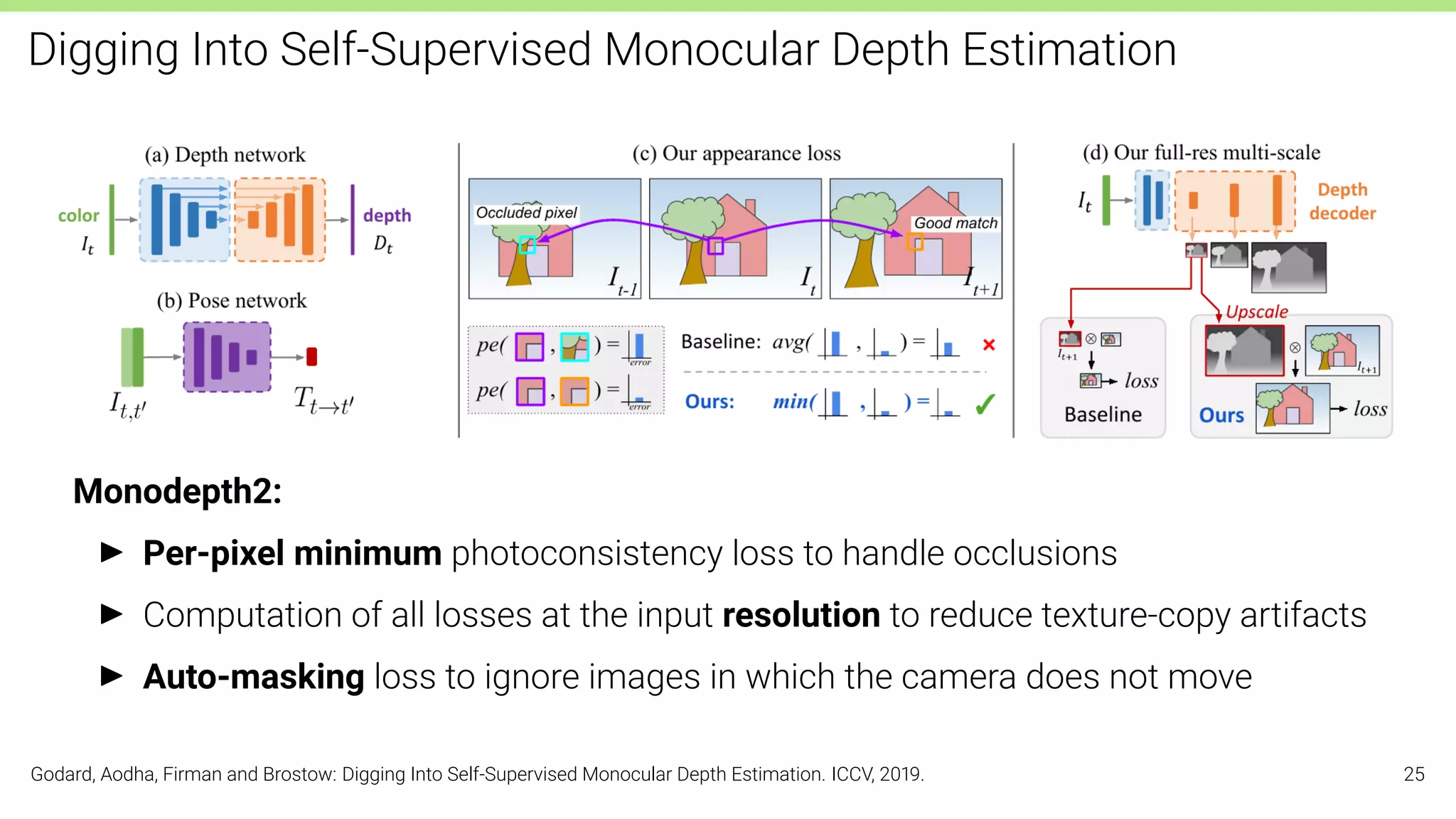
Monodepth2:
I Per-pixel minimum photoconsistency loss to handle occlusions
I Computation of all losses at the input resolution to reduce texture-copy artifacts
I Auto-masking loss to ignore images in which the camera does not move
Godard, Aodha, Firman and Brostow: Digging Into Self-Supervised Monocular Depth Estimation. ICCV, 2019. 25
Digging Into Self-Supervised Monocular Depth Estimation
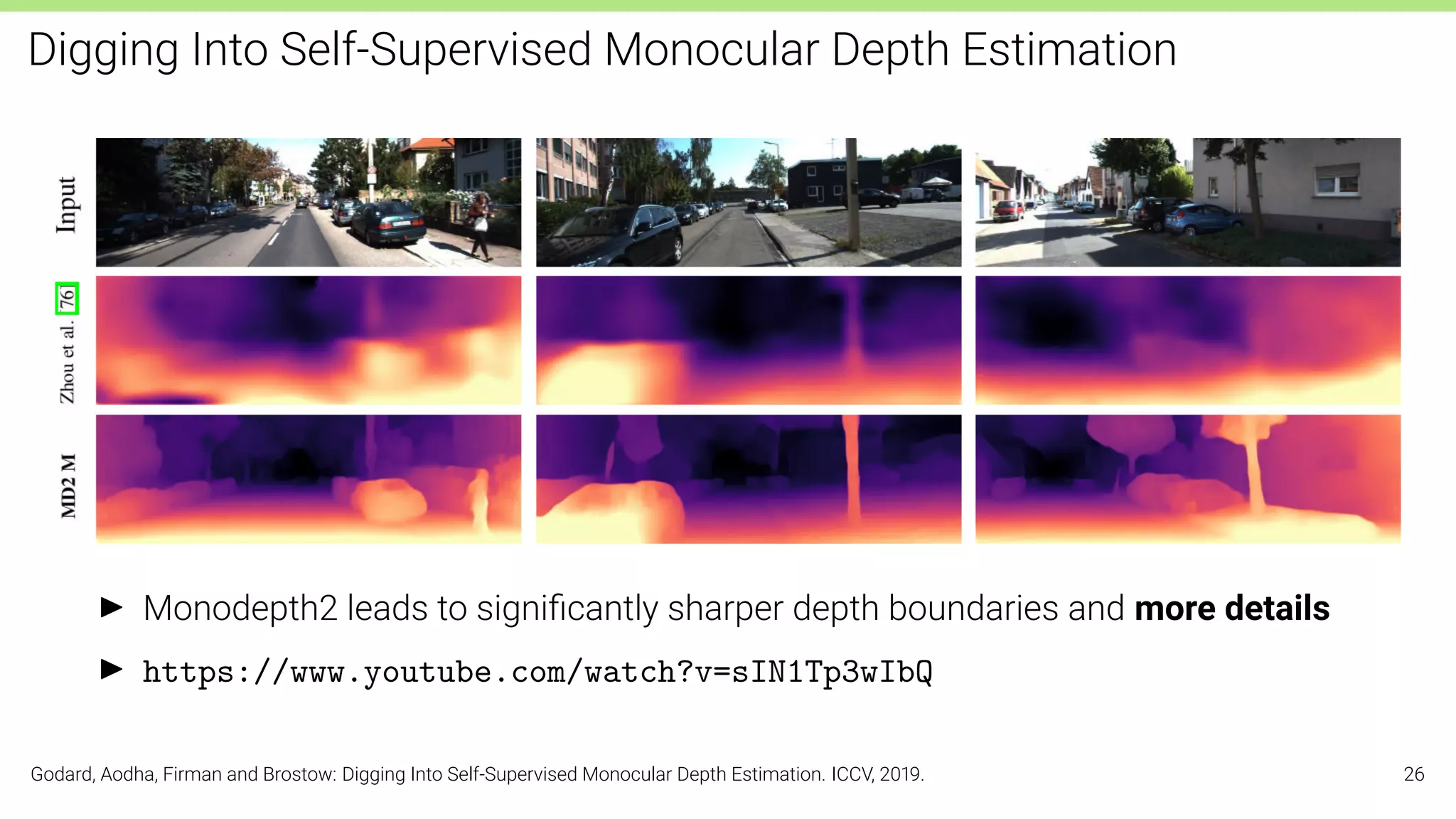
I Monodepth2 leads to significantly sharper depth boundaries and more details
I https://www.youtube.com/watch?v=sIN1Tp3wIbQ
Godard, Aodha, Firman and Brostow: Digging Into Self-Supervised Monocular Depth Estimation. ICCV, 2019. 26
Unsupervised Learning of Optical Flow
Bidirectional Training:
I Share weights between both directions to train a universal network for optical
flow that predicts accurate flow in either direction (forward and backward)
I As network architecture, FlowNetC [Dosovitskiy et al., 2015] is used
Meister, Hur and Roth: UnFlow: Unsupervised Learning of Optical Flow With a Bidirectional Census Loss. AAAI, 2018. 27
Unsupervised Learning of Optical Flow
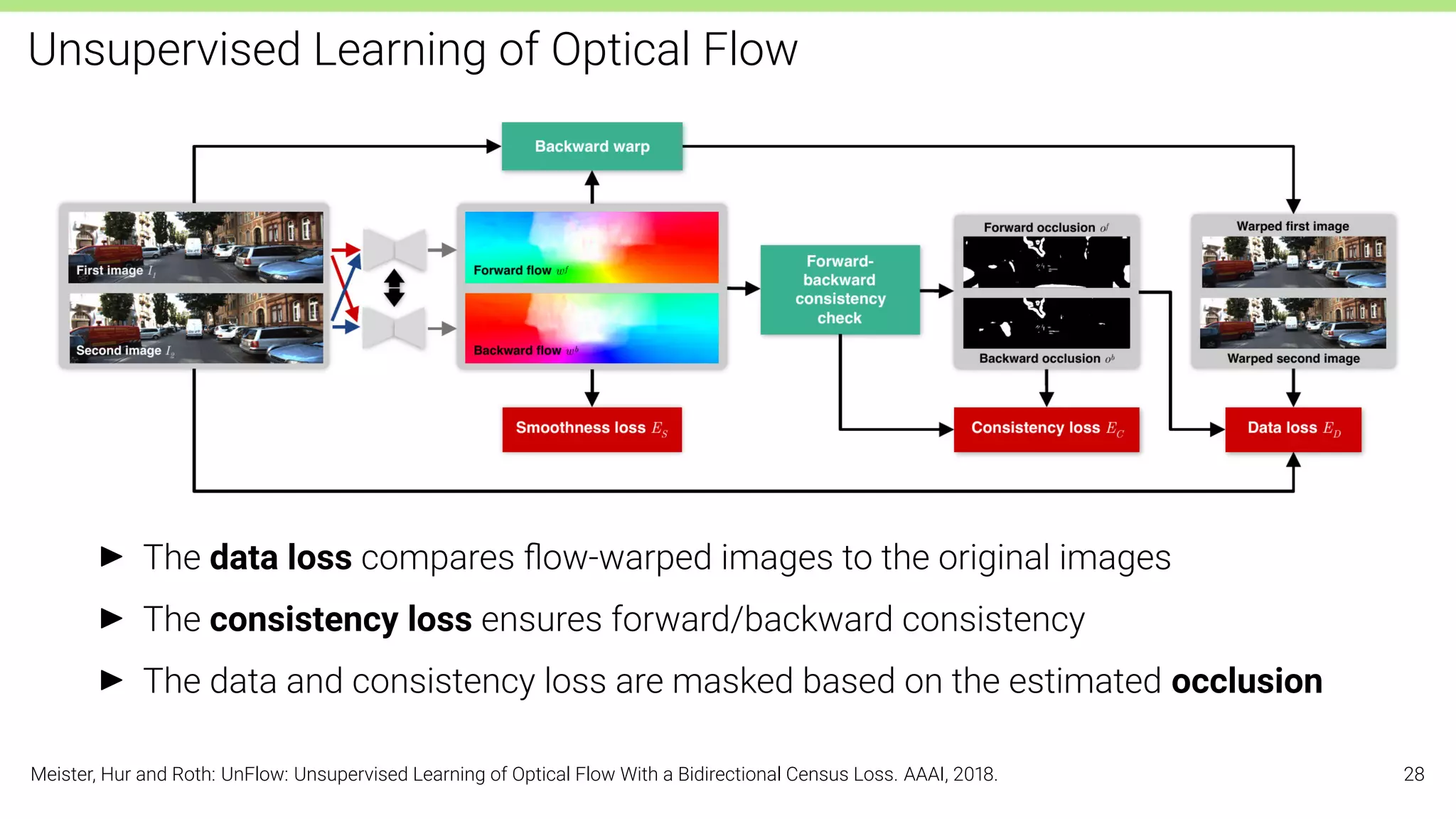
I The data loss compares flow-warped images to the original images
I The consistency loss ensures forward/backward consistency
I The data and consistency loss are masked based on the estimated occlusion
Meister, Hur and Roth: UnFlow: Unsupervised Learning of Optical Flow With a Bidirectional Census Loss. AAAI, 2018. 28
Unsupervised Learning of Optical Flow
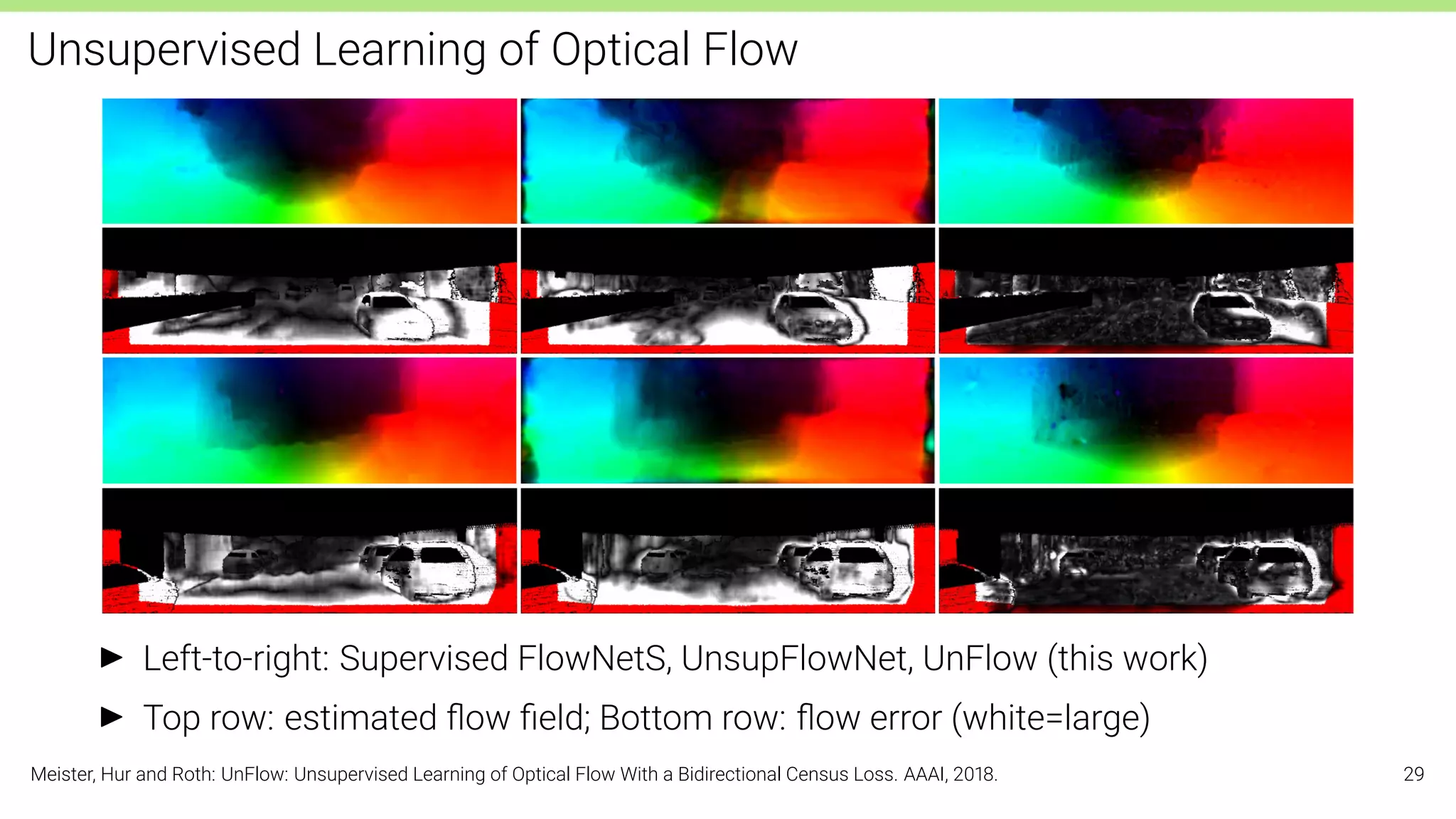
I Left-to-right: Supervised FlowNetS, UnsupFlowNet, UnFlow (this work)
I Top row: estimated flow field; Bottom row: flow error (white=large)
Meister, Hur and Roth: UnFlow: Unsupervised Learning of Optical Flow With a Bidirectional Census Loss. AAAI, 2018. 29
Self-Supervised Monocular Scene Flow Estimation
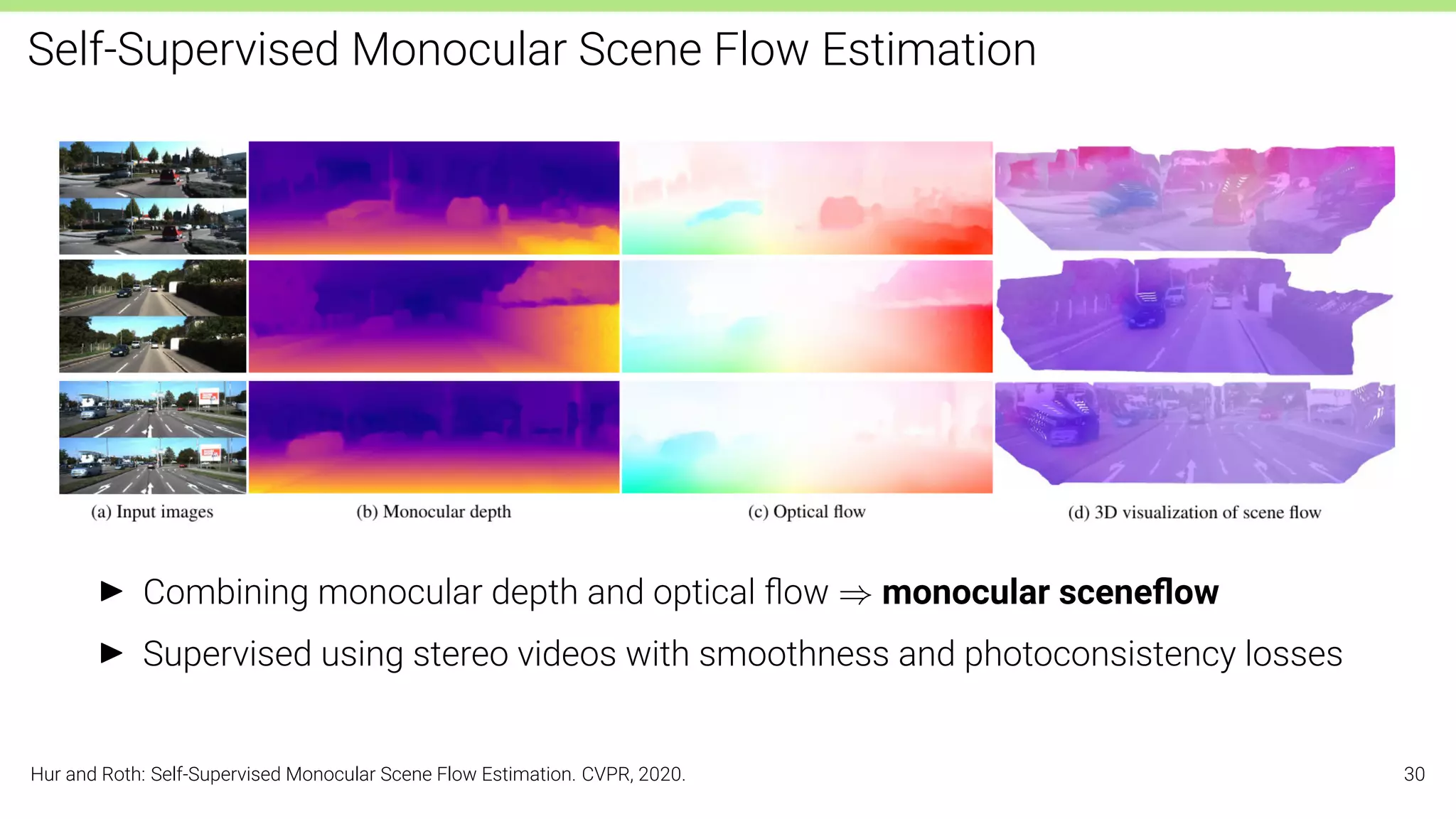
I Combining monocular depth and optical flow ⇒ monocular sceneflow
I Supervised using stereo videos with smoothness and photoconsistency losses
Hur and Roth: Self-Supervised Monocular Scene Flow Estimation. CVPR, 2020. 30
11.3
Pretext Tasks
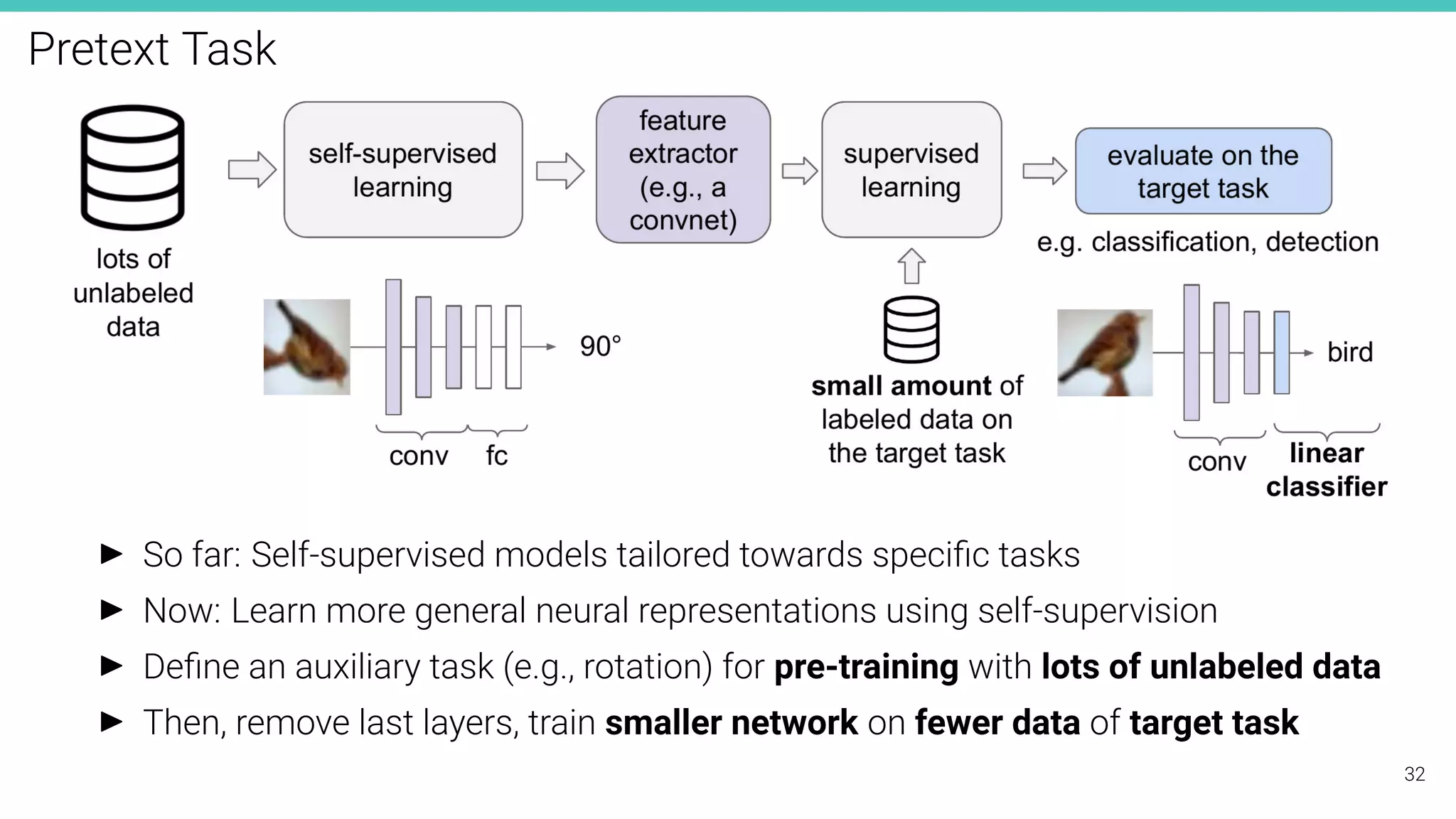
Pretext Task
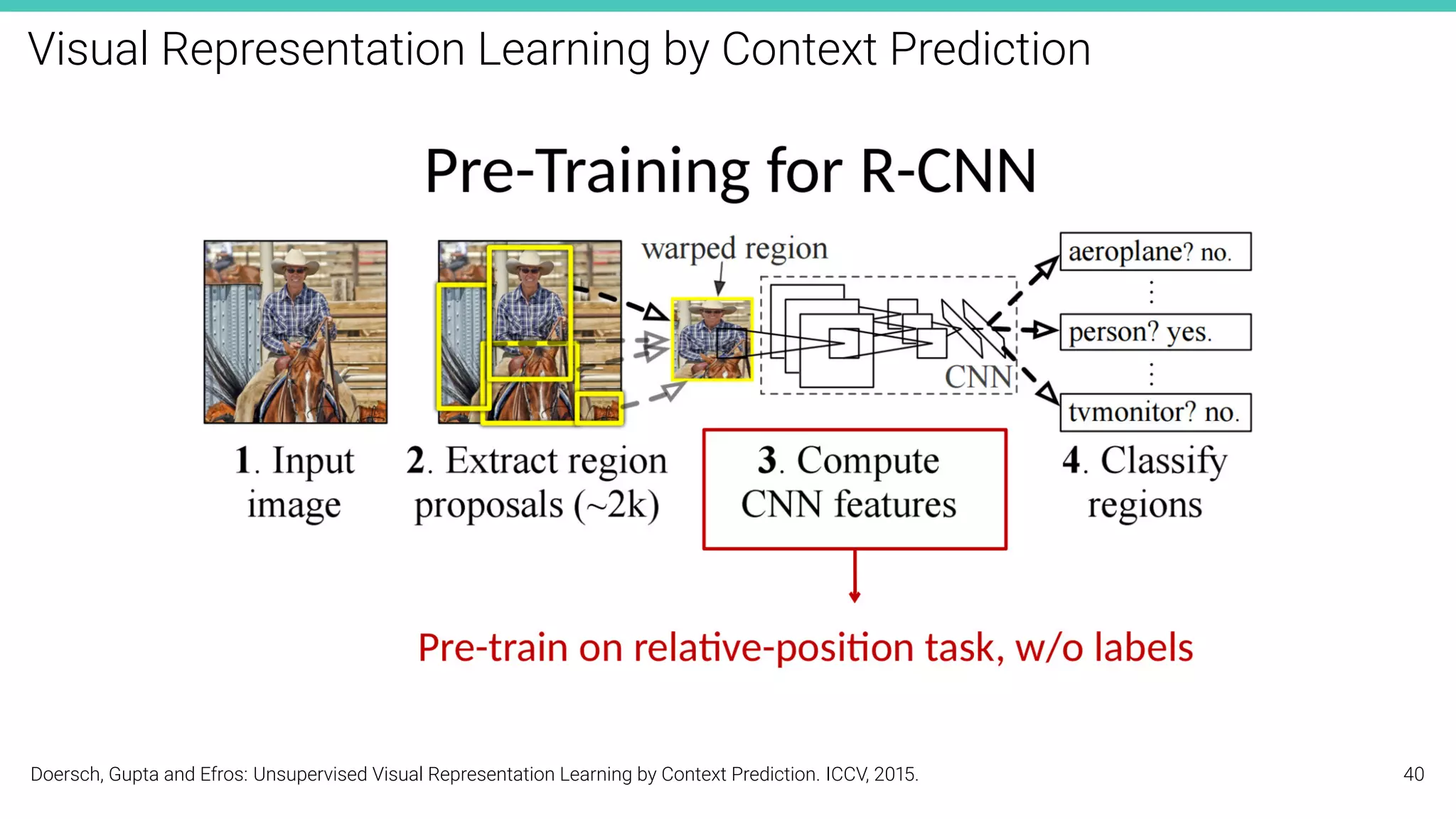
I So far: Self-supervised models tailored towards specific tasks
I Now: Learn more general neural representations using self-supervision
I Define an auxiliary task (e.g., rotation) for pre-training with lots of unlabeled data
I Then, remove last layers, train smaller network on fewer data of target task
32
Pretext Task
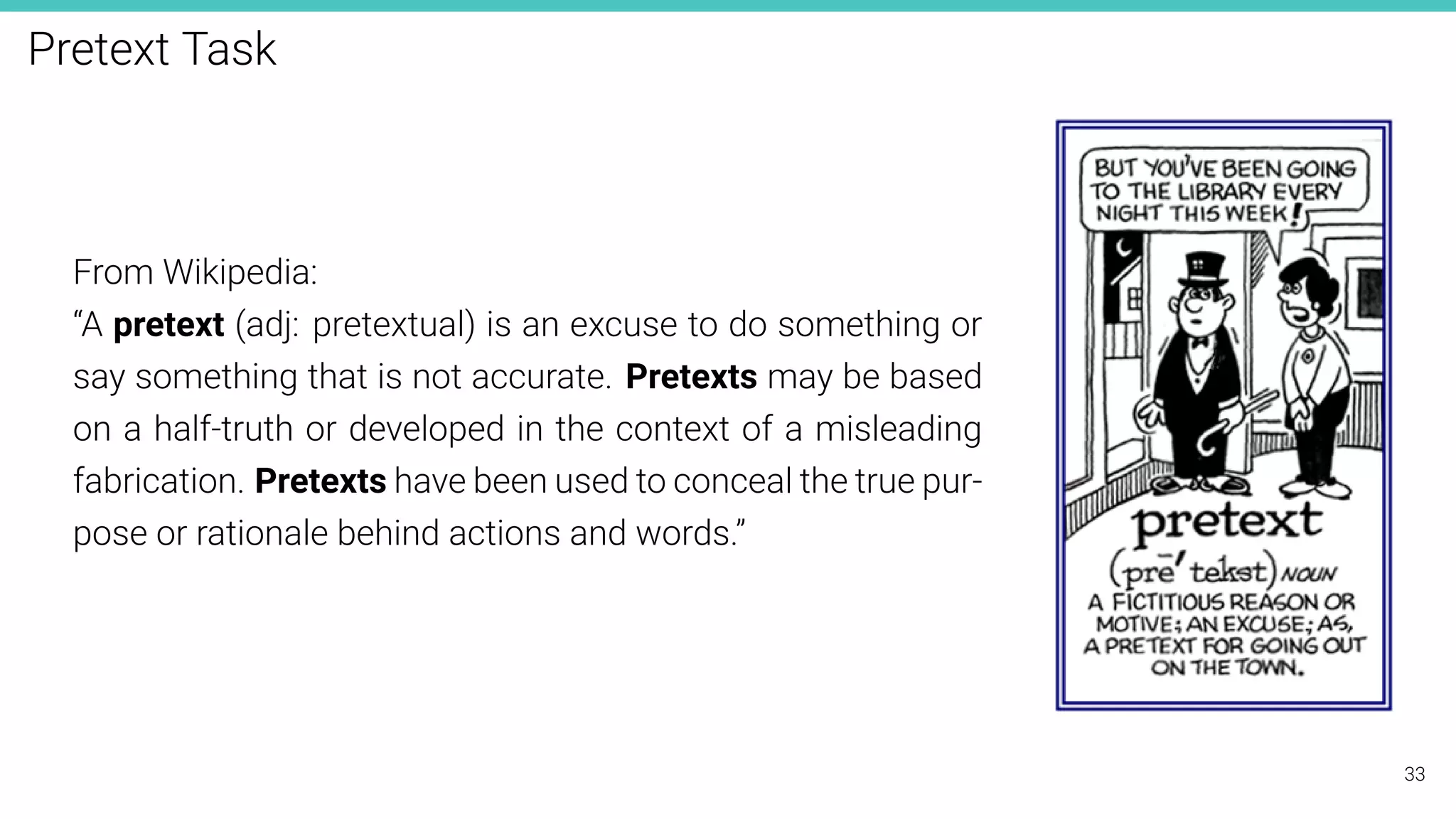
From Wikipedia:
“A pretext (adj: pretextual) is an excuse to do something or
say something that is not accurate. Pretexts may be based
on a half-truth or developed in the context of a misleading
fabrication. Pretexts have been used to conceal the true pur-
pose or rationale behind actions and words.”
33
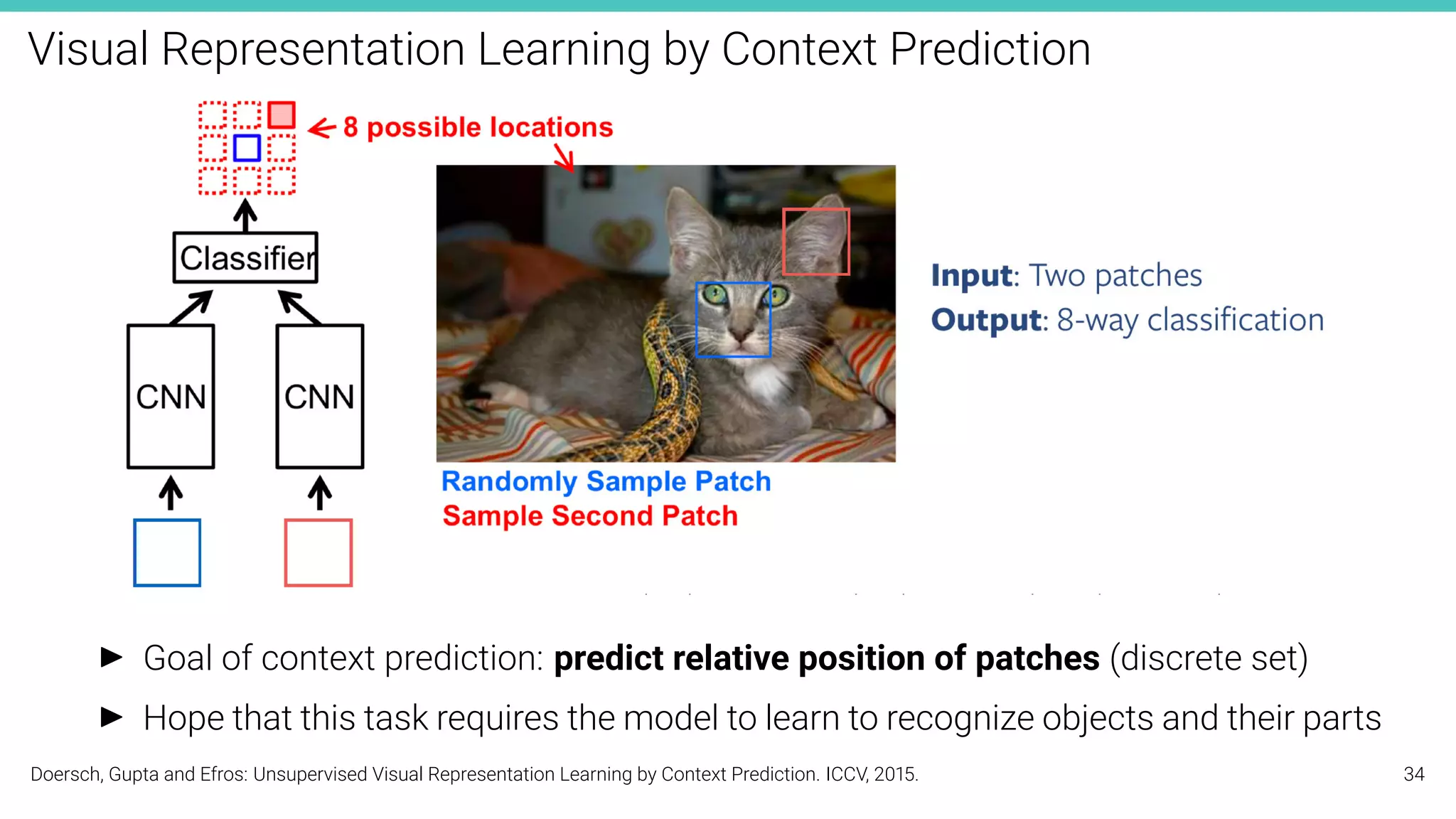
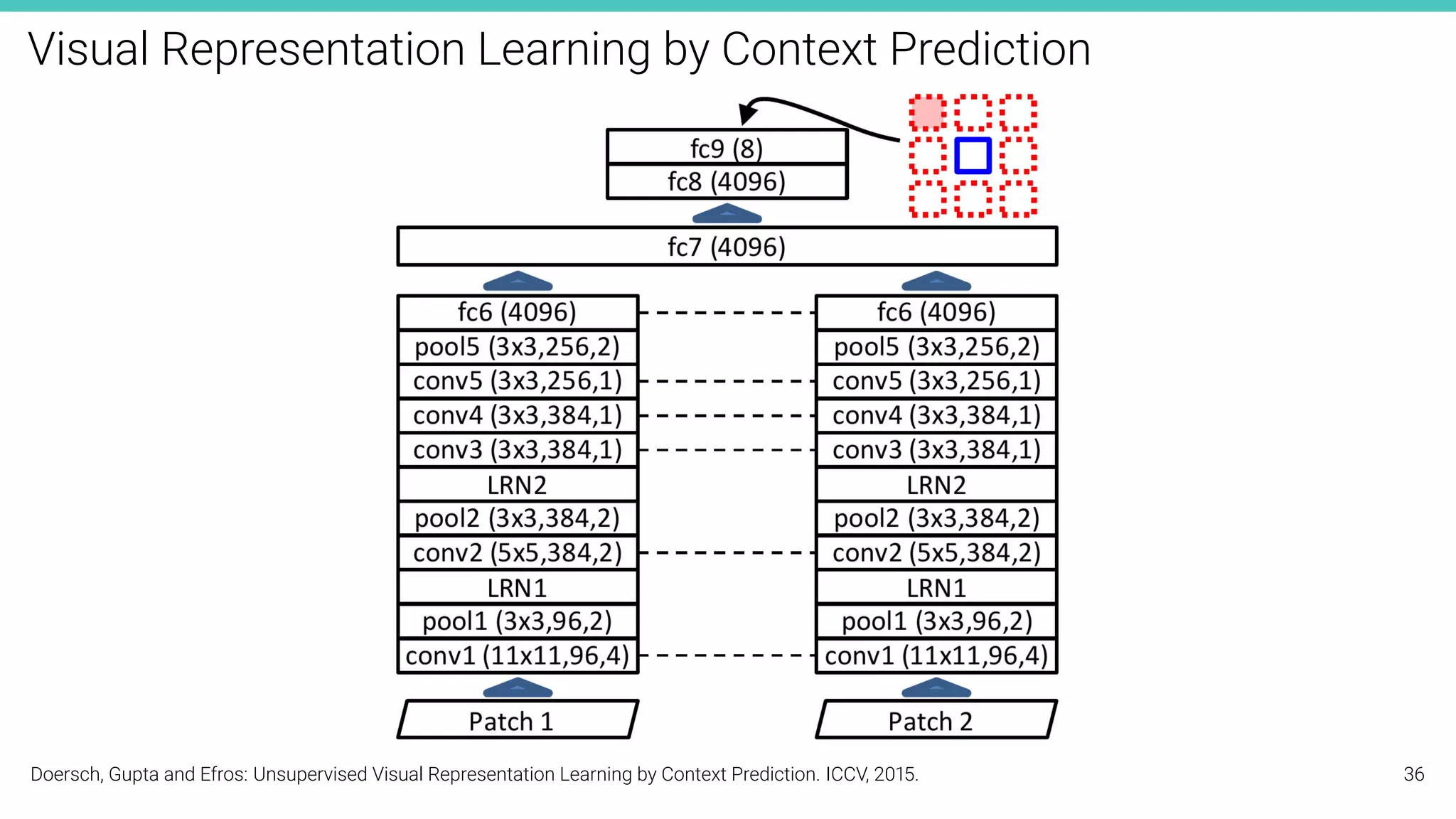
Visual Representation Learning by Context Prediction
I Goal of context prediction: predict relative position of patches (discrete set)
I Hope that this task requires the model to learn to recognize objects and their parts
Doersch, Gupta and Efros: Unsupervised Visual Representation Learning by Context Prediction. ICCV, 2015. 34
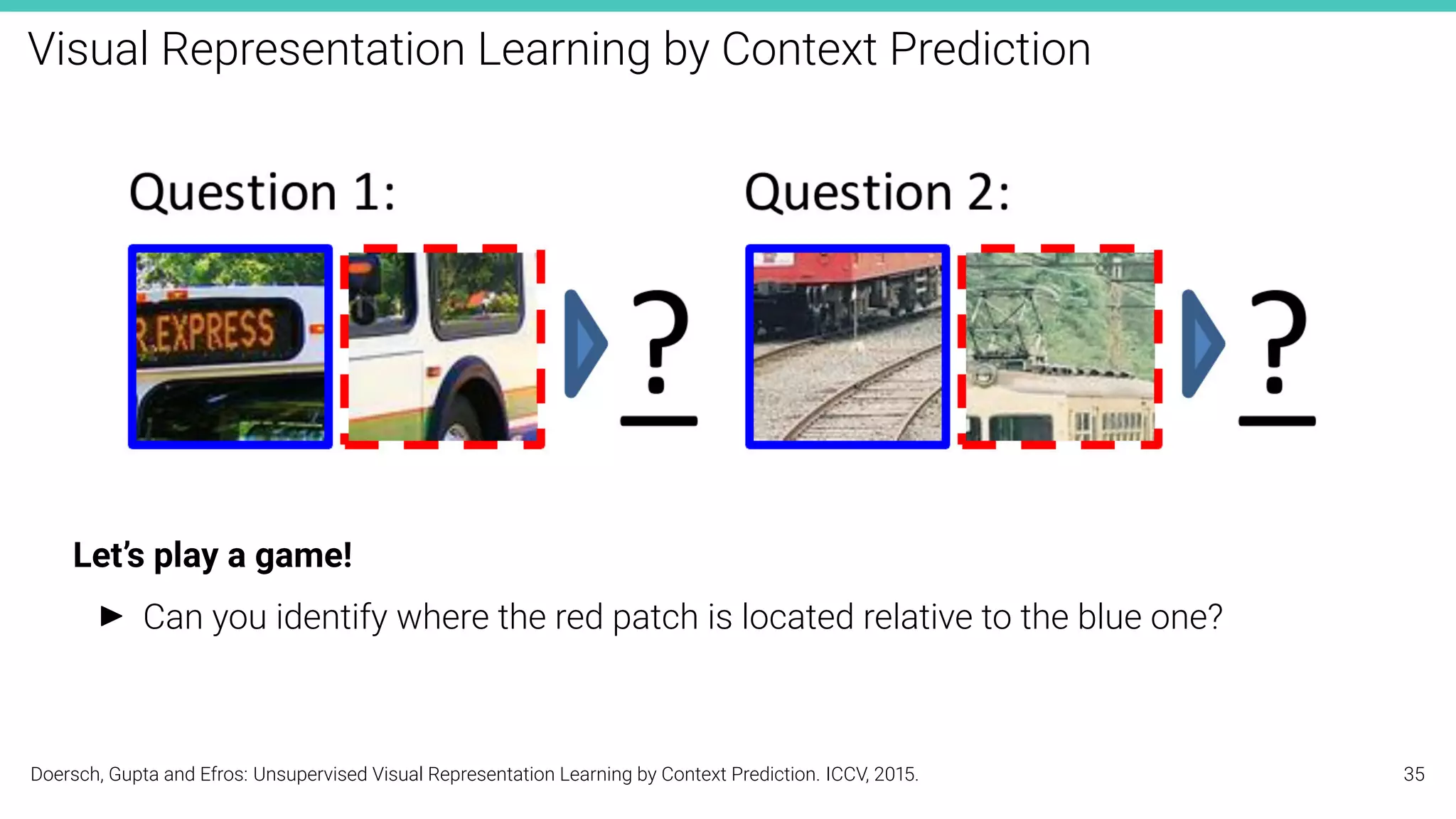
Visual Representation Learning by Context Prediction
Let’s play a game!
I Can you identify where the red patch is located relative to the blue one?
Doersch, Gupta and Efros: Unsupervised Visual Representation Learning by Context Prediction. ICCV, 2015. 35
Visual Representation Learning by Context Prediction
Doersch, Gupta and Efros: Unsupervised Visual Representation Learning by Context Prediction. ICCV, 2015. 36
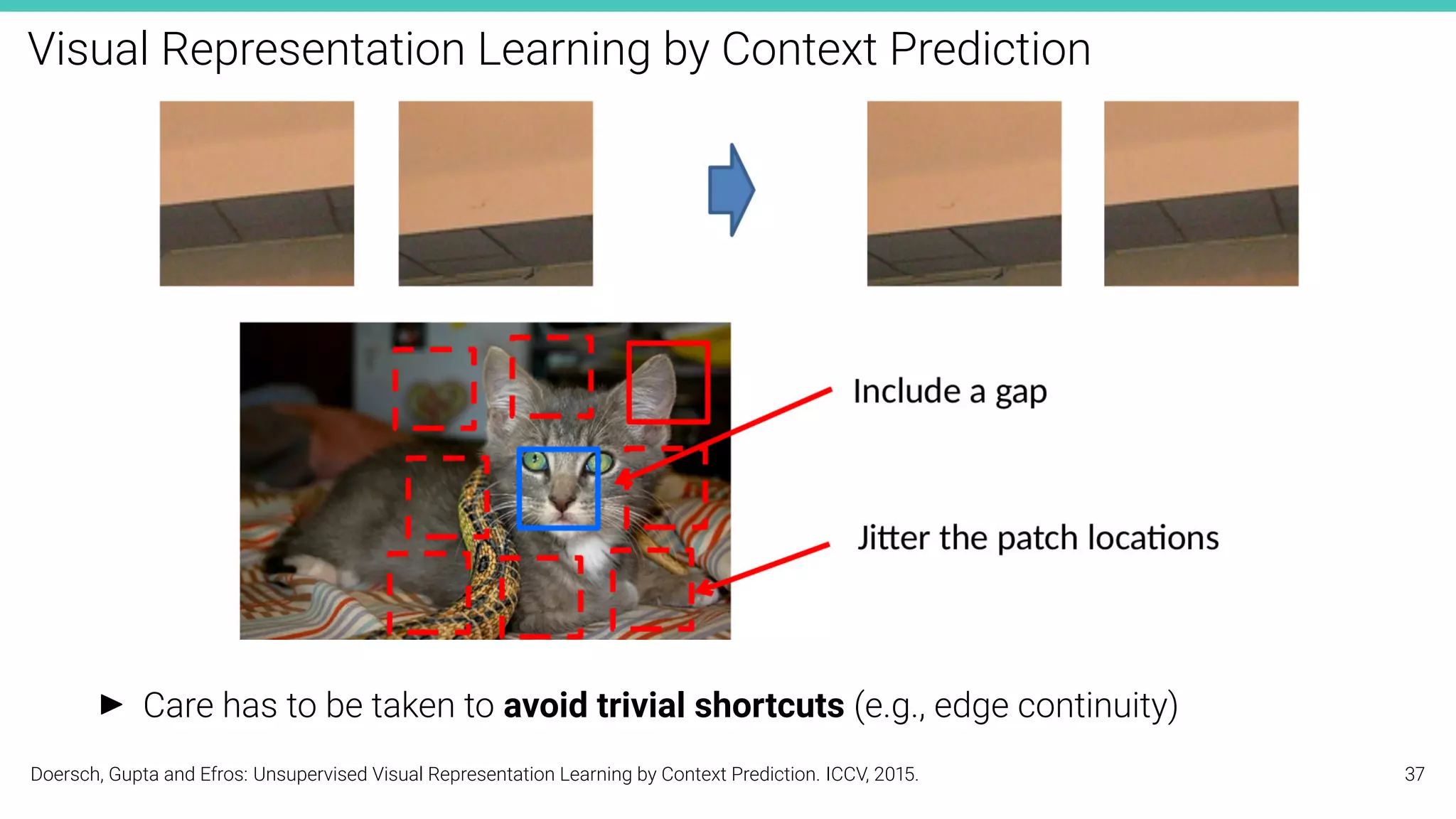
Visual Representation Learning by Context Prediction
I Care has to be taken to avoid trivial shortcuts (e.g., edge continuity)
Doersch, Gupta and Efros: Unsupervised Visual Representation Learning by Context Prediction. ICCV, 2015. 37
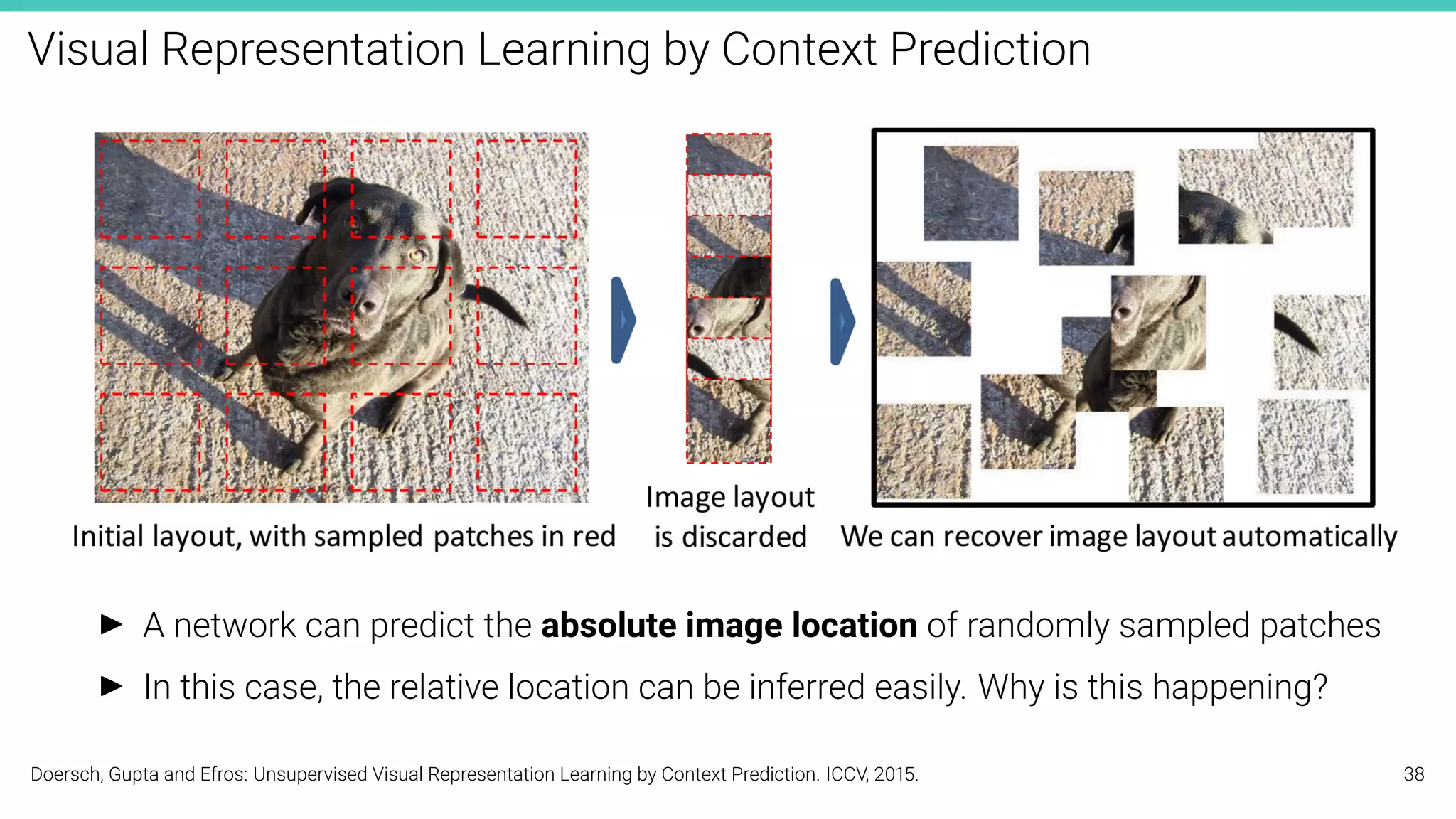
Visual Representation Learning by Context Prediction
I A network can predict the absolute image location of randomly sampled patches
I In this case, the relative location can be inferred easily. Why is this happening?
Doersch, Gupta and Efros: Unsupervised Visual Representation Learning by Context Prediction. ICCV, 2015. 38
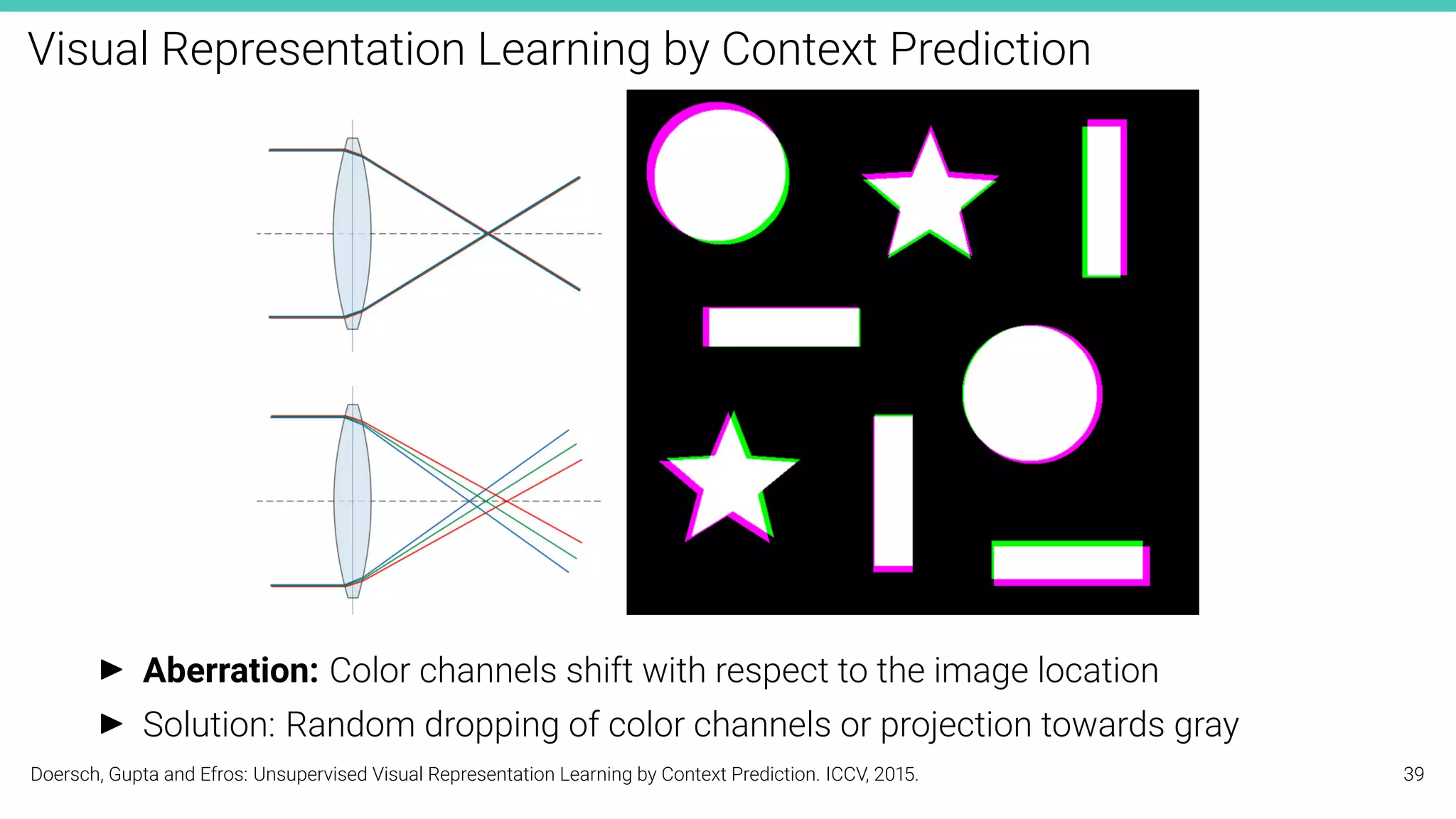
Visual Representation Learning by Context Prediction
I Aberration: Color channels shift with respect to the image location
I Solution: Random dropping of color channels or projection towards gray
Doersch, Gupta and Efros: Unsupervised Visual Representation Learning by Context Prediction. ICCV, 2015. 39
Visual Representation Learning by Context Prediction
Doersch, Gupta and Efros: Unsupervised Visual Representation Learning by Context Prediction. ICCV, 2015. 40
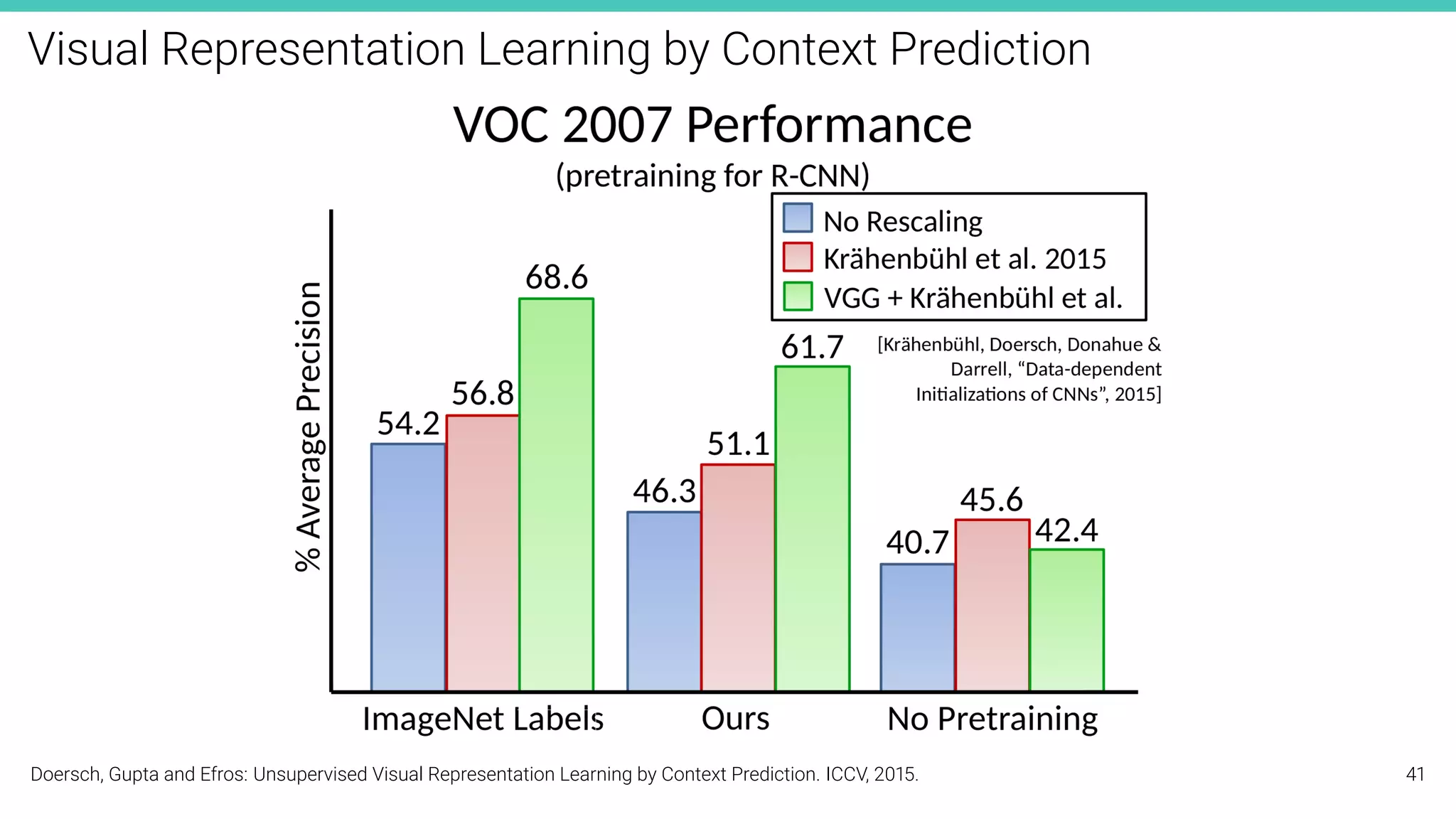
Visual Representation Learning by Context Prediction
Doersch, Gupta and Efros: Unsupervised Visual Representation Learning by Context Prediction. ICCV, 2015. 41
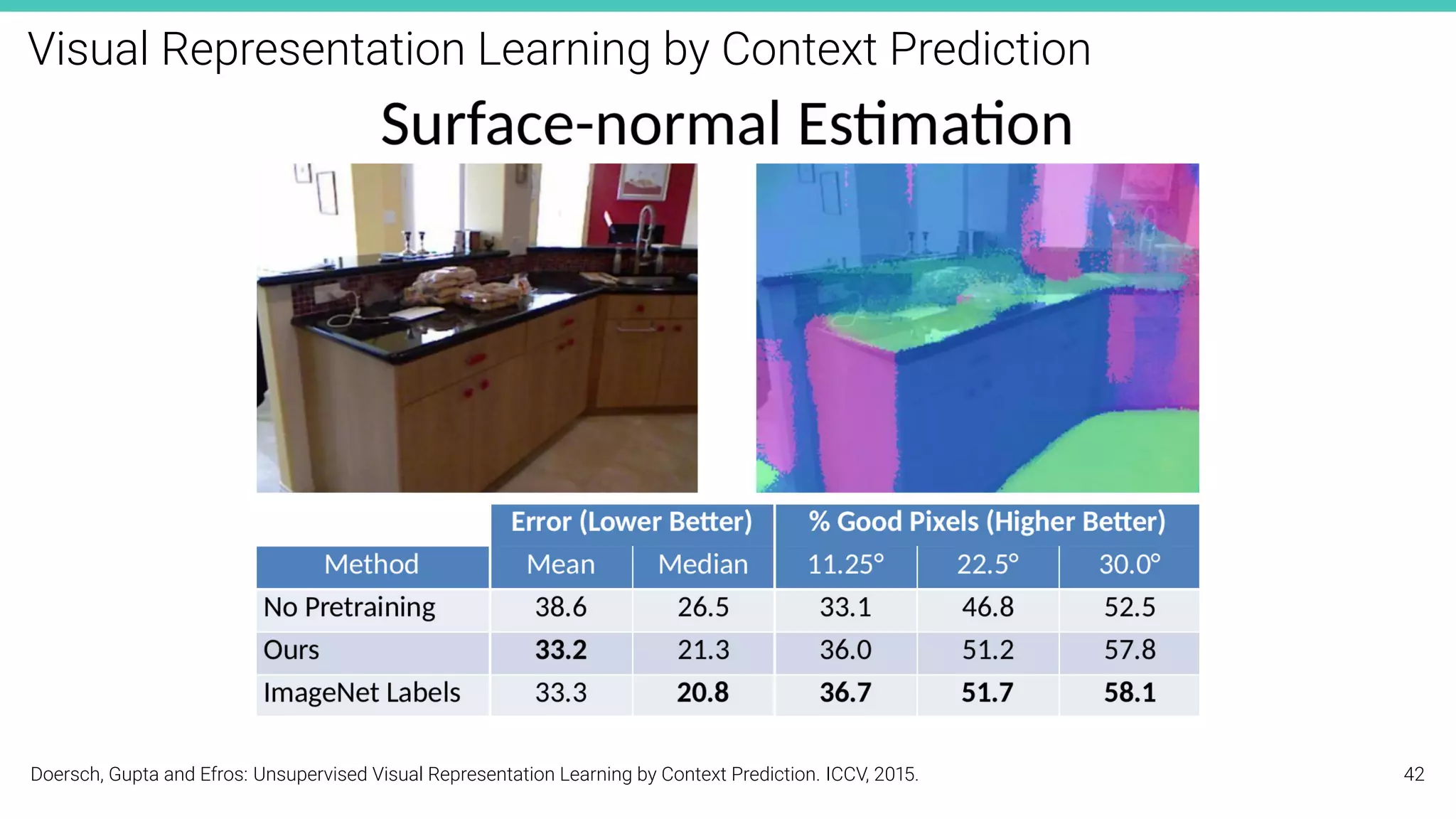
Visual Representation Learning by Context Prediction
Doersch, Gupta and Efros: Unsupervised Visual Representation Learning by Context Prediction. ICCV, 2015. 42
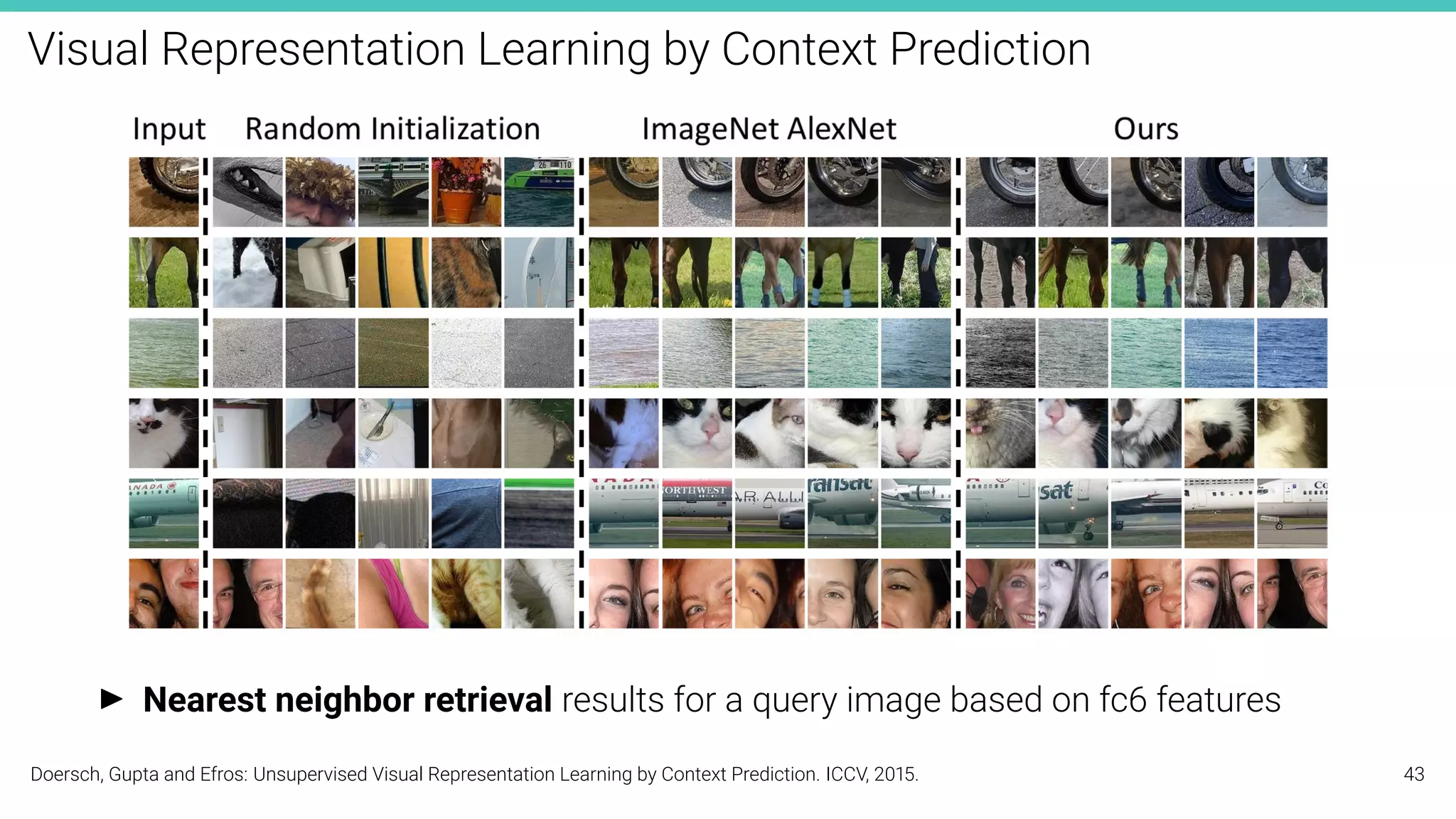
Visual Representation Learning by Context Prediction
I Nearest neighbor retrieval results for a query image based on fc6 features
Doersch, Gupta and Efros: Unsupervised Visual Representation Learning by Context Prediction. ICCV, 2015. 43
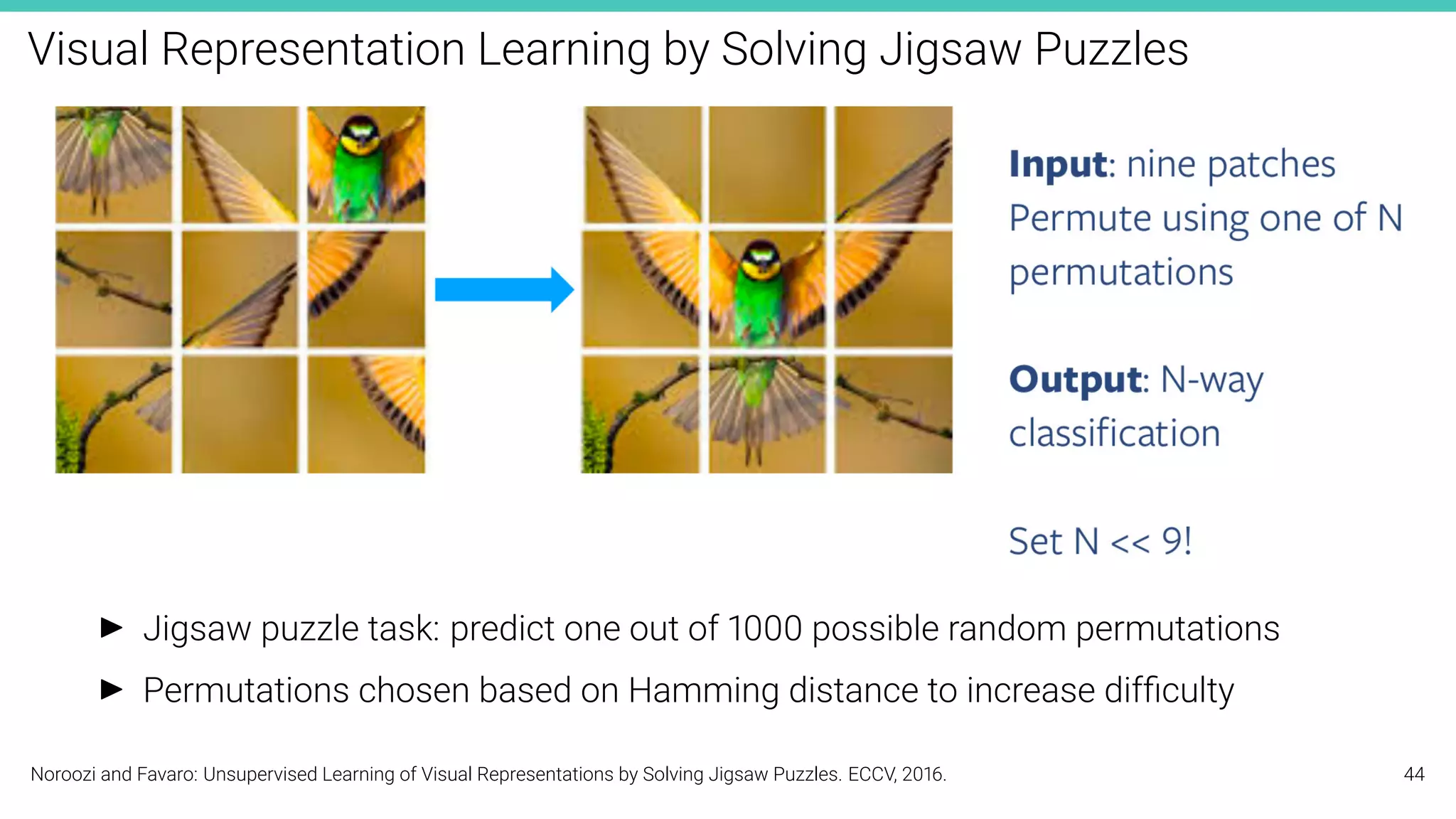
Visual Representation Learning by Solving Jigsaw Puzzles
I Jigsaw puzzle task: predict one out of 1000 possible random permutations
I Permutations chosen based on Hamming distance to increase difficulty
Noroozi and Favaro: Unsupervised Learning of Visual Representations by Solving Jigsaw Puzzles. ECCV, 2016. 44
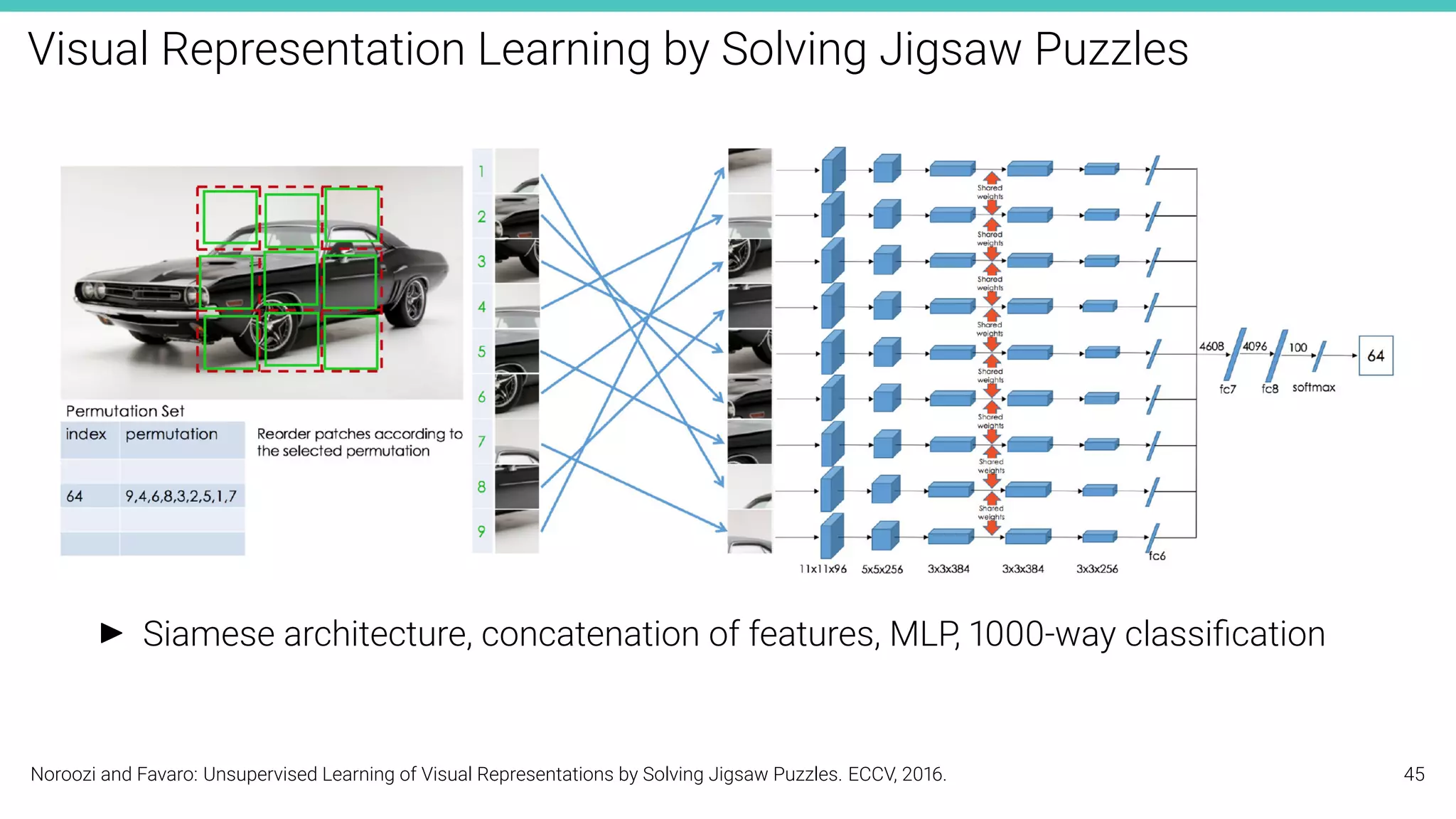
Visual Representation Learning by Solving Jigsaw Puzzles
I Siamese architecture, concatenation of features, MLP, 1000-way classification
Noroozi and Favaro: Unsupervised Learning of Visual Representations by Solving Jigsaw Puzzles. ECCV, 2016. 45
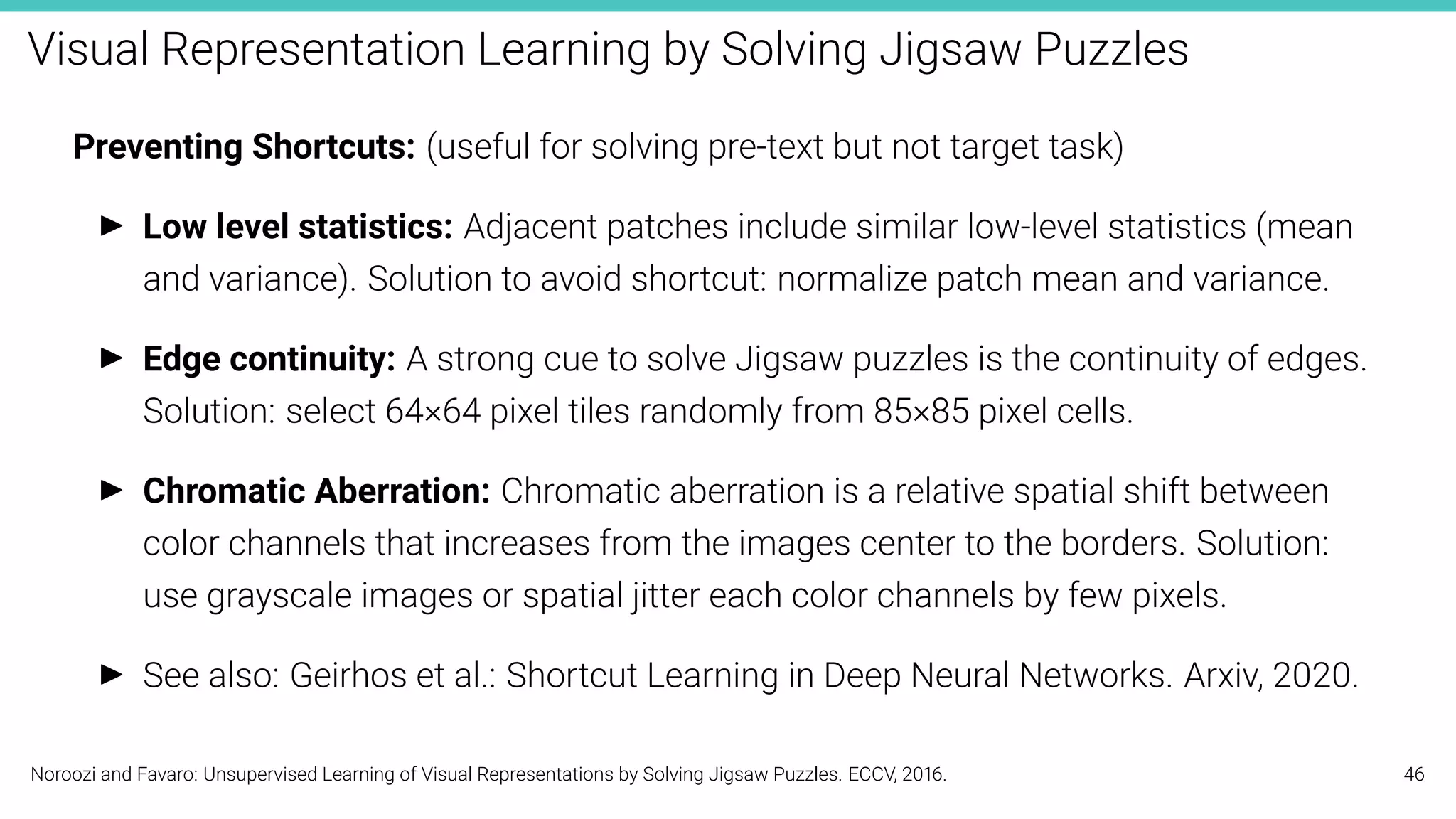
Visual Representation Learning by Solving Jigsaw Puzzles
Preventing Shortcuts: (useful for solving pre-text but not target task)
I Low level statistics: Adjacent patches include similar low-level statistics (mean
and variance). Solution to avoid shortcut: normalize patch mean and variance.
I Edge continuity: A strong cue to solve Jigsaw puzzles is the continuity of edges.
Solution: select 64×64 pixel tiles randomly from 85×85 pixel cells.
I Chromatic Aberration: Chromatic aberration is a relative spatial shift between
color channels that increases from the images center to the borders. Solution:
use grayscale images or spatial jitter each color channels by few pixels.
I See also: Geirhos et al.: Shortcut Learning in Deep Neural Networks. Arxiv, 2020.
Noroozi and Favaro: Unsupervised Learning of Visual Representations by Solving Jigsaw Puzzles. ECCV, 2016. 46
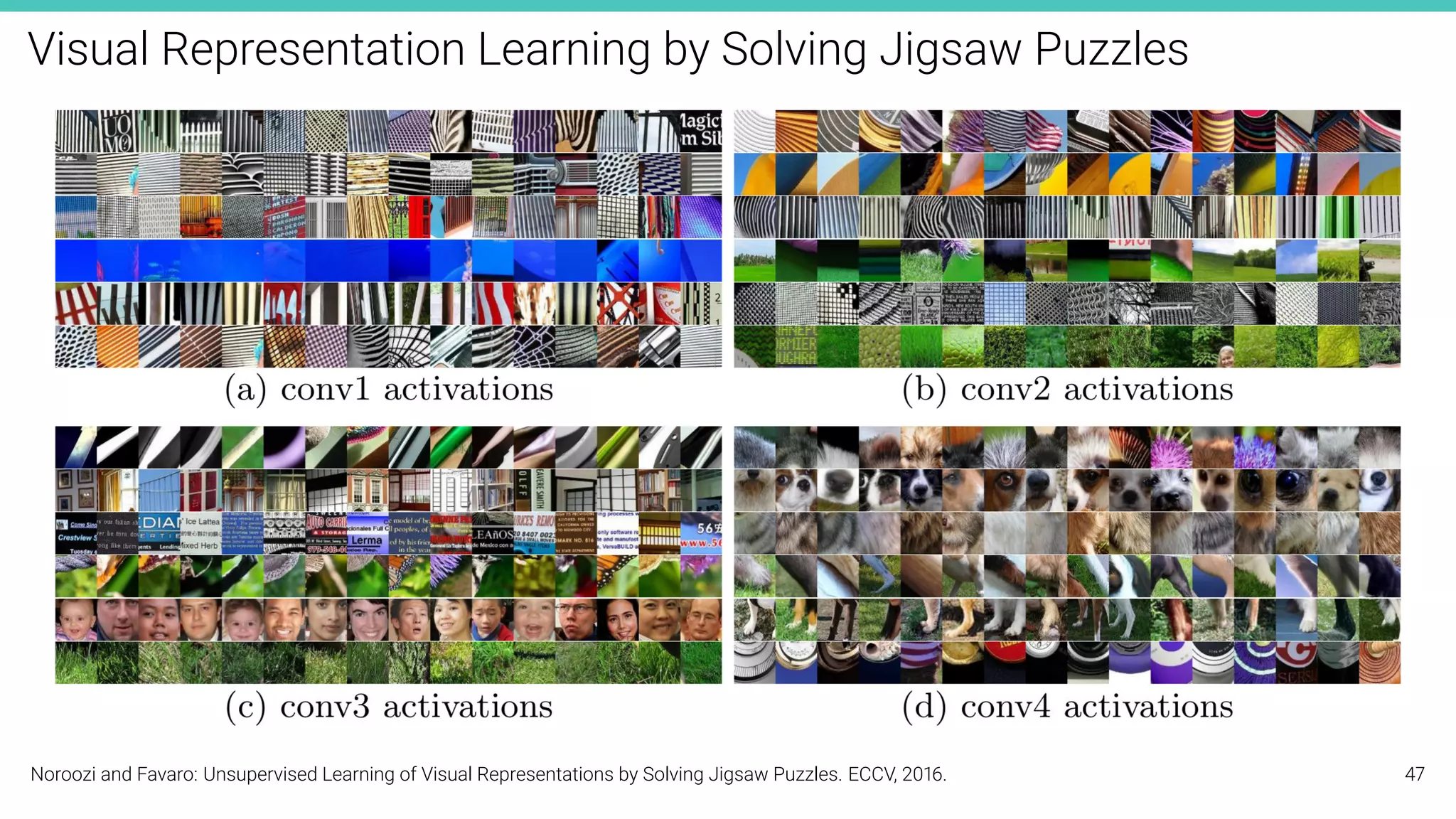
Visual Representation Learning by Solving Jigsaw Puzzles
Noroozi and Favaro: Unsupervised Learning of Visual Representations by Solving Jigsaw Puzzles. ECCV, 2016. 47
Visual Representation Learning by Solving Jigsaw Puzzles
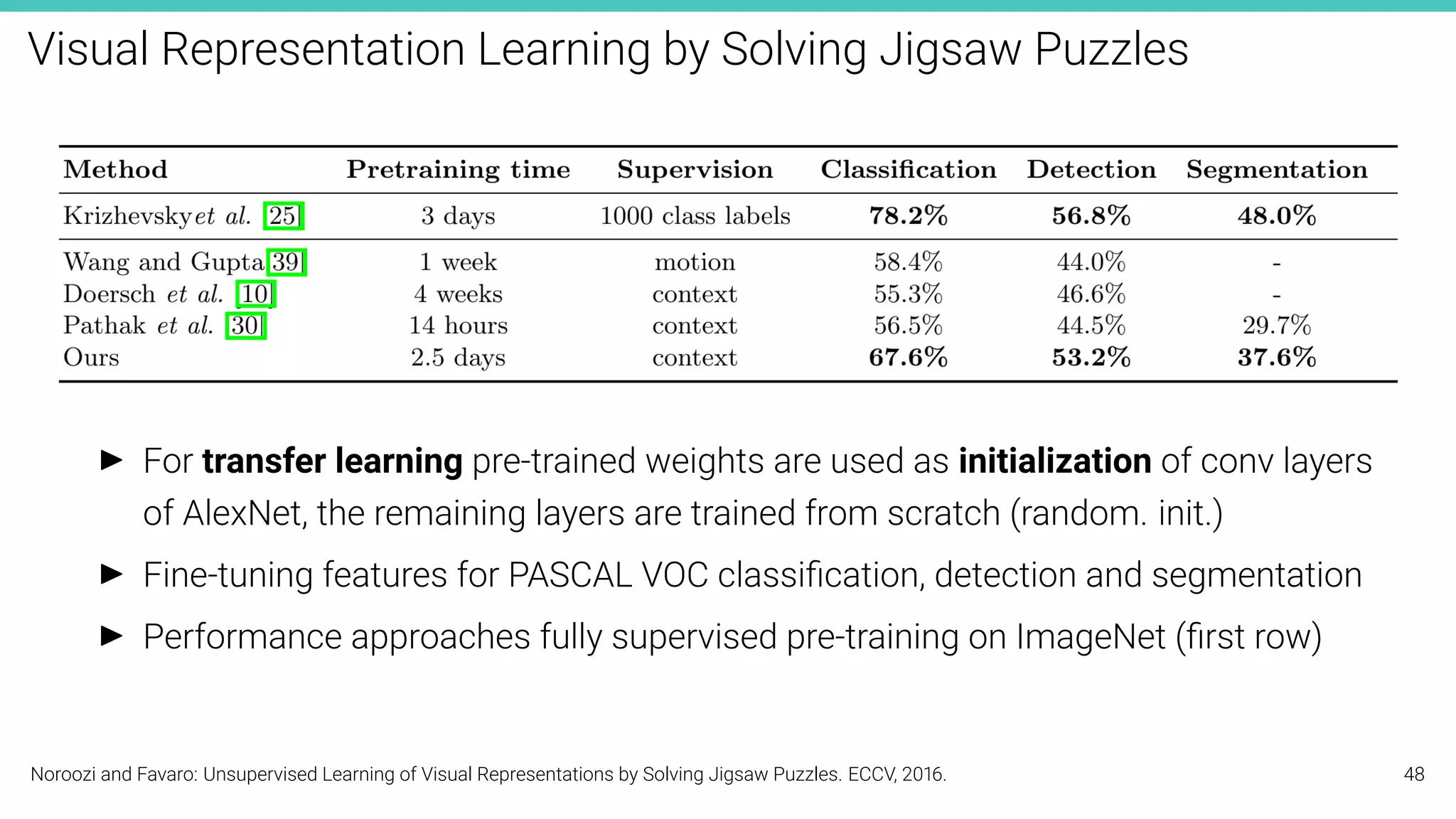
I For transfer learning pre-trained weights are used as initialization of conv layers
of AlexNet, the remaining layers are trained from scratch (random. init.)
I Fine-tuning features for PASCAL VOC classification, detection and segmentation
I Performance approaches fully supervised pre-training on ImageNet (first row)
Noroozi and Favaro: Unsupervised Learning of Visual Representations by Solving Jigsaw Puzzles. ECCV, 2016. 48
Feature Learning by Inpainting
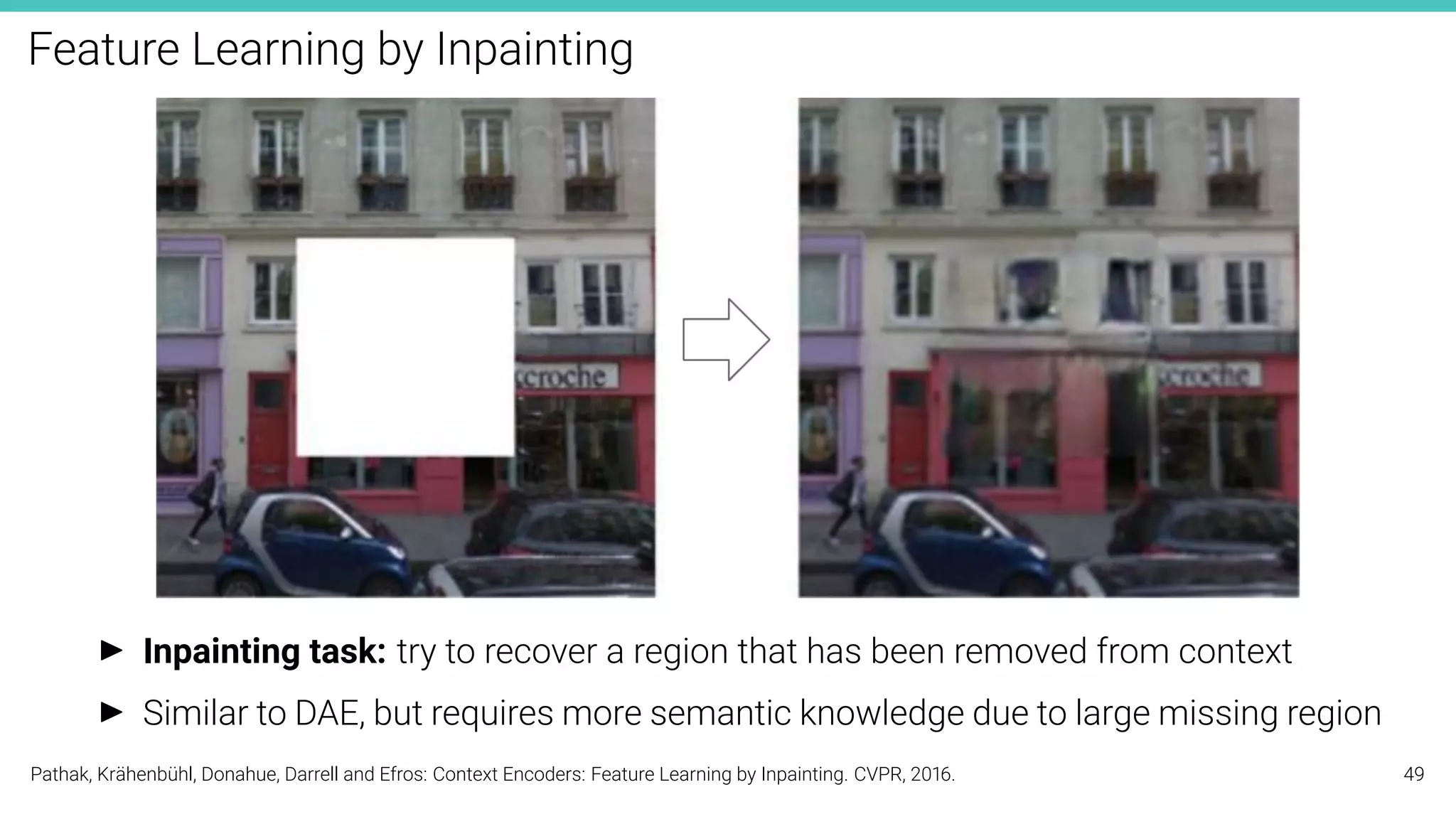
I Inpainting task: try to recover a region that has been removed from context
I Similar to DAE, but requires more semantic knowledge due to large missing region
Pathak, Krähenbühl, Donahue, Darrell and Efros: Context Encoders: Feature Learning by Inpainting. CVPR, 2016. 49
Visual Representation Learning by Predicting Image Rotations
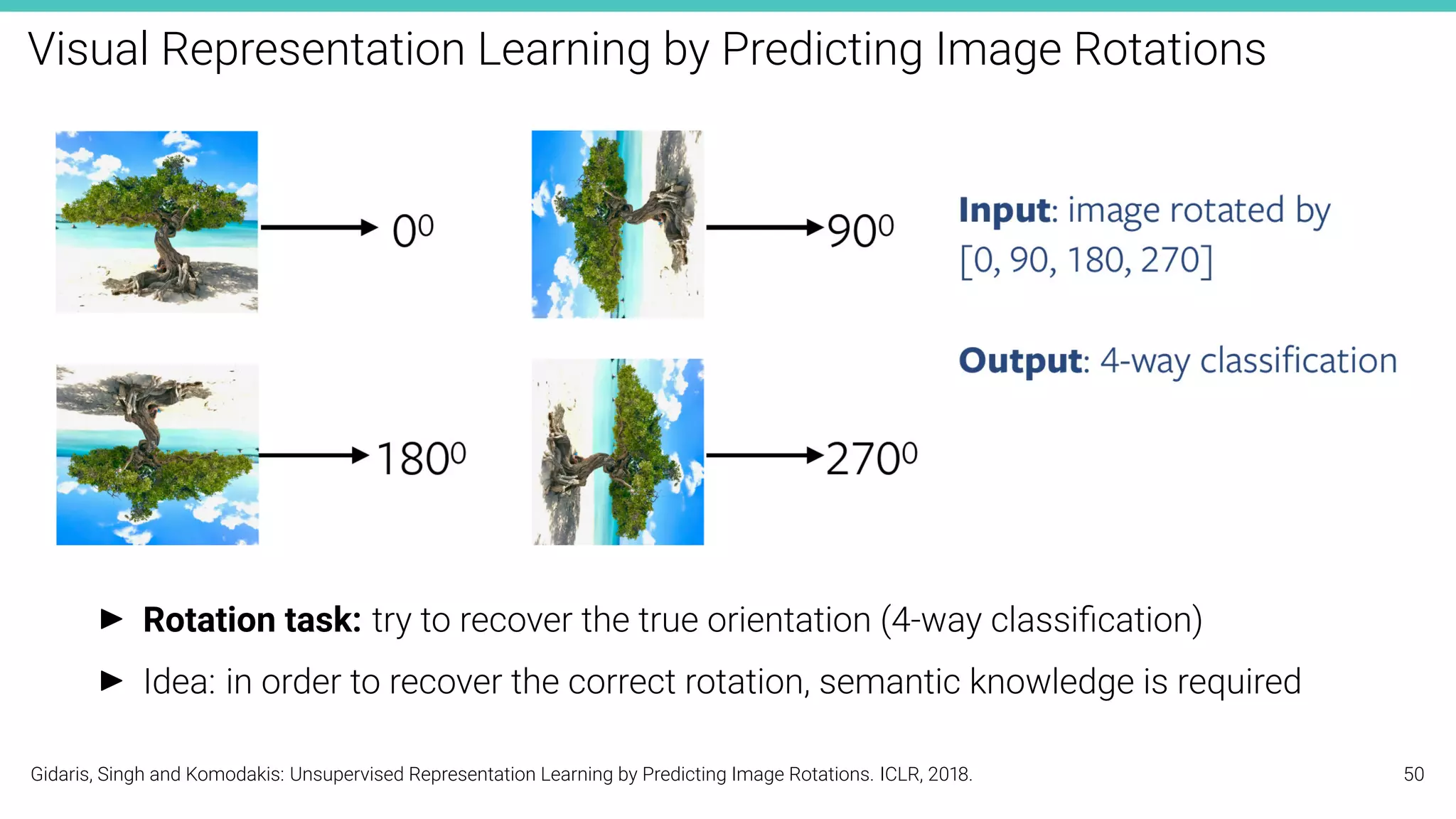
I Rotation task: try to recover the true orientation (4-way classification)
I Idea: in order to recover the correct rotation, semantic knowledge is required
Gidaris, Singh and Komodakis: Unsupervised Representation Learning by Predicting Image Rotations. ICLR, 2018. 50
Summary
Pretext Tasks:
I Pretext tasks focus on “visual common sense”, e.g., rearrangement, predicting
rotations, inpainting, colorization, etc.
I The models are forced learn good features about natural images, e.g., semantic
representation of an object category, in order to solve the pretext tasks
I We don’t care about pretext task performance, but rather about the utility of the
learned features for downstream tasks (classification, detection, segmentation)
Problems:
I Designing good pretext tasks is tedious and some kind of “art”
I The learned representations may not be general
51
11.4
Contrastive Learning
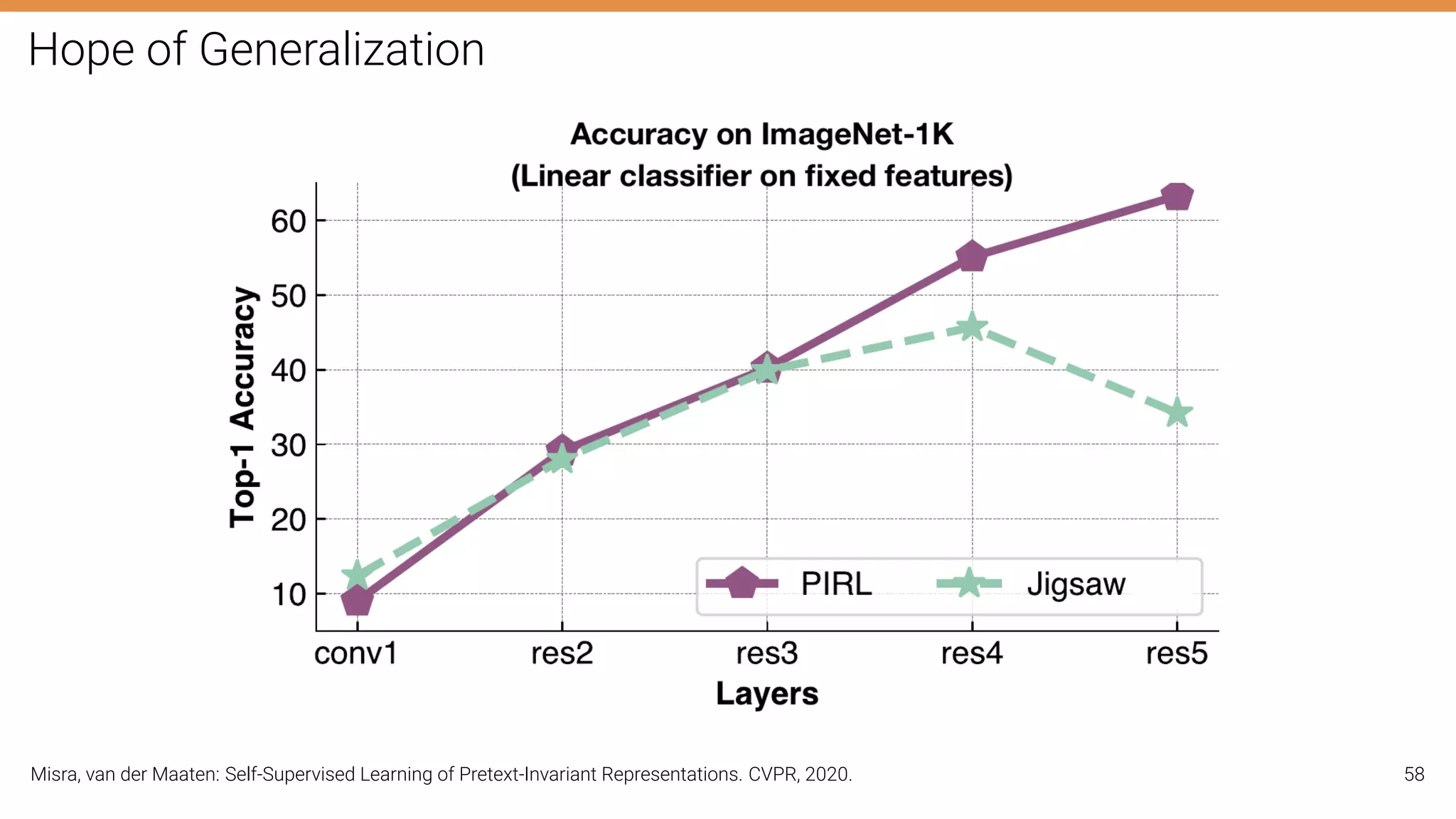
Hope of Generalization
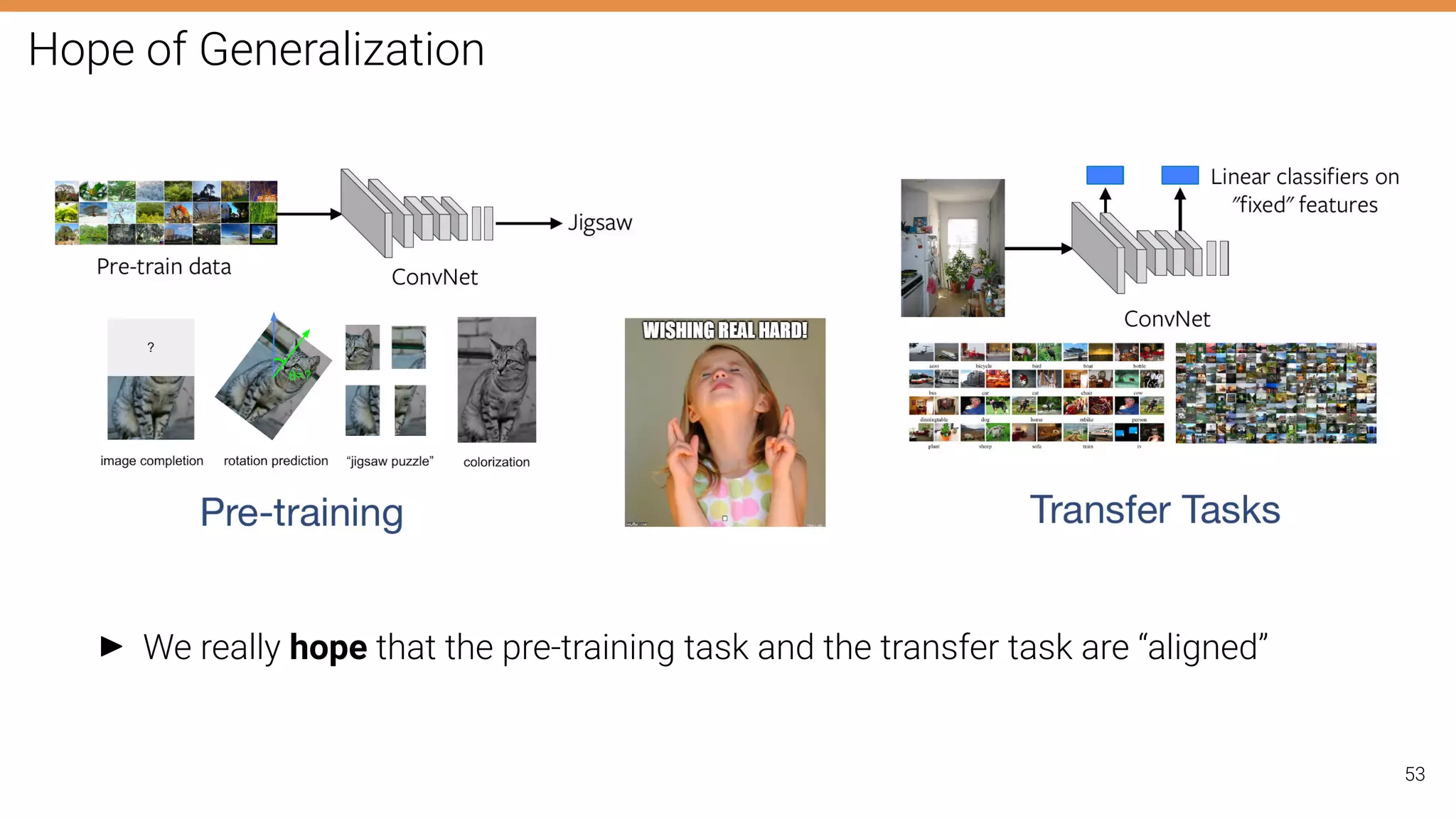
I We really hope that the pre-training task and the transfer task are “aligned”
53
Hope of Generalization
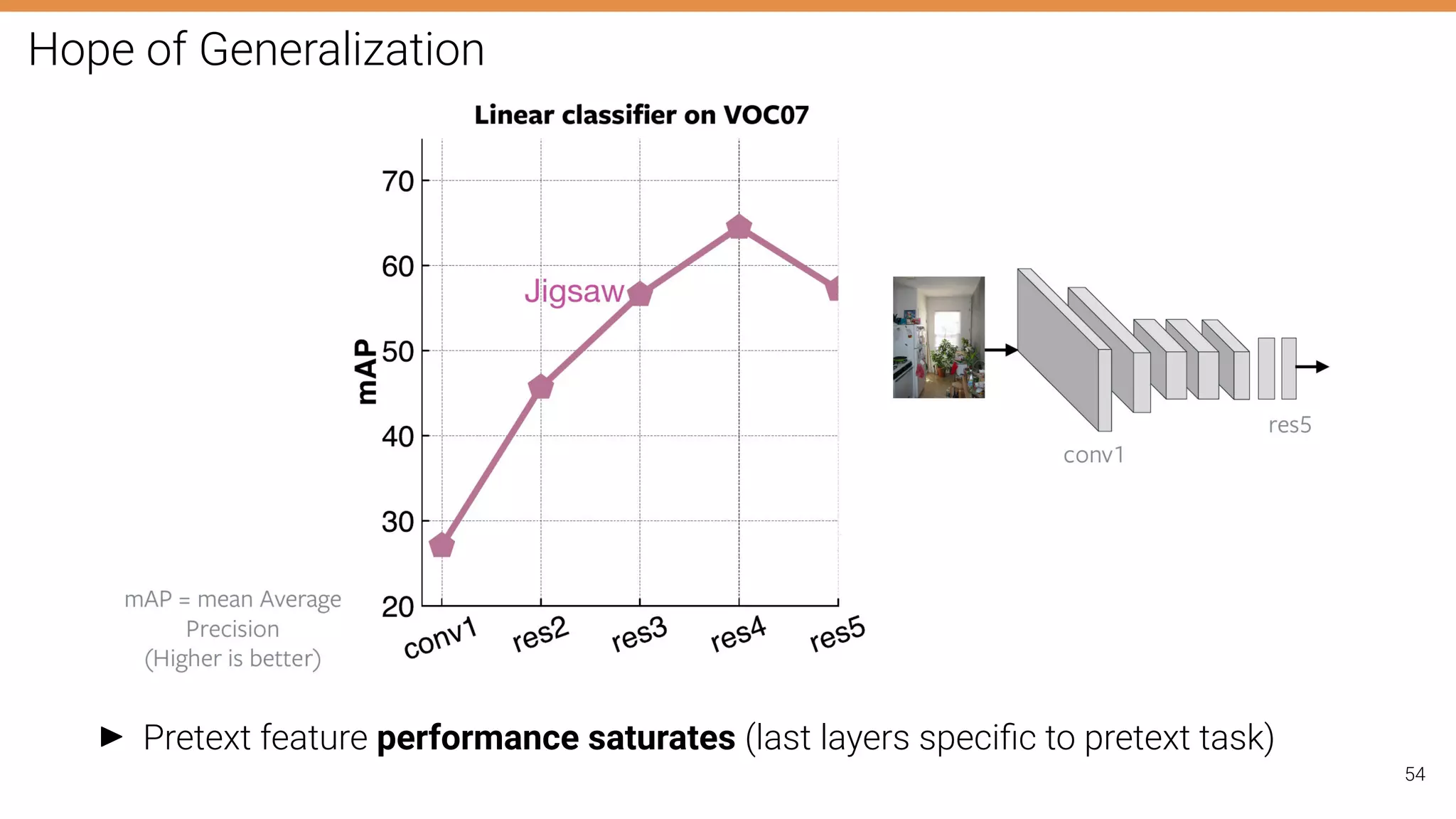
I Pretext feature performance saturates (last layers specific to pretext task)
54
Desiderata
Can we find a more general pretext task?
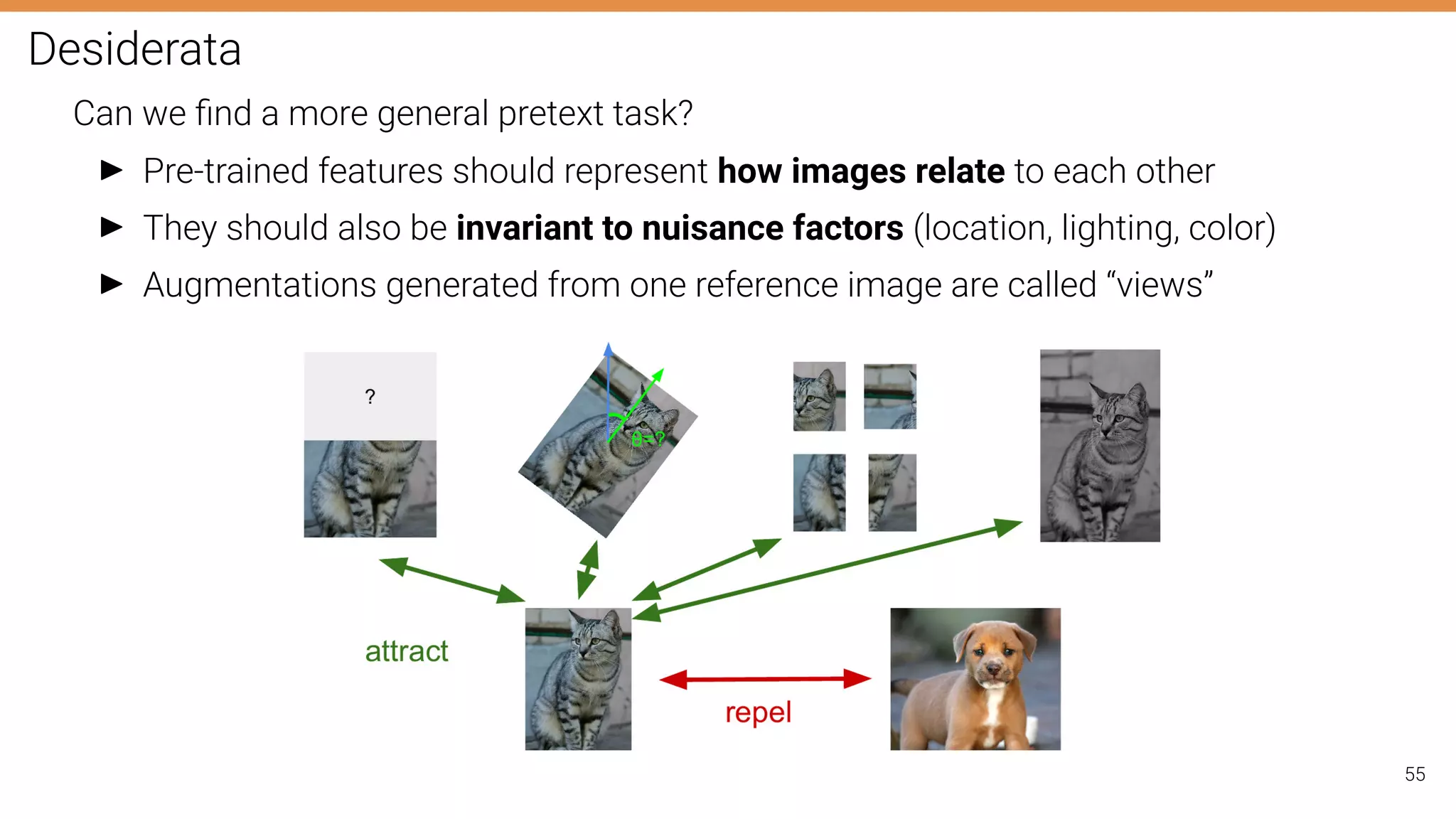
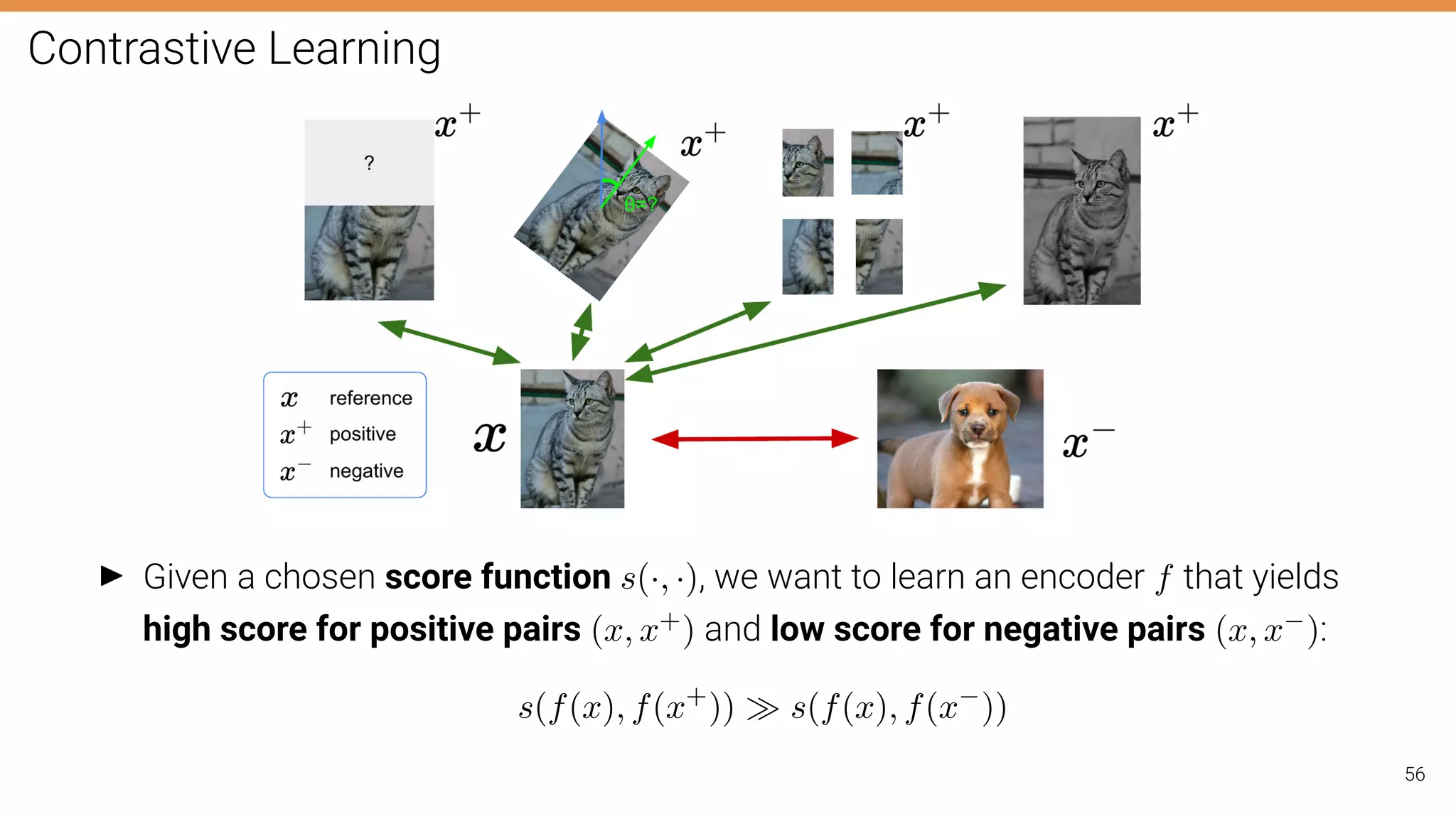
I Pre-trained features should represent how images relate to each other
I They should also be invariant to nuisance factors (location, lighting, color)
I Augmentations generated from one reference image are called “views”
55
Contrastive Learning
I Given a chosen score function s(·, ·), we want to learn an encoder f that yields
high score for positive pairs (x, x+) and low score for negative pairs (x, x−):
s(f(x), f(x+
))  s(f(x), f(x−
))
56
Contrastive Learning
Assume we have1 reference (x), 1 positive (x+) and N-1 negative (x−
j ) examples.
Consider the following multi-class cross entropy loss function:
L = −EX

log
exp(s(f(x), f(x+)))
exp(s(f(x), f(x+))) +
PN−1
j=1 exp(s(f(x), f(x−
j )))
#
This is commonly known as the InfoNCE loss and its negative is a lower bound on the
mutual information between f(x) and f(x+) (See [Oord, 2018] for details):
MI[f(x), f(x+
)] ≥ log(N) − L
Key idea: maximizing mutual information between features extracted from multiple
“views” forces the features to capture information about higher-level factors.
Important remark: The larger the negative sample size (N), the tighter the bound.
Oord, Li and Vinyals: Representation Learning with Contrastive Predictive Coding. Arxiv, 2018. 57
Hope of Generalization
Misra, van der Maaten: Self-Supervised Learning of Pretext-Invariant Representations. CVPR, 2020. 58
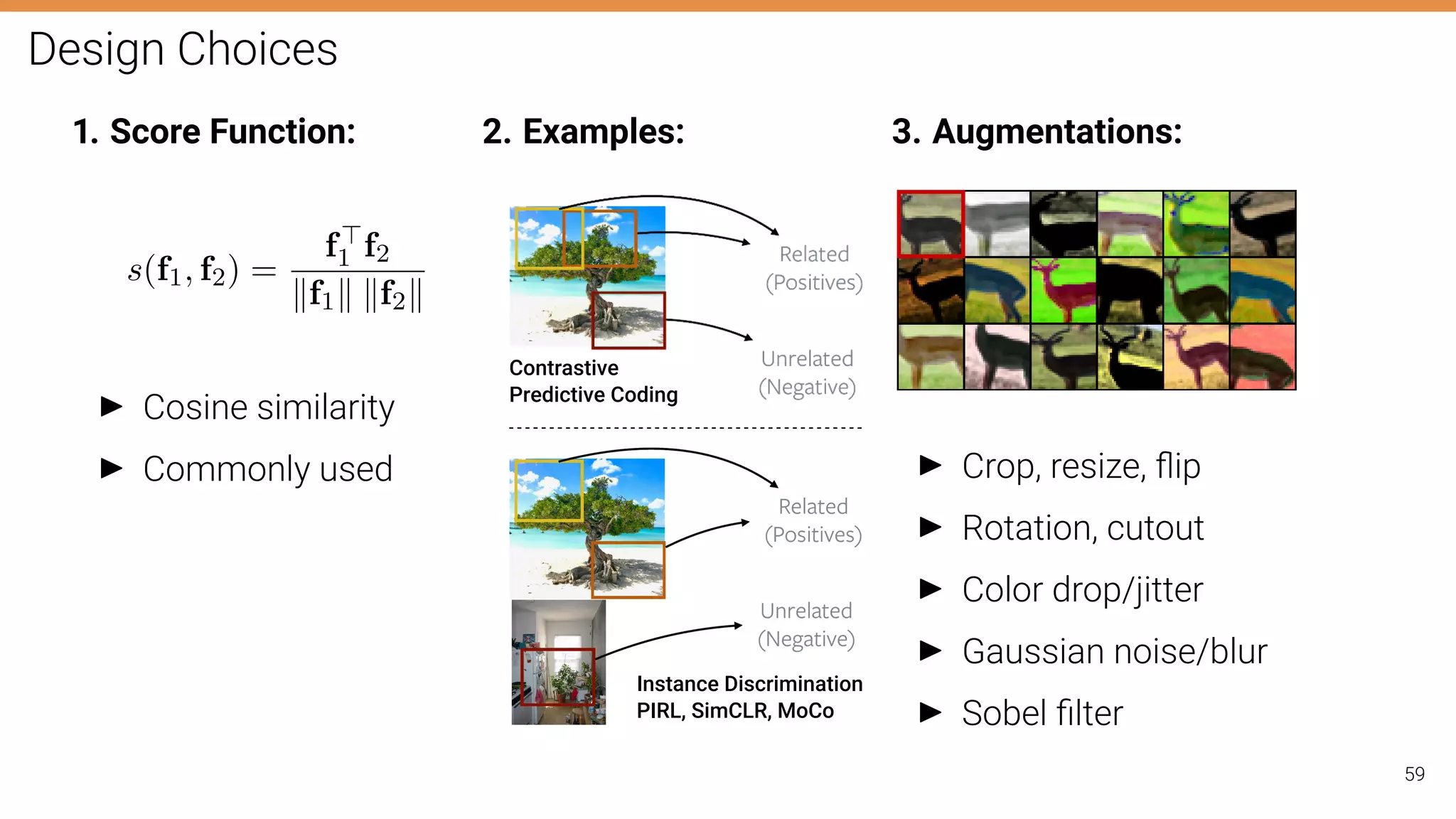
Design Choices
1. Score Function:
s(f1, f2) =
f
1 f2
kf1k kf2k
I Cosine similarity
I Commonly used
2. Examples:
Contrastive
Predictive Coding
Instance Discrimination
PIRL, SimCLR, MoCo
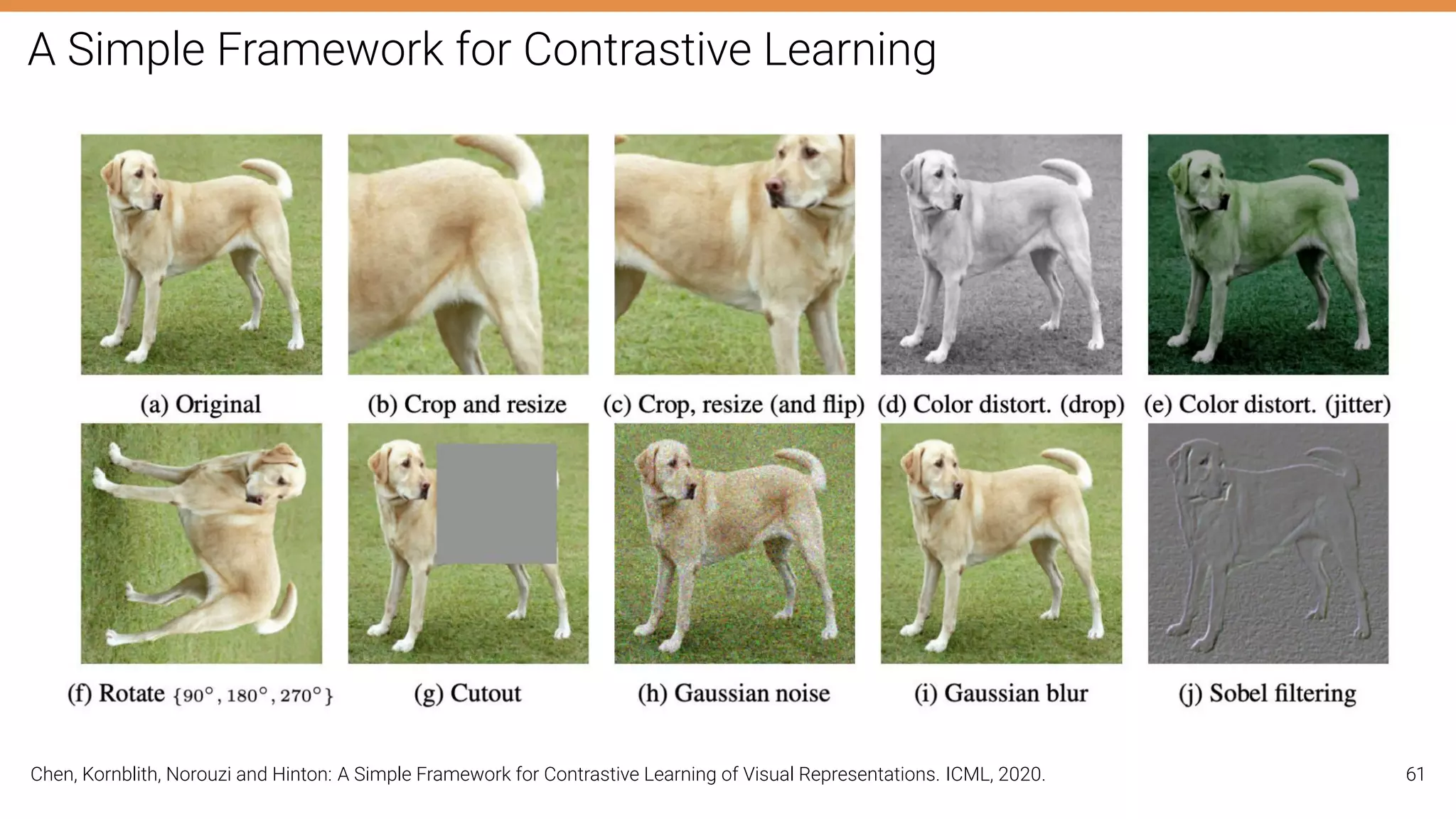
3. Augmentations:
I Crop, resize, flip
I Rotation, cutout
I Color drop/jitter
I Gaussian noise/blur
I Sobel filter
59
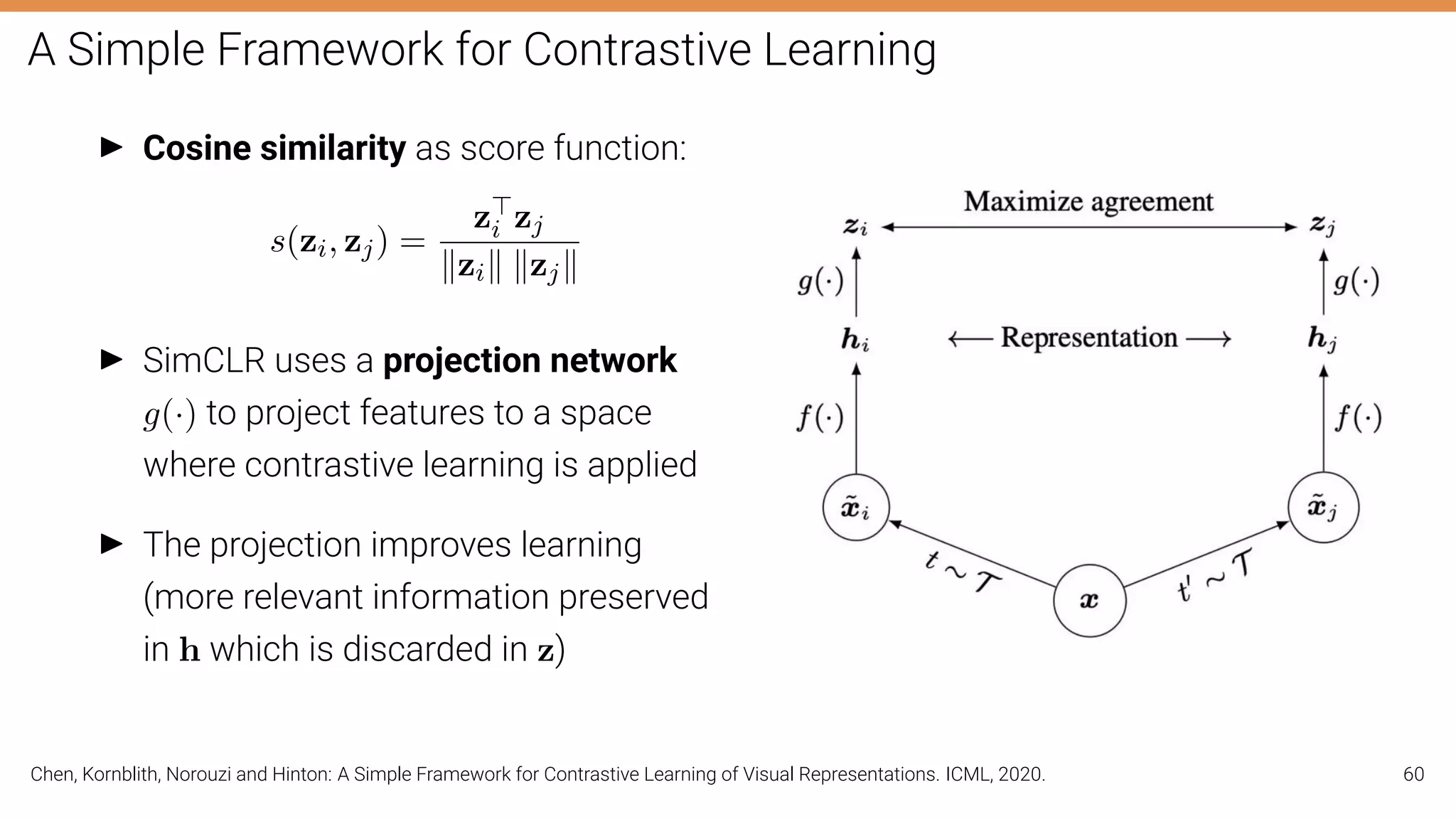
A Simple Framework for Contrastive Learning
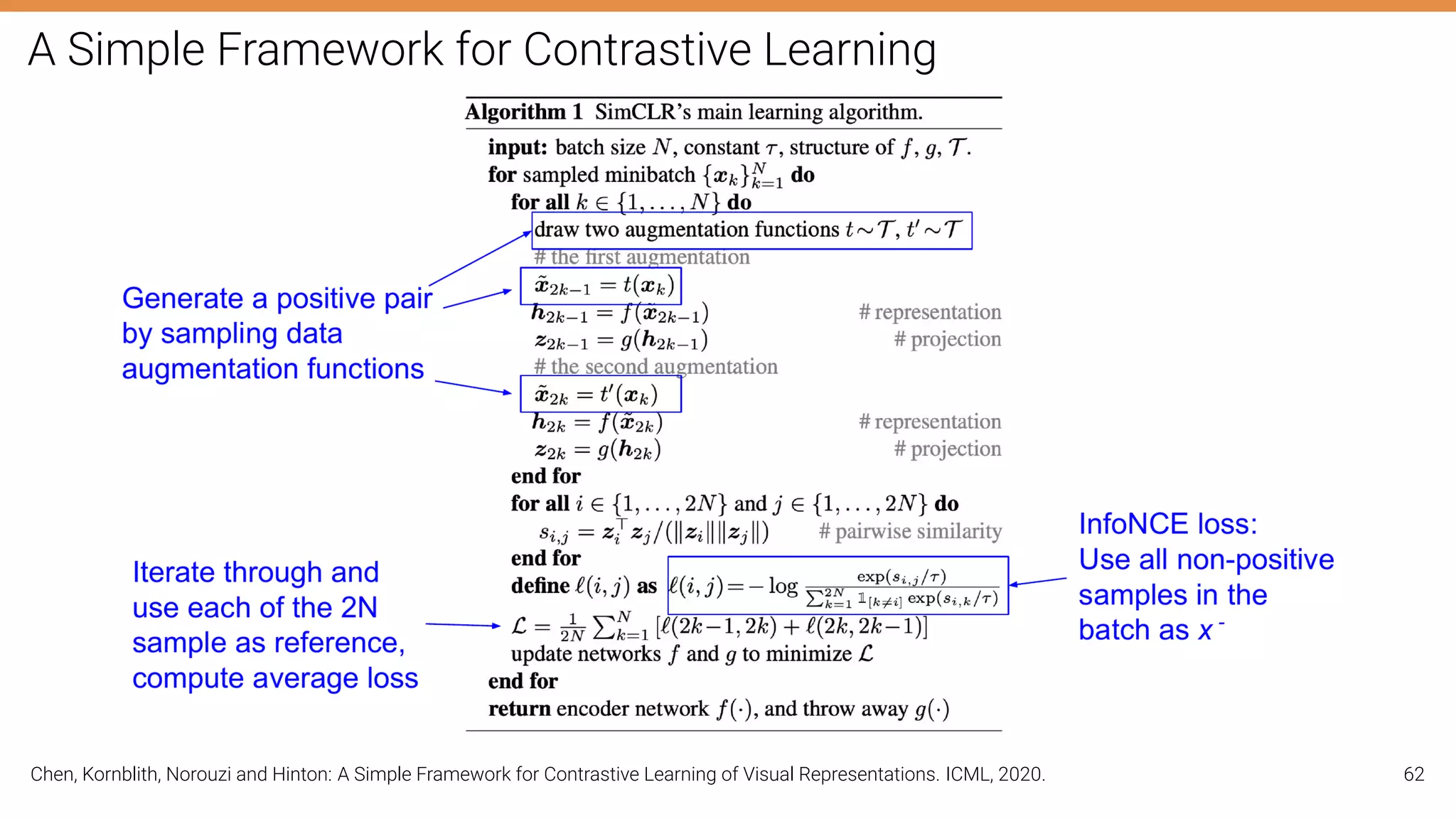
I Cosine similarity as score function:
s(zi, zj) =
z
i zj
kzik kzjk
I SimCLR uses a projection network
g(·) to project features to a space
where contrastive learning is applied
I The projection improves learning
(more relevant information preserved
in h which is discarded in z)
Chen, Kornblith, Norouzi and Hinton: A Simple Framework for Contrastive Learning of Visual Representations. ICML, 2020. 60
A Simple Framework for Contrastive Learning
Chen, Kornblith, Norouzi and Hinton: A Simple Framework for Contrastive Learning of Visual Representations. ICML, 2020. 61
A Simple Framework for Contrastive Learning
Chen, Kornblith, Norouzi and Hinton: A Simple Framework for Contrastive Learning of Visual Representations. ICML, 2020. 62
A Simple Framework for Contrastive Learning
Chen, Kornblith, Norouzi and Hinton: A Simple Framework for Contrastive Learning of Visual Representations. ICML, 2020. 63
A Simple Framework for Contrastive Learning
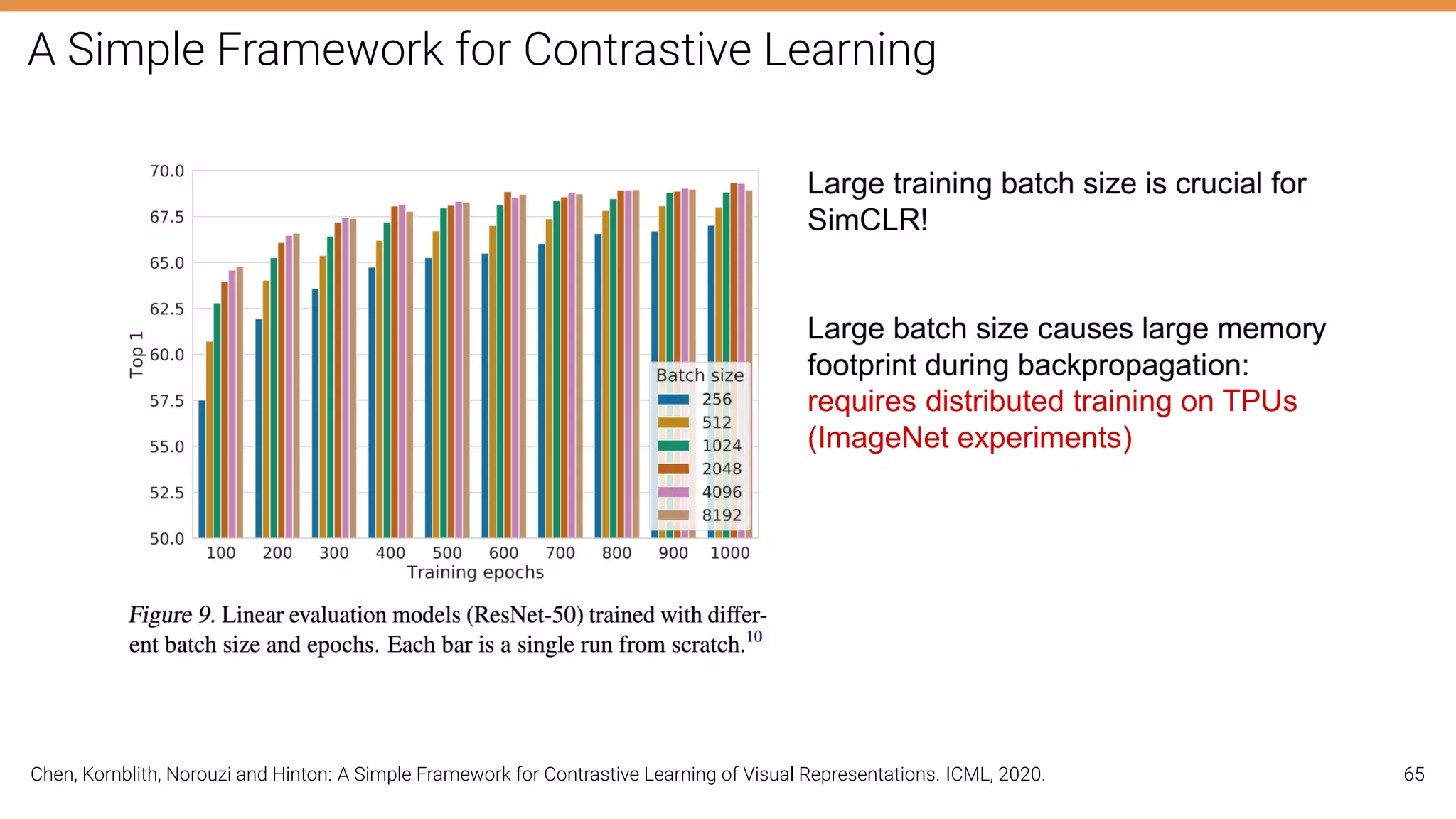
Chen, Kornblith, Norouzi and Hinton: A Simple Framework for Contrastive Learning of Visual Representations. ICML, 2020. 64
A Simple Framework for Contrastive Learning
Chen, Kornblith, Norouzi and Hinton: A Simple Framework for Contrastive Learning of Visual Representations. ICML, 2020. 65
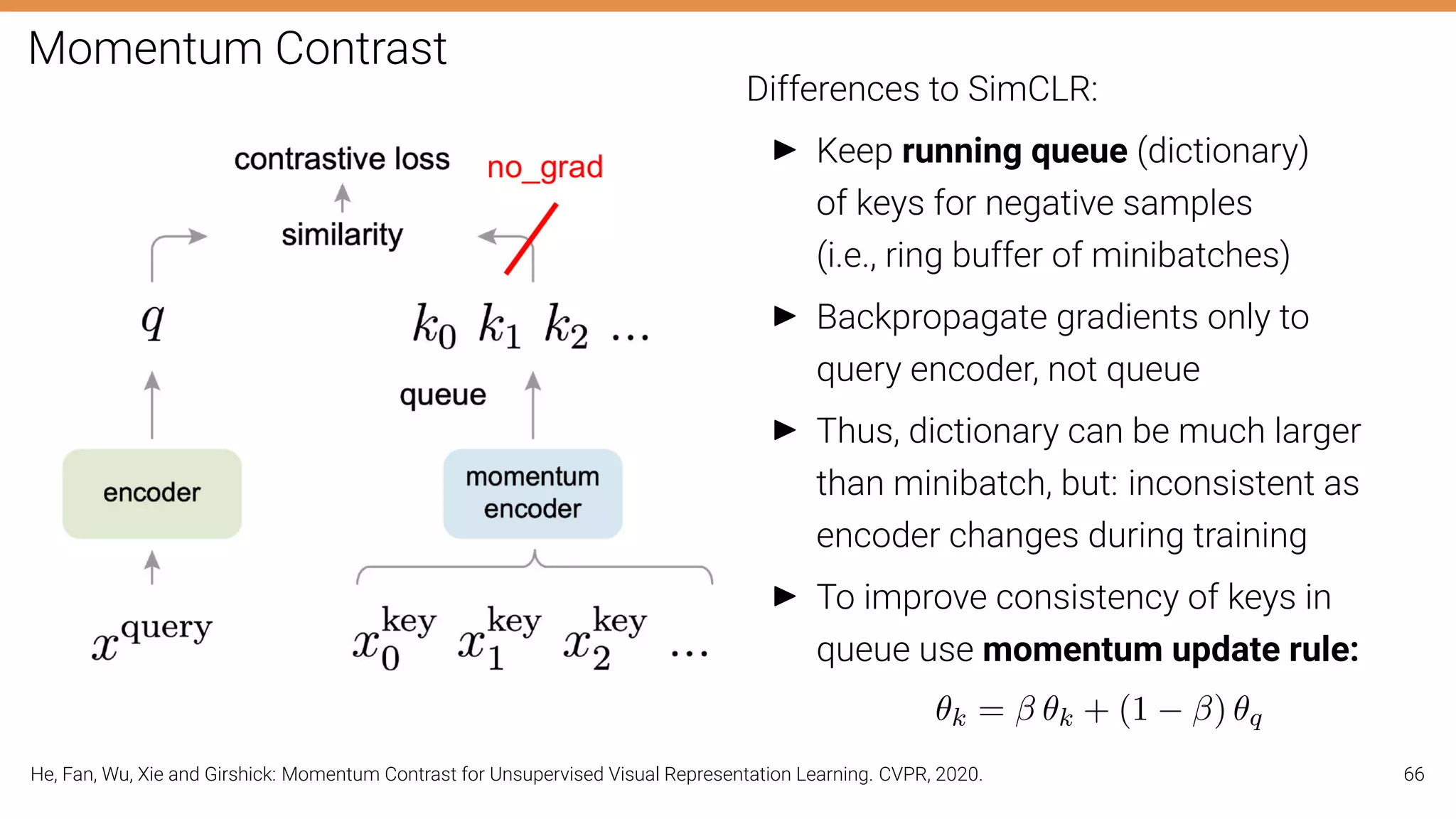
Momentum Contrast
Differences to SimCLR:
I Keep running queue (dictionary)
of keys for negative samples
(i.e., ring buffer of minibatches)
I Backpropagate gradients only to
query encoder, not queue
I Thus, dictionary can be much larger
than minibatch, but: inconsistent as
encoder changes during training
I To improve consistency of keys in
queue use momentum update rule:
θk = β θk + (1 − β) θq
He, Fan, Wu, Xie and Girshick: Momentum Contrast for Unsupervised Visual Representation Learning. CVPR, 2020. 66
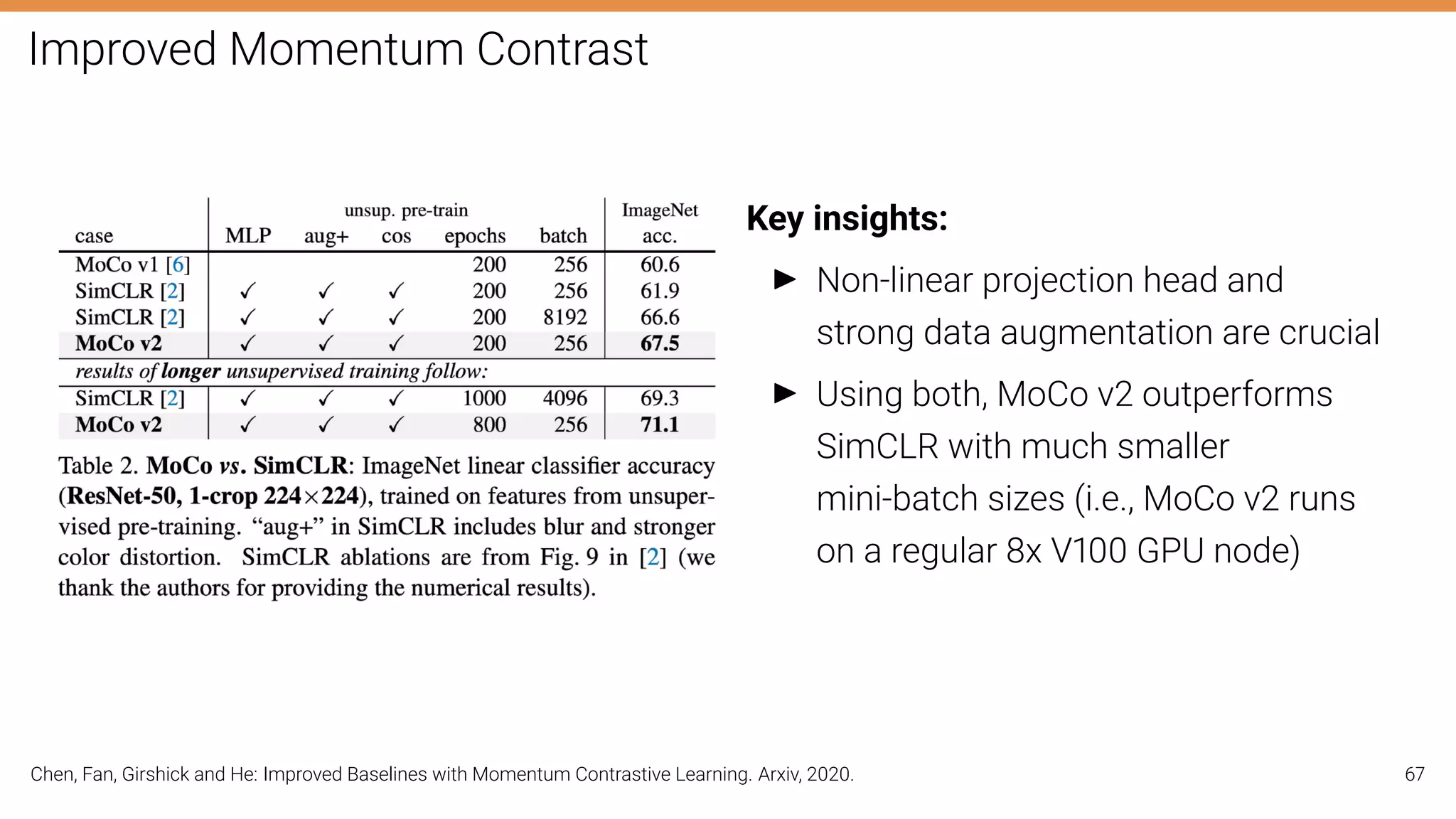
Improved Momentum Contrast
Key insights:
I Non-linear projection head and
strong data augmentation are crucial
I Using both, MoCo v2 outperforms
SimCLR with much smaller
mini-batch sizes (i.e., MoCo v2 runs
on a regular 8x V100 GPU node)
Chen, Fan, Girshick and He: Improved Baselines with Momentum Contrastive Learning. Arxiv, 2020. 67
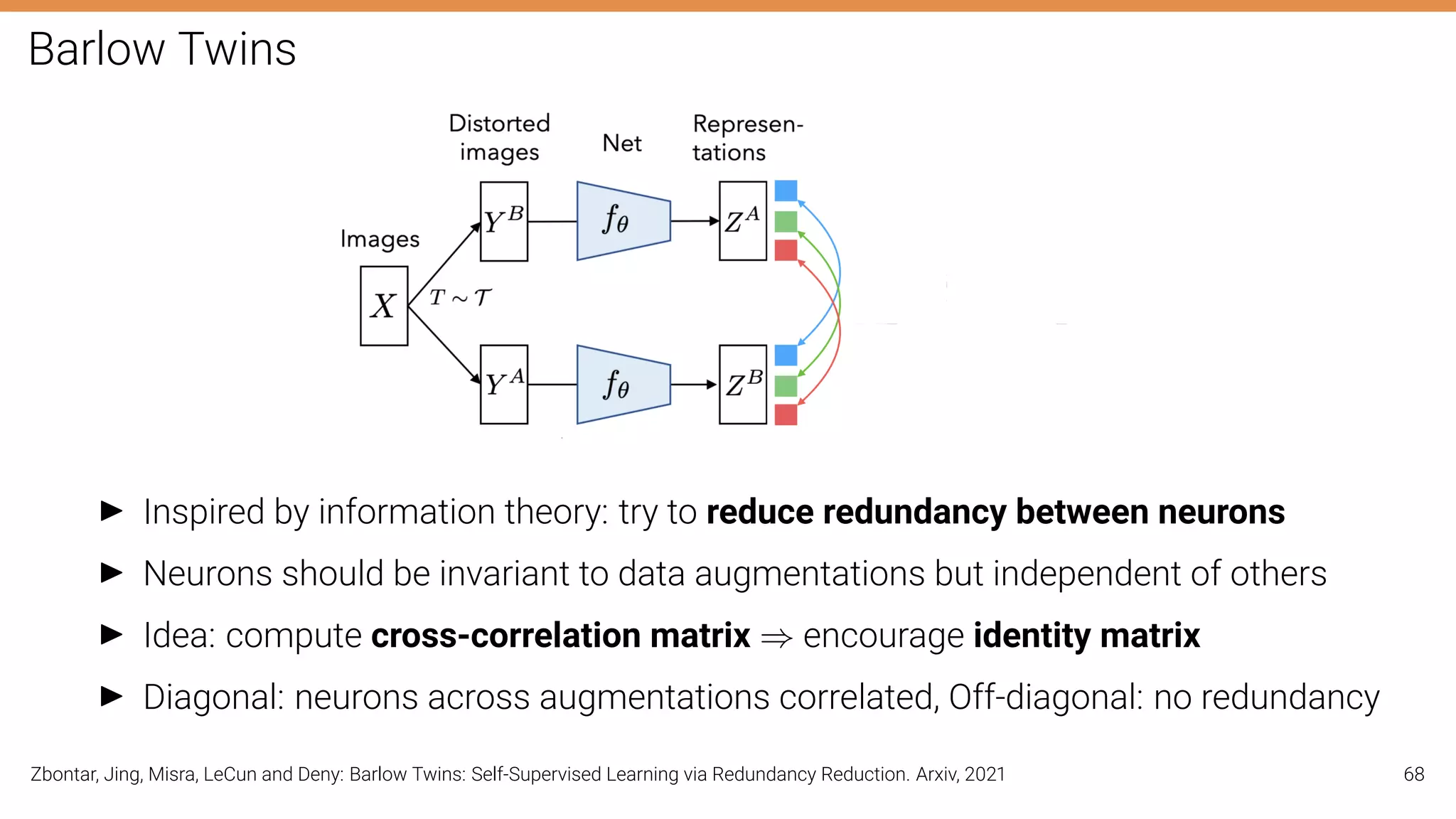
Barlow Twins
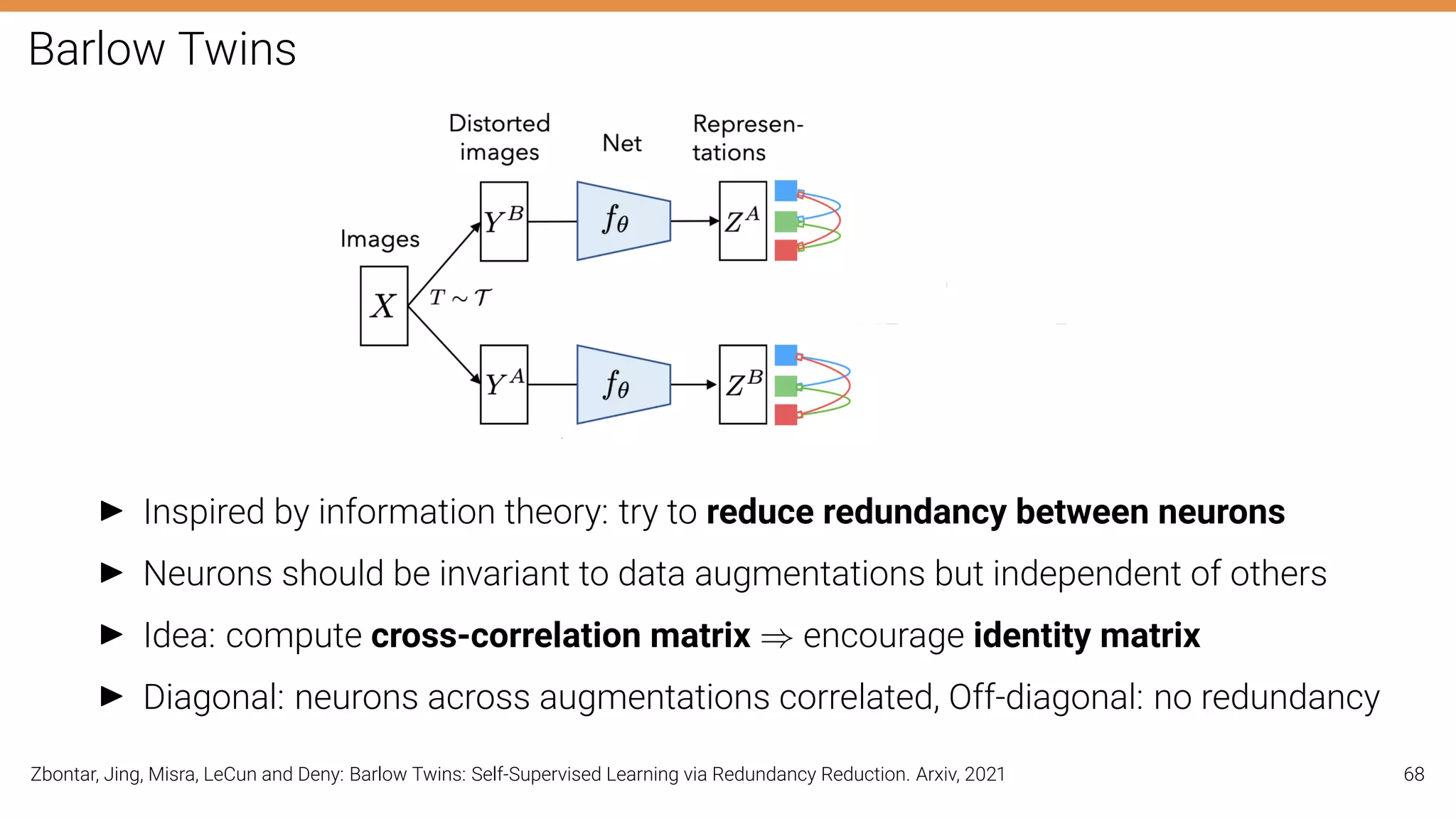
I Inspired by information theory: try to reduce redundancy between neurons
I Neurons should be invariant to data augmentations but independent of others
I Idea: compute cross-correlation matrix ⇒ encourage identity matrix
I Diagonal: neurons across augmentations correlated, Off-diagonal: no redundancy
Zbontar, Jing, Misra, LeCun and Deny: Barlow Twins: Self-Supervised Learning via Redundancy Reduction. Arxiv, 2021 68
Barlow Twins
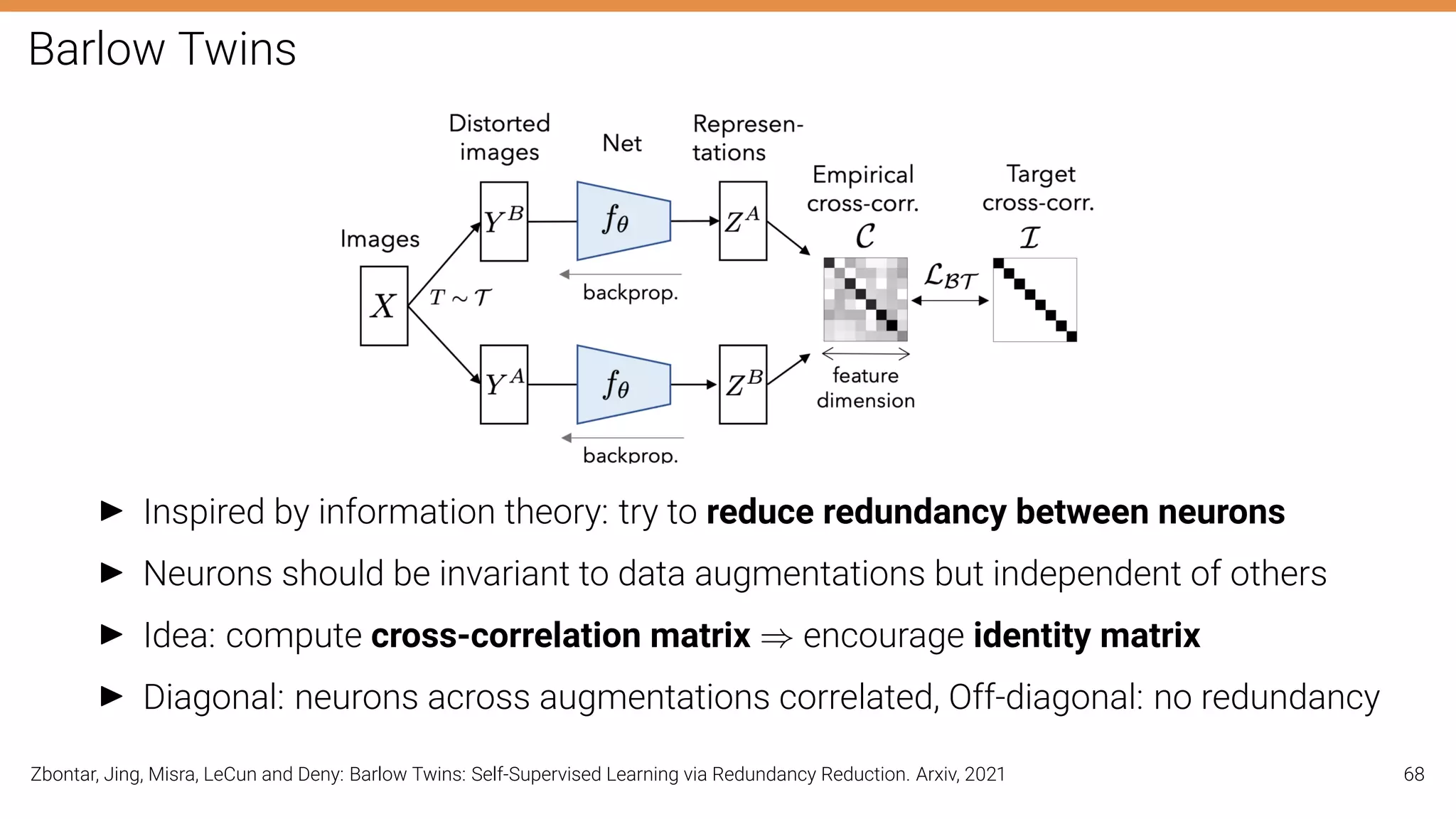
I Inspired by information theory: try to reduce redundancy between neurons
I Neurons should be invariant to data augmentations but independent of others
I Idea: compute cross-correlation matrix ⇒ encourage identity matrix
I Diagonal: neurons across augmentations correlated, Off-diagonal: no redundancy
Zbontar, Jing, Misra, LeCun and Deny: Barlow Twins: Self-Supervised Learning via Redundancy Reduction. Arxiv, 2021 68
Barlow Twins
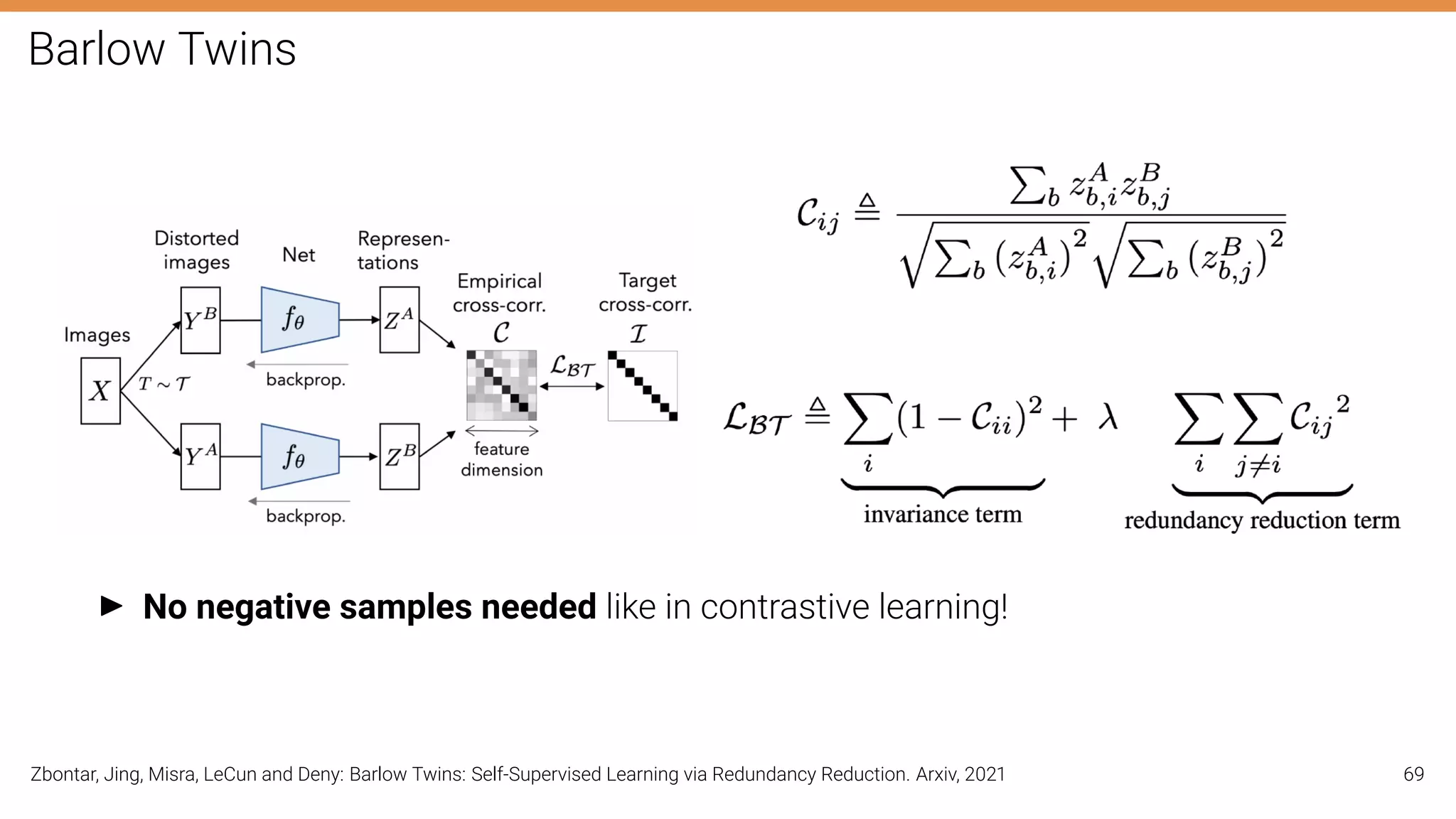
I Inspired by information theory: try to reduce redundancy between neurons
I Neurons should be invariant to data augmentations but independent of others
I Idea: compute cross-correlation matrix ⇒ encourage identity matrix
I Diagonal: neurons across augmentations correlated, Off-diagonal: no redundancy
Zbontar, Jing, Misra, LeCun and Deny: Barlow Twins: Self-Supervised Learning via Redundancy Reduction. Arxiv, 2021 68
Barlow Twins
I No negative samples needed like in contrastive learning!
Zbontar, Jing, Misra, LeCun and Deny: Barlow Twins: Self-Supervised Learning via Redundancy Reduction. Arxiv, 2021 69
Barlow Twins
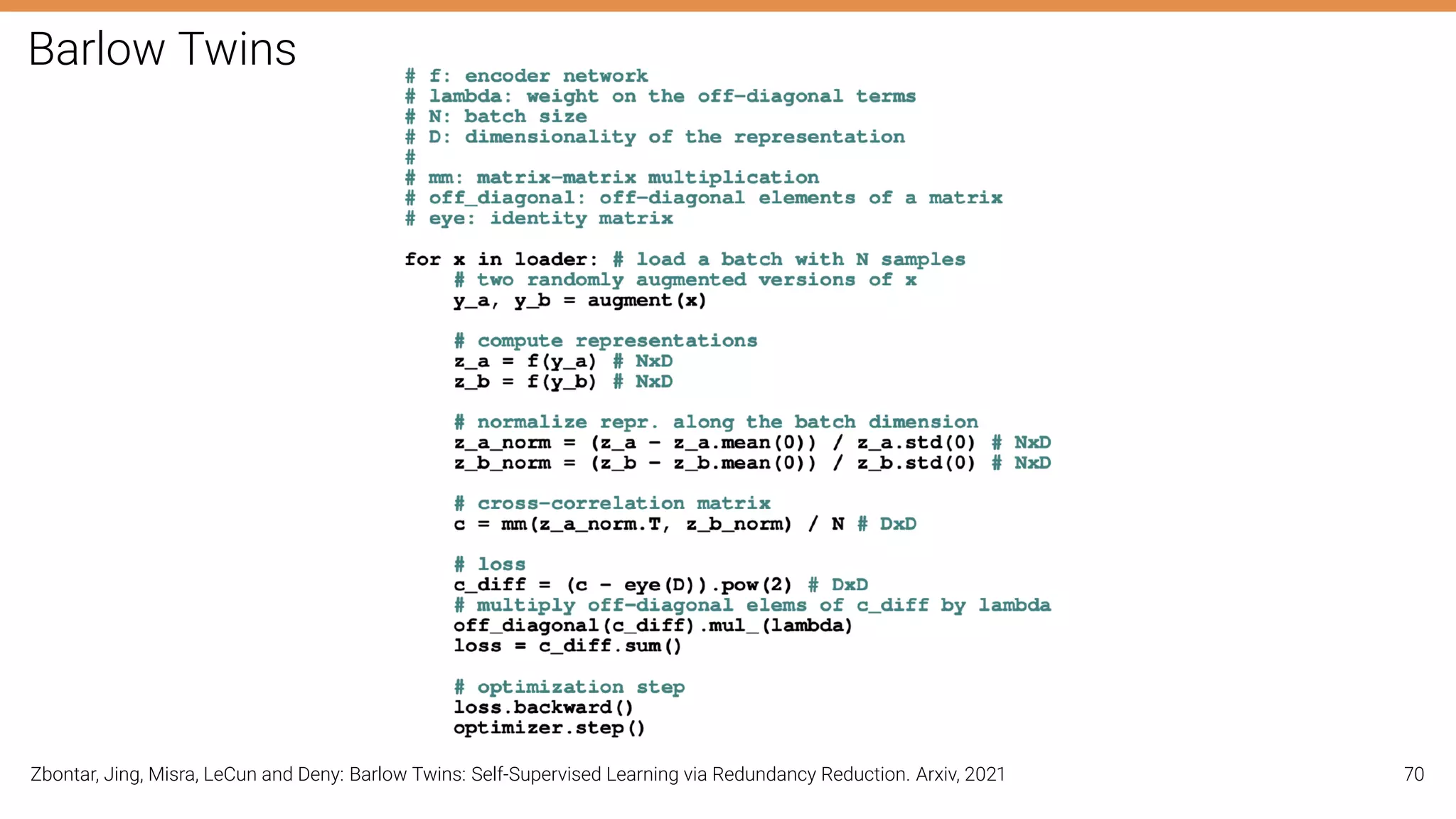
Zbontar, Jing, Misra, LeCun and Deny: Barlow Twins: Self-Supervised Learning via Redundancy Reduction. Arxiv, 2021 70
Barlow Twins
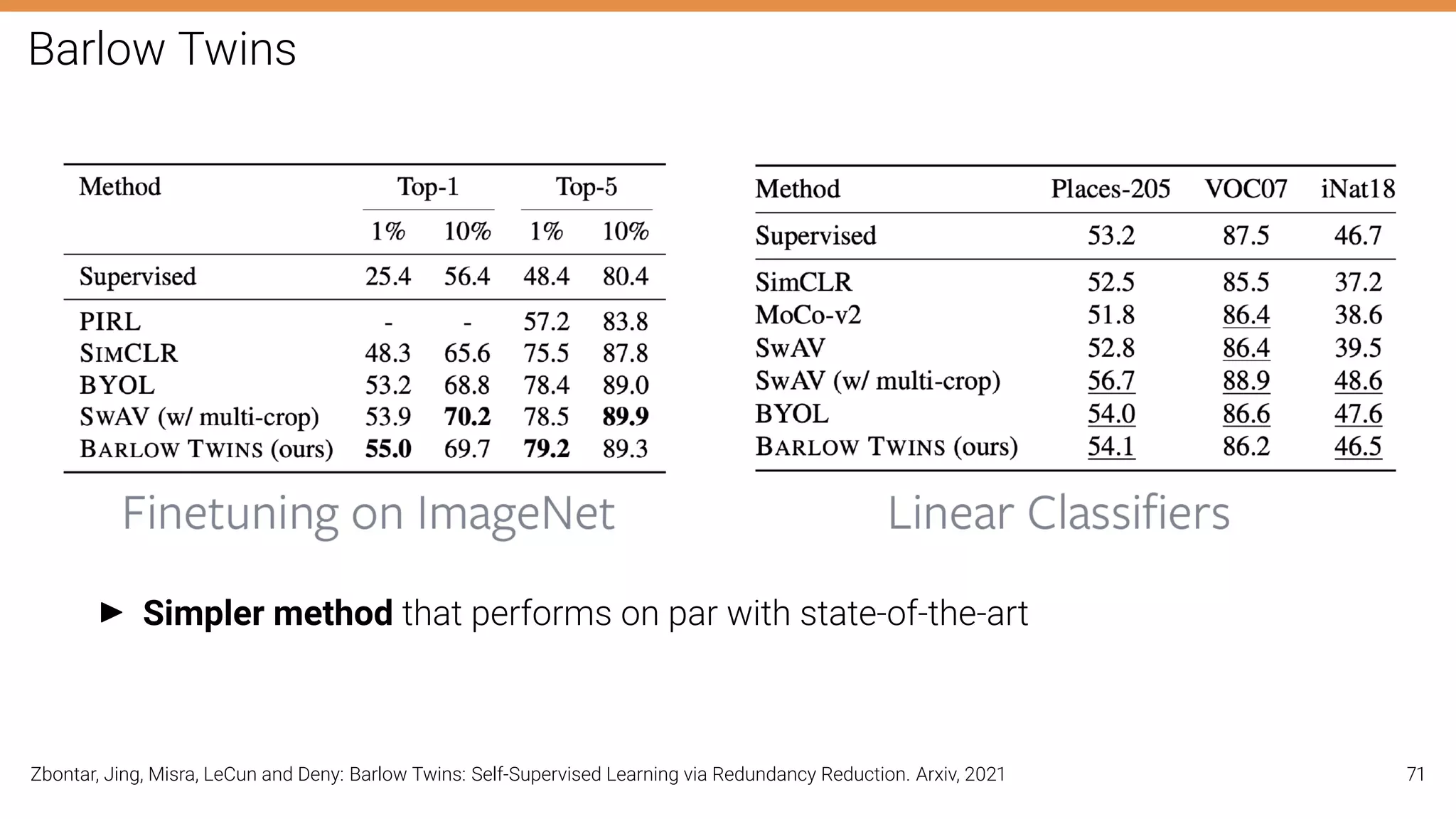
I Simpler method that performs on par with state-of-the-art
Zbontar, Jing, Misra, LeCun and Deny: Barlow Twins: Self-Supervised Learning via Redundancy Reduction. Arxiv, 2021 71
Barlow Twins
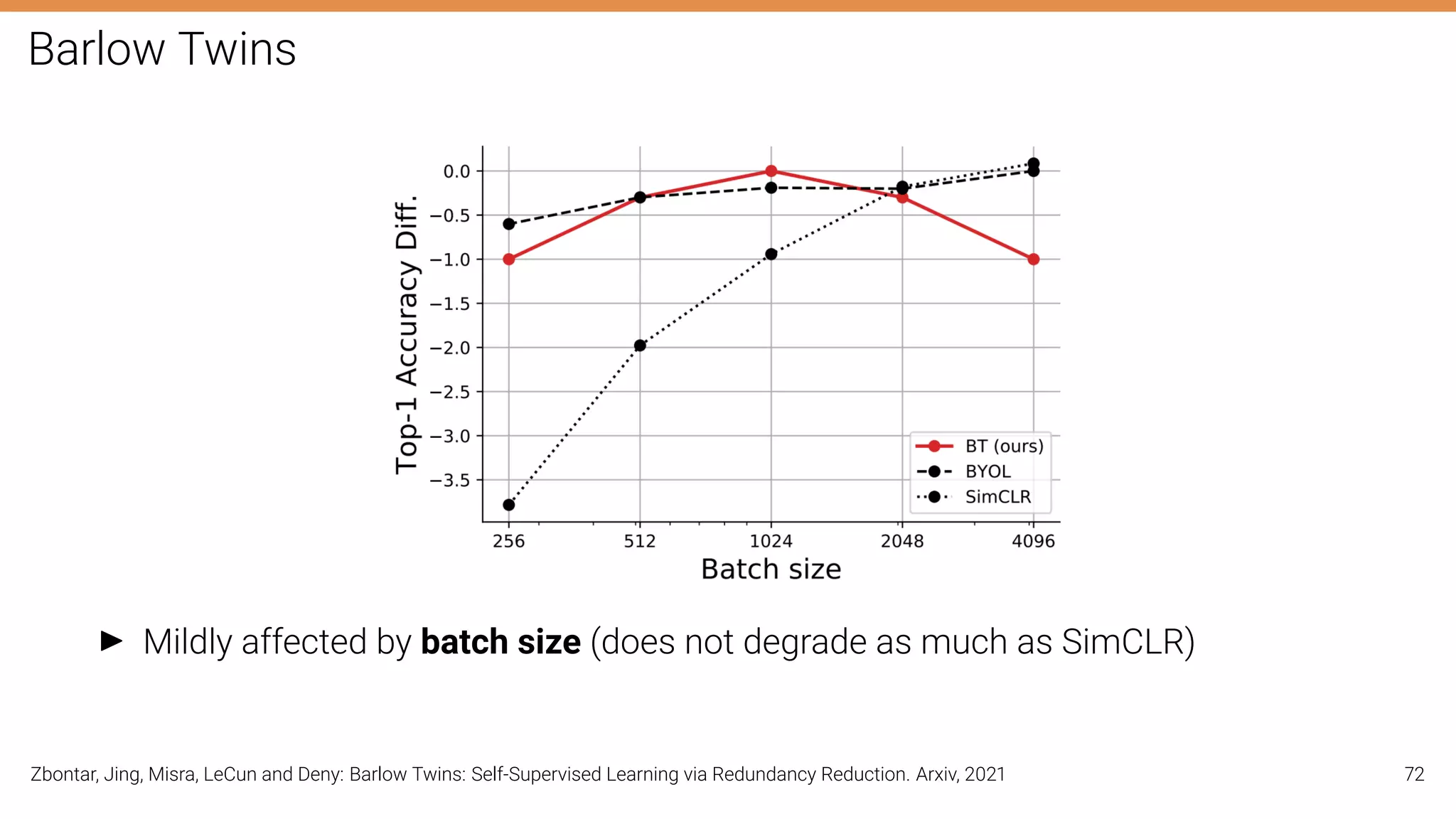
I Mildly affected by batch size (does not degrade as much as SimCLR)
Zbontar, Jing, Misra, LeCun and Deny: Barlow Twins: Self-Supervised Learning via Redundancy Reduction. Arxiv, 2021 72
Barlow Twins
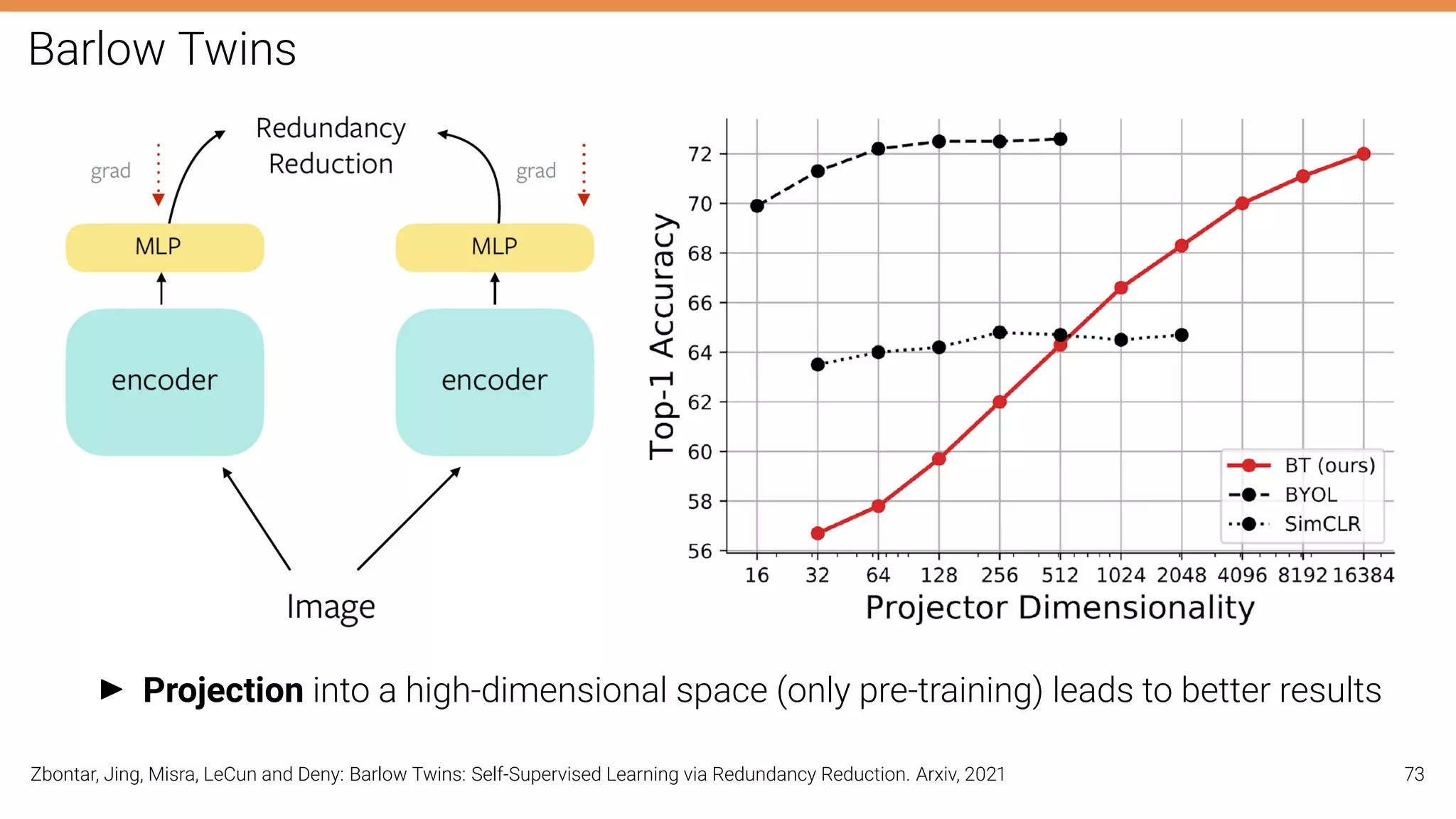
I Projection into a high-dimensional space (only pre-training) leads to better results
Zbontar, Jing, Misra, LeCun and Deny: Barlow Twins: Self-Supervised Learning via Redundancy Reduction. Arxiv, 2021 73
Summary
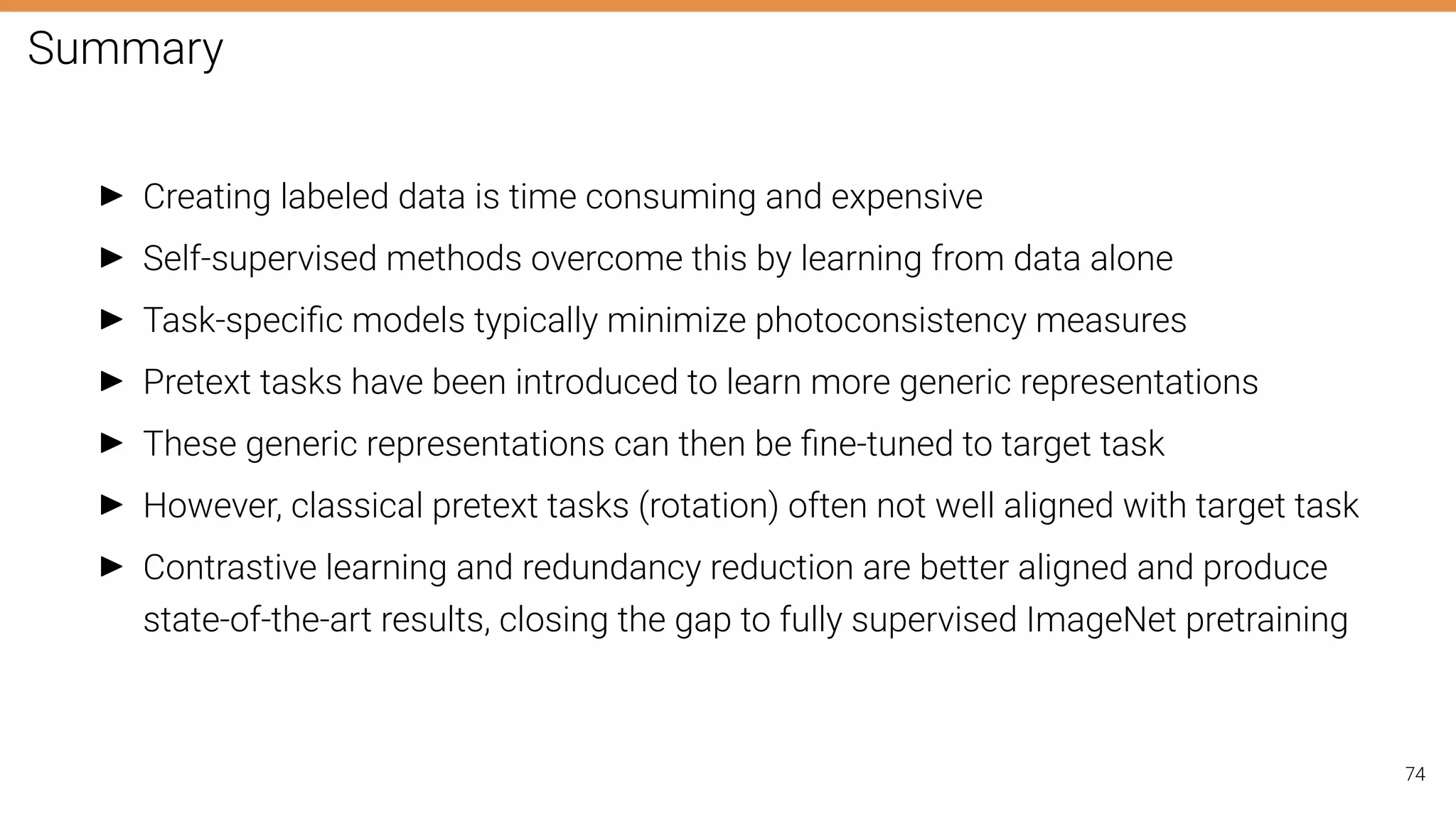
I Creating labeled data is time consuming and expensive
I Self-supervised methods overcome this by learning from data alone
I Task-specific models typically minimize photoconsistency measures
I Pretext tasks have been introduced to learn more generic representations
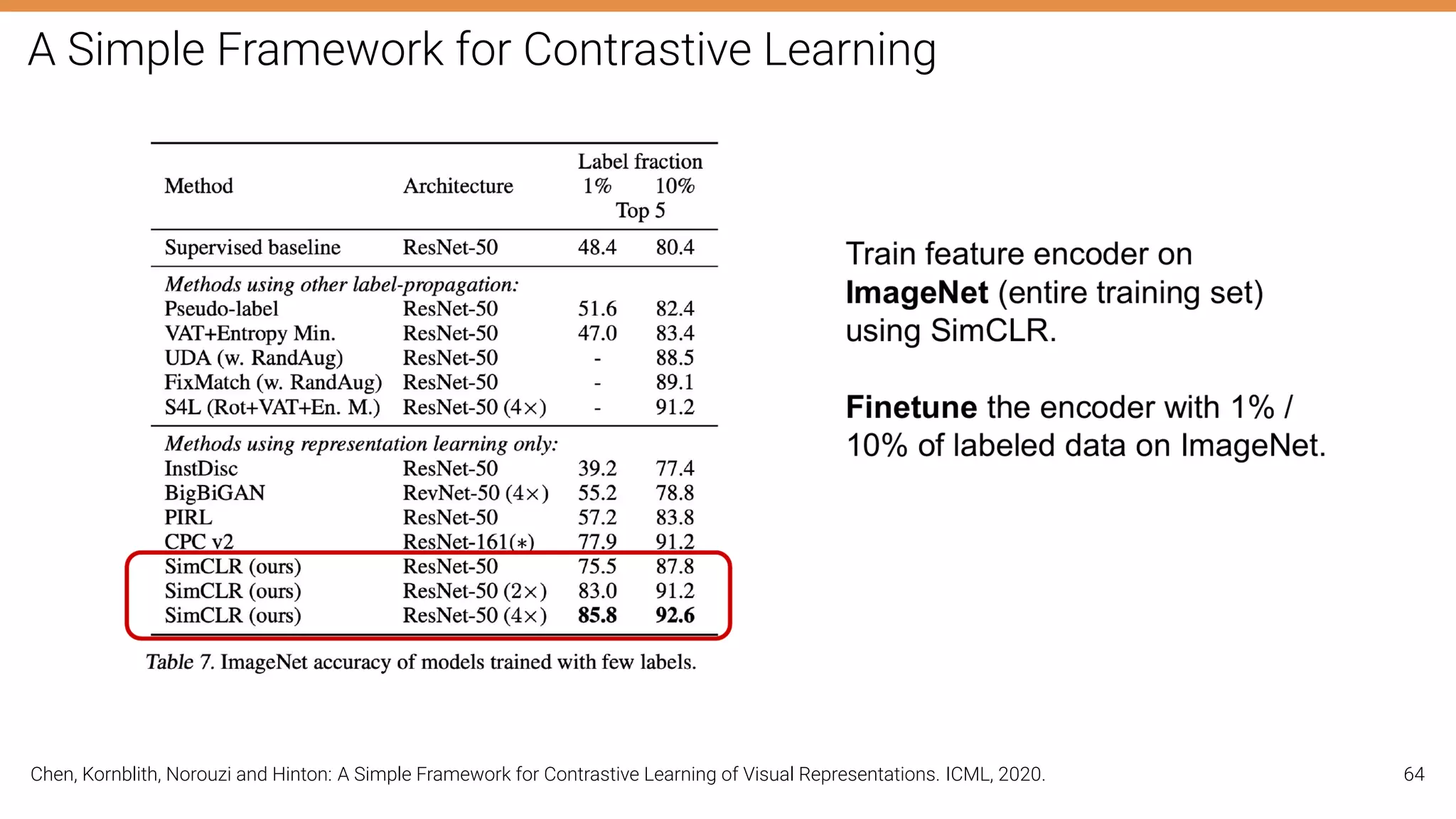
I These generic representations can then be fine-tuned to target task
I However, classical pretext tasks (rotation) often not well aligned with target task
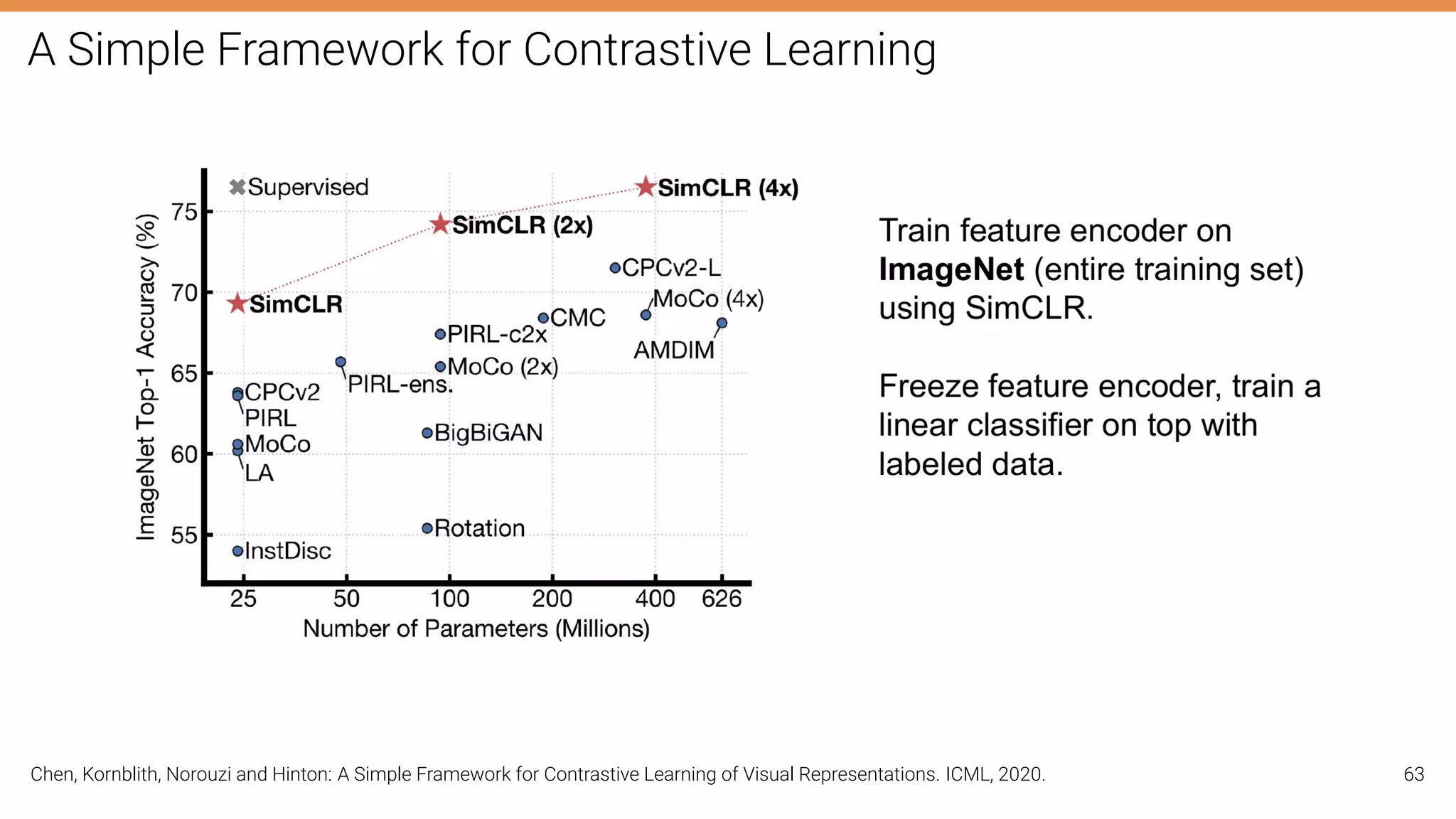
I Contrastive learning and redundancy reduction are better aligned and produce
state-of-the-art results, closing the gap to fully supervised ImageNet pretraining
74

lec_11_self_supervised_learning.pdf

  • 1.
    Computer Vision Lecture 11– Self-Supervised Learning Prof. Dr.-Ing. Andreas Geiger Autonomous Vision Group University of Tübingen / MPI-IS
  • 2.
    Agenda 11.1 Preliminaries 11.2 Task-specificModels 11.3 Pretext Tasks 11.4 Contrastive Learning 2
  • 3.
  • 4.
    Data Annotation I Supervisedlearning requires very large amounts of annotated data! 4
  • 5.
    Data Annotation Annotation Time 0Minutes 30 Minutes 60 Minutes #Images 1,000k 500k 0k ImageNet Classification MS COCO Partial Segmentation ImageNet 2D Detection PASCAL,KITTI 2D and 3D Detection LabelMe Segmentation SUN RGB-D Segmentation CityScapes Segmentation CamVid/ 5
  • 6.
    Image Classification Types ofhuman error: I Fine-grained recognition. There are more than 120 species of dogs in the dataset. We estimate that 28 (37%) of the human errors fall into this category. I Class unawareness. The annotator may sometimes be unaware of the ground truth class present as a label option ⇒ 18 (24%) of the human errors. I Insufficient training data. The annotator is only presented with 13 examples of a class under every category name which is insufficient for generalization. Approximately 4 (5%) of human errors fall into this category. Moreover, image classification is expensive: ImageNet took 22 human years http://karpathy.github.io/2014/09/02/ what-i-learned-from-competing-against-a-convnet-on-imagenet/ 6
  • 7.
    Stanford Dog Dataset ISubset of ImageNet: 120 dog categories I http://vision.stanford.edu/aditya86/ImageNetDogs/ Khosla, Jayadevaprakash, Yao and Fei-Fei: Novel dataset for Fine-Grained Image Categorization. Workshop on Fine-Grained Visual Categorization, CVPR, 2011. 7
  • 8.
    Dense Semantic andInstance Annotation I Cityscapes dataset: dense semantic and instance annotation I Annotation time 90 minutes per image, multiple annotators Cordts et al.: The Cityscapes Dataset for Semantic Urban Scene Understanding. CVPR, 2016. 8
  • 9.
    Stereo, Monodepth andOptical Flow I KITTI dataset: stereo, monocular depth, optical flow, scene flow, ... I Correspondences and depth are extremely difficult to annotate for humans I KITTI labels data using LiDAR and manual object segmentation/tracking Geiger, Lenz and Urtasun: Are we ready for autonomous driving? The KITTI vision benchmark suite. CVPR, 2012. 9
  • 10.
    Human labeling issparse I Provided only very few “labeled” examples, humans generalize very well I Humans learn through interaction and observation 10
  • 11.
    Humans learn throughinteraction and observation 11
  • 12.
    Self-Supervision Idea of self-supervision: IObtain labels from raw unlabeled data itself I Predict parts of the data from other parts Slide credits: Yann LeCun and Ishan Misra 12
  • 13.
    Self-Supervision Slide credits: YannLeCun and Ishan Misra 13
  • 14.
    Example: Denoising Autoencoder IExample: Denoising Autoencoder (DAE) predicts input from corrupted version I After training, only the encoder is kept and the decoder is thrown away Vincent, Larochelle, Bengio and Manzagol: Extracting and composing robust features with denoising autoencoders. ICML, 2008. 14
  • 15.
    Learning Problems I Reinforcementlearning I Learn model parameters using active exploration from sparse rewards I Examples: deep q learning, gradient policy, actor critique I Unsupervised learning I Learn model parameters using dataset without labels {xi}N i=1 I Examples: Clustering, dimensionality reduction, generative models I Supervised learning I Learn model parameters using dataset of data-label pairs {(xi, yi)}N i=1 I Examples: Classification, regression, structured prediction I Self-supervised learning I Learn model parameters using dataset of data-data pairs {(xi, x0 i)}N i=1 I Examples: Self-supervised stereo/flow, contrastive learning 15
  • 16.
  • 17.
    Credits I Ishan Misra— Self-supervised learning in computer vision https://youtu.be/8L10w1KoOU8, https://bit.ly/DLSP21-10L I Stanford CS231n — Convolutional Neural Networks for Visual Recognition http://cs231n.stanford.edu/ I Y. LeCun and I. Misra — Self-supervised learning: Dark matter of intelligence https://ai.facebook.com/blog/ self-supervised-learning-the-dark-matter-of-intelligence I Lilian Weng — Self-Supervised Representation Learning https://lilianweng.github.io/lil-log/2019/11/10/ self-supervised-learning.html 17
  • 18.
  • 19.
    Unsupervised Learning ofDepth and Ego-Motion Target View Source View 1 Source View 2 I Train CNN to jointly predict depth and relative pose from three video frames I Photoconsistency loss btw. warped source views It−1 / It+1 and target view It Zhou, Brown, Snavely and Lowe: Unsupervised Learning of Depth and Ego-Motion from Video. CVPR, 2017. 19
  • 20.
    Unsupervised Learning ofDepth and Ego-Motion I Project each point of target view onto source view based on depth and pose: p̃s = K((R D(p̄t) K−1 p̄t) + t) I Use bilinear interpolation to warp the source image Is to the target view ⇒ ˆ Is I Photoconsistency loss between target and warped image L = P p |It(p) − ˆ Is(p)| Zhou, Brown, Snavely and Lowe: Unsupervised Learning of Depth and Ego-Motion from Video. CVPR, 2017. 20
  • 21.
    Unsupervised Learning ofDepth and Ego-Motion I Traditional U-Net (DispNet) with multi-scale prediction/loss I Final objective includes photoconsistency, smoothness and explainability loss Zhou, Brown, Snavely and Lowe: Unsupervised Learning of Depth and Ego-Motion from Video. CVPR, 2017. 21
  • 22.
    Unsupervised Learning ofDepth and Ego-Motion I Performance nearly on par with depth- or pose-supervised methods I Assumes static scene ⇒ can fail in the presence of dynamic objects Zhou, Brown, Snavely and Lowe: Unsupervised Learning of Depth and Ego-Motion from Video. CVPR, 2017. 22
  • 23.
    Unsupervised Monocular DepthEstimation from Stereo Monodepth from Stereo Supervision: I With naive sampling the CNN produces a disparity map aligned with the target instead of the input I No LR corrects for this, but suffers from artifacts I The proposed approach uses the left image to produce disparities for both images, improving quality by enforcing mutual consistency Godard, Aodha and Brostow: Unsupervised Monocular Depth Estimation with Left-Right Consistency. CVPR, 2017. 23
  • 24.
    Unsupervised Monocular DepthEstimation from Stereo I Losses: photoconsistency, disparity smoothness and left-right consistency I Here: comparison with and without left-right consistency loss Godard, Aodha and Brostow: Unsupervised Monocular Depth Estimation with Left-Right Consistency. CVPR, 2017. 24
  • 25.
    Digging Into Self-SupervisedMonocular Depth Estimation Monodepth2: I Per-pixel minimum photoconsistency loss to handle occlusions I Computation of all losses at the input resolution to reduce texture-copy artifacts I Auto-masking loss to ignore images in which the camera does not move Godard, Aodha, Firman and Brostow: Digging Into Self-Supervised Monocular Depth Estimation. ICCV, 2019. 25
  • 26.
    Digging Into Self-SupervisedMonocular Depth Estimation I Monodepth2 leads to significantly sharper depth boundaries and more details I https://www.youtube.com/watch?v=sIN1Tp3wIbQ Godard, Aodha, Firman and Brostow: Digging Into Self-Supervised Monocular Depth Estimation. ICCV, 2019. 26
  • 27.
    Unsupervised Learning ofOptical Flow Bidirectional Training: I Share weights between both directions to train a universal network for optical flow that predicts accurate flow in either direction (forward and backward) I As network architecture, FlowNetC [Dosovitskiy et al., 2015] is used Meister, Hur and Roth: UnFlow: Unsupervised Learning of Optical Flow With a Bidirectional Census Loss. AAAI, 2018. 27
  • 28.
    Unsupervised Learning ofOptical Flow I The data loss compares flow-warped images to the original images I The consistency loss ensures forward/backward consistency I The data and consistency loss are masked based on the estimated occlusion Meister, Hur and Roth: UnFlow: Unsupervised Learning of Optical Flow With a Bidirectional Census Loss. AAAI, 2018. 28
  • 29.
    Unsupervised Learning ofOptical Flow I Left-to-right: Supervised FlowNetS, UnsupFlowNet, UnFlow (this work) I Top row: estimated flow field; Bottom row: flow error (white=large) Meister, Hur and Roth: UnFlow: Unsupervised Learning of Optical Flow With a Bidirectional Census Loss. AAAI, 2018. 29
  • 30.
    Self-Supervised Monocular SceneFlow Estimation I Combining monocular depth and optical flow ⇒ monocular sceneflow I Supervised using stereo videos with smoothness and photoconsistency losses Hur and Roth: Self-Supervised Monocular Scene Flow Estimation. CVPR, 2020. 30
  • 31.
  • 32.
    Pretext Task I Sofar: Self-supervised models tailored towards specific tasks I Now: Learn more general neural representations using self-supervision I Define an auxiliary task (e.g., rotation) for pre-training with lots of unlabeled data I Then, remove last layers, train smaller network on fewer data of target task 32
  • 33.
    Pretext Task From Wikipedia: “Apretext (adj: pretextual) is an excuse to do something or say something that is not accurate. Pretexts may be based on a half-truth or developed in the context of a misleading fabrication. Pretexts have been used to conceal the true pur- pose or rationale behind actions and words.” 33
  • 34.
    Visual Representation Learningby Context Prediction I Goal of context prediction: predict relative position of patches (discrete set) I Hope that this task requires the model to learn to recognize objects and their parts Doersch, Gupta and Efros: Unsupervised Visual Representation Learning by Context Prediction. ICCV, 2015. 34
  • 35.
    Visual Representation Learningby Context Prediction Let’s play a game! I Can you identify where the red patch is located relative to the blue one? Doersch, Gupta and Efros: Unsupervised Visual Representation Learning by Context Prediction. ICCV, 2015. 35
  • 36.
    Visual Representation Learningby Context Prediction Doersch, Gupta and Efros: Unsupervised Visual Representation Learning by Context Prediction. ICCV, 2015. 36
  • 37.
    Visual Representation Learningby Context Prediction I Care has to be taken to avoid trivial shortcuts (e.g., edge continuity) Doersch, Gupta and Efros: Unsupervised Visual Representation Learning by Context Prediction. ICCV, 2015. 37
  • 38.
    Visual Representation Learningby Context Prediction I A network can predict the absolute image location of randomly sampled patches I In this case, the relative location can be inferred easily. Why is this happening? Doersch, Gupta and Efros: Unsupervised Visual Representation Learning by Context Prediction. ICCV, 2015. 38
  • 39.
    Visual Representation Learningby Context Prediction I Aberration: Color channels shift with respect to the image location I Solution: Random dropping of color channels or projection towards gray Doersch, Gupta and Efros: Unsupervised Visual Representation Learning by Context Prediction. ICCV, 2015. 39
  • 40.
    Visual Representation Learningby Context Prediction Doersch, Gupta and Efros: Unsupervised Visual Representation Learning by Context Prediction. ICCV, 2015. 40
  • 41.
    Visual Representation Learningby Context Prediction Doersch, Gupta and Efros: Unsupervised Visual Representation Learning by Context Prediction. ICCV, 2015. 41
  • 42.
    Visual Representation Learningby Context Prediction Doersch, Gupta and Efros: Unsupervised Visual Representation Learning by Context Prediction. ICCV, 2015. 42
  • 43.
    Visual Representation Learningby Context Prediction I Nearest neighbor retrieval results for a query image based on fc6 features Doersch, Gupta and Efros: Unsupervised Visual Representation Learning by Context Prediction. ICCV, 2015. 43
  • 44.
    Visual Representation Learningby Solving Jigsaw Puzzles I Jigsaw puzzle task: predict one out of 1000 possible random permutations I Permutations chosen based on Hamming distance to increase difficulty Noroozi and Favaro: Unsupervised Learning of Visual Representations by Solving Jigsaw Puzzles. ECCV, 2016. 44
  • 45.
    Visual Representation Learningby Solving Jigsaw Puzzles I Siamese architecture, concatenation of features, MLP, 1000-way classification Noroozi and Favaro: Unsupervised Learning of Visual Representations by Solving Jigsaw Puzzles. ECCV, 2016. 45
  • 46.
    Visual Representation Learningby Solving Jigsaw Puzzles Preventing Shortcuts: (useful for solving pre-text but not target task) I Low level statistics: Adjacent patches include similar low-level statistics (mean and variance). Solution to avoid shortcut: normalize patch mean and variance. I Edge continuity: A strong cue to solve Jigsaw puzzles is the continuity of edges. Solution: select 64×64 pixel tiles randomly from 85×85 pixel cells. I Chromatic Aberration: Chromatic aberration is a relative spatial shift between color channels that increases from the images center to the borders. Solution: use grayscale images or spatial jitter each color channels by few pixels. I See also: Geirhos et al.: Shortcut Learning in Deep Neural Networks. Arxiv, 2020. Noroozi and Favaro: Unsupervised Learning of Visual Representations by Solving Jigsaw Puzzles. ECCV, 2016. 46
  • 47.
    Visual Representation Learningby Solving Jigsaw Puzzles Noroozi and Favaro: Unsupervised Learning of Visual Representations by Solving Jigsaw Puzzles. ECCV, 2016. 47
  • 48.
    Visual Representation Learningby Solving Jigsaw Puzzles I For transfer learning pre-trained weights are used as initialization of conv layers of AlexNet, the remaining layers are trained from scratch (random. init.) I Fine-tuning features for PASCAL VOC classification, detection and segmentation I Performance approaches fully supervised pre-training on ImageNet (first row) Noroozi and Favaro: Unsupervised Learning of Visual Representations by Solving Jigsaw Puzzles. ECCV, 2016. 48
  • 49.
    Feature Learning byInpainting I Inpainting task: try to recover a region that has been removed from context I Similar to DAE, but requires more semantic knowledge due to large missing region Pathak, Krähenbühl, Donahue, Darrell and Efros: Context Encoders: Feature Learning by Inpainting. CVPR, 2016. 49
  • 50.
    Visual Representation Learningby Predicting Image Rotations I Rotation task: try to recover the true orientation (4-way classification) I Idea: in order to recover the correct rotation, semantic knowledge is required Gidaris, Singh and Komodakis: Unsupervised Representation Learning by Predicting Image Rotations. ICLR, 2018. 50
  • 51.
    Summary Pretext Tasks: I Pretexttasks focus on “visual common sense”, e.g., rearrangement, predicting rotations, inpainting, colorization, etc. I The models are forced learn good features about natural images, e.g., semantic representation of an object category, in order to solve the pretext tasks I We don’t care about pretext task performance, but rather about the utility of the learned features for downstream tasks (classification, detection, segmentation) Problems: I Designing good pretext tasks is tedious and some kind of “art” I The learned representations may not be general 51
  • 52.
  • 53.
    Hope of Generalization IWe really hope that the pre-training task and the transfer task are “aligned” 53
  • 54.
    Hope of Generalization IPretext feature performance saturates (last layers specific to pretext task) 54
  • 55.
    Desiderata Can we finda more general pretext task? I Pre-trained features should represent how images relate to each other I They should also be invariant to nuisance factors (location, lighting, color) I Augmentations generated from one reference image are called “views” 55
  • 56.
    Contrastive Learning I Givena chosen score function s(·, ·), we want to learn an encoder f that yields high score for positive pairs (x, x+) and low score for negative pairs (x, x−): s(f(x), f(x+ )) s(f(x), f(x− )) 56
  • 57.
    Contrastive Learning Assume wehave1 reference (x), 1 positive (x+) and N-1 negative (x− j ) examples. Consider the following multi-class cross entropy loss function: L = −EX log exp(s(f(x), f(x+))) exp(s(f(x), f(x+))) + PN−1 j=1 exp(s(f(x), f(x− j ))) # This is commonly known as the InfoNCE loss and its negative is a lower bound on the mutual information between f(x) and f(x+) (See [Oord, 2018] for details): MI[f(x), f(x+ )] ≥ log(N) − L Key idea: maximizing mutual information between features extracted from multiple “views” forces the features to capture information about higher-level factors. Important remark: The larger the negative sample size (N), the tighter the bound. Oord, Li and Vinyals: Representation Learning with Contrastive Predictive Coding. Arxiv, 2018. 57
  • 58.
    Hope of Generalization Misra,van der Maaten: Self-Supervised Learning of Pretext-Invariant Representations. CVPR, 2020. 58
  • 59.
    Design Choices 1. ScoreFunction: s(f1, f2) = f 1 f2 kf1k kf2k I Cosine similarity I Commonly used 2. Examples: Contrastive Predictive Coding Instance Discrimination PIRL, SimCLR, MoCo 3. Augmentations: I Crop, resize, flip I Rotation, cutout I Color drop/jitter I Gaussian noise/blur I Sobel filter 59
  • 60.
    A Simple Frameworkfor Contrastive Learning I Cosine similarity as score function: s(zi, zj) = z i zj kzik kzjk I SimCLR uses a projection network g(·) to project features to a space where contrastive learning is applied I The projection improves learning (more relevant information preserved in h which is discarded in z) Chen, Kornblith, Norouzi and Hinton: A Simple Framework for Contrastive Learning of Visual Representations. ICML, 2020. 60
  • 61.
    A Simple Frameworkfor Contrastive Learning Chen, Kornblith, Norouzi and Hinton: A Simple Framework for Contrastive Learning of Visual Representations. ICML, 2020. 61
  • 62.
    A Simple Frameworkfor Contrastive Learning Chen, Kornblith, Norouzi and Hinton: A Simple Framework for Contrastive Learning of Visual Representations. ICML, 2020. 62
  • 63.
    A Simple Frameworkfor Contrastive Learning Chen, Kornblith, Norouzi and Hinton: A Simple Framework for Contrastive Learning of Visual Representations. ICML, 2020. 63
  • 64.
    A Simple Frameworkfor Contrastive Learning Chen, Kornblith, Norouzi and Hinton: A Simple Framework for Contrastive Learning of Visual Representations. ICML, 2020. 64
  • 65.
    A Simple Frameworkfor Contrastive Learning Chen, Kornblith, Norouzi and Hinton: A Simple Framework for Contrastive Learning of Visual Representations. ICML, 2020. 65
  • 66.
    Momentum Contrast Differences toSimCLR: I Keep running queue (dictionary) of keys for negative samples (i.e., ring buffer of minibatches) I Backpropagate gradients only to query encoder, not queue I Thus, dictionary can be much larger than minibatch, but: inconsistent as encoder changes during training I To improve consistency of keys in queue use momentum update rule: θk = β θk + (1 − β) θq He, Fan, Wu, Xie and Girshick: Momentum Contrast for Unsupervised Visual Representation Learning. CVPR, 2020. 66
  • 67.
    Improved Momentum Contrast Keyinsights: I Non-linear projection head and strong data augmentation are crucial I Using both, MoCo v2 outperforms SimCLR with much smaller mini-batch sizes (i.e., MoCo v2 runs on a regular 8x V100 GPU node) Chen, Fan, Girshick and He: Improved Baselines with Momentum Contrastive Learning. Arxiv, 2020. 67
  • 68.
    Barlow Twins I Inspiredby information theory: try to reduce redundancy between neurons I Neurons should be invariant to data augmentations but independent of others I Idea: compute cross-correlation matrix ⇒ encourage identity matrix I Diagonal: neurons across augmentations correlated, Off-diagonal: no redundancy Zbontar, Jing, Misra, LeCun and Deny: Barlow Twins: Self-Supervised Learning via Redundancy Reduction. Arxiv, 2021 68
  • 69.
    Barlow Twins I Inspiredby information theory: try to reduce redundancy between neurons I Neurons should be invariant to data augmentations but independent of others I Idea: compute cross-correlation matrix ⇒ encourage identity matrix I Diagonal: neurons across augmentations correlated, Off-diagonal: no redundancy Zbontar, Jing, Misra, LeCun and Deny: Barlow Twins: Self-Supervised Learning via Redundancy Reduction. Arxiv, 2021 68
  • 70.
    Barlow Twins I Inspiredby information theory: try to reduce redundancy between neurons I Neurons should be invariant to data augmentations but independent of others I Idea: compute cross-correlation matrix ⇒ encourage identity matrix I Diagonal: neurons across augmentations correlated, Off-diagonal: no redundancy Zbontar, Jing, Misra, LeCun and Deny: Barlow Twins: Self-Supervised Learning via Redundancy Reduction. Arxiv, 2021 68
  • 71.
    Barlow Twins I Nonegative samples needed like in contrastive learning! Zbontar, Jing, Misra, LeCun and Deny: Barlow Twins: Self-Supervised Learning via Redundancy Reduction. Arxiv, 2021 69
  • 72.
    Barlow Twins Zbontar, Jing,Misra, LeCun and Deny: Barlow Twins: Self-Supervised Learning via Redundancy Reduction. Arxiv, 2021 70
  • 73.
    Barlow Twins I Simplermethod that performs on par with state-of-the-art Zbontar, Jing, Misra, LeCun and Deny: Barlow Twins: Self-Supervised Learning via Redundancy Reduction. Arxiv, 2021 71
  • 74.
    Barlow Twins I Mildlyaffected by batch size (does not degrade as much as SimCLR) Zbontar, Jing, Misra, LeCun and Deny: Barlow Twins: Self-Supervised Learning via Redundancy Reduction. Arxiv, 2021 72
  • 75.
    Barlow Twins I Projectioninto a high-dimensional space (only pre-training) leads to better results Zbontar, Jing, Misra, LeCun and Deny: Barlow Twins: Self-Supervised Learning via Redundancy Reduction. Arxiv, 2021 73
  • 76.
    Summary I Creating labeleddata is time consuming and expensive I Self-supervised methods overcome this by learning from data alone I Task-specific models typically minimize photoconsistency measures I Pretext tasks have been introduced to learn more generic representations I These generic representations can then be fine-tuned to target task I However, classical pretext tasks (rotation) often not well aligned with target task I Contrastive learning and redundancy reduction are better aligned and produce state-of-the-art results, closing the gap to fully supervised ImageNet pretraining 74