Management
Fourteenth Edition, Global Edition
Chapter 18
Controlling Activities
and Operations
Copyright © 2018 Pearson Education, Ltd. All Rights Reserved
Learning Objectives
18.1 Explain the nature and importance of control.
18.2 Describe the three steps in the control process.
18.3 Explain how organizational and employee
performance are measured.
Know how to be effective at giving feedback.
18.4 Describe tools used to measure organizational
performance.
18.5 Discuss contemporary issues in control.
Develop your skill at dealing with difficult
people.
What Is Controlling and Why Is
It Important?
• Controlling: management function
that involves monitoring, comparing,
and correcting work performance
Why Is Control So Important?
• Planning
• Empowering employees
• Protecting the workplace
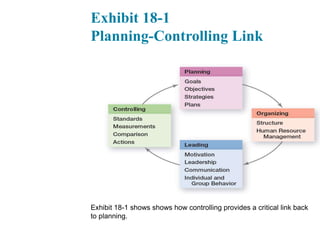
Exhibit 18-1
Planning-Controlling Link
Exhibit 18-1 shows shows how controlling provides a critical link back
to planning.
The Control Process
• Control process: a three-step
process of measuring actual
performance, comparing actual
performance against a standard, and
taking managerial action to correct
deviations or inadequate standards
Exhibit 18-2
The Control Process
Exhibit 18-2 illustrates the three-step control process.
Step 1: Measuring Actual
Performance
• How we measure
• What we measure
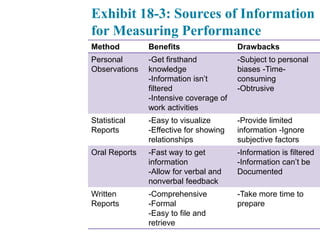
Exhibit 18-3: Sources of Information
for Measuring Performance
Method Benefits Drawbacks
Personal
Observations
-Get firsthand
knowledge
-Information isn’t
filtered
-Intensive coverage of
work activities
-Subject to personal
biases -Time-
consuming
-Obtrusive
Statistical
Reports
-Easy to visualize
-Effective for showing
relationships
-Provide limited
information -Ignore
subjective factors
Oral Reports -Fast way to get
information
-Allow for verbal and
nonverbal feedback
-Information is filtered
-Information can’t be
Documented
Written
Reports
-Comprehensive
-Formal
-Easy to file and
retrieve
-Take more time to
prepare
Step 2: Comparing Actual
Performance Against the
Standard
• Range of variation: the acceptable
parameters of variance between
actual performance and the standard
Exhibit 18-4
Acceptable Range of Variation
Exhibit 18-4 illustrates the acceptable range of variation.
Exhibit 18-5
Green Earth Gardening Supply—
July Sales
Product Standard Actual Over (Under)
Vegetable plants 1,075 913 (162)
Perennial
flowers
630 634 4
Annual flowers 800 912 112
Herbs 160 140 (20)
Flowering bulbs 170 286 116
Flowering
bushes
225 220 (5)
Heirloom seeds 540 672 132
Total 3,600 3,777 177
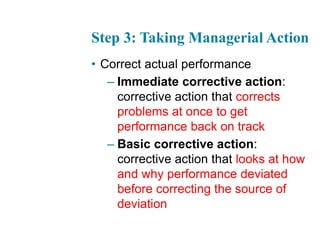
Step 3: Taking Managerial Action
• Correct actual performance
– Immediate corrective action:
corrective action that corrects
problems at once to get
performance back on track
– Basic corrective action:
corrective action that looks at how
and why performance deviated
before correcting the source of
deviation
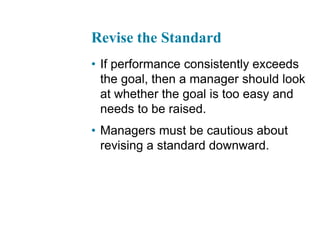
Revise the Standard
• If performance consistently exceeds
the goal, then a manager should look
at whether the goal is too easy and
needs to be raised.
• Managers must be cautious about
revising a standard downward.
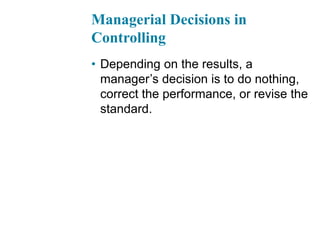
Managerial Decisions in
Controlling
• Depending on the results, a
manager’s decision is to do nothing,
correct the performance, or revise the
standard.
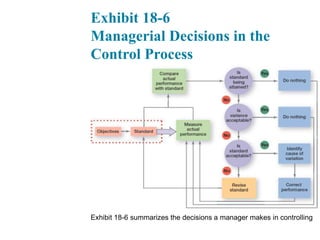
Exhibit 18-6
Managerial Decisions in the
Control Process
Exhibit 18-6 summarizes the decisions a manager makes in controlling
What is Organizational
Performance?
• Performance: the end result of an
activity
• Organizational performance: the
accumulated results of all the
organization’s work activities
Measures of Organizational
Performance
• Productivity: the amount of goods or
services produced divided by the
inputs needed to generate that output
• Organizational effectiveness: a
measure of how appropriate
organizational goals are and how well
those goals are being met
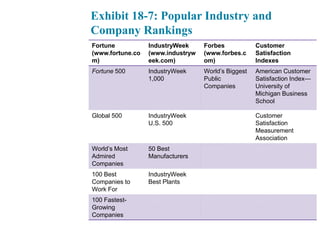
Exhibit 18-7: Popular Industry and
Company Rankings
Fortune
(www.fortune.co
m)
IndustryWeek
(www.industryw
eek.com)
Forbes
(www.forbes.c
om)
Customer
Satisfaction
Indexes
Fortune 500 IndustryWeek
1,000
World’s Biggest
Public
Companies
American Customer
Satisfaction Index—
University of
Michigan Business
School
Global 500 IndustryWeek
U.S. 500
blank Customer
Satisfaction
Measurement
Association
World’s Most
Admired
Companies
50 Best
Manufacturers
blank blank
100 Best
Companies to
Work For
IndustryWeek
Best Plants
blank blank
100 Fastest-
Growing
Companies
blank blank blank
Controlling for Employee
Performance
• Disciplinary action: actions taken by
a manager to enforce the
organization’s work standards and
regulations
• Progressive disciplinary action: an
approach to ensure that the minimum
penalty appropriate to the offense is
imposed
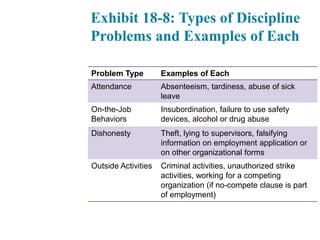
Exhibit 18-8: Types of Discipline
Problems and Examples of Each
Problem Type Examples of Each
Attendance Absenteeism, tardiness, abuse of sick
leave
On-the-Job
Behaviors
Insubordination, failure to use safety
devices, alcohol or drug abuse
Dishonesty Theft, lying to supervisors, falsifying
information on employment application or
on other organizational forms
Outside Activities Criminal activities, unauthorized strike
activities, working for a competing
organization (if no-compete clause is part
of employment)
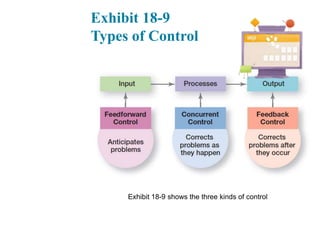
Exhibit 18-9
Types of Control
Exhibit 18-9 shows the three kinds of control
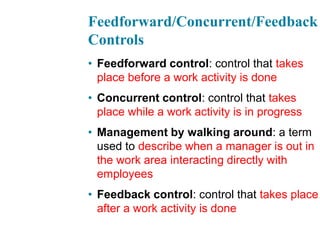
Feedforward/Concurrent/Feedback
Controls
• Feedforward control: control that takes
place before a work activity is done
• Concurrent control: control that takes
place while a work activity is in progress
• Management by walking around: a term
used to describe when a manager is out in
the work area interacting directly with
employees
• Feedback control: control that takes place
after a work activity is done
Financial Controls
• Traditional controls
– Ratio analysis:
ď‚§ Liquidity
ď‚§ Leverage
ď‚§ Activity
ď‚§ Profitability
– Budget analysis:
ď‚§ Quantitative standards
ď‚§ Deviations
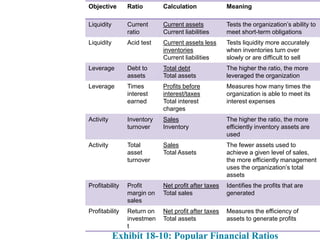
Exhibit 18-10: Popular Financial Ratios
Objective Ratio Calculation Meaning
Liquidity Current
ratio
Current assets
Current liabilities
Tests the organization’s ability to
meet short-term obligations
Liquidity Acid test Current assets less
inventories
Current liabilities
Tests liquidity more accurately
when inventories turn over
slowly or are difficult to sell
Leverage Debt to
assets
Total debt
Total assets
The higher the ratio, the more
leveraged the organization
Leverage Times
interest
earned
Profits before
interest/taxes
Total interest
charges
Measures how many times the
organization is able to meet its
interest expenses
Activity Inventory
turnover
Sales
Inventory
The higher the ratio, the more
efficiently inventory assets are
used
Activity Total
asset
turnover
Sales
Total Assets
The fewer assets used to
achieve a given level of sales,
the more efficiently management
uses the organization’s total
assets
Profitability Profit
margin on
sales
Net profit after taxes
Total sales
Identifies the profits that are
generated
Profitability Return on
investmen
t
Net profit after taxes
Total assets
Measures the efficiency of
assets to generate profits
Information Controls
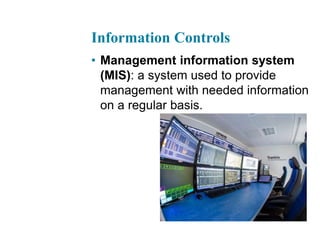
• Management information system
(MIS): a system used to provide
management with needed information
on a regular basis.
Balanced Scorecard
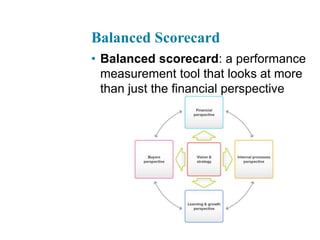
• Balanced scorecard: a performance
measurement tool that looks at more
than just the financial perspective
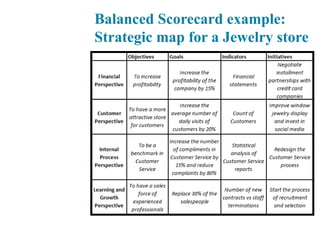
Balanced Scorecard example:
Strategic map for a Jewelry store
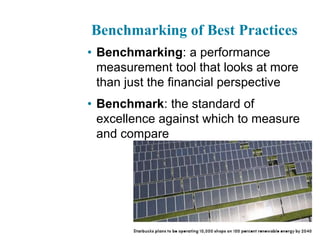
Benchmarking of Best Practices
• Benchmarking: a performance
measurement tool that looks at more
than just the financial perspective
• Benchmark: the standard of
excellence against which to measure
and compare
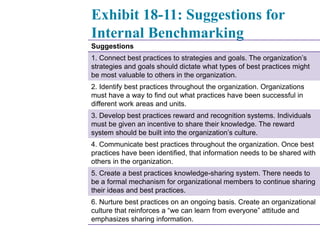
Exhibit 18-11: Suggestions for
Internal Benchmarking
Suggestions
1. Connect best practices to strategies and goals. The organization’s
strategies and goals should dictate what types of best practices might
be most valuable to others in the organization.
2. Identify best practices throughout the organization. Organizations
must have a way to find out what practices have been successful in
different work areas and units.
3. Develop best practices reward and recognition systems. Individuals
must be given an incentive to share their knowledge. The reward
system should be built into the organization’s culture.
4. Communicate best practices throughout the organization. Once best
practices have been identified, that information needs to be shared with
others in the organization.
5. Create a best practices knowledge-sharing system. There needs to
be a formal mechanism for organizational members to continue sharing
their ideas and best practices.
6. Nurture best practices on an ongoing basis. Create an organizational
culture that reinforces a “we can learn from everyone” attitude and
emphasizes sharing information.
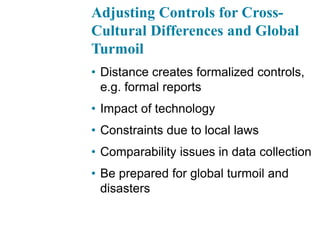
Adjusting Controls for Cross-
Cultural Differences and Global
Turmoil
• Distance creates formalized controls,
e.g. formal reports
• Impact of technology
• Constraints due to local laws
• Comparability issues in data collection
• Be prepared for global turmoil and
disasters
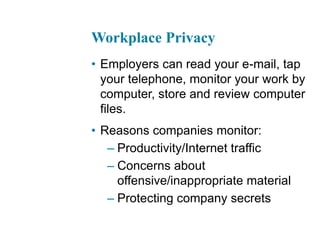
Workplace Privacy
• Employers can read your e-mail, tap
your telephone, monitor your work by
computer, store and review computer
files.
• Reasons companies monitor:
– Productivity/Internet traffic
– Concerns about
offensive/inappropriate material
– Protecting company secrets
Review Learning Objective 18.1
• Explain the nature and importance
of control.
– Controlling = monitoring, comparing,
correcting
– Important:
ď‚§ Are goals being met?
ď‚§ Provides information/feedback
ď‚§ Protects organization and assets
Review Learning Objective 18.2
• Describe the three steps in the
control process.
– Measuring
– Comparing
– Taking action
Review Learning Objective 18.3
• Explain how organizational and
employee performance are
measured.
– Productivity
– Effectiveness
– Industry and company rankings
Review Learning Objective 18.4
• Describe tools used to measure
organizational performance.
– Feedforward controls
– Concurrent controls
– Feedback controls
– Financial controls
– Information controls
– Balanced scorecards
– Benchmarking
Review Learning Objective 18.5
• Discuss contemporary issues in
control.
– Cross-cultural differences
– Workplace privacy
– Employee theft
– Workplace violence
– Corporate governance

Lec11 Controlling Activities and Operations.pptx

  • 1.
    Management Fourteenth Edition, GlobalEdition Chapter 18 Controlling Activities and Operations Copyright © 2018 Pearson Education, Ltd. All Rights Reserved
  • 2.
    Learning Objectives 18.1 Explainthe nature and importance of control. 18.2 Describe the three steps in the control process. 18.3 Explain how organizational and employee performance are measured. Know how to be effective at giving feedback. 18.4 Describe tools used to measure organizational performance. 18.5 Discuss contemporary issues in control. Develop your skill at dealing with difficult people.
  • 3.
    What Is Controllingand Why Is It Important? • Controlling: management function that involves monitoring, comparing, and correcting work performance
  • 4.
    Why Is ControlSo Important? • Planning • Empowering employees • Protecting the workplace
  • 5.
    Exhibit 18-1 Planning-Controlling Link Exhibit18-1 shows shows how controlling provides a critical link back to planning.
  • 6.
    The Control Process •Control process: a three-step process of measuring actual performance, comparing actual performance against a standard, and taking managerial action to correct deviations or inadequate standards
  • 7.
    Exhibit 18-2 The ControlProcess Exhibit 18-2 illustrates the three-step control process.
  • 8.
    Step 1: MeasuringActual Performance • How we measure • What we measure
  • 9.
    Exhibit 18-3: Sourcesof Information for Measuring Performance Method Benefits Drawbacks Personal Observations -Get firsthand knowledge -Information isn’t filtered -Intensive coverage of work activities -Subject to personal biases -Time- consuming -Obtrusive Statistical Reports -Easy to visualize -Effective for showing relationships -Provide limited information -Ignore subjective factors Oral Reports -Fast way to get information -Allow for verbal and nonverbal feedback -Information is filtered -Information can’t be Documented Written Reports -Comprehensive -Formal -Easy to file and retrieve -Take more time to prepare
  • 10.
    Step 2: ComparingActual Performance Against the Standard • Range of variation: the acceptable parameters of variance between actual performance and the standard
  • 11.
    Exhibit 18-4 Acceptable Rangeof Variation Exhibit 18-4 illustrates the acceptable range of variation.
  • 12.
    Exhibit 18-5 Green EarthGardening Supply— July Sales Product Standard Actual Over (Under) Vegetable plants 1,075 913 (162) Perennial flowers 630 634 4 Annual flowers 800 912 112 Herbs 160 140 (20) Flowering bulbs 170 286 116 Flowering bushes 225 220 (5) Heirloom seeds 540 672 132 Total 3,600 3,777 177
  • 13.
    Step 3: TakingManagerial Action • Correct actual performance – Immediate corrective action: corrective action that corrects problems at once to get performance back on track – Basic corrective action: corrective action that looks at how and why performance deviated before correcting the source of deviation
  • 14.
    Revise the Standard •If performance consistently exceeds the goal, then a manager should look at whether the goal is too easy and needs to be raised. • Managers must be cautious about revising a standard downward.
  • 15.
    Managerial Decisions in Controlling •Depending on the results, a manager’s decision is to do nothing, correct the performance, or revise the standard.
  • 16.
    Exhibit 18-6 Managerial Decisionsin the Control Process Exhibit 18-6 summarizes the decisions a manager makes in controlling
  • 17.
    What is Organizational Performance? •Performance: the end result of an activity • Organizational performance: the accumulated results of all the organization’s work activities
  • 18.
    Measures of Organizational Performance •Productivity: the amount of goods or services produced divided by the inputs needed to generate that output • Organizational effectiveness: a measure of how appropriate organizational goals are and how well those goals are being met
  • 19.
    Exhibit 18-7: PopularIndustry and Company Rankings Fortune (www.fortune.co m) IndustryWeek (www.industryw eek.com) Forbes (www.forbes.c om) Customer Satisfaction Indexes Fortune 500 IndustryWeek 1,000 World’s Biggest Public Companies American Customer Satisfaction Index— University of Michigan Business School Global 500 IndustryWeek U.S. 500 blank Customer Satisfaction Measurement Association World’s Most Admired Companies 50 Best Manufacturers blank blank 100 Best Companies to Work For IndustryWeek Best Plants blank blank 100 Fastest- Growing Companies blank blank blank
  • 20.
    Controlling for Employee Performance •Disciplinary action: actions taken by a manager to enforce the organization’s work standards and regulations • Progressive disciplinary action: an approach to ensure that the minimum penalty appropriate to the offense is imposed
  • 21.
    Exhibit 18-8: Typesof Discipline Problems and Examples of Each Problem Type Examples of Each Attendance Absenteeism, tardiness, abuse of sick leave On-the-Job Behaviors Insubordination, failure to use safety devices, alcohol or drug abuse Dishonesty Theft, lying to supervisors, falsifying information on employment application or on other organizational forms Outside Activities Criminal activities, unauthorized strike activities, working for a competing organization (if no-compete clause is part of employment)
  • 22.
    Exhibit 18-9 Types ofControl Exhibit 18-9 shows the three kinds of control
  • 23.
    Feedforward/Concurrent/Feedback Controls • Feedforward control:control that takes place before a work activity is done • Concurrent control: control that takes place while a work activity is in progress • Management by walking around: a term used to describe when a manager is out in the work area interacting directly with employees • Feedback control: control that takes place after a work activity is done
  • 24.
    Financial Controls • Traditionalcontrols – Ratio analysis:  Liquidity  Leverage  Activity  Profitability – Budget analysis:  Quantitative standards  Deviations
  • 25.
    Exhibit 18-10: PopularFinancial Ratios Objective Ratio Calculation Meaning Liquidity Current ratio Current assets Current liabilities Tests the organization’s ability to meet short-term obligations Liquidity Acid test Current assets less inventories Current liabilities Tests liquidity more accurately when inventories turn over slowly or are difficult to sell Leverage Debt to assets Total debt Total assets The higher the ratio, the more leveraged the organization Leverage Times interest earned Profits before interest/taxes Total interest charges Measures how many times the organization is able to meet its interest expenses Activity Inventory turnover Sales Inventory The higher the ratio, the more efficiently inventory assets are used Activity Total asset turnover Sales Total Assets The fewer assets used to achieve a given level of sales, the more efficiently management uses the organization’s total assets Profitability Profit margin on sales Net profit after taxes Total sales Identifies the profits that are generated Profitability Return on investmen t Net profit after taxes Total assets Measures the efficiency of assets to generate profits
  • 26.
    Information Controls • Managementinformation system (MIS): a system used to provide management with needed information on a regular basis.
  • 27.
    Balanced Scorecard • Balancedscorecard: a performance measurement tool that looks at more than just the financial perspective
  • 28.
  • 29.
    Benchmarking of BestPractices • Benchmarking: a performance measurement tool that looks at more than just the financial perspective • Benchmark: the standard of excellence against which to measure and compare
  • 30.
    Exhibit 18-11: Suggestionsfor Internal Benchmarking Suggestions 1. Connect best practices to strategies and goals. The organization’s strategies and goals should dictate what types of best practices might be most valuable to others in the organization. 2. Identify best practices throughout the organization. Organizations must have a way to find out what practices have been successful in different work areas and units. 3. Develop best practices reward and recognition systems. Individuals must be given an incentive to share their knowledge. The reward system should be built into the organization’s culture. 4. Communicate best practices throughout the organization. Once best practices have been identified, that information needs to be shared with others in the organization. 5. Create a best practices knowledge-sharing system. There needs to be a formal mechanism for organizational members to continue sharing their ideas and best practices. 6. Nurture best practices on an ongoing basis. Create an organizational culture that reinforces a “we can learn from everyone” attitude and emphasizes sharing information.
  • 31.
    Adjusting Controls forCross- Cultural Differences and Global Turmoil • Distance creates formalized controls, e.g. formal reports • Impact of technology • Constraints due to local laws • Comparability issues in data collection • Be prepared for global turmoil and disasters
  • 32.
    Workplace Privacy • Employerscan read your e-mail, tap your telephone, monitor your work by computer, store and review computer files. • Reasons companies monitor: – Productivity/Internet traffic – Concerns about offensive/inappropriate material – Protecting company secrets
  • 33.
    Review Learning Objective18.1 • Explain the nature and importance of control. – Controlling = monitoring, comparing, correcting – Important:  Are goals being met?  Provides information/feedback  Protects organization and assets
  • 34.
    Review Learning Objective18.2 • Describe the three steps in the control process. – Measuring – Comparing – Taking action
  • 35.
    Review Learning Objective18.3 • Explain how organizational and employee performance are measured. – Productivity – Effectiveness – Industry and company rankings
  • 36.
    Review Learning Objective18.4 • Describe tools used to measure organizational performance. – Feedforward controls – Concurrent controls – Feedback controls – Financial controls – Information controls – Balanced scorecards – Benchmarking
  • 37.
    Review Learning Objective18.5 • Discuss contemporary issues in control. – Cross-cultural differences – Workplace privacy – Employee theft – Workplace violence – Corporate governance

Editor's Notes

  • #4 What is controlling? It’s the process of monitoring, comparing, and correcting work performance. All managers should control even if their units are performing as planned because they can’t really know that unless they’ve evaluated what activities have been done and compared actual performance against the desired standard. Effective controls ensure that activities are completed in ways that lead to the attainment of goals. Whether controls are effective, then, is determined by how well they help employees and managers achieve their goals.
  • #5 Why is control so important? Planning can be done, an organizational structure created to facilitate efficient achievement of goals, and employees motivated through effective leadership. But there’s no assurance that activities are going as planned and that the goals employees and managers are working toward are, in fact, being attained. Control is important, therefore, because it’s the only way that managers know whether organizational goals are being met and if not, the reasons why. The value of the control function can be seen in three specific areas: planning, empowering employees, and protecting the workplace. Many managers are reluctant to empower their employees because they fear something will go wrong for which they would be held responsible. But an effective control system can provide information and feedback on employee performance and minimize the chance of potential problems. The final reason why managers control is to protect the organization and its assets. Today’s environment brings heightened threats from natural disasters, financial scandals, workplace violence, global supply chain disruptions, security breaches, and even possible terrorist attacks. Managers must protect organizational assets in the event that any of these things should happen.
  • #6 Controlling provides a critical link back to planning (see Exhibit 18-1). If managers didn’t control, they’d have no way of knowing whether their goals and plans were being achieved and what future actions to take.
  • #7 The control process is a three-step process of measuring actual performance, comparing actual performance against a standard, and taking managerial action to correct deviations or to address inadequate standards. The control process assumes that performance standards already exist, and they do. They’re the specific goals created during the planning process.
  • #9 Four approaches used by managers to measure and report actual performance are personal observations, statistical reports, oral reports, and written reports. Exhibit 18-3 summarizes the advantages and drawbacks of each approach. Most managers use a combination of these approaches. To determine what actual performance is, a manager must first get information about it. Thus, the first step in control is measuring. What is measured is probably more critical to the control process than how it’s measured. Why? Because selecting the wrong criteria can create serious problems. Besides, what is measured often determines what employees will do. Most work activities can be expressed in quantifiable terms. However, managers should use subjective measures when they can’t. Although such measures may have limitations, they’re better than having no standards at all and doing no controlling.
  • #10 Four approaches used by managers to measure and report actual performance are personal observations, statistical reports, oral reports, and written reports. Exhibit 18-3 summarizes the advantages and drawbacks of each approach. Most managers use a combination of these approaches.
  • #11 The comparing step determines the variation between actual performance and the standard. Although some variation in performance can be expected in all activities, it’s critical to determine an acceptable range of variation.
  • #14 Managers can choose among three possible courses of action: do nothing, correct the actual performance, or revise the standards. Because “do nothing” is self-explanatory, let’s look at the other two. One decision a manager must make is whether to take immediate corrective action, which corrects problems at once to get performance back on track, or to use basic corrective action, which looks at how and why performance deviated before correcting the source of deviation.
  • #15 It’s possible that the variance was a result of an unrealistic standard—too low or too high a goal. In that situation, the standard needs the corrective action, not the performance. If performance consistently exceeds the goal, then a manager should look at whether the goal is too easy and needs to be raised. On the other hand, managers must be cautious about revising a standard downward.
  • #16 The standards are goals developed during the planning process. These goals provide the basis for the control process, which involves measuring actual performance and comparing it against the standard. Depending on the results, a manager’s decision is to do nothing, correct the performance, or revise the standard.
  • #18 Performance is the end result of an activity. And whether that activity is hours of intense practice before a concert or race or whether it’s carrying out job responsibilities as efficiently and effectively as possible, performance is what results from that activity. Managers are concerned with organizational performance—the accumulated results of all the organization’s work activities. It’s a multifaceted concept, but managers need to understand the factors that contribute to organizational performance.
  • #19 Productivity is the amount of goods or services produced divided by the inputs needed to generate that output. Organizations and individual work units want to be productive. They want to produce the most goods and services using the least amount of inputs. Output is measured by the sales revenue an organization receives when goods are sold (selling price Ă— number sold). Input is measured by the costs of acquiring and transforming resources into outputs. Organizational effectiveness is a measure of how appropriate organizational goals are and how well those goals are met. That’s the bottom line for managers, and it’s what guides managerial decisions in designing strategies and work activities and in coordinating the work of employees.
  • #20 Rankings are a popular way for managers to measure their organization’s performance. And there’s not a shortage of these rankings as Exhibit 18-7 shows. Rankings are determined by specific performance measures, which are different for each list.
  • #21 It’s particularly important for managers to deliver effective performance feedback and to be prepared, if needed, to use disciplinary actions—actions taken by a manager to enforce the organization’s work standards and regulation. We like to know how we’re doing. Managers need to provide their employees with feedback so that the employees know where they stand in terms of their work. When giving performance feedback, both parties need to feel heard, understood, and respected. And if done that way, positive outcomes can result. Progressive disciplinary action is intended to ensure that the minimum penalty appropriate to the offense is imposed.
  • #22 Exhibit 18-8 lists some common types of work discipline problems and examples of each. In those circumstances, it’s important for a manager to know what the organization’s policies are on discipline. Is there a process for dealing with unsatisfactory job performance? Do warnings need to be given when performance is inadequate? What happens if after the warnings, performance or the troublesome behavior doesn’t improve? Disciplinary actions are never easy or pleasant; however, discipline can be used to both control and correct employee performance, and managers must know how to discipline.
  • #23 Managers can implement controls before an activity begins, during the time the activity is going on, and after the activity has been completed. The first type is called feedforward control; the second, concurrent control; and the last, feedback control (see Exhibit 18-9).
  • #24 The most desirable type of control—feedforward control—prevents problems because it takes place before the actual activity. The key to feedforward controls is taking managerial action before a problem occurs. That way, problems can be prevented rather than having to correct them after any damage (poor-quality products, lost customers, lost revenue, etc.) has already been done. Concurrent control, as its name implies, takes place while a work activity is in progress. The best-known form of concurrent control is direct supervision. Another term for it is management by walking around, which is when a manager is in the work area interacting directly with employees. The most popular type of control relies on feedback. In feedback control, the control takes place after the activity is done. Feedback controls have two advantages. First, feedback gives managers meaningful information on how effective their planning efforts were. Feedback that shows little variance between standard and actual performance indicates that the planning was generally on target. Second, feedback can enhance motivation. People want to know how well they’re doing and feedback provides that information.
  • #25 Every business wants to earn a profit. To achieve this goal, managers need financial controls. For instance, they might analyze quarterly income statements for excessive expenses. They might also calculate financial ratios to ensure that sufficient cash is available to pay ongoing expenses, that debt levels haven’t become too high, or that assets are used productively. Budgets are planning and control tools. When a budget is formulated, it’s a planning tool because it indicates which work activities are important and what and how much resources should be allocated to those activities. But budgets are also used for controlling because they provide managers with quantitative standards against which to measure and compare resource consumption. If deviations are significant enough to require action, the manager examines what has happened and tries to uncover why.
  • #26 Managers might use traditional financial measures such as ratio analysis and budget analysis. Exhibit 18-10 summarizes some of the most popular financial ratios. Liquidity ratios measure an organization’s ability to meet its current debt obligations. Leverage ratios examine the organization’s use of debt to finance its assets and whether it’s able to meet the interest payments on the debt. Activity ratios assess how efficiently a company uses its assets. Finally, profitability ratios measure how efficiently and effectively the company uses its assets to generate profits. These ratios are calculated using selected information from the organization’s two primary financial statements (the balance sheet and the income statement), which are then expressed as a percentage or ratio.
  • #27 In measuring actual performance, managers need information about what is happening within their area of responsibility and about the standards in order to be able to compare actual performance with the standard. A management information system (MIS) is a system used to provide managers with needed information on a regular basis. In theory, this system can be manual or computer-based, although most organizations have moved to computer-supported applications. The term system in MIS implies order, arrangement, and purpose. Further, an MIS focuses specifically on providing managers with information (processed and analyzed data), not merely data (raw, unanalyzed facts).
  • #28 The balanced scorecard approach is a way to evaluate organizational performance from more than just the financial perspective. A balanced scorecard typically looks at four areas that contribute to a company’s performance: financial, customer, internal processes, and people/innovation/growth assets. According to this approach, managers should develop goals in each of the four areas and then measure whether the goals are being met.
  • #30 Benchmarking is the search for the best practices among competitors or noncompetitors that lead to their superior performance. Benchmarking should identify various benchmarks, the standards of excellence against which to measure and compare.
  • #31 Sometimes those best practices can be found inside the organization and just need to be shared. Exhibit 18-11 provides some suggestions for internal benchmarking. Source: Based on “Extracting Diamonds in the Rough,” by Tad Leahy, from Business Finance, August 2000.
  • #32 In a global corporation, managers of foreign operations tend to be less controlled by the home office, if for no other reason than the distance keeping managers from being able to observe work directly. Because distance creates a tendency to formalize controls, such organizations often rely on extensive formal reports for control, most of which are communicated electronically. Managers in countries where technology is more advanced often use indirect control devices such as computer-generated reports and analyses in addition to standardized rules and direct supervision to ensure that work activities are going as planned. In less technologically advanced countries, however, managers tend to use more direct supervision and highly centralized decision making for control. Some countries’ laws prohibit closing facilities, laying off employees, taking money out of the country, or bringing in a new management team from outside the country. Another challenge for global managers in collecting data for measurement and comparison is comparability. This difference makes it hard to compare, for instance, labor costs per unit. The best time to be prepared is before an emergency occurs, and many organizations are doing just that, so that if a crisis o
  • #33 If you work, do you think you have a right to privacy at your job? What can your employer find out about you and your work? You might be surprised at the answers! Employers can (and do), among other things, read your e-mail (even those marked “personal or confidential”), tap your telephone, monitor your work by computer, store and review computer files, monitor you in an employee bathroom or dressing room, and track your whereabouts in a company vehicle. And these actions aren’t that uncommon. In fact, some 26 percent of companies have fired an employee for e-mail misuse; 26 percent have fired workers for misusing the Internet; 6 percent have fired employees for inappropriate cell phone use; 4 percent have fired someone for instant messaging misuse; and 3 percent have fired someone for inappropriate text messaging.
  • #34 Controlling is the process of monitoring, comparing, and correcting work performance. As the final step in the management process, controlling provides the link back to planning. If managers didn’t control, they’d have no way of knowing whether goals were being met. Control is important because (1) it’s the only way to know if goals are being met, and if not, why; (2) it provides information and feedback so managers feel comfortable empowering employees; and (3) it helps protect an organization and its assets.
  • #35 The three steps in the control process are measuring, comparing, and taking action. Measuring involves deciding how to measure actual performance and what to measure. Comparing involves looking at the variation between actual performance and the standard (goal). Deviations outside an acceptable range of variation need attention. Taking action can involve doing nothing, correcting the actual performance, or revising the standards. Doing nothing is self-explanatory. Correcting the actual performance can involve different corrective actions, which can either be immediate or basic. Standards can be revised by either raising or lowering them.
  • #36 Organizational performance is the accumulated results of all the organization’s work activities. Three frequently used organizational performance measures include (1) productivity, the output of goods or services produced divided by the inputs needed to generate that output; (2) effectiveness, a measure of how appropriate organizational goals are and how well those goals are being met; and (3) industry and company rankings compiled by various business publications. Employee performance is controlled through effective performance feedback and through disciplinary actions, when needed.
  • #37 Feedforward controls take place before a work activity is done. Concurrent controls take place while a work activity is being done. Feedback controls take place after a work activity is done. Financial controls that managers can use include financial ratios (liquidity, leverage, activity, and profitability) and budgets. One information control managers can use is an MIS, which provides managers with needed information on a regular basis. Others include comprehensive and secure controls such as data encryption, system firewalls, data back-ups, and so forth that protect the organization’s information. Balanced scorecards provide a way to evaluate an organization’s performance in four different areas rather than just from the financial perspective. Benchmarking provides control by finding the best practices among competitors or noncompetitors and from inside the organization itself.
  • #38 Adjusting controls for cross-cultural differences may be needed primarily in the areas of measuring and taking corrective actions. Workplace concerns include cross-cultural differences, workplace privacy, employee theft, and workplace violence. For each of these issues, managers need to have policies in place to control inappropriate actions and ensure that work is getting done efficiently and effectively. Control is important to customer interactions because employee service productivity and service quality influences customer perceptions of service value. Organizations want long-term and mutually beneficial relationships among their employees and customers. Corporate governance is the system used to govern a corporation so that the interests of corporate owners are protected.