HR MANAGEMENT FUNDAMENTALS
Basic definitions,
tactical and strategic Human Resources ,
historical context and main stages of evolution
WHAT IS HUMAN RESOURCE MANAGEMENT
The science and the practice that deals with the nature of
the employment relationship and all of the decisions,
actions and issues that relate to this relationship.
It involves an organization’s acquisition, development and
utilization of employees, as well the employee relationship
to an organization and its performance.
Sources: D.T. Barnum, S. Rosen, G.R. Ferris “Handbook of Human Resource Management”, 1995
J.W. Boudreau, P.M. Ramstad “Beyond HR : the new science of human capital”, 2007
Whatever it is called, the resource that lies within employees
and how they are organized is critical to strategic success
and competitive advantage
WHAT IS HUMAN RESOURCE MANAGEMENT
A strategic and coherent(logical,consistent) approach to the
management of an organization’s most valued assets - the
people working there - who individually and collectively
contribute to the achievement of its objectives
Source: M. Armstrong “A Handbook of Human Resource Management Practice”, 2006
HRM can be regarded as a “set of interrelated policies with
an ideological and philosophical underpinning”, made of:
•a particular constellation of beliefs and assumptions
a particular constellation of beliefs and assumptions
•a strategic thrust informing decisions about people management
a strategic thrust informing decisions about people management
•the central involvement of line managers
the central involvement of line managers
•reliance upon a set of “levers” to shape the employment relationship
reliance upon a set of “levers” to shape the employment relationship
The overall purpose of HRM is to ensure that the organization
is able to achieve success through people
WHAT IS HUMAN CAPITAL MANAGEMENT
The Human Capital of an organization consists of
the people who work for it and on whom
the success of the business depends
Human Capital represents the human factor in the
organization: the combined intelligence, skills and expertise
that give the organization the distinctive character
Source: M. Armstrong “A Handbook of Human Resource Management Practice”,
2006
The human elements are those that are capable of learning,
changing, innovating and providing the creating thrust
which can ensure the long term survival and prosperity
of the organization
of the organization
THE IMPORTANCE OF HUMAN CAPITAL
business leaders recognize that managing people is vital to
organizational success and it is among their top concerns
top HR officers are respected by boards of directors
financial research shows that increasing amounts of market value are
driven by intangible(not physical in nature) assets, including human
capital
consulting firms that built their reputation on strategy, finance and
operations, now have leadership and talent management practices
successful CEOs write memoirs that focus the connections between
their success and their talent management processes
Being one of the best place to work is a goal of top management,
not just HR leaders
not just HR leaders
Today, more and more:
TRENDS THAT HAVE MADE “TALENT” A TOP PRIORITY
DIGITIZATION
LABOR SHORTAGES
GROWTH THROUGH ACQUISITIONS
SIMOULTANEOUS DOWNSIZING AND EXPANSION
WORKFORCE DEMOGRAPHIC TRASFORMATIONS
CONSTANT HYPERCOMPETITION AND CHANGE
Business decisions must happen more quickly,
they increasingly depend on talent and its organization,
the employment relationship is under unprecedented pressure to adapt
THE “WAR FOR TALENT”
The impelling need for organizations to attract, retain and
to attract, retain and
engage the key people
engage the key people they need so to become known in
the talent marketplace as a magnet for the best people
magnet for the best people
Source: M. Shumann, L. Sartain “Brand for talent”, 2009
The ultimate trend is to make your talent as famous as
to make your talent as famous as
your brand
your brand in order to reach - beyond what you invest to
be known for what you do - to be known for
who wants to work with you
Every business is challenged to build a marketing-focused
organization that pursues brand loyalty among workers
brand loyalty among workers as
aggressively as it pursues brand loyalty among customers
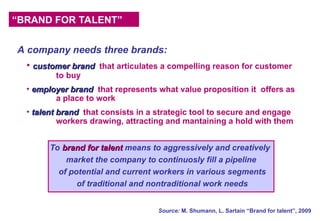
“BRAND FOR TALENT”
A company needs three brands:
• customer brand
customer brand that articulates a compelling reason for customer
to buy
• employer brand
employer brand that represents what value proposition it offers as
a place to work
• talent brand
talent brand that consists in a strategic tool to secure and engage
workers drawing, attracting and mantaining a hold with them
Source: M. Shumann, L. Sartain “Brand for talent”, 2009
To brand for talent
brand for talent means to aggressively and creatively
market the company to continuosly fill a pipeline
of potential and current workers in various segments
of traditional and nontraditional work needs
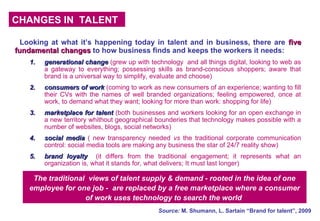
CHANGES IN TALENT
Looking at what it’s happening today in talent and in business, there are five
five
fundamental changes
fundamental changes to how business finds and keeps the workers it needs:
1.
1. generational change
generational change (grew up with technology and all things digital, looking to web as
a gateway to everything; possessing skills as brand-conscious shoppers; aware that
brand is a universal way to simplify, evaluate and choose)
2.
2. consumers of work
consumers of work (coming to work as new consumers of an experience; wanting to fill
their CVs with the names of well branded organizations; feeling empowered, once at
work, to demand what they want; looking for more than work: shopping for life)
3.
3. marketplace for talent
marketplace for talent (both businesses and workers looking for an open exchange in
a new territory whithout geographical bounderies that technology makes possible with a
number of websites, blogs, social networks)
4.
4. social media
social media ( new transparency needed vs the traditional corporate communication
control: social media tools are making any business the star of 24/7 reality show)
5.
5. brand loyalty
brand loyalty (it differs from the traditional engagement; it represents what an
organization is, what it stands for, what delivers; It must last longer)
Source: M. Shumann, L. Sartain “Brand for talent”, 2009
The traditional views of talent supply & demand - rooted in the idea of one
employee for one job - are replaced by a free marketplace where a consumer
of work uses technology to search the world
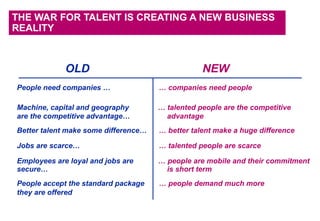
THE WAR FOR TALENT IS CREATING A NEW BUSINESS
REALITY
OLD NEW
People need companies … … companies need people
Machine, capital and geography … talented people are the competitive
are the competitive advantage… advantage
Better talent make some difference… … better talent make a huge difference
Jobs are scarce… … talented people are scarce
Employees are loyal and jobs are … people are mobile and their commitment
secure… is short term
People accept the standard package … people demand much more
they are offered
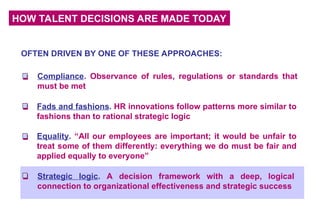
HOW TALENT DECISIONS ARE MADE TODAY
Compliance. Observance of rules, regulations or standards that
must be met
Fads and fashions. HR innovations follow patterns more similar to
fashions than to rational strategic logic
Equality. “All our employees are important; it would be unfair to
treat some of them differently: everything we do must be fair and
applied equally to everyone”
OFTEN DRIVEN BY ONE OF THESE APPROACHES:
Strategic logic. A decision framework with a deep, logical
connection to organizational effectiveness and strategic success
MARKETS’ EVOLUTION FROM PROFESSIONAL
PRACTICE TO THE DECISION SCIENCE
Source: J.W. Boudreau, P.M. Ramstad “ Beyond HR “, 2007
Value
creation
strategy
Organization/
talent
Human
Resources Accounting
Sales
Talentship
Talentship Finance
Marketing
Financial
Capital
Products and
customers
Professional
practice
Decision
science
Vital
markets
Improving the decision about talent resource is the domain of talentship
talentship: the right
talent is the fundamental building block to create an organization capable of
innovating and changing and using this as a source of competitive advantage
THE COMPLEXITY OF THE BUSINESS CHALLENGE
GLOBALIZATION
THE INCREASING PRESSURE ON EMPLOYEES
THE CONTINUE DECLINE IN EMPLOYEE LOYALTY
THE STRENUOS(requiring or using great effort or exertion) INTERVENTION OF
SHAREHOLDERS AND BOARDS OF DIRECTORS
THE INCREASED SPEED OF CHANGES
THE ONGOING DECLINE IN CUSTOMER LOYALTY
THE WAR FOR TOP TALENT
ARE HR LEADERS UP TO THE CHALLENGE ?
They spend too much time discussing the details of HR
They seek line management’s directions and leadership and don’t
provide enough leadership themselves
They lack the detailed business knowledge: they don’t understand
the customers, the technology, the industry, the competitors, the
channels, etc…
MAIN PROBLEMS
They don’t tie HR initiatives to the bottom line(the fundamental and
most important factor.) well enough
ARE HR LEADERS UP TO THE CHALLENGE ? (cont.)
They use a unique language that doesn’t appeal to the
employee or management
They don’t bring enough to the strategic conversation: they move
too quickly to the details of executions
AS A RESULT:
Weak connections among customer requirements,
business strategies and human resources responses
TACTICAL AND STRATEGIC HUMAN RESOURCES
Baseline administration of people issues and data:
• compensation and benefits administration
• employee records and reporting
• policy development and enforcement
TACTICAL HR
Implementation of traditional human resource programs and
work:
• hiring
• basic skills training
• salary surveys and compensation program design
• employee relations work of resolving day-to-day employee
concerns and problems
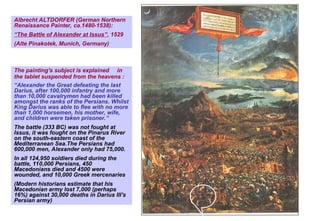
The painting's subject is explained in
the tablet suspended from the heavens :
“Alexander the Great defeating the last
Darius, after 100,000 infantry and more
than 10,000 cavalrymen had been killed
amongst the ranks of the Persians. Whilst
King Darius was able to flee with no more
than 1,000 horsemen, his mother, wife,
and children were taken prisoner.”
The battle (333 BC) was not fought at
Issus, it was fought on the Pinarus River
on the south-eastern coast of the
Mediterranean Sea.The Persians had
600,000 men, Alexander only had 75,000.
In all 124,950 soldiers died during the
battle, 110,000 Persians, 450
Macedonians died and 4500 were
wounded, and 10,000 Greek mercenaries
(Modern historians estimate that his
Macedonian army lost 7,000 (perhaps
16%) against 30,000 deaths in Darius III's
Persian army)
Albrecht ALTDORFER (German Northern
Renaissance Painter, ca.1480-1538):
“The Battle of Alexander at Issus”, 1529
(Alte Pinakotek, Munich, Germany)
Focuses on the path between human talent and winning in the
market place:
• stimulating dialogue among the executive team on the appropriateness
of business strategy
• aligning reward systems across the organization consistently with the
fulfillment of customer needs
• defining talent needs on the basis of the latest business strategy
STRATEGIC HR
TACTICAL AND STRATEGIC HUMAN RESOURCES
• redesigning work processes to eliminate what doesn’t add value and/
or increases cost for the end customer
• Developing training solutions to build organizational capabilities
required by the business strategy
• Redesigning aspects of the organizational culture that obstacles the
delivery of what the customer desires in terms of speed, creativity,
quality, service levels or whatever needs improvement
STRATEGIC HR WORK CONNECTS TO:
Building competitive advantage, enabling business
strategy, fullfilling customer needs
TACTICAL AND STRATEGIC HUMAN RESOURCES
HR STAGES OF DEVELOPMENT
Function
Function
Usually Known as
Usually Known as:
: PRIMARY FOCUS
PRIMARY FOCUS TALENT BACKGROUND
TALENT BACKGROUND
Source: R. Christensen ”Roadmap to Strategic HR”, 2006
Hiring and firing at best costs
Negotiating with unions representing
company employees; negotiating talent
for least costs
Administering employee issues such as
benefits, compensation, and employee
relations; tends to have a strong
enphasis on control
In many cases, represents primarily a
name change with little substantive
difference, regardless of the implication
of a move toward being more strategic
Managing organization and employee
performance towards the business
success
Purchasing
Labor
relations
Personnel
Human
resources (hr)
Strategic HR
Contract negotiations; little focus
on human sensitivity(select right one)
Legal and negotiating background
Administrative background
Both administrative and employee
relations background; increasing
focus on business processes
Background in business strategy,
people, systems, and organization
ORGANIZATION AS A COMPETITIVE ADVANTAGE
Finding, acqiring and retaining the right talent is a necessary - but not
sufficient - step in creating an organization with a sustainable competitive
advantage. For this, it is also mandatory to have the right systems,
processes, and practices in place.
Too often organizations have great people but do not manage or support
them correctly, with systems and processes that:
- restrict experimentation
- limit learning
- hinder the transfer of knowledge
- fail to motivate
- suppress innovation
ORGANIZATION AS A COMPETITIVE ADVANTAGE (cont.)
If talent workers are not managed properly they will leave. Often falling
straight in the welcoming arms of the competition, with potentially
devastating effects.
Organizations then have to spend further time and money on recruiting
replacements.
AS A RESULT:
Organizations fail to capitalize on the talent they have
and in the long run perform poorly
1. Incident
The exit interviews and employee retention
Deficient exit interview data; low morale and high turnover among registered
nurses
The exit interview data are of poor quality and follow up for problems
identified is practically non existent.
Systematic input from employees (both continuing and departing) is
necessary to assist the organization in improving its HRM.
Either the quality of data generated by exit interviews need to be improved or
alternative data sources need to be developed and utilized
1. INCIDENT: “Exit interview and employee retention”
ANSWERS TO INCIDENT QUESTIONS
Discuss the nature and causes of the problem
Exit interviews are key to determine causes for dissatisfaction and
suggestions for countering undesired turnover(the rate at which employees
leave a workforce and are replaced.)
James should consider modifications such as the following:
use focus groups
use focus groups of registered nurses to learn about the major causes of
nurse frustration and stress; then develop a structured exit interviewer form
train the exit interviewer
train the exit interviewer to probe and obtain better information concerning
problems in the organization and their potential solutions
assure departing employees
assure departing employees that the information they provide will not be
not be
disclosed
disclosed to supervisor or others in the organization
provide recommendations
provide recommendations for other organizations prior
prior to conducting the
exit interview
use new company personnel
use new company personnel to conduct exit interviews or contract them out
conduct exit interviews
conduct exit interviews several months after
months after the employee has left the work
1. INCIDENT: “Exit interview and employee retention”
ANSWERS TO INCIDENT QUESTIONS
Should James attempt to improve the exit interview process?
If so, how should this be done?
The major alternative source of employee input is a systematic, periodic
employee attitude survey
Attitude surveys elicit input from all the employees (non just who are leaving).
Giving these surveys periodically, comparisons can be made over time for
particular department or groups of employees.
The data generated should be used to make positive changes; if ignored by
management, employee cynicism will result, participation on the survey will
decline and the input obtained will be much less useful.
In addition to attitude surveys, group meetings or one-to-one meetings also
allow employees to provide input
An atmosphere of openness and trust must be created and not penalize
employees who provide negative input
It is crucial to follow through with constructive change once a problem has
been identified
1. INCIDENT: “Exit interview and employee retention”
ANSWERS TO INCIDENT QUESTIONS
What other alternatives should be considered in addition to exit interviews?
He should improve the existing process for exit interviews and introduce a
new attitude survey process
While enhancing both the existing process and the new one, he should strive
to exploit the job attributes that reduce retention and to eliminate or minimize
those that cause turnover
1. INCIDENT: “Exit interview and employee retention”
ANSWERS TO INCIDENT QUESTIONS
How can James use the information generated about why nurses stay or leave
to improve nurse retention?
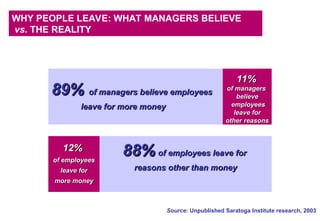
WHY PEOPLE LEAVE: WHAT MANAGERS BELIEVE
vs. THE REALITY
Source: Unpublished Saratoga Institute research, 2003
89%
89% of managers believe employees
of managers believe employees
leave for more money
88%
88% of employees leave for
of employees leave for
reasons other than money
11%
11%
of managers
of managers
believe
believe
employees
employees
leave for
leave for
other reasons
other reasons
12%
12%
of employees
of employees
leave for
leave for
more money
more money
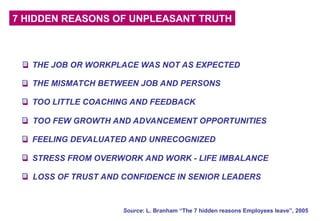
7 HIDDEN REASONS OF UNPLEASANT TRUTH
THE JOB OR WORKPLACE WAS NOT AS EXPECTED
THE MISMATCH BETWEEN JOB AND PERSONS
TOO LITTLE COACHING AND FEEDBACK
FEELING DEVALUATED AND UNRECOGNIZED
STRESS FROM OVERWORK AND WORK - LIFE IMBALANCE
TOO FEW GROWTH AND ADVANCEMENT OPPORTUNITIES
LOSS OF TRUST AND CONFIDENCE IN SENIOR LEADERS
Source: L. Branham “The 7 hidden reasons Employees leave”, 2005
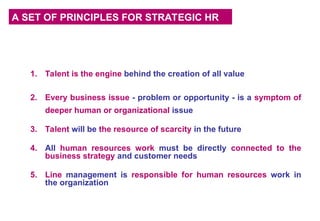
A SET OF PRINCIPLES FOR STRATEGIC HR
1. Talent is the engine behind the creation of all value
2. Every business issue - problem or opportunity - is a symptom of
deeper human or organizational issue
3. Talent will be the resource of scarcity in the future
4. All human resources work must be directly connected to the
business strategy and customer needs
5. Line management is responsible for human resources work in
the organization
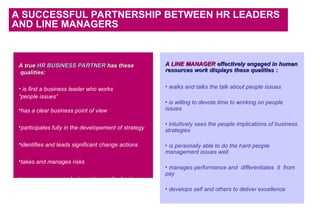
A SUCCESSFUL PARTNERSHIP BETWEEN HR LEADERS
AND LINE MANAGERS
A true
A true HR BUSINESS PARTNER
HR BUSINESS PARTNER has these
has these
qualities:
qualities:
• is first a business leader who works
“people issues”
•has a clear business point of view
•participates fully in the developement of strategy
•identifies and leads significant change actions
•takes and manages risks
•measures success by impact upon the business
A
A LINE MANAGER
LINE MANAGER effectively engaged in human
effectively engaged in human
resources work displays these qualities
resources work displays these qualities :
:
• walks and talks the talk about people issues
• is willing to devote time to working on people
issues
• intuitively sees the people implications of business
strategies
• is personally able to do the hard people
management issues well
• manages performance and differentiates it from
pay
• develops self and others to deliver excellence

Human resource management _Lecture 2.ppt

  • 1.
    HR MANAGEMENT FUNDAMENTALS HRMANAGEMENT FUNDAMENTALS Basic definitions, tactical and strategic Human Resources , historical context and main stages of evolution
  • 2.
    WHAT IS HUMANRESOURCE MANAGEMENT The science and the practice that deals with the nature of the employment relationship and all of the decisions, actions and issues that relate to this relationship. It involves an organization’s acquisition, development and utilization of employees, as well the employee relationship to an organization and its performance. Sources: D.T. Barnum, S. Rosen, G.R. Ferris “Handbook of Human Resource Management”, 1995 J.W. Boudreau, P.M. Ramstad “Beyond HR : the new science of human capital”, 2007 Whatever it is called, the resource that lies within employees Whatever it is called, the resource that lies within employees and how they are organized is critical to strategic success and how they are organized is critical to strategic success and competitive advantage and competitive advantage
  • 3.
    WHAT IS HUMANRESOURCE MANAGEMENT A strategic and coherent(logical,consistent) approach to the management of an organization’s most valued assets - the people working there - who individually and collectively contribute to the achievement of its objectives Source: M. Armstrong “A Handbook of Human Resource Management Practice”, 2006 HRM can be regarded as a “set of interrelated policies with HRM can be regarded as a “set of interrelated policies with an ideological and philosophical underpinning”, made of: an ideological and philosophical underpinning”, made of: •a particular constellation of beliefs and assumptions a particular constellation of beliefs and assumptions •a strategic thrust informing decisions about people management a strategic thrust informing decisions about people management •the central involvement of line managers the central involvement of line managers •reliance upon a set of “levers” to shape the employment relationship reliance upon a set of “levers” to shape the employment relationship The overall purpose of HRM is to ensure that the organization is able to achieve success through people
  • 4.
    WHAT IS HUMANCAPITAL MANAGEMENT The Human Capital of an organization consists of the people who work for it and on whom the success of the business depends Human Capital represents the human factor in the organization: the combined intelligence, skills and expertise that give the organization the distinctive character Source: M. Armstrong “A Handbook of Human Resource Management Practice”, 2006 The human elements are those that are capable of learning, The human elements are those that are capable of learning, changing, innovating and providing the creating thrust changing, innovating and providing the creating thrust which can ensure the long term survival and prosperity which can ensure the long term survival and prosperity of the organization of the organization
  • 5.
    THE IMPORTANCE OFHUMAN CAPITAL business leaders recognize that managing people is vital to organizational success and it is among their top concerns top HR officers are respected by boards of directors financial research shows that increasing amounts of market value are driven by intangible(not physical in nature) assets, including human capital consulting firms that built their reputation on strategy, finance and operations, now have leadership and talent management practices successful CEOs write memoirs that focus the connections between their success and their talent management processes Being one of the best place to work is a goal of top management, Being one of the best place to work is a goal of top management, not just HR leaders not just HR leaders Today, more and more:
  • 6.
    TRENDS THAT HAVEMADE “TALENT” A TOP PRIORITY DIGITIZATION LABOR SHORTAGES GROWTH THROUGH ACQUISITIONS SIMOULTANEOUS DOWNSIZING AND EXPANSION WORKFORCE DEMOGRAPHIC TRASFORMATIONS CONSTANT HYPERCOMPETITION AND CHANGE Business decisions must happen more quickly, Business decisions must happen more quickly, they increasingly depend on talent and its organization, they increasingly depend on talent and its organization, the employment relationship is under unprecedented pressure to adapt the employment relationship is under unprecedented pressure to adapt
  • 7.
    THE “WAR FORTALENT” The impelling need for organizations to attract, retain and to attract, retain and engage the key people engage the key people they need so to become known in the talent marketplace as a magnet for the best people magnet for the best people Source: M. Shumann, L. Sartain “Brand for talent”, 2009 The ultimate trend is to make your talent as famous as to make your talent as famous as your brand your brand in order to reach - beyond what you invest to be known for what you do - to be known for who wants to work with you Every business is challenged to build a marketing-focused organization that pursues brand loyalty among workers brand loyalty among workers as aggressively as it pursues brand loyalty among customers
  • 8.
    “BRAND FOR TALENT” Acompany needs three brands: • customer brand customer brand that articulates a compelling reason for customer to buy • employer brand employer brand that represents what value proposition it offers as a place to work • talent brand talent brand that consists in a strategic tool to secure and engage workers drawing, attracting and mantaining a hold with them Source: M. Shumann, L. Sartain “Brand for talent”, 2009 To brand for talent brand for talent means to aggressively and creatively market the company to continuosly fill a pipeline of potential and current workers in various segments of traditional and nontraditional work needs
  • 9.
    CHANGES IN TALENT Lookingat what it’s happening today in talent and in business, there are five five fundamental changes fundamental changes to how business finds and keeps the workers it needs: 1. 1. generational change generational change (grew up with technology and all things digital, looking to web as a gateway to everything; possessing skills as brand-conscious shoppers; aware that brand is a universal way to simplify, evaluate and choose) 2. 2. consumers of work consumers of work (coming to work as new consumers of an experience; wanting to fill their CVs with the names of well branded organizations; feeling empowered, once at work, to demand what they want; looking for more than work: shopping for life) 3. 3. marketplace for talent marketplace for talent (both businesses and workers looking for an open exchange in a new territory whithout geographical bounderies that technology makes possible with a number of websites, blogs, social networks) 4. 4. social media social media ( new transparency needed vs the traditional corporate communication control: social media tools are making any business the star of 24/7 reality show) 5. 5. brand loyalty brand loyalty (it differs from the traditional engagement; it represents what an organization is, what it stands for, what delivers; It must last longer) Source: M. Shumann, L. Sartain “Brand for talent”, 2009 The traditional views of talent supply & demand - rooted in the idea of one employee for one job - are replaced by a free marketplace where a consumer of work uses technology to search the world
  • 10.
    THE WAR FORTALENT IS CREATING A NEW BUSINESS REALITY OLD NEW People need companies … … companies need people Machine, capital and geography … talented people are the competitive are the competitive advantage… advantage Better talent make some difference… … better talent make a huge difference Jobs are scarce… … talented people are scarce Employees are loyal and jobs are … people are mobile and their commitment secure… is short term People accept the standard package … people demand much more they are offered
  • 11.
    HOW TALENT DECISIONSARE MADE TODAY Compliance. Observance of rules, regulations or standards that must be met Fads and fashions. HR innovations follow patterns more similar to fashions than to rational strategic logic Equality. “All our employees are important; it would be unfair to treat some of them differently: everything we do must be fair and applied equally to everyone” OFTEN DRIVEN BY ONE OF THESE APPROACHES: Strategic logic. A decision framework with a deep, logical connection to organizational effectiveness and strategic success
  • 12.
    MARKETS’ EVOLUTION FROMPROFESSIONAL PRACTICE TO THE DECISION SCIENCE Source: J.W. Boudreau, P.M. Ramstad “ Beyond HR “, 2007 Value creation strategy Organization/ talent Human Resources Accounting Sales Talentship Talentship Finance Marketing Financial Capital Products and customers Professional practice Decision science Vital markets Improving the decision about talent resource is the domain of talentship talentship: the right talent is the fundamental building block to create an organization capable of innovating and changing and using this as a source of competitive advantage
  • 13.
    THE COMPLEXITY OFTHE BUSINESS CHALLENGE GLOBALIZATION THE INCREASING PRESSURE ON EMPLOYEES THE CONTINUE DECLINE IN EMPLOYEE LOYALTY THE STRENUOS(requiring or using great effort or exertion) INTERVENTION OF SHAREHOLDERS AND BOARDS OF DIRECTORS THE INCREASED SPEED OF CHANGES THE ONGOING DECLINE IN CUSTOMER LOYALTY THE WAR FOR TOP TALENT
  • 14.
    ARE HR LEADERSUP TO THE CHALLENGE ? They spend too much time discussing the details of HR They seek line management’s directions and leadership and don’t provide enough leadership themselves They lack the detailed business knowledge: they don’t understand the customers, the technology, the industry, the competitors, the channels, etc… MAIN PROBLEMS They don’t tie HR initiatives to the bottom line(the fundamental and most important factor.) well enough
  • 15.
    ARE HR LEADERSUP TO THE CHALLENGE ? (cont.) They use a unique language that doesn’t appeal to the employee or management They don’t bring enough to the strategic conversation: they move too quickly to the details of executions AS A RESULT: Weak connections among customer requirements, business strategies and human resources responses
  • 16.
    TACTICAL AND STRATEGICHUMAN RESOURCES Baseline administration of people issues and data: • compensation and benefits administration • employee records and reporting • policy development and enforcement TACTICAL HR Implementation of traditional human resource programs and work: • hiring • basic skills training • salary surveys and compensation program design • employee relations work of resolving day-to-day employee concerns and problems
  • 18.
    The painting's subjectis explained in the tablet suspended from the heavens : “Alexander the Great defeating the last Darius, after 100,000 infantry and more than 10,000 cavalrymen had been killed amongst the ranks of the Persians. Whilst King Darius was able to flee with no more than 1,000 horsemen, his mother, wife, and children were taken prisoner.” The battle (333 BC) was not fought at Issus, it was fought on the Pinarus River on the south-eastern coast of the Mediterranean Sea.The Persians had 600,000 men, Alexander only had 75,000. In all 124,950 soldiers died during the battle, 110,000 Persians, 450 Macedonians died and 4500 were wounded, and 10,000 Greek mercenaries (Modern historians estimate that his Macedonian army lost 7,000 (perhaps 16%) against 30,000 deaths in Darius III's Persian army) Albrecht ALTDORFER (German Northern Renaissance Painter, ca.1480-1538): “The Battle of Alexander at Issus”, 1529 (Alte Pinakotek, Munich, Germany)
  • 19.
    Focuses on thepath between human talent and winning in the market place: • stimulating dialogue among the executive team on the appropriateness of business strategy • aligning reward systems across the organization consistently with the fulfillment of customer needs • defining talent needs on the basis of the latest business strategy STRATEGIC HR TACTICAL AND STRATEGIC HUMAN RESOURCES • redesigning work processes to eliminate what doesn’t add value and/ or increases cost for the end customer
  • 20.
    • Developing trainingsolutions to build organizational capabilities required by the business strategy • Redesigning aspects of the organizational culture that obstacles the delivery of what the customer desires in terms of speed, creativity, quality, service levels or whatever needs improvement STRATEGIC HR WORK CONNECTS TO: Building competitive advantage, enabling business strategy, fullfilling customer needs TACTICAL AND STRATEGIC HUMAN RESOURCES
  • 21.
    HR STAGES OFDEVELOPMENT Function Function Usually Known as Usually Known as: : PRIMARY FOCUS PRIMARY FOCUS TALENT BACKGROUND TALENT BACKGROUND Source: R. Christensen ”Roadmap to Strategic HR”, 2006 Hiring and firing at best costs Negotiating with unions representing company employees; negotiating talent for least costs Administering employee issues such as benefits, compensation, and employee relations; tends to have a strong enphasis on control In many cases, represents primarily a name change with little substantive difference, regardless of the implication of a move toward being more strategic Managing organization and employee performance towards the business success Purchasing Labor relations Personnel Human resources (hr) Strategic HR Contract negotiations; little focus on human sensitivity(select right one) Legal and negotiating background Administrative background Both administrative and employee relations background; increasing focus on business processes Background in business strategy, people, systems, and organization
  • 22.
    ORGANIZATION AS ACOMPETITIVE ADVANTAGE Finding, acqiring and retaining the right talent is a necessary - but not sufficient - step in creating an organization with a sustainable competitive advantage. For this, it is also mandatory to have the right systems, processes, and practices in place. Too often organizations have great people but do not manage or support them correctly, with systems and processes that: - restrict experimentation - limit learning - hinder the transfer of knowledge - fail to motivate - suppress innovation
  • 23.
    ORGANIZATION AS ACOMPETITIVE ADVANTAGE (cont.) If talent workers are not managed properly they will leave. Often falling straight in the welcoming arms of the competition, with potentially devastating effects. Organizations then have to spend further time and money on recruiting replacements. AS A RESULT: Organizations fail to capitalize on the talent they have and in the long run perform poorly
  • 24.
    1. Incident The exitinterviews and employee retention The exit interviews and employee retention
  • 25.
    Deficient exit interviewdata; low morale and high turnover among registered nurses The exit interview data are of poor quality and follow up for problems identified is practically non existent. Systematic input from employees (both continuing and departing) is necessary to assist the organization in improving its HRM. Either the quality of data generated by exit interviews need to be improved or alternative data sources need to be developed and utilized 1. INCIDENT: “Exit interview and employee retention” ANSWERS TO INCIDENT QUESTIONS Discuss the nature and causes of the problem
  • 26.
    Exit interviews arekey to determine causes for dissatisfaction and suggestions for countering undesired turnover(the rate at which employees leave a workforce and are replaced.) James should consider modifications such as the following: use focus groups use focus groups of registered nurses to learn about the major causes of nurse frustration and stress; then develop a structured exit interviewer form train the exit interviewer train the exit interviewer to probe and obtain better information concerning problems in the organization and their potential solutions assure departing employees assure departing employees that the information they provide will not be not be disclosed disclosed to supervisor or others in the organization provide recommendations provide recommendations for other organizations prior prior to conducting the exit interview use new company personnel use new company personnel to conduct exit interviews or contract them out conduct exit interviews conduct exit interviews several months after months after the employee has left the work 1. INCIDENT: “Exit interview and employee retention” ANSWERS TO INCIDENT QUESTIONS Should James attempt to improve the exit interview process? If so, how should this be done?
  • 27.
    The major alternativesource of employee input is a systematic, periodic employee attitude survey Attitude surveys elicit input from all the employees (non just who are leaving). Giving these surveys periodically, comparisons can be made over time for particular department or groups of employees. The data generated should be used to make positive changes; if ignored by management, employee cynicism will result, participation on the survey will decline and the input obtained will be much less useful. In addition to attitude surveys, group meetings or one-to-one meetings also allow employees to provide input An atmosphere of openness and trust must be created and not penalize employees who provide negative input It is crucial to follow through with constructive change once a problem has been identified 1. INCIDENT: “Exit interview and employee retention” ANSWERS TO INCIDENT QUESTIONS What other alternatives should be considered in addition to exit interviews?
  • 28.
    He should improvethe existing process for exit interviews and introduce a new attitude survey process While enhancing both the existing process and the new one, he should strive to exploit the job attributes that reduce retention and to eliminate or minimize those that cause turnover 1. INCIDENT: “Exit interview and employee retention” ANSWERS TO INCIDENT QUESTIONS How can James use the information generated about why nurses stay or leave to improve nurse retention?
  • 29.
    WHY PEOPLE LEAVE:WHAT MANAGERS BELIEVE vs. THE REALITY Source: Unpublished Saratoga Institute research, 2003 89% 89% of managers believe employees of managers believe employees leave for more money leave for more money 88% 88% of employees leave for of employees leave for reasons other than money reasons other than money 11% 11% of managers of managers believe believe employees employees leave for leave for other reasons other reasons 12% 12% of employees of employees leave for leave for more money more money
  • 30.
    7 HIDDEN REASONSOF UNPLEASANT TRUTH THE JOB OR WORKPLACE WAS NOT AS EXPECTED THE MISMATCH BETWEEN JOB AND PERSONS TOO LITTLE COACHING AND FEEDBACK FEELING DEVALUATED AND UNRECOGNIZED STRESS FROM OVERWORK AND WORK - LIFE IMBALANCE TOO FEW GROWTH AND ADVANCEMENT OPPORTUNITIES LOSS OF TRUST AND CONFIDENCE IN SENIOR LEADERS Source: L. Branham “The 7 hidden reasons Employees leave”, 2005
  • 31.
    A SET OFPRINCIPLES FOR STRATEGIC HR 1. Talent is the engine behind the creation of all value 2. Every business issue - problem or opportunity - is a symptom of deeper human or organizational issue 3. Talent will be the resource of scarcity in the future 4. All human resources work must be directly connected to the business strategy and customer needs 5. Line management is responsible for human resources work in the organization
  • 32.
    A SUCCESSFUL PARTNERSHIPBETWEEN HR LEADERS AND LINE MANAGERS A true A true HR BUSINESS PARTNER HR BUSINESS PARTNER has these has these qualities: qualities: • is first a business leader who works “people issues” •has a clear business point of view •participates fully in the developement of strategy •identifies and leads significant change actions •takes and manages risks •measures success by impact upon the business A A LINE MANAGER LINE MANAGER effectively engaged in human effectively engaged in human resources work displays these qualities resources work displays these qualities : : • walks and talks the talk about people issues • is willing to devote time to working on people issues • intuitively sees the people implications of business strategies • is personally able to do the hard people management issues well • manages performance and differentiates it from pay • develops self and others to deliver excellence

Editor's Notes

  • #3 Underpinning- a set of ideas, motives, or devices which justify or form the basis for something. Constellation- a group of associated or similar people or things. Ideological- based on or relating to a system of ideas and ideals, especially concerning economic or political theory and policy. Philosophical- relating or devoted to the study of the fundamental nature of knowledge, reality, and existence. line manager. A manager who heads a revenue-generating department and is responsible for achieving an organization's main objectives by executing functions such as policy making, target setting, decision making
  • #5 Memoir-a historical account or biography written from personal knowledge.
  • #6 Hypercompetition. A situation in which there is a lot of very strong competition between companies, markets are changing very quickly, and it is easy to enter a new market, so that it is not possible for one company to keep a competitive advantage for a long time. Unprecedent- never done or known before Talent- It is an ability that someone is born with Unprecedented- never done or known before.
  • #7 Brand- A brand (or marque for car model) is a name, term, design, symbol, or other feature that distinguishes one seller's product from those of others. Brands are used in business, marketing, and advertising.
  • #15 Business strategy- Business Strategy. ... Business (or Strategic) management is the art, science, and craft of formulating, implementing and evaluating cross-functional decisions that will enable an organization to achieve its long-term objectives
  • #16 HR tactics include opening the channels of communication within your organization, making sure that all retention and recruitment policies are carried out in an open, fair and consistent manner and establishing clear lines of authority. Most importantly, your employees expect your human resource department to provide well-designed job descriptions so they know exactly what is expected of them
  • #19 developing an HR strategy, several factors must be taken into consideration. They include the ability of workers to use the latest technology, competitive forces and the dynamics of the marketplace. You should begin by identifying the qualifications of your current employees and what training must be provided to overcome qualification shortfalls. If you determine there are jobs your current employees are unable to fulfill, you must consider what steps you must take to recruit new talented employees. It is important to remember that the pool of qualified employees may be limited.
  • #25 Exit interviews are interviews conducted with departing employees, just before they leave. From the employer's perspective, the primary aim of the exit interview is to learn reasons for the person's departure, on the basis that criticism is a helpful driver for organizational improvement
  • #27 Cynicism- an inclination to believe that people are motivated purely by self-interest or Scepticism- a sceptical attitude; doubt as to the truth of something.
  • #32 Hard people mgmt- People management refers to a manager's role in training, developing and motivating employees to perform their best.