Data Science
CSE-4077
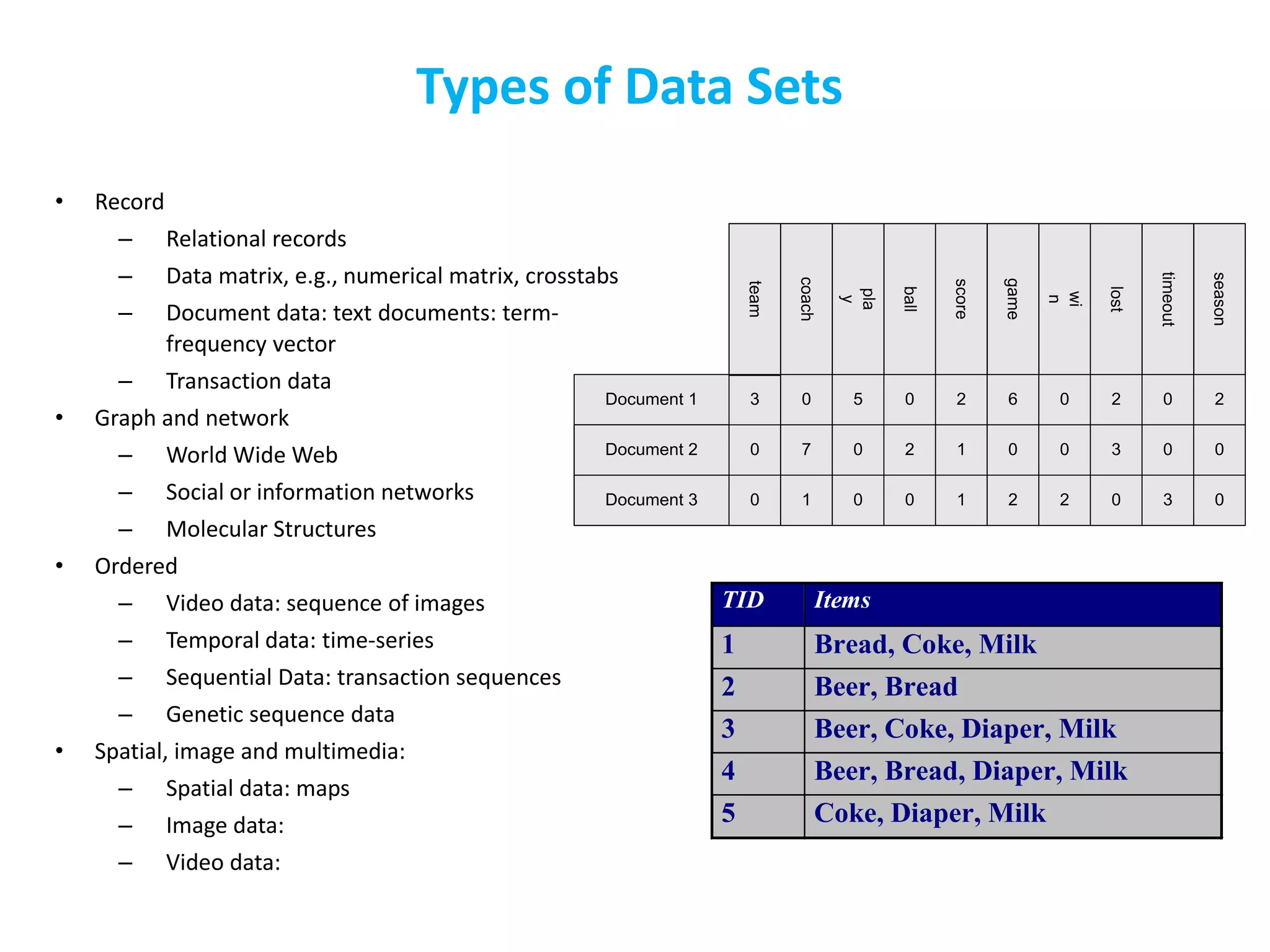
Types of Data Sets
• Record
– Relational records
– Data matrix, e.g., numerical matrix, crosstabs
– Document data: text documents: term-
frequency vector
– Transaction data
• Graph and network
– World Wide Web
– Social or information networks
– Molecular Structures
• Ordered
– Video data: sequence of images
– Temporal data: time-series
– Sequential Data: transaction sequences
– Genetic sequence data
• Spatial, image and multimedia:
– Spatial data: maps
– Image data:
– Video data:
Document 1
season
timeout
lost
wi
n
game
score
ball
pla
y
coach
team
Document 2
Document 3
3 0 5 0 2 6 0 2 0 2
0
0
7 0 2 1 0 0 3 0 0
1 0 0 1 2 2 0 3 0
TID Items
1 Bread, Coke, Milk
2 Beer, Bread
3 Beer, Coke, Diaper, Milk
4 Beer, Bread, Diaper, Milk
5 Coke, Diaper, Milk
Data Objects
• Data sets are made up of data objects.
• A data object represents an entity.
• Examples:
– sales database: customers, store items, sales
– medical database: patients, treatments
– university database: students, professors, courses
• Also called samples , examples, instances, data points, objects,
tuples.
• Data objects are described by attributes.
• Database rows -> data objects; columns ->attributes.
Attributes
• Attribute (or dimensions, features, variables): a
data field, representing a characteristic or
feature of a data object.
– E.g., customer _ID, name, address
• Types:
– Nominal
– Binary
– Numeric: (Discrete, Continuous)
• Interval-scaled
• Ratio-scaled
Attribute Types
• Nominal: categories, states, or “names of things”
– Hair_color = {auburn, black, blond, brown, grey, red, white}
– marital status, occupation, ID numbers, zip codes
• Binary
– Nominal attribute with only 2 states (0 and 1)
– Symmetric binary: both outcomes equally important
• e.g., gender
– Asymmetric binary: outcomes not equally important.
• e.g., medical test (positive vs. negative)
• Convention: assign 1 to most important outcome (e.g., HIV
positive)
• Ordinal
– Values have a meaningful order (ranking) but magnitude between
successive values is not known.
– Size = {small, medium, large}, grades, army rankings
6
Numeric Attribute Types
• Quantity (integer or real-valued)
• Interval
• Measured on a scale of equal-sized units
• Values have order
– E.g., temperature in C˚or F˚, calendar dates
• No true zero-point
• Intangible
• We can add and subtract, but we cannot multiply, divide or calculate
ratios.
• Ratio
• Inherent zero-point
• tangible
• We can speak of values as being an order of magnitude larger than the
unit of measurement (10 K˚ is twice as high as 5 K˚).
– e.g., temperature in Kelvin, length, counts, monetary quantities
7
General Characteristics of Data Sets
• Dimensionality
The dimensionality of a data set is the number of attributes that
the objects in the data set have.
In a particular data set if there are high number of attributes, then it can
become difficult to analyze such a data set. This problem is referred
as Curse of Dimensionality.
• Sparsity
For some data sets, most attributes of an object have values of 0;
in many cases fewer than 1% of the entries are non-zero. Such a
data is called sparse data or it can be said that the data set
has Sparsity.
Resolution
Resolution is the smallest change that can be measured.
Finer resolution reduces rounding errors. However, resolution that is too
coarse may add rounding errors.
8
Repositories of Data Sets
https://www.kaggle.com/datasets
https://www.kdnuggets.com/datasets/index.html
https://archive.ics.uci.edu/ml/datasets.php
https://github.com/datasets
https://github.com/niderhoff/nlp-datasets
https://datasetsearch.research.google.com/
https://data.worldbank.org/
https://towardsdatascience.com/data-repositories-for-almost-every-type-of-data-
science-project-7aa2f98128b
9
Getting Data
Normally in your DS tasks you will be either:
Given data
Required to download data
Required to scrape data of the web
Least
intensive
Most
intensive
Visualization
WHY VISUALIZE DATA?
John Snow
Location of deaths in the 1854 London Cholera Epidemic.
X marks the locations of the water pumps
Dr. John Snow
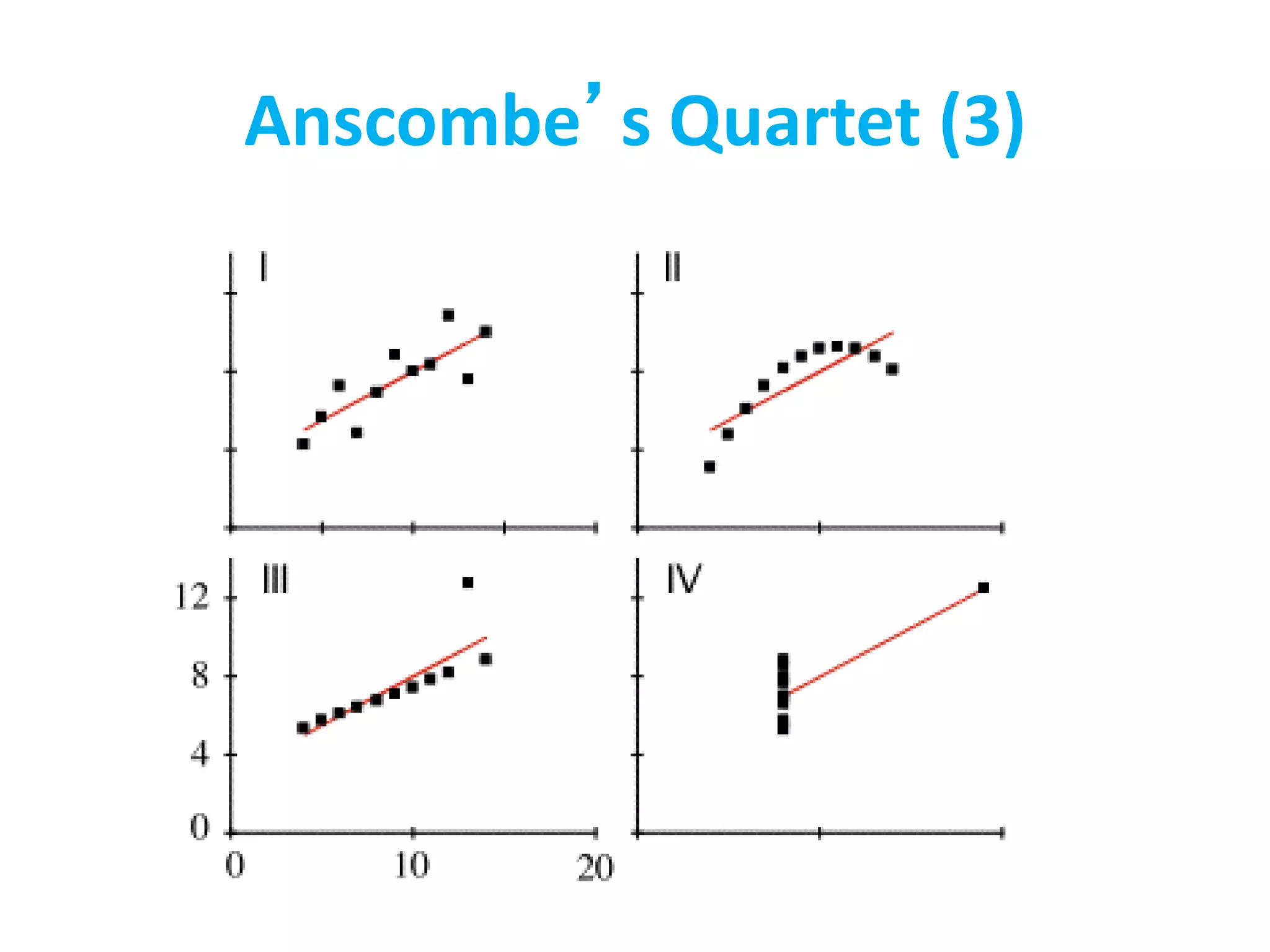
Anscombe’s Quartet
x y x y x y x y
10 8.04 10 9.14 10 7.46 8 6.58
8 6.95 8 8.14 8 6.77 8 5.76
13 7.58 13 8.74 13 12.74 8 7.71
9 8.81 9 8.77 9 7.11 8 8.84
11 8.33 11 9.26 11 7.81 8 8.47
14 9.96 14 8.1 14 8.84 8 7.04
6 7.24 6 6.13 6 6.08 8 5.25
4 4.26 4 3.1 4 5.39 19 12.5
12 10.84 12 9.13 12 8.15 8 5.56
7 4.82 7 7.26 7 6.42 8 7.91
5 5.68 5 4.74 5 5.73 8 6.89
I II III IV
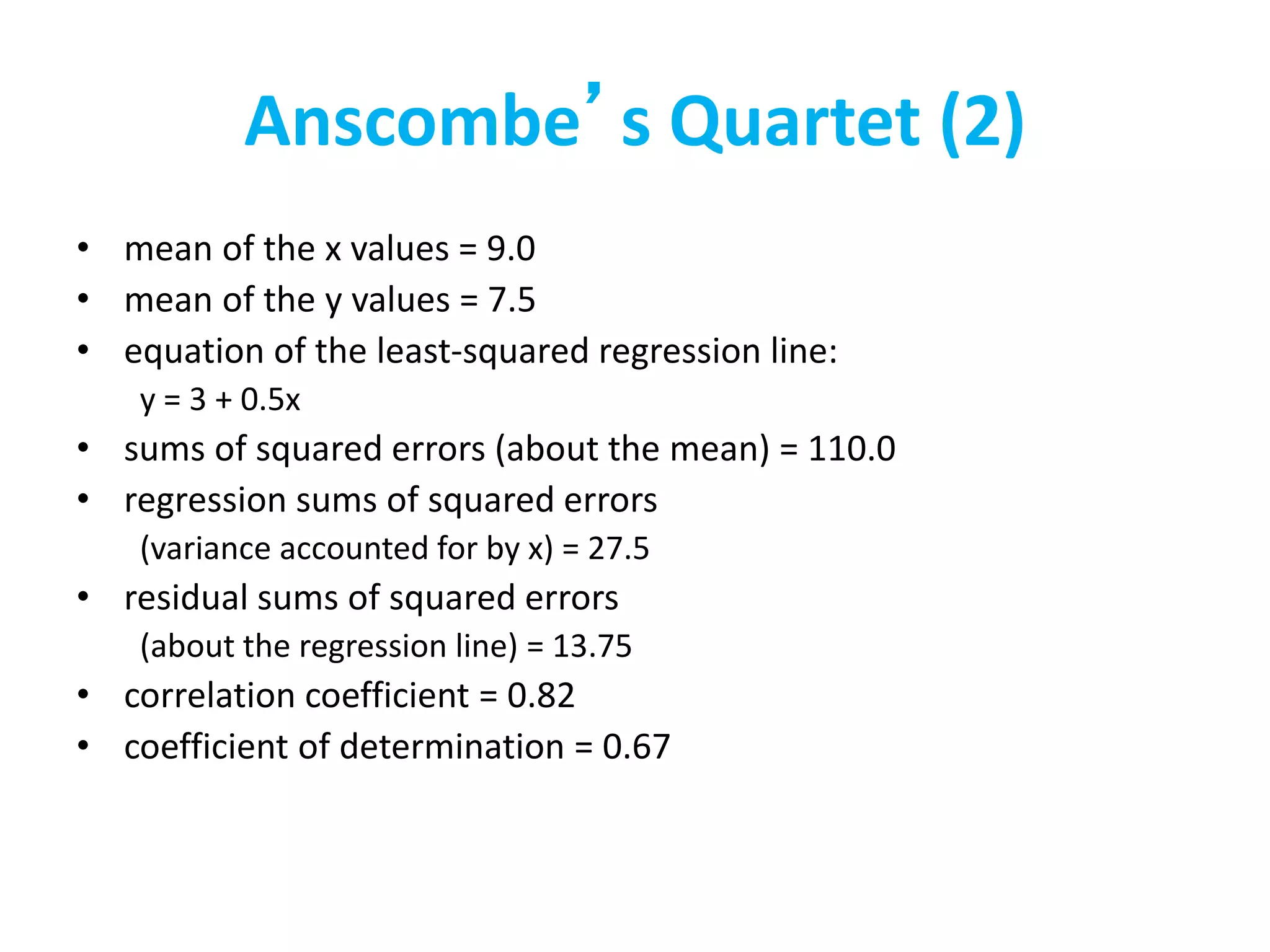
Anscombe’s Quartet (2)
• mean of the x values = 9.0
• mean of the y values = 7.5
• equation of the least-squared regression line:
y = 3 + 0.5x
• sums of squared errors (about the mean) = 110.0
• regression sums of squared errors
(variance accounted for by x) = 27.5
• residual sums of squared errors
(about the regression line) = 13.75
• correlation coefficient = 0.82
• coefficient of determination = 0.67
Anscombe’s Quartet (3)
Another example: Pearson Correlation
Other reasons?
• Visualization is the highest bandwidth channel
into the human brain [Palmer 99]
• The visual cortex is the largest system in the
human brain; it’s wasteful not to make use of it.
• As data volumes grow, visualization becomes a
necessity rather than a luxury.
– “A picture is worth a thousand words”
Time
Amount
of
data
in
the
world
Time
Processing
power
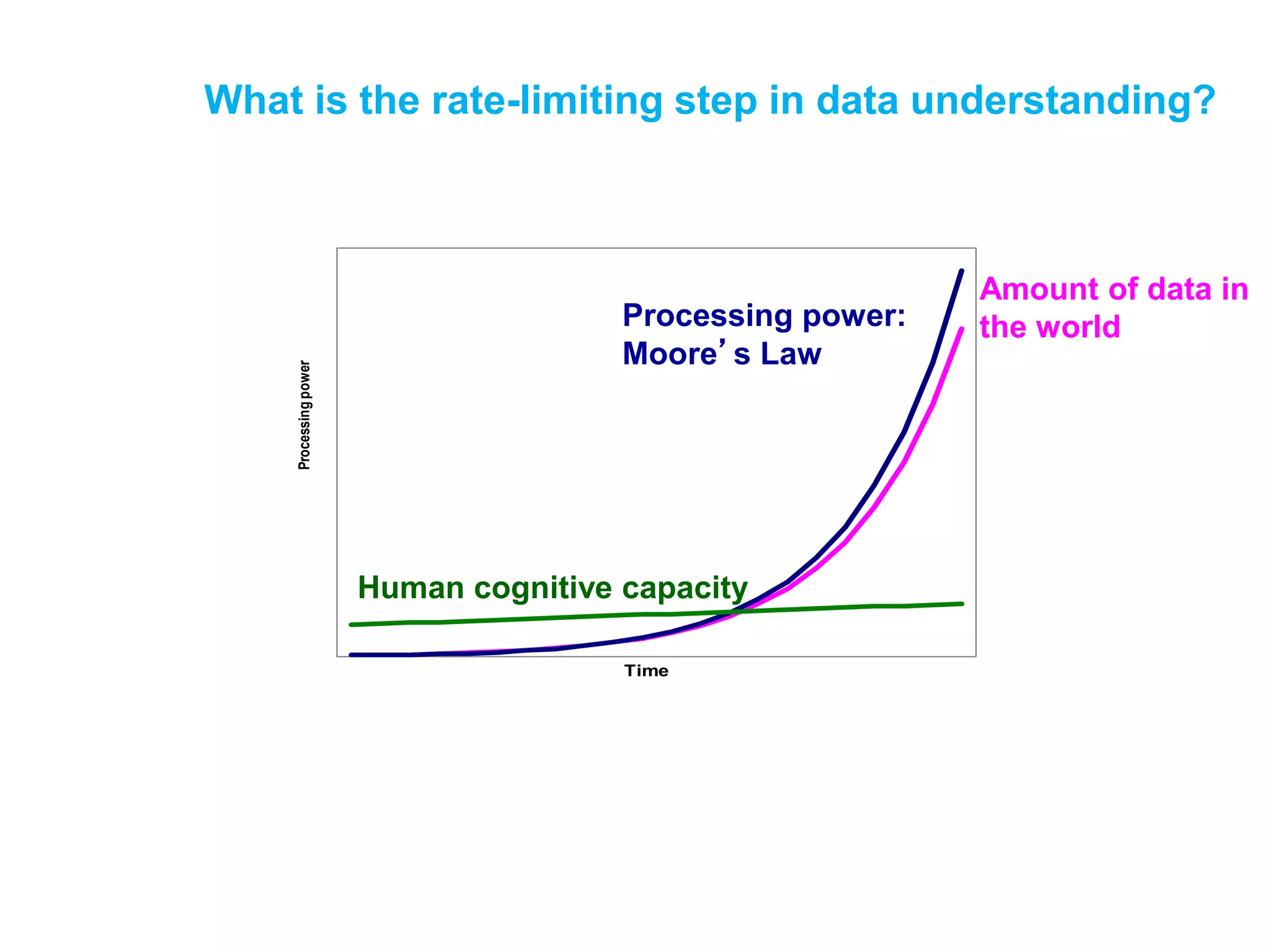
What is the rate-limiting step in data understanding?
Processing power:
Moore’s Law
Amount of data in
the world
Processing
power
Time
What is the rate-limiting step in data understanding?
Processing power:
Moore’s Law
Human cognitive capacity
Amount of data in
the world
What makes a good visualization?
• Edward Tufte: Maximize the data-ink ratio
Example: High or Low Data Ink ratio?
Role of Perception
Human visual system has limitation
These limitations may lead to wrong/incomplete analysis
of graphs
Understanding how we see leads to better display
Misleading graphics needs to be avoided
Colors
Illusion
Pre-attentive processing
Plots/Graphs
Bar chart
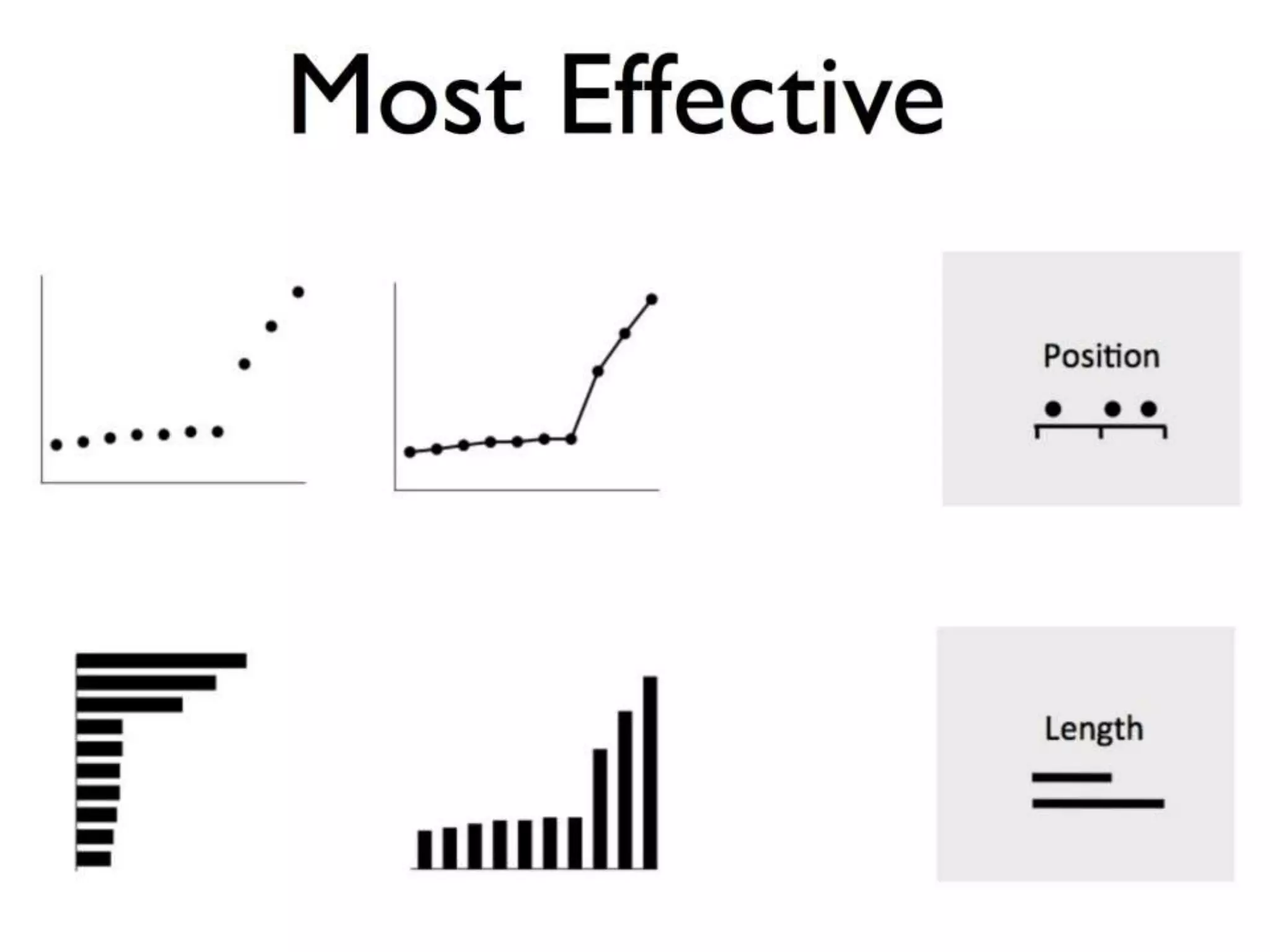
A bar chart or bar graph is a chart or graph that presents categorical data with
rectangular bars with heights or lengths proportional to the values that they
represent. The bars can be plotted vertically or horizontally.
When to use it ?
•Compare categorical data.
•Comparisons among discrete categories.
•One axis of the chart shows the specific categories being compared, and the other
axis represents a measured value.
Grouped Bar chart
In a grouped bar chart, for each categorical group there are two or more bars. These
bars are color-coded to represent a particular grouping.
When to use it ?
•To represent and compare different categories of two or more groups.
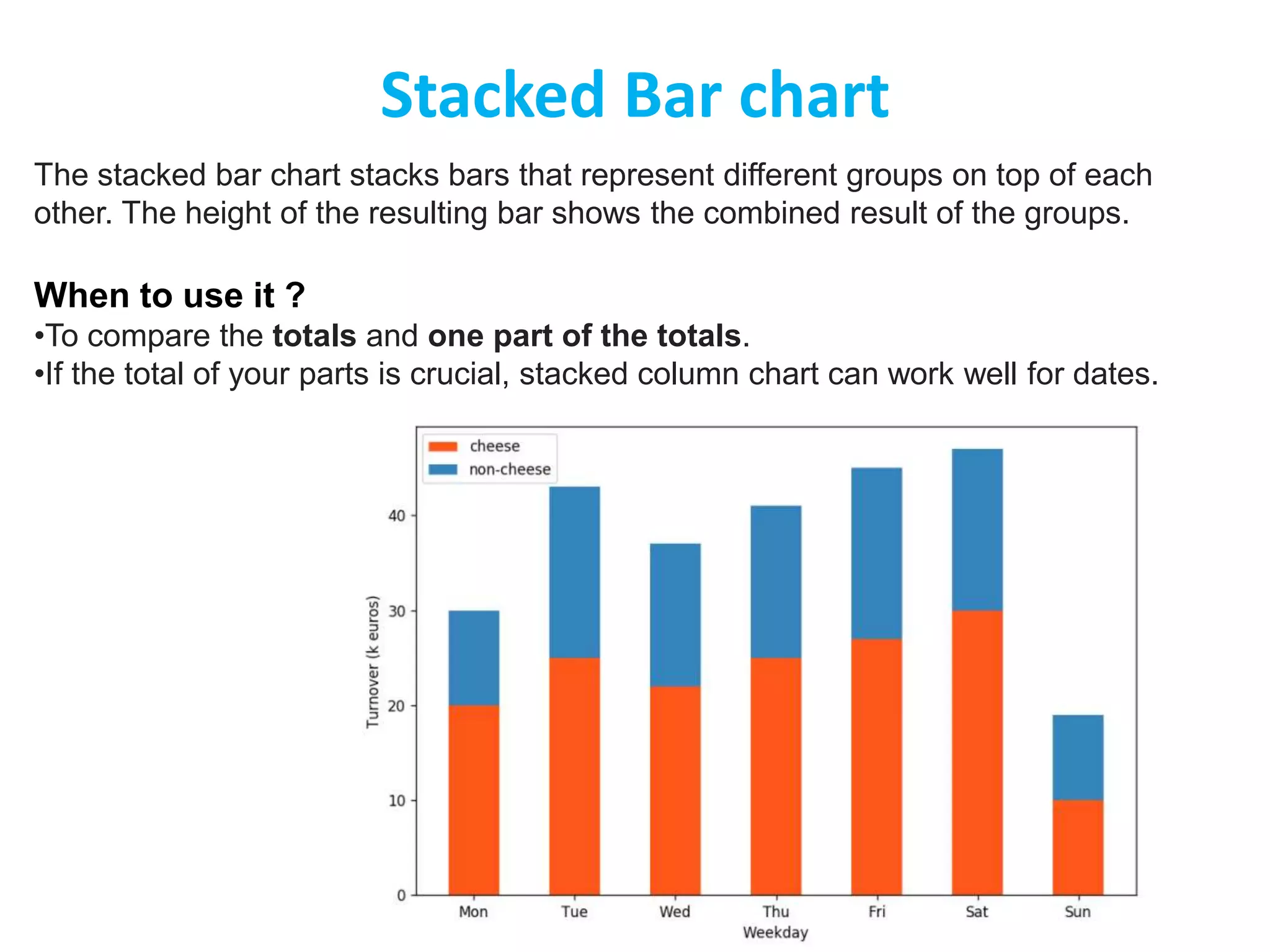
Stacked Bar chart
The stacked bar chart stacks bars that represent different groups on top of each
other. The height of the resulting bar shows the combined result of the groups.
When to use it ?
•To compare the totals and one part of the totals.
•If the total of your parts is crucial, stacked column chart can work well for dates.
Vertical Bar chart
The horizontal bar chart is the same as a vertical bar chart only the x-axis and y-axis
are switched.
When to use it ?
•You need more room to fit text labels for categorical variables.
•When you work with a big dataset, horizontal bar charts tend to work better in a
narrow layout such as mobile view.
Line chart
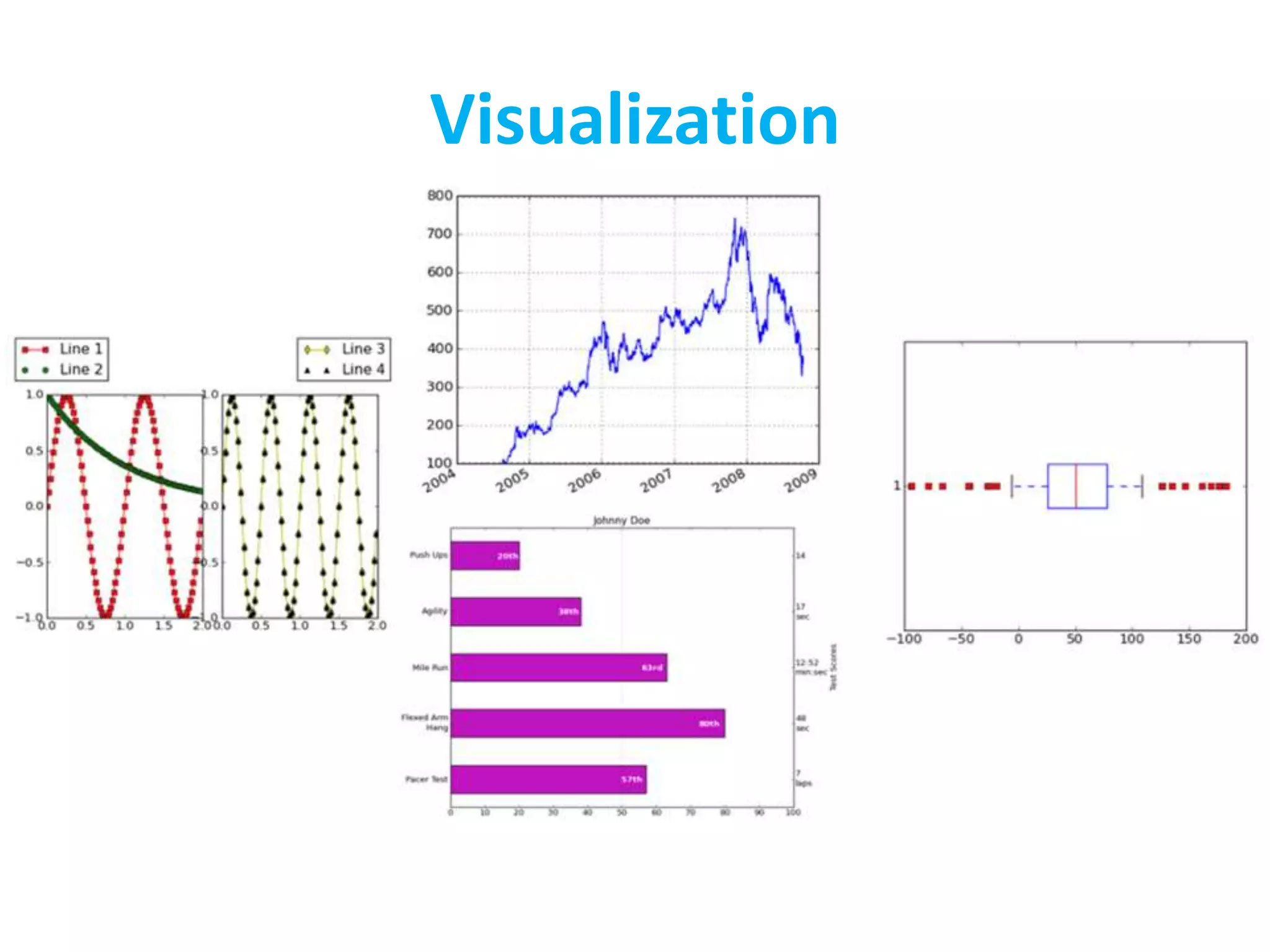
A line chart or line graph is a type of chart which displays information as a series of
data points called ‘markers’ connected by straight line segments. A line chart is often
used to visualize a trend in data over intervals of time – a time series – thus the line is
often drawn chronologically.
When to use it ?
•Track changes over time
•x-axis displays continuous variables
•Y-axis displays measurement
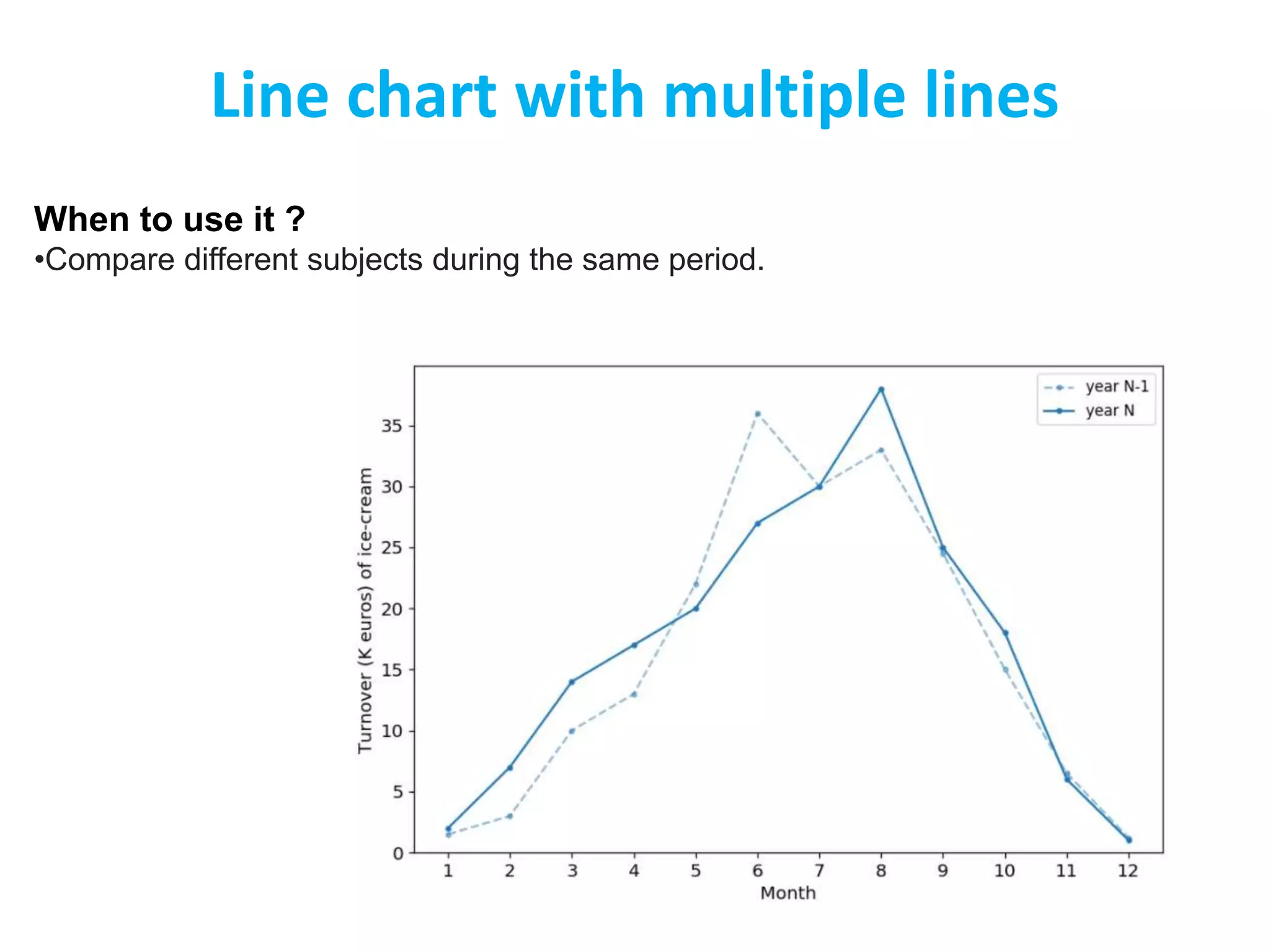
Line chart with multiple lines
When to use it ?
•Compare different subjects during the same period.
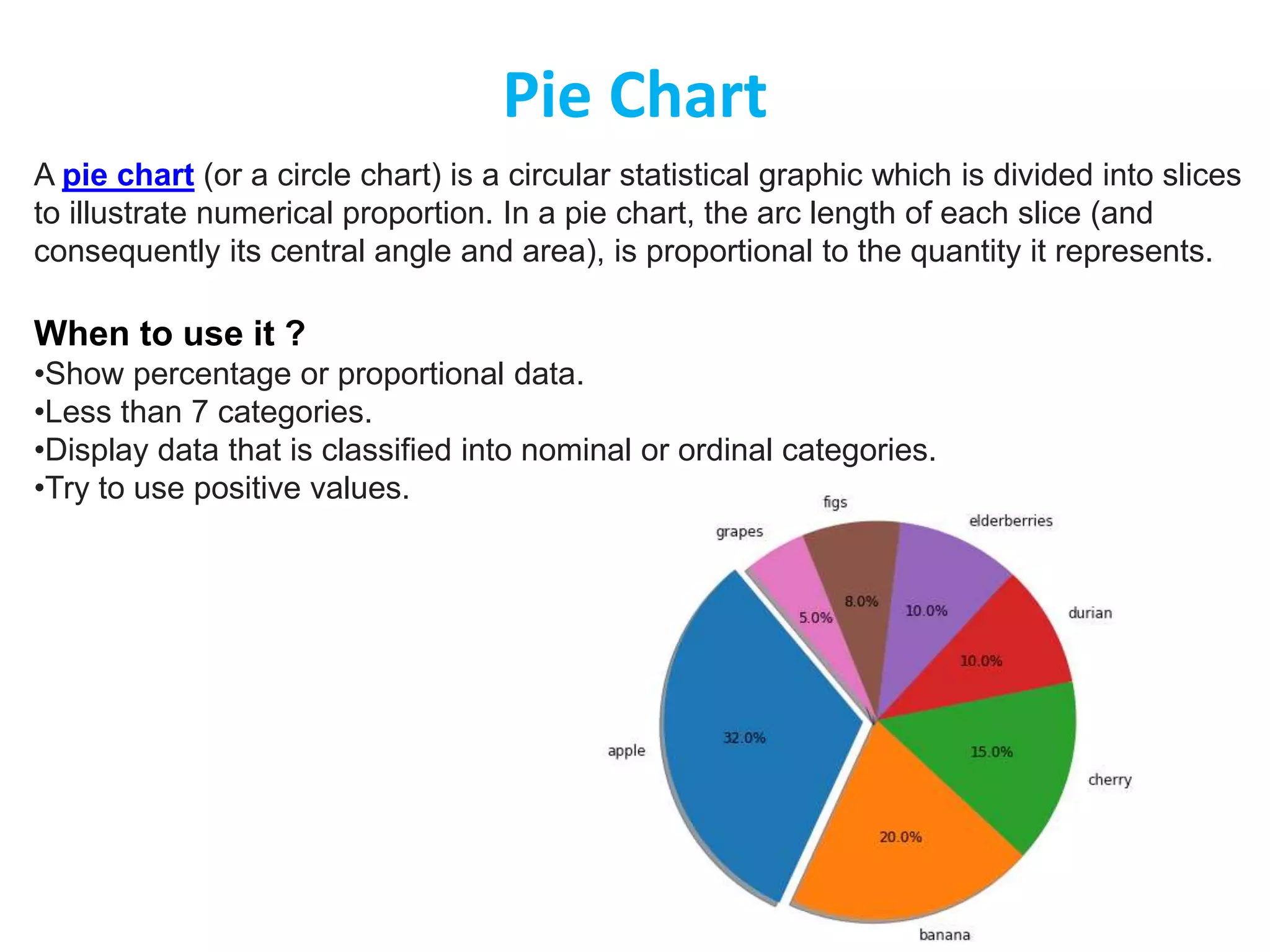
Pie Chart
A pie chart (or a circle chart) is a circular statistical graphic which is divided into slices
to illustrate numerical proportion. In a pie chart, the arc length of each slice (and
consequently its central angle and area), is proportional to the quantity it represents.
When to use it ?
•Show percentage or proportional data.
•Less than 7 categories.
•Display data that is classified into nominal or ordinal categories.
•Try to use positive values.
Nested Pie Chart
A nested pie chart or multi-level pie chart allows you to incorporate multiple levels or
layers into your pie. Nested pies are a module variation on our standard pie chart type.
When to use it ?
•Show symmetrical and asymmetrical tree structures in a consolidated pie-like
structure.
•Multi-tiered data presentation, e.g., keyword analysis
•Inter-linked tree data, e.g., friends of friends
Donut Chart
A donut chart is a variant of the pie chart, with a blank center allowing for additional
information about the data as a whole to be included. This type of circular graph can
support multiple statistics at once and it provides a better data intensity ratio to
standard pie charts. It does not have to contain information in the center.
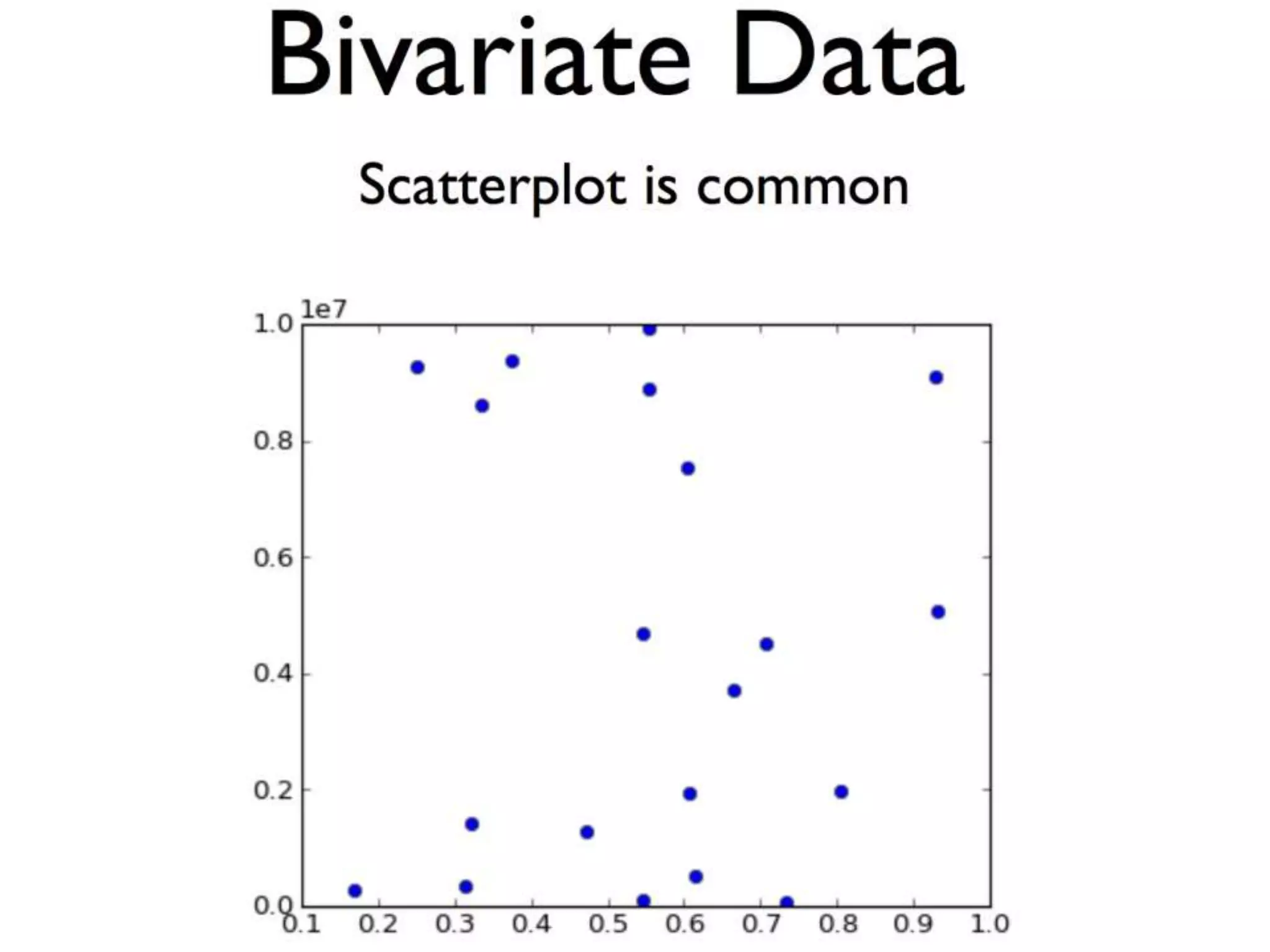
Scatter Plot
A scatter plot (also called a scatter graph, scatter chart, scattergram, or scatter
diagram) is a type of plot or mathematical diagram using Cartesian coordinates to
display values for typically two variables for a set of data.
When to use it ?
•Scatter plots are used when you want to show the relationship between two
variables. Scatter plots are sometimes called correlation plots because they show how
two variables are correlated.
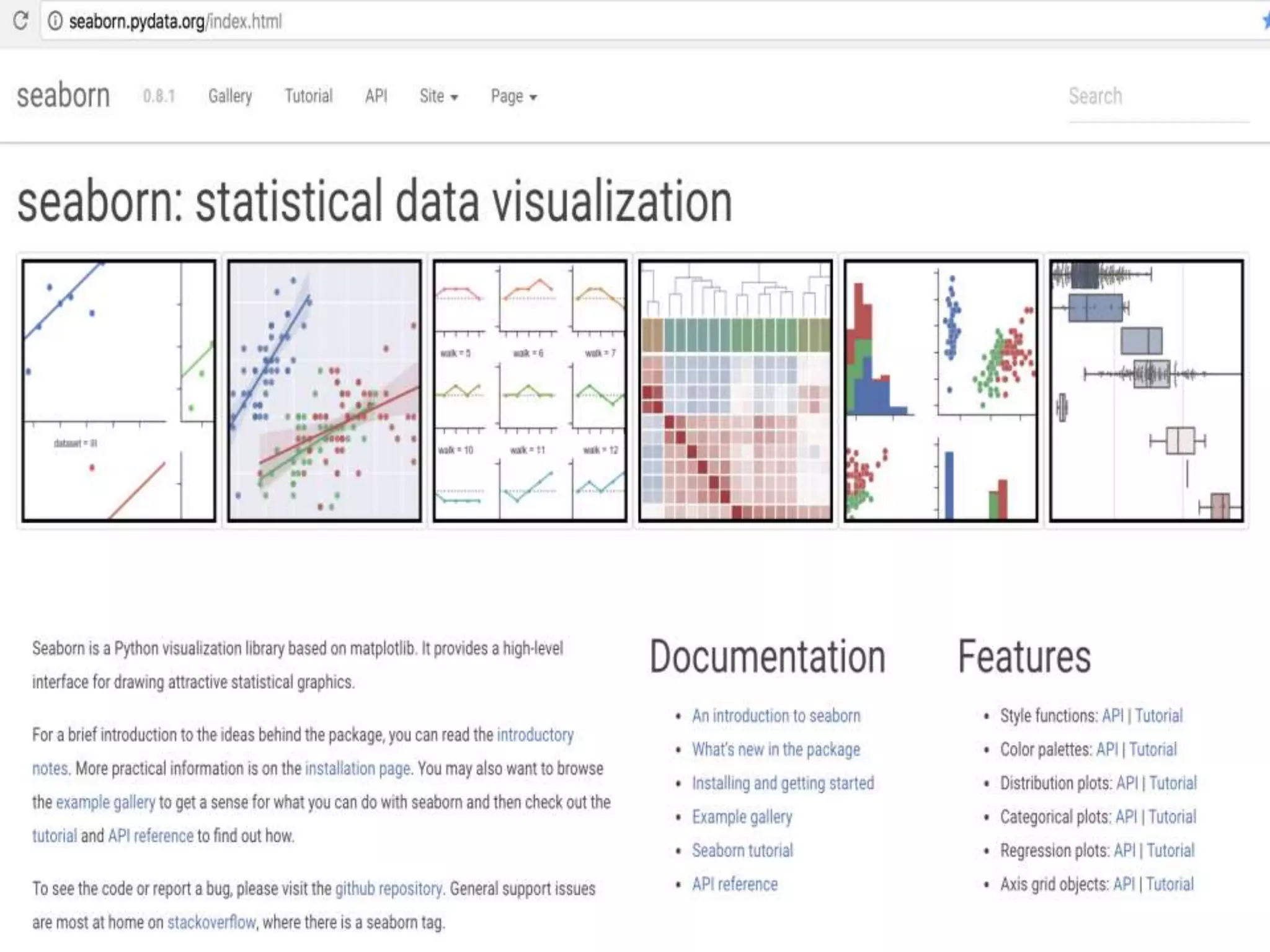
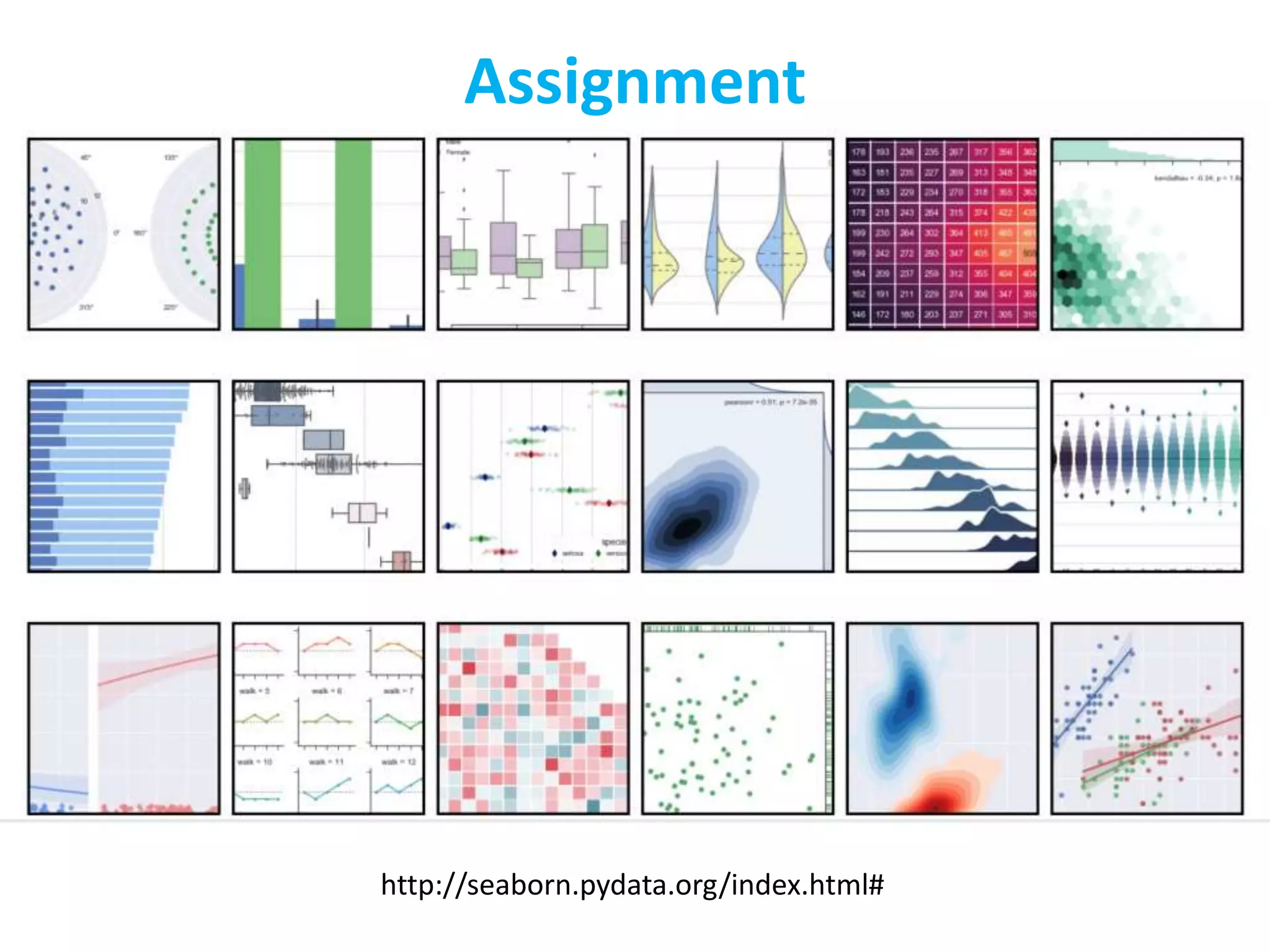
http://seaborn.pydata.org/index.html#
Assignment

Lec 3.pptx

  • 1.
  • 2.
    Types of DataSets • Record – Relational records – Data matrix, e.g., numerical matrix, crosstabs – Document data: text documents: term- frequency vector – Transaction data • Graph and network – World Wide Web – Social or information networks – Molecular Structures • Ordered – Video data: sequence of images – Temporal data: time-series – Sequential Data: transaction sequences – Genetic sequence data • Spatial, image and multimedia: – Spatial data: maps – Image data: – Video data: Document 1 season timeout lost wi n game score ball pla y coach team Document 2 Document 3 3 0 5 0 2 6 0 2 0 2 0 0 7 0 2 1 0 0 3 0 0 1 0 0 1 2 2 0 3 0 TID Items 1 Bread, Coke, Milk 2 Beer, Bread 3 Beer, Coke, Diaper, Milk 4 Beer, Bread, Diaper, Milk 5 Coke, Diaper, Milk
  • 3.
    Data Objects • Datasets are made up of data objects. • A data object represents an entity. • Examples: – sales database: customers, store items, sales – medical database: patients, treatments – university database: students, professors, courses • Also called samples , examples, instances, data points, objects, tuples. • Data objects are described by attributes. • Database rows -> data objects; columns ->attributes.
  • 4.
    Attributes • Attribute (ordimensions, features, variables): a data field, representing a characteristic or feature of a data object. – E.g., customer _ID, name, address • Types: – Nominal – Binary – Numeric: (Discrete, Continuous) • Interval-scaled • Ratio-scaled
  • 5.
    Attribute Types • Nominal:categories, states, or “names of things” – Hair_color = {auburn, black, blond, brown, grey, red, white} – marital status, occupation, ID numbers, zip codes • Binary – Nominal attribute with only 2 states (0 and 1) – Symmetric binary: both outcomes equally important • e.g., gender – Asymmetric binary: outcomes not equally important. • e.g., medical test (positive vs. negative) • Convention: assign 1 to most important outcome (e.g., HIV positive) • Ordinal – Values have a meaningful order (ranking) but magnitude between successive values is not known. – Size = {small, medium, large}, grades, army rankings
  • 6.
    6 Numeric Attribute Types •Quantity (integer or real-valued) • Interval • Measured on a scale of equal-sized units • Values have order – E.g., temperature in C˚or F˚, calendar dates • No true zero-point • Intangible • We can add and subtract, but we cannot multiply, divide or calculate ratios. • Ratio • Inherent zero-point • tangible • We can speak of values as being an order of magnitude larger than the unit of measurement (10 K˚ is twice as high as 5 K˚). – e.g., temperature in Kelvin, length, counts, monetary quantities
  • 7.
    7 General Characteristics ofData Sets • Dimensionality The dimensionality of a data set is the number of attributes that the objects in the data set have. In a particular data set if there are high number of attributes, then it can become difficult to analyze such a data set. This problem is referred as Curse of Dimensionality. • Sparsity For some data sets, most attributes of an object have values of 0; in many cases fewer than 1% of the entries are non-zero. Such a data is called sparse data or it can be said that the data set has Sparsity. Resolution Resolution is the smallest change that can be measured. Finer resolution reduces rounding errors. However, resolution that is too coarse may add rounding errors.
  • 8.
    8 Repositories of DataSets https://www.kaggle.com/datasets https://www.kdnuggets.com/datasets/index.html https://archive.ics.uci.edu/ml/datasets.php https://github.com/datasets https://github.com/niderhoff/nlp-datasets https://datasetsearch.research.google.com/ https://data.worldbank.org/ https://towardsdatascience.com/data-repositories-for-almost-every-type-of-data- science-project-7aa2f98128b
  • 9.
    9 Getting Data Normally inyour DS tasks you will be either: Given data Required to download data Required to scrape data of the web Least intensive Most intensive
  • 10.
  • 14.
  • 15.
    John Snow Location ofdeaths in the 1854 London Cholera Epidemic. X marks the locations of the water pumps Dr. John Snow
  • 16.
    Anscombe’s Quartet x yx y x y x y 10 8.04 10 9.14 10 7.46 8 6.58 8 6.95 8 8.14 8 6.77 8 5.76 13 7.58 13 8.74 13 12.74 8 7.71 9 8.81 9 8.77 9 7.11 8 8.84 11 8.33 11 9.26 11 7.81 8 8.47 14 9.96 14 8.1 14 8.84 8 7.04 6 7.24 6 6.13 6 6.08 8 5.25 4 4.26 4 3.1 4 5.39 19 12.5 12 10.84 12 9.13 12 8.15 8 5.56 7 4.82 7 7.26 7 6.42 8 7.91 5 5.68 5 4.74 5 5.73 8 6.89 I II III IV
  • 17.
    Anscombe’s Quartet (2) •mean of the x values = 9.0 • mean of the y values = 7.5 • equation of the least-squared regression line: y = 3 + 0.5x • sums of squared errors (about the mean) = 110.0 • regression sums of squared errors (variance accounted for by x) = 27.5 • residual sums of squared errors (about the regression line) = 13.75 • correlation coefficient = 0.82 • coefficient of determination = 0.67
  • 18.
  • 19.
  • 20.
    Other reasons? • Visualizationis the highest bandwidth channel into the human brain [Palmer 99] • The visual cortex is the largest system in the human brain; it’s wasteful not to make use of it. • As data volumes grow, visualization becomes a necessity rather than a luxury. – “A picture is worth a thousand words”
  • 21.
    Time Amount of data in the world Time Processing power What is therate-limiting step in data understanding? Processing power: Moore’s Law Amount of data in the world
  • 22.
    Processing power Time What is therate-limiting step in data understanding? Processing power: Moore’s Law Human cognitive capacity Amount of data in the world
  • 23.
    What makes agood visualization? • Edward Tufte: Maximize the data-ink ratio
  • 24.
    Example: High orLow Data Ink ratio?
  • 25.
    Example: High orLow Data Ink ratio?
  • 29.
    Role of Perception Humanvisual system has limitation These limitations may lead to wrong/incomplete analysis of graphs Understanding how we see leads to better display Misleading graphics needs to be avoided
  • 30.
  • 31.
  • 32.
  • 33.
  • 34.
    Bar chart A barchart or bar graph is a chart or graph that presents categorical data with rectangular bars with heights or lengths proportional to the values that they represent. The bars can be plotted vertically or horizontally. When to use it ? •Compare categorical data. •Comparisons among discrete categories. •One axis of the chart shows the specific categories being compared, and the other axis represents a measured value.
  • 35.
    Grouped Bar chart Ina grouped bar chart, for each categorical group there are two or more bars. These bars are color-coded to represent a particular grouping. When to use it ? •To represent and compare different categories of two or more groups.
  • 36.
    Stacked Bar chart Thestacked bar chart stacks bars that represent different groups on top of each other. The height of the resulting bar shows the combined result of the groups. When to use it ? •To compare the totals and one part of the totals. •If the total of your parts is crucial, stacked column chart can work well for dates.
  • 37.
    Vertical Bar chart Thehorizontal bar chart is the same as a vertical bar chart only the x-axis and y-axis are switched. When to use it ? •You need more room to fit text labels for categorical variables. •When you work with a big dataset, horizontal bar charts tend to work better in a narrow layout such as mobile view.
  • 38.
    Line chart A linechart or line graph is a type of chart which displays information as a series of data points called ‘markers’ connected by straight line segments. A line chart is often used to visualize a trend in data over intervals of time – a time series – thus the line is often drawn chronologically. When to use it ? •Track changes over time •x-axis displays continuous variables •Y-axis displays measurement
  • 39.
    Line chart withmultiple lines When to use it ? •Compare different subjects during the same period.
  • 40.
    Pie Chart A piechart (or a circle chart) is a circular statistical graphic which is divided into slices to illustrate numerical proportion. In a pie chart, the arc length of each slice (and consequently its central angle and area), is proportional to the quantity it represents. When to use it ? •Show percentage or proportional data. •Less than 7 categories. •Display data that is classified into nominal or ordinal categories. •Try to use positive values.
  • 41.
    Nested Pie Chart Anested pie chart or multi-level pie chart allows you to incorporate multiple levels or layers into your pie. Nested pies are a module variation on our standard pie chart type. When to use it ? •Show symmetrical and asymmetrical tree structures in a consolidated pie-like structure. •Multi-tiered data presentation, e.g., keyword analysis •Inter-linked tree data, e.g., friends of friends
  • 42.
    Donut Chart A donutchart is a variant of the pie chart, with a blank center allowing for additional information about the data as a whole to be included. This type of circular graph can support multiple statistics at once and it provides a better data intensity ratio to standard pie charts. It does not have to contain information in the center.
  • 43.
    Scatter Plot A scatterplot (also called a scatter graph, scatter chart, scattergram, or scatter diagram) is a type of plot or mathematical diagram using Cartesian coordinates to display values for typically two variables for a set of data. When to use it ? •Scatter plots are used when you want to show the relationship between two variables. Scatter plots are sometimes called correlation plots because they show how two variables are correlated.
  • 45.