LEC: 2 Sterilization & Disinfectant
Sterilization: is defined as the process where all the living microorganisms, including
bacterial spores are killed. Sterilization can be achieved by physical, chemical and
physiochemical means. Chemicals used as sterilizing agents are called chemisterilants.
Disinfection is the process of elimination of most pathogenic microorganisms
(excluding bacterial spores) on inanimate objects. Disinfection can be achieved by
physical or chemical methods.
Chemicals used in disinfection are called disinfectants. Different disinfectants have
different target ranges, not all disinfectants can kill all microorganisms. Some methods
of disinfection such as filtration do not kill bacteria, they separate them out.
Sterilization is an absolute condition while disinfection is not. The two are not
synonymous.
Decontamination is the process of removal of contaminating pathogenic
microorganisms from the articles by a process of sterilization or disinfection. It is the
use of physical or chemical means to remove, inactivate, or destroy living organisms
on a surface so that the organisms are no longer infectious.
Sanitization is the process of chemical or mechanical cleansing, applicable in public
health systems. Usually used by the food industry. It reduces microbes on eating utensils
to safe, acceptable levels for public health.
Asepsis is the employment of techniques (such as usage of gloves, air filters, uv rays
etc) to achieve microbe-free environment.
Antisepsis is the use of chemicals (antiseptics) to make skin or mucus membranes
devoid of pathogenic microorganisms.
Bacteriostasis is a condition where the multiplication of the bacteria is inhibited
without killing them.
Bactericidal is that chemical that can kill or inactivate bacteria. Such chemicals may be
called variously depending on the spectrum of activity, such as bactericidal, virucidal,
fungicidal, microbicidal, sporicidal, tuberculocidal or germicidal.
Antibiotics are substances produced by one microbe that inhibits or kills another
microbe. Often the term is used.
1
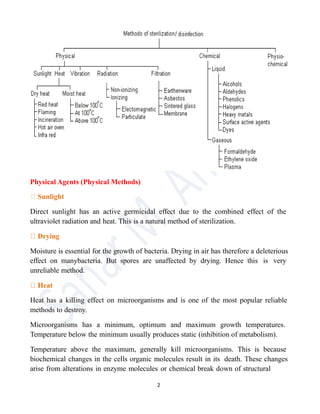
Physical Agents (Physical Methods)
Sunlight
Direct sunlight has an active germicidal effect due to the combined effect of the
ultraviolet radiation and heat. This is a natural method of sterilization.
Drying
Moisture is essential for the growth of bacteria. Drying in air has therefore a deleterious
effect on manybacteria. But spores are unaffected by drying. Hence this is very
unreliable method.
Heat
Heat has a killing effect on microorganisms and is one of the most popular reliable
methods to destroy.
Microorganisms has a minimum, optimum and maximum growth temperatures.
Temperature below the minimum usually produces static (inhibition of metabolism).
Temperature above the maximum, generally kill microorganisms. This is because
biochemical changes in the cells organic molecules result in its death. These changes
arise from alterations in enzyme molecules or chemical break down of structural
2
molecules especially in the cell membranes. Heat also drives off water and this loss of
water may be lethal to the organisms.
The killing rate of heat may be expressed as a function of time and temperature. Each
microbial species has a Thermal Death Time (TDT). It’s the minimum time required to
kill a population of microorganism in a microbial suspension at a given temperature and
under defined condition. Each species also has a Thermal Death Point (TDP), the
temperature at which it dies in a given time.
In determining the time and temperature for microbial destruction with heat, the
following factors are considered.
1. Type of organism to be killed
2. Type of material to the treated
3. Presence of organic matter
4. Acidic or basic nature of the material
Nature of heat:
a) Dry heat
Many objects are best sterilized in the absence of water by dry heat sterilization; killing
by dry heat is due to protein denaturation, oxidative damage and toxic effect of elevated
levels of electrolytes.
Methods of Sterilization by Dry Heat
5. Flaming
Inoculating loops and points of forceps may be heated in the Bunsen flame, till they are
red-hot. Articles such as mouth of the culture tubes, cotton wool plugs, glass slides etc.
are passed over the flame without allowing it to become red hot.
2. Incineration
This is an excellent method for rapidly destroying, animal carcasses, pathological
material and disposables.
3
3. Hot Air Oven
This is the most widely adopted method of sterilization by dry heat. The hot air oven
utilizes radiating dry heat for sterilization. This type of energy does not penetrate
materials easily and thus, long periods of exposure to high temperature are necessary.
For example, at a temperature of 160°C, a period of two hours is required for the
destruction of bacterial spores. Hot air oven is used to sterilize glassware, forceps,
scissors, scalpels, glass syringes, liquid paraffin, dusting powder etc. A holding
period of 160°C for an hour
is used. The oven is usually heated by electricity, with heating elements in the wall of
the chamber and it must be filled with a fan to ensure even distribution of hot air and
elimination of air pockets. The materials should be arranged in a manner which allows
free circulation of hot air in between the objects. It should not be over-loaded. Glass
wares should be perfectly dry before being placed in the oven. Test tubes, flasks etc.
should be wrapped in craft paper. Oven must be allowed to cool slowly for about 2
hours before the door is opened, since the glasswares may get cracked by sudden or
uneven cooling.
Sterilization control: The spores of a non – toxigenic strain of Clostridium tetani are
used as a microbiological test of dry heat efficiency. Paper stripes impregnated with 106
spores are placed in envelop and inserted into suitable packs. After sterilization is over,
the strips are removed and inoculated into thioglycollate or cooked meat media and
incubated for sterility test under strict anaerobic conditions for five days at 37°C.
b) Moist heat
Moist heat kills microorganisms by coagulating their proteins and is much more rapid
and effective than dry heat because water molecules conduct heat better than air. Lower
temperature and less time of exposure are therefore required than for dry heat. Moist
heat readily kills viruses, bacteria, fungi etc.
a) Temperature below 100°C
i. Pasteurization of milk: For pasteurization of milk, there are two methods
Holding Method or Low Temperature Holding Method (LTH): In this method,
the milk is exposed to a temperature of 63°C (145°F) for 30 minutes in an appropriately
designed equipment. This is followed by sudden cooling to 13°C or below.
4
Flash Process or High Temperature Short Time (HTST): In this method, the milk
is exposed to a temperature of 72°C for 15 seconds in the equipment. This is followed
by sudden cooling to 13°C or below. The finished product should be stored at a low
temperature to retard growth of microorganisms and pasteurization removes the
pathogenic bacteria in milk. By these
processes all non-sporing pathogens such as mycobacteria, salmonellae and brucella
are destroyed ‘Coxiella bumetic’ is relatively heat resistant and may survive the holder
method.
ii. Vaccine bath
It’s used for killing non-sporing bacteria which may be present in vaccine. In vaccine
bath, the vaccine is treated with moist heat for one hour at 60°C.
iii.Serum containing coagulable proteins can be sterilized by heating for one hour at
56°C in a water bath for several successive days.
b) Temperature at 100°C
i. Boiling
Most of the vegetative forms of bacteria, fungi etc. are killed almost immediately at 90-
100°C, but sporing bacteria required considerable periods of boiling. Boiling water is
not considered as a sterilizing agent because destruction of bacterial spores and
inactivation of viruses cannot always be assured. Under ordinary circumstances, most
species of microbes can be killed within 10 minutes. However, spores of bacteria and
fungi, protozoa cysts and large concentrations of Hepatitis A viruses requires up to 30
minutes exposure or more because inadequate information exists on the heat tolerance
of many microorganisms, boiling water is not reliable for sterilization purpose
especially the sterilization of instruments and for surgical procedures.
In cases where boiling is considered adequate, the material should be immersed in water
and boiled for a period of 10-30 minutes. The lid of the sterilizer should not be opened
during that period. Addition of little acid, alkali or washing soda will increase the
efficiency of the process.
5
ii. Steam under atmospheric pressure (100°C)
Steam under atmospheric pressure is used to sterilize culture media which may
decompose if subjected to higher temperature. A Koch or Arnold sterilizer is an
instrument that generates free floating steam.
The container and the medium are simultaneously sterilized and evaporation from the
medium is prevented one exposure of 90 minutes usually ensures complete sterilization
of the medium. This is an inexpensive method.
iii. Sterilization above 100°C (steam under pressure)
Heat in the form of saturated steam under pressure is the most practical and dependable
agent for sterilization. Steam under pressure provides temperature above those
obtainable by boiling. Moreover, it has advantages of rapid heating, penetration and
moisture in abundance, which facilitates the coagulation of the protein of
microorganisms, resulting in complete destruction of all forms of microbial life,
including bacterial endospores. It is important to note that the sterilizing agent is the
moist heat not the pressure. The laboratory apparatus designed to use steam under
regulated pressure is called an autoclave. It is essentially a double jacketed steam
6
chamber equipped with devices which permit the chamber to be filled with saturated
steam and maintained at a designed temperature and pressure for any period of time The
articles to be sterilized are
placed in the sterilizing chamber and steam is maintained in the steam jacket into the
sterilizing chamber, cool air is forced out and a special valve increases the pressure
to 15 pounds/square inch above normal atmospheric pressure. The temperature rises to
121.5°C and the superheated water molecules rapidly conduct heat into microorganisms
and will be killed. The time for destruction of the most resistant bacterial spore is
reduced to 15 minutes. For denser objects, up to 30 minutes of exposure may be
required.
Autoclave is an essential equipment in every microbiology laboratory. It’s used to
sterilize many media, solutions, discarded cultures, glass wares, metal wares etc.
Filtration
Filtration is the process of removal of microorganisms from liquid or gases using a
mechanical device known as filter. This is an excellent way to reduce the microbial
population in solution of thermo labile materials such as sera, antibiotic solutions,
intravenous solutions, carbohydrates solutions used in the preparation of culture media
etc. As fluid passes through the filter, microorganisms are trapped in the pores of the
filtering material. The solution that drips through the filter is collected in a previously
sterilized container. Porosity, electric charges of the filter, electric charge carried by the
organisms, nature of the fluid being filtered etc. can influence efficiency of filtration.
Types of filters: Seltz Filter, Berkefeld Filter, Membrane Filter, High Efficiency
Particulate Air (HEPA)filter
Irradiation
The process of exposing organisms to anyone of the radiation such as UV-rays, X-rays,
gamma rays etc. isknown as irradiation. Irradiation is an effective method of
sterilization. Two types of radiations are used for sterilization.
7
a) Non ionizing radiation
UV radiation
Infrared radiation
b) Ionizing
radiation
X rays
Gamma rays
Chemical
Methods
The physical agents for controlling microorganisms are generally intended to achieve
sterilization. Instead, they are expected only to destroy the pathogenic organisms on
or in or removal of pathogenic microorganisms is called disinfection. An agent, usually
a chemical that kills the pathogenic microorganisms on/in animate objects is known as a
disinfectant. A disinfectant does not necessarily sterilize an object because a few
microorganisms and viable spores may remain. The chemical agents that are applied to
the body to prevent infection or species are called antiseptic. The antiseptic prevents the
growth or action of microorganisms either by destroying them or by inhibiting their
growth and metabolism.
An antimicrobial agent is generally called as a germicide. A disinfectant or antiseptic
can be particularly effective against a specific group called as bactericides, fungicides or
algaecides. Some chemicals do not kill microorganisms, but they temporarily prevent
from multiplication. Many different chemicals are available for use as disinfectants and
each has its own advantages and disadvantages.
Disinfectants are those chemicals that destroy pathogenic bacteria from inanimate
surfaces. Some chemical have very narrow spectrum of activity and some have very
wide. Those chemicals that can sterilize are called chemisterilants. Those chemicals that
can be safely applied over skin and mucus membranes are called antiseptics.
An ideal antiseptic or disinfectant should have following properties:
□Should have wide spectrum of activity
□Should be able to destroy microbes within practical period of time
8
□Should be active in the presence of organic matter
□Should make effective contact and be wettable
□Should be active in any pH
□Should be stable
□Should have long shelf life
□Should be speedy
□Should have high penetrating power
□Should be non-toxic, non-allergenic, non-irritative or non-corrosive
□Should not have bad odour
□Should not leave non-volatile residue or stain
□Efficacy should not be lost on reasonable dilution
□Should not be expensive and must be available easily
Such an ideal disinfectant is not yet available. The level of disinfection achieved
depends on contact time, temperature, type and concentration of the active ingredient,
the presence of organic matter, the type and quantum of microbial load. The chemical
disinfectants at working concentrations rapidly lose their strength on standing.
Characteristics of a desirable disinfectant
The disinfectant must be effective against a wide variety of infections/agents, at high
dilutions and in the presence of organic matter. The chemical must be toxic for infection
agents but it should not be toxic to people or corrosive for common upon storage,
colourless with a pleasant odors, soluble in water and lipids for penetration into
microbes and have a low surface tension so that it can cracks in surface. If possible, the
disinfectant should be relatively inexpensive.
The factor influencing the effectiveness of chemical disinfectants:
1. Size of the microbial population
2. Nature of microbes present
9
3. Concentration and nature of the disinfectant
4. Duration of exposure
5. Temperature
6. Local environment
The main modes of action of disinfectant:
7. Protein coagulation
8.Disruption of cell membrane, thus resulting in exposure of the contents of the cell to
the adverse environment and loss of the constituents of the cell and changes in the
composition of the contained cytoplasm. These cause death of cell.
9.Removal of free sulfhydryl groups which are essential for the functioning of the
enzymes and thus the life of the cells.
10.Inhibition of respiration of catabolic/anabolic reactions.
11.Loss of membrane integrity resulting in leakage of essential constituents such as
potassium cations, inorganic phosphate, pentose, nucleotides and nucleosides and
proteins.
Major Group of Chemical Agents: Phenol and Phenol compounds, Alcohols,
Heavy metals and their compounds, Dyes, Soaps and Detergents, Aldehydes, Gaseous
agents
10

LEC 2 sterilization & disinfection.pptx

  • 1.
    LEC: 2 Sterilization& Disinfectant Sterilization: is defined as the process where all the living microorganisms, including bacterial spores are killed. Sterilization can be achieved by physical, chemical and physiochemical means. Chemicals used as sterilizing agents are called chemisterilants. Disinfection is the process of elimination of most pathogenic microorganisms (excluding bacterial spores) on inanimate objects. Disinfection can be achieved by physical or chemical methods. Chemicals used in disinfection are called disinfectants. Different disinfectants have different target ranges, not all disinfectants can kill all microorganisms. Some methods of disinfection such as filtration do not kill bacteria, they separate them out. Sterilization is an absolute condition while disinfection is not. The two are not synonymous. Decontamination is the process of removal of contaminating pathogenic microorganisms from the articles by a process of sterilization or disinfection. It is the use of physical or chemical means to remove, inactivate, or destroy living organisms on a surface so that the organisms are no longer infectious. Sanitization is the process of chemical or mechanical cleansing, applicable in public health systems. Usually used by the food industry. It reduces microbes on eating utensils to safe, acceptable levels for public health. Asepsis is the employment of techniques (such as usage of gloves, air filters, uv rays etc) to achieve microbe-free environment. Antisepsis is the use of chemicals (antiseptics) to make skin or mucus membranes devoid of pathogenic microorganisms. Bacteriostasis is a condition where the multiplication of the bacteria is inhibited without killing them. Bactericidal is that chemical that can kill or inactivate bacteria. Such chemicals may be called variously depending on the spectrum of activity, such as bactericidal, virucidal, fungicidal, microbicidal, sporicidal, tuberculocidal or germicidal. Antibiotics are substances produced by one microbe that inhibits or kills another microbe. Often the term is used. 1
  • 2.
    Physical Agents (PhysicalMethods) Sunlight Direct sunlight has an active germicidal effect due to the combined effect of the ultraviolet radiation and heat. This is a natural method of sterilization. Drying Moisture is essential for the growth of bacteria. Drying in air has therefore a deleterious effect on manybacteria. But spores are unaffected by drying. Hence this is very unreliable method. Heat Heat has a killing effect on microorganisms and is one of the most popular reliable methods to destroy. Microorganisms has a minimum, optimum and maximum growth temperatures. Temperature below the minimum usually produces static (inhibition of metabolism). Temperature above the maximum, generally kill microorganisms. This is because biochemical changes in the cells organic molecules result in its death. These changes arise from alterations in enzyme molecules or chemical break down of structural 2
  • 3.
    molecules especially inthe cell membranes. Heat also drives off water and this loss of water may be lethal to the organisms. The killing rate of heat may be expressed as a function of time and temperature. Each microbial species has a Thermal Death Time (TDT). It’s the minimum time required to kill a population of microorganism in a microbial suspension at a given temperature and under defined condition. Each species also has a Thermal Death Point (TDP), the temperature at which it dies in a given time. In determining the time and temperature for microbial destruction with heat, the following factors are considered. 1. Type of organism to be killed 2. Type of material to the treated 3. Presence of organic matter 4. Acidic or basic nature of the material Nature of heat: a) Dry heat Many objects are best sterilized in the absence of water by dry heat sterilization; killing by dry heat is due to protein denaturation, oxidative damage and toxic effect of elevated levels of electrolytes. Methods of Sterilization by Dry Heat 5. Flaming Inoculating loops and points of forceps may be heated in the Bunsen flame, till they are red-hot. Articles such as mouth of the culture tubes, cotton wool plugs, glass slides etc. are passed over the flame without allowing it to become red hot. 2. Incineration This is an excellent method for rapidly destroying, animal carcasses, pathological material and disposables. 3
  • 4.
    3. Hot AirOven This is the most widely adopted method of sterilization by dry heat. The hot air oven utilizes radiating dry heat for sterilization. This type of energy does not penetrate materials easily and thus, long periods of exposure to high temperature are necessary. For example, at a temperature of 160°C, a period of two hours is required for the destruction of bacterial spores. Hot air oven is used to sterilize glassware, forceps, scissors, scalpels, glass syringes, liquid paraffin, dusting powder etc. A holding period of 160°C for an hour is used. The oven is usually heated by electricity, with heating elements in the wall of the chamber and it must be filled with a fan to ensure even distribution of hot air and elimination of air pockets. The materials should be arranged in a manner which allows free circulation of hot air in between the objects. It should not be over-loaded. Glass wares should be perfectly dry before being placed in the oven. Test tubes, flasks etc. should be wrapped in craft paper. Oven must be allowed to cool slowly for about 2 hours before the door is opened, since the glasswares may get cracked by sudden or uneven cooling. Sterilization control: The spores of a non – toxigenic strain of Clostridium tetani are used as a microbiological test of dry heat efficiency. Paper stripes impregnated with 106 spores are placed in envelop and inserted into suitable packs. After sterilization is over, the strips are removed and inoculated into thioglycollate or cooked meat media and incubated for sterility test under strict anaerobic conditions for five days at 37°C. b) Moist heat Moist heat kills microorganisms by coagulating their proteins and is much more rapid and effective than dry heat because water molecules conduct heat better than air. Lower temperature and less time of exposure are therefore required than for dry heat. Moist heat readily kills viruses, bacteria, fungi etc. a) Temperature below 100°C i. Pasteurization of milk: For pasteurization of milk, there are two methods Holding Method or Low Temperature Holding Method (LTH): In this method, the milk is exposed to a temperature of 63°C (145°F) for 30 minutes in an appropriately designed equipment. This is followed by sudden cooling to 13°C or below. 4
  • 5.
    Flash Process orHigh Temperature Short Time (HTST): In this method, the milk is exposed to a temperature of 72°C for 15 seconds in the equipment. This is followed by sudden cooling to 13°C or below. The finished product should be stored at a low temperature to retard growth of microorganisms and pasteurization removes the pathogenic bacteria in milk. By these processes all non-sporing pathogens such as mycobacteria, salmonellae and brucella are destroyed ‘Coxiella bumetic’ is relatively heat resistant and may survive the holder method. ii. Vaccine bath It’s used for killing non-sporing bacteria which may be present in vaccine. In vaccine bath, the vaccine is treated with moist heat for one hour at 60°C. iii.Serum containing coagulable proteins can be sterilized by heating for one hour at 56°C in a water bath for several successive days. b) Temperature at 100°C i. Boiling Most of the vegetative forms of bacteria, fungi etc. are killed almost immediately at 90- 100°C, but sporing bacteria required considerable periods of boiling. Boiling water is not considered as a sterilizing agent because destruction of bacterial spores and inactivation of viruses cannot always be assured. Under ordinary circumstances, most species of microbes can be killed within 10 minutes. However, spores of bacteria and fungi, protozoa cysts and large concentrations of Hepatitis A viruses requires up to 30 minutes exposure or more because inadequate information exists on the heat tolerance of many microorganisms, boiling water is not reliable for sterilization purpose especially the sterilization of instruments and for surgical procedures. In cases where boiling is considered adequate, the material should be immersed in water and boiled for a period of 10-30 minutes. The lid of the sterilizer should not be opened during that period. Addition of little acid, alkali or washing soda will increase the efficiency of the process. 5
  • 6.
    ii. Steam underatmospheric pressure (100°C) Steam under atmospheric pressure is used to sterilize culture media which may decompose if subjected to higher temperature. A Koch or Arnold sterilizer is an instrument that generates free floating steam. The container and the medium are simultaneously sterilized and evaporation from the medium is prevented one exposure of 90 minutes usually ensures complete sterilization of the medium. This is an inexpensive method. iii. Sterilization above 100°C (steam under pressure) Heat in the form of saturated steam under pressure is the most practical and dependable agent for sterilization. Steam under pressure provides temperature above those obtainable by boiling. Moreover, it has advantages of rapid heating, penetration and moisture in abundance, which facilitates the coagulation of the protein of microorganisms, resulting in complete destruction of all forms of microbial life, including bacterial endospores. It is important to note that the sterilizing agent is the moist heat not the pressure. The laboratory apparatus designed to use steam under regulated pressure is called an autoclave. It is essentially a double jacketed steam 6
  • 7.
    chamber equipped withdevices which permit the chamber to be filled with saturated steam and maintained at a designed temperature and pressure for any period of time The articles to be sterilized are placed in the sterilizing chamber and steam is maintained in the steam jacket into the sterilizing chamber, cool air is forced out and a special valve increases the pressure to 15 pounds/square inch above normal atmospheric pressure. The temperature rises to 121.5°C and the superheated water molecules rapidly conduct heat into microorganisms and will be killed. The time for destruction of the most resistant bacterial spore is reduced to 15 minutes. For denser objects, up to 30 minutes of exposure may be required. Autoclave is an essential equipment in every microbiology laboratory. It’s used to sterilize many media, solutions, discarded cultures, glass wares, metal wares etc. Filtration Filtration is the process of removal of microorganisms from liquid or gases using a mechanical device known as filter. This is an excellent way to reduce the microbial population in solution of thermo labile materials such as sera, antibiotic solutions, intravenous solutions, carbohydrates solutions used in the preparation of culture media etc. As fluid passes through the filter, microorganisms are trapped in the pores of the filtering material. The solution that drips through the filter is collected in a previously sterilized container. Porosity, electric charges of the filter, electric charge carried by the organisms, nature of the fluid being filtered etc. can influence efficiency of filtration. Types of filters: Seltz Filter, Berkefeld Filter, Membrane Filter, High Efficiency Particulate Air (HEPA)filter Irradiation The process of exposing organisms to anyone of the radiation such as UV-rays, X-rays, gamma rays etc. isknown as irradiation. Irradiation is an effective method of sterilization. Two types of radiations are used for sterilization. 7
  • 8.
    a) Non ionizingradiation UV radiation Infrared radiation b) Ionizing radiation X rays Gamma rays Chemical Methods The physical agents for controlling microorganisms are generally intended to achieve sterilization. Instead, they are expected only to destroy the pathogenic organisms on or in or removal of pathogenic microorganisms is called disinfection. An agent, usually a chemical that kills the pathogenic microorganisms on/in animate objects is known as a disinfectant. A disinfectant does not necessarily sterilize an object because a few microorganisms and viable spores may remain. The chemical agents that are applied to the body to prevent infection or species are called antiseptic. The antiseptic prevents the growth or action of microorganisms either by destroying them or by inhibiting their growth and metabolism. An antimicrobial agent is generally called as a germicide. A disinfectant or antiseptic can be particularly effective against a specific group called as bactericides, fungicides or algaecides. Some chemicals do not kill microorganisms, but they temporarily prevent from multiplication. Many different chemicals are available for use as disinfectants and each has its own advantages and disadvantages. Disinfectants are those chemicals that destroy pathogenic bacteria from inanimate surfaces. Some chemical have very narrow spectrum of activity and some have very wide. Those chemicals that can sterilize are called chemisterilants. Those chemicals that can be safely applied over skin and mucus membranes are called antiseptics. An ideal antiseptic or disinfectant should have following properties: □Should have wide spectrum of activity □Should be able to destroy microbes within practical period of time 8
  • 9.
    □Should be activein the presence of organic matter □Should make effective contact and be wettable □Should be active in any pH □Should be stable □Should have long shelf life □Should be speedy □Should have high penetrating power □Should be non-toxic, non-allergenic, non-irritative or non-corrosive □Should not have bad odour □Should not leave non-volatile residue or stain □Efficacy should not be lost on reasonable dilution □Should not be expensive and must be available easily Such an ideal disinfectant is not yet available. The level of disinfection achieved depends on contact time, temperature, type and concentration of the active ingredient, the presence of organic matter, the type and quantum of microbial load. The chemical disinfectants at working concentrations rapidly lose their strength on standing. Characteristics of a desirable disinfectant The disinfectant must be effective against a wide variety of infections/agents, at high dilutions and in the presence of organic matter. The chemical must be toxic for infection agents but it should not be toxic to people or corrosive for common upon storage, colourless with a pleasant odors, soluble in water and lipids for penetration into microbes and have a low surface tension so that it can cracks in surface. If possible, the disinfectant should be relatively inexpensive. The factor influencing the effectiveness of chemical disinfectants: 1. Size of the microbial population 2. Nature of microbes present 9
  • 10.
    3. Concentration andnature of the disinfectant 4. Duration of exposure 5. Temperature 6. Local environment The main modes of action of disinfectant: 7. Protein coagulation 8.Disruption of cell membrane, thus resulting in exposure of the contents of the cell to the adverse environment and loss of the constituents of the cell and changes in the composition of the contained cytoplasm. These cause death of cell. 9.Removal of free sulfhydryl groups which are essential for the functioning of the enzymes and thus the life of the cells. 10.Inhibition of respiration of catabolic/anabolic reactions. 11.Loss of membrane integrity resulting in leakage of essential constituents such as potassium cations, inorganic phosphate, pentose, nucleotides and nucleosides and proteins. Major Group of Chemical Agents: Phenol and Phenol compounds, Alcohols, Heavy metals and their compounds, Dyes, Soaps and Detergents, Aldehydes, Gaseous agents 10