Solution
Lecture 1
A solution
is a homogeneous mixture of two or more substances. The constituent of the
mixture present in a smaller amount is called the Solute and the one present in a
larger amount is called the Solvent.
For example, when a smaller amount of sugar (solute) is mixed with water
(solvent).
Types of Solutions
The common solutions that we come across are those where the solute is a solid
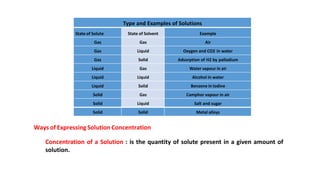
and the solvent is a liquid. There are nine types of solutions whose examples are
Type and Examples of Solutions
State of Solute State of Solvent Example
Gas Gas Air
Gas Liquid Oxygen and CO2 in water
Gas Solid Adsorption of H2 by palladium
Liquid Gas Water vapour in air
Liquid Liquid Alcohol in water
Liquid Solid Benzene in Iodine
Solid Gas Camphor vapour in air
Solid Liquid Salt and sugar
Solid Solid Metal alloys
Ways of Expressing Solution Concentration
Concentration of a Solution : is the quantity of solute present in a given amount of
solution.
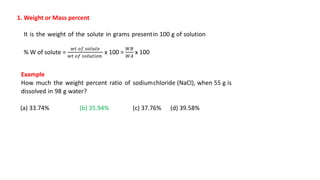
1. Weight or Mass percent
It is the weight of the solute in grams presentin 100 g of solution
% W of solute =
𝑤𝑡 𝑜𝑓 𝑠𝑜𝑙𝑢𝑡𝑒
𝑤𝑡 𝑜𝑓 𝑠𝑜𝑙𝑢𝑡𝑖𝑜𝑛
x 100 =
𝑊𝐵
𝑊𝐴
x 100
Example
How much the weight percent ratio of sodiumchloride (NaCl), when 55 g is
dissolved in 98 g water?
(a) 33.74% (b) 35.94% (c) 37.76% (d) 39.58%
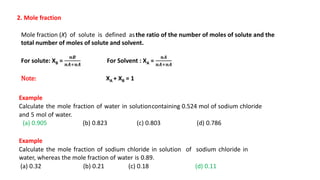
2. Mole fraction
Mole fraction (X) of solute is defined asthe ratio of the number of moles of solute and the
total number of moles of solute and solvent.
For solute: XB =
𝒏𝑩
𝒏𝑨+𝒏𝑨
For Solvent : XA =
𝒏𝑨
𝒏𝑨+𝒏𝑨
Note: XA + XB = 1
Example
Calculate the mole fraction of water in solutioncontaining 0.524 mol of sodium chloride
and 5 mol of water.
(a) 0.905 (b) 0.823 (c) 0.803 (d) 0.786
Example
Calculate the mole fraction of sodium chloride in solution of sodium chloride in
water, whereas the mole fraction of water is 0.89.
(a) 0.32 (b) 0.21 (c) 0.18 (d) 0.11
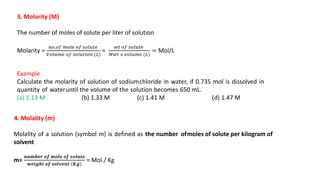
3. Molarity (M)
The number of moles of solute per liter of solution
Molarity =
𝑛𝑜.𝑜𝑓 𝑚𝑜𝑙𝑒 𝑜𝑓 𝑠𝑜𝑙𝑢𝑡𝑒
𝑉𝑜𝑙𝑢𝑚𝑒 𝑜𝑓 𝑠𝑜𝑙𝑢𝑡𝑖𝑜𝑛 (𝐿)
=
𝑤𝑡 𝑜𝑓 𝑠𝑜𝑙𝑢𝑡𝑒
𝑀𝑤𝑡 𝑥 𝑣𝑜𝑙𝑢𝑚𝑒 (𝐿)
= Mol/L
Example
Calculate the molarity of solution of sodiumchloride in water, if 0.735 mol is dissolved in
quantity of wateruntil the volume of the solution becomes 650 mL.
(a) 1.13 M (b) 1.33 M (c) 1.41 M (d) 1.47 M
4. Molality (m)
Molality of a solution (symbol m) is defined as the number ofmoles of solute per kilogram of
solvent
m=
𝒏𝒖𝒎𝒃𝒆𝒓 𝒐𝒇 𝒎𝒐𝒍𝒆 𝒐𝒇 𝒔𝒐𝒍𝒖𝒕𝒆
𝒘𝒆𝒊𝒈𝒉𝒕 𝒐𝒇 𝒔𝒐𝒍𝒗𝒆𝒏𝒕 (𝑲𝒈)
= Mol / Kg
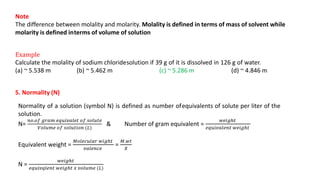
Note
The difference between molality and molarity. Molality is defined in terms of mass of solvent while
molarity is defined interms of volume of solution
Example
Calculate the molality of sodium chloridesolution if 39 g of it is dissolved in 126 g of water.
(a) ~ 5.538 m (b) ~ 5.462 m (c) ~ 5.286 m (d) ~ 4.846 m
5. Normality (N)
Normality of a solution (symbol N) is defined as number ofequivalents of solute per liter of the
solution.
N=
𝑛𝑜.𝑜𝑓 𝑔𝑟𝑎𝑚 𝑒𝑞𝑢𝑖𝑣𝑎𝑙𝑒𝑡 𝑜𝑓 𝑠𝑜𝑙𝑢𝑡𝑒
𝑉𝑜𝑙𝑢𝑚𝑒 𝑜𝑓 𝑠𝑜𝑙𝑢𝑡𝑖𝑜𝑛 (𝐿)
& Number of gram equivalent =
𝑤𝑒𝑖𝑔ℎ𝑡
𝑒𝑞𝑢𝑖𝑣𝑎𝑙𝑒𝑛𝑡 𝑤𝑒𝑖𝑔ℎ𝑡
Equivalent weight =
𝑀𝑜𝑙𝑒𝑐𝑢𝑙𝑎𝑟 𝑤𝑖𝑔ℎ𝑡
𝑣𝑎𝑙𝑒𝑛𝑐𝑒
=
𝑀.𝑤𝑡
𝑋
N =
𝑤𝑒𝑖𝑔ℎ𝑡
𝑒𝑞𝑢𝑖𝑣𝑞𝑙𝑒𝑛𝑡 𝑤𝑒𝑖𝑔ℎ𝑡 𝑥 𝑣𝑜𝑙𝑢𝑚𝑒 (𝐿)
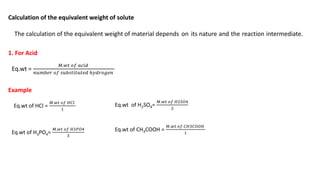
Calculation of the equivalent weight of solute
The calculation of the equivalent weight of material depends on its nature and the reaction intermediate.
1. For Acid
Eq.wt =
𝑀.𝑤𝑡 𝑜𝑓 𝑎𝑐𝑖𝑑
𝑛𝑢𝑚𝑏𝑒𝑟 𝑜𝑓 𝑠𝑢𝑏𝑠𝑡𝑖𝑡𝑢𝑡𝑒𝑑 ℎ𝑦𝑑𝑟𝑜𝑔𝑒𝑛
Example
Eq.wt of HCl =
𝑀.𝑤𝑡 𝑜𝑓 𝐻𝐶𝑙
1
Eq.wt of H2SO4=
𝑀.𝑤𝑡 𝑜𝑓 𝐻2𝑆𝑂4
2
Eq.wt of H3PO4=
𝑀.𝑤𝑡 𝑜𝑓 𝐻3𝑃𝑂4
3
Eq.wt of CH3COOH =
𝑀.𝑤𝑡 𝑜𝑓 𝐶𝐻3𝐶𝑂𝑂𝐻
1
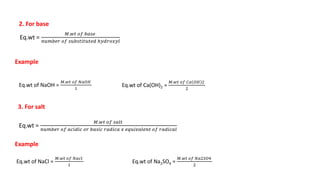
3. For salt
Eq.wt =
𝑀.𝑤𝑡 𝑜𝑓 𝑏𝑎𝑠𝑒
𝑛𝑢𝑚𝑏𝑒𝑟 𝑜𝑓 𝑠𝑢𝑏𝑠𝑡𝑖𝑡𝑢𝑡𝑒𝑑 ℎ𝑦𝑑𝑟𝑜𝑥𝑦𝑙
Example
Eq.wt of NaOH =
𝑀.𝑤𝑡 𝑜𝑓 𝑁𝑎𝑂𝐻
1
Eq.wt of Ca(OH)2 =
𝑀.𝑤𝑡 𝑜𝑓 𝐶𝑎 𝑂𝐻 2
2
2. For base
Eq.wt =
𝑀.𝑤𝑡 𝑜𝑓 𝑠𝑎𝑙𝑡
𝑛𝑢𝑚𝑏𝑒𝑟 𝑜𝑓 𝑎𝑐𝑖𝑑𝑖𝑐 𝑜𝑟 𝑏𝑎𝑠𝑖𝑐 𝑟𝑎𝑑𝑖𝑐𝑎 𝑥 𝑒𝑞𝑢𝑖𝑣𝑎𝑙𝑒𝑛𝑡 𝑜𝑓 𝑟𝑎𝑑𝑖𝑐𝑎𝑙
Example
Eq.wt of NaCl =
𝑀.𝑤𝑡 𝑜𝑓 𝑁𝑎𝑐𝑙
1
Eq.wt of Na2SO4 =
𝑀.𝑤𝑡 𝑜𝑓 𝑁𝑎2𝑆𝑂4
2
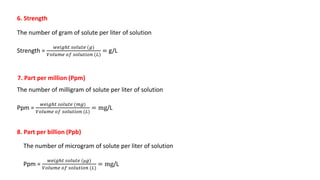
6. Strength
The number of gram of solute per liter of solution
Strength =
𝑤𝑒𝑖𝑔ℎ𝑡 𝑠𝑜𝑙𝑢𝑡𝑒 (𝑔)
𝑉𝑜𝑙𝑢𝑚𝑒 𝑜𝑓 𝑠𝑜𝑙𝑢𝑡𝑖𝑜𝑛 (𝐿)
= g/L
8. Part per billion (Ppb)
The number of milligram of solute per liter of solution
Ppm =
𝑤𝑒𝑖𝑔ℎ𝑡 𝑠𝑜𝑙𝑢𝑡𝑒 (𝑚𝑔)
𝑉𝑜𝑙𝑢𝑚𝑒 𝑜𝑓 𝑠𝑜𝑙𝑢𝑡𝑖𝑜𝑛 (𝐿)
= mg/L
7. Part per million (Ppm)
The number of microgram of solute per liter of solution
Ppm =
𝑤𝑒𝑖𝑔ℎ𝑡 𝑠𝑜𝑙𝑢𝑡𝑒 (µ𝑔)
𝑉𝑜𝑙𝑢𝑚𝑒 𝑜𝑓 𝑠𝑜𝑙𝑢𝑡𝑖𝑜𝑛 (𝐿)
= mg/L

lec 1 .pptx

  • 1.
  • 2.
    A solution is ahomogeneous mixture of two or more substances. The constituent of the mixture present in a smaller amount is called the Solute and the one present in a larger amount is called the Solvent. For example, when a smaller amount of sugar (solute) is mixed with water (solvent). Types of Solutions The common solutions that we come across are those where the solute is a solid and the solvent is a liquid. There are nine types of solutions whose examples are
  • 3.
    Type and Examplesof Solutions State of Solute State of Solvent Example Gas Gas Air Gas Liquid Oxygen and CO2 in water Gas Solid Adsorption of H2 by palladium Liquid Gas Water vapour in air Liquid Liquid Alcohol in water Liquid Solid Benzene in Iodine Solid Gas Camphor vapour in air Solid Liquid Salt and sugar Solid Solid Metal alloys Ways of Expressing Solution Concentration Concentration of a Solution : is the quantity of solute present in a given amount of solution.
  • 4.
    1. Weight orMass percent It is the weight of the solute in grams presentin 100 g of solution % W of solute = 𝑤𝑡 𝑜𝑓 𝑠𝑜𝑙𝑢𝑡𝑒 𝑤𝑡 𝑜𝑓 𝑠𝑜𝑙𝑢𝑡𝑖𝑜𝑛 x 100 = 𝑊𝐵 𝑊𝐴 x 100 Example How much the weight percent ratio of sodiumchloride (NaCl), when 55 g is dissolved in 98 g water? (a) 33.74% (b) 35.94% (c) 37.76% (d) 39.58%
  • 5.
    2. Mole fraction Molefraction (X) of solute is defined asthe ratio of the number of moles of solute and the total number of moles of solute and solvent. For solute: XB = 𝒏𝑩 𝒏𝑨+𝒏𝑨 For Solvent : XA = 𝒏𝑨 𝒏𝑨+𝒏𝑨 Note: XA + XB = 1 Example Calculate the mole fraction of water in solutioncontaining 0.524 mol of sodium chloride and 5 mol of water. (a) 0.905 (b) 0.823 (c) 0.803 (d) 0.786 Example Calculate the mole fraction of sodium chloride in solution of sodium chloride in water, whereas the mole fraction of water is 0.89. (a) 0.32 (b) 0.21 (c) 0.18 (d) 0.11
  • 6.
    3. Molarity (M) Thenumber of moles of solute per liter of solution Molarity = 𝑛𝑜.𝑜𝑓 𝑚𝑜𝑙𝑒 𝑜𝑓 𝑠𝑜𝑙𝑢𝑡𝑒 𝑉𝑜𝑙𝑢𝑚𝑒 𝑜𝑓 𝑠𝑜𝑙𝑢𝑡𝑖𝑜𝑛 (𝐿) = 𝑤𝑡 𝑜𝑓 𝑠𝑜𝑙𝑢𝑡𝑒 𝑀𝑤𝑡 𝑥 𝑣𝑜𝑙𝑢𝑚𝑒 (𝐿) = Mol/L Example Calculate the molarity of solution of sodiumchloride in water, if 0.735 mol is dissolved in quantity of wateruntil the volume of the solution becomes 650 mL. (a) 1.13 M (b) 1.33 M (c) 1.41 M (d) 1.47 M 4. Molality (m) Molality of a solution (symbol m) is defined as the number ofmoles of solute per kilogram of solvent m= 𝒏𝒖𝒎𝒃𝒆𝒓 𝒐𝒇 𝒎𝒐𝒍𝒆 𝒐𝒇 𝒔𝒐𝒍𝒖𝒕𝒆 𝒘𝒆𝒊𝒈𝒉𝒕 𝒐𝒇 𝒔𝒐𝒍𝒗𝒆𝒏𝒕 (𝑲𝒈) = Mol / Kg
  • 7.
    Note The difference betweenmolality and molarity. Molality is defined in terms of mass of solvent while molarity is defined interms of volume of solution Example Calculate the molality of sodium chloridesolution if 39 g of it is dissolved in 126 g of water. (a) ~ 5.538 m (b) ~ 5.462 m (c) ~ 5.286 m (d) ~ 4.846 m 5. Normality (N) Normality of a solution (symbol N) is defined as number ofequivalents of solute per liter of the solution. N= 𝑛𝑜.𝑜𝑓 𝑔𝑟𝑎𝑚 𝑒𝑞𝑢𝑖𝑣𝑎𝑙𝑒𝑡 𝑜𝑓 𝑠𝑜𝑙𝑢𝑡𝑒 𝑉𝑜𝑙𝑢𝑚𝑒 𝑜𝑓 𝑠𝑜𝑙𝑢𝑡𝑖𝑜𝑛 (𝐿) & Number of gram equivalent = 𝑤𝑒𝑖𝑔ℎ𝑡 𝑒𝑞𝑢𝑖𝑣𝑎𝑙𝑒𝑛𝑡 𝑤𝑒𝑖𝑔ℎ𝑡 Equivalent weight = 𝑀𝑜𝑙𝑒𝑐𝑢𝑙𝑎𝑟 𝑤𝑖𝑔ℎ𝑡 𝑣𝑎𝑙𝑒𝑛𝑐𝑒 = 𝑀.𝑤𝑡 𝑋 N = 𝑤𝑒𝑖𝑔ℎ𝑡 𝑒𝑞𝑢𝑖𝑣𝑞𝑙𝑒𝑛𝑡 𝑤𝑒𝑖𝑔ℎ𝑡 𝑥 𝑣𝑜𝑙𝑢𝑚𝑒 (𝐿)
  • 8.
    Calculation of theequivalent weight of solute The calculation of the equivalent weight of material depends on its nature and the reaction intermediate. 1. For Acid Eq.wt = 𝑀.𝑤𝑡 𝑜𝑓 𝑎𝑐𝑖𝑑 𝑛𝑢𝑚𝑏𝑒𝑟 𝑜𝑓 𝑠𝑢𝑏𝑠𝑡𝑖𝑡𝑢𝑡𝑒𝑑 ℎ𝑦𝑑𝑟𝑜𝑔𝑒𝑛 Example Eq.wt of HCl = 𝑀.𝑤𝑡 𝑜𝑓 𝐻𝐶𝑙 1 Eq.wt of H2SO4= 𝑀.𝑤𝑡 𝑜𝑓 𝐻2𝑆𝑂4 2 Eq.wt of H3PO4= 𝑀.𝑤𝑡 𝑜𝑓 𝐻3𝑃𝑂4 3 Eq.wt of CH3COOH = 𝑀.𝑤𝑡 𝑜𝑓 𝐶𝐻3𝐶𝑂𝑂𝐻 1
  • 9.
    3. For salt Eq.wt= 𝑀.𝑤𝑡 𝑜𝑓 𝑏𝑎𝑠𝑒 𝑛𝑢𝑚𝑏𝑒𝑟 𝑜𝑓 𝑠𝑢𝑏𝑠𝑡𝑖𝑡𝑢𝑡𝑒𝑑 ℎ𝑦𝑑𝑟𝑜𝑥𝑦𝑙 Example Eq.wt of NaOH = 𝑀.𝑤𝑡 𝑜𝑓 𝑁𝑎𝑂𝐻 1 Eq.wt of Ca(OH)2 = 𝑀.𝑤𝑡 𝑜𝑓 𝐶𝑎 𝑂𝐻 2 2 2. For base Eq.wt = 𝑀.𝑤𝑡 𝑜𝑓 𝑠𝑎𝑙𝑡 𝑛𝑢𝑚𝑏𝑒𝑟 𝑜𝑓 𝑎𝑐𝑖𝑑𝑖𝑐 𝑜𝑟 𝑏𝑎𝑠𝑖𝑐 𝑟𝑎𝑑𝑖𝑐𝑎 𝑥 𝑒𝑞𝑢𝑖𝑣𝑎𝑙𝑒𝑛𝑡 𝑜𝑓 𝑟𝑎𝑑𝑖𝑐𝑎𝑙 Example Eq.wt of NaCl = 𝑀.𝑤𝑡 𝑜𝑓 𝑁𝑎𝑐𝑙 1 Eq.wt of Na2SO4 = 𝑀.𝑤𝑡 𝑜𝑓 𝑁𝑎2𝑆𝑂4 2
  • 10.
    6. Strength The numberof gram of solute per liter of solution Strength = 𝑤𝑒𝑖𝑔ℎ𝑡 𝑠𝑜𝑙𝑢𝑡𝑒 (𝑔) 𝑉𝑜𝑙𝑢𝑚𝑒 𝑜𝑓 𝑠𝑜𝑙𝑢𝑡𝑖𝑜𝑛 (𝐿) = g/L 8. Part per billion (Ppb) The number of milligram of solute per liter of solution Ppm = 𝑤𝑒𝑖𝑔ℎ𝑡 𝑠𝑜𝑙𝑢𝑡𝑒 (𝑚𝑔) 𝑉𝑜𝑙𝑢𝑚𝑒 𝑜𝑓 𝑠𝑜𝑙𝑢𝑡𝑖𝑜𝑛 (𝐿) = mg/L 7. Part per million (Ppm) The number of microgram of solute per liter of solution Ppm = 𝑤𝑒𝑖𝑔ℎ𝑡 𝑠𝑜𝑙𝑢𝑡𝑒 (µ𝑔) 𝑉𝑜𝑙𝑢𝑚𝑒 𝑜𝑓 𝑠𝑜𝑙𝑢𝑡𝑖𝑜𝑛 (𝐿) = mg/L