C
Programming:
A Journey
into the
Beginners
C is a programming
language that can do
a lot of powerful
things
Introduction
C Programming
C programming language
was developed in 1972 by
Dennis Ritchie at bell
laboratories of AT&T
(American Telephone &
Telegraph), located in the
U.S.A. Dennis Ritchie is known
as the founder of the C
language. It was developed to
overcome the problems of
previous languages such as B,
BCPL, etc.
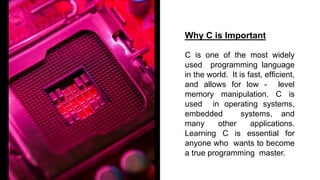
Why C is Important
C is one of the most widely
used programming language
in the world. It is fast, efficient,
and allows for low - level
memory manipulation. C is
used in operating systems,
embedded systems, and
many other applications.
Learning C is essential for
anyone who wants to become
a true programming master.
C Fundamentals
To become a C
programming master, you
must first master the
fundamentals. This
includes understanding
data types, variables,
control structures, and
functions. By mastering
these fundamentals, you
will have a solid
foundation for building
more complex programs.
Creative C Programming
C programming is not just
about writing code - it's
about being creative. By
thinking outside the box and
exploring new ideas, you
can create programs that are
both functional and
beautiful. This slide will
explore some of the creative
aspects of C programming.
Advanced C Programming
Once you have mastered the
fundamentals and explored your
creativity, it's time to take your C
programming skills to the next
level. This slide will cover some
of the more advanced topics in
C programming, including
pointers, memory management,
and optimization techniques.
Conclusion
C is not just a language, it is a journey into the heart of
computation. Whether you are developing a simple utility or
working on complex systems, the principles you learn from C will
continue to serve you well. In a rapidly evolving technological
landscape, the C programming language remains a timeless
treasure, offering a solid foundation for anyone seeking to become
a skilled programmer or engineer.
Thank you

least.ppt

  • 1.
    C Programming: A Journey into the Beginners Cis a programming language that can do a lot of powerful things
  • 2.
    Introduction C Programming C programminglanguage was developed in 1972 by Dennis Ritchie at bell laboratories of AT&T (American Telephone & Telegraph), located in the U.S.A. Dennis Ritchie is known as the founder of the C language. It was developed to overcome the problems of previous languages such as B, BCPL, etc.
  • 3.
    Why C isImportant C is one of the most widely used programming language in the world. It is fast, efficient, and allows for low - level memory manipulation. C is used in operating systems, embedded systems, and many other applications. Learning C is essential for anyone who wants to become a true programming master.
  • 4.
    C Fundamentals To becomea C programming master, you must first master the fundamentals. This includes understanding data types, variables, control structures, and functions. By mastering these fundamentals, you will have a solid foundation for building more complex programs.
  • 5.
    Creative C Programming Cprogramming is not just about writing code - it's about being creative. By thinking outside the box and exploring new ideas, you can create programs that are both functional and beautiful. This slide will explore some of the creative aspects of C programming.
  • 6.
    Advanced C Programming Onceyou have mastered the fundamentals and explored your creativity, it's time to take your C programming skills to the next level. This slide will cover some of the more advanced topics in C programming, including pointers, memory management, and optimization techniques.
  • 7.
    Conclusion C is notjust a language, it is a journey into the heart of computation. Whether you are developing a simple utility or working on complex systems, the principles you learn from C will continue to serve you well. In a rapidly evolving technological landscape, the C programming language remains a timeless treasure, offering a solid foundation for anyone seeking to become a skilled programmer or engineer.
  • 8.