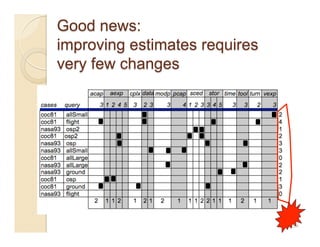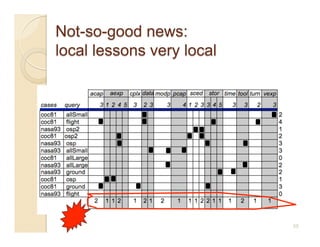
Tim Menzies, WVU, USA,
tim@menzies.us
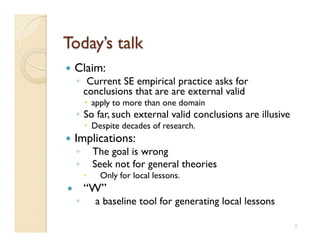
  Claim:
     ◦  Current SE empirical practice asks for
       conclusions that are are external valid
            apply to more than one domain
     ◦  So far, such external valid conclusions are illusive
            Despite decades of research.
  Implications:
     ◦         The goal is wrong
     ◦         Seek not for general theories
               Only for local lessons.
         “W”
     ◦         a baseline tool for generating local lessons

                                                               2
    A hypothetical                A plan to create,
     description of a               according to a model
     complex entity or              or models
     process.                       ◦  Model of the research
     ◦  Model as output from           machine
        research machine            ◦  The “generator” of
     ◦  The “product” of               products
        research

                                   “W” is a general
                                    model generator.

                                                               3
Popper ’60: Everything is a “hypothesis”
     ◦        And the good ones have weathered the most attack
     ◦        SE “theories” aren’t even “hypotheses”

Endres & Rombach ’03: Distinguish “observations”, “laws”, “theory”
     ◦        Laws predict repeatable observations
     ◦        Theories explain laws
     ◦        Laws are either hypotheses (tentatively accepted) or conjectures (guesses)

Gregor’06 : 5 types of “theory”:
    1.    Analysis (e.g. ontologies, taxonomies)
    2.    Explanation (but it is hard to explain “explanation”)
    3.    Prediction (some predictors do not explain)
    4.    Explanation and prediction
    5.    “models” for design + action
          –  Don’t have to be “right”
          –  Just “useful”
          –  A.k.a. Endres & Rombach’s “laws”?
                                                                                           4
  Want   to find some general conclusions
   on SE?
  Need to go somewhere to get a lot of
   data from different projects?


                                             5
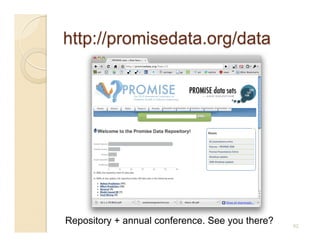
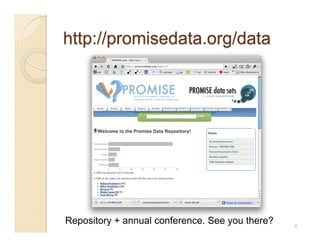
Repository + annual conference. See you there?   6
7
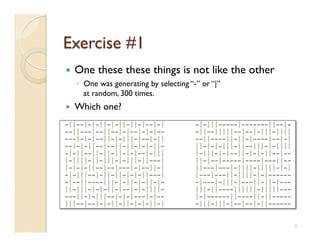
    One these these things is not like the other
     ◦  One was generating by selecting “-” or “|”
        at random, 300 times.
    Which one?


                                                     8
  A little experiment
  Rules
     ◦  No one talks for the next 4 minutes
     ◦  If you know what is about to happen, see (1)
    This will is a selective attention test
     ◦  Count the number of times the team with the white shirt
        passes the ball.
     ◦  http://www.youtube.com/v/
        vJG698U2Mvo&hl=en_US&fs=1&rel=0

                                                              9
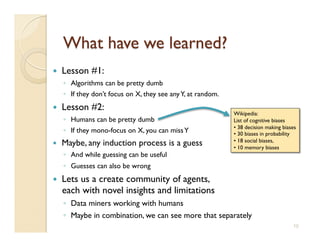
    Lesson #1:
     ◦  Algorithms can be pretty dumb
     ◦  If they don’t focus on X, they see any Y, at random.
    Lesson #2:
                                                                Wikipedia: 
     ◦  Humans can be pretty dumb
                              List of cognitive biases
                                                                • 38 decision making biases
     ◦  If they mono-focus on X, you can miss Y
                • 30 biases in probability
                                                                • 18 social biases,
    Maybe, any induction process is a guess
                   • 10 memory biases
     ◦  And while guessing can be useful
     ◦  Guesses can also be wrong
    Lets us a create community of agents, 
     each with novel insights and limitations
     ◦  Data miners working with humans
     ◦  Maybe in combination, we can see more that separately 
                                                                                          10
11
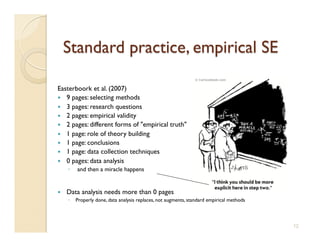
Easterboork et al. (2007)
  9 pages: selecting methods 
  3 pages: research questions
  2 pages: empirical validity
  2 pages: different forms of empirical truth 
  1 page: role of theory building 
  1 page: conclusions 
  1 page: data collection techniques 
  0 pages: data analysis
     ◦    and then a miracle happens 


    Data analysis needs more than 0 pages
     ◦  Properly done, data analysis replaces, not augments, standard empirical methods


                                                                                           12
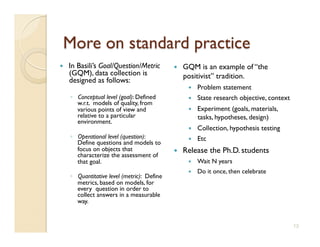
    In Basili’s Goal/Question/Metric             GQM is an example of “the
     (GQM), data collection is                     positivist” tradition.
     designed as follows:
                                                        Problem statement
     ◦  Conceptual level (goal): Defined                State research objective, context
        w.r.t. models of quality, from
        various points of view and                      Experiment (goals, materials,
        relative to a particular                         tasks, hypotheses, design)
        environment.
                                                        Collection, hypothesis testing
     ◦  Operational level (question):                   Etc
        Define questions and models to
        focus on objects that                     Release the Ph.D. students
        characterize the assessment of
        that goal.                                      Wait N years
                                                        Do it once, then celebrate
     ◦  Quantitative level (metric): Define
        metrics, based on models, for
        every question in order to
        collect answers in a measurable
        way.


                                                                                             13
    Does the pace of change in modern software engineering make GQM impractical?
     ◦  Researchers need rapid adaptation methods to keep up with this faster pace. Otherwise…

    Basili’s SEL’s learning organization experiment lasted ten years (from 1984 to 1994) during a
     period of relative stability within the NASA organization. 

    Starting in 1995, the pace of change within NASA increased dramatically.
     ◦    New projects were often outsourced 
     ◦  SEL became less the driver and more the observer, less proactive and more reactive. 
     ◦  Each project could adopt its own structure. 
     ◦  SEL-style experimentation became difficult: no longer a central model to build on. 

    NASA also tried some pretty radical development methods
     ◦  ‘Faster, Better, Cheaper” lead led to certain high profile errors which were attributed to
        production haste, poor communications, and mistakes in engineering management.
     ◦  When ‘Faster, Better, Cheaper’ ended, NASA changed, again, their development practices. 

    This constant pace of change proved fatal to the SEL. 
     ◦  Basili el al. [24] describe the period 1995-2001 as one of ‘retrenchment’ at the SEL.
                                                                                                     14
Ground swell of complaint against empirical SE
   ◦  DOD funding ends, 2002 (exception: SEI)
   ◦  Zanier paper, ICSE, 2006
   ◦  http://www.semat.org, 2009
   ◦  NSF funding, 2010
   ◦  Robbles, MSR 2010
   ◦  Shull  Menzies, 2010, O’Reilly

Data collection is different
    ◦  20th century:
         design data collection around targeted questions
    ◦  21st century:
         Science 2.0, more data on the web from other sites than you
          can ever collect yourself.

Data analysis is different
    ◦  20th century:
         2 populations of 10 experts, 20 questions.
         Check for differences using chi-squared
    ◦  21st century:
         Explore 3 gigabytes of core dumps; search for frequent
          sequences of method calls that lead to a crash.
         Use a multitude of rapidly changing methods to find patterns:
          LDA, frequent sequence mining, model trees, etc
    ◦  More re-analysis of old data using new techniques             15
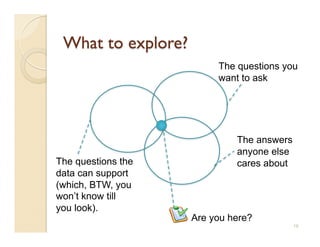
The questions you
                         want to ask


                             The answers
                             anyone else
The questions the            cares about
data can support
(which, BTW, you
won’t know till
you look).
                    Are you here?
                                           16
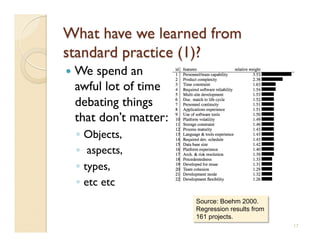
  Wespend an
 awful lot of time
 debating things
 that don’t matter:
 ◦  Objects,
 ◦  aspects,
 ◦  types,
 ◦  etc etc
                      Source: Boehm 2000.
                      Regression results from
                      161 projects.
                                                17
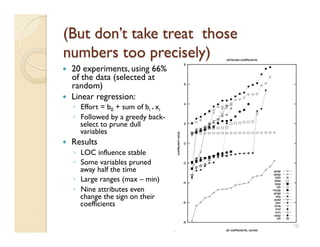
    20 experiments, using 66%
     of the data (selected at
     random)
    Linear regression:
     ◦  Effort = b0 + sum of bi * xi
     ◦  Followed by a greedy back-
        select to prune dull
        variables
    Results
     ◦  LOC influence stable
     ◦  Some variables pruned
        away half the time
     ◦  Large ranges (max – min)
     ◦  Nine attributes even
        change the sign on their
        coefficients

                                       18
    PROMISE 2005 … 2009 :
     ◦  64 presentations
    48 papers
     ◦  tried a new analysis on old data (repeatability is a GOOD thing)
     ◦  Or reported a new method that worked once for one project.
    4 papers
     ◦  argued against model generality
    9 papers
     ◦  found issues that challenged the validity of prior results
        (re-assessment is a GOOD thing)
     ◦  E.g. Menzies et al. Promise 2006
          The variance study described above


                                                                           19
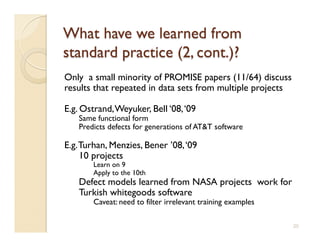
Only a small minority of PROMISE papers (11/64) discuss
results that repeated in data sets from multiple projects

E.g. Ostrand, Weyuker, Bell ‘08, ‘09
   Same functional form
   Predicts defects for generations of ATT software

E.g. Turhan, Menzies, Bener ’08, ‘09
     10 projects
       Learn on 9
       Apply to the 10th
   Defect models learned from NASA projects work for
   Turkish whitegoods software
       Caveat: need to filter irrelevant training examples

                                                             20
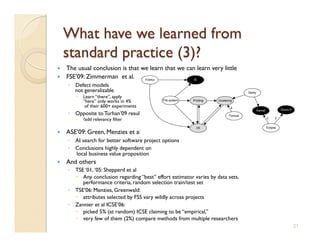
    The usual conclusion is that we learn that we can learn very little
    FSE’09: Zimmerman et al.
     ◦  Defect models
        not generalizable
          Learn “there”, apply
           “here” only works in 4%
            of their 600+ experiments
     ◦  Opposite to Turhan’09 results
          ?add relevancy filter

    ASE’09: Green, Menzies et al.
     ◦  AI search for better software project options
     ◦  Conclusions highly dependent on
        local business value proposition
    And others
     ◦  TSE ‘01, ’05: Shepperd et al
          Any conclusion regarding “best” effort estimator varies by data sets,
           performance criteria, random selection train/test set
     ◦  TSE’06: Menzies, Greenwald:
          attributes selected by FSS vary wildly across projects
     ◦  Zannier et al ICSE’06:
          picked 5% (at random) ICSE claiming to be “empirical,”
          very few of them (2%) compare methods from multiple researchers
                                                                                   21
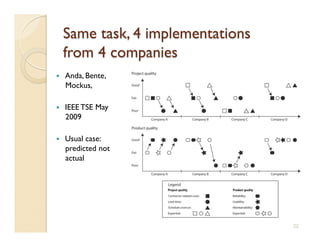
    Anda, Bente,
     Mockus,

    IEEE TSE May
     2009

    Usual case:
     predicted not
     actual


                     22
    Fenton at PROMISE’ 07
     ◦  ... much of the current software metrics research is
        inherently irrelevant to the industrial mix ...”
     ◦  ... any software metrics program that depends on some
        extensive metrics collection is doomed to failure ...”


    Budgen  Kitchenham:
     ◦  “Is Evidence Based Software Engineering mature
        enough for Practice  Policy? ”
     ◦  Need for better reporting: more reviews.
     ◦  Empirical SE results too immature for making
        policy.

    Basili : still far to go
     ◦  But we should celebrate the progress made over
        the last 30 years.
     ◦  And we are turning the corner                            23
    Experience factories
     ◦  Method for find local lessons
    Basili’09 (pers. comm.):
     ◦  “All my papers have the same form.
     ◦  “For the project being studied, we find that changing X
        improved Y.”
    Translation (mine):
     ◦  Even if we can’t find general models (which seem to be
        quite rare)….
     ◦  … we can still research general methods for
        finding local lessons learned
                                                                  24
25/46


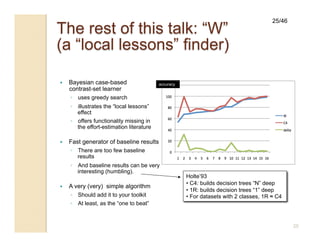
    Bayesian case-based                   accuracy
     contrast-set learner
     ◦  uses greedy search
     ◦  illustrates the “local lessons”
        effect
     ◦  offers functionality missing in
        the effort-estimation literature

    Fast generator of baseline results
     ◦  There are too few baseline
        results
     ◦  And baseline results can be very
        interesting (humbling).
                                                      Holte’93
                                                      • C4: builds decision trees “N” deep
    A very (very) simple algorithm
                                                      • 1R: builds decision trees “1” deep
     ◦  Should add it to your toolkit                 • For datasets with 2 classes, 1R ≈ C4
     ◦  At least, as the “one to beat”


                                                                                                25
26
27/46
                                 good


                                     ok
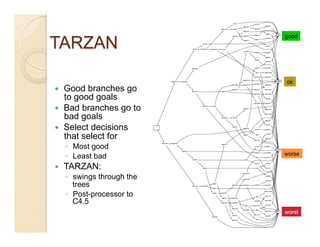
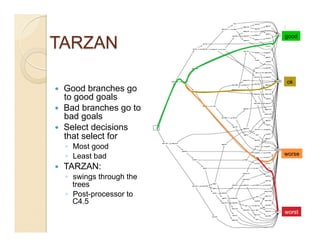
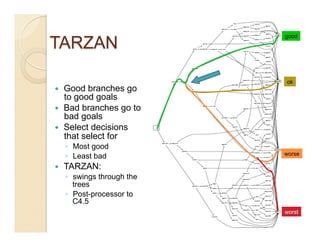
    Good branches go
     to good goals
    Bad branches go to
     bad goals
    Select decisions
     that select for
     ◦  Most good
                                 worse
     ◦  Least bad
    TARZAN:
     ◦  swings through the
        trees
     ◦  Post-processor to
        C4.5
                                 worst
28/46
                                 good


                                     ok
    Good branches go
     to good goals
    Bad branches go to
     bad goals
    Select decisions
     that select for
     ◦  Most good
                                 worse
     ◦  Least bad
    TARZAN:
     ◦  swings through the
        trees
     ◦  Post-processor to
        C4.5
                                 worst
29/46
                                 good


                                     ok
    Good branches go
     to good goals
    Bad branches go to
     bad goals
    Select decisions
     that select for
     ◦  Most good
                                 worse
     ◦  Least bad
    TARZAN:
     ◦  swings through the
        trees
     ◦  Post-processor to
        C4.5
                                 worst
30/46
                              good


                                  ok
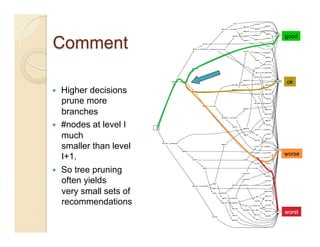
    Higher decisions
     prune more
     branches
    #nodes at level I
     much
     smaller than level
                              worse
     I+1.
    So tree pruning
     often yields
     very small sets of
     recommendations
                              worst
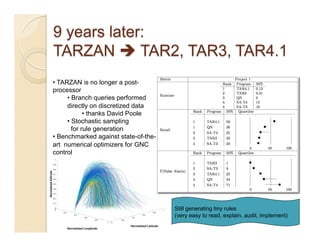
•  TARZAN is no longer a post-
processor
      •  Branch queries performed
      directly on discretized data
             •  thanks David Poole
      •  Stochastic sampling
        for rule generation
•  Benchmarked against state-of-the-
art numerical optimizers for GNC
control


                                       Still generating tiny rules
                                       (very easy to read, explain, audit, implement)
  Not TAR
  Can   achieve same effect
  ◦  Tiny rules
  Using   a much simpler approach
  ◦  A greedy search based on Bayesian range
     selection heuristic


                                               32
33
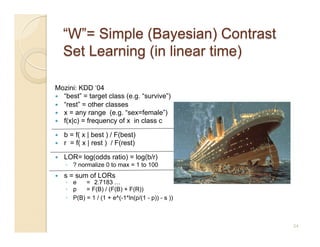
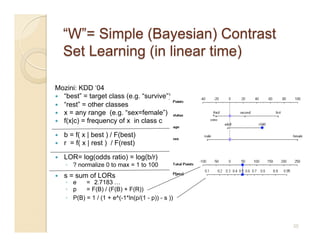
Mozini: KDD ‘04
  “best” = target class (e.g. “survive”)
  “rest” = other classes
  x = any range (e.g. “sex=female”)
  f(x|c) = frequency of x in class c

    b = f( x | best ) / F(best)
    r = f( x | rest ) / F(rest)

    LOR= log(odds ratio) = log(b/r)
     ◦  ? normalize 0 to max = 1 to 100
    s = sum of LORs
     ◦  e    = 2.7183 …
     ◦  p    = F(B) / (F(B) + F(R))
     ◦  P(B) = 1 / (1 + e^(-1*ln(p/(1 - p)) - s ))


                                                     34
Mozini: KDD ‘04
  “best” = target class (e.g. “survive”)
  “rest” = other classes
  x = any range (e.g. “sex=female”)
  f(x|c) = frequency of x in class c

    b = f( x | best ) / F(best)
    r = f( x | rest ) / F(rest)

    LOR= log(odds ratio) = log(b/r)
     ◦  ? normalize 0 to max = 1 to 100
    s = sum of LORs
     ◦  e    = 2.7183 …
     ◦  p    = F(B) / (F(B) + F(R))
     ◦  P(B) = 1 / (1 + e^(-1*ln(p/(1 - p)) - s ))


                                                     35
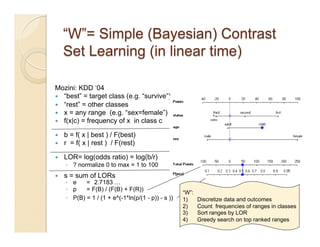
Mozini: KDD ‘04
  “best” = target class (e.g. “survive”)
  “rest” = other classes
  x = any range (e.g. “sex=female”)
  f(x|c) = frequency of x in class c

    b = f( x | best ) / F(best)
    r = f( x | rest ) / F(rest)

    LOR= log(odds ratio) = log(b/r)
     ◦  ? normalize 0 to max = 1 to 100
    s = sum of LORs
     ◦  e    = 2.7183 …
     ◦  p    = F(B) / (F(B) + F(R))
                                                     “W”:
     ◦  P(B) = 1 / (1 + e^(-1*ln(p/(1 - p)) - s ))   1)     Discretize data and outcomes
                                                     2)     Count frequencies of ranges in classes
                                                     3)     Sort ranges by LOR
                                                     4)     Greedy search on top ranked ranges
                                                                                                36
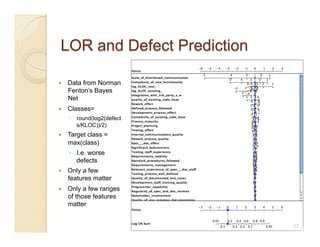
    Data from Norman
     Fenton’s Bayes
     Net
    Classes=
     ◦  round(log2(defect
        s/KLOC))/2)
    Target class =
     max(class)
     ◦  I.e. worse
        defects
    Only a few
     features matter
    Only a few ranges
     of those features
     matter


                            37
• “Query”
   • What kind of project you want to analyze; e.g.
      • Analysts not so clever,
      • High reliability system
      • Small KLOC
• “Cases”
   • Historical records, with their development effort
• Output:
   • A recommendation on how to change our
   projects in order to reduce development effort
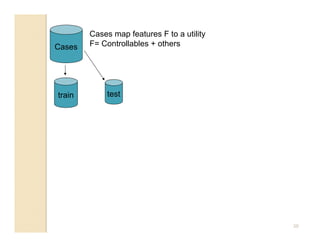
Cases map features F to a utility
Cases   F= Controllables + others


train        test


                                            39
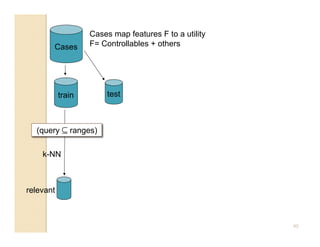
Cases map features F to a utility
       Cases       F= Controllables + others


           train        test


  (query ⊆ ranges)

    k-NN


relevant


                                                       40
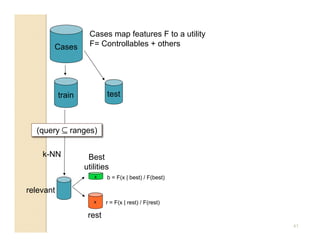
Cases map features F to a utility
       Cases        F= Controllables + others


           train           test


  (query ⊆ ranges)

    k-NN            Best
                   utilities
                      x    b = F(x | best) / F(best)

relevant
                      x    r = F(x | rest) / F(rest)

                    rest
                                                        41
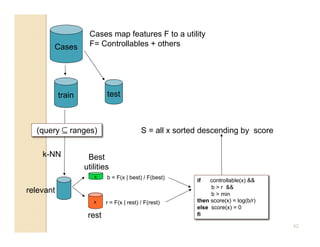
Cases map features F to a utility
       Cases        F= Controllables + others


           train           test


  (query ⊆ ranges)                         S = all x sorted descending by score

    k-NN            Best
                   utilities
                      x    b = F(x | best) / F(best)
                                                          if   controllable(x) 
                                                               b  r 
relevant                                                       b  min
                      x    r = F(x | rest) / F(rest)      then score(x) = log(b/r)
                                                          else score(x) = 0
                    rest                                  fi

                                                                                     42
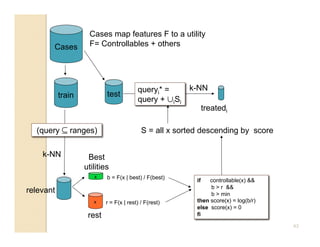
Cases map features F to a utility
       Cases        F= Controllables + others


                                         queryi* =      k-NN
           train           test
                                         query + ∪iSi
                                                               treatedi

  (query ⊆ ranges)                         S = all x sorted descending by score

    k-NN            Best
                   utilities
                      x    b = F(x | best) / F(best)
                                                          if   controllable(x) 
                                                               b  r 
relevant                                                       b  min
                      x    r = F(x | rest) / F(rest)      then score(x) = log(b/r)
                                                          else score(x) = 0
                    rest                                  fi

                                                                                     43
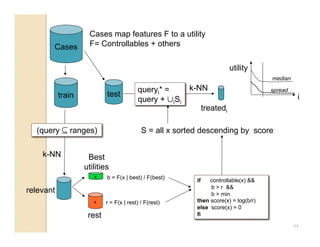
Cases map features F to a utility
       Cases        F= Controllables + others

                                                                          utility
                                                                                     median

                                         queryi* =      k-NN                         spread
           train           test                                                                i
                                         query + ∪iSi
                                                               treatedi

  (query ⊆ ranges)                         S = all x sorted descending by score

    k-NN            Best
                   utilities
                      x    b = F(x | best) / F(best)
                                                          if   controllable(x) 
                                                               b  r 
relevant                                                       b  min
                      x    r = F(x | rest) / F(rest)      then score(x) = log(b/r)
                                                          else score(x) = 0
                    rest                                  fi

                                                                                              44
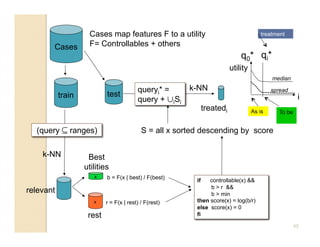
Cases map features F to a utility                                   treatment

       Cases        F= Controllables + others
                                                                              q 0* q i*
                                                                          utility
                                                                                            median

                                         queryi* =      k-NN                                spread
           train           test                                                                        i
                                         query + ∪iSi
                                                               treatedi             As is     To be


  (query ⊆ ranges)                         S = all x sorted descending by score

    k-NN            Best
                   utilities
                      x    b = F(x | best) / F(best)
                                                          if   controllable(x) 
                                                               b  r 
relevant                                                       b  min
                      x    r = F(x | rest) / F(rest)      then score(x) = log(b/r)
                                                          else score(x) = 0
                    rest                                  fi

                                                                                                      45
#1: Brooks’s Law
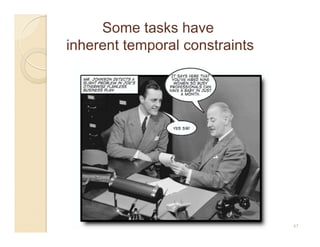
Some tasks have
inherent temporal constraints


                                47
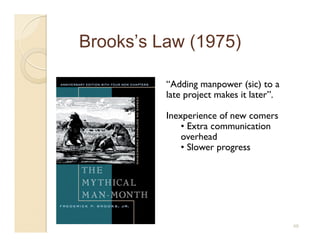
Brooks’s Law (1975)

          “Adding manpower (sic) to a
          late project makes it later”.

          Inexperience of new comers
              • Extra communication
              overhead
              • Slower progress


                                          48
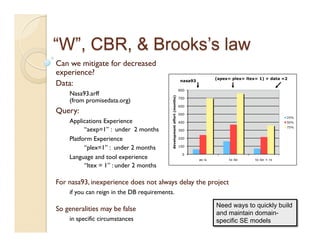
Can we mitigate for decreased
experience?
Data:
    Nasa93.arff
    (from promisedata.org)
Query:
    Applications Experience
          “aexp=1” : under 2 months
    Platform Experience
          “plex=1” : under 2 months
    Language and tool experience
          “ltex = 1” : under 2 months

For nasa93, inexperience does not always delay the project
    if you can reign in the DB requirements.

                                                     Need ways to quickly build
So generalities may be false
                                                     and maintain domain-
    in specific circumstances                        specific SE models
#2 , #3,…. #13
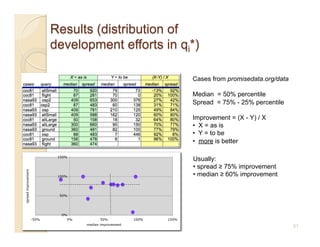
Cases from promisedata.org/data

                                                                       Median = 50% percentile
                                                                       Spread = 75% - 25% percentile

                                                                       Improvement = (X - Y) / X
                                                                       •  X = as is
                                                                       •  Y = to be
                                                                       •  more is better

                            150%
                                                                       Usually:
                                                                       •  spread ≥ 75% improvement
spread improvement


                            100%                                       •  median ≥ 60% improvement


                            50%


                             0%
                     -50%      0%          50%           100%   150%
                                    median improvement
                                                                                                         51
  And that’s the whole point
  Yes, finding local lessons learned need not be
   difficult
  Strange to say…
     ◦  There are no references in the CBR effort
        estimation literature for anything else than estimate
        = nearest neighbors
     ◦  No steps beyond into planning , etc
     ◦  Even though that next steps is easy
                                                                52
53
54
55
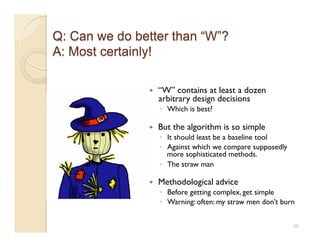
    “W” contains at least a dozen
     arbitrary design decisions
     ◦  Which is best?

    But the algorithm is so simple
     ◦  It should least be a baseline tool
     ◦  Against which we compare supposedly
        more sophisticated methods.
     ◦  The straw man

    Methodological advice
     ◦  Before getting complex, get simple
     ◦  Warning: often: my straw men don’t burn


                                              56
57
    But don’t be alarmed if you can’t find it.
    The experience to date is that,
     ◦  with rare exceptions,
     ◦  SE research does not lead to general models

    But that’s ok
     ◦  Very few others have found general models (in SE)
     ◦  E.g. Turhan, Menzies, Ayse ESE journal ’09
     ◦  E.g. Menzies et al ASE conference, 2010


    Anyway
     ◦  If there are few general results, there may be general methods to find local results
          Seek not “models as products”
          But general models to generate products


                                                                                               58
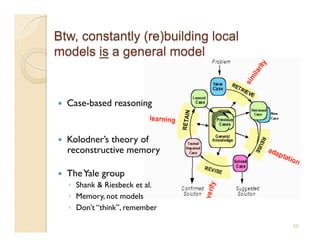
    Case-based reasoning


    Kolodner’s theory of
     reconstructive memory

    The Yale group
     ◦  Shank  Riesbeck et al.
     ◦  Memory, not models
     ◦  Don’t “think”, remember

                                  59
Kludges: they work

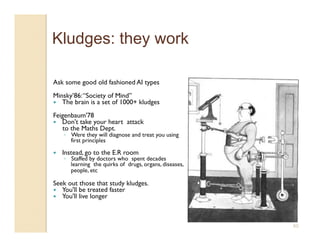
Ask some good old fashioned AI types
Minsky’86: “Society of Mind”
  The brain is a set of 1000+ kludges

Feigenbaum'78
  Don't take your heart attack
   to the Maths Dept.
     ◦  Were they will diagnose and treat you using 
        first principles 

    Instead, go to the E.R room
     ◦  Staffed by doctors who  spent decades 
        learning  the quirks of  drugs, organs, diseases,
        people, etc  

Seek out those that study kludges.
  You'll be treated faster
  You'll live longer


                                                            60
  Want   to find some general conclusions
   on SE?
  Need to go somewhere to get a lot of
   data from different projects?


                                             61
Repository + annual conference. See you there?   62
“You want proof? I’ll give you proof!”

Learning Local Lessons in Software Engineering

  • 1.
    Tim Menzies, WVU,USA, tim@menzies.us
  • 2.
      Claim: ◦  Current SE empirical practice asks for conclusions that are are external valid   apply to more than one domain ◦  So far, such external valid conclusions are illusive   Despite decades of research.   Implications: ◦  The goal is wrong ◦  Seek not for general theories   Only for local lessons.   “W” ◦  a baseline tool for generating local lessons 2
  • 3.
      A hypothetical   A plan to create, description of a according to a model complex entity or or models process. ◦  Model of the research ◦  Model as output from machine research machine ◦  The “generator” of ◦  The “product” of products research   “W” is a general model generator. 3
  • 4.
    Popper ’60: Everythingis a “hypothesis” ◦  And the good ones have weathered the most attack ◦  SE “theories” aren’t even “hypotheses” Endres & Rombach ’03: Distinguish “observations”, “laws”, “theory” ◦  Laws predict repeatable observations ◦  Theories explain laws ◦  Laws are either hypotheses (tentatively accepted) or conjectures (guesses) Gregor’06 : 5 types of “theory”: 1.  Analysis (e.g. ontologies, taxonomies) 2.  Explanation (but it is hard to explain “explanation”) 3.  Prediction (some predictors do not explain) 4.  Explanation and prediction 5.  “models” for design + action –  Don’t have to be “right” –  Just “useful” –  A.k.a. Endres & Rombach’s “laws”? 4
  • 5.
      Want to find some general conclusions on SE?   Need to go somewhere to get a lot of data from different projects? 5
  • 6.
    Repository + annualconference. See you there? 6
  • 7.
  • 8.
      One these these things is not like the other ◦  One was generating by selecting “-” or “|” at random, 300 times.   Which one? 8
  • 9.
      A littleexperiment   Rules ◦  No one talks for the next 4 minutes ◦  If you know what is about to happen, see (1)   This will is a selective attention test ◦  Count the number of times the team with the white shirt passes the ball. ◦  http://www.youtube.com/v/ vJG698U2Mvo&hl=en_US&fs=1&rel=0 9
  • 10.
      Lesson #1: ◦  Algorithms can be pretty dumb ◦  If they don’t focus on X, they see any Y, at random.   Lesson #2: Wikipedia: ◦  Humans can be pretty dumb List of cognitive biases • 38 decision making biases ◦  If they mono-focus on X, you can miss Y • 30 biases in probability • 18 social biases,   Maybe, any induction process is a guess • 10 memory biases ◦  And while guessing can be useful ◦  Guesses can also be wrong   Lets us a create community of agents, each with novel insights and limitations ◦  Data miners working with humans ◦  Maybe in combination, we can see more that separately 10
  • 11.
  • 12.
    Easterboork et al.(2007)   9 pages: selecting methods   3 pages: research questions   2 pages: empirical validity   2 pages: different forms of empirical truth   1 page: role of theory building   1 page: conclusions   1 page: data collection techniques   0 pages: data analysis ◦  and then a miracle happens   Data analysis needs more than 0 pages ◦  Properly done, data analysis replaces, not augments, standard empirical methods 12
  • 13.
      In Basili’s Goal/Question/Metric   GQM is an example of “the (GQM), data collection is positivist” tradition. designed as follows:   Problem statement ◦  Conceptual level (goal): Defined   State research objective, context w.r.t. models of quality, from various points of view and   Experiment (goals, materials, relative to a particular tasks, hypotheses, design) environment.   Collection, hypothesis testing ◦  Operational level (question):   Etc Define questions and models to focus on objects that   Release the Ph.D. students characterize the assessment of that goal.   Wait N years   Do it once, then celebrate ◦  Quantitative level (metric): Define metrics, based on models, for every question in order to collect answers in a measurable way. 13
  • 14.
      Does the pace of change in modern software engineering make GQM impractical? ◦  Researchers need rapid adaptation methods to keep up with this faster pace. Otherwise…   Basili’s SEL’s learning organization experiment lasted ten years (from 1984 to 1994) during a period of relative stability within the NASA organization.   Starting in 1995, the pace of change within NASA increased dramatically. ◦  New projects were often outsourced ◦  SEL became less the driver and more the observer, less proactive and more reactive. ◦  Each project could adopt its own structure. ◦  SEL-style experimentation became difficult: no longer a central model to build on.   NASA also tried some pretty radical development methods ◦  ‘Faster, Better, Cheaper” lead led to certain high profile errors which were attributed to production haste, poor communications, and mistakes in engineering management. ◦  When ‘Faster, Better, Cheaper’ ended, NASA changed, again, their development practices.   This constant pace of change proved fatal to the SEL. ◦  Basili el al. [24] describe the period 1995-2001 as one of ‘retrenchment’ at the SEL. 14
  • 15.
    Ground swell ofcomplaint against empirical SE ◦  DOD funding ends, 2002 (exception: SEI) ◦  Zanier paper, ICSE, 2006 ◦  http://www.semat.org, 2009 ◦  NSF funding, 2010 ◦  Robbles, MSR 2010 ◦  Shull Menzies, 2010, O’Reilly Data collection is different ◦  20th century:   design data collection around targeted questions ◦  21st century:   Science 2.0, more data on the web from other sites than you can ever collect yourself. Data analysis is different ◦  20th century:   2 populations of 10 experts, 20 questions.   Check for differences using chi-squared ◦  21st century:   Explore 3 gigabytes of core dumps; search for frequent sequences of method calls that lead to a crash.   Use a multitude of rapidly changing methods to find patterns: LDA, frequent sequence mining, model trees, etc ◦  More re-analysis of old data using new techniques 15
  • 16.
    The questions you want to ask The answers anyone else The questions the cares about data can support (which, BTW, you won’t know till you look). Are you here? 16
  • 17.
      Wespend an awful lot of time debating things that don’t matter: ◦  Objects, ◦  aspects, ◦  types, ◦  etc etc Source: Boehm 2000. Regression results from 161 projects. 17
  • 18.
      20 experiments, using 66% of the data (selected at random)   Linear regression: ◦  Effort = b0 + sum of bi * xi ◦  Followed by a greedy back- select to prune dull variables   Results ◦  LOC influence stable ◦  Some variables pruned away half the time ◦  Large ranges (max – min) ◦  Nine attributes even change the sign on their coefficients 18
  • 19.
      PROMISE 2005 … 2009 : ◦  64 presentations   48 papers ◦  tried a new analysis on old data (repeatability is a GOOD thing) ◦  Or reported a new method that worked once for one project.   4 papers ◦  argued against model generality   9 papers ◦  found issues that challenged the validity of prior results (re-assessment is a GOOD thing) ◦  E.g. Menzies et al. Promise 2006   The variance study described above 19
  • 20.
    Only a smallminority of PROMISE papers (11/64) discuss results that repeated in data sets from multiple projects E.g. Ostrand, Weyuker, Bell ‘08, ‘09 Same functional form Predicts defects for generations of ATT software E.g. Turhan, Menzies, Bener ’08, ‘09 10 projects Learn on 9 Apply to the 10th Defect models learned from NASA projects work for Turkish whitegoods software Caveat: need to filter irrelevant training examples 20
  • 21.
      The usual conclusion is that we learn that we can learn very little   FSE’09: Zimmerman et al. ◦  Defect models not generalizable   Learn “there”, apply “here” only works in 4% of their 600+ experiments ◦  Opposite to Turhan’09 results   ?add relevancy filter   ASE’09: Green, Menzies et al. ◦  AI search for better software project options ◦  Conclusions highly dependent on local business value proposition   And others ◦  TSE ‘01, ’05: Shepperd et al   Any conclusion regarding “best” effort estimator varies by data sets, performance criteria, random selection train/test set ◦  TSE’06: Menzies, Greenwald:   attributes selected by FSS vary wildly across projects ◦  Zannier et al ICSE’06:   picked 5% (at random) ICSE claiming to be “empirical,”   very few of them (2%) compare methods from multiple researchers 21
  • 22.
      Anda, Bente, Mockus,   IEEE TSE May 2009   Usual case: predicted not actual 22
  • 23.
      Fenton at PROMISE’ 07 ◦  ... much of the current software metrics research is inherently irrelevant to the industrial mix ...” ◦  ... any software metrics program that depends on some extensive metrics collection is doomed to failure ...”   Budgen Kitchenham: ◦  “Is Evidence Based Software Engineering mature enough for Practice Policy? ” ◦  Need for better reporting: more reviews. ◦  Empirical SE results too immature for making policy.   Basili : still far to go ◦  But we should celebrate the progress made over the last 30 years. ◦  And we are turning the corner 23
  • 24.
      Experience factories ◦  Method for find local lessons   Basili’09 (pers. comm.): ◦  “All my papers have the same form. ◦  “For the project being studied, we find that changing X improved Y.”   Translation (mine): ◦  Even if we can’t find general models (which seem to be quite rare)…. ◦  … we can still research general methods for finding local lessons learned 24
  • 25.
    25/46   Bayesian case-based accuracy contrast-set learner ◦  uses greedy search ◦  illustrates the “local lessons” effect ◦  offers functionality missing in the effort-estimation literature   Fast generator of baseline results ◦  There are too few baseline results ◦  And baseline results can be very interesting (humbling). Holte’93 • C4: builds decision trees “N” deep   A very (very) simple algorithm • 1R: builds decision trees “1” deep ◦  Should add it to your toolkit • For datasets with 2 classes, 1R ≈ C4 ◦  At least, as the “one to beat” 25
  • 26.
  • 27.
    27/46 good ok   Good branches go to good goals   Bad branches go to bad goals   Select decisions that select for ◦  Most good worse ◦  Least bad   TARZAN: ◦  swings through the trees ◦  Post-processor to C4.5 worst
  • 28.
    28/46 good ok   Good branches go to good goals   Bad branches go to bad goals   Select decisions that select for ◦  Most good worse ◦  Least bad   TARZAN: ◦  swings through the trees ◦  Post-processor to C4.5 worst
  • 29.
    29/46 good ok   Good branches go to good goals   Bad branches go to bad goals   Select decisions that select for ◦  Most good worse ◦  Least bad   TARZAN: ◦  swings through the trees ◦  Post-processor to C4.5 worst
  • 30.
    30/46 good ok   Higher decisions prune more branches   #nodes at level I much smaller than level worse I+1.   So tree pruning often yields very small sets of recommendations worst
  • 31.
    •  TARZAN isno longer a post- processor •  Branch queries performed directly on discretized data •  thanks David Poole •  Stochastic sampling for rule generation •  Benchmarked against state-of-the- art numerical optimizers for GNC control Still generating tiny rules (very easy to read, explain, audit, implement)
  • 32.
      Not TAR  Can achieve same effect ◦  Tiny rules   Using a much simpler approach ◦  A greedy search based on Bayesian range selection heuristic 32
  • 33.
  • 34.
    Mozini: KDD ‘04  “best” = target class (e.g. “survive”)   “rest” = other classes   x = any range (e.g. “sex=female”)   f(x|c) = frequency of x in class c   b = f( x | best ) / F(best)   r = f( x | rest ) / F(rest)   LOR= log(odds ratio) = log(b/r) ◦  ? normalize 0 to max = 1 to 100   s = sum of LORs ◦  e = 2.7183 … ◦  p = F(B) / (F(B) + F(R)) ◦  P(B) = 1 / (1 + e^(-1*ln(p/(1 - p)) - s )) 34
  • 35.
    Mozini: KDD ‘04  “best” = target class (e.g. “survive”)   “rest” = other classes   x = any range (e.g. “sex=female”)   f(x|c) = frequency of x in class c   b = f( x | best ) / F(best)   r = f( x | rest ) / F(rest)   LOR= log(odds ratio) = log(b/r) ◦  ? normalize 0 to max = 1 to 100   s = sum of LORs ◦  e = 2.7183 … ◦  p = F(B) / (F(B) + F(R)) ◦  P(B) = 1 / (1 + e^(-1*ln(p/(1 - p)) - s )) 35
  • 36.
    Mozini: KDD ‘04  “best” = target class (e.g. “survive”)   “rest” = other classes   x = any range (e.g. “sex=female”)   f(x|c) = frequency of x in class c   b = f( x | best ) / F(best)   r = f( x | rest ) / F(rest)   LOR= log(odds ratio) = log(b/r) ◦  ? normalize 0 to max = 1 to 100   s = sum of LORs ◦  e = 2.7183 … ◦  p = F(B) / (F(B) + F(R)) “W”: ◦  P(B) = 1 / (1 + e^(-1*ln(p/(1 - p)) - s )) 1)  Discretize data and outcomes 2)  Count frequencies of ranges in classes 3)  Sort ranges by LOR 4) Greedy search on top ranked ranges 36
  • 37.
      Data from Norman Fenton’s Bayes Net   Classes= ◦  round(log2(defect s/KLOC))/2)   Target class = max(class) ◦  I.e. worse defects   Only a few features matter   Only a few ranges of those features matter 37
  • 38.
    • “Query” • What kind of project you want to analyze; e.g. • Analysts not so clever, • High reliability system • Small KLOC • “Cases” • Historical records, with their development effort • Output: • A recommendation on how to change our projects in order to reduce development effort
  • 39.
    Cases map featuresF to a utility Cases F= Controllables + others train test 39
  • 40.
    Cases map featuresF to a utility Cases F= Controllables + others train test (query ⊆ ranges) k-NN relevant 40
  • 41.
    Cases map featuresF to a utility Cases F= Controllables + others train test (query ⊆ ranges) k-NN Best utilities x b = F(x | best) / F(best) relevant x r = F(x | rest) / F(rest) rest 41
  • 42.
    Cases map featuresF to a utility Cases F= Controllables + others train test (query ⊆ ranges) S = all x sorted descending by score k-NN Best utilities x b = F(x | best) / F(best) if controllable(x) b r relevant b min x r = F(x | rest) / F(rest) then score(x) = log(b/r) else score(x) = 0 rest fi 42
  • 43.
    Cases map featuresF to a utility Cases F= Controllables + others queryi* = k-NN train test query + ∪iSi treatedi (query ⊆ ranges) S = all x sorted descending by score k-NN Best utilities x b = F(x | best) / F(best) if controllable(x) b r relevant b min x r = F(x | rest) / F(rest) then score(x) = log(b/r) else score(x) = 0 rest fi 43
  • 44.
    Cases map featuresF to a utility Cases F= Controllables + others utility median queryi* = k-NN spread train test i query + ∪iSi treatedi (query ⊆ ranges) S = all x sorted descending by score k-NN Best utilities x b = F(x | best) / F(best) if controllable(x) b r relevant b min x r = F(x | rest) / F(rest) then score(x) = log(b/r) else score(x) = 0 rest fi 44
  • 45.
    Cases map featuresF to a utility treatment Cases F= Controllables + others q 0* q i* utility median queryi* = k-NN spread train test i query + ∪iSi treatedi As is To be (query ⊆ ranges) S = all x sorted descending by score k-NN Best utilities x b = F(x | best) / F(best) if controllable(x) b r relevant b min x r = F(x | rest) / F(rest) then score(x) = log(b/r) else score(x) = 0 rest fi 45
  • 46.
  • 47.
    Some tasks have inherenttemporal constraints 47
  • 48.
    Brooks’s Law (1975) “Adding manpower (sic) to a late project makes it later”. Inexperience of new comers • Extra communication overhead • Slower progress 48
  • 49.
    Can we mitigatefor decreased experience? Data: Nasa93.arff (from promisedata.org) Query: Applications Experience “aexp=1” : under 2 months Platform Experience “plex=1” : under 2 months Language and tool experience “ltex = 1” : under 2 months For nasa93, inexperience does not always delay the project if you can reign in the DB requirements. Need ways to quickly build So generalities may be false and maintain domain- in specific circumstances specific SE models
  • 50.
  • 51.
    Cases from promisedata.org/data Median = 50% percentile Spread = 75% - 25% percentile Improvement = (X - Y) / X •  X = as is •  Y = to be •  more is better 150% Usually: •  spread ≥ 75% improvement spread improvement 100% •  median ≥ 60% improvement 50% 0% -50% 0% 50% 100% 150% median improvement 51
  • 52.
      And that’sthe whole point   Yes, finding local lessons learned need not be difficult   Strange to say… ◦  There are no references in the CBR effort estimation literature for anything else than estimate = nearest neighbors ◦  No steps beyond into planning , etc ◦  Even though that next steps is easy 52
  • 53.
  • 54.
  • 55.
  • 56.
      “W” contains at least a dozen arbitrary design decisions ◦  Which is best?   But the algorithm is so simple ◦  It should least be a baseline tool ◦  Against which we compare supposedly more sophisticated methods. ◦  The straw man   Methodological advice ◦  Before getting complex, get simple ◦  Warning: often: my straw men don’t burn 56
  • 57.
  • 58.
      But don’t be alarmed if you can’t find it.   The experience to date is that, ◦  with rare exceptions, ◦  SE research does not lead to general models   But that’s ok ◦  Very few others have found general models (in SE) ◦  E.g. Turhan, Menzies, Ayse ESE journal ’09 ◦  E.g. Menzies et al ASE conference, 2010   Anyway ◦  If there are few general results, there may be general methods to find local results   Seek not “models as products”   But general models to generate products 58
  • 59.
      Case-based reasoning   Kolodner’s theory of reconstructive memory   The Yale group ◦  Shank Riesbeck et al. ◦  Memory, not models ◦  Don’t “think”, remember 59
  • 60.
    Kludges: they work Asksome good old fashioned AI types Minsky’86: “Society of Mind”   The brain is a set of 1000+ kludges Feigenbaum'78   Don't take your heart attack to the Maths Dept. ◦  Were they will diagnose and treat you using  first principles    Instead, go to the E.R room ◦  Staffed by doctors who  spent decades  learning  the quirks of  drugs, organs, diseases, people, etc   Seek out those that study kludges.   You'll be treated faster   You'll live longer 60
  • 61.
      Want to find some general conclusions on SE?   Need to go somewhere to get a lot of data from different projects? 61
  • 62.
    Repository + annualconference. See you there? 62
  • 63.
    “You want proof?I’ll give you proof!”