Social Studies, Reading, Math,
and Writing
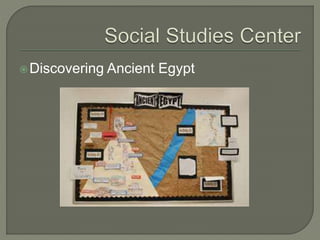
Discovering Ancient Egypt
Book Exploration
Classic Games
Map It
Website Browsing
Build Your Own Pyramid
 Books magazines will be available on the subject
of Egypt. Subjects will included pyramids,
mythology, mummification, life in the society, and
politics.
 The children can read these during our specified
“silent reading” times throughout the day (for
example, if they finish an assignment early).
 I could build in activity time while we study about
Ancient Egypt, such as, “Share with a partner one
thing you learned from the book you have been
reading. Then we will share with the class.”
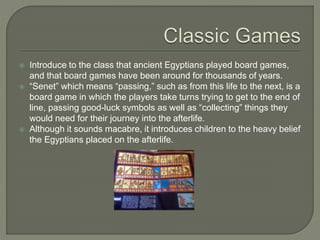
 Introduce to the class that ancient Egyptians played board games,
and that board games have been around for thousands of years.
 “Senet” which means “passing,” such as from this life to the next, is a
board game in which the players take turns trying to get to the end of
line, passing good-luck symbols as well as “collecting” things they
would need for their journey into the afterlife.
 Although it sounds macabre, it introduces children to the heavy belief
the Egyptians placed on the afterlife.
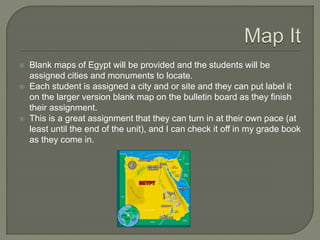
 Blank maps of Egypt will be provided and the students will be
assigned cities and monuments to locate.
 Each student is assigned a city and or site and they can put label it
on the larger version blank map on the bulletin board as they finish
their assignment.
 This is a great assignment that they can turn in at their own pace (at
least until the end of the unit), and I can check it off in my grade book
as they come in.
Let the students use laptops to explore
webquest sites, as well as other
informational sites on ancient Egypt.
Some sites can include ancient-egypt.org,
egypt.mrdonn.org, or
guardians.net/egypt/kids/index.htm, which
lists several interactive websites in one
location.
This a great activity in which the students
can construct their own paper pyramid and
design the interior images and exterior
images that would reflect their
understanding of Egyptian burial and
afterlife ceremonies.
At the end of the unit students could
showcase their pyramids for the class in a
“show and tell” style event.
Book and magazines on the subject of
Ancient Egypt (and modern Egypt, too).
Bulletin Board, as showcased in my visual
Blank maps
Laptops
Reproducible/laminated games of Senet
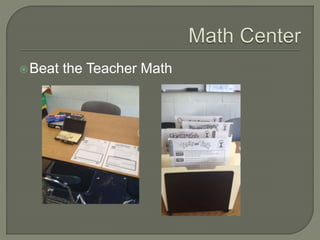
Beat the Teacher Math
Tangrams
• this is one of my favorite math activities. Not only can the kids try to solve the
manipulative, but they can also use tangram shapes to create their own art. This is one
of those math activities that can span the grades seamlessly.
Math Games
• There visual and special games available such as dominos, Mancala, Othello,
Qizmo and Tri-Onimos. These can be used for center times when all other work is
complete.
Extra Credit
• There will be several manila folders available with extra worksheets
in them that pertain to the most current lessons happening during the
core instruction, as well as several previewing sections to come. That
way if a student finishes their homework early, he or she can try and
solve problems from tomorrow’s concept.
 enVision Games
• Use games designed by the curriculum in the
classroom. For example, EnVisions offers a variety of
team and pair games that coordinate with each section
covered in the text. Those could also be available for
students to take back to their desks.
 Stump the Teacher
• Design your own problem: create several math
problems designed to stump the teacher (all questions
must have an answer before I will try to solve, hence
the “Beat the Teacher” center title). I have used this in
the past and it is quite fun as older kids try to prove
they are smarter than their teacher.
Math games such as Dominoes, Mancala,
Othello, Tri-Ominoes
enVision reproducible games
Notebook paper, pencils
Tangram sets (plastic and paper cut-outs
Turn-in station
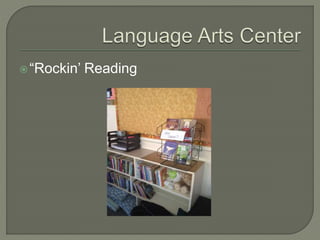
“Rockin’ Reading
 Writing Journal
• each student will have a composition notebook that they will keep
notes in about the book they are reading. The notes will require
the students to keep tract of indicating words about the setting of
the story as well as new words, words they liked or scenes that
stood out to them.
 Book Summary
• Each child will fill out a book summary after completing each book
(they must finish one 200 page book per month) and turn in the
completed sheet into a “submit” folder.
 Genre Board
• There will be a genre poster near the reading rug in which the
children can write their finished books on a post-it and place it in
the coordinating section. They must write on it who they think
would like to read the book and why (ie Molly should read this
because she loves horses).
“May I Quote You?”
• There will be a bulletin board available that the
children can post their favorite quotes from the
books they have just read.
Genre Game
• There will be a box of books that need categorized
as to what genre they belong to. The books will
rotate monthly and each student must use clues
from the text to prove which genre it is.
Bulletin Board for two activities
Blank notebook paper
Composition notebook for each child
A plethora of grade-level novels
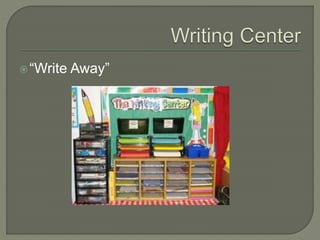
“Write Away”
 I Wonder Prompts
• Such as “I wonder what would have happened to
Katniss Everdeen if she never volunteered for tribute?”
or “I wonder which event changed Esperanza’s life the
most?” (A book my 6th graders read).
 Picture Prompts
• Using images such as Chris Van Allsburg The
Mysteries of Harris Burdick,” students can create a
story based on the picture promts. 6.W.3 Write
narratives to develop real or imagined experiences or
events using effective technique, relevant descriptive
details, and well-structured event sequences.
Add On
• A student can pick a story that is already in action and build
upon what is already typed on the prompt paper.
Slipping, Sliding, Tumbling
• Reinforcing Cause and Effect Through Diamante
Poems found on readwritethink.org, a great
activity for having poetry be present in the
classroom
Free Choice
• If a student is motivated for this activity they can
free write about anything they want.
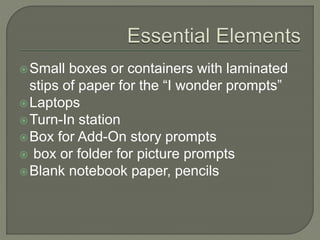
Small boxes or containers with laminated
stips of paper for the “I wonder prompts”
Laptops
Turn-In station
Box for Add-On story prompts
 box or folder for picture prompts
Blank notebook paper, pencils
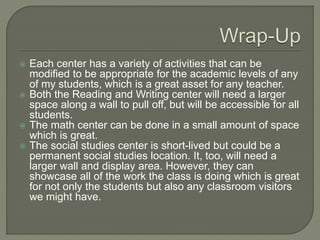
 Each center has a variety of activities that can be
modified to be appropriate for the academic levels of any
of my students, which is a great asset for any teacher.
 Both the Reading and Writing center will need a larger
space along a wall to pull off, but will be accessible for all
students.
 The math center can be done in a small amount of space
which is great.
 The social studies center is short-lived but could be a
permanent social studies location. It, too, will need a
larger wall and display area. However, they can
showcase all of the work the class is doing which is great
for not only the students but also any classroom visitors
we might have.

Learning centers 588

  • 1.
    Social Studies, Reading,Math, and Writing
  • 2.
  • 3.
    Book Exploration Classic Games MapIt Website Browsing Build Your Own Pyramid
  • 4.
     Books magazineswill be available on the subject of Egypt. Subjects will included pyramids, mythology, mummification, life in the society, and politics.  The children can read these during our specified “silent reading” times throughout the day (for example, if they finish an assignment early).  I could build in activity time while we study about Ancient Egypt, such as, “Share with a partner one thing you learned from the book you have been reading. Then we will share with the class.”
  • 5.
     Introduce tothe class that ancient Egyptians played board games, and that board games have been around for thousands of years.  “Senet” which means “passing,” such as from this life to the next, is a board game in which the players take turns trying to get to the end of line, passing good-luck symbols as well as “collecting” things they would need for their journey into the afterlife.  Although it sounds macabre, it introduces children to the heavy belief the Egyptians placed on the afterlife.
  • 6.
     Blank mapsof Egypt will be provided and the students will be assigned cities and monuments to locate.  Each student is assigned a city and or site and they can put label it on the larger version blank map on the bulletin board as they finish their assignment.  This is a great assignment that they can turn in at their own pace (at least until the end of the unit), and I can check it off in my grade book as they come in.
  • 7.
    Let the studentsuse laptops to explore webquest sites, as well as other informational sites on ancient Egypt. Some sites can include ancient-egypt.org, egypt.mrdonn.org, or guardians.net/egypt/kids/index.htm, which lists several interactive websites in one location.
  • 8.
    This a greatactivity in which the students can construct their own paper pyramid and design the interior images and exterior images that would reflect their understanding of Egyptian burial and afterlife ceremonies. At the end of the unit students could showcase their pyramids for the class in a “show and tell” style event.
  • 9.
    Book and magazineson the subject of Ancient Egypt (and modern Egypt, too). Bulletin Board, as showcased in my visual Blank maps Laptops Reproducible/laminated games of Senet
  • 10.
  • 11.
    Tangrams • this isone of my favorite math activities. Not only can the kids try to solve the manipulative, but they can also use tangram shapes to create their own art. This is one of those math activities that can span the grades seamlessly. Math Games • There visual and special games available such as dominos, Mancala, Othello, Qizmo and Tri-Onimos. These can be used for center times when all other work is complete. Extra Credit • There will be several manila folders available with extra worksheets in them that pertain to the most current lessons happening during the core instruction, as well as several previewing sections to come. That way if a student finishes their homework early, he or she can try and solve problems from tomorrow’s concept.
  • 12.
     enVision Games •Use games designed by the curriculum in the classroom. For example, EnVisions offers a variety of team and pair games that coordinate with each section covered in the text. Those could also be available for students to take back to their desks.  Stump the Teacher • Design your own problem: create several math problems designed to stump the teacher (all questions must have an answer before I will try to solve, hence the “Beat the Teacher” center title). I have used this in the past and it is quite fun as older kids try to prove they are smarter than their teacher.
  • 13.
    Math games suchas Dominoes, Mancala, Othello, Tri-Ominoes enVision reproducible games Notebook paper, pencils Tangram sets (plastic and paper cut-outs Turn-in station
  • 14.
  • 15.
     Writing Journal •each student will have a composition notebook that they will keep notes in about the book they are reading. The notes will require the students to keep tract of indicating words about the setting of the story as well as new words, words they liked or scenes that stood out to them.  Book Summary • Each child will fill out a book summary after completing each book (they must finish one 200 page book per month) and turn in the completed sheet into a “submit” folder.  Genre Board • There will be a genre poster near the reading rug in which the children can write their finished books on a post-it and place it in the coordinating section. They must write on it who they think would like to read the book and why (ie Molly should read this because she loves horses).
  • 16.
    “May I QuoteYou?” • There will be a bulletin board available that the children can post their favorite quotes from the books they have just read. Genre Game • There will be a box of books that need categorized as to what genre they belong to. The books will rotate monthly and each student must use clues from the text to prove which genre it is.
  • 17.
    Bulletin Board fortwo activities Blank notebook paper Composition notebook for each child A plethora of grade-level novels
  • 18.
  • 19.
     I WonderPrompts • Such as “I wonder what would have happened to Katniss Everdeen if she never volunteered for tribute?” or “I wonder which event changed Esperanza’s life the most?” (A book my 6th graders read).  Picture Prompts • Using images such as Chris Van Allsburg The Mysteries of Harris Burdick,” students can create a story based on the picture promts. 6.W.3 Write narratives to develop real or imagined experiences or events using effective technique, relevant descriptive details, and well-structured event sequences.
  • 20.
    Add On • Astudent can pick a story that is already in action and build upon what is already typed on the prompt paper. Slipping, Sliding, Tumbling • Reinforcing Cause and Effect Through Diamante Poems found on readwritethink.org, a great activity for having poetry be present in the classroom Free Choice • If a student is motivated for this activity they can free write about anything they want.
  • 21.
    Small boxes orcontainers with laminated stips of paper for the “I wonder prompts” Laptops Turn-In station Box for Add-On story prompts  box or folder for picture prompts Blank notebook paper, pencils
  • 22.
     Each centerhas a variety of activities that can be modified to be appropriate for the academic levels of any of my students, which is a great asset for any teacher.  Both the Reading and Writing center will need a larger space along a wall to pull off, but will be accessible for all students.  The math center can be done in a small amount of space which is great.  The social studies center is short-lived but could be a permanent social studies location. It, too, will need a larger wall and display area. However, they can showcase all of the work the class is doing which is great for not only the students but also any classroom visitors we might have.