1
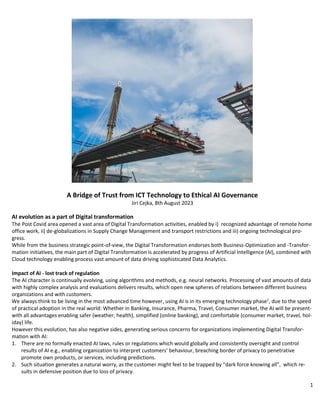
A Bridge of Trust from ICT Technology to Ethical AI Governance
Jiri Cejka, 8th August 2023
AI evolution as a part of Digital transformation
The Post Covid area opened a vast area of Digital Transformation activities, enabled by i) recognized advantage of remote home
office work, ii) de-globalizations in Supply Change Management and transport restrictions and iii) ongoing technological pro-
gress.
While from the business strategic point-of-view, the Digital Transformation endorses both Business-Optimization and -Transfor-
mation initiatives, the main part of Digital Transformation is accelerated by progress of Artificial Intelligence (AI), combined with
Cloud technology enabling process vast amount of data driving sophisticated Data Analytics.
Impact of AI - lost track of regulation
The AI character is continually evolving, using algorithms and methods, e.g. neural networks. Processing of vast amounts of data
with highly complex analysis and evaluations delivers results, which open new spheres of relations between different business
organizations and with customers.
We always think to be living in the most advanced time however, using AI is in its emerging technology phase1
, due to the speed
of practical adoption in the real world: Whether in Banking, Insurance, Pharma, Travel, Consumer market, the AI will be present-
with all advantages enabling safer (weather, health), simplified (online banking), and comfortable (consumer market, travel, hol-
iday) life.
However this evolution, has also negative sides, generating serious concerns for organizations implementing Digital Transfor-
mation with AI:
1. There are no formally enacted AI laws, rules or regulations which would globally and consistently oversight and control
results of AI e.g., enabling organization to interpret customers’ behaviour, breaching border of privacy to penetrative
promote own products, or services, including predictions.
2. Such situation generates a natural worry, as the customer might feel to be trapped by “dark force knowing all”, which re-
sults in defensive position due to loss of privacy.
2
The personal data law(s) are protecting basic privacy information however, only to certain level, as the level of information being
processed by AI enables results having much bigger impact, based on “hidden AI functionalities”.
Involvement of AI –long way to be establish rules
Rapid adoption of AI by business in Digital Transformation and technology advances causes lawless “Wild-West” situation.
To protect the basic human rights of democracy, freedom, and privacy, regulated usage of AI will have to established.
Many activities were started on regional, e.g. European2
or business finance3
levels proposing to formulate controlling govern-
ance structures for AI and Ethic, e.g. specifying global AI frameworks, publishing recommendations4
or even specifying policies
or high-level guidelines.
However, a standardized global AI governance framework, based on specified and formally agreed enacted Ethic regulation rules
does not exist yet. Worse than ever, it may not come in the short term. Studies estimate that in advanced countries 2-3 years
will be needed to build such widely enacted legislations5
.
Such situation makes a difficult life to Risk Management and Audit in the 2nd
and 3rd
LoD (Line of Defense):
“How to measure Risks where ICT know-how incl. Development, Operation management, Sustainability are core required com-
petencies, moreover with current Audit standards not embedding AI main areas6
?”
Threat of missing Ethic regulations and standard Framework recognized
Advanced organizations have recognized the negative impact and threat of regulatory gap, while grasping the seriousness of
customer’s worry about loss of transparency and fairness, resulting in risk of potential client loss. Insurances as logical leaders,
followed by banks started to implement own Digital Transformation Ethics models and Frameworks for AI Governance proac-
tively: To provide customer necessary trust with transparency and proof of righteous handling of customer’s relevant data, with
consent and meaningfully.
Ethics based Framework structure for AI
The creation of trustworthy AI environment has critical importance as the risk goes beyond reputation and customer satisfac-
tion. Trustworthy AI should be:
• Lawful, complying with all applicable laws and regulations
• Ethical, ensuring adherence to ethical principles and values and
• Robust, both from a technical and social perspective as AI systems can cause unintentional harm
Praxis recognizes four ethical principles:
1. respect for human autonomy
2. prevention of harm
3. fairness and
4. explicability.
which are instantiated by Ethic Governance into:
1. Fairness — ensuring AI systems are Ethical , free from bias, free from prejudice and that protected attributes are not being used.
2. Explain ability — transparency through understanding the algorithmic decision-making process in simple terms
3. Integrity — algorithm integrity and data validity including lineage and appropriateness of how data is used
4. Resilience — technical robustness and compliance of your AI and its agility across platforms and resistance against bad actors.
Two major factors influence the implementation of Ethic Governance framework:
• Pressure with speed to market implementing AI driven solution
• Decisive importance of technology, independent of AI business character role.
ICT challenge - EPAM supportive role
To achieve transparent compliant Digital Transformation with AI, the Ethic Governance Framework must encompass technology-
enabled methods and ICT specifics. This combination can cause a significant burden for the organizations, as the build-up of such
governance framework is domain of 2nd
LoD (Line of Defence) or Business-responsible, often supported by management consul-
tancy companies or Big 4th
- all lacking required technology experience and ICT know-how.
3
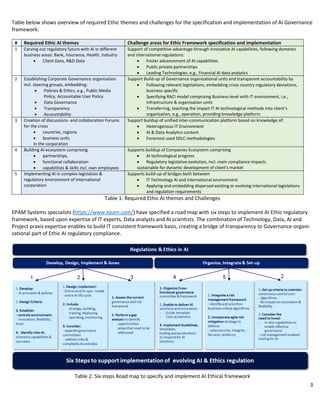
Table below shows overview of required Ethic themes and challenges for the specification and implementation of AI Governance
framework:
# Required Ethic AI themes Challenge areas for Ethic Framework specification and implementation
1 Carving out regulatory future with AI in different
business areas: Bank, Insurance, Health, Industry
• Client Data, R&D Data
Support of competitive advantage through innovative AI capabilities, following domestic
and international regulations:
• Foster advancement of AI capabilities
• Public private partnerships
• Leading Technologies, e.g., Financial AI data analytics
2 Establishing Corporate Governance organisation
incl. steering groups, embedding:
• Policies & Ethics, e.g., Public Media
Policy, Accountable User Policy
• Data Governance
• Transparency
• Accountability
Support Build-up of Governance organizational units and transparent accountability by
• Following relevant legislations, embedding cross country regulatory deviations,
business specific
• Specifying RACI model comprising Business-level with IT environment, i.e.,
Infrastructure & organisation units
• Transferring, teaching the impact IT AI technological methods into client’s
organisation, e.g., operation, providing knowledge platform
3 Creation of discussions- and collaboration Forums
for the cross
• countries, regions
• business units
in the corporation
Support buildup of unified inter-communication platform based on knowledge of:
• Heterogenous IT Environment
• AI & Data Analytics content
• Foremost used SDLC methodologies
4 Building AI ecosystem comprising
• partnerships,
• functional collaboration
• capabilities & skills incl. own employees
Supports buildup of Companies Ecosystem comprising
• AI technological progress
• Regulatory legislative evolution, incl. main compliance impacts
sustainable for dynamic development of client’s market
5 Implementing AI in complex legislation &
regulatory environment of international
corporation
Supports build-up of bridges both between
• IT Technology AI and international environment
• Applying and embedding dispersed existing or evolving international legislations
and regulation requirements
Table 1: Required Ethic AI themes and Challenges
EPAM Systems specialists (https://www.epam.com/) have specified a road map with six steps to implement AI Ethic regulatory
framework, based upon expertise of IT experts, Data analysts and AI scientists. The combination of Technology, Data, AI and
Project praxis expertise enables to build IT consistent framework basis, creating a bridge of transparency to Governance-organi-
zational part of Ethic AI regulatory compliance.
Table 2: Six steps Road map to specify and implement AI Ethical framework
4
Summary
The ongoing evolutionary process of Digital Transformation with AI, Algorithms and Data Analytics development, endorsed by
speedy technology evolution, enables immense progress in human history.
However, it also generates high responsibility and risks for loss of privacy, democracy, freedom, and privacy.
It is the responsibility of organizations, regulatory bodies, and whole human society to be aware of the risks to open recklessly
the evil part of Pandora-box.
To build and to implement Ecosystems of Digital trust based on standardised AI Framework will be one of our biggest challenges
in the next future, combined with evoking awareness and self-wisdom of individuals – on the whole planet.
Endnotes
1
“The AI Revolution: The Road to Superintelligence”, Tim Urban, January 22, 2015
https://waitbutwhy.com/2015/01/artificial-intelligence-revolution-1.html
“The Future of Mobility 2040”, Spark Labs, ETH Zurich, Baloise Group, January 2020
https://www.baloise.com/dam/baloise-com/documents/en/stories/the-future-of-mobility.pdf
“The Managing AI in the Enterprise”, Klaus Haller Security Architect AXA, 17.12.2021
https://www.orellfuessli.ch/shop/home/artikeldetails/A1062196035
2
“Proposal “Artificial Intelligence Act”, European Commission Brussels, 14 June 2023 finalised, the earliest expected adoption: 2025
https://www.europarl.europa.eu/doceo/document/TA-9-2023-0236_EN.pdf
“Ethic Guidelines for trustworthy AI”; European Commission, 8 April 2019
https://ec.europa.eu/futurium/en/ai-alliance-consultation.1.html
The OECD Framework for Classifying AI Systems to assess policy challenges and ensure international standards in AI; OECD, February 17, 2022
https://oecd.ai/en/wonk/classification
“MAS Partners Financial Industry to Create Framework for Responsible Use of AI”; The Monetary Authority of Singapore (MAS) 13 November
2019
3
https://www.mas.gov.sg/news/media-releases/2019/mas-partners-financial-industry-to-create-framework-for-responsible-use-of-ai
4
“Recommendation on the ethics of artificial intelligence”; UNESCO, 24th November 2021
https://unesdoc.unesco.org/ark:/48223/pf0000380455
5
The shape of AI governance to come; page 12; KPMG, 2020/12
https://assets.kpmg/content/dam/kpmg/xx/pdf/2021/01/the-shape-of-ai-governance-to-come.pdf
6
Position paper “Auditing a Digital Insurance World” Artificial Intelligence and Machine Learning Audits within Insurance Firms, ECIIA; June
2023
https://www.eciia.eu/wp-content/uploads/2023/06/Auditing-a-Digital-Insurance-World.pdf

Written-Blog_Ethic_AI_08Aug23_pub_jce.pdf

  • 1.
    1 A Bridge ofTrust from ICT Technology to Ethical AI Governance Jiri Cejka, 8th August 2023 AI evolution as a part of Digital transformation The Post Covid area opened a vast area of Digital Transformation activities, enabled by i) recognized advantage of remote home office work, ii) de-globalizations in Supply Change Management and transport restrictions and iii) ongoing technological pro- gress. While from the business strategic point-of-view, the Digital Transformation endorses both Business-Optimization and -Transfor- mation initiatives, the main part of Digital Transformation is accelerated by progress of Artificial Intelligence (AI), combined with Cloud technology enabling process vast amount of data driving sophisticated Data Analytics. Impact of AI - lost track of regulation The AI character is continually evolving, using algorithms and methods, e.g. neural networks. Processing of vast amounts of data with highly complex analysis and evaluations delivers results, which open new spheres of relations between different business organizations and with customers. We always think to be living in the most advanced time however, using AI is in its emerging technology phase1 , due to the speed of practical adoption in the real world: Whether in Banking, Insurance, Pharma, Travel, Consumer market, the AI will be present- with all advantages enabling safer (weather, health), simplified (online banking), and comfortable (consumer market, travel, hol- iday) life. However this evolution, has also negative sides, generating serious concerns for organizations implementing Digital Transfor- mation with AI: 1. There are no formally enacted AI laws, rules or regulations which would globally and consistently oversight and control results of AI e.g., enabling organization to interpret customers’ behaviour, breaching border of privacy to penetrative promote own products, or services, including predictions. 2. Such situation generates a natural worry, as the customer might feel to be trapped by “dark force knowing all”, which re- sults in defensive position due to loss of privacy.
  • 2.
    2 The personal datalaw(s) are protecting basic privacy information however, only to certain level, as the level of information being processed by AI enables results having much bigger impact, based on “hidden AI functionalities”. Involvement of AI –long way to be establish rules Rapid adoption of AI by business in Digital Transformation and technology advances causes lawless “Wild-West” situation. To protect the basic human rights of democracy, freedom, and privacy, regulated usage of AI will have to established. Many activities were started on regional, e.g. European2 or business finance3 levels proposing to formulate controlling govern- ance structures for AI and Ethic, e.g. specifying global AI frameworks, publishing recommendations4 or even specifying policies or high-level guidelines. However, a standardized global AI governance framework, based on specified and formally agreed enacted Ethic regulation rules does not exist yet. Worse than ever, it may not come in the short term. Studies estimate that in advanced countries 2-3 years will be needed to build such widely enacted legislations5 . Such situation makes a difficult life to Risk Management and Audit in the 2nd and 3rd LoD (Line of Defense): “How to measure Risks where ICT know-how incl. Development, Operation management, Sustainability are core required com- petencies, moreover with current Audit standards not embedding AI main areas6 ?” Threat of missing Ethic regulations and standard Framework recognized Advanced organizations have recognized the negative impact and threat of regulatory gap, while grasping the seriousness of customer’s worry about loss of transparency and fairness, resulting in risk of potential client loss. Insurances as logical leaders, followed by banks started to implement own Digital Transformation Ethics models and Frameworks for AI Governance proac- tively: To provide customer necessary trust with transparency and proof of righteous handling of customer’s relevant data, with consent and meaningfully. Ethics based Framework structure for AI The creation of trustworthy AI environment has critical importance as the risk goes beyond reputation and customer satisfac- tion. Trustworthy AI should be: • Lawful, complying with all applicable laws and regulations • Ethical, ensuring adherence to ethical principles and values and • Robust, both from a technical and social perspective as AI systems can cause unintentional harm Praxis recognizes four ethical principles: 1. respect for human autonomy 2. prevention of harm 3. fairness and 4. explicability. which are instantiated by Ethic Governance into: 1. Fairness — ensuring AI systems are Ethical , free from bias, free from prejudice and that protected attributes are not being used. 2. Explain ability — transparency through understanding the algorithmic decision-making process in simple terms 3. Integrity — algorithm integrity and data validity including lineage and appropriateness of how data is used 4. Resilience — technical robustness and compliance of your AI and its agility across platforms and resistance against bad actors. Two major factors influence the implementation of Ethic Governance framework: • Pressure with speed to market implementing AI driven solution • Decisive importance of technology, independent of AI business character role. ICT challenge - EPAM supportive role To achieve transparent compliant Digital Transformation with AI, the Ethic Governance Framework must encompass technology- enabled methods and ICT specifics. This combination can cause a significant burden for the organizations, as the build-up of such governance framework is domain of 2nd LoD (Line of Defence) or Business-responsible, often supported by management consul- tancy companies or Big 4th - all lacking required technology experience and ICT know-how.
  • 3.
    3 Table below showsoverview of required Ethic themes and challenges for the specification and implementation of AI Governance framework: # Required Ethic AI themes Challenge areas for Ethic Framework specification and implementation 1 Carving out regulatory future with AI in different business areas: Bank, Insurance, Health, Industry • Client Data, R&D Data Support of competitive advantage through innovative AI capabilities, following domestic and international regulations: • Foster advancement of AI capabilities • Public private partnerships • Leading Technologies, e.g., Financial AI data analytics 2 Establishing Corporate Governance organisation incl. steering groups, embedding: • Policies & Ethics, e.g., Public Media Policy, Accountable User Policy • Data Governance • Transparency • Accountability Support Build-up of Governance organizational units and transparent accountability by • Following relevant legislations, embedding cross country regulatory deviations, business specific • Specifying RACI model comprising Business-level with IT environment, i.e., Infrastructure & organisation units • Transferring, teaching the impact IT AI technological methods into client’s organisation, e.g., operation, providing knowledge platform 3 Creation of discussions- and collaboration Forums for the cross • countries, regions • business units in the corporation Support buildup of unified inter-communication platform based on knowledge of: • Heterogenous IT Environment • AI & Data Analytics content • Foremost used SDLC methodologies 4 Building AI ecosystem comprising • partnerships, • functional collaboration • capabilities & skills incl. own employees Supports buildup of Companies Ecosystem comprising • AI technological progress • Regulatory legislative evolution, incl. main compliance impacts sustainable for dynamic development of client’s market 5 Implementing AI in complex legislation & regulatory environment of international corporation Supports build-up of bridges both between • IT Technology AI and international environment • Applying and embedding dispersed existing or evolving international legislations and regulation requirements Table 1: Required Ethic AI themes and Challenges EPAM Systems specialists (https://www.epam.com/) have specified a road map with six steps to implement AI Ethic regulatory framework, based upon expertise of IT experts, Data analysts and AI scientists. The combination of Technology, Data, AI and Project praxis expertise enables to build IT consistent framework basis, creating a bridge of transparency to Governance-organi- zational part of Ethic AI regulatory compliance. Table 2: Six steps Road map to specify and implement AI Ethical framework
  • 4.
    4 Summary The ongoing evolutionaryprocess of Digital Transformation with AI, Algorithms and Data Analytics development, endorsed by speedy technology evolution, enables immense progress in human history. However, it also generates high responsibility and risks for loss of privacy, democracy, freedom, and privacy. It is the responsibility of organizations, regulatory bodies, and whole human society to be aware of the risks to open recklessly the evil part of Pandora-box. To build and to implement Ecosystems of Digital trust based on standardised AI Framework will be one of our biggest challenges in the next future, combined with evoking awareness and self-wisdom of individuals – on the whole planet. Endnotes 1 “The AI Revolution: The Road to Superintelligence”, Tim Urban, January 22, 2015 https://waitbutwhy.com/2015/01/artificial-intelligence-revolution-1.html “The Future of Mobility 2040”, Spark Labs, ETH Zurich, Baloise Group, January 2020 https://www.baloise.com/dam/baloise-com/documents/en/stories/the-future-of-mobility.pdf “The Managing AI in the Enterprise”, Klaus Haller Security Architect AXA, 17.12.2021 https://www.orellfuessli.ch/shop/home/artikeldetails/A1062196035 2 “Proposal “Artificial Intelligence Act”, European Commission Brussels, 14 June 2023 finalised, the earliest expected adoption: 2025 https://www.europarl.europa.eu/doceo/document/TA-9-2023-0236_EN.pdf “Ethic Guidelines for trustworthy AI”; European Commission, 8 April 2019 https://ec.europa.eu/futurium/en/ai-alliance-consultation.1.html The OECD Framework for Classifying AI Systems to assess policy challenges and ensure international standards in AI; OECD, February 17, 2022 https://oecd.ai/en/wonk/classification “MAS Partners Financial Industry to Create Framework for Responsible Use of AI”; The Monetary Authority of Singapore (MAS) 13 November 2019 3 https://www.mas.gov.sg/news/media-releases/2019/mas-partners-financial-industry-to-create-framework-for-responsible-use-of-ai 4 “Recommendation on the ethics of artificial intelligence”; UNESCO, 24th November 2021 https://unesdoc.unesco.org/ark:/48223/pf0000380455 5 The shape of AI governance to come; page 12; KPMG, 2020/12 https://assets.kpmg/content/dam/kpmg/xx/pdf/2021/01/the-shape-of-ai-governance-to-come.pdf 6 Position paper “Auditing a Digital Insurance World” Artificial Intelligence and Machine Learning Audits within Insurance Firms, ECIIA; June 2023 https://www.eciia.eu/wp-content/uploads/2023/06/Auditing-a-Digital-Insurance-World.pdf