Fundamentals	
  of	
  western	
  music	
  
theory	
  
Can	
  we	
  learn	
  by	
  crea6ng	
  a	
  code	
  model?	
  
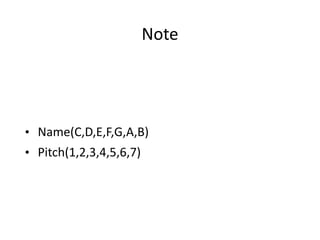
Note	
  
• Name(C,D,E,F,G,A,B)	
  
• Pitch(1,2,3,4,5,6,7)	
  
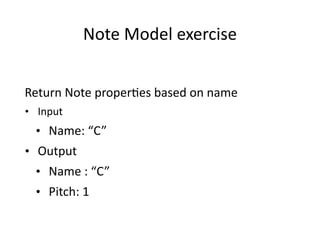
Note	
  Model	
  exercise	
  
Return	
  Note	
  proper6es	
  based	
  on	
  name	
  
• Input	
  
• Name:	
  “C”	
  
• Output	
  
• Name	
  :	
  “C”	
  
• Pitch:	
  1	
  
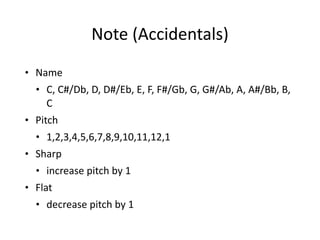
Note	
  (Accidentals)
• Name	
  
• C,	
  C#/Db,	
  D,	
  D#/Eb,	
  E,	
  F,	
  F#/Gb,	
  G,	
  G#/Ab,	
  A,	
  A#/Bb,	
  B,	
  
C	
  
• Pitch	
  
• 1,2,3,4,5,6,7,8,9,10,11,12,1
• Sharp	
  	
  
• increase	
  pitch	
  by	
  1	
  
• Flat	
  	
  
• decrease	
  pitch	
  by	
  1
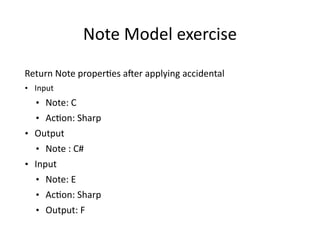
Note	
  Model	
  exercise	
  
Return	
  Note	
  proper6es	
  aZer	
  applying	
  accidental	
  	
  
• Input	
  
• Note:	
  C	
  
• Ac6on:	
  Sharp
• Output	
  
• Note	
  :	
  C#	
  
• Input	
  
• Note:	
  E	
  
• Ac6on:	
  Sharp	
  
• Output:	
  F
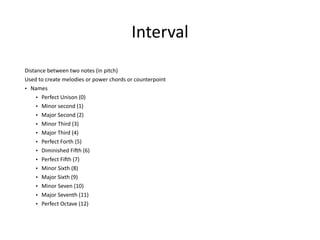
Interval

Distance	
  between	
  two	
  notes	
  (in	
  pitch)	
  
Used	
  to	
  create	
  melodies	
  or	
  power	
  chords	
  or	
  counterpoint	
  
• Names	
  
• Perfect	
  Unison	
  (0)	
  
• Minor	
  second	
  (1)	
  
• Major	
  Second	
  (2)	
  
• Minor	
  Third	
  (3)	
  
• Major	
  Third	
  (4)	
  
• Perfect	
  Forth	
  (5)	
  
• Diminished	
  FiZh	
  (6)	
  
• Perfect	
  FiZh	
  (7)	
  
• Minor	
  Sixth	
  (8)	
  
• Major	
  Sixth	
  (9)	
  
• Minor	
  Seven	
  (10)	
  
• Major	
  Seventh	
  (11)	
  
• Perfect	
  Octave	
  (12)	
  
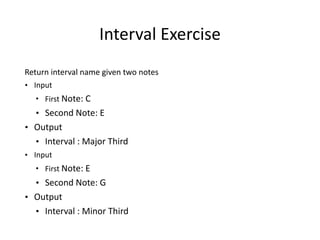
Interval	
  Exercise	
  
Return	
  interval	
  name	
  given	
  two	
  notes	


• Input	
  
• First	
  Note:	
  C	
  
• Second	
  Note:	
  E
• Output	
  
• Interval	
  :	
  Major	
  Third	
  
• Input	
  
• First	
  Note:	
  E	
  
• Second	
  Note:	
  G
• Output	
  
• Interval	
  :	
  Minor	
  Third
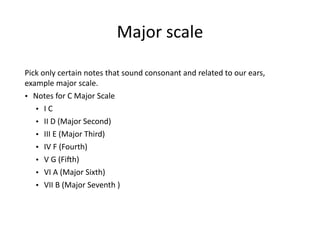
Major	
  scale

Pick	
  only	
  certain	
  notes	
  that	
  sound	
  consonant	
  and	
  related	
  to	
  our	
  ears,	
  
example	
  major	
  scale.	
  
• Notes	
  for	
  C	
  Major	
  Scale	
  
• I	
  C	
  
• II	
  D	
  (Major	
  Second)	
  
• III	
  E	
  (Major	
  Third)	
  
• IV	
  F	
  (Fourth)	
  
• V	
  G	
  (FiZh)	
  
• VI	
  A	
  (Major	
  Sixth)	
  
• VII	
  B	
  (Major	
  Seventh	
  )	
  
Major	
  scale	
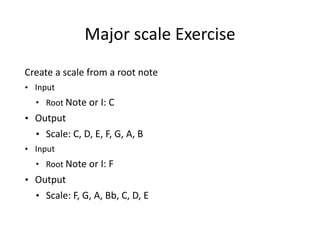
  Exercise	
  
Create	
  a	
  scale	
  from	
  a	
  root	
  note	


• Input	
  
• Root	
  Note	
  or	
  I:	
  C
• Output	
  
• Scale:	
  C,	
  D,	
  E,	
  F,	
  G,	
  A,	
  B	
  
• Input	
  
• Root	
  Note	
  or	
  I:	
  F
• Output	
  
• Scale:	
  F,	
  G,	
  A,	
  Bb,	
  C,	
  D,	
  E	
  
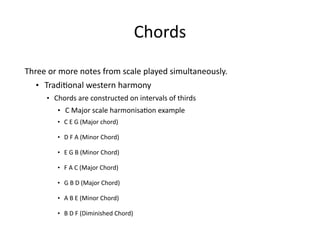
Chords

Three	
  or	
  more	
  notes	
  from	
  scale	
  played	
  simultaneously.	
  
• Tradi6onal	
  western	
  harmony	
  
• Chords	
  are	
  constructed	
  on	
  intervals	
  of	
  thirds	
  	
  
• C	
  Major	
  scale	
  harmonisa6on	
  example
• C	
  E	
  G	
  (Major	
  chord)	
  
• D	
  F	
  A	
  (Minor	
  Chord)	
  
• E	
  G	
  B	
  (Minor	
  Chord)	
  
• F	
  A	
  C	
  (Major	
  Chord)	
  
• G	
  B	
  D	
  (Major	
  Chord)	
  
• A	
  B	
  E	
  (Minor	
  Chord)	
  
• B	
  D	
  F	
  (Diminished	
  Chord)
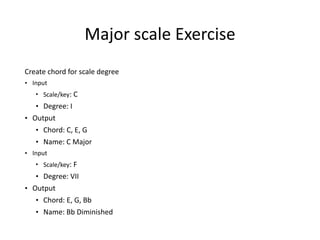
Major	
  scale	
  Exercise	
  
Create	
  chord	
  for	
  scale	
  degree	


• Input	
  
• Scale/key:	
  C	
  
• Degree:	
  I
• Output	
  
• Chord:	
  C,	
  E,	
  G	
  
• Name:	
  C	
  Major	
  
• Input	
  
• Scale/key:	
  F	
  
• Degree:	
  VII
• Output	
  
• Chord:	
  E,	
  G,	
  Bb	
  
• Name:	
  Bb	
  Diminished

Learn music theory by coding it

  • 1.
    Fundamentals  of  western  music   theory   Can  we  learn  by  crea6ng  a  code  model?  
  • 2.
    Note   • Name(C,D,E,F,G,A,B)   • Pitch(1,2,3,4,5,6,7)  
  • 3.
    Note  Model  exercise   Return  Note  proper6es  based  on  name   • Input   • Name:  “C”   • Output   • Name  :  “C”   • Pitch:  1  
  • 4.
    Note  (Accidentals) • Name   • C,  C#/Db,  D,  D#/Eb,  E,  F,  F#/Gb,  G,  G#/Ab,  A,  A#/Bb,  B,   C   • Pitch   • 1,2,3,4,5,6,7,8,9,10,11,12,1 • Sharp     • increase  pitch  by  1   • Flat     • decrease  pitch  by  1
  • 5.
    Note  Model  exercise   Return  Note  proper6es  aZer  applying  accidental     • Input   • Note:  C   • Ac6on:  Sharp • Output   • Note  :  C#   • Input   • Note:  E   • Ac6on:  Sharp   • Output:  F
  • 6.
    Interval
 Distance  between  two  notes  (in  pitch)   Used  to  create  melodies  or  power  chords  or  counterpoint   • Names   • Perfect  Unison  (0)   • Minor  second  (1)   • Major  Second  (2)   • Minor  Third  (3)   • Major  Third  (4)   • Perfect  Forth  (5)   • Diminished  FiZh  (6)   • Perfect  FiZh  (7)   • Minor  Sixth  (8)   • Major  Sixth  (9)   • Minor  Seven  (10)   • Major  Seventh  (11)   • Perfect  Octave  (12)  
  • 7.
    Interval  Exercise   Return  interval  name  given  two  notes       • Input   • First  Note:  C   • Second  Note:  E • Output   • Interval  :  Major  Third   • Input   • First  Note:  E   • Second  Note:  G • Output   • Interval  :  Minor  Third
  • 8.
    Major  scale
 Pick  only  certain  notes  that  sound  consonant  and  related  to  our  ears,   example  major  scale.   • Notes  for  C  Major  Scale   • I  C   • II  D  (Major  Second)   • III  E  (Major  Third)   • IV  F  (Fourth)   • V  G  (FiZh)   • VI  A  (Major  Sixth)   • VII  B  (Major  Seventh  )  
  • 9.
    Major  scale  Exercise   Create  a  scale  from  a  root  note         • Input   • Root  Note  or  I:  C • Output   • Scale:  C,  D,  E,  F,  G,  A,  B   • Input   • Root  Note  or  I:  F • Output   • Scale:  F,  G,  A,  Bb,  C,  D,  E  
  • 10.
    Chords
 Three  or  more  notes  from  scale  played  simultaneously.   • Tradi6onal  western  harmony   • Chords  are  constructed  on  intervals  of  thirds     • C  Major  scale  harmonisa6on  example • C  E  G  (Major  chord)   • D  F  A  (Minor  Chord)   • E  G  B  (Minor  Chord)   • F  A  C  (Major  Chord)   • G  B  D  (Major  Chord)   • A  B  E  (Minor  Chord)   • B  D  F  (Diminished  Chord)
  • 11.
    Major  scale  Exercise   Create  chord  for  scale  degree       • Input   • Scale/key:  C   • Degree:  I • Output   • Chord:  C,  E,  G   • Name:  C  Major   • Input   • Scale/key:  F   • Degree:  VII • Output   • Chord:  E,  G,  Bb   • Name:  Bb  Diminished