http://www.bized.co.uk
Copyright 2007 – Biz/ed
WHO IS A LEADER ?
"a person who influences a group of people
towards the achievement of a goal".
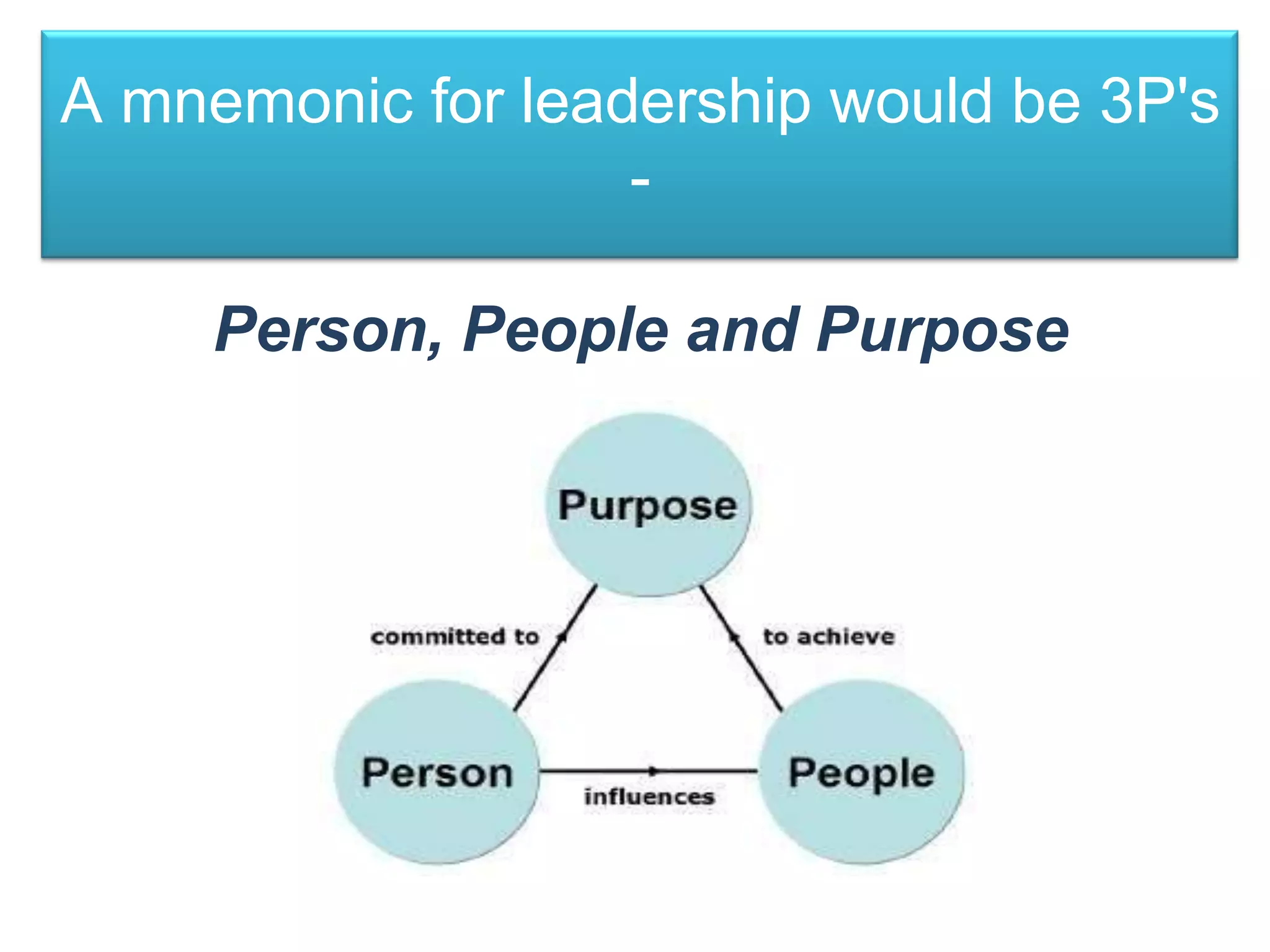
A mnemonic for leadership would be 3P's
-
Person, People and Purpose
PERSON
Is leadership a position of office or
authority?
Or,
Is leadership an ability in the sense that
he is a leader because he leads?
NO…..
A leader by its meaning is one who goes
first and leads by example, so that
others are motivated to follow him.
To be a leader, a person must have a
deep- rooted commitment to the goal
that he will
strive to achieve it even if nobody follows
him!
PURPOSE
A requirement for leadership is personal vision - the ability
to visualize your goal as an accomplished
fact; a thing already achieved.
“
Why are some individuals more effective than
others at influencing people?
Effectiveness in leadership has been
attributed to
(1)Persuasion-Panghihikayat
skills,
(2)leadership styles and
(3)personal attributes-Katangian
of the leader.
PEOPLE
To be a leader, one must have followers.
To have followers, one must have their
trust.
How do you win their trust? Why would
others trust you?
Most important, are you worthy of their
trust?
http://www.bized.co.uk
Copyright 2007 – Biz/ed
• T - - - - T o g e t h e r
• E - - - - E v e r y o n e
• A - - - - A c h i e v e s
• M - - - - M o r e
9
http://www.bized.co.uk
Copyright 2007 – Biz/ed
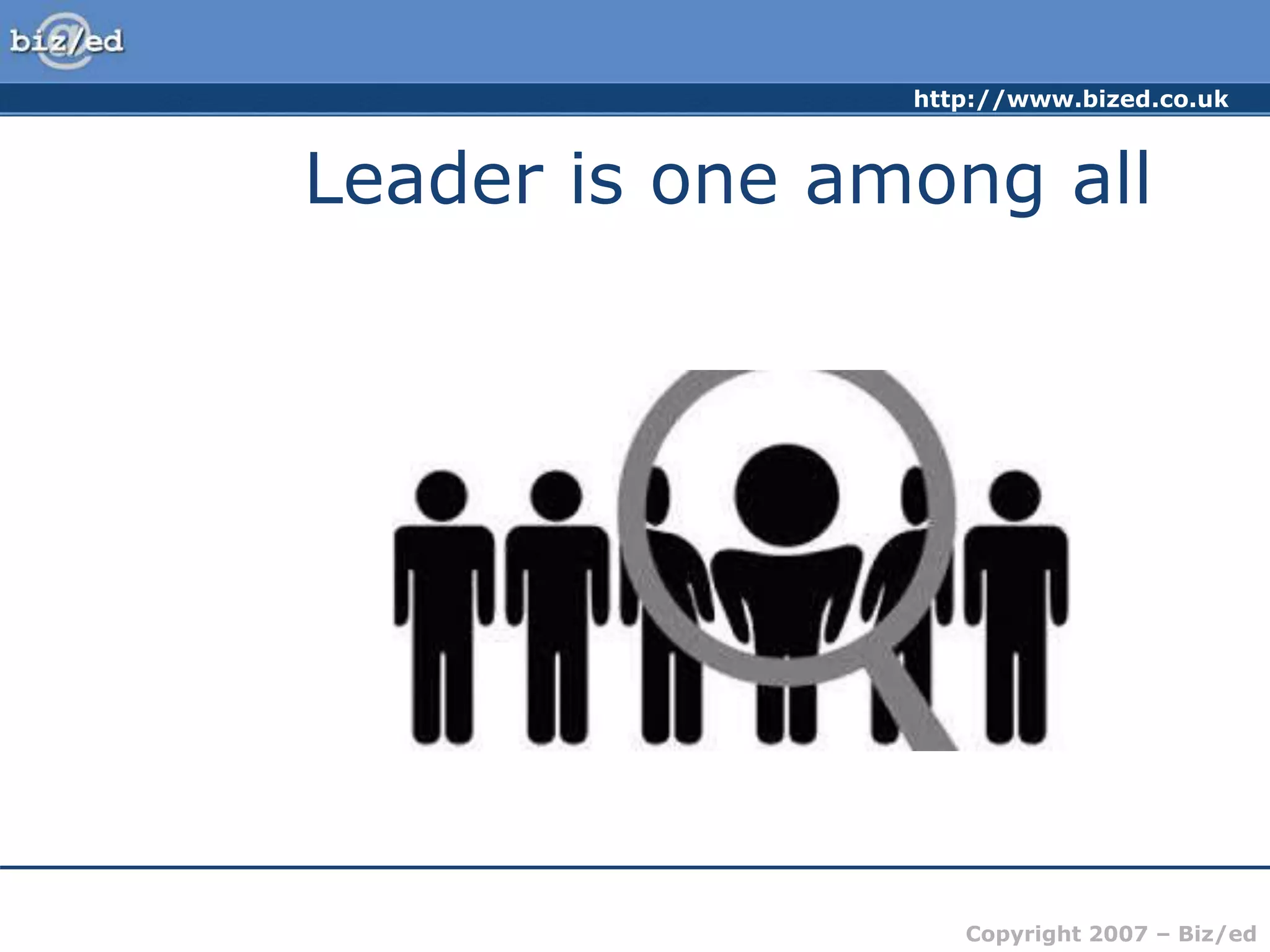
Leader is one among all
http://www.bized.co.uk
Copyright 2007 – Biz/ed
http://www.bized.co.uk
Copyright 2007 – Biz/ed
Leadership - what is it?
“influencing people so that they
will strive willingly towards the
achievement of group goals” 1
As a leader you can never say thank you
enough, but even more important is
the idea of serving the people you are
leading.
“Being a leader can be a very humbling
experience.”
http://www.bized.co.uk
Copyright 2007 – Biz/ed
Conceptions of Leadership:
• Exercising power.
• Gaining and exercising the privileges
of high status.
• Being the boss.
• Task orientation.
• Taking care of people.
• Empowerment.
• Providing moral leadership.
• Providing and working toward a vision.
http://www.bized.co.uk
Copyright 2007 – Biz/ed
What is leadership style?
Leaders’ styles encompass how they relate to
others within and outside the organization,
how they view themselves and their position,
and—to a large extent—whether or not they
are successful as leaders.
http://www.bized.co.uk
Copyright 2007 – Biz/ed
Origins of leadership
– BOTH. Evidence that both inherent
personality and environment are
factors
Are leaders born or made?
What kind of leader would you be?
http://www.bized.co.uk
Copyright 2007 – Biz/ed
Boss versus Leader
Are a boss and leader
always the same?
Think about a boss, and think about a leader.
16
http://www.bized.co.uk
Copyright 2007 – Biz/ed
Types of Leadership Style
• Autocratic:
– Leader makes decisions without reference
to anyone else
– High degree of dependency on the leader
– Can create de-motivation and alienation
of staff
– May be valuable in some types of business
where decisions need to be made quickly
and decisively
http://www.bized.co.uk
Copyright 2007 – Biz/ed
Types of Leadership Style
• Democratic:
• Encourages decision making
from different perspectives – leadership
may be emphasised throughout
the organisation
– Consultative: process of consultation before
decisions are taken
– Persuasive: Leader takes decision and seeks
to persuade others that the decision
is correct
http://www.bized.co.uk
Copyright 2007 – Biz/ed
Types of Leadership Style
• Democratic:
– May help motivation and involvement
– Workers feel ownership of the firm
and its ideas
– Improves the sharing of ideas
and experiences within the business
– Can delay decision making
http://www.bized.co.uk
Copyright 2007 – Biz/ed
Types of Leadership Style
• Laissez-Faire:
– ‘Let it be’ – the leadership responsibilities
are shared by all
– Can be very useful in businesses
where creative ideas are important
– Can be highly motivational,
as people have control over their working life
– Can make coordination and decision making
time-consuming and lacking in overall direction
– Relies on good team work
– Relies on good interpersonal relations
http://www.bized.co.uk
Copyright 2007 – Biz/ed

Leadership-ppt.ppt

  • 1.
  • 2.
    WHO IS ALEADER ? "a person who influences a group of people towards the achievement of a goal".
  • 3.
    A mnemonic forleadership would be 3P's - Person, People and Purpose
  • 4.
    PERSON Is leadership aposition of office or authority? Or, Is leadership an ability in the sense that he is a leader because he leads?
  • 5.
    NO….. A leader byits meaning is one who goes first and leads by example, so that others are motivated to follow him. To be a leader, a person must have a deep- rooted commitment to the goal that he will strive to achieve it even if nobody follows him!
  • 6.
    PURPOSE A requirement forleadership is personal vision - the ability to visualize your goal as an accomplished fact; a thing already achieved. “
  • 7.
    Why are someindividuals more effective than others at influencing people? Effectiveness in leadership has been attributed to (1)Persuasion-Panghihikayat skills, (2)leadership styles and (3)personal attributes-Katangian of the leader.
  • 8.
    PEOPLE To be aleader, one must have followers. To have followers, one must have their trust. How do you win their trust? Why would others trust you? Most important, are you worthy of their trust?
  • 9.
    http://www.bized.co.uk Copyright 2007 –Biz/ed • T - - - - T o g e t h e r • E - - - - E v e r y o n e • A - - - - A c h i e v e s • M - - - - M o r e 9
  • 10.
    http://www.bized.co.uk Copyright 2007 –Biz/ed Leader is one among all
  • 11.
  • 12.
    http://www.bized.co.uk Copyright 2007 –Biz/ed Leadership - what is it? “influencing people so that they will strive willingly towards the achievement of group goals” 1 As a leader you can never say thank you enough, but even more important is the idea of serving the people you are leading. “Being a leader can be a very humbling experience.”
  • 13.
    http://www.bized.co.uk Copyright 2007 –Biz/ed Conceptions of Leadership: • Exercising power. • Gaining and exercising the privileges of high status. • Being the boss. • Task orientation. • Taking care of people. • Empowerment. • Providing moral leadership. • Providing and working toward a vision.
  • 14.
    http://www.bized.co.uk Copyright 2007 –Biz/ed What is leadership style? Leaders’ styles encompass how they relate to others within and outside the organization, how they view themselves and their position, and—to a large extent—whether or not they are successful as leaders.
  • 15.
    http://www.bized.co.uk Copyright 2007 –Biz/ed Origins of leadership – BOTH. Evidence that both inherent personality and environment are factors Are leaders born or made? What kind of leader would you be?
  • 16.
    http://www.bized.co.uk Copyright 2007 –Biz/ed Boss versus Leader Are a boss and leader always the same? Think about a boss, and think about a leader. 16
  • 17.
    http://www.bized.co.uk Copyright 2007 –Biz/ed Types of Leadership Style • Autocratic: – Leader makes decisions without reference to anyone else – High degree of dependency on the leader – Can create de-motivation and alienation of staff – May be valuable in some types of business where decisions need to be made quickly and decisively
  • 18.
    http://www.bized.co.uk Copyright 2007 –Biz/ed Types of Leadership Style • Democratic: • Encourages decision making from different perspectives – leadership may be emphasised throughout the organisation – Consultative: process of consultation before decisions are taken – Persuasive: Leader takes decision and seeks to persuade others that the decision is correct
  • 19.
    http://www.bized.co.uk Copyright 2007 –Biz/ed Types of Leadership Style • Democratic: – May help motivation and involvement – Workers feel ownership of the firm and its ideas – Improves the sharing of ideas and experiences within the business – Can delay decision making
  • 20.
    http://www.bized.co.uk Copyright 2007 –Biz/ed Types of Leadership Style • Laissez-Faire: – ‘Let it be’ – the leadership responsibilities are shared by all – Can be very useful in businesses where creative ideas are important – Can be highly motivational, as people have control over their working life – Can make coordination and decision making time-consuming and lacking in overall direction – Relies on good team work – Relies on good interpersonal relations
  • 21.