CENTRE FOR CORPORATE
PLANNING AND LEADERSHIP
The National University of Malaysia
by:
Adlin Masood
Prof. Dr. Wan Kamal Mujani
Mahyudin Omar
This paper seeks to study leadership qualities
required by academicians to build world-class
universities and how to create and nurture a
positive environment to enhance these
leadership qualities thereby ensuring
sustainability of the higher institution of
learning.
CENTRE FOR CORPORATE
PLANNING AND LEADERSHIP
The National University of Malaysia
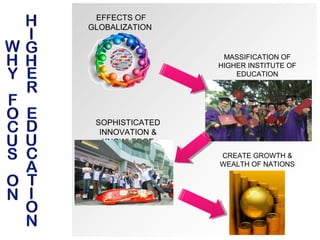
MASSIFICATION OF
HIGHER INSTITUTE OF
EDUCATION
SOPHISTICATED
INNOVATION &
KNOWLEDGE
CREATE GROWTH &
WEALTH OF NATIONS
EFFECTS OF
GLOBALIZATION
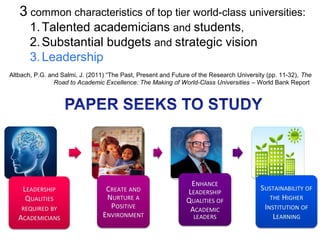
3 common characteristics of top tier world-class universities:
1.Talented academicians and students,
2.Substantial budgets and strategic vision
3.Leadership
Altbach, P.G. and Salmi, J. (2011) “The Past, Present and Future of the Research University (pp. 11-32), The
Road to Academic Excellence: The Making of World-Class Universities – World Bank Report
CENTRE FOR CORPORATE
PLANNING AND LEADERSHIP
The National University of Malaysia
CENTRE FOR CORPORATE
PLANNING AND LEADERSHIP
The National University of Malaysia
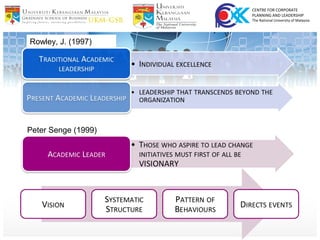
Rowley, J. (1997)
Peter Senge (1999)
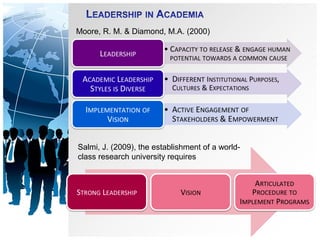
Moore, R. M. & Diamond, M.A. (2000)
Salmi, J. (2009), the establishment of a world-
class research university requires
CENTRE FOR CORPORATE
PLANNING AND LEADERSHIP
The National University of Malaysia
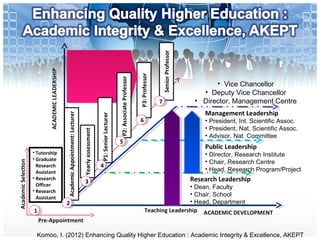
• Tutorship
• Graduate
Research
Assistant
• Research
Officer
• Research
Assistant
11
22
33
77
66
Research Leadership
• Dean, Faculty
• Chair, School
• Head, Department
Public Leadership
• Director, Research Institute
• Chair, Research Centre
• Head, Research Program/Project
Management Leadership
• President, Int. Scientific Assoc.
• President, Nat. Scientific Assoc.
• Advisor, Nat. Committee
• Vice Chancellor
• Deputy Vice Chancellor
• Director, Management Centre
Komoo, I. (2012) Enhancing Quality Higher Education : Academic Integrity & Excellence, AKEPT
44
55
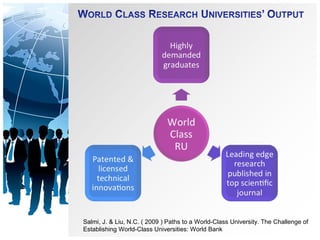
Salmi, J. & Liu, N.C. ( 2009 ) Paths to a World-Class University. The Challenge of
Establishing World-Class Universities: World Bank
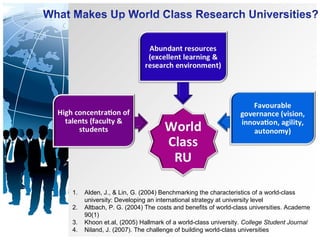
1. Alden, J., & Lin, G. (2004) Benchmarking the characteristics of a world-class
university: Developing an international strategy at university level
2. Altbach, P. G. (2004) The costs and benefits of world-class universities. Academe
90(1)
3. Khoon et.al, (2005) Hallmark of a world-class university. College Student Journal
4. Niland, J. (2007). The challenge of building world-class universities
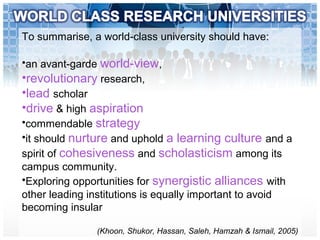
To summarise, a world-class university should have:
•an avant-garde world-view,
•revolutionary research,
•lead scholar
•drive & high aspiration
•commendable strategy
•it should nurture and uphold a learning culture and a
spirit of cohesiveness and scholasticism among its
campus community.
•Exploring opportunities for synergistic alliances with
other leading institutions is equally important to avoid
becoming insular
(Khoon, Shukor, Hassan, Saleh, Hamzah & Ismail, 2005)
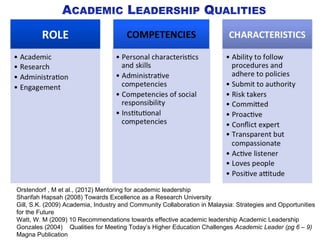
Orstendorf , M et al., (2012) Mentoring for academic leadership
Sharifah Hapsah (2008) Towards Excellence as a Research University
Gill, S.K. (2009) Academia, Industry and Community Collaboration in Malaysia: Strategies and Opportunities
for the Future
Watt, W. M (2009) 10 Recommendations towards effective academic leadership Academic Leadership
Gonzales (2004) Qualities for Meeting Today’s Higher Education Challenges Academic Leader (pg 6 – 9)
Magna Publication
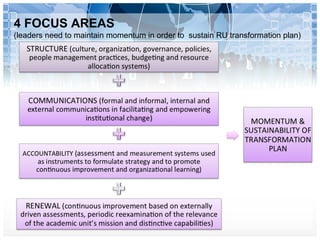
4 FOCUS AREAS
(leaders need to maintain momentum in order to sustain RU transformation plan)
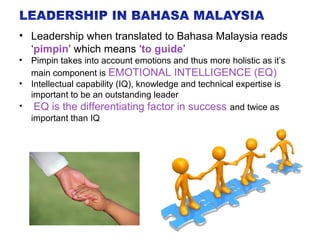
• Leadership when translated to Bahasa Malaysia reads
‘pimpin’ which means ‘to guide’
• Pimpin takes into account emotions and thus more holistic as it’s
main component is EMOTIONAL INTELLIGENCE (EQ)
• Intellectual capability (IQ), knowledge and technical expertise is
important to be an outstanding leader
• EQ is the differentiating factor in success and twice as
important than IQ
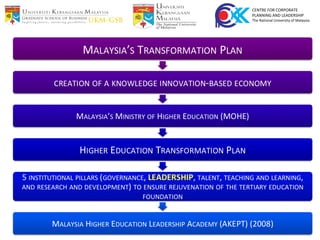
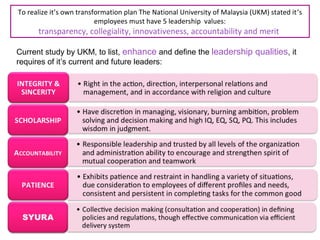
To realize it’s own transformation plan The National University of Malaysia (UKM) stated it’s
employees must have 5 leadership values:
transparency, collegiality, innovativeness, accountability and merit
Current study by UKM, to list, enhance and define the leadership qualities, it
requires of it’s current and future leaders:
• Academic leaders are caught between 2 worlds have to
balance the demands between
 ‘academe’: advancement of scholarship and knowledge
 ‘business’: administrative and reporting requirements
• Academics leaders needs to be better supported in
their leadership roles as their general expectation upon
entering the profession is to excel in their field of expertise
through research, publication and/or teaching
• Counterpart in the corporate sector where the natural
progression from the role of an individual contributor to that of
a leader
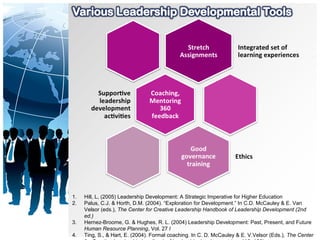
1. Hill, L, (2005) Leadership Development: A Strategic Imperative for Higher Education
2. Palus, C.J. & Horth, D.M. (2004). “Exploration for Development.” In C.D. McCauley & E. Van
Velsor (eds.), The Center for Creative Leadership Handbook of Leadership Development (2nd
ed.)
3. Hernez-Broome, G. & Hughes, R. L. (2004) Leadership Development: Past, Present, and Future
Human Resource Planning, Vol. 27 l
4. Ting, S., & Hart, E. (2004). Formal coaching. In C. D. McCauley & E. V.Velsor (Eds.), The Center
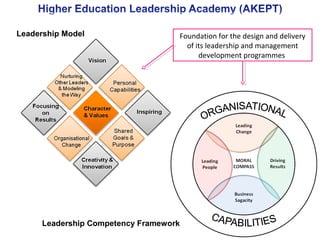
Leadership Model
Leadership Competency Framework
Foundation for the design and delivery
of its leadership and management
development programmes
1. Identifying & nurturing leaders can make the difference between success & failure.
Thus there is need to review the selection and promotion process plus examine the
IQ, EQ, PQ and SQ of the recruits.
2. Wondra (2009) recommends developing a systematic approach to talent and
succession management
3. Drew, G. (2005) Leader’s attitude must include 3 core beliefs
a. the institution is more important than any single individual, it is a
b. leader’s job to help other succeed
c. decision must consider the organization’s future and sustainability
4. Malaysia National Transformational Strategic Plan for Higher Education:
1. Academic leadership development as a means to build world-class
university
2. Autonomy to public universities
3. Implementation of talent management and succession planning at all
levels of the higher education institutions
5. Ultimately, universities leaders have to:
a. be held accountable for development and nurturing of existing and
emerging leaders
b. promote an environment that is agile, conducive and encourages their
faculty to be strategically visionary, innovative, and flexible thereby able to
address the social, technological, and political challenges in the highly complex
and shifting global landscape

Leadership qualitiesacademia(qs)

  • 1.
    CENTRE FOR CORPORATE PLANNINGAND LEADERSHIP The National University of Malaysia by: Adlin Masood Prof. Dr. Wan Kamal Mujani Mahyudin Omar
  • 2.
    This paper seeksto study leadership qualities required by academicians to build world-class universities and how to create and nurture a positive environment to enhance these leadership qualities thereby ensuring sustainability of the higher institution of learning. CENTRE FOR CORPORATE PLANNING AND LEADERSHIP The National University of Malaysia
  • 3.
    MASSIFICATION OF HIGHER INSTITUTEOF EDUCATION SOPHISTICATED INNOVATION & KNOWLEDGE CREATE GROWTH & WEALTH OF NATIONS EFFECTS OF GLOBALIZATION
  • 4.
    3 common characteristicsof top tier world-class universities: 1.Talented academicians and students, 2.Substantial budgets and strategic vision 3.Leadership Altbach, P.G. and Salmi, J. (2011) “The Past, Present and Future of the Research University (pp. 11-32), The Road to Academic Excellence: The Making of World-Class Universities – World Bank Report
  • 5.
    CENTRE FOR CORPORATE PLANNINGAND LEADERSHIP The National University of Malaysia
  • 6.
    CENTRE FOR CORPORATE PLANNINGAND LEADERSHIP The National University of Malaysia Rowley, J. (1997) Peter Senge (1999)
  • 7.
    Moore, R. M.& Diamond, M.A. (2000) Salmi, J. (2009), the establishment of a world- class research university requires
  • 8.
    CENTRE FOR CORPORATE PLANNINGAND LEADERSHIP The National University of Malaysia
  • 9.
    • Tutorship • Graduate Research Assistant •Research Officer • Research Assistant 11 22 33 77 66 Research Leadership • Dean, Faculty • Chair, School • Head, Department Public Leadership • Director, Research Institute • Chair, Research Centre • Head, Research Program/Project Management Leadership • President, Int. Scientific Assoc. • President, Nat. Scientific Assoc. • Advisor, Nat. Committee • Vice Chancellor • Deputy Vice Chancellor • Director, Management Centre Komoo, I. (2012) Enhancing Quality Higher Education : Academic Integrity & Excellence, AKEPT 44 55
  • 10.
    Salmi, J. &Liu, N.C. ( 2009 ) Paths to a World-Class University. The Challenge of Establishing World-Class Universities: World Bank
  • 11.
    1. Alden, J.,& Lin, G. (2004) Benchmarking the characteristics of a world-class university: Developing an international strategy at university level 2. Altbach, P. G. (2004) The costs and benefits of world-class universities. Academe 90(1) 3. Khoon et.al, (2005) Hallmark of a world-class university. College Student Journal 4. Niland, J. (2007). The challenge of building world-class universities
  • 12.
    To summarise, aworld-class university should have: •an avant-garde world-view, •revolutionary research, •lead scholar •drive & high aspiration •commendable strategy •it should nurture and uphold a learning culture and a spirit of cohesiveness and scholasticism among its campus community. •Exploring opportunities for synergistic alliances with other leading institutions is equally important to avoid becoming insular (Khoon, Shukor, Hassan, Saleh, Hamzah & Ismail, 2005)
  • 13.
    Orstendorf , Met al., (2012) Mentoring for academic leadership Sharifah Hapsah (2008) Towards Excellence as a Research University Gill, S.K. (2009) Academia, Industry and Community Collaboration in Malaysia: Strategies and Opportunities for the Future Watt, W. M (2009) 10 Recommendations towards effective academic leadership Academic Leadership Gonzales (2004) Qualities for Meeting Today’s Higher Education Challenges Academic Leader (pg 6 – 9) Magna Publication
  • 14.
    4 FOCUS AREAS (leadersneed to maintain momentum in order to sustain RU transformation plan)
  • 15.
    • Leadership whentranslated to Bahasa Malaysia reads ‘pimpin’ which means ‘to guide’ • Pimpin takes into account emotions and thus more holistic as it’s main component is EMOTIONAL INTELLIGENCE (EQ) • Intellectual capability (IQ), knowledge and technical expertise is important to be an outstanding leader • EQ is the differentiating factor in success and twice as important than IQ
  • 16.
    To realize it’sown transformation plan The National University of Malaysia (UKM) stated it’s employees must have 5 leadership values: transparency, collegiality, innovativeness, accountability and merit Current study by UKM, to list, enhance and define the leadership qualities, it requires of it’s current and future leaders:
  • 17.
    • Academic leadersare caught between 2 worlds have to balance the demands between  ‘academe’: advancement of scholarship and knowledge  ‘business’: administrative and reporting requirements • Academics leaders needs to be better supported in their leadership roles as their general expectation upon entering the profession is to excel in their field of expertise through research, publication and/or teaching • Counterpart in the corporate sector where the natural progression from the role of an individual contributor to that of a leader
  • 18.
    1. Hill, L,(2005) Leadership Development: A Strategic Imperative for Higher Education 2. Palus, C.J. & Horth, D.M. (2004). “Exploration for Development.” In C.D. McCauley & E. Van Velsor (eds.), The Center for Creative Leadership Handbook of Leadership Development (2nd ed.) 3. Hernez-Broome, G. & Hughes, R. L. (2004) Leadership Development: Past, Present, and Future Human Resource Planning, Vol. 27 l 4. Ting, S., & Hart, E. (2004). Formal coaching. In C. D. McCauley & E. V.Velsor (Eds.), The Center
  • 19.
    Leadership Model Leadership CompetencyFramework Foundation for the design and delivery of its leadership and management development programmes
  • 20.
    1. Identifying &nurturing leaders can make the difference between success & failure. Thus there is need to review the selection and promotion process plus examine the IQ, EQ, PQ and SQ of the recruits. 2. Wondra (2009) recommends developing a systematic approach to talent and succession management 3. Drew, G. (2005) Leader’s attitude must include 3 core beliefs a. the institution is more important than any single individual, it is a b. leader’s job to help other succeed c. decision must consider the organization’s future and sustainability 4. Malaysia National Transformational Strategic Plan for Higher Education: 1. Academic leadership development as a means to build world-class university 2. Autonomy to public universities 3. Implementation of talent management and succession planning at all levels of the higher education institutions 5. Ultimately, universities leaders have to: a. be held accountable for development and nurturing of existing and emerging leaders b. promote an environment that is agile, conducive and encourages their faculty to be strategically visionary, innovative, and flexible thereby able to address the social, technological, and political challenges in the highly complex and shifting global landscape