Leaders of change
Companies prepare for a stronger future
A report from the Economist Intelligence Unit


sponsored by
Leaders of change
                                                                         Companies prepare for a stronger future


Preface


Leaders of change: Companies prepare for a stronger future is an Economist Intelligence Unit report,
sponsored by Celerant Consulting. The Economist Intelligence Unit conducted the survey and analysis and
wrote the report. The findings and views expressed in the report do not necessarily reflect the views of the
sponsor.
   The report’s quantitative findings come from a survey of 288 senior executives, conducted in November
2010. The Economist Intelligence Unit’s editorial team designed the survey. Paul Kielstra was the author
of the report and Gilda Stahl was the editor. Mike Kenny was responsible for the design.
   To supplement the quantitative survey results, the Economist Intelligence Unit conducted in-depth
interviews with relevant experts. We would like to thank all interviewees for their time and insights.

January 2011


 About the survey                                       were in senior management. Respondents hailed
                                                        from North America (44%), Western Europe (40%)
                                                        and Latin America (16%). Survey participants came
 A total of 288 senior executives participated in the   from a wide range of industries, with just over 75%
 change management survey, which was conducted          from organisations with annual revenue greater than
 in November 2010. Of those who responded, 42%          US$1bn. For more details on the survey sample and
 were C-level executives or above and the remainder     results, see the appendix of this study.


© Economist Intelligence Unit Limited 2011                                                                         1
Leaders of change
    Companies prepare for a stronger future


    Introduction


    T   he focus of change management has shifted, according to a survey conducted by the Economist
        Intelligence Unit and sponsored by Celerant Consulting. Although companies remain, as always, cost
    conscious, they are putting much more emphasis on growing market share and preparing for the future.
       Similarly, organisations are increasingly devoting their attention to the sales and marketing functions.
    This further reflects the shift in emphasis towards growth and the future and away from cost cutting.
    Apparently, executives are leaving the preoccupations of surviving the downturn behind.
       Yet companies are still, all too often, unable to execute change. The responsibility inevitably resides
    with their leaders.


2                                                                           © Economist Intelligence Unit Limited 2011
Leaders of change
                                                                             Companies prepare for a stronger future


Looking to the future


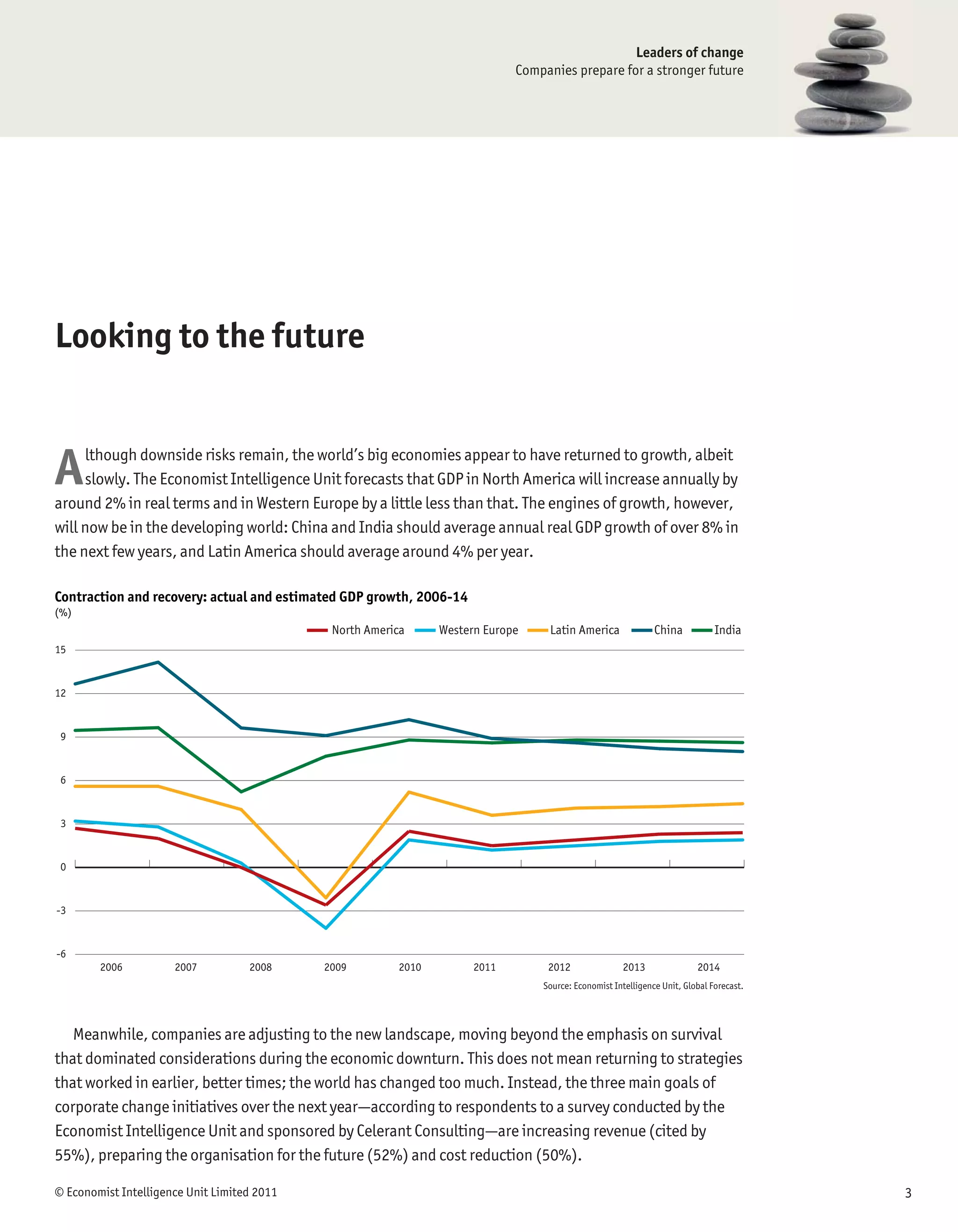
A    lthough downside risks remain, the world’s big economies appear to have returned to growth, albeit
     slowly. The Economist Intelligence Unit forecasts that GDP in North America will increase annually by
around 2% in real terms and in Western Europe by a little less than that. The engines of growth, however,
will now be in the developing world: China and India should average annual real GDP growth of over 8% in
the next few years, and Latin America should average around 4% per year.

Contraction and recovery: actual and estimated GDP growth, 2006-14
(%)
                                              North America     Western Europe    Latin America               China           India
15


12


 9


 6


 3


 0


-3


-6
        2006          2007          2008     2009        2010         2011        2012                2013               2014
                                                                                 Source: Economist Intelligence Unit, Global Forecast.


   Meanwhile, companies are adjusting to the new landscape, moving beyond the emphasis on survival
that dominated considerations during the economic downturn. This does not mean returning to strategies
that worked in earlier, better times; the world has changed too much. Instead, the three main goals of
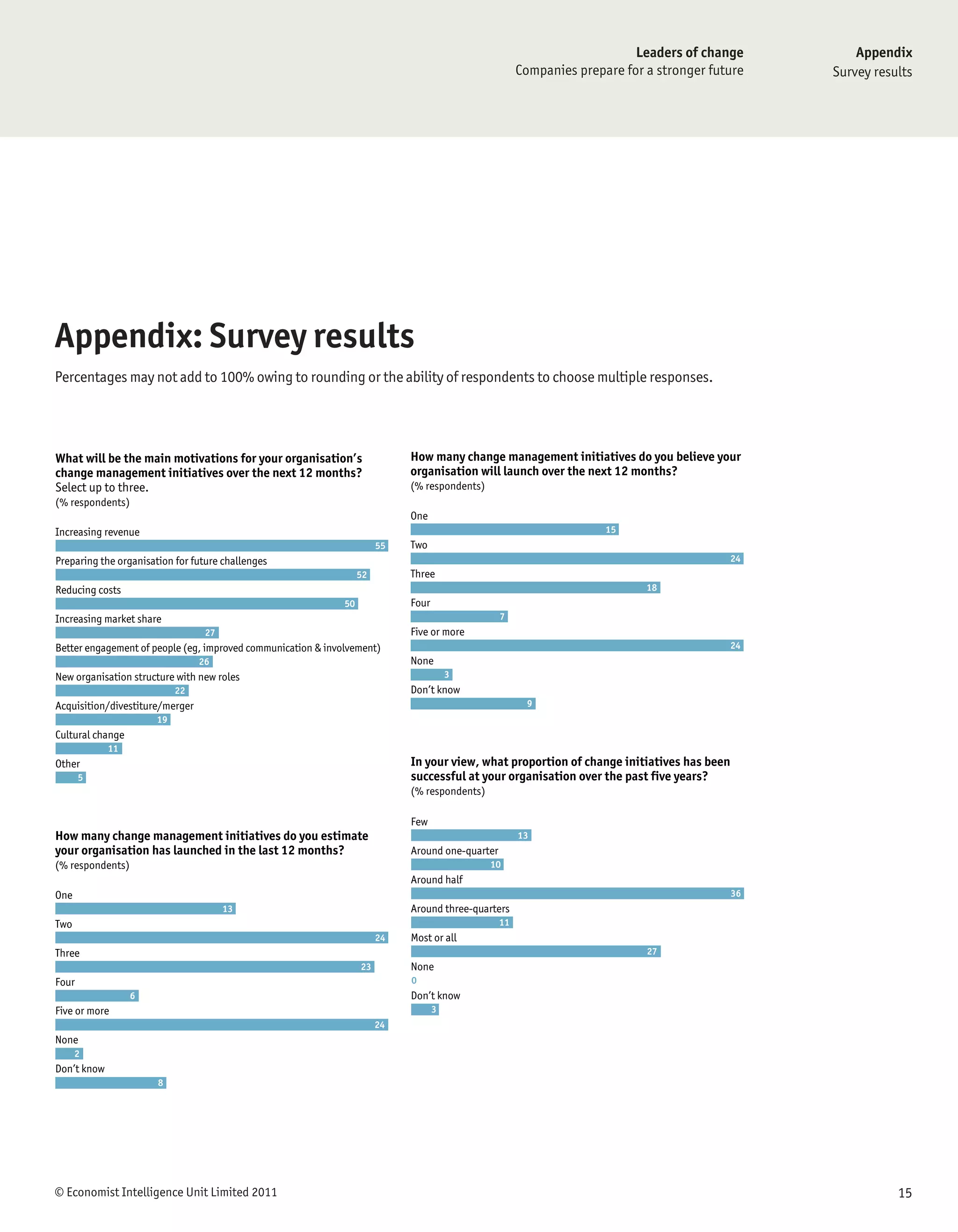
corporate change initiatives over the next year—according to respondents to a survey conducted by the
Economist Intelligence Unit and sponsored by Celerant Consulting—are increasing revenue (cited by
55%), preparing the organisation for the future (52%) and cost reduction (50%).

© Economist Intelligence Unit Limited 2011                                                                                               3
Leaders of change
    Companies prepare for a stronger future


    What are the main forces driving change at your company?
    (% respondents)
                                                                Consumer goods        Energy & natural resources         Healthcare, pharmaceuticals & biotechnology

    Competitive/cost pressures
                                                                                                                                                      56
                                                                                                                                                                         63
                                                                                                                          46
    Customer demand (eg, for better quality, service, different products)
                                                                                                                    44
                                                                                             34
                                                           21
    Regulation
                             10
                                                                                 31
                                                                                 31
    Desire to increase market share
                                                                                                                                        51
                                                                          26
                                                                                        33
    Merger or acquisition
                                  12
                                            14
                                                                                                  36
    Exploiting emerging market opportunities (sourcing and sales)
                                                                     24
            3
                                                      18
    Investor expectations
                                                 17
                                                                23
                                                                          26
    Reducing complexity within company
                                                                                                       37
                                                 17
                                                                          26
    Change for the sake of change
        2
    0
    0
    Sustainability/green initiatives
                5
                         9
                5
    Reduction of headcount
                    7
            3
                                       13
                                                                                                                   Source: Economist Intelligence Unit survey, November 2010.


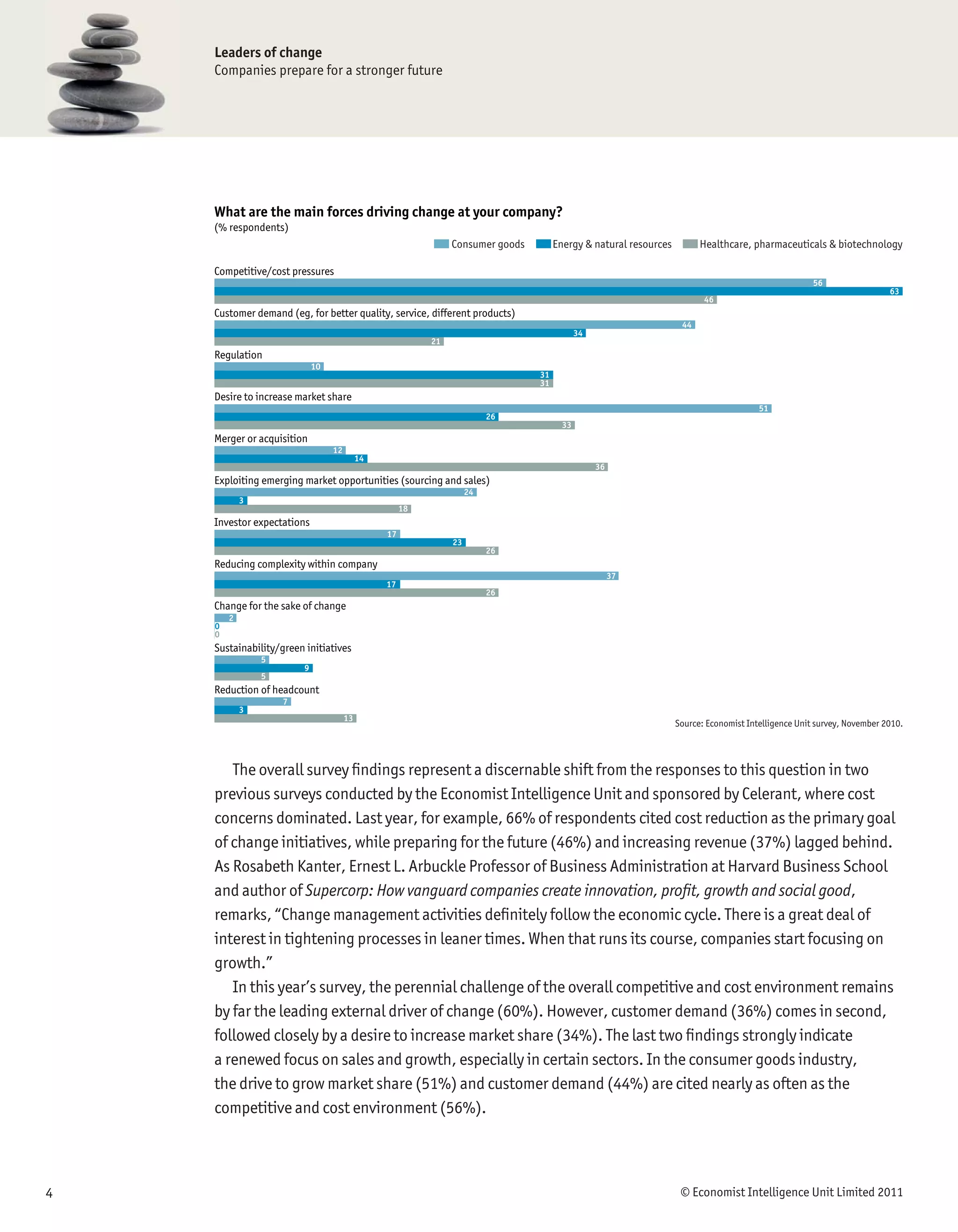
       The overall survey findings represent a discernable shift from the responses to this question in two
    previous surveys conducted by the Economist Intelligence Unit and sponsored by Celerant, where cost
    concerns dominated. Last year, for example, 66% of respondents cited cost reduction as the primary goal
    of change initiatives, while preparing for the future (46%) and increasing revenue (37%) lagged behind.
    As Rosabeth Kanter, Ernest L. Arbuckle Professor of Business Administration at Harvard Business School
    and author of Supercorp: How vanguard companies create innovation, profit, growth and social good,
    remarks, “Change management activities definitely follow the economic cycle. There is a great deal of
    interest in tightening processes in leaner times. When that runs its course, companies start focusing on
    growth.”
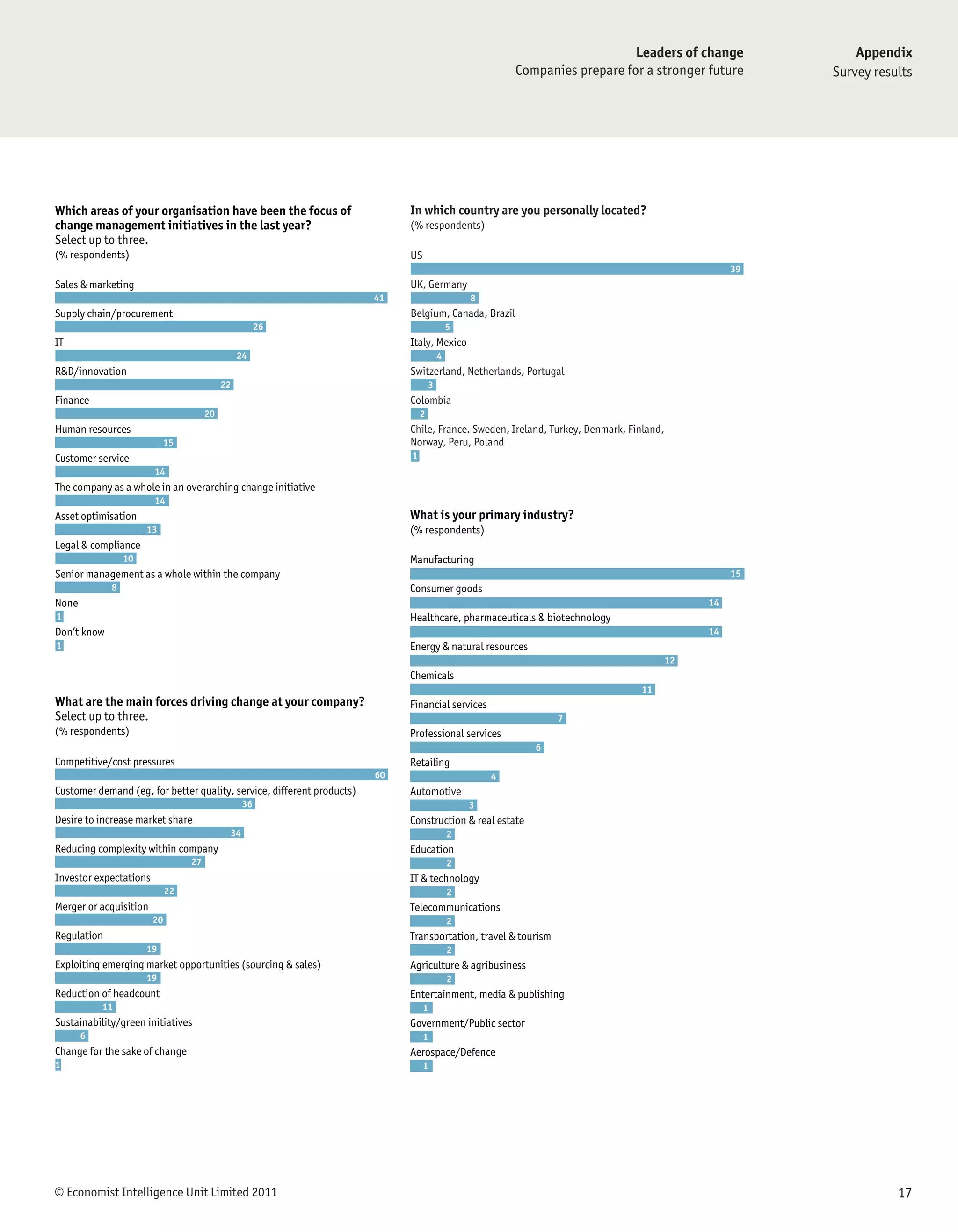
       In this year’s survey, the perennial challenge of the overall competitive and cost environment remains
    by far the leading external driver of change (60%). However, customer demand (36%) comes in second,
    followed closely by a desire to increase market share (34%). The last two findings strongly indicate
    a renewed focus on sales and growth, especially in certain sectors. In the consumer goods industry,
    the drive to grow market share (51%) and customer demand (44%) are cited nearly as often as the
    competitive and cost environment (56%).


4                                                                                                                   © Economist Intelligence Unit Limited 2011
Leaders of change
                                                                        Companies prepare for a stronger future


    According to Dean Nelson, founder of KKR Capstone, “Most companies have recently focused change               “Down markets are
management on cost”. To improve further, “they need to focus some of their resources on growth”. Down             ideally the best
markets, he adds, are ideally the best times to engage in growth-related change, because they experience          times to engage
the biggest shifts in market share.                                                                               in growth-related
    Although the emphasis on market growth and the future is increasing in line with the economic cycle,          change, because
it is important not to exaggerate the shift. This year’s survey results suggest a different emphasis, rather      they experience
than a sea change in where firms are focusing their change efforts. One-half of companies surveyed still           the biggest shifts
see the reduction of costs as a primary aim. Ultimately, notes Robert Tartaglia, chief operating officer           in market share.”
(COO) of Allianz Global Corporate & Specialty, a Munich-based large corporate and specialty insurer,              Dean Nelson, founder of KKR
                                                                                                                  Capstone
“Change is driven by the needs of the company,” not some “initiative du jour”. At the moment, for many,
those needs relate increasingly to the future.


© Economist Intelligence Unit Limited 2011                                                                                                  5
Leaders of change
    Companies prepare for a stronger future


    Sales and marketing function is in the
    front line of change

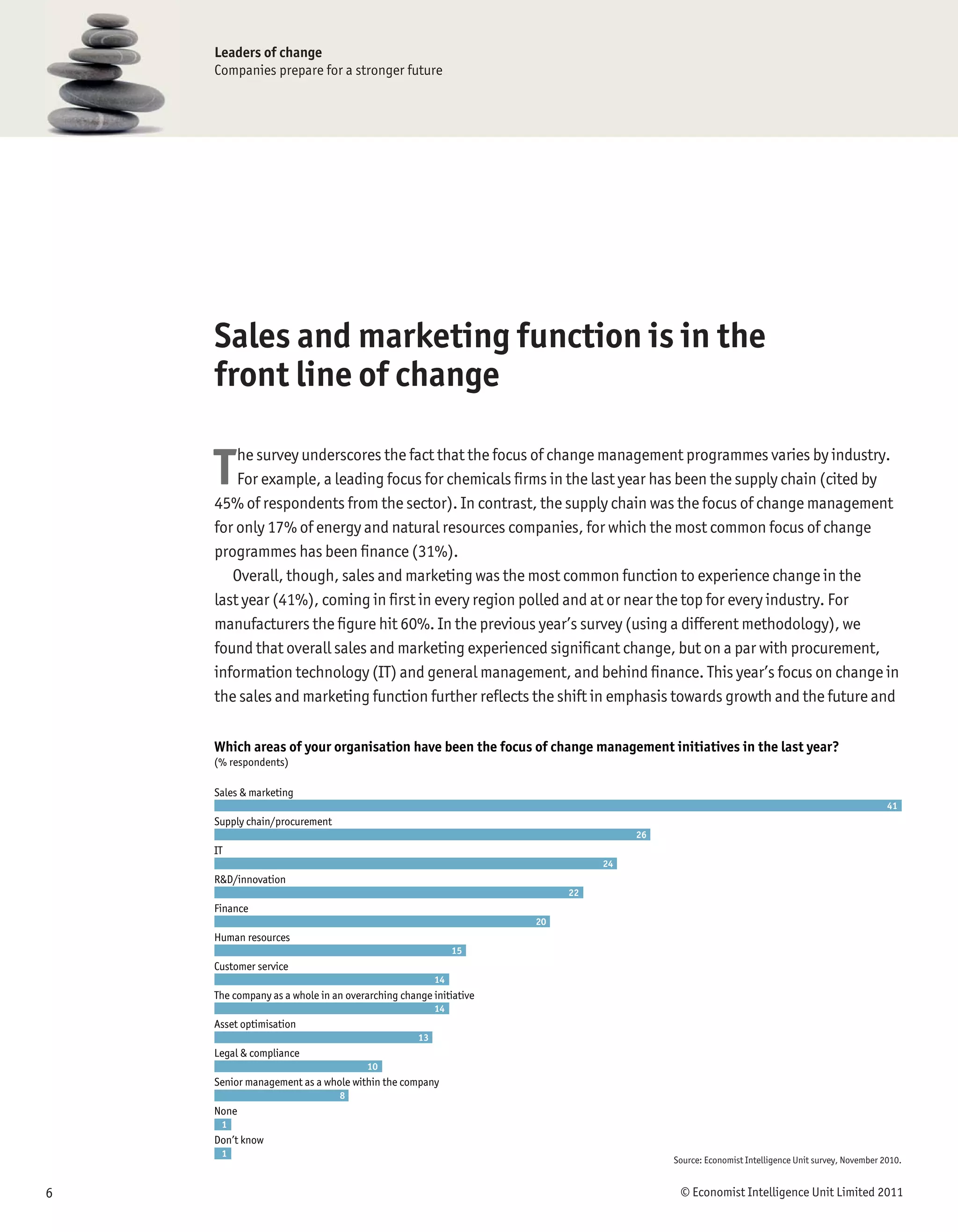
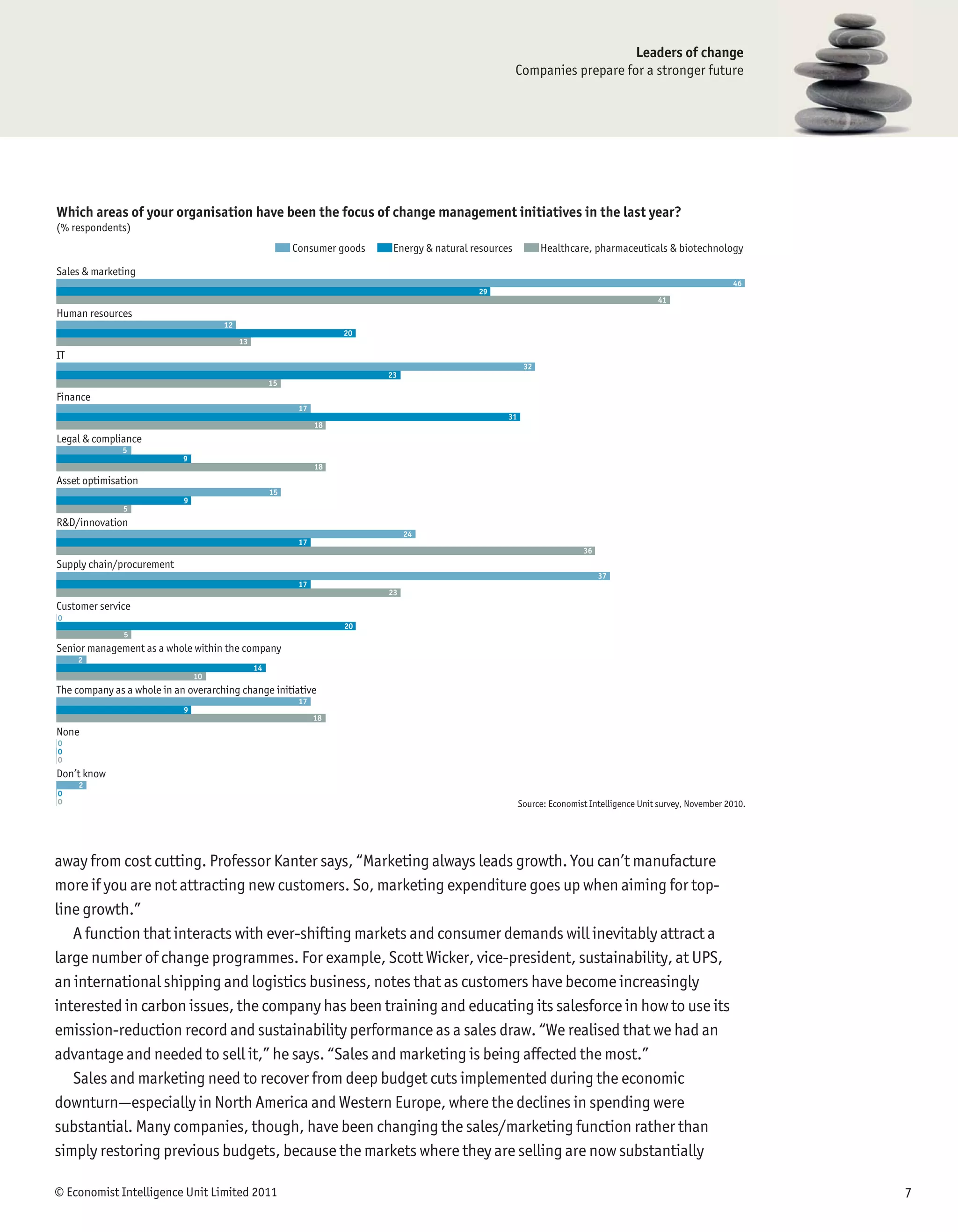
    T   he survey underscores the fact that the focus of change management programmes varies by industry.
        For example, a leading focus for chemicals firms in the last year has been the supply chain (cited by
    45% of respondents from the sector). In contrast, the supply chain was the focus of change management
    for only 17% of energy and natural resources companies, for which the most common focus of change
    programmes has been finance (31%).
       Overall, though, sales and marketing was the most common function to experience change in the
    last year (41%), coming in first in every region polled and at or near the top for every industry. For
    manufacturers the figure hit 60%. In the previous year’s survey (using a different methodology), we
    found that overall sales and marketing experienced significant change, but on a par with procurement,
    information technology (IT) and general management, and behind finance. This year’s focus on change in
    the sales and marketing function further reflects the shift in emphasis towards growth and the future and

    Which areas of your organisation have been the focus of change management initiatives in the last year?
    (% respondents)

    Sales & marketing
                                                                                                                                           41
    Supply chain/procurement
                                                                                26
    IT
                                                                           24
    R&D/innovation
                                                                      22
    Finance
                                                                 20
    Human resources
                                                           15
    Customer service
                                                      14
    The company as a whole in an overarching change initiative
                                                      14
    Asset optimisation
                                                 13
    Legal & compliance
                                      10
    Senior management as a whole within the company
                                8
    None
     1
    Don’t know
     1
                                                                                     Source: Economist Intelligence Unit survey, November 2010.


6                                                                                     © Economist Intelligence Unit Limited 2011
Leaders of change
                                                                                                        Companies prepare for a stronger future


Which areas of your organisation have been the focus of change management initiatives in the last year?
(% respondents)
                                                         Consumer goods    Energy & natural resources          Healthcare, pharmaceuticals & biotechnology

Sales & marketing
                                                                                                                                                               46
                                                                                             29
                                                                                                                                            41
Human resources
                                     12
                                                                    20
                                          13
IT
                                                                                                          32
                                                                          23
                                                    15
Finance
                                                          17
                                                                                                    31
                                                               18
Legal & compliance
              5
                            9
                                                               18
Asset optimisation
                                                    15
                            9
              5
R&D/innovation
                                                                               24
                                                          17
                                                                                                                         36
Supply chain/procurement
                                                                                                                              37
                                                          17
                                                                          23
Customer service
0
                                                                    20
               5
Senior management as a whole within the company
     2
                                               14
                                10
The company as a whole in an overarching change initiative
                                                          17
                            9
                                                               18
None
0
0
0
Don’t know
     2
0
0                                                                                                        Source: Economist Intelligence Unit survey, November 2010.


away from cost cutting. Professor Kanter says, “Marketing always leads growth. You can’t manufacture
more if you are not attracting new customers. So, marketing expenditure goes up when aiming for top-
line growth.”
   A function that interacts with ever-shifting markets and consumer demands will inevitably attract a
large number of change programmes. For example, Scott Wicker, vice-president, sustainability, at UPS,
an international shipping and logistics business, notes that as customers have become increasingly
interested in carbon issues, the company has been training and educating its salesforce in how to use its
emission-reduction record and sustainability performance as a sales draw. “We realised that we had an
advantage and needed to sell it,” he says. “Sales and marketing is being affected the most.”
   Sales and marketing need to recover from deep budget cuts implemented during the economic
downturn—especially in North America and Western Europe, where the declines in spending were
substantial. Many companies, though, have been changing the sales/marketing function rather than
simply restoring previous budgets, because the markets where they are selling are now substantially

© Economist Intelligence Unit Limited 2011                                                                                                                            7
Leaders of change
    Companies prepare for a stronger future


    different. Growth is largely occurring in less-developed economies and these require different marketing
    approaches. With evolving communication channels, such as social networking technology, businesses
    would have to adjust rapidly anyway. Two years of cutbacks only make the need for some companies to
    act more pressing. Mr Nelson explains, “The sales and marketing function is a higher-return place to
    implement real change than management on the cost side. The customer base has changed; the world has
    changed. People realise that they need to change their sales and marketing approach.”
       Broad organisational retooling holds some advantages over a narrower focus on a single function,
    however important. According to the survey findings, companies that have not engaged in change to the
    sales/marketing function most commonly implemented initiatives that addressed the company as a whole
    (24%). Professor Kanter points out that sales strength is less of an issue than an ability to innovate across
    the company and in product offerings. “In the long run”, she says, “you need to be investing in constantly
    renewing products and services. Innovation is the only way to have sustainable growth.”
       Larger companies, in particular, are addressing the problem of complexity. For those businesses
    with over US$5bn in annual sales, simplification is the second-biggest aim of change. Such change is,
    in Professor Kanter’s words, “an exercise that goes on periodically”. Large organisations add on layers
    and roles—particularly in good times—and then need to shed them. Mr Tartaglia of Allianz says, “I’ve yet
    to embark on a change initiative or project where one of the ultimate objectives is not the reduction of
    complexity”, because of the costs that it brings. Complexity reduction can have multiple advantages. A
    programme at P&G, a global consumer-products company, to simplify its European distribution system,
    notes Peter White, its director for global sustainability, decreased carbon emissions and costs.


8                                                                             © Economist Intelligence Unit Limited 2011
Leaders of change
                                                                                          Companies prepare for a stronger future


‘A’ for effort, but ‘E’ for execution?


A    s companies make their strategic choices about how best to change in order to face current and future
     challenges, change programmes are consuming ever more corporate resources. Sixty-three percent
of survey respondents report that more senior executive time was devoted to change management
initiatives over the past year, against just 7% noting a decline. The equivalent figures for increased
spending are 47% and 11%.
   Nevertheless, most companies are still remarkably unsuccessful at implementing change. Respondents
say that on average only 56% of change initiatives are successful. This is no surprise to Allianz’s Mr
Tartaglia. Surveying the corporate world as a whole, he sees “a lot more experienced people out there and
a better understanding of best practice, but I can’t say I have seen any empirical evidence that companies
are doing better [at change management]”.

On average, to what extent…
(% respondents)
                                   …have the resources spent on your                   …has the amount of senior executive time spent
                                   organisation’s most significant change              on your organisation’s most significant change
                                   initiatives altered over the past 12 months?        initiatives altered over the past 12 months?
Increased greatly
                              10
                                                                   21
Increased
                                                                                                                           37
                                                                                                                                                42
Stayed the same
                                                                                                                                38
                                                                                  27
Decreased
                          9
                    6
Decreased greatly
     2
 1
Don’t know
             4
         3                                                                                Source: Economist Intelligence Unit survey, November 2010.


© Economist Intelligence Unit Limited 2011                                                                                                             9
Leaders of change
     Companies prepare for a stronger future


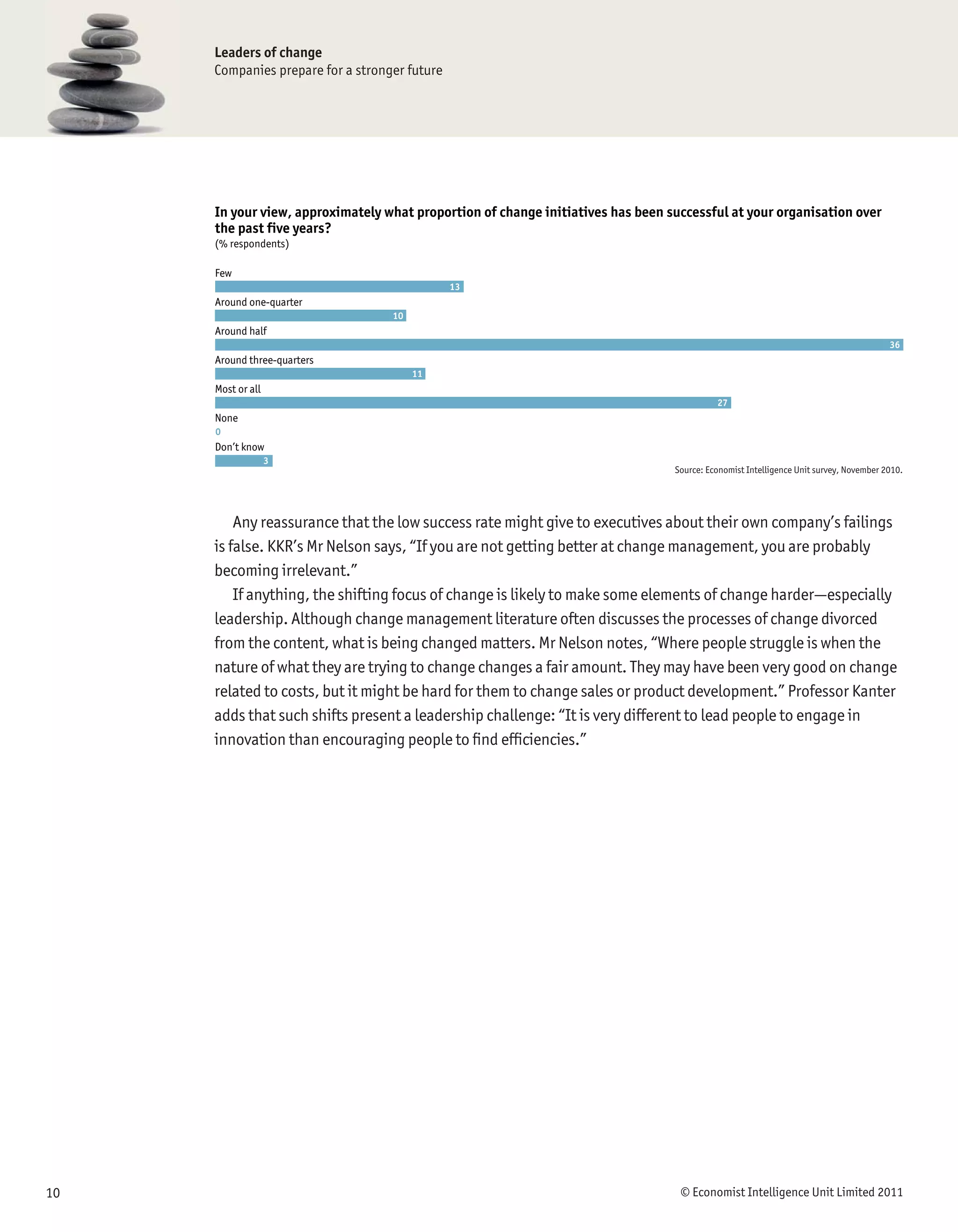
     In your view, approximately what proportion of change initiatives has been successful at your organisation over
     the past five years?
     (% respondents)

     Few
                                               13
     Around one-quarter
                                   10
     Around half
                                                                                                                                       36
     Around three-quarters
                                        11
     Most or all
                                                                                           27
     None
     0
     Don’t know
                   3
                                                                                 Source: Economist Intelligence Unit survey, November 2010.


         Any reassurance that the low success rate might give to executives about their own company’s failings
     is false. KKR’s Mr Nelson says, “If you are not getting better at change management, you are probably
     becoming irrelevant.”
         If anything, the shifting focus of change is likely to make some elements of change harder—especially
     leadership. Although change management literature often discusses the processes of change divorced
     from the content, what is being changed matters. Mr Nelson notes, “Where people struggle is when the
     nature of what they are trying to change changes a fair amount. They may have been very good on change
     related to costs, but it might be hard for them to change sales or product development.” Professor Kanter
     adds that such shifts present a leadership challenge: “It is very different to lead people to engage in
     innovation than encouraging people to find efficiencies.”


10                                                                                © Economist Intelligence Unit Limited 2011
Leaders of change
                                                                          Companies prepare for a stronger future


Where the buck stops: a challenge for leaders


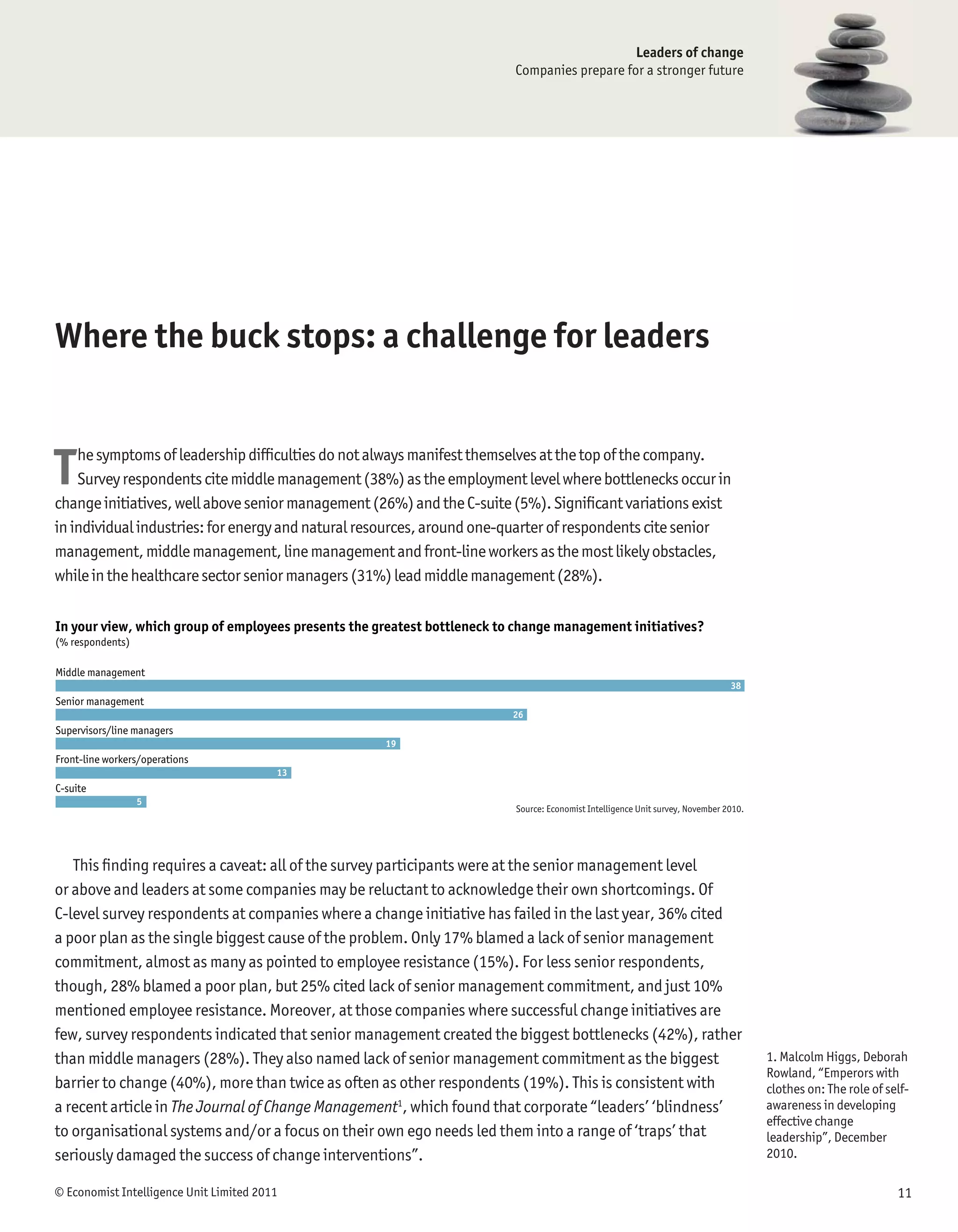
T   he symptoms of leadership difficulties do not always manifest themselves at the top of the company.
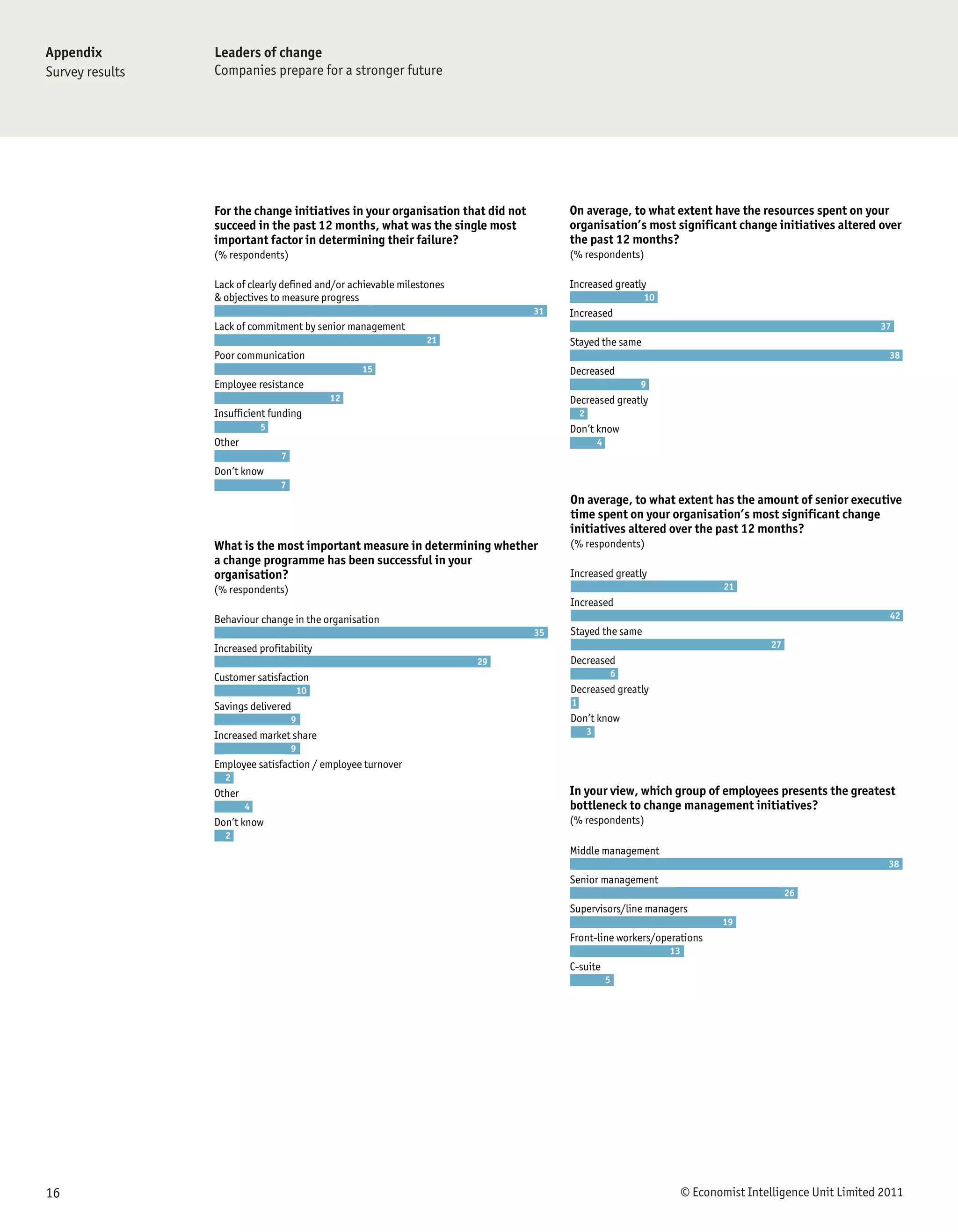
    Survey respondents cite middle management (38%) as the employment level where bottlenecks occur in
change initiatives, well above senior management (26%) and the C-suite (5%). Significant variations exist
in individual industries: for energy and natural resources, around one-quarter of respondents cite senior
management, middle management, line management and front-line workers as the most likely obstacles,
while in the healthcare sector senior managers (31%) lead middle management (28%).

In your view, which group of employees presents the greatest bottleneck to change management initiatives?
(% respondents)

Middle management
                                                                                                                                38
Senior management
                                                                          26
Supervisors/line managers
                                                     19
Front-line workers/operations
                                         13
C-suite
                  5
                                                                          Source: Economist Intelligence Unit survey, November 2010.


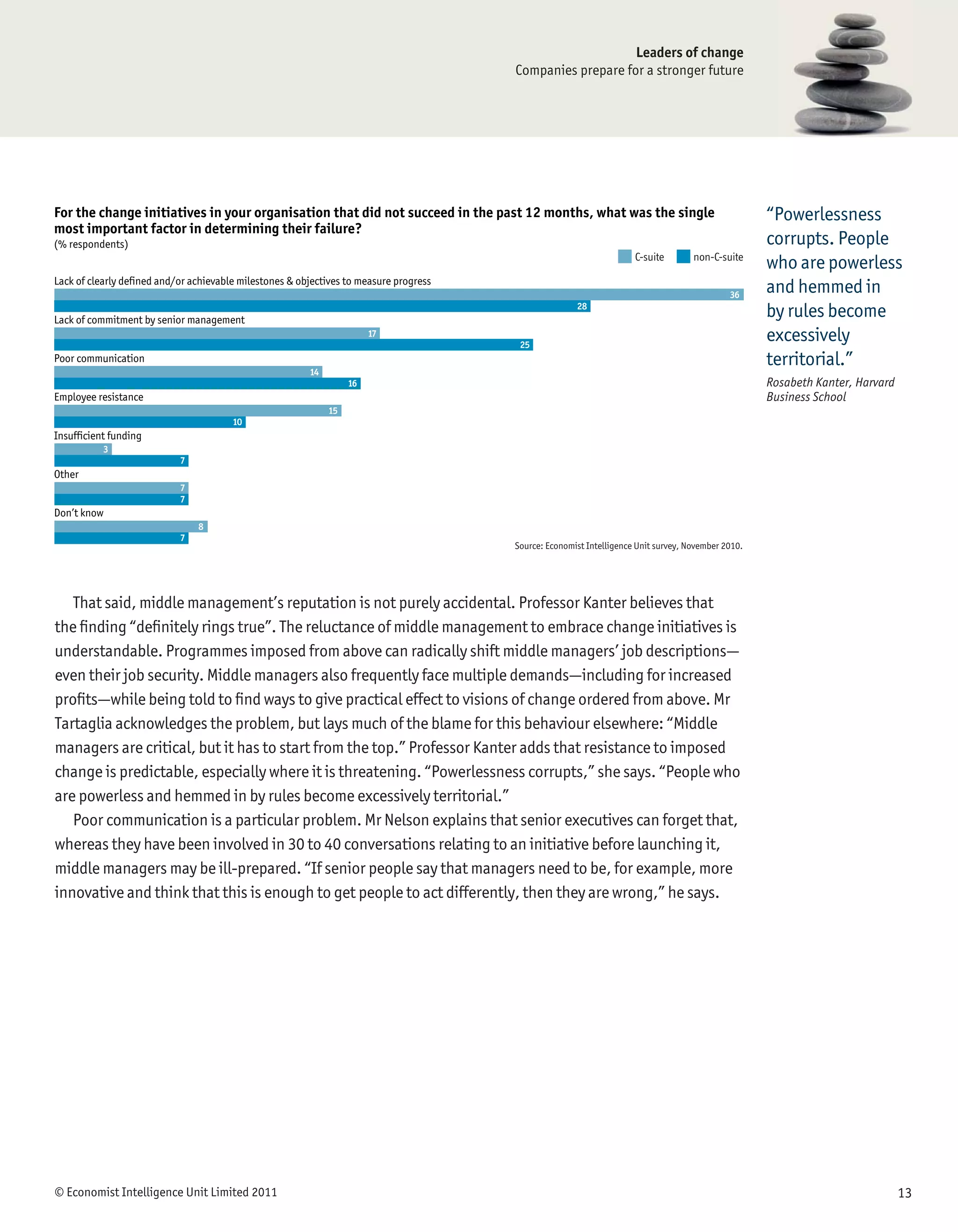
   This finding requires a caveat: all of the survey participants were at the senior management level
or above and leaders at some companies may be reluctant to acknowledge their own shortcomings. Of
C-level survey respondents at companies where a change initiative has failed in the last year, 36% cited
a poor plan as the single biggest cause of the problem. Only 17% blamed a lack of senior management
commitment, almost as many as pointed to employee resistance (15%). For less senior respondents,
though, 28% blamed a poor plan, but 25% cited lack of senior management commitment, and just 10%
mentioned employee resistance. Moreover, at those companies where successful change initiatives are
few, survey respondents indicated that senior management created the biggest bottlenecks (42%), rather
than middle managers (28%). They also named lack of senior management commitment as the biggest                                        1. Malcolm Higgs, Deborah
                                                                                                                                       Rowland, “Emperors with
barrier to change (40%), more than twice as often as other respondents (19%). This is consistent with                                  clothes on: The role of self-
a recent article in The Journal of Change Management1, which found that corporate “leaders’ ‘blindness’                                awareness in developing
                                                                                                                                       effective change
to organisational systems and/or a focus on their own ego needs led them into a range of ‘traps’ that                                  leadership”, December
seriously damaged the success of change interventions”.                                                                                2010.

© Economist Intelligence Unit Limited 2011                                                                                                                       11
Leaders of change
     Companies prepare for a stronger future


      Change management in practice: a focus                       ventures in which the benefits are partly intangible.
      on sustainability                                            Mr Wicker therefore stresses the need to blend
                                                                   environmental with financial gains clearly, as both
                                                                   are a part of sustainability. Similarly, Dr White says,
                                                                   “You need a clear line of sight for sustainability to the
      The requirements of successful change management             company’s purpose.” This ideally should include social
      are often described in broad terms. The details,             and environmental, as well as financial elements, and
      however, also matter, and invariably differ from field        P&G changed its formal statement of purpose to do so.
      to field. For example, the integration of sustainability      The strong link between sustainability and efficiency
      into companies in recent years has involved substantial      frequently helps here as well.
      change efforts. The experience of P&G and UPS                    Planning: Effective change requires a good
      illustrates the process of applying broad rules in           roadmap, including clear delineations of responsibility
      particular circumstances.                                    and steps, preferably with initial easy wins to boost
          Leadership and communication to create a                 morale and momentum. This is as true in sustainability
      sense of urgency: Successful change requires a               as other fields, but those working in this area face
      widespread belief within the organisation that action        particular complications. Mr Wicker notes that
      is necessary. This requires a consistent message from        initiatives tend to involve multiple departments
      senior executives—otherwise employees will assume            and sometimes even external stakeholders such as
      that the issue is not important within the business.         communities or non-governmental organisations
      UPS and P&G start their sustainability efforts with          (NGOs). Co-ordinated planning and execution are
      an unambiguous commitment from the CEO and the               therefore typically more difficult than for initiatives
      Board. Both also have extensive internal educational         relating to single departments.
      and communication efforts to explain the concept.                Selecting the appropriate metrics for success may
          So far, this does not vary noticeably from the general   not be as straightforward as initiatives focused on
      template for change. For companies seeking to become         money saved, or a company might not even measure
      more sustainable, though, success does not depend so         them before a given initiative begins. The accurate
      much on winning people over to individual initiatives as     measurement of carbon emissions related to a given
      convincing them of the need to embrace sustainability        activity, for example, can be highly complex. Yet
      more broadly. Here developments in the outside world         such measurement can provide additional business
      certainly help. UPS vice-president, sustainability,          opportunities: UPS, for example, finds it valuable to
      Scott Wicker, says that increasing awareness of climate      be able to give customers information related to the
      change has made it far easier to win hearts and minds.       carbon produced in their shipments.
      “The emergence of climate change as a business issue is          Focus of change: Although in parts of the business
      driving sustainability,” he notes.                           the focus of changes has varied with the economic
          Yet P&G’s Dr White points out that sustainability        cycle, sustainability provides an example of one that
      can be managed in terms of corporate behaviour. This         has not. It certainly could have fluctuated between
      approach requires greater corporate change, but once         concentrating on efficiency initiatives that reduce cost
      employees have been won over to its logic, these flow         and those that focus on preparation for the future. Yet
      more easily.                                                 Dr White says that the downturn and recovery brought
          Building support for particular initiatives: A           “no real change” to the balance between these two.
      sense of urgency must be converted into a willingness        Similarly, Lynnette McIntire, who heads sustainability
      for the company to provide resources to any given            communication at UPS, says that recently, “We’ve not
      programme. With companies carefully shepherding              been shifting efforts from cost cutting to opportunity;
      resources, it can be difficult to advocate sustainability     it is more of everything.”


12                                                                                    © Economist Intelligence Unit Limited 2011
Leaders of change
                                                                                        Companies prepare for a stronger future


For the change initiatives in your organisation that did not succeed in the past 12 months, what was the single                                      “Powerlessness
most important factor in determining their failure?
(% respondents)                                                                                                                                      corrupts. People
                                                                                                                      C-suite        non-C-suite
                                                                                                                                                     who are powerless
Lack of clearly defined and/or achievable milestones & objectives to measure progress
                                                                                                                                              36
                                                                                                                                                     and hemmed in
                                                                                                       28
Lack of commitment by senior management
                                                                                                                                                     by rules become
                                                                        17
                                                                                         25
                                                                                                                                                     excessively
Poor communication                                                                                                                                   territorial.”
                                                         14
                                                                   16                                                                                Rosabeth Kanter, Harvard
Employee resistance                                                                                                                                  Business School
                                                              15
                                        10
Insufficient funding
             3
                            7
Other
                            7
                            7
Don’t know
                                8
                            7
                                                                                        Source: Economist Intelligence Unit survey, November 2010.


   That said, middle management’s reputation is not purely accidental. Professor Kanter believes that
the finding “definitely rings true”. The reluctance of middle management to embrace change initiatives is
understandable. Programmes imposed from above can radically shift middle managers’ job descriptions—
even their job security. Middle managers also frequently face multiple demands—including for increased
profits—while being told to find ways to give practical effect to visions of change ordered from above. Mr
Tartaglia acknowledges the problem, but lays much of the blame for this behaviour elsewhere: “Middle
managers are critical, but it has to start from the top.” Professor Kanter adds that resistance to imposed
change is predictable, especially where it is threatening. “Powerlessness corrupts,” she says. “People who
are powerless and hemmed in by rules become excessively territorial.”
   Poor communication is a particular problem. Mr Nelson explains that senior executives can forget that,
whereas they have been involved in 30 to 40 conversations relating to an initiative before launching it,
middle managers may be ill-prepared. “If senior people say that managers need to be, for example, more
innovative and think that this is enough to get people to act differently, then they are wrong,” he says.


© Economist Intelligence Unit Limited 2011                                                                                                                                      13
Leaders of change
     Companies prepare for a stronger future


     Conclusion


     T  he global economy is always evolving and companies need in turn to adjust. Businesses, however, are
        simply not that good at change—failing nearly half the time, according to the Economist Intelligence
     Unit survey. As this study shows, getting the most out of change initiatives requires going beyond the
     basics of leadership commitment, good planning and communication. The following principles emerge.

     l Treat change programmes as a key, but limited strategic resource. In practice there are limits
       to how much change a company can absorb—on average survey companies make just 3.6 change
       initiatives annually. Competitors will be looking at other areas than just cost cutting, including trying
       to grab some of your market share. Aligning the focus of change with the most pressing strategic
       priorities has therefore become more important than before.
     l In preparing for the future, consider whether your sales function needs an overhaul or you need
       to address an overarching company-wide issue. The most popular area for change programmes
       over the past year has been sales/marketing. Other businesses, meanwhile, are making a strategic
       choice to look at company-wide change such as complexity reduction. The key consideration is where
       change will best prepare the firm for the new competitive environment being shaped by the multi-
       speed global recovery.
     l Sweat the details. The broad principles of change management may vary little, but the details vary
       in ways that matter. As executives opt for new goals and locations for change programmes, they
       will need to understand the resulting specific requirements of success. These will likely differ from
       the requirements of changes in the depths of the downturn. Cutting costs, encouraging growth and
       promoting sustainability need distinct playbooks.
     l Treat bottlenecks as a symptom not a disease. If middle management is a difficult bottleneck to
       change, then leadership needs to improve. Bring middle managers into the change process earlier,
       have them work on the planning, and use them as champions of change. Leadership is not about
       telling people what to do, but getting them to do it. If more senior employees are the problem, then
       leadership is dysfunctional and needs to address its conflicts quickly.

     “Change management”, says Professor Kanter, “is a very broad term for a lot of different activities that are
     all a part of leadership”. Such leadership will, as ever, be essential as business prepares itself for the future.


14                                                                                © Economist Intelligence Unit Limited 2011
Leaders of change         Appendix
                                                                                                       Companies prepare for a stronger future   Survey results


Appendix: Survey results
Percentages may not add to 100% owing to rounding or the ability of respondents to choose multiple responses.


What will be the main motivations for your organisation’s                    How many change management initiatives do you believe your
change management initiatives over the next 12 months?                       organisation will launch over the next 12 months?
Select up to three.                                                          (% respondents)
(% respondents)
                                                                             One
Increasing revenue                                                                                                    15
                                                                        55   Two
Preparing the organisation for future challenges                                                                                            24
                                                                   52        Three
Reducing costs                                                                                                               18
                                                              50             Four
Increasing market share                                                                           7
                                  27                                         Five or more
Better engagement of people (eg, improved communication & involvement)                                                                      24
                                 26                                          None
New organisation structure with new roles                                               3
                            22                                               Don’t know
Acquisition/divestiture/merger                                                                          9
                       19
Cultural change
             11
Other                                                                        In your view, what proportion of change initiatives has been
       5                                                                     successful at your organisation over the past five years?
                                                                             (% respondents)

                                                                             Few
How many change management initiatives do you estimate                                                 13
your organisation has launched in the last 12 months?                        Around one-quarter
(% respondents)                                                                                10
                                                                             Around half
One                                                                                                                                         36
                                       13                                    Around three-quarters
Two                                                                                               11
                                                                        24   Most or all
Three                                                                                                                        27
                                                                   23        None
Four                                                                         0
                  6                                                          Don’t know
Five or more                                                                        3
                                                                        24
None
      2
Don’t know
                       8


© Economist Intelligence Unit Limited 2011                                                                                                                  15
Appendix         Leaders of change
Survey results   Companies prepare for a stronger future


                 For the change initiatives in your organisation that did not        On average, to what extent have the resources spent on your
                 succeed in the past 12 months, what was the single most             organisation’s most significant change initiatives altered over
                 important factor in determining their failure?                      the past 12 months?
                 (% respondents)                                                     (% respondents)

                 Lack of clearly defined and/or achievable milestones                Increased greatly
                 & objectives to measure progress                                                        10
                                                                                31   Increased
                 Lack of commitment by senior management                                                                                                37
                                                                21                   Stayed the same
                 Poor communication                                                                                                                       38
                                                   15                                Decreased
                 Employee resistance                                                                     9
                                              12                                     Decreased greatly
                 Insufficient funding                                                    2
                             5                                                       Don’t know
                 Other                                                                           4
                                 7
                 Don’t know
                                 7
                                                                                     On average, to what extent has the amount of senior executive
                                                                                     time spent on your organisation’s most significant change
                                                                                     initiatives altered over the past 12 months?
                 What is the most important measure in determining whether           (% respondents)
                 a change programme has been successful in your
                 organisation?                                                       Increased greatly
                 (% respondents)                                                                                           21
                                                                                     Increased
                 Behaviour change in the organisation                                                                                                     42
                                                                                35   Stayed the same
                 Increased profitability                                                                                            27
                                                                        29           Decreased
                 Customer satisfaction                                                               6
                                         10                                          Decreased greatly
                 Savings delivered                                                   1
                                     9                                               Don’t know
                 Increased market share                                                      3
                                     9
                 Employee satisfaction / employee turnover
                   2
                 Other                                                               In your view, which group of employees presents the greatest
                         4                                                           bottleneck to change management initiatives?
                 Don’t know                                                          (% respondents)
                   2
                                                                                     Middle management
                                                                                                                                                          38
                                                                                     Senior management
                                                                                                                                         26
                                                                                     Supervisors/line managers
                                                                                                                          19
                                                                                     Front-line workers/operations
                                                                                                              13
                                                                                     C-suite
                                                                                                     5


16                                                                                                                 © Economist Intelligence Unit Limited 2011
Leaders of change              Appendix
                                                                                                         Companies prepare for a stronger future        Survey results


Which areas of your organisation have been the focus of                      In which country are you personally located?
change management initiatives in the last year?                              (% respondents)
Select up to three.
(% respondents)                                                              US
                                                                                                                                                   39
Sales & marketing                                                            UK, Germany
                                                                        41                       8
Supply chain/procurement                                                     Belgium, Canada, Brazil
                                                       26                                    5
IT                                                                           Italy, Mexico
                                                 24                                      4
R&D/innovation                                                               Switzerland, Netherlands, Portugal
                                            22                                       3
Finance                                                                      Colombia
                                       20                                        2
Human resources                                                              Chile, France. Sweden, Ireland, Turkey, Denmark, Finland,
                             15                                              Norway, Peru, Poland
Customer service                                                             1
                        14
The company as a whole in an overarching change initiative
                        14
Asset optimisation                                                           What is your primary industry?
                      13                                                     (% respondents)
Legal & compliance
                 10                                                          Manufacturing
Senior management as a whole within the company                                                                                                    15
             8                                                               Consumer goods
None                                                                                                                                          14
1                                                                            Healthcare, pharmaceuticals & biotechnology
Don’t know                                                                                                                                    14
1                                                                            Energy & natural resources
                                                                                                                                         12
                                                                             Chemicals
                                                                                                                                11
What are the main forces driving change at your company?                     Financial services
Select up to three.                                                                                             7
(% respondents)                                                              Professional services
                                                                                                            6
Competitive/cost pressures                                                   Retailing
                                                                        60                           4
Customer demand (eg, for better quality, service, different products)        Automotive
                                                  36                                             3
Desire to increase market share                                              Construction & real estate
                                             34                                              2
Reducing complexity within company                                           Education
                                  27                                                         2
Investor expectations                                                        IT & technology
                             22                                                              2
Merger or acquisition                                                        Telecommunications
                        20                                                                   2
Regulation                                                                   Transportation, travel & tourism
                      19                                                                     2
Exploiting emerging market opportunities (sourcing & sales)                  Agriculture & agribusiness
                      19                                                                     2
Reduction of headcount                                                       Entertainment, media & publishing
           11                                                                     1
Sustainability/green initiatives                                             Government/Public sector
       6                                                                          1
Change for the sake of change                                                Aerospace/Defence
1                                                                                 1


© Economist Intelligence Unit Limited 2011                                                                                                                         17
Appendix         Leaders of change
Survey results   Companies prepare for a stronger future


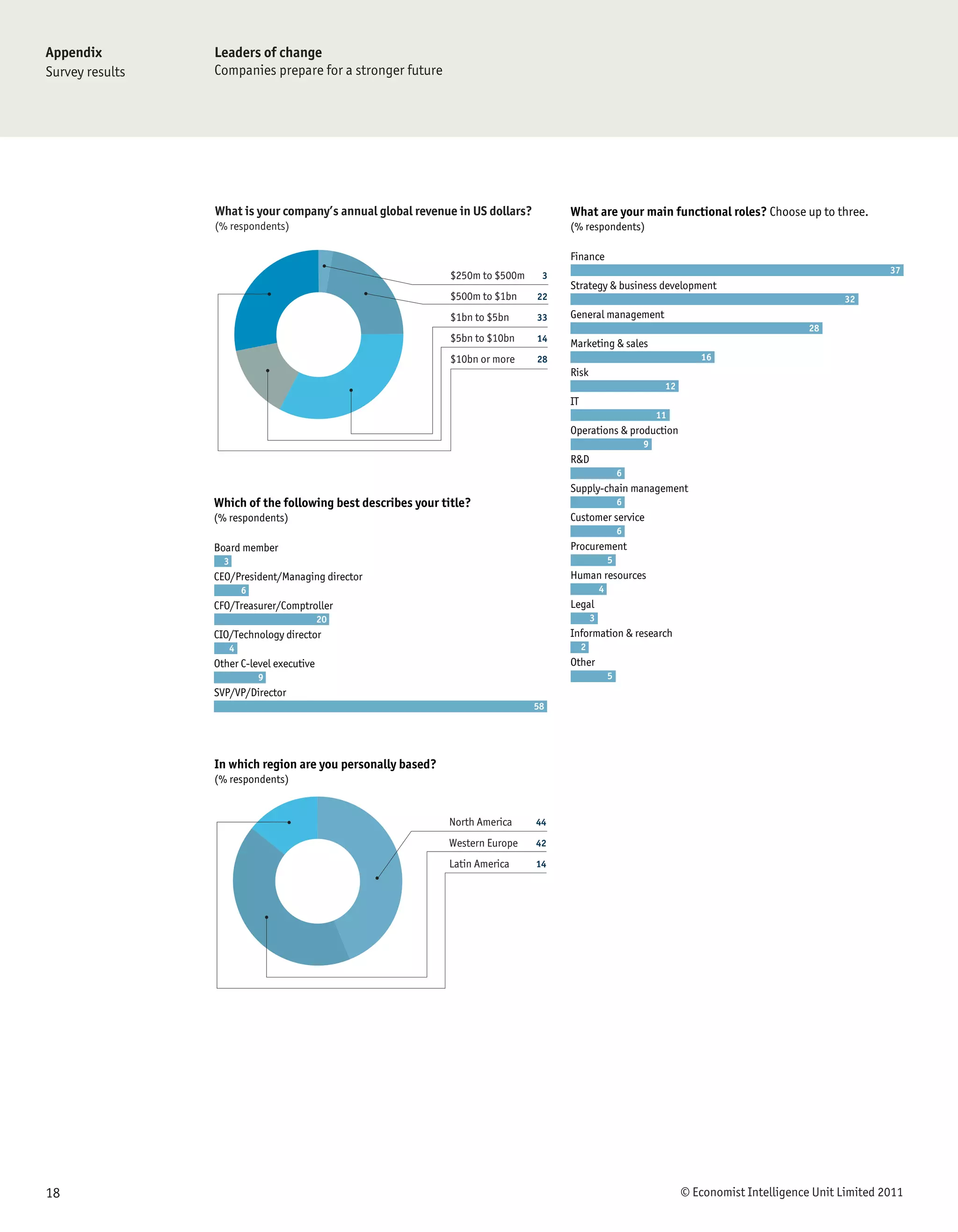
                 What is your company’s annual global revenue in US dollars?        What are your main functional roles? Choose up to three.
                 (% respondents)                                                    (% respondents)

                                                                                    Finance
                                                                                                                                                              37
                                                              $250m to $500m    3
                                                                                    Strategy & business development
                                                              $500m to $1bn    22                                                                    32
                                                              $1bn to $5bn     33   General management
                                                                                                                                               28
                                                              $5bn to $10bn    14
                                                                                    Marketing & sales
                                                              $10bn or more    28                                         16
                                                                                    Risk
                                                                                                                  12
                                                                                    IT
                                                                                                                 11
                                                                                    Operations & production
                                                                                                             9
                                                                                    R&D
                                                                                                         6
                                                                                    Supply-chain management
                 Which of the following best describes your title?                                       6
                 (% respondents)                                                    Customer service
                                                                                                         6
                 Board member                                                       Procurement
                   3                                                                                 5
                 CEO/President/Managing director                                    Human resources
                           6                                                                     4
                 CFO/Treasurer/Comptroller                                          Legal
                                           20                                                3
                 CIO/Technology director                                            Information & research
                       4                                                                 2
                 Other C-level executive                                            Other
                               9                                                                     5
                 SVP/VP/Director
                                                                               58


                 In which region are you personally based?
                 (% respondents)


                                                             North America     44

                                                             Western Europe    42

                                                             Latin America     14


18                                                                                                                     © Economist Intelligence Unit Limited 2011
Whilst every effort has been taken to verify the accuracy
of this information, neither The Economist Intelligence
Unit Ltd. nor the sponsors of this report can accept any
                                                            Cover: Shutterstock


responsibility or liability for reliance by any person on
this white paper or any of the information, opinions or
conclusions set out in the white paper.
LONDON
26 Red Lion Square
London
WC1R 4HQ
United Kingdom
Tel: (44.20) 7576 8000
Fax: (44.20) 7576 8476
E-mail: london@eiu.com

NEW YORK
750 Third Avenue
5th Floor
New York, NY 10017
United States
Tel: (1.212) 554 0600
Fax: (1.212) 586 0248
E-mail: newyork@eiu.com

HONG KONG
6001, Central Plaza
18 Harbour Road
Wanchai
Hong Kong
Tel: (852) 2585 3888
Fax: (852) 2802 7638
E-mail: hongkong@eiu.com

GENEVA
Boulevard des Tranchées 16
1206 Geneva
Switzerland
Tel: (41) 22 566 2470
Fax: (41) 22 346 93 47
E-mail: geneva@eiu.com

Leaders of change EIU report Jan_11

  • 1.
    Leaders of change Companiesprepare for a stronger future A report from the Economist Intelligence Unit sponsored by
  • 2.
    Leaders of change Companies prepare for a stronger future Preface Leaders of change: Companies prepare for a stronger future is an Economist Intelligence Unit report, sponsored by Celerant Consulting. The Economist Intelligence Unit conducted the survey and analysis and wrote the report. The findings and views expressed in the report do not necessarily reflect the views of the sponsor. The report’s quantitative findings come from a survey of 288 senior executives, conducted in November 2010. The Economist Intelligence Unit’s editorial team designed the survey. Paul Kielstra was the author of the report and Gilda Stahl was the editor. Mike Kenny was responsible for the design. To supplement the quantitative survey results, the Economist Intelligence Unit conducted in-depth interviews with relevant experts. We would like to thank all interviewees for their time and insights. January 2011 About the survey were in senior management. Respondents hailed from North America (44%), Western Europe (40%) and Latin America (16%). Survey participants came A total of 288 senior executives participated in the from a wide range of industries, with just over 75% change management survey, which was conducted from organisations with annual revenue greater than in November 2010. Of those who responded, 42% US$1bn. For more details on the survey sample and were C-level executives or above and the remainder results, see the appendix of this study. © Economist Intelligence Unit Limited 2011 1
  • 3.
    Leaders of change Companies prepare for a stronger future Introduction T he focus of change management has shifted, according to a survey conducted by the Economist Intelligence Unit and sponsored by Celerant Consulting. Although companies remain, as always, cost conscious, they are putting much more emphasis on growing market share and preparing for the future. Similarly, organisations are increasingly devoting their attention to the sales and marketing functions. This further reflects the shift in emphasis towards growth and the future and away from cost cutting. Apparently, executives are leaving the preoccupations of surviving the downturn behind. Yet companies are still, all too often, unable to execute change. The responsibility inevitably resides with their leaders. 2 © Economist Intelligence Unit Limited 2011
  • 4.
    Leaders of change Companies prepare for a stronger future Looking to the future A lthough downside risks remain, the world’s big economies appear to have returned to growth, albeit slowly. The Economist Intelligence Unit forecasts that GDP in North America will increase annually by around 2% in real terms and in Western Europe by a little less than that. The engines of growth, however, will now be in the developing world: China and India should average annual real GDP growth of over 8% in the next few years, and Latin America should average around 4% per year. Contraction and recovery: actual and estimated GDP growth, 2006-14 (%) North America Western Europe Latin America China India 15 12 9 6 3 0 -3 -6 2006 2007 2008 2009 2010 2011 2012 2013 2014 Source: Economist Intelligence Unit, Global Forecast. Meanwhile, companies are adjusting to the new landscape, moving beyond the emphasis on survival that dominated considerations during the economic downturn. This does not mean returning to strategies that worked in earlier, better times; the world has changed too much. Instead, the three main goals of corporate change initiatives over the next year—according to respondents to a survey conducted by the Economist Intelligence Unit and sponsored by Celerant Consulting—are increasing revenue (cited by 55%), preparing the organisation for the future (52%) and cost reduction (50%). © Economist Intelligence Unit Limited 2011 3
  • 5.
    Leaders of change Companies prepare for a stronger future What are the main forces driving change at your company? (% respondents) Consumer goods Energy & natural resources Healthcare, pharmaceuticals & biotechnology Competitive/cost pressures 56 63 46 Customer demand (eg, for better quality, service, different products) 44 34 21 Regulation 10 31 31 Desire to increase market share 51 26 33 Merger or acquisition 12 14 36 Exploiting emerging market opportunities (sourcing and sales) 24 3 18 Investor expectations 17 23 26 Reducing complexity within company 37 17 26 Change for the sake of change 2 0 0 Sustainability/green initiatives 5 9 5 Reduction of headcount 7 3 13 Source: Economist Intelligence Unit survey, November 2010. The overall survey findings represent a discernable shift from the responses to this question in two previous surveys conducted by the Economist Intelligence Unit and sponsored by Celerant, where cost concerns dominated. Last year, for example, 66% of respondents cited cost reduction as the primary goal of change initiatives, while preparing for the future (46%) and increasing revenue (37%) lagged behind. As Rosabeth Kanter, Ernest L. Arbuckle Professor of Business Administration at Harvard Business School and author of Supercorp: How vanguard companies create innovation, profit, growth and social good, remarks, “Change management activities definitely follow the economic cycle. There is a great deal of interest in tightening processes in leaner times. When that runs its course, companies start focusing on growth.” In this year’s survey, the perennial challenge of the overall competitive and cost environment remains by far the leading external driver of change (60%). However, customer demand (36%) comes in second, followed closely by a desire to increase market share (34%). The last two findings strongly indicate a renewed focus on sales and growth, especially in certain sectors. In the consumer goods industry, the drive to grow market share (51%) and customer demand (44%) are cited nearly as often as the competitive and cost environment (56%). 4 © Economist Intelligence Unit Limited 2011
  • 6.
    Leaders of change Companies prepare for a stronger future According to Dean Nelson, founder of KKR Capstone, “Most companies have recently focused change “Down markets are management on cost”. To improve further, “they need to focus some of their resources on growth”. Down ideally the best markets, he adds, are ideally the best times to engage in growth-related change, because they experience times to engage the biggest shifts in market share. in growth-related Although the emphasis on market growth and the future is increasing in line with the economic cycle, change, because it is important not to exaggerate the shift. This year’s survey results suggest a different emphasis, rather they experience than a sea change in where firms are focusing their change efforts. One-half of companies surveyed still the biggest shifts see the reduction of costs as a primary aim. Ultimately, notes Robert Tartaglia, chief operating officer in market share.” (COO) of Allianz Global Corporate & Specialty, a Munich-based large corporate and specialty insurer, Dean Nelson, founder of KKR Capstone “Change is driven by the needs of the company,” not some “initiative du jour”. At the moment, for many, those needs relate increasingly to the future. © Economist Intelligence Unit Limited 2011 5
  • 7.
    Leaders of change Companies prepare for a stronger future Sales and marketing function is in the front line of change T he survey underscores the fact that the focus of change management programmes varies by industry. For example, a leading focus for chemicals firms in the last year has been the supply chain (cited by 45% of respondents from the sector). In contrast, the supply chain was the focus of change management for only 17% of energy and natural resources companies, for which the most common focus of change programmes has been finance (31%). Overall, though, sales and marketing was the most common function to experience change in the last year (41%), coming in first in every region polled and at or near the top for every industry. For manufacturers the figure hit 60%. In the previous year’s survey (using a different methodology), we found that overall sales and marketing experienced significant change, but on a par with procurement, information technology (IT) and general management, and behind finance. This year’s focus on change in the sales and marketing function further reflects the shift in emphasis towards growth and the future and Which areas of your organisation have been the focus of change management initiatives in the last year? (% respondents) Sales & marketing 41 Supply chain/procurement 26 IT 24 R&D/innovation 22 Finance 20 Human resources 15 Customer service 14 The company as a whole in an overarching change initiative 14 Asset optimisation 13 Legal & compliance 10 Senior management as a whole within the company 8 None 1 Don’t know 1 Source: Economist Intelligence Unit survey, November 2010. 6 © Economist Intelligence Unit Limited 2011
  • 8.
    Leaders of change Companies prepare for a stronger future Which areas of your organisation have been the focus of change management initiatives in the last year? (% respondents) Consumer goods Energy & natural resources Healthcare, pharmaceuticals & biotechnology Sales & marketing 46 29 41 Human resources 12 20 13 IT 32 23 15 Finance 17 31 18 Legal & compliance 5 9 18 Asset optimisation 15 9 5 R&D/innovation 24 17 36 Supply chain/procurement 37 17 23 Customer service 0 20 5 Senior management as a whole within the company 2 14 10 The company as a whole in an overarching change initiative 17 9 18 None 0 0 0 Don’t know 2 0 0 Source: Economist Intelligence Unit survey, November 2010. away from cost cutting. Professor Kanter says, “Marketing always leads growth. You can’t manufacture more if you are not attracting new customers. So, marketing expenditure goes up when aiming for top- line growth.” A function that interacts with ever-shifting markets and consumer demands will inevitably attract a large number of change programmes. For example, Scott Wicker, vice-president, sustainability, at UPS, an international shipping and logistics business, notes that as customers have become increasingly interested in carbon issues, the company has been training and educating its salesforce in how to use its emission-reduction record and sustainability performance as a sales draw. “We realised that we had an advantage and needed to sell it,” he says. “Sales and marketing is being affected the most.” Sales and marketing need to recover from deep budget cuts implemented during the economic downturn—especially in North America and Western Europe, where the declines in spending were substantial. Many companies, though, have been changing the sales/marketing function rather than simply restoring previous budgets, because the markets where they are selling are now substantially © Economist Intelligence Unit Limited 2011 7
  • 9.
    Leaders of change Companies prepare for a stronger future different. Growth is largely occurring in less-developed economies and these require different marketing approaches. With evolving communication channels, such as social networking technology, businesses would have to adjust rapidly anyway. Two years of cutbacks only make the need for some companies to act more pressing. Mr Nelson explains, “The sales and marketing function is a higher-return place to implement real change than management on the cost side. The customer base has changed; the world has changed. People realise that they need to change their sales and marketing approach.” Broad organisational retooling holds some advantages over a narrower focus on a single function, however important. According to the survey findings, companies that have not engaged in change to the sales/marketing function most commonly implemented initiatives that addressed the company as a whole (24%). Professor Kanter points out that sales strength is less of an issue than an ability to innovate across the company and in product offerings. “In the long run”, she says, “you need to be investing in constantly renewing products and services. Innovation is the only way to have sustainable growth.” Larger companies, in particular, are addressing the problem of complexity. For those businesses with over US$5bn in annual sales, simplification is the second-biggest aim of change. Such change is, in Professor Kanter’s words, “an exercise that goes on periodically”. Large organisations add on layers and roles—particularly in good times—and then need to shed them. Mr Tartaglia of Allianz says, “I’ve yet to embark on a change initiative or project where one of the ultimate objectives is not the reduction of complexity”, because of the costs that it brings. Complexity reduction can have multiple advantages. A programme at P&G, a global consumer-products company, to simplify its European distribution system, notes Peter White, its director for global sustainability, decreased carbon emissions and costs. 8 © Economist Intelligence Unit Limited 2011
  • 10.
    Leaders of change Companies prepare for a stronger future ‘A’ for effort, but ‘E’ for execution? A s companies make their strategic choices about how best to change in order to face current and future challenges, change programmes are consuming ever more corporate resources. Sixty-three percent of survey respondents report that more senior executive time was devoted to change management initiatives over the past year, against just 7% noting a decline. The equivalent figures for increased spending are 47% and 11%. Nevertheless, most companies are still remarkably unsuccessful at implementing change. Respondents say that on average only 56% of change initiatives are successful. This is no surprise to Allianz’s Mr Tartaglia. Surveying the corporate world as a whole, he sees “a lot more experienced people out there and a better understanding of best practice, but I can’t say I have seen any empirical evidence that companies are doing better [at change management]”. On average, to what extent… (% respondents) …have the resources spent on your …has the amount of senior executive time spent organisation’s most significant change on your organisation’s most significant change initiatives altered over the past 12 months? initiatives altered over the past 12 months? Increased greatly 10 21 Increased 37 42 Stayed the same 38 27 Decreased 9 6 Decreased greatly 2 1 Don’t know 4 3 Source: Economist Intelligence Unit survey, November 2010. © Economist Intelligence Unit Limited 2011 9
  • 11.
    Leaders of change Companies prepare for a stronger future In your view, approximately what proportion of change initiatives has been successful at your organisation over the past five years? (% respondents) Few 13 Around one-quarter 10 Around half 36 Around three-quarters 11 Most or all 27 None 0 Don’t know 3 Source: Economist Intelligence Unit survey, November 2010. Any reassurance that the low success rate might give to executives about their own company’s failings is false. KKR’s Mr Nelson says, “If you are not getting better at change management, you are probably becoming irrelevant.” If anything, the shifting focus of change is likely to make some elements of change harder—especially leadership. Although change management literature often discusses the processes of change divorced from the content, what is being changed matters. Mr Nelson notes, “Where people struggle is when the nature of what they are trying to change changes a fair amount. They may have been very good on change related to costs, but it might be hard for them to change sales or product development.” Professor Kanter adds that such shifts present a leadership challenge: “It is very different to lead people to engage in innovation than encouraging people to find efficiencies.” 10 © Economist Intelligence Unit Limited 2011
  • 12.
    Leaders of change Companies prepare for a stronger future Where the buck stops: a challenge for leaders T he symptoms of leadership difficulties do not always manifest themselves at the top of the company. Survey respondents cite middle management (38%) as the employment level where bottlenecks occur in change initiatives, well above senior management (26%) and the C-suite (5%). Significant variations exist in individual industries: for energy and natural resources, around one-quarter of respondents cite senior management, middle management, line management and front-line workers as the most likely obstacles, while in the healthcare sector senior managers (31%) lead middle management (28%). In your view, which group of employees presents the greatest bottleneck to change management initiatives? (% respondents) Middle management 38 Senior management 26 Supervisors/line managers 19 Front-line workers/operations 13 C-suite 5 Source: Economist Intelligence Unit survey, November 2010. This finding requires a caveat: all of the survey participants were at the senior management level or above and leaders at some companies may be reluctant to acknowledge their own shortcomings. Of C-level survey respondents at companies where a change initiative has failed in the last year, 36% cited a poor plan as the single biggest cause of the problem. Only 17% blamed a lack of senior management commitment, almost as many as pointed to employee resistance (15%). For less senior respondents, though, 28% blamed a poor plan, but 25% cited lack of senior management commitment, and just 10% mentioned employee resistance. Moreover, at those companies where successful change initiatives are few, survey respondents indicated that senior management created the biggest bottlenecks (42%), rather than middle managers (28%). They also named lack of senior management commitment as the biggest 1. Malcolm Higgs, Deborah Rowland, “Emperors with barrier to change (40%), more than twice as often as other respondents (19%). This is consistent with clothes on: The role of self- a recent article in The Journal of Change Management1, which found that corporate “leaders’ ‘blindness’ awareness in developing effective change to organisational systems and/or a focus on their own ego needs led them into a range of ‘traps’ that leadership”, December seriously damaged the success of change interventions”. 2010. © Economist Intelligence Unit Limited 2011 11
  • 13.
    Leaders of change Companies prepare for a stronger future Change management in practice: a focus ventures in which the benefits are partly intangible. on sustainability Mr Wicker therefore stresses the need to blend environmental with financial gains clearly, as both are a part of sustainability. Similarly, Dr White says, “You need a clear line of sight for sustainability to the The requirements of successful change management company’s purpose.” This ideally should include social are often described in broad terms. The details, and environmental, as well as financial elements, and however, also matter, and invariably differ from field P&G changed its formal statement of purpose to do so. to field. For example, the integration of sustainability The strong link between sustainability and efficiency into companies in recent years has involved substantial frequently helps here as well. change efforts. The experience of P&G and UPS Planning: Effective change requires a good illustrates the process of applying broad rules in roadmap, including clear delineations of responsibility particular circumstances. and steps, preferably with initial easy wins to boost Leadership and communication to create a morale and momentum. This is as true in sustainability sense of urgency: Successful change requires a as other fields, but those working in this area face widespread belief within the organisation that action particular complications. Mr Wicker notes that is necessary. This requires a consistent message from initiatives tend to involve multiple departments senior executives—otherwise employees will assume and sometimes even external stakeholders such as that the issue is not important within the business. communities or non-governmental organisations UPS and P&G start their sustainability efforts with (NGOs). Co-ordinated planning and execution are an unambiguous commitment from the CEO and the therefore typically more difficult than for initiatives Board. Both also have extensive internal educational relating to single departments. and communication efforts to explain the concept. Selecting the appropriate metrics for success may So far, this does not vary noticeably from the general not be as straightforward as initiatives focused on template for change. For companies seeking to become money saved, or a company might not even measure more sustainable, though, success does not depend so them before a given initiative begins. The accurate much on winning people over to individual initiatives as measurement of carbon emissions related to a given convincing them of the need to embrace sustainability activity, for example, can be highly complex. Yet more broadly. Here developments in the outside world such measurement can provide additional business certainly help. UPS vice-president, sustainability, opportunities: UPS, for example, finds it valuable to Scott Wicker, says that increasing awareness of climate be able to give customers information related to the change has made it far easier to win hearts and minds. carbon produced in their shipments. “The emergence of climate change as a business issue is Focus of change: Although in parts of the business driving sustainability,” he notes. the focus of changes has varied with the economic Yet P&G’s Dr White points out that sustainability cycle, sustainability provides an example of one that can be managed in terms of corporate behaviour. This has not. It certainly could have fluctuated between approach requires greater corporate change, but once concentrating on efficiency initiatives that reduce cost employees have been won over to its logic, these flow and those that focus on preparation for the future. Yet more easily. Dr White says that the downturn and recovery brought Building support for particular initiatives: A “no real change” to the balance between these two. sense of urgency must be converted into a willingness Similarly, Lynnette McIntire, who heads sustainability for the company to provide resources to any given communication at UPS, says that recently, “We’ve not programme. With companies carefully shepherding been shifting efforts from cost cutting to opportunity; resources, it can be difficult to advocate sustainability it is more of everything.” 12 © Economist Intelligence Unit Limited 2011
  • 14.
    Leaders of change Companies prepare for a stronger future For the change initiatives in your organisation that did not succeed in the past 12 months, what was the single “Powerlessness most important factor in determining their failure? (% respondents) corrupts. People C-suite non-C-suite who are powerless Lack of clearly defined and/or achievable milestones & objectives to measure progress 36 and hemmed in 28 Lack of commitment by senior management by rules become 17 25 excessively Poor communication territorial.” 14 16 Rosabeth Kanter, Harvard Employee resistance Business School 15 10 Insufficient funding 3 7 Other 7 7 Don’t know 8 7 Source: Economist Intelligence Unit survey, November 2010. That said, middle management’s reputation is not purely accidental. Professor Kanter believes that the finding “definitely rings true”. The reluctance of middle management to embrace change initiatives is understandable. Programmes imposed from above can radically shift middle managers’ job descriptions— even their job security. Middle managers also frequently face multiple demands—including for increased profits—while being told to find ways to give practical effect to visions of change ordered from above. Mr Tartaglia acknowledges the problem, but lays much of the blame for this behaviour elsewhere: “Middle managers are critical, but it has to start from the top.” Professor Kanter adds that resistance to imposed change is predictable, especially where it is threatening. “Powerlessness corrupts,” she says. “People who are powerless and hemmed in by rules become excessively territorial.” Poor communication is a particular problem. Mr Nelson explains that senior executives can forget that, whereas they have been involved in 30 to 40 conversations relating to an initiative before launching it, middle managers may be ill-prepared. “If senior people say that managers need to be, for example, more innovative and think that this is enough to get people to act differently, then they are wrong,” he says. © Economist Intelligence Unit Limited 2011 13
  • 15.
    Leaders of change Companies prepare for a stronger future Conclusion T he global economy is always evolving and companies need in turn to adjust. Businesses, however, are simply not that good at change—failing nearly half the time, according to the Economist Intelligence Unit survey. As this study shows, getting the most out of change initiatives requires going beyond the basics of leadership commitment, good planning and communication. The following principles emerge. l Treat change programmes as a key, but limited strategic resource. In practice there are limits to how much change a company can absorb—on average survey companies make just 3.6 change initiatives annually. Competitors will be looking at other areas than just cost cutting, including trying to grab some of your market share. Aligning the focus of change with the most pressing strategic priorities has therefore become more important than before. l In preparing for the future, consider whether your sales function needs an overhaul or you need to address an overarching company-wide issue. The most popular area for change programmes over the past year has been sales/marketing. Other businesses, meanwhile, are making a strategic choice to look at company-wide change such as complexity reduction. The key consideration is where change will best prepare the firm for the new competitive environment being shaped by the multi- speed global recovery. l Sweat the details. The broad principles of change management may vary little, but the details vary in ways that matter. As executives opt for new goals and locations for change programmes, they will need to understand the resulting specific requirements of success. These will likely differ from the requirements of changes in the depths of the downturn. Cutting costs, encouraging growth and promoting sustainability need distinct playbooks. l Treat bottlenecks as a symptom not a disease. If middle management is a difficult bottleneck to change, then leadership needs to improve. Bring middle managers into the change process earlier, have them work on the planning, and use them as champions of change. Leadership is not about telling people what to do, but getting them to do it. If more senior employees are the problem, then leadership is dysfunctional and needs to address its conflicts quickly. “Change management”, says Professor Kanter, “is a very broad term for a lot of different activities that are all a part of leadership”. Such leadership will, as ever, be essential as business prepares itself for the future. 14 © Economist Intelligence Unit Limited 2011
  • 16.
    Leaders of change Appendix Companies prepare for a stronger future Survey results Appendix: Survey results Percentages may not add to 100% owing to rounding or the ability of respondents to choose multiple responses. What will be the main motivations for your organisation’s How many change management initiatives do you believe your change management initiatives over the next 12 months? organisation will launch over the next 12 months? Select up to three. (% respondents) (% respondents) One Increasing revenue 15 55 Two Preparing the organisation for future challenges 24 52 Three Reducing costs 18 50 Four Increasing market share 7 27 Five or more Better engagement of people (eg, improved communication & involvement) 24 26 None New organisation structure with new roles 3 22 Don’t know Acquisition/divestiture/merger 9 19 Cultural change 11 Other In your view, what proportion of change initiatives has been 5 successful at your organisation over the past five years? (% respondents) Few How many change management initiatives do you estimate 13 your organisation has launched in the last 12 months? Around one-quarter (% respondents) 10 Around half One 36 13 Around three-quarters Two 11 24 Most or all Three 27 23 None Four 0 6 Don’t know Five or more 3 24 None 2 Don’t know 8 © Economist Intelligence Unit Limited 2011 15
  • 17.
    Appendix Leaders of change Survey results Companies prepare for a stronger future For the change initiatives in your organisation that did not On average, to what extent have the resources spent on your succeed in the past 12 months, what was the single most organisation’s most significant change initiatives altered over important factor in determining their failure? the past 12 months? (% respondents) (% respondents) Lack of clearly defined and/or achievable milestones Increased greatly & objectives to measure progress 10 31 Increased Lack of commitment by senior management 37 21 Stayed the same Poor communication 38 15 Decreased Employee resistance 9 12 Decreased greatly Insufficient funding 2 5 Don’t know Other 4 7 Don’t know 7 On average, to what extent has the amount of senior executive time spent on your organisation’s most significant change initiatives altered over the past 12 months? What is the most important measure in determining whether (% respondents) a change programme has been successful in your organisation? Increased greatly (% respondents) 21 Increased Behaviour change in the organisation 42 35 Stayed the same Increased profitability 27 29 Decreased Customer satisfaction 6 10 Decreased greatly Savings delivered 1 9 Don’t know Increased market share 3 9 Employee satisfaction / employee turnover 2 Other In your view, which group of employees presents the greatest 4 bottleneck to change management initiatives? Don’t know (% respondents) 2 Middle management 38 Senior management 26 Supervisors/line managers 19 Front-line workers/operations 13 C-suite 5 16 © Economist Intelligence Unit Limited 2011
  • 18.
    Leaders of change Appendix Companies prepare for a stronger future Survey results Which areas of your organisation have been the focus of In which country are you personally located? change management initiatives in the last year? (% respondents) Select up to three. (% respondents) US 39 Sales & marketing UK, Germany 41 8 Supply chain/procurement Belgium, Canada, Brazil 26 5 IT Italy, Mexico 24 4 R&D/innovation Switzerland, Netherlands, Portugal 22 3 Finance Colombia 20 2 Human resources Chile, France. Sweden, Ireland, Turkey, Denmark, Finland, 15 Norway, Peru, Poland Customer service 1 14 The company as a whole in an overarching change initiative 14 Asset optimisation What is your primary industry? 13 (% respondents) Legal & compliance 10 Manufacturing Senior management as a whole within the company 15 8 Consumer goods None 14 1 Healthcare, pharmaceuticals & biotechnology Don’t know 14 1 Energy & natural resources 12 Chemicals 11 What are the main forces driving change at your company? Financial services Select up to three. 7 (% respondents) Professional services 6 Competitive/cost pressures Retailing 60 4 Customer demand (eg, for better quality, service, different products) Automotive 36 3 Desire to increase market share Construction & real estate 34 2 Reducing complexity within company Education 27 2 Investor expectations IT & technology 22 2 Merger or acquisition Telecommunications 20 2 Regulation Transportation, travel & tourism 19 2 Exploiting emerging market opportunities (sourcing & sales) Agriculture & agribusiness 19 2 Reduction of headcount Entertainment, media & publishing 11 1 Sustainability/green initiatives Government/Public sector 6 1 Change for the sake of change Aerospace/Defence 1 1 © Economist Intelligence Unit Limited 2011 17
  • 19.
    Appendix Leaders of change Survey results Companies prepare for a stronger future What is your company’s annual global revenue in US dollars? What are your main functional roles? Choose up to three. (% respondents) (% respondents) Finance 37 $250m to $500m 3 Strategy & business development $500m to $1bn 22 32 $1bn to $5bn 33 General management 28 $5bn to $10bn 14 Marketing & sales $10bn or more 28 16 Risk 12 IT 11 Operations & production 9 R&D 6 Supply-chain management Which of the following best describes your title? 6 (% respondents) Customer service 6 Board member Procurement 3 5 CEO/President/Managing director Human resources 6 4 CFO/Treasurer/Comptroller Legal 20 3 CIO/Technology director Information & research 4 2 Other C-level executive Other 9 5 SVP/VP/Director 58 In which region are you personally based? (% respondents) North America 44 Western Europe 42 Latin America 14 18 © Economist Intelligence Unit Limited 2011
  • 20.
    Whilst every efforthas been taken to verify the accuracy of this information, neither The Economist Intelligence Unit Ltd. nor the sponsors of this report can accept any Cover: Shutterstock responsibility or liability for reliance by any person on this white paper or any of the information, opinions or conclusions set out in the white paper.
  • 21.
    LONDON 26 Red LionSquare London WC1R 4HQ United Kingdom Tel: (44.20) 7576 8000 Fax: (44.20) 7576 8476 E-mail: london@eiu.com NEW YORK 750 Third Avenue 5th Floor New York, NY 10017 United States Tel: (1.212) 554 0600 Fax: (1.212) 586 0248 E-mail: newyork@eiu.com HONG KONG 6001, Central Plaza 18 Harbour Road Wanchai Hong Kong Tel: (852) 2585 3888 Fax: (852) 2802 7638 E-mail: hongkong@eiu.com GENEVA Boulevard des Tranchées 16 1206 Geneva Switzerland Tel: (41) 22 566 2470 Fax: (41) 22 346 93 47 E-mail: geneva@eiu.com