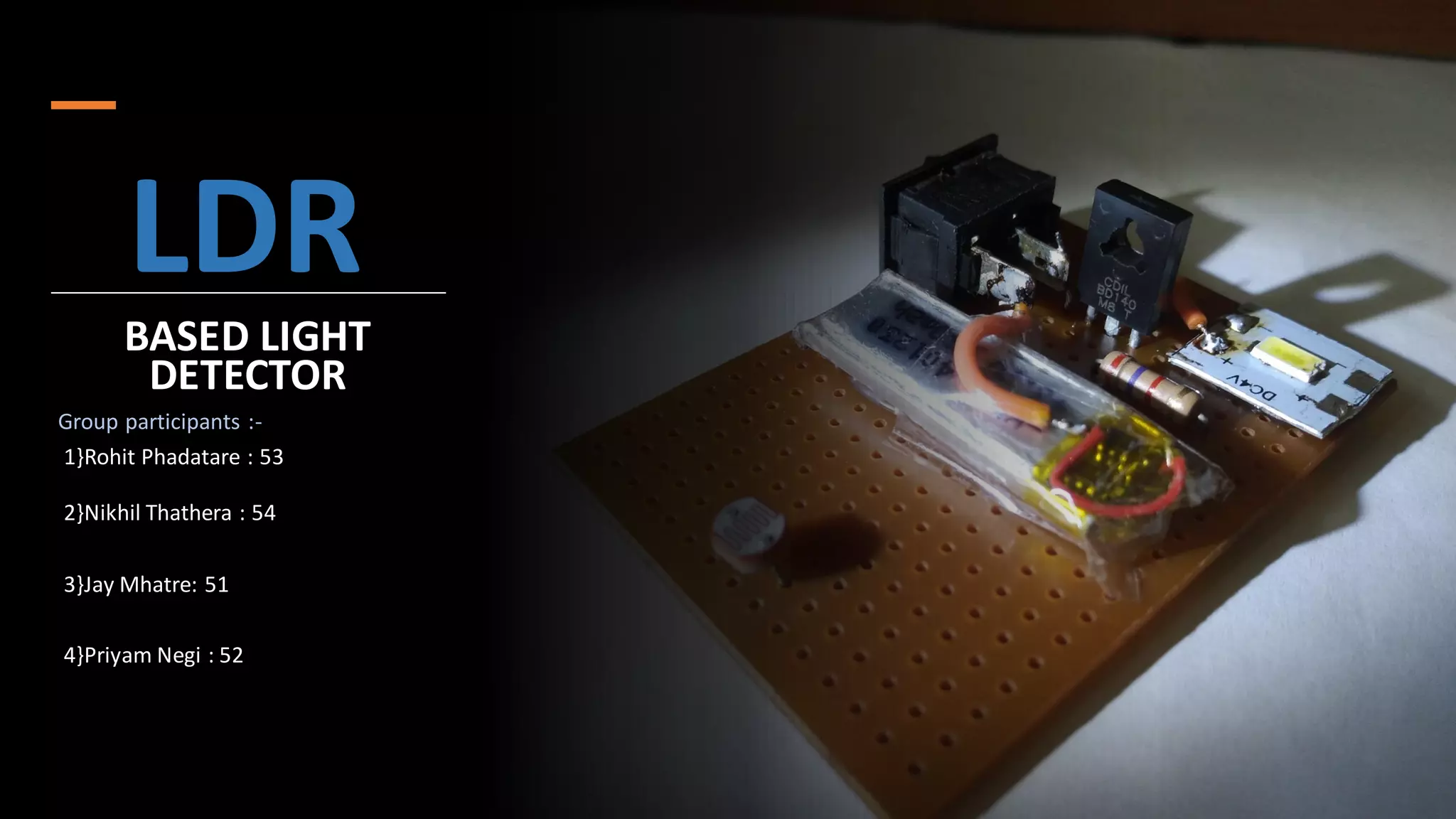
LDR
BASED LIGHT
DETECTOR
Group participants :-
1}Rohit Phadatare : 53
2}Nikhil Thathera : 54
3}Jay Mhatre: 51
4}Priyam Negi : 52
THINGS USED
•LDR
•2.7k resistor
•BD140 transistor
•3.7V battery
•SPST switch
•4V LED
LDR
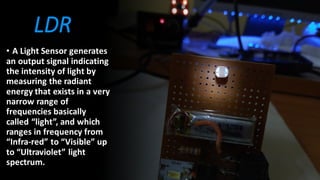
• A Light Sensor generates
an output signal indicating
the intensity of light by
measuring the radiant
energy that exists in a very
narrow range of
frequencies basically
called “light”, and which
ranges in frequency from
“Infra-red” to “Visible” up
to “Ultraviolet” light
spectrum.
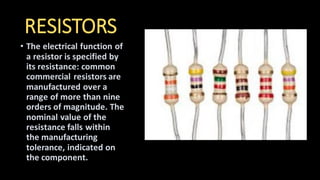
RESISTORS
• The electrical function of
a resistor is specified by
its resistance: common
commercial resistors are
manufactured over a
range of more than nine
orders of magnitude. The
nominal value of the
resistance falls within
the manufacturing
tolerance, indicated on
the component.
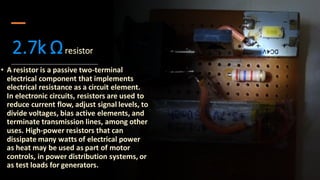
2.7k Ωresistor
• A resistor is a passive two-terminal
electrical component that implements
electrical resistance as a circuit element.
In electronic circuits, resistors are used to
reduce current flow, adjust signal levels, to
divide voltages, bias active elements, and
terminate transmission lines, among other
uses. High-power resistors that can
dissipate many watts of electrical power
as heat may be used as part of motor
controls, in power distribution systems, or
as test loads for generators.
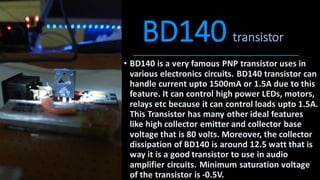
BD140 transistor
• BD140 is a very famous PNP transistor uses in
various electronics circuits. BD140 transistor can
handle current upto 1500mA or 1.5A due to this
feature. It can control high power LEDs, motors,
relays etc because it can control loads upto 1.5A.
This Transistor has many other ideal features
like high collector emitter and collector base
voltage that is 80 volts. Moreover, the collector
dissipation of BD140 is around 12.5 watt that is
way it is a good transistor to use in audio
amplifier circuits. Minimum saturation voltage
of the transistor is -0.5V.
BATTERY
• Batteries are classified into primary and
secondary forms:
• Primary batteries are designed to be used
until exhausted of energy then discarded. Their
chemical reactions are generally not reversible,
so they cannot be recharged. When the supply of
reactants in the battery is exhausted, the battery
stops producing current and is useless.[28]
• Secondary batteries can be recharged; that is,
they can have their chemical reactions reversed
by applying electric current to the cell. This
regenerates the original chemical reactants, so
they can be used, recharged, and used again
multiple times.
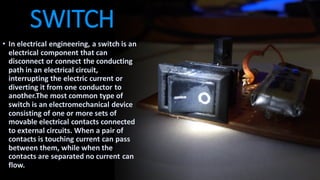
SWITCH
• In electrical engineering, a switch is an
electrical component that can
disconnect or connect the conducting
path in an electrical circuit,
interrupting the electric current or
diverting it from one conductor to
another.The most common type of
switch is an electromechanical device
consisting of one or more sets of
movable electrical contacts connected
to external circuits. When a pair of
contacts is touching current can pass
between them, while when the
contacts are separated no current can
flow.
SPST SWITCH
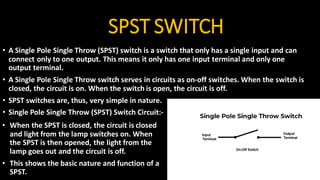
• A Single Pole Single Throw (SPST) switch is a switch that only has a single input and can
connect only to one output. This means it only has one input terminal and only one
output terminal.
• A Single Pole Single Throw switch serves in circuits as on-off switches. When the switch is
closed, the circuit is on. When the switch is open, the circuit is off.
• SPST switches are, thus, very simple in nature.
• Single Pole Single Throw (SPST) Switch Circuit:-
• When the SPST is closed, the circuit is closed
and light from the lamp switches on. When
the SPST is then opened, the light from the
lamp goes out and the circuit is off.
• This shows the basic nature and function of a
SPST.
LED
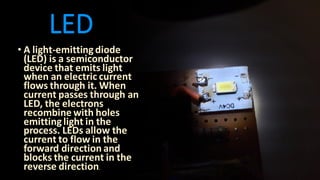
• A light-emitting diode
(LED) is a semiconductor
device that emits light
when an electric current
flows through it. When
current passes through an
LED, the electrons
recombine with holes
emitting light in the
process. LEDs allow the
current to flow in the
forward direction and
blocks the current in the
reverse direction.
ADVANTAGES
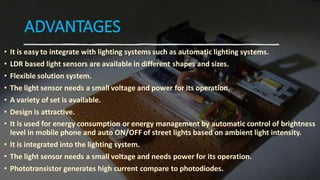
• It is easy to integrate with lighting systems such as automatic lighting systems.
• LDR based light sensors are available in different shapes and sizes.
• Flexible solution system.
• The light sensor needs a small voltage and power for its operation.
• A variety of set is available.
• Design is attractive.
• It is used for energy consumption or energy management by automatic control of brightness
level in mobile phone and auto ON/OFF of street lights based on ambient light intensity.
• It is integrated into the lighting system.
• The light sensor needs a small voltage and needs power for its operation.
• Phototransistor generates high current compare to photodiodes.
DISADVANTAGES
• LDR is highly inaccurate with the high response time.
• The photodiodeis temperature sensitive and is unidirectionalunlike photoresistor,
• Resistance varies continuously in photoresistorsand is tuggedin nature.
• Photodiodesare temperature sensitivevoltage and are unidirectional,unlike
photoresistor.
• High initial investment.
• Phototransistorcan not withstandvoltage above 1000volts.
• The phototransistoris vulnerable to surges, spikes, and EM energy.
• Separation of power circuitand command more connection,more cabling.
FOR
REFERENCE:-
• https://en.m.wikipedia.org/wiki/Photoresist
or
• https://alltransistors.com/transistor.php?tra
nsistor=24718
• https://projectpoint.in/index.php?route=pro
duct/product&product_id=499991556765
LDR PROJECT

LDR PROJECT

  • 1.
    LDR BASED LIGHT DETECTOR Group participants:- 1}Rohit Phadatare : 53 2}Nikhil Thathera : 54 3}Jay Mhatre: 51 4}Priyam Negi : 52
  • 2.
    THINGS USED •LDR •2.7k resistor •BD140transistor •3.7V battery •SPST switch •4V LED
  • 3.
    LDR • A LightSensor generates an output signal indicating the intensity of light by measuring the radiant energy that exists in a very narrow range of frequencies basically called “light”, and which ranges in frequency from “Infra-red” to “Visible” up to “Ultraviolet” light spectrum.
  • 4.
    RESISTORS • The electricalfunction of a resistor is specified by its resistance: common commercial resistors are manufactured over a range of more than nine orders of magnitude. The nominal value of the resistance falls within the manufacturing tolerance, indicated on the component.
  • 5.
    2.7k Ωresistor • Aresistor is a passive two-terminal electrical component that implements electrical resistance as a circuit element. In electronic circuits, resistors are used to reduce current flow, adjust signal levels, to divide voltages, bias active elements, and terminate transmission lines, among other uses. High-power resistors that can dissipate many watts of electrical power as heat may be used as part of motor controls, in power distribution systems, or as test loads for generators.
  • 6.
    BD140 transistor • BD140is a very famous PNP transistor uses in various electronics circuits. BD140 transistor can handle current upto 1500mA or 1.5A due to this feature. It can control high power LEDs, motors, relays etc because it can control loads upto 1.5A. This Transistor has many other ideal features like high collector emitter and collector base voltage that is 80 volts. Moreover, the collector dissipation of BD140 is around 12.5 watt that is way it is a good transistor to use in audio amplifier circuits. Minimum saturation voltage of the transistor is -0.5V.
  • 7.
    BATTERY • Batteries areclassified into primary and secondary forms: • Primary batteries are designed to be used until exhausted of energy then discarded. Their chemical reactions are generally not reversible, so they cannot be recharged. When the supply of reactants in the battery is exhausted, the battery stops producing current and is useless.[28] • Secondary batteries can be recharged; that is, they can have their chemical reactions reversed by applying electric current to the cell. This regenerates the original chemical reactants, so they can be used, recharged, and used again multiple times.
  • 8.
    SWITCH • In electricalengineering, a switch is an electrical component that can disconnect or connect the conducting path in an electrical circuit, interrupting the electric current or diverting it from one conductor to another.The most common type of switch is an electromechanical device consisting of one or more sets of movable electrical contacts connected to external circuits. When a pair of contacts is touching current can pass between them, while when the contacts are separated no current can flow.
  • 9.
    SPST SWITCH • ASingle Pole Single Throw (SPST) switch is a switch that only has a single input and can connect only to one output. This means it only has one input terminal and only one output terminal. • A Single Pole Single Throw switch serves in circuits as on-off switches. When the switch is closed, the circuit is on. When the switch is open, the circuit is off. • SPST switches are, thus, very simple in nature. • Single Pole Single Throw (SPST) Switch Circuit:- • When the SPST is closed, the circuit is closed and light from the lamp switches on. When the SPST is then opened, the light from the lamp goes out and the circuit is off. • This shows the basic nature and function of a SPST.
  • 10.
    LED • A light-emittingdiode (LED) is a semiconductor device that emits light when an electric current flows through it. When current passes through an LED, the electrons recombine with holes emitting light in the process. LEDs allow the current to flow in the forward direction and blocks the current in the reverse direction.
  • 11.
    ADVANTAGES • It iseasy to integrate with lighting systems such as automatic lighting systems. • LDR based light sensors are available in different shapes and sizes. • Flexible solution system. • The light sensor needs a small voltage and power for its operation. • A variety of set is available. • Design is attractive. • It is used for energy consumption or energy management by automatic control of brightness level in mobile phone and auto ON/OFF of street lights based on ambient light intensity. • It is integrated into the lighting system. • The light sensor needs a small voltage and needs power for its operation. • Phototransistor generates high current compare to photodiodes.
  • 12.
    DISADVANTAGES • LDR ishighly inaccurate with the high response time. • The photodiodeis temperature sensitive and is unidirectionalunlike photoresistor, • Resistance varies continuously in photoresistorsand is tuggedin nature. • Photodiodesare temperature sensitivevoltage and are unidirectional,unlike photoresistor. • High initial investment. • Phototransistorcan not withstandvoltage above 1000volts. • The phototransistoris vulnerable to surges, spikes, and EM energy. • Separation of power circuitand command more connection,more cabling.
  • 13.